A b s t r a c t. A study was conducted on the effect of stimulation with He-Ne laser and variable magnetic field on germination of seeds of amaranth cv. Aztek and Rawa at various temperatures. The study involved the use of laser light with power density of F= 6 mW cm-2, in five replications, variable magnetic field with induction B = 30 mT and exposure time t = 30 s, and combinations of laser light and variable magnetic field at the above parameters. Amaranth seeds were sown on Petri dishes, at 100 seeds per dish in five replications. The tests were conducted in a con-trolled climate chamber at temperatures of 10, 12, 15, 20, 25, 35, 45, 55°C, in total darkness. On the basis of the experiments it can be stated that laser stimulation, variable magnetic field, and com-binations of the two factors had a favourable effect on the germi-nation of seeds of amaranth, for the applied doses and germigermi-nation temperatures, but primarily in the initial phase of germination that lasted from several to several dozen hours.
K e y w o r d s: laser and variable magnetic field stimulation, amaranth, germination temperature
INTRODUCTION
Amaranth is one of the oldest crop plants in the world, originating from South America and more and more frequently referred to as the cereal of the 21st Century (Szot, 1999; Szumi³o, 2006). Amaranth is classified in class dico-tyledones,familyAmarantaceae,genusAmaranthus.It com-prises approximately 60 species, a vast majority of them being highly troublesome weeds. There is a predominance of annual forms, but some of the species are perennial plants
egA.muricatus,A.deflexus.The height of the particular species varies within the range from 0.3 to more than 3 m (Szot, 1999). It is characterised by high content of proteins, high concentration of fats, fibre, valuable minerals (calcium, phosphor, iron, zinc)and vitamins from groups A, B, C and
E, and by the presence of tocotrienols which are inhibitors of synthesis of cholesterol, and of squalenes, and has an exten-sive range of applications on the industrial scale (Resioet al., 2006; Szumi³o, 2006; Zapotocznyet al., 2006).
The high protein content of seeds of amaranth (15-22%) (Tosiet al., 2001; Zapotocznyet al., 2006) suggests that pro-tein extracts from its seeds may become a valuable source of dietary proteins. It is also a good source of amino acids – lysine (Resioet al., 2006) and methionine (Avanzaet al., 2005), deficit levels of which are observable in other cereals (Sujaket al., 2009). Amaranth is used in the production of food products (Pospišilet al., 2006) (groats, gruels, muesli, popcorn, cookies, nuddles, flour as a component of bread, rolls, cakes), animal fodders, cosmetics, medical preparations counteracting the processes of ageing of human organism, and for the protection of surfaces of computer memory discs. It occurs in various climatic zones – from the tropics to mo-derate areas, and also at various altitudes – from 0 to 3 000 m a.s.l. The period of amaranth vegetation is 160 days. The optimum temperature during vegetation is 26-28°C, and it grows and develops the best within the temperature range of 16 to 35°C (Szot, 1999).
One of the problems involved in amaranth growing lies in its being sensitive to weed infestation, with simultaneous negative effect of most of the active substances contained in herbicides on the growth and development of its plants (Szot, 1999;Szumi³o, 2006). Seed quality is the main factor affecting the growth, development and yielding of amaranth plants. Therefore, in amaranth cultures, apart from shorte-ning the period of vegetation, efforts are undertaken to im-prove the sowing material using a variety of methods. Better and higher crop yields can be obtained through sorting,
Effect of laser and variable magnetic field simulation on amaranth seeds germination
A. Dziwulska-Hunek
1*, K. Kornarzyñski
1, A. Matwijczuk
1, S. Pietruszewski
1, and B. Szot
21Department of Physics, University of Life Sciences, Akademicka 13, 20-033 Lublin, Poland 2
Institute of Agrophysics, Polish Academy of Science, Doœwiadczana 4, 20-290 Lublin, Poland
Received January 21, 2009; accepted April 23, 2009
© 2009 Institute of Agrophysics, Polish Academy of Sciences *Corresponding author’s e-mail: [email protected]
A A
Agggrrroooppphhyhyysssiiicccsss
cleaning, drying, and improvement through priming, coat-ing, scarification and stratification of sowing material (Górecki and Grzesiuk, 1994).
For a long time now physical methods have been used to improve the quality of sowing material, including seed irra-diation with laser light and stimulation with magnetic or electric field (Dziwulskaet al., 2004; Koper, 1994; Pietru-szewski, 1993; Pietruszewskiet al., 2002a, 2002b; Rochalska, 2002). Such methods are safe for the natural environment, and they only modify the physiological and biochemical pro-cesses in seeds, while increasing their nutritional value. In agricultural production, pre-sowing treatment of seeds with physical factors is gaining in popularity (Dziwulska, 2006; Dziwulska and Koper, 2003; Pietruszewski et al., 2007; Sujaket al., 2009).
OBJECTIVE OF STUDY
The objective of the study was to estimate the effect of stimulation with He-Ne laser light and with variable magne-tic field on the germination of seeds of amaranth cv. Aztek and Rawa at various temperatures. The Aztek cultivar origi-nates from South America and was entered in the COBORU register in the year 2000 (2004), while the Polish cv. Rawa was bred in the year 1997 (Szot, 1999).
MATERIAL AND METHODS
At the beginning of the nineteen nineties, at the Faculty of Physics of the University of Natural Sciences in Lublin, three different methods of pre-sowing stimulation of seeds have been developed. For practical implementation of those technologies, apparatus for laser stimulation of crop seeds and vegetable plants was designed (Koper, 1996; Koper and Dygda³a, 1993; 1994; Koper and WoŸniak, 1995), the basic element of which is the He-Ne laser (Hallidayet al., 2005).
In this study was employed a technology known as the divergent beam method, using a He-Ne laser with relative power of40 mW. The seeds were placed in the feed contai-ner of the apparatus, and they were irradiated with He-Ne laser light during their free descent down the vibration trough. The trough is provided with adjustment of slope angle and vibration frequency, which permits control of the speed of move- ment of the layer of irradiated seeds.
The study involved the use of laser light with power density of F= 6 mW cm-2, in five replications, variable magnetic field with induction B = 30 mT and exposure time t = 30 s, and combinations of laser light and variable magne-tic field at the above parameters. The stimulation of seeds was conducted using test apparatuses: for the stimulation with laser light – the apparatus designed by Koper and Dygda³a (1993 and 1994), and for the stimulation with variable magnetic field by means of an electromagnet – a system de-signed by Pietruszewski (1993).
The germination capacity of seeds was determined in the laboratory experiment. Amaranth seeds were sown on Petri dishes, at 100 seeds per dish, in five replications. The tests were conducted in a controlled-climate chamber, at temperatures of 10, 12, 15, 20, 25, 35, 45, and 55°C, in total darkness.
RESULTS AND DISCUSSION
Designation of the germination capacity of different seed species the optimal, minimal and maximal tempera-tures are used, although the optimal temperature does not warrant the highest germination capacity (Ciupak et al., 2007). Amaranth seeds grown in the soil at the temperature of 10°C usually germinate after 4 to 5 days, however the higher temperature is required for the growth of the plants. The temperature optimal for the germination of the ama-ranth seeds was estimated as 25°C (Szot, 1999). In the case of the seeds of tomatoes and capsicum the maximal germi-nation capacity was observed at 20 and 25°C, respectively, what was also observed by Podleœny (2002) for the seeds of white lupin.
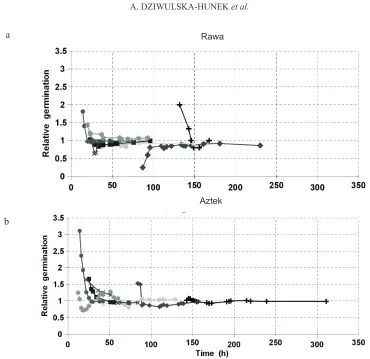
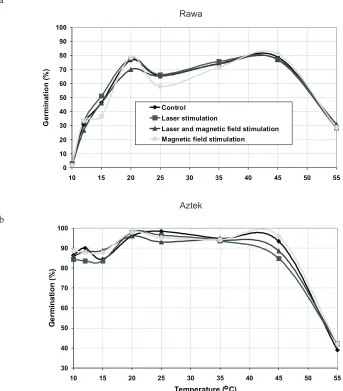
Figures 1-3 present the relative kinetics of germination of amaranth seeds of both of the studied cultivars, stimulated with laser light and variable magnetic field, in the function of time, at various temperatures. The relative kinetics is expressed as a number giving the ratio of the number of ger-minated seeds subjected to stimulation to the number of seeds germinated in the control sample for a given time. Figure 4 presents the germination capacity of amaranth seeds with relation to temperature, for stimulated seeds and for the control.
Stimulation of seeds of amaranth cv. Rawa with varia-ble magnetic field gave a positive effect on the germination kinetics in the initial phase (lasting ca. 10-12 h) for the temperature of 55°C, and within a time interval of up toca. 80 h for the temperature of 12°C (Fig. 1a). Seeds of ama-ranth cv. Aztek were also favourably affected by variable magnetic field during the initial period of germination at low temperatures of 10 and 15°C, as well as at room temperature and higher - 25, 35, 45, and 55°C (Fig. 1b).
Laser stimulation of seeds of amaranth cv. Rawa, in the initial phase of germination, had a favourable effect for the low temperatures of 12 and 15°C, and for temperatures of 35 and 55°C (Fig. 2a). In the case of amaranth seeds cv. Aztek, in the initial phase of germination, the effect of laser light stimulation was favourable for temperatures of 10 and 15, and for 35, and 55°C (Fig. 2b). A favourable effect of the stimulation on the germination of those seeds was also observed within the time range of up to ca.80 h, for the temperature of 12°C .
a
Fig. 1.Relative kinetics of germination of amaranth seeds: a – cv. Rawa, b – Aztek stimulated with variable magnetic field. b
Fig. 2.Relative kinetics of germination of amaranth seeds: a – cv. Rawa, b – Aztek stimulated with laser light. Explanations as on Fig. 1. b
a Rawa
Aztek Aztek
Rawa
Relative
Kora at a defined temperature of 21°C. As was shown these physical factors had an effect exclusively on the germination velocity in the initial stage (48 h after sowing). Podleœny (2002) showed that the number of germinating seeds of the white lupin differed already after 24 h past sowing but the highest differences in the germination dynamics have been found during the period of 48 to 96 h past sowing.
Simultaneous stimulation with magnetic field and laser light had a favourable effect on germination of seeds of ama-ranth cv. Rawa in the initial phase of germination, for the temperature of 10 and for 35 and 45°C, as presented in Fig. 3a. For seeds of amaranth cv. Aztek, magnetic field and laser stimulation effect on germination in the initial phase was positive at temperatures of 12, 25, 35, and 55°C (Fig. 3b).
The kinetics of germination of seeds of amaranth of both cultivars, for all types of stimulation and for the control sam-ples, was the highest at temperatures ofca.20 and 42°C, and the lowest at temperature of 10°C, which is presented in Fig. 4.
Tables 1 and 2 present the germination capacity of ama-ranth seeds of both cultivars at various temperatures. Ana-lysis of results of the study with a level of statistical signi-ficance was conducted by means of the Tukey test for seed germination capacity.
For the estimation of the effect of stimulation with se-lected factors the authors used also the coefficient of varia-tion, expressed in percentages, that is the ratio of standard deviation and the value of mean germination capacity of sti-mulated seeds germinating at a specific temperature. The coefficient of variation is a measure of differentiation in the distribution of a trait and defines its absolute variationieit is a relative measure that depends on the value of the arithme-tic mean. The coefficient of variation was the highest for samples of seeds of amaranth cv. Rawa germinating at low (10, 12 and 15°C) and high (45 and 55°C) temperatures for all samples of stimulated seeds and for the control. In the case of seeds of amaranth cv. Aztek, the highest values of the coefficient were recorded for germination temperatures of 10, 20 and 55°C. The coefficient of variation was also the highest for samples that were not statistically significant, for which a positive effect of stimulation was obtained for the initial phase of germination and which achieved germina-tion capacity that differed only slightly from that of the control samples.
a
Fig. 3.Relative kinetics of germination of amaranth seeds: a – cv. Rawa, b – Aztek stimulated with magnetic field and laser light. Explanations as on Fig. 1.
b
Amaranth Rawa
0 10 20 30 40 50 60 70 80 90 100
10 15 20 25 30 35 40 45 50 55
Temperature ( C)
G
e
rm
in
a
ti
o
n
(%
)
Control
Laser stimulation
Laser and magnetic field stimulation
Magnetic field stimulation
a
Amaranth Aztek
30 40 50 60 70 80 90 100
10 15 20 25 30 35 40 45 50 55
Temperature ( C)
G
e
rm
in
a
ti
o
n
(%
)
Fig. 4.Germination kinetics of amaranth seeds: a – cv. Rawa, b – Aztek stimulated with magnetic field, laser light, and magnetic field and laser light, in the function of temperature.
b
Aztek Rawa
Temperature
(°C) Control
Laser stimulation
Laser and magnetic field stimulation
Magnetic field stimulation
10 29.6 ± 2.4 (8.21) 34.6 ± 2.2b (6.31) 23.4 ± 2.0c (8.66) 28.2 ± 2.4d (8.46)
12 30.8 ± 3.3 (10.81) 33.0 ± 3.3b (10.06) 26.6 ± 1.2c (4.51) 33.6 ± 2.7d (7.93)
15 46.4 ± 2.0 (4.26) 51.2 ± 1.4b (2.83) 46.2 ± 4.4c (9.61) 36.8 ± 3.0d (8.28)
20 78.0 ± 0.8 (0.99) 76.5 ± 1.8b (2.33) 78.8 ± 1.5cd (1.95) 70.0 ± 1.5dac (2.18)
25 65.6 ± 3.0 (4.63) 96.4 ± 0.9b (0.95) 93.0 ± 1.1ca (1.24) 95.2 ± 1.2d (1.28)
35 94.8 ± 0.16 (0.17) 93.6 ± 1.5b (1.60) 94.0 ± 1.1c (1.13) 94.2 ± 1.2d (1.30)
45 93.4 ± 1.2 (1.28) 84.8 ± 4.2b (4.95) 88.6 ± 2.7c (2.79) 96.0 ± 0.8d (0.85)
55 39.0 ± 2.2 (5.67) 48.0 ± 2.6b (5.52) 44.2 ± 2.7c (6.04) 42.2 ± 1.7d (3.93)
± standard deviation. Mean values in the same column marked with different letters, a-d, differ at statistically significant level of p£0.05 (bold type). Values of coefficient of variation are given in parentheses.
CONCLUSIONS
1. Based on the study presented herein we can state that laser stimulation, variable magnetic field, and combination of those factors had a positive effect on the process of nation of amaranth seeds for the selected doses and nation temperatures, but mainly in the initial phase of germi-nation that lasted from several to several dozen hours.
2. Analysis of results with statistical significance level, performed by means of the Tukey test, that was concerned with the germination capacity alone, revealed significance for only several selected samples germinating at tempe-ratures of 20 and 25°C (Rawa and Aztek – magnetic field and laser stimulation for 25°C, Rawa – magnetic field stimulation for 20°C).
3. Seed stimulation with the physical factors applied in this study had practically no effect on the germination capa-city, which probable resulted from the fact that the study was conducted under laboratory conditions.
4. Studies on the effect of laser light and magnetic field stimulation of amaranth seeds should be continued under field conditions, due to the significant effect of those factors in the initial phase, which may have a bearing on further growth and development of plants and on the level of yielding.
REFERENCES
Avanza M.V., Puppo M.C., and Añón M.C., 2005.Rheological
characterization of amaranth protein gels. Food Hydro-colloids, 19, 889-898.
Ciupak A., Szczurowska I., G³adyszewska B., and Pietruszewski S., 2007.Impact of laser light and magnetic field stimulation on the process of buckwheat seed germination. Technical Sci. Abbrev. Techn. Sci., 10, 1-10.
COBORU, 2004. List of Cultivars of Agricultural and Horti-cultural Crop Plants On Register In Poland (in Polish). COBORU Press, S³upia Wielka, Poland.
Dziwulska A.,2006.Effects of pre-sowing laser stimulation on swing value of lucerne seeds (in Polish). Acta Sci. Polish Technica Agraria, 5(1), 27-36.
Dziwulska A., Koper R., and Wilczek M., 2004.Estimation of the effect of He-Ne laser light on germination capacity of white clover cv. Anda (in Polish). Acta Agrophysica, 106, 435-441.
Dziwulska A. and Koper R., 2003.Effects of pre-sowing laser biostimulation on germination of lucerne seeds (in Polish). Acta Agrophysica, 82, 33-39.
Górecki R. J. and Grzesiuk S., 1994.World trends and directions in sowing material improvement (in Polish). Proc. Conf. Refining of seeding material. June 9-10, Olsztyn-Kortowo, Poland.
Halliday D.,Resnick R., and Walker J., 2005.Fundamentals of Physics. Wiley Press, New York, USA.
Koper R.,1994.Pre-sowing laser bio-stimulation of seeds of culti-vated plants and its results in agrotechnics. Int. Agrophysics, 8, 593-596.
Koper R., 1996.Apparatus for pre-sowing laser bio-stimula-tion of seeds with the method of their irradiabio-stimula-tion with controlled doses of energy (in Polish). Patent UP RP, No. 69380.
Koper R. and Dygda³a Z., 1993. Apparatus for pre-sowing treatment of seeds with laser light (in Polish). Patent UP RP, No. 1669380.
Koper R. and Dygda³a Z., 1994. Apparatus for pre-sowing bio-stimulation of seeds with laser light (in Polish). Patent UP RP, No. 1669380.
Koper R. and WoŸniak Z., 1995.Methods of pre-sowing bio-stimulation of crop plant seeds with laser light (in Polish). Zesz. Prob. Post. Nauk Roln., 424, 65-70.
Pietruszewski S., 1993. Effect of magnetic seed treatment on yields of wheat. Seed Sci. Technol., 21, 621-626.
Pietruszewski S., Kornarzyñski K., and Prokop M., 2002a. Germination of onion seeds in stationary magnetic field (in Polish). Acta Agrophysica, 62, 69-74.
Pietruszewski S., Kornarzyñski K., and Prokop M., 2002b. Germination of white cabbate seeds In stationary magnetic field (in Polish). Acta Agrophysica, 62, 75-82.
Temperature
(°C) Control
Laser stimulation
Laser and magnetic field stimulation
Magnetic field stimulation
10 86.4 ± 4.3 (4.93) 84.4 ± 3.3b (3.91) 85.8 ± 3.2c (3.73) 88.8 ± 2.7d (2.99)
12 90.0 ± 1.9 (2.31) 83.6 ± 2.1b (2.56) 88.4 ± 3.1c (3.54) 87.8 ± 2.4d (2.72)
15 84.4 ± 0.7 (0.78) 83.6 ± 1.9b (2.26) 88.8 ± 2.5c (2.85) 87.8 ± 0.9d (1.07)
20 88.8 ± 3.1 (3.48) 94.2 ± 1.6b (1.70) 81.6 ± 4.4c (5.43) 74.0 ± 6.7d (9.08)
25 98.4 ± 0.3 (0.33) 96.4 ± 0.8b (0.87) 93.0 ± 1.1ca (1.24) 95.2 ± 1.2d (1.28)
35 94.8 ± 0.4 (0.42) 93.6 ± 1.5b (1.60) 94.0 ± 1.1c (1.20) 94.2 ± 1.2d (1.30)
45 93.4 ± 1.2 (1.28) 84.8 ± 4.1b (4.89) 88.6 ± 2.7c (3.09) 96.0 ± 0.5d (0.54)
55 39.0 ± 2.2 (5.66) 42.2 ± 1.2b (2.83) 44.2 ± 2.6c (5.94) 42.2 ± 1.7d (3.93)
Explanations as in Table 1.
Pietruszewski S.,Muszyñski S., and Dziwulska A., 2007. Electro-magnetic fields and electroElectro-magnetic radiation as non-invasive external stimulants for seeds (selected methods and responses). Int. Agrophysics, 21, 95-100.
Podleœny J., 2002.Studies on influence of laser light on seed, growth, development and yielding of the white lupine (Lupinus albusL.) plants (in Polish). IUNG Press, Pu³awy, Poland. PospišilA.,Pospišil M., Varga B., and Sveènjak Z. 2006.Grain
yield and protein concentration of two amaranth species (Amaranthus Spp.)as influenced by the nitrogen fertiliza-tion. Eur. J. Agronomy, 25, 250-253.
Resio A.C., Aguerre R.J., and Constatino S., 2006.Hydration kinetics of amaranth grain. J. Food Eng., 72, 247-253. Rochalska M., 2002.Magnetic field as a method of seeds vigour
estimation (in Polish). Acta Agrophysica, 62, 103-111.
Sujak A.,Dziwulska-Hunek A., and Kornarzyñski K., 2009. Compositional and nutritional values of amaranth seeds after pre-sowing He-Ne laser light and alternating magnetic field treatment. Int. Agrophysics, 23, 81-86.
Szot B., 1999.Agrophysical properties of amarath (Amaranthus cruentusL.) (in Polish). Acta Agrophysica, 18, 7-73. Szumi³o G., 2006.Amaranth – a valuable cereal of the Indians (in
Polish). Top Agrar Polska, 3, 148-150.
Tosi E.A., Ré E., Lucero H., and Masciareli R., 2001.Dietary fiber obtained from amaranth(Amaranthus cruentus)grain by differential milling. Food Chemistry, 73, 441-443. Zapotoczny P.,Markowski M., Majewska K., Ratajski A., and