IJETMR
International Journal of Engineering
Technologies and Management Research
A knowledge RepositoryHttp://www.ijetmr.com©International Journal of Engineering Technologies and Management Research [23-34]
MICROSTRUCTURAL ANALYSIS, MICROHARDNESS AND
COMPRESSIVE BEHAVIOUR OF DUAL REINFORCED PARTICLES
ADC-12 ALLOY COMPOSITE
Surendra Kumar Patel *1, Raman Nateriya2, G. Dixit3
*1
M. Tech. Scholar, Department of Mechanical Engineering, MANIT, Bhopal, MP, INDIA
2
Assistant Professor, Department of Civil Engineering, MANIT, Bhopal, MP, INDIA
3
Professor, Department of Mechanical Engineering, MANIT, Bhopal, MP, INDIA Abstract:
The aim of this study was to determine the compressive properties of silicon carbide (SiC) and zircon sand (ZrSiO4) particulate reinforced with ADC-12 alloy, ADC-12 alloy composite. In this experimental study, SiC and ZrSiO4 particulates reinforced with ADC-12 alloy composite were manufactured by stir casting methods. Compressive properties of these composite materials were investigated by different weight percentages of dual reinforcement combinations (9+3) %, (6+6) %, (3+9) %wt. silicon carbide (SiC) and zircon sand (ZrSiO4) respectively, The compressive tests were conducted to determine compressive strength and young’s modulus to investigate the effects of reinforce materials on different combinations of weight percentages. The outcome of the investigations reveals that the tensile strength of composites reinforced by Zircon sand (ZrSiO4) and silicon carbide particles with a total reinforcement 12% wt, and in this hybrid reinforcement the variations (9+3) %, (6+6) %, (3+9) % were taken in to account for investigating the properties such as density, compressive strength and hardness of the composites synthesized by Stir casting technique, also compared between each other’s. The mechanical properties evaluation reveals variations in hardness and the compressive strength values with the composite combinations. From the experimental studies, the optimum volume fraction of hybrid reinforcement in ADC-12 alloy on the basis of microstructure and mechanical properties it is found that the (6+6) wt.% combination.
Keywords:
ADC-12 alloy, reinforcements, stirs casting, Microstructure, Mechanical properties, SiC and ZrSiO4 particles.
Cite This Article: Surendra Kumar Patel, Raman Nateriya, And G. Dixit, “Microstructural Analysis, Microhardness and Compressive Behaviour Of Dual Reinforced Particles Adc-12 Alloy Composite.” International Journal of Engineering Technology and Management Research, Vol. 1, No. 1(2015): 23-34. DOI: 10.29121/ijetmr.v1.i1.2015.23.
1. INTRODUCTION
Http://www.ijetmr.com©International Journal of Engineering Technologies and Management Research [23-34] performance of metal-matrix composites is superior in terms of improved physical, mechanical, and thermal properties (specific strength and modulus, elevated temperature stability, thermal conductivity, and controlled coefficient of thermal expansion). The performance advantages of metal matrix composites are their tailored mechanical, physical, and thermal properties that include low density, high specific strength, high specific modulus, high thermal conductivity, and good fatigue response, control of thermal expansion, and high abrasion and wear resistance. In general, the reduced weight and improved strength and stiffness of the MMCs are achieved by various monolithic matrix materials. However, material liabilities for continuous fiber systems include low transverse and inter-laminar shear strength, foreign object impact damage, mechanical/chemical property incompatibility, and high fiber and processing costs. The ability to transition a metal-matrix composite from an advanced composite material to a cost-effective application for the commercial market involves several factors, including a large material production capacity, reliable static and dynamic properties, cost-effective processing, and a change in design philosophy based on experience and extensive durability evaluation [1]. Low wear resistance of aluminum has caused reducing its tribological uses; the aluminum matrix composites reinforced with ceramic particulates have shown significant improvements [2-9]. Many studies have been made in fabrication of secondary phase particles reinforced materials [10-15], but there are few studies on aluminum alloy/ ZrSiO4/ SiC. The aluminum alloy which
has been used in present research has good casting and fluidity in aluminum matrix composites producing process (16). In the present study, the effects ofZrSiO4 and SiC reinforcing particles
on microstructure and mechanical properties of this alloy have been investigated and compared.
2. MATERIALS USED AND EXPERIMENT PROCEDURE
The present study, well-known aluminum alloy ADC-12 is used as matrix material and high purity zircon sand (ZrSiO4) and silicon carbide (SiC) as reinforcement. ADC-12 alloy was
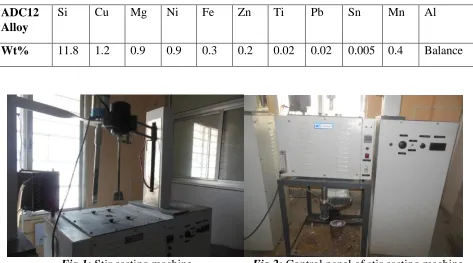
Http://www.ijetmr.com©International Journal of Engineering Technologies and Management Research [23-34] Table 1: Composition of the ADC-12 alloy in wt%
ADC12 Alloy
Si Cu Mg Ni Fe Zn Ti Pb Sn Mn Al
Wt% 11.8 1.2 0.9 0.9 0.3 0.2 0.02 0.02 0.005 0.4 Balance
Fig 1: Stir casting machine Fig 2: Control panel of stir casting machine
Fig 3: Casting processes [18]
Table 2: List of processing parameter
Parameter 1st step 2nd step
Melting temperature 7500C 8000C
Http://www.ijetmr.com©International Journal of Engineering Technologies and Management Research [23-34]
Mixing time 8-10 min -
Blade angle 900 900
No of blades 4 4
Position of stirrer Up to 2/3 depth in the melt Up to 2/3 depth in the melt
In order to compare and correlate the effect of dual particle reinforcement on mechanical and tribological properties, five different composites containing a total of 12 wt. % reinforcement in different proportion were fabricated and have been designated by alphabets.
Table 3: 12Wt% Reinforcement combination in composites
Composite ZrSiO4 SiC
A 3 9
B 6 6
C 9 3
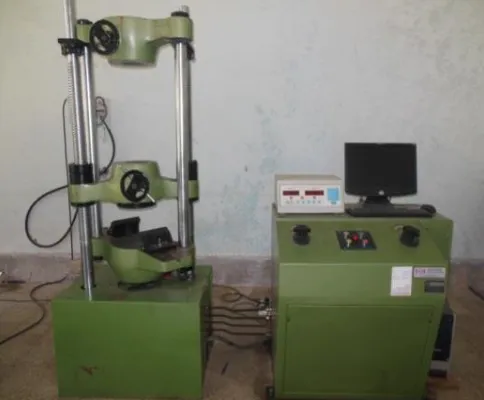
The reinforcement combinations are given in Table 3. The compressive strength of ADC-12 alloy/SiC/ZrSiO4 composites are test at Universal testing machine (model- MECH/UTE-40T).
Fig 4: Universal testing machine (model- MECH/UTE-40T).
Http://www.ijetmr.com©International Journal of Engineering Technologies and Management Research [23-34] 2.1.MECHANICAL PROPERTIES OF REINFORCEMENT PARTICLES
2.1.1. Zircon Sand
Zircon sand consists of mostly zirconium silicate (ZrSiO4) and some hafnium in addition to some
rare earth elements, titanium minerals, monazite, etc. Zirconium was found to be a promising candidate as reinforcement material for aluminum, zinc and lead based composites (19).
Table 4: Chemical composition of zircon sand
composition ZrO2 SiO2 HfO2 Al2O3 Fe2O3 MgO
Content (wt%) 67.22 30.85 1.39 0.11 0.029 0.014
Table 5: Mechanical properties of zircon sand.
Properties Zircon sand
M.P.(0c ) 2500
Limit of application (0c) 1870
Hardness(Moh‟s Scale ) 7.5
Density( g/cm3) 4.5-4.7
Linear coeff. Of expansion(10-6k) 4.5
Fracture toughness(MPa-m1/2) 5
Crystal structure Tetragonal
2.2.2. Silicon Carbide
Silicon Carbide is the only chemical compound of carbon and Silicon. It is used in abrasives, refractories, ceramics, and numerous high-performance applications. Silicon carbide crystal structure is tetrahedral.
Table 6: Mechanical properties of silicon carbide
Properties Silicon carbide
M.P. (0c) 2200-2700
Limit of application (0c) 1400-1700
Http://www.ijetmr.com©International Journal of Engineering Technologies and Management Research [23-34]
Density g/cm3 4.9
Hardness (Moh‟s scale) 9
Fracture toughness(MPa-m1/2) 4.6
Crystal structure Hexagonal
3. RESULTS AND DISCUSSION
3.1.MICROSTRUCTURE ANALYSIS
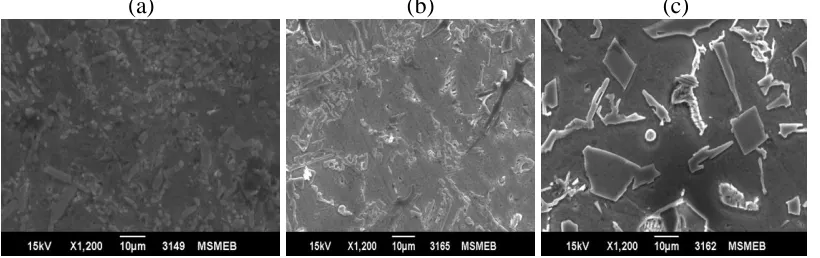
The optical micrograph of the composites is shown in Fig. 5a–c. The micrograph clearly reveals the absence of dendritic morphology in all the composites under investigation. The dendritic structure can be modified during casting which is influenced by many factors such as dendritic fragmentation, restriction of dendritic growth by the particles, and thermal conductivity mismatch between the particles and melt. Dendritic fragmentation can be attributed to the shearing of initial dendritic arms by the stirring action. It was also found that the perturbation in the solute field due to the presence of particles can change the dendrite tip radius and the dendrite tip temperature. These effects give rise to a dendrite to cell transition as the density of particles is increased. Also the length of the dendrite is reduced in the presence of the particles. Ceramic particle also act as a barrier for dendritic growth and this phenomena is more pronounced if the cooling rate is high. In this work reported that the particle can be assumed to act as a barrier to the dendritic growth.
(a) (b) (c)
Fig 5: The SEM micrograph of composites a composite A, b composite B, c composite C
Http://www.ijetmr.com©International Journal of Engineering Technologies and Management Research [23-34] and also restricts the growth of dendrite and modifies the matrix with more refined structure leading to improvement in strength.
The SEM micrographs of composite „B‟ containing 12 % of silicon carbide and zircon sand particles of the ratio of 1:1 in this work is shown good bonding in Fig. 5b. It depicts the refinement of microstructure and eutectic silicon. Eutectic silicon along with dispersed particles is densely arranged in such a way that they almost cover the entire matrix. The eutectic silicon refines to finer scale and nucleates near particles as colonies. Clustering of particles is observed at some places and some of the clustered particles have chipped out during polishing the samples. However, fine particles have the tendency of clustering though it is not much pronounced in the prepared composites.
The SEM micrograph of composite „C‟ containing 12 % of SiC and zircon sand particles in the ratio 1:3 is shown in Fig. 5c. Finer to coarse distribution of eutectic silicon along with homogeneous distribution of particles can be seen. Eutectic silicon colonies around particle are more pronounced in the micrograph. Eutectic silicon distribution is more refined and morphology has changed from acicular to globular around the particles. Also in the matrix the eutectic silicon having blunted morphology as compared to long needle shape or acicular is seen. However, the fine particles and silicon form a network structure because of pushing interface from different nucleation sites. Moreover, the clustering of fine particles at some places is also observed.
Overall analysis of structure indicates that microstructure is refined whereas eutectic silicon are having blunted and globular morphological features. This refinement may lead to better tribological and mechanical properties in the composite. The colonization of eutectic silicon in the vicinity of the particles enhances particle capability of wear resistance. The reinforced particles are uniformly distributed in the alloy matrix. The good bonding between particles and alloy matrix is also revealed in the microstructural analysis. Moreover, porosity is at minimum level and not observed in the optical examination, although clustering is seen at same places in the composite. Microstructure analysis shows that addition of SiC has a pronounced effect on the microstructure and eutectic silicon refinement. The degree of microstructure and eutectic silicon refinement increases in accordance with the increase of SiC-reinforced particle percentage. The most prominent feature observed in all composite is the absence of dendritic growth which is accounted for two-step stir casting processing of the composites.
3.2.MICRO HARDNESS AND DENSITY OF COMPOSITE
Http://www.ijetmr.com©International Journal of Engineering Technologies and Management Research [23-34] Table 7: Variation of micro hardness (Hv) And Density
Composite Particle (HV) Interface (HV) Matrix (HV) Density g/cm3
A 228.03 121.38 73.06 2.716
B 165.10 109.81 61.43 2.735
C 180.43 111.91 63.98 2.715
3.3. COMPRESSIVE TEST
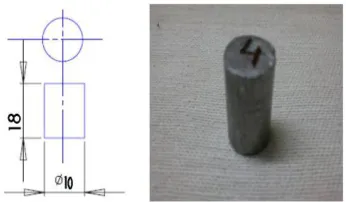
The room temperature tensile test was conducted using Universal testing machine (model- MECH/UTE-40T). The as-cast ADC-12 alloy composite samples for compressive test were prepared using lathe machine. The tests were conducted trice to get the average response value.
Fig 6: Dimension of testing specimen
Fig 7: composites before testing Fig 8: composites after testing
Table 8: Compressive strength of composite A
Ultimate compressive load (KN) 19.040
Ultimate compressive strength (N/mm2) 242.424
Deflection at ultimate load (mm) 1.600
Http://www.ijetmr.com©International Journal of Engineering Technologies and Management Research [23-34] Table 9: Compressive strength of composite B
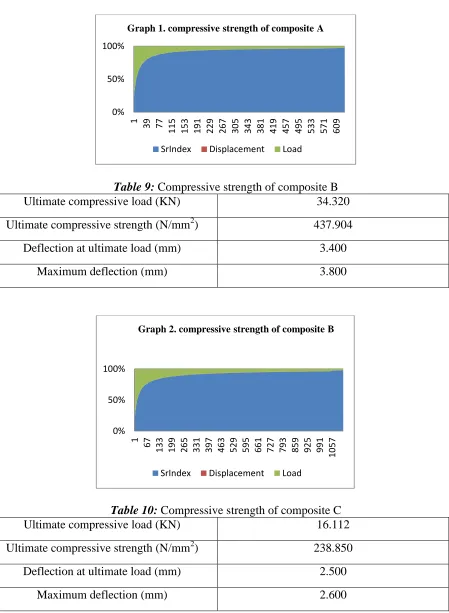
Ultimate compressive load (KN) 34.320
Ultimate compressive strength (N/mm2) 437.904
Deflection at ultimate load (mm) 3.400
Maximum deflection (mm) 3.800
Table 10: Compressive strength of composite C
Ultimate compressive load (KN) 16.112
Ultimate compressive strength (N/mm2) 238.850
Deflection at ultimate load (mm) 2.500
Maximum deflection (mm) 2.600
0% 50% 100%
1 39 77
11 5 15 3 19 1 22 9 26 7 30 5 34 3 38 1 41 9 45 7 49 5 53 3 57 1 60 9
Graph 1. compressive strength of composite A
SrIndex Displacement Load
0% 50% 100% 1 67 13 3 19 9 26 5 33 1 39 7 46 3 52 9 59 5 66 1 72 7 79 3 85 9 92 5 99 1 10 57
Graph 2. compressive strength of composite B
Http://www.ijetmr.com©International Journal of Engineering Technologies and Management Research [23-34] The compressive strength of composites A and C is nearly similar but C is higher for composite A. The composite with equal amount of dual reinforcement, i.e., composite B provides better strength as compared to composites C &A. The composite with 50 % silicon carbide and 50 % zircon sand shows better compressive strength as compared to composite B&C. Dual particles have different role in the matrix, silicon carbide particles refines the eutectic silicon whereas zircon sand particles provides good bonding characteristics to the matrix. The composite B is combination of 50 % zircon sand and 50 % silicon carbide particles shows better compressive strength as compared to composite C&A which is composite C having 75 % zircon sand and 25 % silicon carbide particles and composite A having 25 % zircon sand and 75 % silicon carbide particles and.
After analyzing micro hardness and compressive strength behavior of composites, it is clear that dual particle reinforcement mixed in definite proportion is only effective for enhancing micro hardness and compressive strength. Silicon carbide particles are better reinforcement for compressive behavior as compared to zircon sand particles. Composite B exhibits better compressive strength due to high micro hardness of the interface between particle and matrix.
4. CONCLUSIONS
In this study the effects of SiC and ZrSiO4 ceramic grain sizes and mixing proportions on the
michrohardness and compressive strength characteristics of composite materials were studied. The following conclusions can be drawn from the results of the present study performed on dual particle sized reinforced composites. The microstructure and micro hardness of the micro size particle reinforced composites, which have positively affected the michrohardness and compressive strength behavior. We found that as the size of the reinforcement increases the microstructure heterogeneity increases. It has been observed that, in dual particle reinforced composites, large particles prove useful in preventing agglomerations.
1. Dual particles have different functions in the composite. Silicon carbide refines the eutectic silicon where as zirconium silicate provides good internal bonding strength and micro hardness. 2. The morphology is not observed in the composites as can be seen in the microstructures of stir cast composites.
3. The combination of reinforcement in ADC-12 alloy composites 50 % SiC and 50 % zircon sand particles reinforced composite (Composite B) yields better compressive strength as compared to other combination.
0% 20% 40% 60% 80% 100% 1 10 6 21 1 31 6 42 1 52 6 63 1 73 6 84 1 94 6 10 51 11 56 12 61 13 66 14 71 15 76 16 81
Graph 3. compressive strength of composite C
Http://www.ijetmr.com©International Journal of Engineering Technologies and Management Research [23-34] 4. The reinforcement up to 12Wt% yields better mechanical properties as compared to other combination.
5. ACKNOWLEDGEMENTS
The authors are thankful to acknowledge the financial support from Maulana Azad National Institute of Technology Bhopal (M.P.) India.
6. REFERENCES
[1] S. Soresh, A. Mortensen, and A. Neddleman, “Fundamentals of metalmatrix composites”, Butterworth-Heinemam, 16, 297-298 (2000).
[2] A. T. Alpas and J. Zhang, “Wear rate transitions in cast aluminumsilicon alloys reinforced with SiC particles”, Scripta Metall Mater., 26, 505-509 (1992).
[3] H. Akbulut, M. Durman, and F. Yilmaz, “Dry wear and friction properties of Al2O3 short fiber reinforced Al-Si (LM 13) alloy metal matrix composites”, Wear, 215, 170-6 (1998).
[4] S. Skolianos and T. Z. Kattamis, “Tribological properties of SiCreinforced Al-4.5% Cu-1.5% Mg alloy composites”, Mater. Sci. Eng. A, 163, 107-12 (1993).
[5] Y. Sahin, M. Kok, and H. Celik, “Tool wear and surface roughness of Al2O3 particle-reinforced aluminum alloy composites”, J. Mater.Process Technol., 128, 280-91 (2002).
[6] M. K. Surappa, S. C. Prasad, and P. K. Rohatgi, “Wear and abrasion of cast Al-Alumina particle composites, Wear, 77, 295-312 (1982).
[7] A. Sato and R. Mehrabian, “Aluminum matrix composite: fabrication and properties”, Metall. Trans. B, 7B, 443-51 (1976).
[8] J. K. M. Kwok and S. C. Lim, “High-speed tribological properties of some Al/SiC composites: Wear mechanisms”, Comp. Sci. Technol., 59, 65-75 (1999).
[9] J. K. M. Kwok and S. C. Lim, “High-speed tribological properties of some Al/SiC composites: Frictional and wear-rate characteristics”,
Comp. Sci. Technol., 59, 55-63 (1999).
[10] A. T. Alpas and J. Zhang, “Wear rate transitions in cast aluminumsilicon alloys reinforced with SiC particles”, Scripta Metal Mater., 26, 505-509 (1992).
[11] H. Akbulut, M. Durman, and F. Yilmaz, “Dry wear and friction properties of Al2O3 short fiber reinforced Al-Si (LM 13) alloy metal matrix composites”, Wear, 215, 170-6 (1998).
[12] S. Skolianos and T. Z. Kattamis, “Tribological properties of SiCreinforced Al-4.5% Cu-1.5% Mg alloy composites”, Mater. Sci. Eng. A, 163, 107-12 (1993).
[13] Y. Sahin, M. Kok and H. Celik, “Tool wear and surface roughness of Al2O3 particle-reinforced aluminum alloy composites”, J. Mater.Process Technol., 128, 280-91 (2002).
[14] M. K. Surappa, S. C. Prasad and P. K. Rohatgi, “Wear and abrasion of cast Al-Alumina particle composites”, Wear, 77, 295-312 (1982).
[15] A. Sato and R. Mehrabian, “Aluminum matrix composite: fabrication and properties”, Metal Trans. B, 7B, 443-51 (1976).
[16] A. Banerji, S. V. Prasad, M. K. Surappa, and P. K. Rohatgi, “Abrasive wear of cast aluminum alloy-zircon particle composites”, Wear, 82, 141- 151 (1982).
Http://www.ijetmr.com©International Journal of Engineering Technologies and Management Research [23-34] [18] Manoj Singla, D. Deepak Dwivedi, Lakhvir Singh, Vikas Chawla-“Development of Aluminium Based Silicon Carbide Particulate Metal Matrix Composite”.Journal of Minerals & Materials Characterization & Engineering, page 455-467, 2009.