\
T
RANSLATIONF
RAMEWORK FOR THEW
ORLDB
ANK:
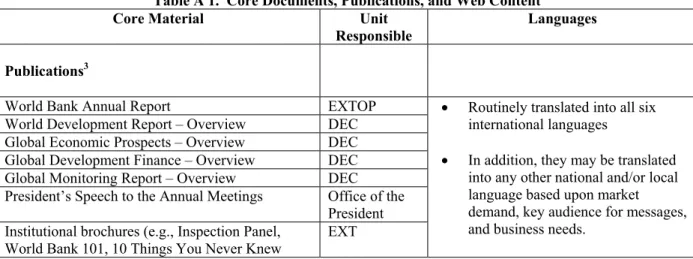
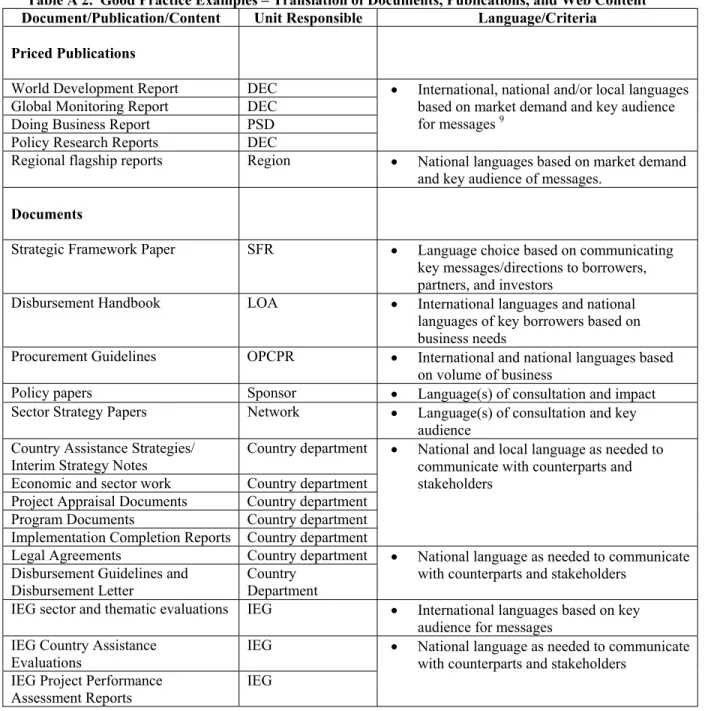
P
ROGRESS INI
MPLEMENTATIONOPERATIONS POLICY AND COUNTRY SERVICES
DECEMBER 8, 2006
AAA Analytic and advisory activities
BP Bank Procedure (statement)
CAS Country Assistance Strategy
CFAA Country Financial Accountability Assessment CPAR Country Procurement Assessment Report CPS Country Partnership Strategy
CRM Corporate Resource Management
DEC Development Economics
ESW Economic and sector work
EXT External Affairs, Communications and United Nations Affairs
FY Fiscal year
GSD General Services Department
IBRD International Bank for Reconstruction and Development IDA International Development Association
IDU Internal Documents Unit
IFC International Finance Corporation IRIS Integrated Records Information System ISG Information Solutions Group
ISYS A terminological and text-storage tool for professional translators
IT Information technology
MIGA Multilateral Investment Guarantee Agency OED Operations Evaluation Department
OP Operational Policy (statement)
OPCS Operations Policy and Country Services
PAD Project Appraisal Document
PIC Public Information Center
PID Project Information Document/Program Information Document
QA Quality assurance
RM Resource Management
SAP Systems, Applications, and Products in Data Processing SEC Corporate Secretariat
TSS Transitional Support Strategy VPU Vice presidential unit
P
ROGRESS INI
MPLEMENTATIONCONTENTS
Executive Summary ... i
I. Introduction ... 1
II. Implementation of the Translation Framework... 1
A. Guidance to Staff ... 2
B. Outreach ... 5
C. Document Translation Activity... 6
D. Multilingual Web Initiative: On-line Dissemination of Translated Materials.. 9
III. Refining the Model of Translation Service Delivery... 12
A. Decentralized Provision of Translation Service... 13
B. Monitoring Performance ... 15
IV. Remaining Implementation Agenda and Next Steps... 17
BOXES: Box 1: Good Practice Guidelines - Criteria for Decisions on Translation ... 4
TABLES: Table 1: Core Documents, Free Publications, and Web Content for Translation... 3
Table 2: Translation of Selected Document Types from July 2003 to December 2004 . 8 ANNEXES: Annex A: Translation of World Bank Documents, Publications, and Web Content: Staff Guidelines ... 21
Annex B: Multilingual Web Pilot ... 29
Annex C: Operationalizing the new Model of Service Delivery ... 31
Annex D: Terminology Infrastructure... 33
Annex E: Evolving Product lines and Service Levels ... 35
The preparation of this report was a collaborative effort by OPCS, EXT and GSD. The report was prepared by a team led by Sheoli Pargal and consisting of Zeina Afif, Ridwan Blond, Nicole Frost, Ilmita Hutagalung, Valentina Kalk, Robert King, Marco Mantovanelli, Maureen Moore, Ida Mori, John Strawhorn, Caroline Vagneron, and Robert Valantin.
Useful comments and input were received from Wyfield Chow, Rui Coutinho, Shakuntala Gunaratne, Dana Lane, Lisa Lui, Galina Mikhlin Oliver, and Patricia Rogers. The report also benefited from feedback from members of the Communications Network, including staff in Public Information Centers across all Regions. The report was prepared under the supervision of Vinay Bhargava and Robert Van Pulley and the general guidance of James W. Adams.
1. In July 2003, the Executive Directors discussed the paper A Document Translation Framework for the World Bank Group (SecM2003-0284; IDA/SecM2003-0369; IFC/SecM2003-0037; MIGA/SecM2003-0045), which proposed a framework to support integrated decision making and planning for translation to ensure greater consistency, quality, efficiency, and accountability in the translation of World Bank Group documents. This paper reviews the implementation of the Translation Framework in IBRD/IDA between July 2003 and May 2006.
2. Progress. Progress has been made on developing staff guidelines, enhancing the capacity of Public Information Centers (PICs), increasing the Bank’s capacity for quality translation while controlling costs by establishing an offshore translation capability, developing new technological solutions, and upgrading infrastructure to manage translations and ensure quality. In addition, Management has made efforts to extend electronic outreach on the Internet through the development of a multilingual web pilot program, to better integrate translation planning into unit communication strategies, and to strengthen the Bank’s outreach in local languages through the use of licensed publications.
3. Guidance and Outreach. Staff guidelines on translation have been developed and will be issued shortly. The guidelines set out a core list of documents, free publications and web content that will routinely be translated into specific languages; this list will be updated periodically. For all other documents, publications, and web content, the originating unit is responsible for deciding on translation: the guidelines specify criteria for staff to use when deciding what to translate and into which languages.1 In all cases, the originating unit responsible for preparing a Bank document, publication, or web content is also responsible for commissioning, financing, and assuring the quality of any translation. Recognizing that in the Bank’s multilingual and multicultural business environment, translation is an integral part of any outreach and communication strategy, the Framework envisions a key role for PICs/country offices in disseminating translated content. Over the past two years the Bank has established new PICs around the globe and immensely improved their technological capabilities. All PIC staff have also been trained in the Bank’s approach to and guidelines on translation.
4. Document Translation Activity. Systems to accurately track and measure translation activity are still being developed, so a complete picture of the extent of Bank translation in different languages is not yet possible. However, a snapshot of translation activity between July 2003 and December 2004 indicates that a wide range of documents are being translated, including press releases, free and priced publications, and operational documents: documents pertaining to Bank strategy; core diagnostic economic sector work; other analytic and advisory activities, including economic and sector reports;
1
Six “international languages”—Arabic, Chinese, French, Portuguese, Russian, and Spanish—have been identified as key for the Bank’s communication with the multinational community. See A Document Translation Framework for the World Bank Group (SecM2003-0284), June 12, 2003.
project-related documents; Evaluation Reports and Independent Evaluation Group summaries.
5. Multilingual Web. In FY04, Management launched a program to create Arabic, French, and Spanish “pilot” websites that provide overall institutional content such as information about the Board and how to do business with the Bank, and information on projects and programs. The websites also facilitate searching for documents that have been translated into these three languages. Within three months of the launch of the pilot, the number of visitors to the French and Arabic websites doubled and the number of visitors to the Spanish website grew by one-third. This success highlights the importance of high-quality websites that integrate country- and Region-specific content with global development knowledge and institutional content in different languages. Management has recently made budget decisions that will permit the Bank to mainstream the pilot websites within existing budgets.
6. Service Provision and Quality Assurance. The model of translation service provision proposed in the 2003 Translation Framework paper has been modified in light of experience during implementation. That model retained the Bank’s then existing approach of vesting responsibility for decisions on translation in the business sponsor of each document. It proposed that competitive pressure be used to bring down costs: the Bank would rely on a network of vendors to undertake translations, with a central translation services Core Facility to support and facilitate the contracting out of translation services and ensure quality. It has since been determined that the assumptions underlying this model were too optimistic: the risk of poor quality is high, and the cost of supporting institution-wide individual interaction with the marketplace is prohibitive. In response, Management is now setting up translation hubs in selected country offices to undertake translation in-house at lower cost than if it were done in Washington, with vendors used to supplement capacity in peak periods. The volume of translation the General Services Department (GSD) undertakes is expected to increase substantially due to more affordable chargeback for the service. In addition, greater reliance on GSD is expected to lower the risk of inaccurate or poor-quality translations. However, business units will still be able to arrange for translation by outside providers, a measure that will keep up pressure for achieving cost savings and efficiencies. Initial indications on the performance of this business model are promising.
7. Next Steps. In FY07, work to establish the first six decentralized translation hubs will be completed. Guidelines on translation will be disseminated to staff, and appropriate training will be provided to raise awareness of the need to translate. Standard tools will be developed to systematically assess the demand for translation, and processes and systems to capture and monitor translation activity will be improved. Management will also explore resources to extend the multilingual web initiative to additional languages such as Chinese, Portuguese and Russian. A steering committee with representation from OPCS, EXT, GSD, and ISG will provide oversight of the implementation of the Translation Framework. Management will regularly update the Board on the Bank’s translation activity.
P
ROGRESS INI
MPLEMENTATIONI. INTRODUCTION
1. In July 2003, the Executive Directors discussed the paper A Document Translation Framework for the World Bank Group (SecM2003-0284; IDA/SecM2003-0369; IFC/SecM2003-0037; MIGA/SecM2003-0045), which proposed a framework to support integrated decision-making and planning for translation to ensure greater consistency, quality, efficiency, and accountability in the translation of World Bank Group documents. To this end, the paper laid out a flexible and pragmatic approach to translation, which was envisaged to occur in the context of corporate and individual unit communication and dissemination strategies. In particular, the framework retained the Bank’s existing approach of vesting responsibility for decisions on translation in the business sponsor of each document. It proposed arrangements to facilitate greater outsourcing of translation work in combination with reliance on a core facility that would manage glossaries, maintain a database of vendors, and carry out quality assurance, with greater use of technology to improve efficiency. Management proposed a transition to the new framework over three years, during which investments would be made in upgrading facilities to manage translations more efficiently and in building the capacity to manage higher translation volumes. Management also committed to reporting to the Board on progress in implementation, including early lessons.
2. Purpose and Structure of this Paper. This paper reviews the implementation of the Translation Framework between July 2003 and May 2006. While the framework covered the entire World Bank Group, it was agreed that each institution should develop appropriate guidelines for its own staff relating to the implementation of its translation needs. Moreover, each institution would work on managing translations in line with its own business model. This report focuses on IBRD/IDA. Section II describes progress on implementation, including translation activity, since the framework was presented to the Board. It also discusses an initiative to set up multilingual web sites. Section III explains that while the vision of decentralized decision-making for translation laid out in the Translation Framework paper remains appropriate, the model proposed for implementing that vision in 2003 has required refinement. It describes the refinements to the model that have been made in line with early lessons of experience. Section IV describes the work remaining and next steps.
II. IMPLEMENTATION OF THE TRANSLATION FRAMEWORK
3. This section describes the model of translation delivery envisioned under the 2003 Translation Framework paper and key achievements in implementation during the last three years. Progress has been made on developing guidelines, training staff, enhancing the capacity of Public Information Centers (PICs), increasing capacity for quality translation while controlling costs by establishing off-shore translation capability, developing new technological solutions, and upgrading infrastructure to manage
translations and ensure quality. In addition, Management has made particular efforts to further outreach on the internet through the development of a multilingual web pilot program, to better integrate translation planning into unit communication strategies, and to strengthen the Bank’s outreach in local languages through the use of licensed publications.
4. Original Translation Framework Model. The 2003 Translation Framework paper proposed a model of translation delivery premised on the assumption that the Bank’s need for high quality, cost-effective translations could be satisfied by having all units that require translation services deal independently with the translation market, as long as they were given the following support: (a) Information (e.g., rosters of carefully vetted vendors, access to Bank-specific glossaries, and samples of previously translated material); (b) Tools (such as computer-assisted translation aids – translation memory, terminology-management software, etc.); and (c) Quality assurance services (identification/screening of vendors, review of quality of translation performed by vendors, etc.). In implementing this vision, it was proposed that Bank staff rely on a network of vendors to undertake translations and that a central translation services Core Facility be established in the General Services Department (GSD) that would support and facilitate the contracting out of translation services by document “owners” and ensure quality.2 Clients throughout the institution would deal independently with the vendor community, and both clients and vendors would use centrally developed quality assurance tools and systems made available by the Core Facility.3 Key to this model was a reliance on technology in support of the dispersed provision of translation services. PIC staff in country offices were expected to play a key role in understanding the demand for translated documents and in assisting staff in deciding on content to be translated and the languages it should be available in.4 As described in section III, Management has now modified this model in light of lessons learned in the course of implementation. A. Guidance to Staff
5. The model of service delivery articulated in the Translation Framework paper was based on the premise that document owners or sponsors would continue to exercise judgment and translate documents in accordance with their business needs and particular audiences. Because Management recognizes that business sponsors have diverse translation needs and fluctuating portfolios, it believes strongly that a simple, flexible approach that encourages them to translate content on the basis of specific needs is preferable to a more prescriptive approach. Accordingly, to assist sponsors in making 2
The Framework assumed that corporate priority translations would continue to be provided in-house by the Core Facility in GSD.
3
The Core Facility was also expected to (a) provide advisory and facilitation services; (b) vet and negotiate with vendors on behalf of Bank clients, and establish a vendor management information system; and, (c) monitor and analyze data on costs and the volume of translation activity. In addition, it was expected to maintain and manage the translation workflow infrastructure, provide project management assistance/coordination, and establish translation storage and retrieval systems integrated/compatible with existing systems in the Bank.
4
See Strengthening Public Information Centers (Sec008, IDA/Sec007, IFC/Sec M2003-001, MIGA/SecM2003-004), January 8, 2003.
such determinations, Management has prepared guidance to staff on what to translate, and into what languages. Communications staff within business units will play an integral role in advising on translation in line with the unit communications strategies. 6. Guidelines. The guidelines, set out in Annex A, identify a core set of documents, free publications and web content (see Table 1) that will routinely be translated into specific languages, and that will be updated periodically, as the Bank’s business evolves.5 For all other documents, publications and web content, the originating unit is responsible for deciding upon translation: the guidelines specify criteria (see Box 1) for staff to use when deciding what to translate and into which languages.6 In all cases, the originating unit is responsible for commissioning, financing, and assuring the quality of any translation.7 The core set of documents, free publications and web content is currently routinely translated by the Bank into the languages specified. Hence core translation requirements can be accommodated within existing budgets.8 Following current practice, institutional core content will continue to be edited, structured, and disseminated on the web by EXT. The guidelines will be made available to staff on the intranet, and Administrative Manual Statement 8.10, Translation Services, will include a link to them. The guidelines will be maintained by OPCS.
Table 1: Core Documents, Free Publications, and Web Content for Translation
Documents Free Publications
Articles of Agreement and Updates World Bank Annual Report
General Conditions World Development Report – Overview Operational Policies (OPs) and Bank Procedures (BPs),
including environmental and social safeguards policies and the disclosure policy 9
Global Economic Prospects – Overview Global Development finance – Overview Global Monitoring Report – Overview Disbursement Guidelines
Procurement Guidelines
Annual Review of Development Effectiveness–Executive Summary Core Standard Bidding Documents President’s Speech to the Annual Meetings Project Information Document /Program Information
Document
Institutional brochures (e.g., Inspection Panel, World Bank 101, 10 Things You Never Knew About the World Bank, etc.)
5
Feedback from PICs on demand and usage is expected to aid in identifying any changes required to the list of core materials (para.9).
6
Six “international languages” – Arabic, Chinese, French, Portuguese, Russian, and Spanish – have been identified as key for the Bank’s communication with the multinational community. See A Document Translation Framework for the World Bank Group (SecM2003-0284), June 12, 2003. 7
This means that units must make arrangements to ensure the quality of translated content (which could include hiring reputable outside vendors (or GSD) who guarantee translation quality, or having the document translated back into English to verify accuracy, etc.). When the originating unit consults other units on translation (e.g., LEG for Legal Agreements) the cost of doing so is borne by the originating unit.
8
Regional core content is required to be made available in local/national languages, not in all six international languages.
9
Excludes OPs and BPs that are in the process of being updated or will be updated during the next 2 years.
Table 1 (contd.) Web Content
Institutional core content (e.g., basic information about the Bank and its activities, general information on the Board; types of lending instruments; the results of the Bank’s lending and knowledge programs.)
Institutional press releases
Sector and Thematic press releases Country press releases
Country and Regional issue briefs
7. Communication Strategies for Business Units. Integrating translation into the Bank’s corporate and unit-specific communication and dissemination strategies is key to ensuring appropriate planning and resourcing of translation needs. For this, EXT/CommNet staff across the institution need to be more systematically involved in language strategy discussions and decisions at the unit level: once the guidelines on translation have been issued to staff, EXT will disseminate them widely to ensure that dissemination needs (including budgets for translation) are considered early in the process of preparation of operations and reports, particularly at the country, Regional and Network level. Data on the budget implications of different translation options, a key input in developing unit communication strategies, will be provided by the Core Facility.
Box 1: Good Practice Guidelines - Criteria for Decisions on Translation
Criteria Languages
Documents, publications, and web content that disseminate key messages that reflect development or other institutional priorities and that are destined for a wide international audience.
International, national and/or local languages based upon market demand, key audience for messages, and business needs.
Documents, publications, and web content that address the institution’s overall business and strategic thinking and that are destined for a wide international audience.
International, national and/or local languages based upon market demand, key audience for messages, and business needs.
Documents, publications, and web content that address country- Region- and project-specific information.
National/local languages as appropriate—for example, the national language of a country, local languages used within a country, and/or language(s) understood by the people affected by, or likely to be affected by, a project. Documents provided for public consultation For international public consultation, normally
the relevant international languages. For local public consultation, generally the language(s) used by the parties to be consulted.
B. Outreach
8. In 2001, when the Executive Directors approved revisions to the World Bank Disclosure Policy, they underscored the need for greater dissemination of disclosed material.10 Subsequently, in 2003, Management presented to the Board two elements of a proactive strategy for dissemination and outreach—the Translation Framework and a program to upgrade and modernize the Bank’s PICs. The Translation Framework recognized that in the World Bank’s multilingual and multicultural business environment, translation is an integral part of any outreach and communication strategy—whether at the corporate, regional, country, or project level. Thus it envisioned a key role for PICs/country offices in disseminating translated content. The Framework also anticipated that PIC staff would maintain a record of users and monitor the volume of requests for specific documents in English and in other languages to identify demand for translations from the public. This section discusses progress in this area as well as other aspects of Bank outreach in different languages.
9. Establishment of PICs. Over the past two years the Bank has made substantial progress in establishing new PICs around the globe and in improving their technological capabilities. As of July 1, 2006, 97 countries have Public Information Services Programs, and 89 Public Information Centers have been opened worldwide. Several PICs house state-of-the-art Global Development Learning Network (GDLN) facilities and have become sought-after locations for development-related conferences, speeches, publication launches, and so on. In response to demand, EXT has also established 98 satellite centers that allow access to Bank information from secondary cities and other locations in borrower countries. Seventeen PICs are currently functioning in partnership with other donors. PIC staff have developed outreach and survey tools to gather data on audience demand for information in languages other than English. In addition, PIC and communications staff in some Regions (e.g., ECA) now include planning for translation in their communication strategies. Going forward, PIC staff will more systematically assess the demand for translation activity (for example, by introducing standard tools such as client surveys), monitor and report on what is translated, and provide feedback on the relevance to users and the quality of translated content.
10. Training of PIC staff. Staff in PICs are often the first point of contact with the Bank for external stakeholders, and therefore particularly need to understand the Bank’s Translation Framework. The Orientation Program for PIC staff now includes training on the Bank’s approach to and guidelines on translation. General informational training on the Bank’s language approach has also been developed for operations staff, and the guidelines and good practices on translation are being integrated into Bank orientation and other core training.
11. Press Releases. Translation of press releases is key to ensuring the dissemination of messages important to the Bank’s development mission. Press releases relate to key decisions taken by the Board on policy, strategy, and operational matters, events of public 10
World Bank Disclosure Policy Review: Proposals for Revision of the Policy, Chairman’s Summary and Final Text (R2001-0166, IDA/R2001-0151), September 6, 2001.
significance, and other messages of public interest. In the last few years, the Regions have issued press releases in English as well as the following other languages, depending on the topic and audience: Arabic, Bahasa-Indonesian, Bengali, Chinese, Dari, Farsi, French, German, Hindi, Japanese, Kannada, Nepali, Portuguese, Pushto, Romanian, Russian, Serbo-Croatian, Sinhalese, Spanish, Tamil, Telugu, Tetum, Turkish, Urdu, and Vietnamese. Since July 2004, corporate press releases on topics of broad interest have been translated into Arabic, French and Spanish under a pilot program to set up multilingual websites (see section II. D). Before the pilot program was launched, most corporate press releases were only available in English.
12. Dissemination of Translated Materials. The multilingual web initiative described below has been central to the dissemination of translated content during the past two years. In addition, the Bank is increasingly using broadcast and multimedia more strategically – it has developed a new corporate video in 7 languages (“Working for a World Free of Poverty”) and a new video about the Millennium Development Goals (“One World One Goal”) for use in outreach activities.
C. Document Translation Activity
13. The Bank translates a wide variety of documents, including a range of publications and reports containing information about Bank operations. As discussed in section III, systems to accurately track and measure translation activity are currently under development, so a complete picture of the extent of translation in different languages is presently lacking. However, a snapshot of translation activity between July 2003 and December 2004 (based on data from a survey of PICs) provides an indicator of the range of documents being translated. It is anticipated that content will be more consistently translated and disseminated once the good practice guidelines have been issued and cost-sharing and other arrangements to facilitate translation of global development knowledge products have been put in place.
14. Publications. The Office of the Publisher in EXT publishes both free (such as the Annual Report) and priced (such as the World Development Report) publications. Such publications are available to the public in print form at the Infoshop, through the Bank’s e-commerce site (www.worldbank.org/publications), and from wholesalers, distributors and bookstores worldwide. Electronic and e-book versions are available through the World Bank e-Library (www.worldbank.org/elibrary) and various content aggregators. Non-English-language editions of priced publications are produced by local language publishers who arrange for document translation under license from the Bank.11 This mechanism permits the Bank to disseminate key development-related messages in multiple languages cost-effectively. In FY05 alone, EXTOP signed 108 licensing
11
A separate licensing agreement is signed for each language a particular document is translated into. Quality assurance is managed through reviews by the Bank of sample translated text. Since local language publishers must recoup their costs from publication sales, they have the incentive to assess demand, invest in high quality translation, and market the product aggressively, ensuring that the Bank’s message is widely disseminated.
agreements12for translation of 88 Bank publications into 19 languages.13 This involved 73 publishing partners, operating in 28 countries. The 2006 World Bank Annual Report was translated into nine languages, and licensing agreements have been signed to translate the 2006 World Development Report into 10 languages.14
15. Translation of Operational Documents. Operational information that is publicly available under the World Bank Disclosure Policy includes a wide array of policy, strategy, economic, sectoral, and lending related documents. Among the operational document types that have been translated in recent years are documents pertaining to Bank strategy (such as the CAS, CAS Progress Report, CAS Public Information Notice); core diagnostic ESW (such as the CFAA and CPAR); other AAA, including economic and sector reports; project-related documents (such as the PAD, Program Document, Project Information Document, Implementation Completion Report); Evaluation Reports and IEG summaries; as well as Working Papers and Newsletters. Table 2 provides a picture of the extent of translation between July 2003 and December 2004 for selected document types; this information was derived from a survey of the Bank’s global network of PICs and from the Bank’s database of disclosed documents.15 These translations were carried out by outside vendors, country office staff, Regional staff in Washington, and GSD. A major share of the work was performed by outside vendors. However, since translated documents and reports are not yet routinely submitted to the Internal Documents Unit (IDU), the volume of Bank translation activity is not fully captured in the Bank’s databases.16 Management anticipates that dissemination of the good practice guidelines will increase awareness of the need to submit translated documents to the institutional filing system. It will launch an effort to increase this awareness when the guidelines are issued, and is devising technical and other mechanisms to make it as easy as possible to capture translation activity.
12
Licensed (i.e., translated) titles in a given period are not necessarily a subset of the titles published by the Bank in the same period: the pace of translations is very different and publishers sometimes acquire translation rights to World Bank publications several months after a book has been published in English.
13
Arabic, Bahasa Malaysia, Bahasa Indonesia, Chinese, Czech, French, German, Hindi, Japanese, Korean, Latvian, Polish, Portuguese, Romanian, Russian, Spanish, Thai, Turkish, and Vietnamese. 14
EXTOP coordinates in-house translation, publication and dissemination of such high-profile publications for non-commercial distribution.
15
The share of documents that have been translated out of the set that “should” have been translated (following good practice) would be the most meaningful indicator of how well the Bank is doing in this regard. However, the good practice guidelines on translation will only be issued in FY07, so it is not possible to use this measure yet.
16
In addition, the data received from the PICs on translation is not strictly comparable to the data on disclosed documents since there is often a lag between Board discussion of a document and its disclosure in English and the translation of the same document and disclosure in other languages.
Table 2: Translation of Selected Document Types from July 2003 to December 200417 Document Type Number of Translations18 (Number of Documents Translated) Number of Documents Disclosed19 Languages Country Assistance Strategy (CAS) or Country Partnership Strategy 23(20) 33
Bengali, Bosnian, Chinese, Croatian, French, Georgian, Hindi, Kazakh, Lao, Macedonian, Nepalese, Polish, Portuguese, Romanian, Russian, Spanish, Turkish, Ukrainian, Vietnamese. CAS Progress Report 8 (7) 7 French, Georgian, Nepalese, Russian, Ukrainian, Vietnamese. CAS PIN 7 (6) 15 French, Portuguese, Russian, Ukrainian.
Transitional Support
Strategy (TSS) 5 ( 4) 4 Albanian, Portuguese, Russian, Serbian. TSS Public Notice 2 4 Russian
Country Assistance
Evaluation 6 28 Chinese, Polish, Russian, Spanish. Country Economic
Memorandum 18 (17 ) 20
Arabic, Chinese, Croatian, Latvian, Lao, Macedonian, Polish, Portuguese, Romanian, Russian, Spanish, Turkish, Ukrainian, Vietnamese,
Development Policy
Review 6 (5 ) 7 Bengali, Hindi, Russian, Ukrainian. Country Financial
Accountability Assessment
10 (9 ) 30 Arabic, Croatian, French, Russian, Spanish, Ukrainian, Vietnamese.
Country Procurement
Assessment Review 11 (10 ) 17
Croatian, French, Khmer, Polish, Russian, Spanish, Ukrainian, Vietnamese.
Poverty Assessment 19 (18 ) 18 Albanian, Arabic, Bosnian, Georgian, Polish, Romanian, Russian, Serbian, Spanish, Turkish, Vietnamese. Public Expenditure
Review 18 16
Croatian, French, Georgian, Khmer, Lao, Portuguese, Russian, Spanish, Vietnamese.
PAD20 67 (66 ) 301 Croatian, French, Macedonian, Nepalese, Portuguese, Russian, Spanish, Turkish, Ukrainian, Vietnamese.
Project or Program Information Document
252 (251 ) 926 Bengali, Chinese, Dari, French, Khmer, Latvian, Macedonian, Pashto, Romanian, Russian, Spanish, Ukrainian.
Program Document 28 81 Latvian, Russian, Romanian, Spanish.
16. Translation approach of the IFC and MIGA. The business model in IFC and MIGA is distinct from that of IBRD/IDA, which warrants their having a somewhat different approach to translation. Because they interact with the private sector, both agencies have a more demand-driven approach to translation than the Bank’s.
17. IFC Translation Activity. The IFC routinely translates a small set of institutional documents. The IFC Annual Report is translated into Arabic, Chinese, French, Japanese, Portuguese, Russian, and Spanish, under the sponsorship of the Corporate Relations unit.
17
Survey of PICs, June 2005. 18
The number of documents translated is less than the number of translations done since the same document may be translated into more than one language (e.g., in multilingual countries).
19
These numbers are from the database of documents that have been publicly disclosed on the Web. 20
The number of PADs, PIDs and Program Documents translated is understated because several PICs affirmed that these documents were translated but did not provide numbers.
In addition, IFC translates and publishes fiscal year highlights, drawn from the annual report, in Arabic, Chinese, French, Japanese, Portuguese, Russian, and Spanish. On IFC’s web site, key content is available in Arabic, Chinese, French, Japanese, Portuguese, Russian, and Spanish.21 Beyond the set of institutional documents, translation is driven by the requirements of business developers in operations. IFC translates roughly 60 press releases a year (approximately 15 percent of the total). In addition, as appropriate, Summaries of Project Information are translated in local languages as part of the local disclosure phase of IFC operations. About seventy percent of IFC’s translation work is done by GSD, and the balance by vendors in the field.22 Translation of publications other than corporate products is commissioned and financed by the sponsoring departments. In FY04 the Sustainability Review was translated into Japanese and Corporate Governance in China into Chinese. In addition, the Municipal Fund brochure was translated into French, Portuguese, Russian and Spanish.
18. MIGA Translation Activity. MIGA translates content based on its business needs. While the working language of MIGA’s private sector clients generally is English, an increasing amount of information and numerous marketing publications are now available in other languages. MIGA’s Convention and By-Laws are available in English, French and Spanish while the Highlights and Development Impact sections of MIGA’s Annual Report are translated into the six international languages. In line with demand, publications dealing with MIGA's core products and services are translated into other languages: Corporate Brochure (French, Spanish), Investment Guarantee Guide (French, Spanish, Arabic, Chinese, Japanese, Turkish, Italian, and German), and Small Investment Program Brochure (French, and Spanish). Press releases are translated as needed depending on the language of the target audience, as are news articles, interviews, or advertorials published in foreign language journals.23 Plans are underway to make the Foreign Direct Investment Promotion Center website available in Arabic and Russian. GSD provides translation services in French, Portuguese, Russian and Spanish, while Chinese translation is provided by an external vendor and Arabic is done out of the Bank Group's Beirut office. As needed, MIGA works with in-country EXT staff to do quick translations of press releases and talking points.
D. Multilingual Web Initiative: On-line Dissemination of Translated Materials 19. Most information disclosed by the Bank, including publications and reports, is disseminated through the Bank’s external website. Ensuring the online availability of updated content in languages other than English is therefore key to maximizing access to the Bank’s work by borrowers and other members of the global audience, and 21
This includes Basic Facts about IFC, What We Do, History, Member Countries, Articles of Agreement, By-laws, IFC Structure and Management, Mission Statement, and IFC Products and Services.
22
Depending on the business case, IFC’s Regional Departments may have publications translated into other /local languages. In addition corporate slides and publicity material are made available in different languages as needed.
23
For example, interviews conducted in Japanese with MIGA’s Executive Vice President published in Japanese news journals, or interviews around MIGA’s Chinese language Benchmark in Asia publication.
complements the work on document translation and PICs in terms of furthering dissemination of publicly available material. While the Translation Framework did not explicitly address the need for the Bank to host non-English-language websites,24 over the past two years awareness of this need has increased. In FY04, Management launched a Multilingual Web Pilot Program to learn more about providing and managing translated content on the Bank’s external website.25 A key finding from this initiative was that one-third of all online traffic to the Bank’s website originates in developing countries, representing a larger and more rapidly increasing amount than had been anticipated.26 20. Background. Until very recently, the provision of multilingual information on the web was largely uncoordinated across the Bank. Sponsors frequently set up single-issue websites, resulting in a multiplicity of non-English Bank websites.27 The lack of clear accountability led to uneven quality of these sites, including irregular updates and poor maintenance,28 which had negative implications for the Bank’s reputation and ability to reach large portions of audiences worldwide. The Bank did not have Arabic or French corporate websites (and therefore speakers of these languages had no entry point to access translated Bank material online) before resources were allocated to implement the Translation Framework. Also, the Bank’s websites in Chinese, Brazilian Portuguese, Russian, and Spanish tended to focus on the work of the sponsoring country office or Regional VPU alone and did not include Bank-wide content. In the last few years, surveys, focus groups, and other outreach have confirmed the existence of a robust demand for both institutional and country-focused online content in international languages and pointed to the need to coordinate the two. Annex B provides more details on this.
21. Multilingual Web Initiative. With this impetus, EXT has worked with the Regions to create Arabic, French, and Spanish “pilot” websites that provide overall institutional content such as information about the Board and how to do business with the Bank, and information on projects and programs, and that facilitate searching for
24
The Translation Framework stated that non-English websites should be “complete” or fully functional, but did not explore how specific content should be knit together into an integrated online presence. 25
See paper “Why the World Bank Needs a Multilingual Web Site and What to do About it” [http://intranet.worldbank.org/WBSITE/INTRANET/WRC/0,contentMDK:20131481~menuPK:34076 5~pagePK:39343~piPK:39371~theSitePK:30502,00.htm].
26
See Web in Review 2004 (Internet Working Group Community). 27
In view of the need to rationalize the number of websites across the Bank, EXT and ISG are assessing usage levels so that dormant websites can be identified and closed while more active ones can be combined and monitored routinely for currency. In 2004, the Bank had 56 websites devoted to corporate content, 225 sites for disseminating global development knowledge, and 274 country-specific sites managed by the Regions and Country Offices.
28
Basic information about the Bank was often missing or out of date. Research findings and data from DEC, global sectoral analysis and best practice information from the Networks, training materials from WBI, evaluations by IEG, and information on Bank lending were almost entirely lacking.
documents that have been translated into these three languages.29 As part of the pilot, 35 sites were launched in Arabic, French and Spanish.30 Over 25 feature packages were translated into Arabic, Chinese, French, Russian, and Spanish for posting on the multilingual websites. These packages include stories, project profiles, multimedia presentations, and briefs on key topics, among other materials. In addition, all press releases and pages relating to the President of the World Bank, the Tsunami, the Chad-Cameroon pipeline, and Avian Flu, as well as profiles of over twenty newsworthy projects have been translated into these languages. Decisions on what to translate were informed by a web survey on the French site, and focus groups in France, Senegal and Algeria in an effort to learn exactly what our clients are looking for online. Under a companion four-year initiative launched in 2005 to ensure that the Bank’s depositories and information systems support multilingual content, Bank units now have the ability to publish web pages in languages other than English, and corporate sites have been set up in the six international languages.31 In addition, 96 publications that had already been translated have been made available online.
22. Lessons from the ‘Pilot.’ Within three months of the launch of the pilot in July 2004, the number of visitors to the French and Arabic websites doubled and the number of visitors to the Spanish website grew by one-third. As more content became available and an improved outreach strategy was implemented, “returning visitors”32 rose, as did subscriptions to online “language” content (see Annex B for more details). Surveys indicated that demand was greatest for project information, research, data and statistics, and country related information. Overall, the success of the pilot highlighted the importance of high quality websites that integrate country- and Region-specific content with global development knowledge and institutional content in different languages. It reinforced the need to have a coordination team in place that can easily adapt to changing needs and priorities, and that can respond efficiently and effectively to the increasing demand for information by our audiences.
23. Implementation. Implementation of a multilingual web presence will involve the flexible and selective allocation of resources on the basis of demand. Clear accountabilities are being established for the selection, preparation, posting, and maintenance of content appropriate to specific language audiences. Maintaining updated 29
The purpose of the pilot program was: (i) to assess how to coordinate and structure multilingual content in a such a way that audiences could easily find it; (ii) to define tools and guidelines on how to write content, how to publish it, and how to adapt English content to different cultures and languages (translation of web content requires a simultaneous ability to create, localize and translate content); (iii) to put together a plan to ensure all relevant Bank systems support multilingual content and information; (iv) to define whether web connectivity in client countries would be an obstacle to effectively reaching out to audiences; and (v) to assess the online presence of those interested in languages other than English, in particular, the international languages
30
These sites include: Civil Society, IDA, Development Committee (French and Spanish only), Parliamentarians, Development Marketplace, IEG main website, Tsunami, Spring/Annual Meetings, WDR 2007 consultations, Publications website, Documents and reports, Project website, Business Center, and About the World Bank, among others.
31
The corporate sites include the following categories of information: About Us, Projects, News, For Businesses, and For Civil Society.
32
core corporate content (including basic information about the Bank) in key international languages is an institutional responsibility that will be managed centrally by EXT. Agreements with content owners regarding maintenance of language websites will ensure clear understanding of responsibilities and accountabilities. Establishing and maintaining Regional and country-specific sites in local languages will continue to be the responsibility of the Regions, with some central coordination (e.g., for consistency of appearance). In addition, EXT will prepare a concise version of corporate content for other languages (e.g., Hindi), to be updated annually, and offered to country units to have translated and make available online. Making global development knowledge (defined as content produced by the Networks and DEC) available in languages other than English will require a special effort on the part of originating units to include dissemination of knowledge (as well as translation, where necessary) in their planning and budgeting process. Following the experience with the pilot, a combination of market research and Regional demand analysis will be used by EXT to identify global development content that ought to be translated and priority languages for translation. Arrangements are being explored for EXT to share the cost of translation with document originators in order to facilitate dissemination of this content in languages other than English.
24. Resource Requirements. Seed budget allocations to EXT were used to finance the pilot websites through FY05. Since then, internal cost savings have been identified that will permit the Bank to mainstream the Arabic, French, and Spanish websites, i.e., fund specialized language editors33 for Arabic, French, and Spanish and cover the core cost of the program including translation of corporate content on an ongoing basis. To extend the multilingual web pilots to the other international languages important to the Bank, i.e., Chinese, Portuguese (dual website with less content but both Brazilian and continental African Portuguese), and Russian, will require additional resources. Management will explore allocation of resources to this end in view of the importance of non-English-language websites for reaching key clients.
III. REFINING THE MODEL OF TRANSLATION SERVICE DELIVERY
25. The Translation Framework paper of 2003 retained the Bank’s existing approach of vesting responsibility for decisions on translation in the business sponsor of each document, while proposing that competitive pressure be used to bring down costs: the Bank would rely on a network of vendors to undertake translations, with a central translation services Core Facility to support and facilitate the contracting out of translation services and ensure quality. The Framework represented the Bank’s first attempt to take a comprehensive and systematic approach to the provision of translations. Not surprisingly, as the various responsible units began to implement the Framework, they found that the model proposed requires refinement. The assumptions that 33
Responsibilities include editing and updating the homepage and main sections of the website; liaising with other VPUs to ensure that priority corporate content is translated and included online; offering support and guidance to Bank units in successful translation practices; coordinating translation of Web content; tracking usage; conducting outreach; and ensuring the quality of translated content in close collaboration with GSD. These staff would also provide Bankwide guidance on language strategies for documents that are disseminated through channels other than the web.
(a) suitable technology to manage a decentralized and largely outsourced model of translation service delivery was easily available, and that (b) simple terminology tools were all that vendors needed to deliver quality translations, both proved to be too optimistic. It had also been assumed that the Core Facility would be able to collect and provide information regarding the quality of work delivered in a fully decentralized market, without itself being involved in the provision of translation – but this too, was not borne out by experience. In fact, it has become clear that the cost of supporting institution-wide individual recourse to the marketplace is prohibitive, and even then there is no assurance of high quality (see Annex C for more details). Since translation for the Bank is highly specialized, quality can best be assured if specialists deal with both the providers of service and tools. This is also the experience of comparator international organizations, such as the EU, IMF and OECD which undertake translation in-house and organize it centrally.34 This section presents the adjustments Management has made to the original model in light of implementation experience.
A. Decentralized Provision of Translation Service
26. Recognizing that the ability to provide good-quality translations of Bank documents greatly depends upon having a sound understanding of the Bank and also recognizing the importance of timely delivery, Management has decided that GSD’s Core Facility should play a somewhat enhanced role in service delivery and quality assurance than the Translation Framework Paper articulated. While maintaining the ability of document originators to arrange for translation by outside providers, the adjusted model puts greater emphasis on internal control of the means of production in order to: (a) facilitate access to cost-effective service so as to encourage translation, (b) assure quality, and (c) permit regular monitoring of Bank translation volumes and quality. These adjustments to the Translation Framework by no means imply that all the work accomplished to date will need to be redone. Under the new model of service delivery, the role of the Core Facility remains largely unchanged; therefore, much of the investment undertaken since presentation of the Translation Framework paper remains relevant.
27. Establishment of Translation Hubs. The refined model is based on a network of translation service provision that exploits the specialized skills and resources of the Core Translation Facility and takes advantage of the Bank’s global presence. The Core Facility will continue to play a central management, coordination, and quality assurance role as envisaged under the Translation Framework. In parallel, decentralized translation hubs housed in selected World Bank country offices will undertake a significant proportion of the translation work that the Translation Framework Paper envisaged as being performed routinely by vendors. Vendors will still be used to supplement in-house capacity for peak periods and for highly specialized translation from time to time, and increasingly will be sourced from hub countries for cost, efficiency and quality assurance. 34
In other institutions facing demand for content in multiple languages such as the EBRD, IDB, IMF, and UN, the entire cost of translation (salaries, benefits, systems, terminology, management, etc.) is budgeted and managed centrally. For more details on practices in other international organizations, see
28. Locally Recruited Translators. Carefully selected translators are being recruited locally, initially on local fixed term contracts, to staff the translation service hubs. As Bank staff, these local translators are subject to controls and provided with support that vendors do not receive. They are being trained and mentored, and their work monitored, reviewed and, as necessary, revised, by the Bank’s more experienced translators from the Washington office. They have access to all of the Bank’s specialized translation-support systems and tools, along with training and technical support in their use, including access to copyrighted terminology tools (see Annex D) that the Bank cannot make generally available to vendors.35 It is anticipated that this system will not only build capacity at the hubs, but will also contribute to the development and professionalization of the local translation industry. As of January 2006, an Arabic hub in Egypt, a French hub in Cameroon, a Russian hub in Russia, a Spanish hub in Argentina, and a hub in Jamaica, where French and Spanish documents are translated into English, have been established and staffed, and are currently in the early phase of production. The results have been very promising. The volume of translation passing through GSD in FY06 rose by 30% after declining for over 10 years. Work has begun to establish a Portuguese translation hub in Mozambique and is expected to be completed in FY07. Thereafter, GSD will explore the possibility of establishing hubs in Brazil, China, Indonesia, and Vietnam. 29. Global Coordination of Work. A flexible, robust, and reliable system for work flow management is vital for successful operation of the hub-and-spoke network. GSD has established a central coordinating group to manage all aspects of work flow and client relations. The necessary technology infrastructure to connect the hubs with Washington and provide management information has also been put in place, permitting coordinators to oversee the quality of work being done in the hubs as well as in Washington. As some coordinators have been placed in translation hubs that have time differences with Washington, this allows translation jobs to be placed and to proceed round the clock. 30. Impact on Demand and Costs. The initial investment required to establish the hubs and staff them is justified by the lowered cost structure of Bank translation services that will result from the redistribution of work between the hubs and Washington, and by the increased volume of translation expected to pass through GSD due to more affordable chargeback for the service. Operations staff have expressed enthusiasm for this model of translation service delivery since it brings qualified sources of supply much closer to them while relieving them of the burden of managing translation. The Core Facility is also moving towards a menu of translation services differentiated by quality level (i.e., the amount of document processing and quality assurance), that would, in turn, be reflected in pricing (see Annex E for details).
31. Storage and retrieval of translated documents. Imagebank and IRIS, which constitute the Bank’s depositories of documents and are managed by ISG, include everything from PIDs to research working papers. However, they are largely limited to 35
A network of peer organizations has been a major factor in developing ISYS, which contains a large number of copyrighted glossaries shared with the Bank by their originating institutions on condition that they be limited to internal use.
content in English. While the Imagebank repository was updated to accept more languages and the IDU has issued guidelines for staff on how to submit translations into the system, more work is needed to ensure that these systems are truly multilingual, i.e., have the capacity to store, retrieve and search for documents in languages with different alphabetic characters than English. ISG is working with GSD to explore the feasibility of arrangements for automatic forwarding to these repositories of completed translations processed by GSD. GSD will handle the capture of translations produced by other parties through improvements to the system for tracking translation.36
32. Funding. In implementing the Translation Framework, funding was allocated to the establishment of the Core Facility, including the infrastructure investments required. However, the unit was left without a base budget, e.g., to cover the cost of providing the ongoing support needed for decentralized translation, leading to large financial losses in GSD, as described in Annex F. The lower costs and higher volumes of business resulting from the establishment of translation hubs in selected country offices and streamlining the core facility to provide management and quality assurance will ameliorate this problem. It is expected that when the translation hubs are fully operational the staff costs of translation service provision by GSD37 will be fully recovered by chargeback. However, chargeback will not be sufficient to cover the cost of shared services provided by the core translation facility and that are essential for quality assurance, i.e., terminology, training, co-ordination, space and technology, client relations, and management. These costs will be financed from GSD’s general budget.
33. Challenges. Important challenges in implementation of the adjusted model relate to the acculturation of local translation staff to the Bank, since they will be located at varying distances from Washington. An experienced translator who joins GSD in Washington would normally take two years to “learn the Bank” with careful guidance, oversight, and feedback. Management will therefore put special emphasis on delivering Bank values and knowledge to GSD translators in country offices through training, immersion in Bank documents and their nuanced language, and mentoring. This will be made easier by the changes of recent years—the information revolution, and the decentralization of large numbers of Bank staff to country offices. Other challenges relate to the retention of hub staff once they are trained, and to the feasibility of developing adequate depth and quality in local translation markets. These will only become known over time.
B. Monitoring Performance
34. Mechanisms to measure translation quality and productivity are needed to monitor the working of the system. A process to accurately record and measure Bankwide expenditures on translation as well as the volume of translation activity undertaken is also necessary to (a) permit an estimation of the costs of provision, language needs, and
36
Arrangements with local publishers may result in a lag between publication in English and availability of the translated version of certain priced publications.
37
demand trends for planning purposes, and (b) facilitate the integration of translation requirements into unit business plans. This section describes initiatives in these areas. 35. Translation Quality. Translation of Bank documents by business units’ direct use of vendors rather than GSD is often a trade off between cost and quality. The low cost of vendors can be attractive especially since the business unit is not the end user of the translated document. However, the inability of most ‘buying’ units to assess the quality of translated content has led to a risk of reputational harm to the Bank from poor-quality or inaccurate translation.38 Management expects that this risk will diminish significantly if, as anticipated, the number of translation requests channeled through GSD increases with more competitive pricing, since this would subject translated output to GSD’s rigorous quality assurance process.39 This will be complemented by market research conducted by EXT to identify demand and to provide feedback on the quality and relevance of translated materials.
36. Tracking Translation Spending. The Bank’s management information system (SAP) is able to measure Bankwide expenditures on translation for all requests processed through GSD, as well as those expenditures on translation that are entered into SAP explicitly as purchases of translation services by business units. However, translation is almost always handled as a subsidiary process that is embedded in or associated with other work. It is carried out variously by GSD, Bank staff in country offices and Washington, vendors, and consultants. Except for work passing through GSD in Washington, it is seldom labeled as translation in the module of SAP used to process expenditures, and completely unaddressed by the modules that deal with time recording and management of major work processes. Hence, translation performed outside GSD cannot readily be tracked in SAP. There is, in fact, no straightforward approach to capturing Bankwide data. Partly as a result, existing systems underreport the extent of spending on translation in the Bank. GSD is working with SFR to increase the awareness of staff, particularly those working in resource management, about the need to use the appropriate commitment item structure in SAP to record translation costs accurately. This will be especially important for translation work not handled by GSD but contracted directly with outside vendors.
37. Monitoring Translation Activity. Besides making it difficult to track expenditures on translation, the absence of consistent procedures and practices for commissioning translations, for recording information about translation, and for the storage of translated materials adds to the difficulty of monitoring what is translated and the volume of translation. GSD has, therefore, started working with the units that design and support the Bank’s major institutional systems for managing work processes and 38
The risk is illustrated by a recent report on the quality of translations of Bank documents into Arabic, which references the particular difficulty of translating Bank documents by those not well versed in the Bank’s usage. See “Assessment of the translation of World Bank publications into Arabic” by the Arab Organisation for Translation, June 2005.
39
Under the new model, translation by GSD will remain one of many options available to business units. However, GSD will not provide a vendor referral service, nor will it be an additional processing layer - it will provide quality assurance for materials it translates but will not be responsible for assuring quality of translation by other providers.
document collections, as well as with major sources of material likely to be translated under the Framework, to adjust both the systems and user guidelines to facilitate better monitoring and capture of different classes of translated content.40 Periodic stocktaking will supplement this approach to determine the adequacy of the data being collected and of the documents being translated. On completion of system changes, GSD will regularly monitor the translation of key program and project related documents. As mentioned earlier, going forward, PIC staff will assess the demand for translation in a more systematic manner, monitor translation activity and provide feedback on the demand, relevance and quality of translated material. In addition, EXT will regularly monitor traffic volumes and topics of interest to visitors on the non-English websites.
IV. REMAINING IMPLEMENTATION AGENDA AND NEXT STEPS
38. In FY07, remaining work on the first six decentralized translation hubs will be completed. Guidelines on translation will be disseminated to staff, and appropriate training will be provided to raise awareness of the need to undertake translation. Standard tools will be developed to systematically assess the demand for translation, and processes and systems to capture and monitor translation activity will be improved. Management anticipates that with the streamlined model of service delivery currently contemplated, including the lower cost structure arising from the use of locally recruited staff in the hubs, staff will have a much stronger incentive to utilize Bank translation services and quality assurance. This will greatly facilitate more accurate tracking of both the volume and costs of translation activity, which, in turn, should feed into better budgeting and planning for translation. As stated in para. 24, Management will also explore resources to extend the multilingual web to additional languages such as Chinese, Portuguese, and Russian.
39. Further Technology Investments. The following additional investments will be undertaken in FY07/08: (a) E-publish, the Bank’s web publishing tool, which allows staff to maintain websites easily with minimal or no technical training, will be expanded to allow for all languages to be published through it, and updated to permit better reporting of what has already been published; (b) metadata and thesaurus enhancements will be made to enable the cataloging of content in all languages and thus allow visitors to search and find content in languages other than English; and (c) the Bank’s Imagebank and IRIS repositories will be upgraded to hold content and permit searches in languages other than English.41
40. Implications for Staffing. The opening of six or seven translation hubs will mean the addition of approximately 20 local staff to GSD’s staff complement, although the additional cost of this is significantly offset by a concomitant reduction in staff of the 40
This involves the Activity Initiation Summary and Materials Management modules of SAP (to capture operational and administrative procurement data respectively) as well as the systems used by IEG, DEC and EXT. A similar effort will be made with the IDU to capture repository data.
41
Another priority is making DEC’s Development Data Platform, which contains externally sought-after web content, available in the six international languages; but this will be addressed once the main institutional needs have been met.
central translation unit in Washington that has already taken place. Mainstreaming the Arabic, French and Spanish multilingual web pilots will require hiring three new language editors, each accountable for the overall management, growth, and quality of the Bank’s online presence in a specific language.42 In addition, an EXT coordinator responsible for managing the team of language communications officers and maintaining translation relationships has been hired.
41. Cost Implications. The operation of the hubs and use of local vendors will dramatically lower the cost of translation by GSD and will help greatly in increasing the volume of business in all languages GSD undertakes to translate. Management has assessed likely demand from the Regions for one-stop translation provision through GSD and has taken this into account in developing the menu of services that is being offered to staff. It also plans to routinely survey users to ensure that GSD remains an attractive source of translation services in terms of cost, quality, and responsiveness. GSD revenues from chargeback for translation have already increased and management expects that the salary costs of basic translation will shortly be fully recovered through chargeback. At the same time, the full costs of providing core support services cannot be recovered through chargeback and will be funded from GSD’s budget. The mainstreaming of the multilingual web in Arabic, French, and Spanish, including the cost of additional language editors and a coordinator, will be covered within EXT’s budget. Management will allocate resources to ensure adequate funds for ongoing translation of core corporate content for the web. It is also exploring arrangements to facilitate translation of global development knowledge produced by DEC and the networks through cost-sharing with EXT.
42. Staff Incentives. Identifying and negotiating with vendors of translation services takes time and is not the comparative advantage of most operational staff. For this reason, translation has often been done by bilingual program assistants and country office staff, and documents that are not required to be translated but that would be useful to translate have often not been translated. Thus a key issue in the implementation of the Translation Framework is creating incentives for task managers (a) to have documents translated as needed, (b) to take measures—such as proper planning, budgeting, and schedule management—to ensure that translations are of appropriate quality, and (c) to ensure that translated documents are routinely deposited in the appropriate institutional databases and libraries. A related concern is ensuring that units appropriately code and enter (in SAP) their spending on translation so that the tracking mechanisms put in place are able to generate meaningful information for management of the Bank’s translation expenditures. Management plans to address these risks through a concerted program of outreach and training, focusing on RM, PIC, and other key staff. In addition, Management will explore the use of translation flags, automatic system-generated reminders, and similar mechanisms to ensure that document originators are reminded of the need for translation and, once documents have been translated, to ensure that they are deposited in the appropriate repositories. The initiative to track and monitor all translation activity across the Bank (paras. 36 & 37), along with reporting of such activity by unit and document class, should also act as a further incentive.
42
43. Partnerships. Building upon GSD’s existing liaison functions, the Core Facility will further develop partnerships with other organizations to foster the exchange of information and experience on issues regarding translation and to advance selective sharing of translated material, develop and train vendors, leverage expertise across institutions, and identify both high-quality contractors and candidates for recruitment. These partnerships will also be used to promote the development and upgrading of the local translation industry in different countries.
44. Overall Coordination and Reporting. Going forward, a steering committee with representation from OPCS, EXT, GSD, and ISG will provide oversight of the implementation of the Translation Framework. GSD will play a lead role in the provision, facilitation, and monitoring of in-house translation in the Bank whereas EXT will provide guidance to staff on the Bank’s language approach and what needs to be translated. EXT will also retain primary responsibility for oversight of the multilingual web. Management will regularly update the Board on the Bank’s translation activity.