Analysis of Proxy Mobile IPV6 Based on Multihoming
Technology
L.K.INDUMATHI
National College of Engineering
Maruthakulam
TamilNadu,India.
Dr.D.SHALINI PUNITHA VATHANI
Government College of Engineering
Tirunelveli
TamilNadu,India.
ABSTRACT:- This document specifies the problems of multihoming in Proxy Mobile IPv6(PMIPv6) and analysis the solutions of multihoming problem with various multihoming protocols in PMIPv6.In this paper provides the analysis between are PMIPV6,FPMIPv6(Fast Handovers for PMIPv6) PMIPv6 with TRANSIENT BINDING. Proxy Mobile IPv6 (PMIPv6) is a protocol for building a common and access technology independent of mobile core networks, accommodating various access technologies such as WiMAX, 3GPP, 3GPP2 and WLAN based access architectures. Fast Handover for Proxy MIPv6 (F-PMIPv6), introduced in RFC 5949, performs an efficient handover by reducing the delay and minimizing packet loss without involving the MN in signaling to comply with the main goal of PMIPv6 [2], [22]. This protocol is based on establishing a bidirectional tunnel between the Previous MAG (PMAG) that the MN is handing over from and the NMAG that the MN is handing over to and performing context transfer between them. Transient Binding is a mechanism applicable to the mobile node's inter-MAG handover while using a single interface or different interfaces.
The extension of Proxy Mobile IPv6 with transient binding will support multi-homing and optimizes the handover. Here the handover problem in multihoming is reduced by transient binding by using modified Local Mobility Anchor (m-LMA) with its updated Binding Cache Entry (u-BCE). Also this mechanism efficiently supports the uplink and downlink packets between mobile nodes, so it avoids superfluous packet forwarding delay and packet loss.
Keywords: PMIPv6,F-PMIPv6, transient binding, multi-homing, LR, m-LMA, u-BCE, m_MAG, handover I. INTRODUCTION
Internet Protocol (IP) was designed initially to support communication between fixed end points. Therefore, every device that is willing to connect to the Internet is expected to have an IP address that identifies it. This IP address can be obtained by self-configuration or from the router/gateway sitting in its home network by means of Dynamic Host Configuration Protocol (DHCP). This IP address is called Home Address and can be either IPv4 or IPv6. However, for the purpose of this research, we are focusing on future network generations therefore IPv6 will be chosen. When this device is willing to move to another network, referred to as Foreign Network, then the device has to still maintain connectivity and may obtain a new temporary IP Care-of-Address where information still need to be exchanged between the Mobile Node (MN) and its Correspondent Nodes (CN). When MN connects to a new access network, then this process is called MN handover. This IP mobility management is handled by the introduction multiple Mobile Management protocols such as Mobile IPv6 (MIPv6) and its extensions within the control of the Internet Engineering Task Force (IETF).
Generally In the wireless communication the handover latency and packet loss are somewhat challenging concepts in multi-homing environment. The successful mobile environment must provides the efficient multi-homing wireless protocols several groups in IETF have set out to develop
solutions on multi-homing in response to the market demand, e.g.Monami6 [1], Shim6 [2]. PMIPv6 is a protocol for building a common and access technology independent of mobile core networks, accommodating various access technologies such as WiMAX, 3GPP, 3GPP2 and WLAN based access architectures [1]. Fast Handover for Proxy MIPv6 (F-PMIPv6), introduced in RFC 5949, performs an efficient handover by reducing the delay and minimizing packet loss without involving the MN in signalling to comply with the main goal of PMIPv6 [2]. Since Proxy Mobile IPv6 (PMIPv6) is the most widely accepted NETLMM protocol due to the fact that it is the only one currently in an RFC state, it is wise to study this protocol and come up with solution for the issues surrounding the implementation of this protocol such high handover delay, increased signaling cost as well as the utilization of core network elements. PMIPv6 suffers from long handover delay as the new access network needs to register the connection of MN and grant it network access. The main disadvantage of the long handover delay is that MN will encounter a service disruption due to packet loss. In an attempt to reduce the impact of this issue, some literature has been done in that area such as [3-5]. In addition, PMIPv6 data packets suffer extra delay from the un-optimized route. Packets always have to go through the MN’s Local Mobility Anchor (LMA) even if the source and destination are connected to the same Mobility Access Gateway (MAG) [5]. This introduces a significant delay on
packets especially if the LMA is far away from the MAGs. This can be referred to as triangular routing in MIPv4 and MIPv6. Also, an attempt is made to solve the route optimization issue by setting up Localized Routing (LR) path as describe in [6-9].
II. Total Local Routing and Handover Latency The local routing and hand over latency plays vital role in multi_homing environment.
The MN faces some downtime when it performs a handover to a new MAG because it is unable to send or receive packets during that operation. For our analysis, we define total localized routing handover latency as the time between the last optimized data packet received by the CN prior to MN handover until the first optimized data packet is received by CN after MN handover to the new network. An optimized packet is defined as any packet sent by MN and received by its CN after the LR has been completely established between MN and CN. In other words:
HO_2 = HO_1 + D_LR (2.1)
Where HO_2 is the total LR handover latency, HO_1 is the basic handover delay for MN till it is capable of sending and receiving packets andD_LR is the delay for LR establishment.
The MN starts attaching to the new Access Point (NMAG) prior to MN full detachment from the PMAG. This is due to the assumption that there is some coverage overlap between the MAGs which prevents MN from being totally disconnected. As a result, the layer 2 delay (L2) is the delay between the moment that MN informs the access network of its intention to attach to the new Access Point and the moment that the NMAG knows about this new attachment. As the L2 delay is a common additive delay for all protocols, we can safely ignore this value in our analysis since it does not affect the mathematical comparison. However, it is shown in the equations for completion purposes. The messaging flow for the PMIPv6, F-PMIPv6 and T-PMIPv6(Transient binding PMIPv6) when MN performs handover is shown in Figure (3.1a,b,c). In the remaining of this section, the total LR handover latency (HO_2) is computed as the sum of all the encountered delay during the whole process for each protocol.
III. ANLYSIS OF PROXY MOBILE IPv6 (PMIPv6)
Proxy Mobile IPv6 is one of the protocols that have been developed to mainly enhance the mobility management in mobile IP [10]. This protocol is the focus of our research due to its overall benefits over the previous protocols as discussed below. The main difference between PMIPv6 and MIPv6 along with its other extensions is that MIP is a
“host-based” approach while PMIP is a network-based approach. Being a “network-network-based” approach has the following salient features and advantages: Deployment: MN does not require any modification which enables service providers to offer the services to as many customers as possible. Performance: Since MN is not required to participate in the mobility-related signalling, the tunnelling overhead and the number of exchanged messages are reduced as the network is doing the mobility management on behalf of the MN. Controllability: from the network service provider point of view, having a network-based approach is advantageous as it gives them the opportunity to control the network in terms of traffic and QoS such as differentiated services.
The figure3.1 below is a comparison summary between the different IP mobility protocols including PMIPv6 [12 -14]. Protocol Criteria M IP v6 F M IP v6 H M IP v6 P M IP v6 F -P M IP v6 T -P M IP v6 Mobility Scope
Global Local Local/Global Local Local Local
Location managem
ent Yes Yes No Yes Yes Yes
Required infrastru cture Home Agent Home Agent, MAP Home Agent, enhanced Access Router LMA, MAG LMA, MAG m-LMA, n-MGA MN modificat ion
Yes Yes Yes No No No
Handove r latency Bad
Moderat
e Good Good Good Best
Localized
Routing Yes Yes Yes No No No
Fig3.1 Comparison between the common protocols for IP mobility
According to the PMIPv6 base specification, an LMA updates a mobile node’s (MN’s) Binding Cache Entry (BCE) and switches the forwarding tunnel after receiving a Proxy Binding Update (PBU) message from the mobile node’s new MAG (n_MAG). At the same time, the LMA disables the
forwarding entry towards the mobile node’s previous MAG (p_MAG) in case of an inter-technology handover. One of the primary issues for mobile networking is the multi-homing, in which MN has multiple network interfaces, e.g., WLAN and 3G network [11]. However, it is noted that the current PMIPv6 was originally designed without consideration of multi-homing.
For real time transmission, it is essential that packet loss should be reduced or avoided for the user to enjoy high user perceived QoS. Thus, there should be a fast handover binding mechanism to re-route flows to another interface when one interface has lost its connection with the shortest possible delay.
3.1 PMIPv6 LR Handover Analysis
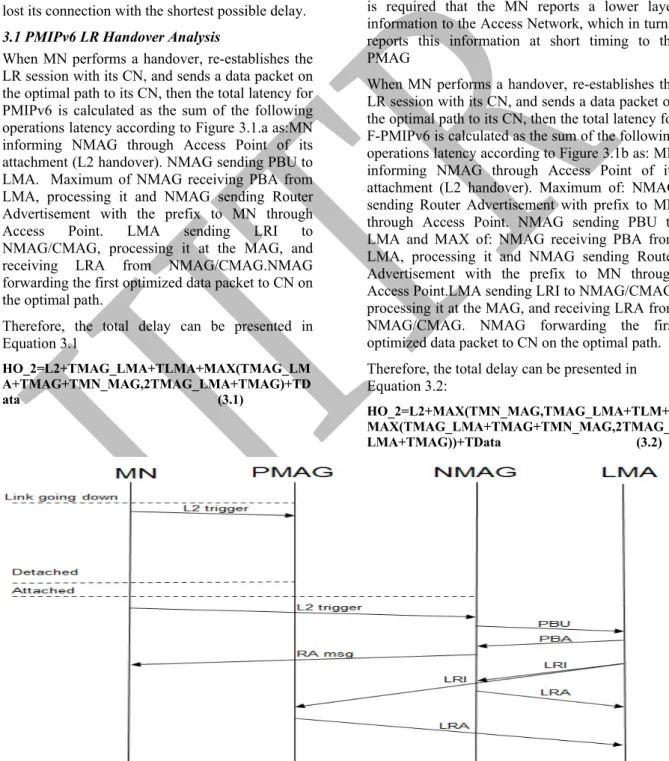
When MN performs a handover, re-establishes the LR session with its CN, and sends a data packet on the optimal path to its CN, then the total latency for PMIPv6 is calculated as the sum of the following operations latency according to Figure 3.1.a as:MN informing NMAG through Access Point of its attachment (L2 handover). NMAG sending PBU to LMA. Maximum of NMAG receiving PBA from LMA, processing it and NMAG sending Router Advertisement with the prefix to MN through Access Point. LMA sending LRI to NMAG/CMAG, processing it at the MAG, and receiving LRA from NMAG/CMAG.NMAG forwarding the first optimized data packet to CN on the optimal path.
Therefore, the total delay can be presented in Equation 3.1
HO_2=L2+TMAG_LMA+TLMA+MAX(TMAG_LM A+TMAG+TMN_MAG,2TMAG_LMA+TMAG)+TD
ata (3.1)
3.2 F-PMIPv6 LR Handover Analysis
There are two modes of operation for F-PMIPv6: the predictive mode and the reactive mode. In the predictive mode, the bidirectional tunnel between the NMAG and PMAG is established prior to performing a handover. While in the reactive mode, it is established after the MN starts its handover process. In the most severe case when the MN is detached from both old link and new link, the MAGs have to have the capability of buffering the packets for future forwarding. For the predictive mode to work efficiently and to avoid the involvement of MN in the IP mobility signaling, it is required that the MN reports a lower layer information to the Access Network, which in turns, reports this information at short timing to the PMAG
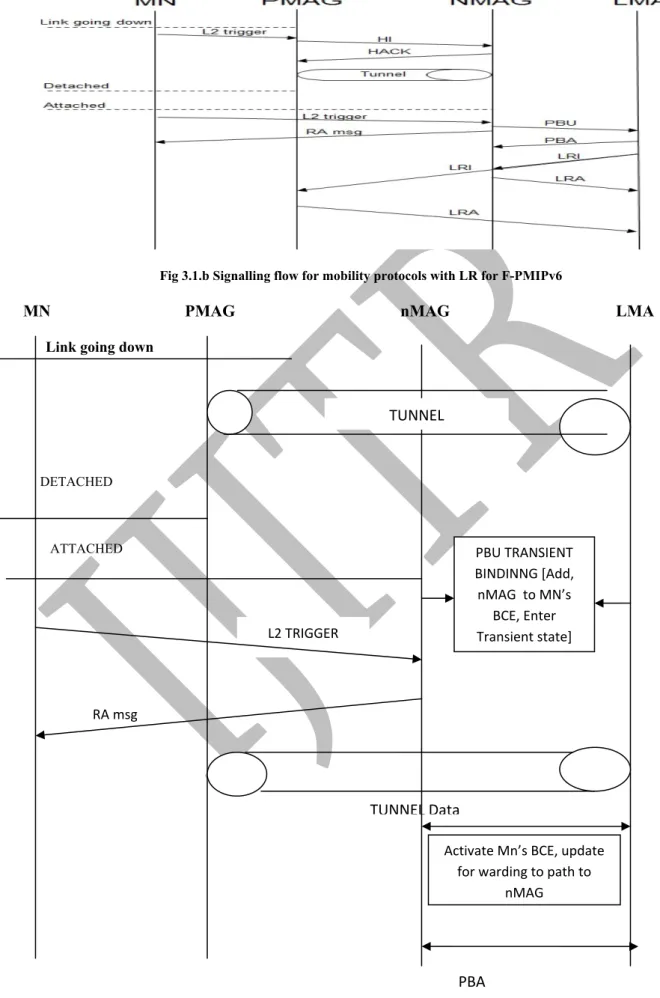
When MN performs a handover, re-establishes the LR session with its CN, and sends a data packet on the optimal path to its CN, then the total latency for F-PMIPv6 is calculated as the sum of the following operations latency according to Figure 3.1b as: MN informing NMAG through Access Point of its attachment (L2 handover). Maximum of: NMAG sending Router Advertisement with prefix to MN through Access Point. NMAG sending PBU to LMA and MAX of: NMAG receiving PBA from LMA, processing it and NMAG sending Router Advertisement with the prefix to MN through Access Point.LMA sending LRI to NMAG/CMAG, processing it at the MAG, and receiving LRA from NMAG/CMAG. NMAG forwarding the first optimized data packet to CN on the optimal path. Therefore, the total delay can be presented in Equation 3.2:
HO_2=L2+MAX(TMN_MAG,TMAG_LMA+TLM+ MAX(TMAG_LMA+TMAG+TMN_MAG,2TMAG_
LMA+TMAG))+TData (3.2)
Fig 3.1.b Signalling flow for mobility protocols with LR for F-PMIPv6
MN
PMAG
nMAG
LMA
Link going down
DETACHED
ATTACHED
Fig 3.1 .C.Signalling flow for mobility protocols with LR for T-PMIPv6 L2 TRIGGER RA msg
TUNNEL Data
PBU
PBU TRANSIENT BINDINNG [Add, nMAG to MN’s BCE, Enter Transient state]Activate Mn’s BCE, update for warding to path to
nMAG
PBA
TUNNEL
3.3 Hand over analysis of Transient binding PMIPv6
Transient BCEs as an extension to the PMIPv6 protocol. Set up and configuration of a transient BCE can be performed by means of extended PMIPv6 signalling messages between the MAG and the LMA component using a new Transient Binding mobility option. The transient BCE mechanism supports three clearly distinguished sequences of transient states to suit various handover scenarios and to improve handover performance for both inter- and intra-technology handover. As a result of using transient BCEs, excessive packet buffering at the nMAG during the MN’s handover process is not necessary and packet losses and major jitter can be avoided.[4]
Multi-homing technology handle the concept handover with multiple interfaces. In that the PMIPv6 have the problem of message format which is solved by the transient binding.[2 gcecon] Because of this transient binding multiple interface problem solved using automatic address configuration which is available in Proxy mobile IPv6[10].But without the transient binding the automatic address configuration provide only one PBU for that particular CoA of that MN, so the MN not able to identify the U-PBU so there is lag in the hand over, because this lag there is also pocket loss problem is arise. These drawbacks of the PMIPv6 are solved by the extension of multi-homing with transient binding.
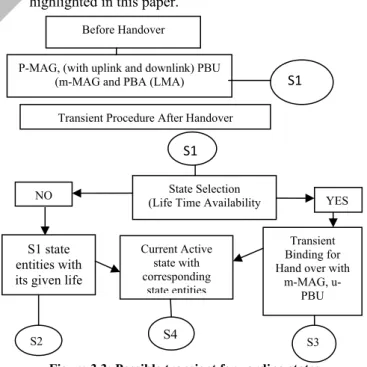
In the given figure3.3 S2,S3,S4 specifies the mechanism of transient binding with its entities Mn,LMA,MAG.s4 specifies the total transient binding of PMIPv6 with the extension multi-homing mechanism. First, when MN moves to the transient binding region, it detects that a handover is imminent, and thus it performs the link layer signalling. The P-MAG sends Handover Init (HI) message to N-MAG, where HI messages includes the MN’s IP addresses that are Proxy-CoA (P-CoA), Home address (MN-HoA), LMA address (LMAA), MN’s Identifier, and HNP. When the m-MAG receives HI message, it should examine whether a tunnel to LMA exists or not. If the tunnel has not been established, it should establish the tunnel with LMA. To establish the tunnel, the N-MAG sends a PBU message to LMA, which includes MN Identifier, MN-HoA, and HNP. When LMA receives the PBU message, it creates a new binding cache entry or modifies the existing binding cache entry [15][4]. If the LMA successfully processes the PBU it sets the tunnel with m-MAG to send and receive the data packets. After successful establishment of the tunnel, the LMA sends a PBA message to indicate whether or not the PBU message was processed successfully. If there is a failure, the PBA message indicates the failure. Otherwise, m-MAG creates a tunnel to
LMA and ensures that the data packets with the destination address as Proxy CoA are copied and forwarded to LMA over the tunnel. It also creates a host route for forwarding packets to the MN. When MN connects to the new link, it establishes a physical link connection with m-MAG (for example, radio channel assignment), which in turn triggers the establishment of a link-layer connection with the m-MAG. An IP layer connection setup may be performed at this time. This step can be a substitute for Unsolicited Neighbour Advertisement (UNA) in [11gce]. Then, the m-MAG sends a Handover ACK message back to the P-MAG to indicate whether the handover procedure was successfully done or not. The m-MAG sends a PBU (De-registration) message to LMA. This message includes MN-identifier and P-CoA of m-MAG. On reception of this PBU message, the LMA deletes the HNP1 of IF1 in the binding cache entry and release the tunnel between LMA and P-MAG). In response to PBU (Deregistration) message, the LMA sends PBA message to m-MAG.
For real time transmission, it is essential that packet loss should be reduced or avoided for the user to enjoy high user perceived QoS. Thus, there should be a fast handover binding mechanism to re-route flows to another interface when one interface has lost its connection with the shortest possible delay[16]
A possible approach to solve multi-homing issue will be such that a transient binding to flows tied to an interface via which disconnection will happen to a stable interface needs to be present and stored in the system whereby, when disconnection happens packet loss can be prevented. Such mechanism is highlighted in this paper.
Figure 3.3: Possible transient forwarding states during a handover Current Active state with corresponding state entities State Selection (Life Time Availability
NO YES
S1
S1 state entities with its given life
Transient Binding for Hand over with
m-MAG, u-PBU
S3
S2 S4
Before Handover
P-MAG, (with uplink and downlink) PBU (m-MAG and PBA (LMA)
Transient Procedure After Handover
IV. SUMMARY
4.1
Basic
Requirements
of
successful
Multihoming
*An IPv6 CE router MUST create a separate DRIB for each WAN interface (real or virtual) and installs a route for the associated delegated prefix, default route and more specific routes.
* An IPv6 CE router MUST create an SRIB containing entries for associated delegated prefixes. Each entry points to one or more DRIBs. An entry points to multiple DRIBs only in the case where an identical delegated prefix is associated with multiple WAN interfaces.
*When forwarding a packet from a LAN interface, the CE router MUST do a longest matching lookup based on the packet’s Source Address in the SRIB. A Destination Address lookup is then performed in the corresponding DRIB or DRIBs. When there are multiple equal matches, the route with the lowest cost is chosen [16].
4.2 Support of Transient Binding for Multihoming
Multi-homing technology handle the concept handover with multiple interfaces. In that the PMIPv6 have the problem of message format which is solved by the transient binding.[4] Because of this transient binding multiple interface(called as multi-homing) problem solved using automatic address configuration which is available in Proxy mobile IPv6[10].But without the transient binding the automatic address configuration provide only one PBU for that particular CoA of that MN, so the MN not able to identify the U-PBU so there is lag in the hand over, because this lag there is also pocket loss problem is arise. These drawbacks of the PMIPv6 are solved by the extension of multi-homing with transient binding.
Figure 3.3 explains the concept of possible transient forwarding states during a handover. In this with time the current state of LMA i.e. m-LMA and u-BCE is also identified. When MN connects to the new link, it establishes a physical link connection with N-MAG (for example, radio channel assignment), which in turn triggers the establishment of a link-layer connection with the N-MAG. An IP layer connection setup may be performed at this time. This step can be a substitute for Unsolicited Neighbor Advertisement (UNA) in [5].
In the transient state, the LMA accepts uplink packets from both the PMAG and NMAG. In addition, downlink can still be forwarded to the PMAG to make use of the old link. This is denoted as “late path switch”. In the case where there is a single interface handover, the PMAG has to get the
packets to the MN by sending them to the Previous Access network then New Access Network then MN. The transient option can be turned off by setting the Binding Cache Entry to an active state. This can be done by a transient time out at the LMA, the receiving of an empty PBU when the handover is completed, or a deregistration message from the PMAG.
V. CONCLUSION
This paper provide an analysis of an various protocols for the support of multi-homing and provides the transient binding with PMIPv6 best for the multi-homing .Extension handover scheme of the PMIPv6 with transient binding for multi-homing and mobility, in which the PMIPv6 binding update is performed in advance and then LMA performs the binding and the data packets to the m-MAG as well as P-m-MAG. The LMA is extended to support the multiple Binding Cache Entry. (BCE). This transient binding with PMIPv6 mechanism offers binded data to the MN’s new access router that shortens the handover latency period and decreases packet loss. It showed that buffering could eliminate the packet loss. This gives sufficient time for security sub-processes like mutual MN-network authentication, authorization and key distribution. We showed that when the handover prediction time is not sufficient, the protocol still functions properly and its performance converges towards that of PMIPv6 We highlighted additional work that has to be done with respect to multi-homing for the PMIPv6 protocol The main categories of additional are, Achieving flow mobility when a subset of prefixes needs to be transferred to the newly powered on interface or connected interface. Extending PMIPv6 operation in scenarios where multiple interfaces are attached to the same MAG. Achieving flow mobility when a subset of prefixes needs to be transferred to the newly powered on interface or connected interface.
6. REFERENCES
[1] WG Charter IETF, "Mobile Nodes and Multiple Interfaces in IPv6 (monami6)"
http://www.ietf.org/html.charters/monami 6-charter.html,Dec 2006.
[2] WG Charter IETF, "Site Multihoming by IPv6 Intermediation (shim6)",
http://www.ietf.org/html.charters/shim6-charter.html,May 2006.
[3] Yokota, H., Chowdhur, K., Koodli, R., Patil, B., Xia, F.,"Fast Handovers for Proxy Mobile IPv6", RFC 5949, Sept 2010.
[4] Liebsch, M., Muhanna, A., and Blume, O.,"Transient Binding for Proxy Mobile IPv6", RFC 6058, Mar 2011.
[5] Yokota, H., Chowdhur, K., Koodli, R., Patil, B., Xia, F.," Fast Handovers for Proxy Mobile IPv6", RFC 5949, Sept 2010. [6] Loureiro, P., "Proxy Mobile IPv6 Localized
Routing", draft-loureiro-netext-pmipv6-ro-02.txt, Mar 2010.
[7] Krishnan, S., Koodli, R., Loureiro, P., Wu, Q., Dutta, A., "Localized Routing for Proxy Mobile IPv6", draft-ietf-netext-pmip-lr-01, Oct 2010.
[8] Choi, Y. and Chung, T., “Enhanced Light Weight Route Optimization in Proxy Mobile IPv6”, Proc. The Fifth International Joint Conference on INC, IMS and IDC, pp. 501-504, Aug 2009.
[9] Han, B., Lee, J., Lee, J., and Chung, T., “PMIPv6 Route Optimization Mechanism using the Routing Table of MAG”, Proc. The Third International Conference on Systems and Networks Communications, pp. 274–279, Oct 2008.
[10] Gundavelli, S., Leung, K., Devarapalli, V., Chowdhury, K., and Patil, B., "Proxy Mobile IPv6", RFC 5213, Aug 2008. [11 ] M. Jeyatharan, C. Ng, “Multihoming
Problem Statement in NetLMM”, IETF Internet Draft draft-jeyatharan-netext-multihomingps- 02, March 2010.
[12] P´erez-Costa, X., Torrent-Moreno, M., and Hartenstein, H., “A performance comparison of mobile IPv6, hierarchical mobile IPv6, fast handovers for mobile IPv6 and their combination,” ACM Mobile Computing and Commun. Rev., vol. 7, no. 4, pp. 5-19, Oct. 2003.
[13] Gwon, Y., Kempf, J., and Yegin, A., “Scalability and robustness analysis of mobile IPv6, fast mobile IPv6, hierarchical mobile IPv6, and hybrid IPv6 mobility protocols using a large-scale simulation,” in Proc. IEEE Int. Conf. on Commun. (ICC’04), vol. 7, pp. 4087-4091, Jun. 2004 [14] P´erez-Costa, X., Schmitz, R., Hartenstein,
H., and Leibsch, M., “A MIPv6, FMIPv6 and HMIPv6 handover latency study: analytical approach,” in Proc. IST Mobile and Wireless Commun. Summit, pp. 100-105, Jun. 2002
[15] RFC4140, “Hierarchical Mobile IPv6 Mobility Management (HMIPv6)”, IETF, August 2005
[16] M. Jeyatharan, C. Ng, “Multihoming Problem Statement in NetLMM”, IETF Internet Draft draft-jeyatharan-netext-multihomingps- 02, March 2010.
[17] M. Townsley O. TroanBasic Requirements for Customer Edge Routers - multihoming and transition draft–townsley–troan-ipv6–ce -transitioning-02 December 16, 2011