Newcastle University
Doctorate in Applied Educational Psychology
School of Education, Communication and Language Sciences
Exploring and enhancing teacher-pupil relationships
using Video Interaction Guidance
Stacey Louise Sketchley March 2019
Disclaimer
I declare that this work is my own and has not previously been submitted for any other qualification
Acknowledgements
I would like to thank my supervisor, Billy Peters, for his support, guidance and encouragement throughout my doctoral training.
My sincere thanks go to the head teacher, teacher and pupils for offering their valuable time and taking part in this research. I acknowledge that without your participation, this piece of work would not have been possible.
To my parents and family, thank you for your love, support and continuous belief in me.
To my TEP colleagues who have become friends, I could not have completed this journey without you.
Finally to Dan, I do not have the words to express how grateful I am for your continuous love, patience and faith in me whilst I put our lives on hold; and for supplying me with endless cups of tea in the meantime.
Overarching Abstract
It is widely acknowledged that interpersonal relationships in school influence pupils both academically and psychologically. This thesis explores teacher-pupil
relationships and consists of three parts: systematic literature review, bridging document and empirical research project. The systematic literature review investigated what is known about interventions to improve teacher-pupil
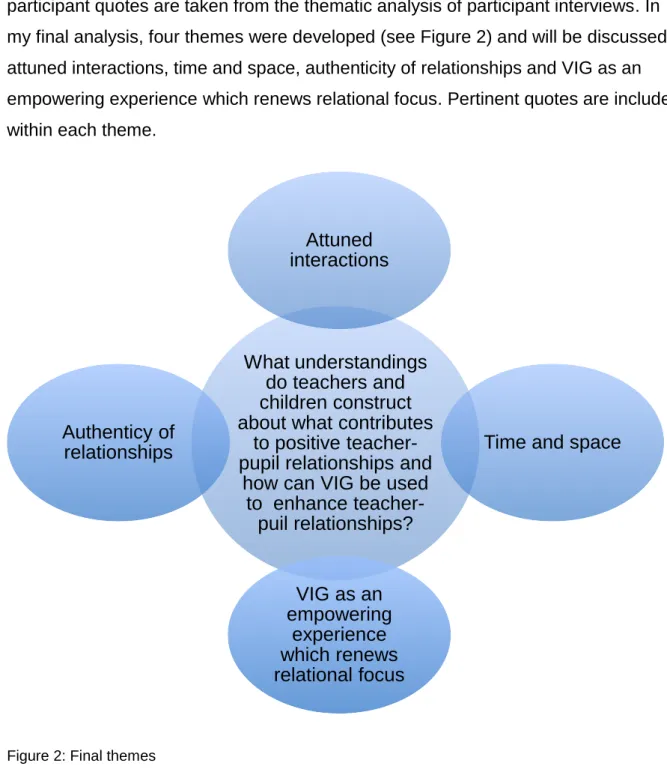
relationships. The results of the review highlighted the need for further exploration of how teacher-pupil relationships are jointly constructed by both teachers and pupils and how they can be enhanced. The bridging document aims to link the systematic review and empirical research project. My ontological and epistemological stance, methodological decisions and ethical considerations are discussed. The empirical research project aimed to explore what factors contribute to positive teacher-pupil relationships from the perspectives of both children and their teacher and how Video Interaction Guidance (VIG) could be used to explore and enhance teacher-pupil relationships in a Year 5 class. A qualitative case study method was employed. Three films were taken with a teacher working with a group of pupils and three shared review sessions took place between the researcher and the teacher. In addition, the research explored what children and their teacher value about teacher-pupil relationships and how they experienced VIG. Four key themes emerged from the data: attuned interactions, time and space, authenticity of relationships and VIG as an empowering experience. VIG was found to be a useful tool to provide time and space to reflect upon the complexities of teacher-pupil relationships and how they can be enhanced at an individual, group and classroom level. Educational
psychologists are well placed to support schools to enhance teacher-pupil relationships. Implications for practice are discussed.
Table of Contents
Chapter 1: Systematic Literature Review: what is known about interventions to
improve teacher-pupil relationships? ... 1
Abstract ... 1
Introduction ... 2
Defining teacher-pupil relationships ... 2
Previous research into teacher-pupil relationships ... 3
Relevance to Educational Psychology practice ... 3
Focus of the Review ... 4
Method ... 4
Defining the review question ... 5
Literature search to locate studies ... 6
Systematic screening ... 6
Description and appraisal of studies in the in-depth review ... 7
Review findings ... 12
General characteristics of the studies included in the in-depth review ... 12
Experimental design ... 12
Participants ... 13
Ethics ... 14
Interventions to improve teacher pupil relationships ... 14
Assessing quality of studies and weight of evidence ... 16
Synthesis of review findings and concluding remarks ... 21
Limitations of this review ... 22
Implications for future research and practice ... 23
Chapter 2: Bridging document ... 24
Introduction ... 24
Personal rationale ... 24
Ontology and Epistemology ... 25
Methodological decisions ... 25
Why a qualitative approach? ... 25
Why Video Interaction Guidance? ... 26
Why Thematic Analysis? ... 28
Chapter 3: An exploration of children’s and teacher perceptions of what factors contribute to positive teacher-pupil relationships and how they can be
enhanced using Video Interaction Guidance ... 32
Abstract ... 32
Introduction ... 33
Video Interaction Guidance and Intersubjectivity ... 34
Research aims ... 36
Methodology ... 37
Research design ... 37
Participants ... 39
Methods of data generation ... 39
Ethics ... 40
Data Analysis ... 41
Discussion of findings ... 43
Theme 1: Authenticity of relationships ... 44
Theme 2: Attuned interactions... 45
Theme 3: Time and Space ... 47
Theme 4: VIG as an empowering experience to renew relational focus ... 49
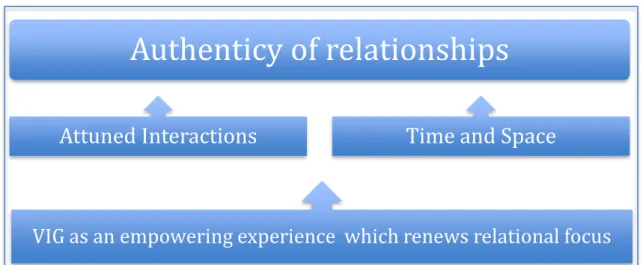
Model to illustrate relationships between themes ... 51
Limitations of the research ... 51
Implications for Educational Psychology practice and future research ... 52
Conclusion ... 53
References. ... 55
Appendices ... 61
Appendix 1: Assessing study quality using EPPI Weight of Evidence... 61
Appendix 2: Principles of attuned interactions and guidance (from Kennedy, 2011)70 Appendix 3: Teacher Information Sheet and Consent Form ... 72
Appendix 4: Parent/Carer Information Sheet and Consent Form ... 75
Appendix 5: Pupil Information Sheet and Consent Form ... 79
Appendix 6: Sample interview questions ... 82
Appendix 7: Example of coding ... 83
List of Tables
Table 1: Petticrew and Roberts' systematic review structure (2008, p.27) ... 5
Table 2: Search Terms... 6
Table 3: Inclusion and exclusion criteria ... 7
Table 4: Description of the studies ... 8
Table 5: Weight of Evidence ... 17
Table 6: Reported effect sizes... 19
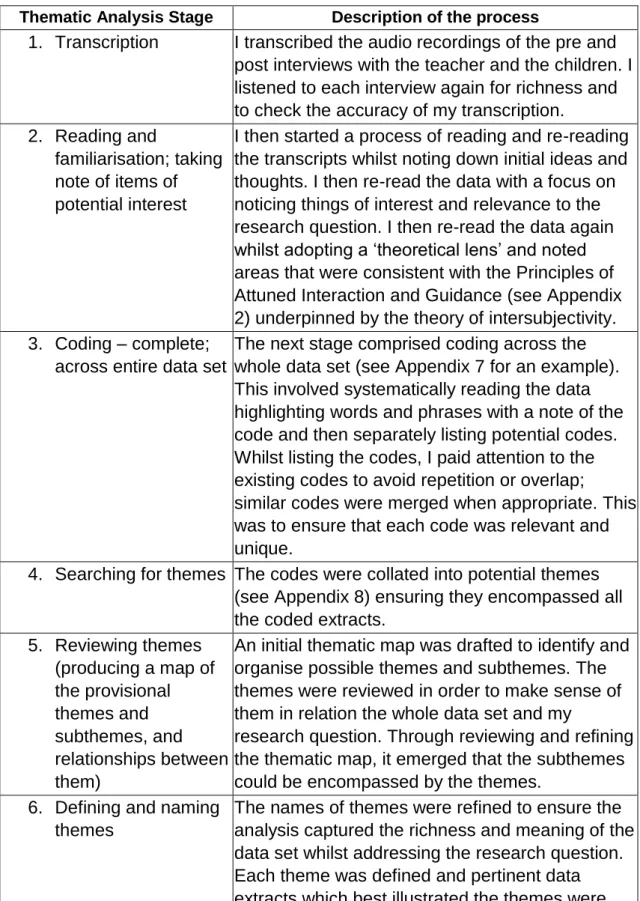
Table 7: Stages of coding and analysis (Braun & Clarke, 2013) ... 42
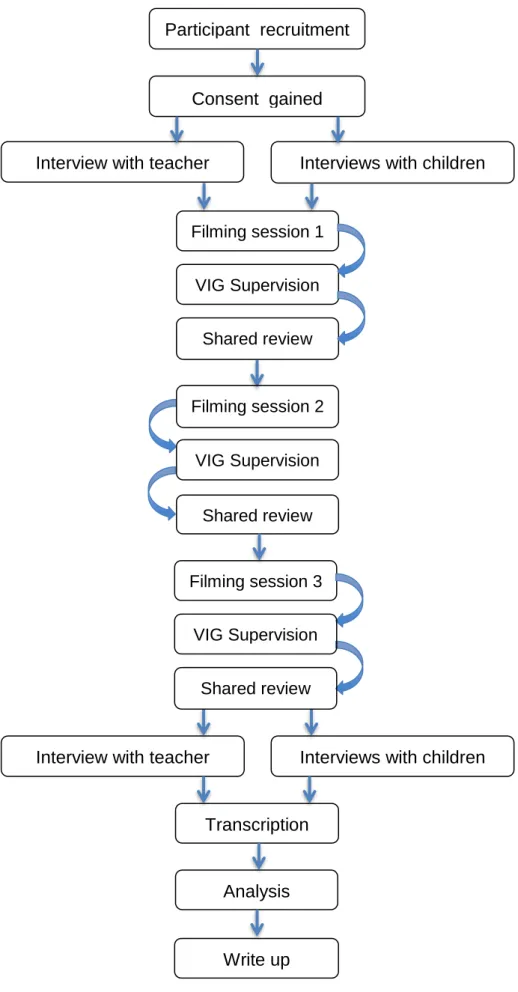
List of Figures Figure 1: Empirical research process ... 38
Chapter 1: Systematic Literature Review: what is known about
interventions to improve teacher-pupil relationships?
Abstract
Research indicates that teacher-pupil relationships influence pupils both academically and psychologically. The quality of teacher pupil-relationships is
associated with a range of outcomes for children and young people. This systematic literature review aimed to explore what is known about interventions to improve teacher-pupil relationships and to discuss the characteristics and effectiveness of these interventions. The process was guided by the seven stage systematic method outlined by Petticrew and Roberts (2008). Five studies were selected using inclusion and exclusion criteria. Each study employed a teacher-focused intervention within an educational setting. The findings of the review indicate that interventions designed to improve teacher-pupil relationships had some significant effects on the reported quality of teacher-pupil relationships. Though it is acknowledged the effects were often correlational as opposed to causal. Comparison of findings across and between studies was difficult as each study measured a range of constructs relating to
teacher-pupil relationship quality and employed different methods to do so. The majority of research on improving teacher-pupil relationship quality has been conducted solely from the perspective of the classroom teacher. Consequently, children’s perceptions of the quality of their relationships and the impact of the interventions were absent from the studies. Further research into the contextual and dyadic aspects of relationships, from both teacher and pupil perspectives, may help to develop understanding about how teacher-pupil relationships can be enhanced.
Introduction
A growing body of research indicates that teacher-pupil relationships influence pupils both academically and psychologically from starting school through to secondary school (Baker, Grant, & Morlock, 2008; Hamre & Pianta, 2001; Hattie, 2009; McLaughlin & Clarke, 2010; Roorda, Koomen, Spilt, & Oort, 2011). The quality of teacher pupil-relationships is associated with a range of affective, behavioural, social and academic outcomes for children and young people (Baker, 2006; Hattie, 2009; Martin & Dowson, 2009; Murray-Harvey, 2010). Positive teacher-pupil relationships can enhance pupil motivation and engagement in learning activities (Roorda et al., 2011) and increase sense of school belonging and emotional connectedness
(Cemalcilar, 2010; Furrer & Skinner, 2003). Research has found supportive teacher-pupil relationships can act as a protective factor for children and young people at risk of negative outcomes such as poor school performance, disengagement and school exclusion (Hughes, Wu, Kwok, Villarreal, & Johnson, 2012; Sabol & Pianta, 2012). In addition, Roffey (2012c) argues that the quality of teacher-pupil relationships can impact on teacher wellbeing.
Defining teacher-pupil relationships
Within the literature teacher-pupil relationships have been understood in many different ways. As such, Koepke and Harkins (2008) discuss the difficulties in
defining teacher-pupil relationship as a consistent definition does not appear to exist within the research literature. Rather than a unifying definition, three constructs are widely used to conceptualise and measure the quality of teacher-pupil relationships: closeness, conflict and dependency. These three constructs form the basis of the Student-Teacher Relationship Scale (STRS; Pianta, 2001), a quantitative measure of teacher perspectives of their relationships with pupils, which is underpinned by
attachment theory (Bowlby, 1969, 1988). Fraire, Longobardi, and Sclavo (2008) attempt to define the three subscales. They state that ‘closeness’ relates to affection and warmth and is founded on mutual trust and high-quality communication. This results in pupil self-confidence due to the teacher being seen as a figure of help and support. The ‘conflict’ subscale refers to the presence of a hostile attitude, feelings of rage or aggression. This results in teacher feelings of incompetence and pupil
responding negatively to separation from the teacher or seeking help when it is not required. Positive teacher-pupil relationships are characterised by high levels of closeness and low levels of conflict and dependency (Fraire et al., 2008). These three constructs underpin my understanding of teacher-pupil relationships within this systematic literature review.
Previous research into teacher-pupil relationships
Previous research into teacher-pupil relationships has predominantly comprised quantitative studies measuring the effects of relationship quality on pupil outcomes (Hughes, 2012). Two recent meta-analyses have synthesised the existing empirical research. Cornelius-White (2007) considered the effect sizes across 119 studies for specific aspects of teacher relationships and their influence on academic outcomes. The overall finding was that teacher relationship quality was positively correlated with academic outcomes. It was concluded that ‘learner-centred’ teacher-pupil
relationships are most effective. Teachers fostered such relationships through demonstrating warmth and empathy and encouraging pupils to think through non-directive teaching. The findings resonate with Rogers’ (1951) principles of client-centred therapy underpinned by humanistic psychology. This approach emphasises the importance of teachers showing pupils unconditional positive regard, warmth, empathy, trust and encouragement of thinking in order to facilitate the development of the whole person. The range of outcomes measured in the meta-analysis
demonstrated that positive teacher-pupil relationships influence cognitive, affective and behavioural outcomes (Cornelius-White, 2007). A subsequent meta-analysis carried out by Roorda et al. (2011) built on the work of Cornelius-White (2007) by exploring studies measuring both positive and negative aspects of teacher
relationships and the impact of these relationship qualities on pupil engagement and achievement. All studies included found significant associations between teacher-pupil relationships and achievement or engagement.
Relevance to Educational Psychology practice
As teacher-pupil relationships are important due to their effects on pupils’ psychological well-being and academic achievement, understanding the development of these interpersonal relationships is crucial to Educational
have observed that EP involvement often starts when relationships between teachers and pupils have broken down. Understandings of interventions that support or
enhance teacher-pupil relationships are therefore worthy of EP consideration. It is arguably important for EPs to facilitate improvement in teacher-relationships in order to ensure opportunities for positive outcomes are afforded to all children and young people.
Focus of the Review
Hughes (2012) classifies the nature of the studies included in the aforementioned meta-analyses as ‘first generation’ research and recognises the need for a ‘second generation’ of research on teacher-pupil relationships.
Second generation research should aim to increase understanding of the development of teacher-pupil relationships; explore how relationships can be
improved; evaluate interventions to enhance teacher-pupil relationships; and adopt a broader theoretical and conceptual perspective of teacher-pupil relationships
(Hughes, 2012). The systematic literature review aims to explore one area of second-generation research by identifying existing interventions that have been implemented to improve teacher-pupil relationships and consider possibilities for further research from systematic review findings.
Method
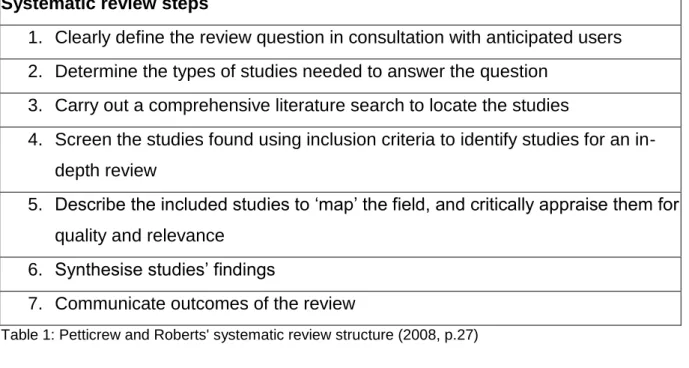
This systematic review utilised the method outlined by Petticrew and Roberts (2008). The stages involved in this process can be found in Table 1 and pertinent aspects are described in further detail in this section.
Systematic review steps
1. Clearly define the review question in consultation with anticipated users 2. Determine the types of studies needed to answer the question
3. Carry out a comprehensive literature search to locate the studies
4. Screen the studies found using inclusion criteria to identify studies for an in-depth review
5. Describe the included studies to ‘map’ the field, and critically appraise them for quality and relevance
6. Synthesise studies’ findings
7. Communicate outcomes of the review
Table 1: Petticrew and Roberts' systematic review structure (2008, p.27)
Defining the review question
The first step involved exploring the literature in order to identify a relevant and clearly defined review question. It was recognised that previous research into teacher-pupil relationships mainly consisted of quantitative studies measuring the effects of relationship quality on pupil outcomes (Hughes, 2012). My initial searching found two meta-analyses had been conducted which synthesised the volume of empirical research on the impact and outcomes of teacher-pupil relationships (see Cornelius-White (2007) and Roorda et al. (2011)). The evidence presented in these meta-analyses indicated a clear relationship between positive teacher-pupil
relationships and pupil outcomes. Similarly, a strong relationship between negative teacher-pupil relationships and negative outcomes for both pupils and teachers was found to exist. There is a growing body of evidence that looks at outcomes in relation to teacher-pupil relationships (Baker et al., 2008; Hamre & Pianta, 2001; Hattie, 2009; McLaughlin & Clarke, 2010; Roorda et al., 2011). However, less is known about how relationships can be improved in order to maximise the positive outcomes that are evident in the literature. Consequently, in the current review, the question ‘what is known about interventions to improve teacher-pupil relationships?’ was adopted.
Literature search to locate studies
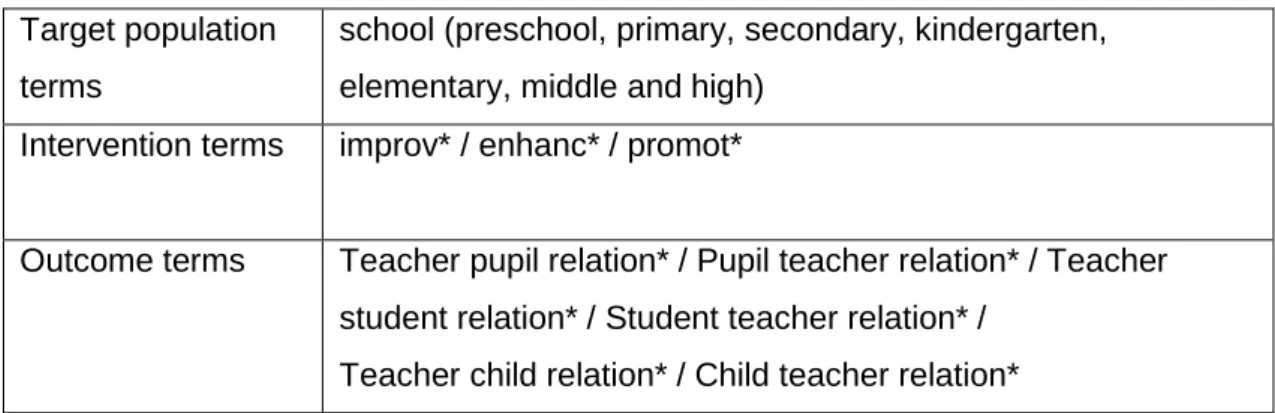
The initial broad searches of the literature helped to focus the review question and gave an insight into the size of the literature field. In order to identify studies relevant to the review question, electronic databases were searched using the search terms detailed in Table 2. Search terms and synonyms were created using a combination of search terms that emerged from wider reading and electronic database thesauri. The terms were then used systematically and consistently to search the following
electronic databases: PsycInfo, Scopus, ERIC (Educational Resource Index and Abstracts) and BEI (British Education Index). These databases were selected in order to identify papers specifically related to the areas of psychology and education in line with the focus of the review question. Roorda et al. (2011) found that the negative impact of teacher pupil relationships was more significant in primary than in secondary school. Therefore, I hoped to explore how relationships in the classroom can be enhanced or improved in the primary school sector. Due to the low number of papers initially found, the search term ‘primary school’ was subsequently broadened to include all types of school in order to establish any existing interventions. In an attempt to find a greater number of studies, hand searches and citation searches were subsequently conducted from relevant papers.
Table 2: Search Terms
Target population terms
school (preschool, primary, secondary, kindergarten, elementary, middle and high)
Intervention terms improv* / enhanc* / promot*
Outcome terms Teacher pupil relation* / Pupil teacher relation* / Teacher student relation* / Student teacher relation* /
Teacher child relation* / Child teacher relation* (*including suffix variations of the word)
Systematic screening
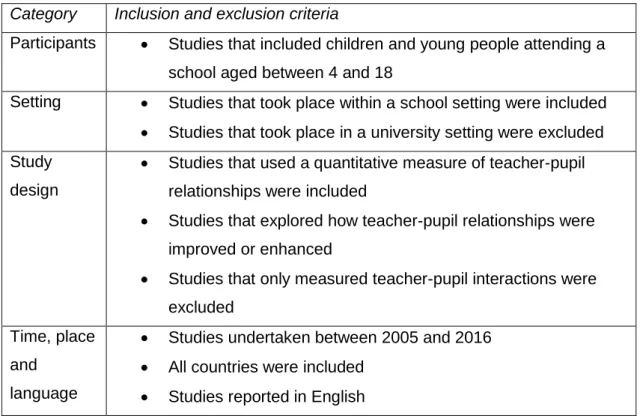
The systematic screening method recommended by Petticrew and Roberts (2008) details a process of identifying studies that should be considered for the in-depth review which involves sifting through retrieved studies and determining which ones require a more detailed examination. In order to do this, I established inclusion and
exclusion criteria through which I screened studies to ensure the literature included in the review was relevant in answering my systematic review question (see Table 3).
Table 3: Inclusion and exclusion criteria
Category Inclusion and exclusion criteria
Participants Studies that included children and young people attending a school aged between 4 and 18
Setting Studies that took place within a school setting were included Studies that took place in a university setting were excluded Study
design
Studies that used a quantitative measure of teacher-pupil relationships were included
Studies that explored how teacher-pupil relationships were improved or enhanced
Studies that only measured teacher-pupil interactions were excluded
Time, place and
language
Studies undertaken between 2005 and 2016 All countries were included
Studies reported in English
Description and appraisal of studies in the in-depth review
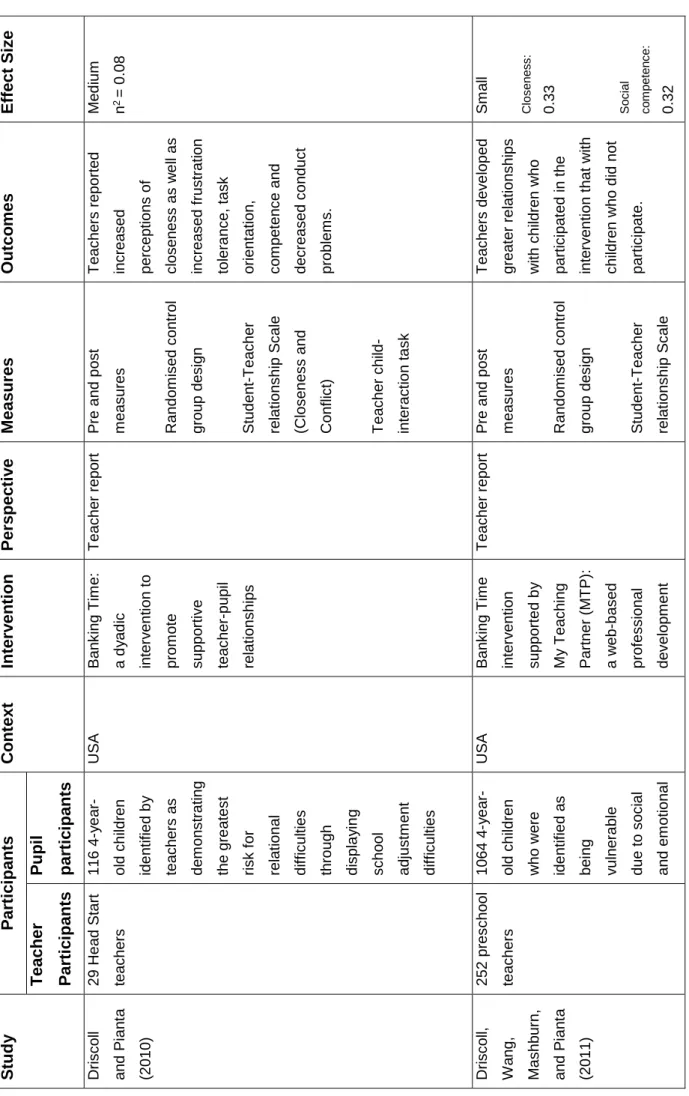
The five studies that met the inclusion criteria were mapped according to the information presented in Table 4.
8 T ab le 4 : D es c ri pti on of th e s tud ies S tud y P art ic ipa nts C on tex t Interv en ti on P ersp ec ti v e M ea su res O utco mes E ff ec t S ize T ea ch er P art ic ipa nts P up il pa rt ic ipa nts Dr is c ol l an d P ian ta (20 10 ) 29 He ad S tart tea c he rs 11 6 4 -y e ar -ol d c h ildren ide nti fi e d b y tea c he rs as de m on s tr ati ng the gre ate s t ri s k f or rel at ion al di ff ic ul ti es throug h di s pl a y in g s c ho ol ad jus tm en t di ff ic ul ti es US A B an k ing T im e: a d y ad ic inte rv en ti on t o prom ote s up po rti v e tea c he r-pu pi l rel at ion s h ips T ea c he r r ep ort P re a nd p os t m ea s ures Rand om is ed c on tr ol group de s ign S tud en t-T ea c he r rel at ion s h ip S c al e (Cl os en es s an d Conf lic t) T ea c he r c hi ld -inte rac ti o n t as k T ea c he rs r ep orted inc rea s ed pe rc ep ti on s of c los en es s as w e ll as inc rea s ed f rus tr ati on tol era nc e, tas k orie nt ati on , c o m pe ten c e an d de c rea s ed c o nd uc t probl em s . Me d ium n 2 = 0.0 8 Dr is c ol l, W a ng , Ma s hb ur n, an d P ian ta (20 11 ) 25 2 pres c ho o l tea c he rs 10 64 4 -y e ar -ol d c h ildren who wer e ide nti fi e d a s be ing v u lne ra bl e du e t o s oc ia l an d em oti on a l US A B an k ing T im e inte rv en ti on s up po rte d b y M y T ea c hi ng P artn er ( MT P ): a w eb -b as ed prof es s ion al de v el op m en t T ea c he r r ep ort P re a nd p os t m ea s ures Rand om is ed c on tr ol group de s ign S tud en t-T ea c he r rel at ion s h ip S c al e T ea c he rs de v e lop ed greate r r e lat io ns hi ps wi th c h ildren who pa rti c ipa ted i n t he inte rv en ti on t ha t wi th c hi ldr en who d id no t pa rti c ipa te. S m al l C los e n e s s : 0.33 So c ial c o m p e te n c e : 0.32
9 de v el op m en t an d ne e ds as s oc iate d wi th de pri v at io n progr am m e (Cl os en es s an d Conf lic t) Mu rr a y an d Ma lm gren (20 05 ) 8 s ec on d ar y s c ho ol tea c he rs 48 a do les c en t pu p ils ide nti fi e d b y tea c he rs as ha v in g s ign if ic an t em oti on al or be ha v iou ra l probl em s US A T he inte rv en ti on c on s is ted of three co m po ne nts an d was de v el op e d w ith tea c he rs du ri n g t wo af ter -s c ho ol m ee ti ng s : 1. W ee k ly m ee ti ng s be tw e en tea c he r a nd pu p il to s et an d re v ie w go a ls ; 2. Inc rea s e d tea c he r pr ai s e; 3. T ea c he r tel e ph o ne d T ea c he r r ep ort P re a nd p os t m ea s ures Rand om is ed c on tr ol group de s ign P up ils ’ s oc ia l, em oti on al , be ha v iou ra l, an d ac ad em ic ad jus tm en t us ing : W al k e r-Mc Conn el l S c al e of s oc ial c o m pe ten c e an d s c ho ol a dj us tm en t (W al k er & Mc Conn el l, 1 99 6) A c he n ba c h c h ild be ha v iou r c h ec k lis t (CB CL; A c he nb ac h , 1991) A lt ho u gh t he po s t ou tc om e m ea s ures wer e h igh er f or the pu p ils i nv ol v e d i n t h e inte rv en ti on gro up tha n tho s e in the c on tr ol group i n al l areas of s oc ial , em oti on al an d ac ad em ic ad jus tm en t, t he di ff erenc es be tw e en the f ind in gs w er e no t s tat is ti c a lly s ign if ic an t. Di d no t ap pe ar to im pa c t o n s oc ial an d em oti on al a d ju s tm e n t Not s ig n if ic a n t
10 pu p ils at ho m e on e t o t wo ti m es pe r m on ths to di s c us s s c ho ol progr es s . Cl as s roo m en ga ge m en t (C on ne ll & W el lbo rn, 1 99 1) A c ad em ic grade s A tte nd a nc e Not s ig n if ic a n t Me d ium : n2 = .0 9 A c ad em ic grades o nl y Di ff erenc e was no t s tat is ti c a lly s ign if ic an t P ia nta , Ma s hb ur n, Do w ne r, Ham re, an d J us ti c e (20 08 ) 11 3 pres c ho o l tea c he rs None US A M y T ea c hi ng P artn er ( MT P ): a w eb -b as ed prof es s ion al de v el op m en t progr am m e T ea c he r r ep ort P re a nd p os t m ea s ures Rand om is ed c on tr ol group de s ign T he po s iti v e ef fec ts of MT P w ere pa rti c u larl y e v ide nt in c las s roo m s w it h hi g he r pro po rti on s of c hi ldr en who ex pe ri e nc ed ec on om ic r is k s . S m al l S pi lt, K oo m en , T hi js , a nd v an de r L ei j 32 te ac he rs 64 c hi ldre n (2 pe r te ac h er) who wer e ide nti fi e d b y Net h e rl a n d s Rel a ti o ns hi p -foc us ed ref lec ti on progr am T ea c he r r ep ort Res ea rc he r ob s erv a ti on s P re a nd p os t m ea s ures Rand om is ed c on tr ol T he RF RP r es ul ted in im prov em en ts i n the l e v el of c los en es s for hal f of th e Me d ium
11 (20 12 ) the t ea c he r as de m on s tr ati ng ab o v e -m ed ian le v el s of ex ternal is ing be ha v iou r (RF RP ) group de s ign pa rti c ipa n ts . T he s tud y prov id ed prel im ina ry e v ide nc e for the po ten ti a l of i n -de pt h ref lec ti on o n sp ec if ic r el at ion s h ips to prom ote po s iti v e tea c he r-pu pi l rel at ion s h ips .
Review findings
General characteristics of the studies included in the in-depth review
In order to find an adequate number of studies to conduct a systematic literature review, it was necessary to broaden the search for studies that were conducted outside England. Four studies were conducted in the USA and one study was carried out in the Netherlands. All studies took place in educational settings: three
interventions took place in a range of preschool classrooms; one intervention took place across a range of 15 primary schools; and one took place within a high school. Types of intervention and the way in which they were designed and delivered varied. They included interventions co-constructed with teachers, interventions delivered in a face-to-face context and a number which were based online. Sample sizes ranged from 56 (Murray & Malmgren, 2005) to 1,316 (Driscoll et al., 2011). There was also variation in the duration of interventions, which ranged from 12 weeks to a year, and in the number and frequency of intervention sessions provided.
Experimental design
All of the studies used a pre and post design to explore the impact of their intervention on measures of teacher-pupil relationships. In addition, all studies utilised a control group with random assignment to groups.
Three studies utilised measures that were based solely on teacher report. Murray and Malmgren (2005) identified relying only on teacher ratings to measure the impact of the intervention as a limitation. The remaining two studies employed both teacher report and researcher observations. In all studies, data was included from the
perception of teachers who reflected and evaluated the improvement in the quality of relationships using quantitative measure of teachers’ perceptions of teacher-pupil relationships.
There was no involvement from parents or pupils in the design or conduct any of the studies. This finding is supportive of Koepke and Harkins (2008), Rey, Smith, Yoon, Somers, and Barnett (2007) and White (2016) who argue that pupil perceptions have been relatively overlooked when exploring perspectives of teacher-pupil
interventions designed to improve their relationships. If we consider the teacher-pupil relationship as a dyadic construct (O'Connor, 2010) then consideration should be given to the perspectives of both teachers and pupils.
Data was collected using a variety of quantitative measures, with all assessing some aspect of teacher-pupil relationships and one measured the impact of the intervention on academic outcomes. All of the studies employed standardised tools to measure teacher perceptions of the quality of teacher-pupil relationship. In addition, Driscoll et al. (2011) and Spilt et al. (2012) measured changes in teacher self-efficacy (Bandura, 1977).
The Student Teacher Relationship Scale (STRS; Pianta, 2001) was used in three studies included in the in-depth review (Driscoll & Pianta, 2010; Driscoll et al., 2011; Spilt et al., 2012). It is a teacher-report measure which is theoretically underpinned by attachment theory and research on teacher-pupil relationships (Baker, 2006; Bowlby, 1969) consisting of three subscales: conflict, closeness and dependency. Research has found the STRS has high internal consistency, significant test-retest correlation and predictive and concurrent validity (Pianta, 2001). A limitation of this measure is that it fails to consider pupils’ views. The scale was originally designed for use in the USA. Differences between education settings across cultures are
acknowledged to affect findings and generalisability. However, more recently it has been found to be a valid and reliable measure of teacher-pupil relationship quality in other countries including Greece (Gregoriadis & Tsigilis, 2008), Italy (Fraire et al., 2008) and Norway (Drugli & Hjemdal, 2013).
Participants
Children who participated in the interventions were described as being ‘at risk’ of relational difficulties by teachers in four of the five studies included in the review. These studies used criterion sampling as participants were drawn from particular populations targeted by the researcher (Braun & Clarke, 2013). Research suggests that interactions between teachers and students with learning or behavioural
difficulties are often characterized by fewer positive interactions and less positive relationships (Murray, 2009). The studies were identified to target relationships that were considered as having a potential to be problematic from the perspectives of the teacher. Pupil views of their relational quality were not sought. This raises an
implication that the interventions are ‘being done to’ the children rather than ‘with’ them. It appears that whilst it is acknowledged that relationships are dyadic and reciprocal (Cornelius-White, 2007; O'Connor, 2010), the majority of current research focuses its exploration on the perspectives of adults, thus raising an important ethical consideration. However, this ethical issue is not critically discussed within the
research papers.
Ethics
Ethical considerations were not documented in-depth in any of the written reports of the studies. Neither Driscoll and Pianta (2010) or Driscoll et al. (2011) mentioned any aspect of ethical consideration. Based on the published reports, Spilt et al. (2012) appeared to be the only study to seek and obtain informed consent from parents. The remaining four studies did not provide any information regarding how the nature of the study or intervention was communicated to parents and children. Therefore, there are potential ethical concerns regarding issues such as the informed consent from parents and children who were receiving increased level of interaction from the teachers delivering the intervention as taking part in the research. The lack of focus on ethics might be explained by the nature of the studies, which involved direct contact with a small group of staff members. The researchers may argue that classroom interactions would exist within any classroom. Though this lack of transparency is regarded as a limitation.
Inconsistency in the recruitment methods for teachers and children existed. For instance, teacher participation was voluntary across all studies and teachers were provided with varying levels of information about the intervention. However, children were either randomly selected or nominated by the teachers. This difference was particularly distinct in the research undertaken by Murray and Malmgren (2005) as teachers were involved in the design and conduct of the intervention yet the students were approached by teachers and asked if they would be willing to begin meeting with the teacher regularly. This indicates a lack of informed consent.
Interventions to improve teacher pupil relationships
The findings of the systematic literature review are consistent with White (2016) who acknowledge there are a limited number of interventions that focus specifically on
enhancing relationships between teachers and children. The systematic review
identified four interventions that have been used with an aim to improve teacher-pupil relationships. Four interventions, which focus on increasing teacher-pupil interactions and enhancing teacher-pupil relationships, are described in this section.
Banking Time was implemented by two studies: Driscoll and Pianta (2010) and Driscoll et al. (2011). This intervention aims to target the quality of teacher-pupil relationships through regular sessions of positive interaction between teacher-pupil dyads. It is reported that the sessions are led by the child as the teacher observes while narrating the child’s actions; labels the child’s feelings and emotions; and develops key relational areas with the pupil which are later measured (trust, reliability and dependability). Teachers who participated in the Banking Time intervention consistently reported increased perceptions of relationship quality with children. This included increased perceptions of relational closeness, frustration tolerance, task orientation and competence as well as decreased concerns regarding behaviour (Driscoll & Pianta, 2010; Driscoll et al., 2011). A limitation of the intervention is that Banking Time has only been established to be effective with preschool children. Murray and Malmgren (2005) developed a relationship-focused intervention in the United States alongside high school teachers, which lasted for a period of five months. In the first instance, teachers and researchers generated ideas of ways to promote positive relationships with students. Following this, the researchers
developed specific strategies that were further discussed and refined with the teachers who were interested in taking part in the intervention. Each teacher was assigned 4 or 5 target students to participate in the intervention, which consisted of three components. The first component of the intervention involved weekly meetings between each teacher and each student to set and review academic and personal goals. The second component of the intervention consisted of increased teacher praise. Finally, teachers were asked to telephone each student at home one to two times per month to discuss their progress in school. Murray and Malmgren (2005) stated that the purpose of these activities was to establish on-going involvement, communication and warmth in teacher–student relationships. However, these concepts were not measured. Interestingly, only teacher ratings of the perceived impact of the intervention were sought. The results indicated that the students in the intervention group made greater academic progress than the control group during
intervention. However, there were no differences observed across social, emotional and behavioural domains. As the intervention consisted of different components it is difficult to determine whether one particular aspect was helpful or if all components were necessary. Koepke and Harkins (2008) and Rey et al. (2007) highlighted the importance of exploring pupil perceptions of teacher-pupil relationships. While the involvement of young people was carefully considered, the researchers do not critically discuss their rational for not seeking their voice.
Spilt et al. (2012) evaluated a reflection-based intervention which began with a course entitled Support of Language and Literacy Development in Preschool
Classrooms Through Effective Teacher-Child Interactions and Relationships. In this intervention preschool teachers took part in a 14-week course focusing on increasing positive teacher-pupil interactions in the classroom. The course met weekly for three hours and was organised based on three domains outlined by the Classroom
Assessment Scoring System (CLASS): emotional support, classroom organisation and instructional support. Data from teacher report and research observation suggested that the course increased positive teacher-pupil interactions in the classroom.
Pianta et al. (2008) employed and evaluated an internet-based consultative approach to improve teacher-pupil relationships. In this intervention, teachers attend a
workshop-based training, during which they were shown videoed examples of high-quality practice. Following this, teachers were required to video tape their interactions with students and share the footage with a consultant through web-based
technology. Teachers received feedback two times a month over the academic year about the extent to which their classroom interactions promoted learning. This approach was tested in early years and classrooms and was associated with an increase in positive teacher-pupil interactions, as well as an increase in achievement test scores.
Assessing quality of studies and weight of evidence
The quality of each study was assessed using the Evidence for Policy and Practice Information and Co-ordinating Centre Centre) Weight of Evidence tool (EPPI-Centre, 2007). This tool provided a framework to critically consider the quality of each
study using twelve guiding questions relating to aspects including ethics, research design, generalisability, data collection and data analysis (See Appendix 1). Taking the areas discussed above into account, each study was given a weight of evidence rating for three summary questions (see A, B & C below) in order to assign an overall weight of evidence rating (D) based on the quality of the study:
A. Can the study findings be trusted in answering the study question?
B. How appropriate are the research design and analysis for addressing the systematic literature review question?
C. How relevant is the focus of the study for addressing the systematic literature review question?
D. An overall weight of evidence, taking into account A, B and C
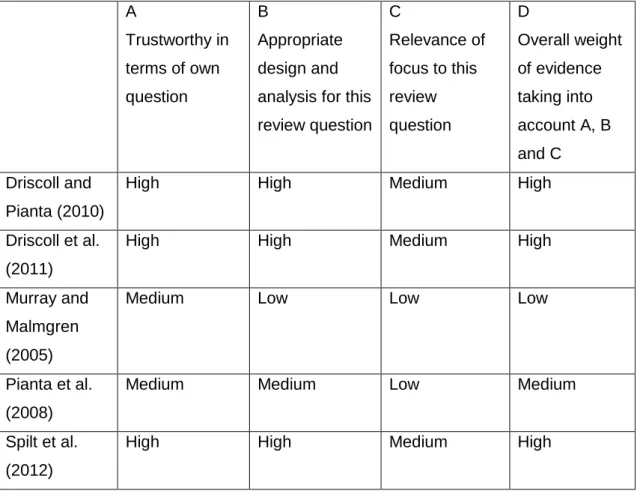
The weight of evidence judgements for each study can be seen in Table 5.
Table 5: Weight of Evidence
A Trustworthy in terms of own question B Appropriate design and analysis for this review question C Relevance of focus to this review question D Overall weight of evidence taking into account A, B and C Driscoll and Pianta (2010)
High High Medium High
Driscoll et al. (2011)
High High Medium High
Murray and Malmgren (2005)
Medium Low Low Low
Pianta et al. (2008)
Medium Medium Low Medium
Spilt et al. (2012)
Driscoll and Pianta (2010), Driscoll et al. (2011) and Spilt et al. (2012) received an overall high weight of evidence. These studies were appraised as being trustworthy in terms of their own research question. They employed a high level of control and utilised robust research designs and methods. Their data collection tools were reliable and valid. Statistical analyses were robust and clearly explained in order to establish sufficient reliability and repeatability. Missing data and limitations were acknowledged and explained. Their relevance of focus to this review was reduced to medium as their sample meant generalisability to wider ages ranges and the UK was limited.
Pianta et al. (2008) received an overall medium weight of evidence due to the relevance of their design to their own research question, large sample size, use of control group and research design which utilised a reliable and valid tool for data collection and statistical analysis. Although missing data was explained, the overall information provided about their results was limited and they did not coherently discuss their use of quantitative data. The relevance to the systematic review
question was low as the focus of the data analysis, results and discussion shifted as towards the difference between the different interventions (consultancy or internet based) as opposed to clearly discussing the effects on teacher-pupil relationships. Murray and Malmgren (2005) received an overall low weight of evidence rating. The researchers designed their intervention with the teachers who participated and therefore its validity and reliability were not established. Some measures were in place to increase the fidelity of the intervention. However, the delivery of the intervention was not consistent across teachers and subsequently teachers were relied on to collect the research data. Whilst the purpose of their research was to investigate the impact of a program designed to improve teacher-pupil relationships, the perceptions of the quality of the relationship were not measured at any point during the research from either the teachers or the young people. The use of a small sample of African American adolescents limited the ability to generalise the findings to a wider population.
Intervention outcomes
The studies included within the systematic review explored the impact of the interventions on a range of outcome measures. The statistical significance of the
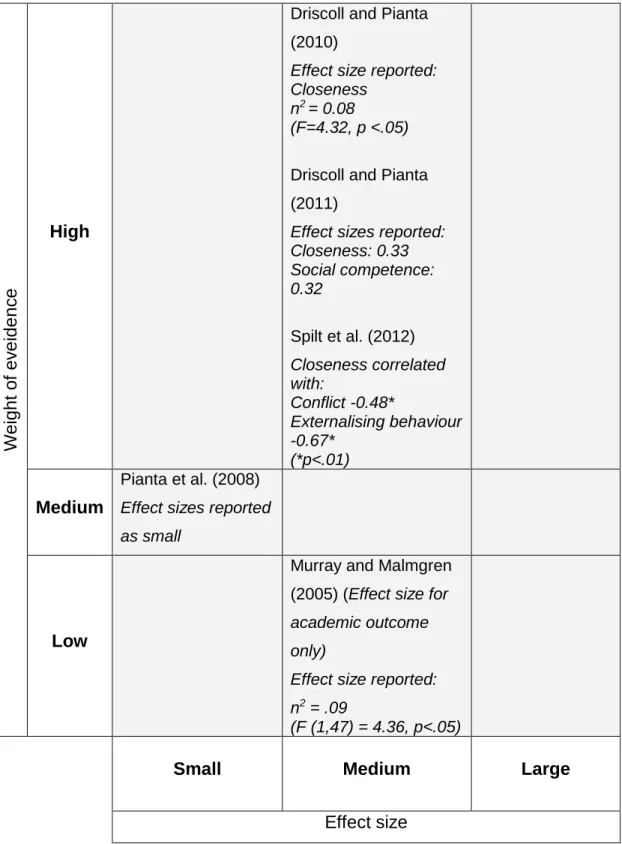
interventions was generally limited. Comparison between the studies was difficult as a range of different measures were used. The studies also varied regarding the type of effect sizes they used. Although detailed statistical information was provided for all studies, the researchers did not clearly or consistently report effect sizes. This is recognised as a common issue in psychological research (Baguley, 2009).
W e igh t o f e v e ide n c e High
Driscoll and Pianta (2010)
Effect size reported: Closeness
n2 = 0.08
(F=4.32, p <.05)
Driscoll and Pianta (2011)
Effect sizes reported: Closeness: 0.33 Social competence: 0.32 Spilt et al. (2012) Closeness correlated with: Conflict -0.48* Externalising behaviour -0.67* (*p<.01) Medium Pianta et al. (2008)
Effect sizes reported as small
Low
Murray and Malmgren (2005) (Effect size for academic outcome only)
Effect size reported: n2 = .09
(F (1,47) = 4.36, p<.05)
Small Medium Large
Effect size
Closeness was a measure that was used consistently across three out of the five studies as an outcome measure of the interventions (Driscoll & Pianta, 2010; Driscoll et al., 2011; Split et al., 2012). Driscoll & Pianta (2010) found there was a significant interaction between the measurement at pre-intervention and post-intervention for teacher closeness ratings (F=4.32, p <.05). Children who received the Banking Time intervention demonstrated greater gains in teacher-reported closeness than the children who did not. The effect size was reported as medium (n2 =0.8). Driscoll et al.
(2011) reported that children who participated in Banking Time developed closer relationships over the school year than children who did not participate. They found increased levels of closeness significantly correlated with a decrease in conflict (-0.48) and externalising behaviour (-0.67). This was based on a reported medium effect size (0.33) for closeness. Spilt et al. (2012) measured how the effects of the intervention changed across four intervals of time. Changes were reported in perceived closeness across the majority of teacher-pupil dyads. Fifteen dyads showed a high stable pattern of closeness (intercept = 4.48, p.001; slope .06) and eleven dyads with a baseline of low closeness showed an increase (intercept = 3.63, p< .001; slope .21, p<.10). This suggests that when teachers perceived high levels of closeness, these levels were maintained during the intervention. However, the
potential impact of the intervention as an explanation for this stability was not significant. When teachers perceived the levels of closeness to be low, the
intervention had a significant impact on increasing levels of perceived closeness. The impact of the intervention was not consistent as six dyads showed a decrease in closeness across the intervention.
Pianta et al. (2008) found significant effects for only three out of ten dimensions from the Classroom Assessment Scoring System (CLASS) following their intervention which was focused on teacher professional development to improve teacher-child interactions. These were an improvement in behaviour management (which could be interpreted as lower levels of conflict if measure using the STRS), teacher sensitivity (which shares similarities with the closeness measure of the STRS) and productivity. They state that the effect sizes for the intervention conditions were small. However, they do not provide numerical effect sizes. They concluded that teachers who received personalised consultancy support with professional development demonstrated greater teacher sensitivity and improvement in teacher-child
p<.05). Therefore, advocating for a more personalised approach to supporting teachers to develop positive relationships as opposed to a generic approach. Murray and Malmgren (2005) measured the impact of an intervention focused on improving teacher-pupil relationships on social, emotional and academic adjustment. They found that this was not significant in terms of social and emotional outcomes (F (1,47) = .42, ns) or school engagement (F (1,47) = .81, ns) but was correlated with a significant increase in academic achievement (F (1,47) = 4.36, p<.05). Student absences were slightly fewer in the intervention (M=21.3) the control group (M=23.5) but this was not significant. The nature of the intervention means that this effect was correlational rather than causal.
Synthesis of review findings and concluding remarks
In this systematic literature review I aimed to produce a summary of what the
research tells us about interventions designed to improve teacher-pupil relationships. In doing this I intended to create a clearer picture of which interventions have be utilised by educational professionals to improve teacher-pupil relationships in schools and ultimately to promote positive academic and psychological outcomes associated with positive teacher-pupil relationships. The effects across the majority of
interventions were small in magnitude. Further research into the effectiveness of existing interventions to improve teacher-pupil relationships is required.
The majority of existing interventions aim to increase the skill set of teachers through programmes that are focused on how they approach interactions. They do not
necessarily consider the dynamic and reciprocal nature of interactions and the development of teacher-pupil relationships. Bae (2012) posited that effective relationships cannot be achieved through only focussing on specific techniques or using specific programs. Therefore, it would be useful for research to explore how teachers can enhance relationships in ways that reflect the complexity and reciprocal nature of interactions.
Research on improving teacher-pupil relationships is often centred on children who have been identified by teachers as being ‘at risk’ for relational difficulties. There is scope to consider a more preventative approach to enhancing teacher-pupil
relationships at a classroom level. Prilleltensky (2014) proposes interventions and approaches that focus strengths, prevention, empowerment and community on value of interventions that are fundamental in achieving wellness within education.
Research to evaluate the effectiveness of interventions to improve teacher-pupil relationships is based upon perspectives of teachers and research observers. Rey et al. (2007) reported pupils’ perceptions of the teacher-pupil relationship to be more significant than teachers’ perceptions in predicting school adjustment and outcomes. However, pupil perceptions regarding intervention to improve teacher-pupil relationships is absent from the existing research. This systematic literature review has highlighted a number of methodological gaps that exist which have implications for future research and practice.
The systematic review highlighted that there is limited research from the UK
exploring interventions to enhance teacher-pupil relationships within the classroom. Therefore, it is important to consider this contextual perspective.
Limitations of this review
Whilst I aimed to undertake the review in way which is systematic, transparent and replicable, a number of limitations are acknowledged. The structure outlined by Petticrew and Roberts (2008) was followed to provide some transparency in the review process. However, I carried out the review and devised the inclusion and exclusion criteria independently. Therefore, the review remains subject to bias to the interpretations as a researcher interested in exploring interventions to improved teacher-pupil relationships. Similarly, whilst Weight of Evidence judgements were made using the framework provided by the EPPI-Centre (2007) tool, the judgements include a level of subjectivity.
An additional limitation relates to the variability between studies selected for inclusion using the inclusion and exclusion criteria. There are methodological differences between studies. Although all studies included teacher report, a variety of measures were used. The sample size varied in number and participants were selected from different populations. For instance, the children’s ages varied from four to sixteen years. Previous research has suggested that the nature and importance of
teacher-pupil relationship can differ across different age ranges. Therefore, attempting to compare the studies was challenging. Furthermore, the generalisability of this systematic literature review is limited as the majority of participants were from the USA and all studies draw predominantly upon white female teachers’ views.
Studies reviewed were drawn from published articles within the time specified in the inclusion criteria. This presents risk of the file drawer problem (Rosenthal, 1979), which means studies reporting significant results are more likely to be published than those that do not. Therefore, this study may be biased based on only published articles being considered.
Implications for future research and practice
In order to increase understanding of how teacher-pupil relationships can be
enhanced further research is needed (Hughes, 2012). Previous research has often focused on the effects of teacher pupil relationships. This is recognised by Hughes (2012) as first-generation research. However, it is important to explore what factors contribute to positive teacher-pupil relationships in order to identify how an
Educational Psychologist can intervene to support the development of effective teacher-pupil relationships.
Research has found that differences often exist between teacher and pupil
perceptions of their relationships with one another (Koepke & Harkins, 2008; Rey et al., 2007; White, 2016). This may indicate that teachers and pupils may assess the quality of the relationship based on different perceived values. Koepke & Harkins (2008) reported teachers’ and pupils’ perceptions of relationships can subsequently influence the way in which they approach interactions. Therefore, understanding teachers’ views and pupils’ views of their relationships and which aspects of relationships teachers and pupils value would provide a useful starting to point in determining how best to enhance relationships in the classroom from both
Chapter 2: Bridging document
Introduction
This bridging document is intended to capture the process and my reflections on this piece of research. This is done in a way that is more informal than my Systematic Review and Empirical Research documents. Within this document I will reflect upon my personal rational, my ontological and epistemological stance and discuss my methodological decisions and ethical considerations.
Personal rationale
Relationship building has always been at the heart of my practice both as a teacher and a Trainee Educational Psychologist (TEP). As a newly qualified and
inexperienced primary school teacher I found the strongest and most reliable tool available to me in the classroom was my own investment in building relationships with the children in my class. I noticed that the investment produced positive
outcomes such as better engagement in learning, increased motivation and school enjoyment. Opportunities for children to learn were apparently maximised when relationships were nurtured and attended to. Yet whilst other aspects of my teaching could apparently be measured, the quality and impact of those relationships
remained less possible to quantify. I often felt frustrated due to curriculum
expectations and increasing demands in workload, time was not prioritised from a national and local perspective to focus on the significant aspect of my work that I valued most. As a TEP, teacher-pupil relationships became the focus of my attention. I noticed and attended to the language and narratives used regarding the quality of the teacher-pupil relationships influenced a range of outcomes for children and young people. I noticed that when teachers and pupils perceived relationships to be positive their engagement in learning and the possibility for positive change was maximised. I began to consider how I could use my research to explore this in more depth.
Alongside this, I received training in Video Interaction Guidance (VIG) at University, which resonated with my core values and principles relating to the centrality of relationships. VIG will be discussed later in this document.
As a TEP, I spent time exploring and conceptualising my own ontological and epistemological stance and how this contributes to the value I placed upon relationships. In the following section I discuss my underpinning philosophy.
Ontology and Epistemology
The process of my research and the decisions I made are underpinned by my
ontology and epistemology. Ontology refers to what there is to know in the world and epistemology relates to how we can know it (Grix, 2002; Willig, 2013). Parker (2013) argues that it is important for EPs to understand and clarify their own view of the world in order to consider how this shapes effective research and professional practice. My current philosophical stance is consistent with a social constructionist perspective. This stance emphasises the importance of social contexts and assumes that reality is contextually constructed through social interactions and dialogue (Burr, 2015; Willig, 2013). My research focus was driven by my interest in the social
meanings of interactions between children and teachers and what this might tell us about what they value as part of their relationships. It was important that research included discussions through which meaning making emerged. This concept is a fundamental element of VIG, which was one reason for utilising it.
Methodological decisions Why a qualitative approach?
The studies identified in the systematic review adopted a quantitative approach to conceptualise and measure the quality of teacher-pupil relationships. Standardised measures were used to investigate the effectiveness of interventions designed to improve teacher-pupil relationships. Across all studies, the perceptions of the children with regards to their understanding of teacher pupil-relationships and their experiences of the interventions were absent.
I decided that a qualitative methodology would be employed for my empirical research (Willig, 2013). I was interested in understanding how teachers and pupils made sense of their relationships with each other in a way that could not be captured within the questionnaire scores relied upon in the systematic literature review. In the
research I wanted to provide an opportunity to consider the complexities of teacher pupil relationships and gain an understanding of the perhaps differing perspectives into what teachers and pupils both value about their relationships. As my research emerged, I was interested in how the teacher and pupils experienced VIG and how that supported them to make sense of teacher-pupil relationships.
It is argued that a case study design is most useful in research that seeks to
generate rich, detailed and complex knowledge (Yin, 2014). Therefore, it seemed a qualitative case study design would best enable me to create a rich picture of the perspectives of a teacher and children about their relationships.
Why Video Interaction Guidance?
Within this section, I will outline the process of Video Interaction Guidance and consider why it was chosen as an approach within my research. Video Interaction Guidance is an intervention which aims to increase positive communication and interactions in order to enhance relationships (Kennedy, 2011). It is a staged process in which a VIG guider usually films an interaction between two people then engages in shared reflection about positive aspects of the interaction with one of the people from the film with an aim to facilitate positive change through strength-based
reflection and collaborative discussion. The VIG guider uses the principles of attuned interaction and guidance (Kennedy, 2011; Appendix 2) as a framework to support the conceptualisation of positive interactions. The principles are underpinned by the theory of intersubjectivity which postulates that humans are innately relational beings (Kennedy, 2011; Trevarthen & Aitken, 2001). The session of filming followed by a shared discussion to reflect on the video is referred to as a ‘VIG cycle’ (Kennedy, 2011).
Many of the principles of the VIG process are consistent with my epistemological perspective. For instance, within VIG careful consideration is given to the role of the VIG guider to ensure they adopt a facilitatory approach which values the views of participants and empowers them to realise they are experts in their own lives. Therefore, it was utilised within the current study as both a research tool and intervention, allowing both teacher-pupil relationships and VIG to be explored. The way the VIG client and guider are positioned within VIG is coherent with the way I
position myself within my professional practice whereby I strive to develop relationships through working collaboratively and empowering others instead of employing an expert stance.
Video feedback is considered to be a powerful way to promote teacher’s reflective practice (Fukkink & Tavecchio, 2010; Fukkink, Trienekens, & Kramer, 2011; Gavine & Forsyth, 2011). In my systematic literature review I found that Pianta et al. (2008) used video-clips of other teachers to demonstrate ways in which teachers could build positive relationships with children. Whilst this supported teachers to change their behaviours, I reflected upon whether video clips of their own behaviour would be more meaningful and effective.
Although the use of video is the main element of Video Interaction Guidance (VIG), this method includes several other elements that may contribute towards its
effectiveness. It is a personalised intervention and provides opportunities for individualised feedback on concrete interactions. Gavine and Forsyth (2011) advocate that VIG is an effective tool to support school staff.
Doria, Kennedy, Strathie, and Strathie (2014) highlight that the limitations of VIG are rarely considered. One limitation could be that VIG is often utilised when adults identify relationships, often with children, as being problematic. I felt it was important to recognise, due to the nature of the research, that if I was to utilise VIG with a child whom the teacher had identified as having a difficult relationship with, the language used and positioning of the child could lead to negative effects following the
completion of the research. This could be particularly detrimental if the intervention did not enhance the relationship. This led to me widening the focus of the
intervention from a teacher-pupil dyad to a teacher and a group of pupils. I considered that using VIG with a group of pupils could be a way to support the teacher to consider how to enhance relationships at a group level as this may be more applicable to the classroom context. This is consistent with understanding teacher-pupil relationships from an ecological perspective as suggested by Roffey (2010). A further rational for using a group of pupils was to explore different levels of relationship quality that might exist across the range of children. I was interested in supporting the notion that all relationships can be enhanced despite any existing categorisations of relational quality; and to explore whether VIG could be used in a
more preventative way. The use of VIG in this way resonated with the work by Prilleltensky (2014) who advocates for interventions and approaches that focus on strengths, prevention, empowerment and community.
Why Thematic Analysis?
A number of qualitative analysis approaches were explored such as Interpretative Phenomenological Analysis, Grounded Theory and Pattern-based Discourse
Analysis. However, I concluded that the most appropriate method would be Thematic Analysis (Braun & Clarke, 2006, 2013). A number of reasons informed my decision to use this method of analysis. Thematic Analysis offers a flexible approach, which has been widely utilised in research. Thematic Analysis can be applied to data in different ways and used within different epistemological stances. Therefore, it was an
appropriate method to enable the creation of a rich data and thick descriptions (Braun and Clark 2013) in line with the aim of my empirical research; seeking a rich and meaningful understanding of teacher-pupil relationships. Additionally, Thematic Analysis was also compatible with my social constructionist epistemological stance as it recognises the researcher role in actively interpreting the assumptions and meanings from the data. In line with this, a latent level approach to analysis was conducted. This approach aims to go beyond purely describing data content to create a deeper interpretative understanding of ideas, assumptions and
conceptualisations within the data (Braun & Clark, 2006). Furthermore, Braun and Clark argue that Thematic Analysis is a valuable method for those who are new to qualitative research. The transparent guidance available for Thematic Analysis provides the opportunity for new qualitative researchers to develop their skills at a range of levels.
As outlined by Braun and Clark, theory driven Thematic Analysis is “guided by an existing theory and theoretical concepts” (p.175). Initially I set out to conduct an inductive Thematic Analysis as I hoped that the data would drive the creation of themes rather than the existing literature (Braun & Clarke, 2006, 2013). However, as my coding evolved, I noticed two theories, intersubjectivity and attunement, were driving my interpretation as an active researcher. Therefore, I made the decision to adopt a theory driven approach and analyse my data with a more specific focus on these two theories. I realised that the separation between inductive and theoretical analysis is not always distinct as researchers often possess knowledge of theoretical
underpinnings and a certain theoretical lens may influence the analysis process. Another distinction within Thematic Analysis is between semantic and latent levels of analysis. Semantic analysis focuses on the content of the data whereas latent
analysis explores the “underlying ideas, assumptions and conceptualisations” (Braun & Clarke, 2006, p. 13). As an active researcher using VIG, I found it difficult to
analysis the data without trying to understand that meanings behind it. This led me to reflect that there may be whether some degree of latent analysis involved in all qualitative research (Vaismoradi, Turunen, & Bondas, 2013).
Ethical considerations
Guillemin and Gillam (2004) distinguish two different dimensions of ethics in
research: ‘procedural ethics’ and ‘ethics in practice’. Procedural ethics refers to the formal process to acquire ethical approval from the relevant ethics committee; whilst ethics in practice refers to the day-to-day ethical decisions.
This resonated with my thoughts about ethics not being a one-off process but a continuous activity which needed to be kept in mind and revisited throughout the research.
The procedural aspect of seeking consent is important however it does not always encompass the on-going ethics in practice. I felt that this was particularly pertinent in relation to the procedural aspect of consent for VIG. The use of video appeared to be daunting for schools and teachers when I approached them for their participation. This illuminated the importance of consent for holding video data. I questioned whether a person could truly give consent to VIG until they had experienced the shared review whereby they watched theirself on video. This meant that at the time of developing the research, it was important to allow for flexibility with the participants to ensure that the number of cycles was agreed with the participants and revisited throughout.
The three children involved in the research also presented an interesting stance regarding their consent to the use of video. They agreed to give consent for adults to view the video but not children. I acknowledged that the use of video could perhaps be viewed as being potentially exposing. In response to this I ensured that I
process view of consent whereby I regularly revisited their consent and paid attention to any signs of apprehension.
Guillemin and Gillam (2004) posit that procedural ethics cannot account for dealing with ethically important moments in qualitative research. Ethically important moments may arise when perhaps participants indicate discomfort with their answer or reveal vulnerability through discussion. In my research or any research using VIG,
procedural ethics cannot predict what may happen in the moment that a person sees theirself on video for the first time during the process of a shared review; something which they have not previously experienced. The researcher cannot predict what may happen and therefore needs to take a process view into account even after obtaining the initial consent.
Reflexivity involves the researcher looking critically at their role and influence on the research (Guillemin & Gillam, 2004; Willig, 2008). It is recognised as an essential tool for understanding the nature of ethics in qualitative research and how ethical practice in research can be achieved (Guillemin & Gillam, 2004; Lazard & McAvoy, 2017). Reflexivity enables the researcher to critically consider their assumptions and sense-making throughout the research process and is a way of achieving rigour within good quality qualitative research (Guillemin & Gillam, 2004; Lazard & McAvoy, 2017). I recognise the need to be reflexive in my work through giving critical consideration to my role. Throughout the research process I used a personal research diary as a reflective tool to document key decision points, challenges and tensions I
experienced and other personal reflections.
Willig (2013) considered the concept of reflexivity in terms of research and suggested there are two types: personal and epistemological. Personal reflexivity includes
reflection upon “values, experiences, interests, beliefs, political commitments, wider aims in life and social identities”, whilst epistemological reflexivity “encourages us to reflect upon the assumptions (about the world, about knowledge) that we have made in the course of the research” (Willig, 2013, p. 10). My engagement in reflexivity included consideration of the influence of my previous role as a primary school teacher my current role as a TEP and my interest in the use of VIG on the research and my data analysis.
Reflexivity can also encompass ways in which the researcher has changed
throughout the research process (Guillemin & Gillam, 2004; Lazard & McAvoy, 2017; Willig, 2013). This is perhaps illustrated by my shift towards using VIG as more preventative approach. I was initially interested in understanding how teacher-pupil relationships can be improved after they have broken down. However, my focus then shifted to consider how VIG might be used in a more generalised and preventative way by adopting a strengths based approach to considering and enhancing teacher-pupil relationships (Wilding & Griffey, 2015). This involved considering how a larger number of teacher-pupil relationships could be strengthened, regardless of their current relational quality, by using VIG with a group of pupils, which naturally included a range of different teacher-pupil relationship dynamics. It was hoped that VIG could be used in a way which supported teachers to focus upon positive aspects that were contributing to moments of success within relationships whilst considering ways in which relationships could be strengthened rather than exploring negative or problematic aspects of relationships.
Chapter 3: An exploration of children’s and teacher perceptions of
what factors contribute to positive teacher-pupil relationships and
how they can be enhanced using Video Interaction Guidance
Abstract
It is widely acknowledged that interpersonal relationships in school influence pupils both academically and psychologically. This research project aimed to explore what factors contribute to positive teacher-pupil relationships from the perspectives of both children and their teacher and how Video Interaction Guidance (VIG) could be used to explore and enhance teacher-pupil relationships in a Year 5 class. A qualitative case study method was employed. Three films were taken with a teacher working with a group of pupils and three shared review sessions took place between the researcher and the teacher. In addition, the research explored what children and their teacher value about teacher-pupil relationships and how they experienced VIG. Within the analysis five themes were constructed: attuned interactions, time and space, authenticity of relationships, professional identity and VIG as an empowering experience. The research findings were placed within the context of existing research into attunement, intersubjectivity and VIG. VIG was found to be a useful tool to provide time and space to reflect upon the complexities of teacher-pupil relationships and how they can be enhanced at an individual, group and classroom level.