FOUNDATION PHASE TEACHERS’ CONTINUOUS PROFESSIONAL
DEVELOPMENT
by
Reinhold Justin Gallant
Submitted in fulfilment of the requirements for the degree
Magister Educationis
In the Faculty of Education at the
Nelson Mandela Metropolitan University
Supervisor: DR. D.C. GEDULD
Port Elizabeth December 2012
i
I, REINHOLD JUSTIN GALLANT, declare that
FOUNDATION PHASE TEACHERS’ CONTINUOUS PROFESSIONAL
DEVELOPMENT
is my own work, and all the resources used or quoted have been indicated and acknowledged by means of complete references in the bibliography, and that this dissertation or research project was not previously submitted by me for a degree at another university.
SIGNATURE: ________________________________
ii ABSTRACT
This research was based on the question of how Foundation Phase teachers perceived and experienced their professional development. This study was done at a school in the Northern Areas of Nelson Mandela Bay, South Africa. The school is situated in a developing community that has a low socio-economic status characterised by infrastructural challenges. The school is newly established and started the year 2012 with mostly newly qualified teachers.
In this study, the researcher wanted to know how the participants’ perceptions and experiences as teachers impact on their professional development. The review of relevant literature provided a conceptual framework for the study. This study explored the fact that a social constructivist theory is relevant for the professional development of foundation phase teachers. This theory is based on the fact that teachers construct their own knowledge and that more emphasis should be placed on theory within teachers’ practice.
A qualitative research approach was suitable for this study. The data for the study was obtained by using photovoice and focus group interviews. The most important theme that emerged from the data collection was that the physical environment of the school and the surrounding area played a major role in how the teachers experienced their development. Other themes that emerged from the study were the need for educational resources, teacher collaboration and leadership. The findings show that more emphasis should be placed on the professional development of Foundation Phase teachers.
Schools in poverty stricken areas of South Africa have an impact on how teachers experience their professional development. It has become clear that places of higher
iii
education need to consider the contexts in which schools are situated, especially in poverty stricken areas. Foundation Phase teachers are a vital part of education and as such the training of teachers in this phase should develop around whole-person learning within a life-long learning framework.
KEY WORDS: foundation phase,higher education, identity, practice, professional development, social constructivist theory, teacher, whole-person learning
iv
ACKNOWLEDGEMENTS
I place on record my sincere appreciation and gratitude to the following individuals who made the completion of this dissertation possible:
• To God Almighty who has given me the strength, courage and determination to persevere and succeed.
• My wife Lucelle, my children Rowan and Joshuah for their love, patience and support during the writing up of this dissertation.
• My supervisor Dr Deidre Geduld for her invaluable guidance, advice and motivation throughout this study
• To Ms Marthie Nel for her professional and efficient way in which she went about editing my study.
• My study partners Naadirah Abader, Ernest Loggenberg and Bruce Damons for always raising the bar and for accepting nothing less than the best.
• All my friends and colleagues who motivated and encouraged me throughout my studies.
• Last but not least, the Foundation Phase educators who took part in this study and who gave so readily of their time and experience.
v
DEDICATION
I dedicate this work to my mother, Erica Paulina Gallant, a Foundation Phase teacher for 32 years and in solemn respect to my late father, Roland James Gallant. They instilled in me the value of education, dedication and a commitment to one’s work.
vi
LIST OF APPENDICES
Appendix A : NMMU Application Form: Ethics Approval 110
Appendix A(a) : Research methodology and data generating tool 116
Appendix B : Letter to foundation phase participants and consent form 119
Appendix C : Letter to school principal & consent form 122
Appendix D : Letter to the district director 125
Appendix E : Response from district director 126
Appendix F : Letter of approval from ethics 127
Appendix G : Guide to conduct Focus Group Interview 128
vii
LIST OF FIGURES, PICTURES AND TABLES
FIGURES
Figure 1: Emotional, Intellectual and Career Development 36
Figure 2: Themes and sub-themes from focus group interviews 66
PICTURES Picture A 64 Picture B 68 Picture C 72 Picture D 74 Picture E 78 Picture F 82 LIST OF TABLES
Table 1: Teaching as a professional 32
Table 2: Strengths and weaknesses as highlighted by participants 51
viii LIST OF ABREVIATIONS
AIDS Acquired Immuno Deficiency Syndrome CCS : Centre for the Community School CPD : Continuous Professional Development
DHET : Department of Higher Education and Training DoE : Department of Education
ECD : Early Childhood Development
ECED : Eastern Cape Education Department
EU : European Union
EU SPSP : European Union's Sector Policy Support Programme Strengthening
FP : Foundation Phase Teacher Education
GM : General Motors
Grade R : Reception year
HIV Human Immuno Deficiency Virus LOLT Language of Learning and Teaching NMMM Nelson Mandela Metropolitan Municipality NMMU : Nelson Mandela Metropolitan University OBE : Outcomes-Based Education
RNCS : The Revised National Curriculum Statement SACE : South African Council for Educators
SAIDE : South African Institute for Distance Education: SMT : School Management Team
TA : Teacher Assistant
UNESCO : United Nations Educational, Scientific and Cultural Organization
ix TABLE OF CONTENTS Declaration i Abstract ii Acknowledgements iv Dedication v List of Appendices vi
List of figures, Pictures and tables vii List of Abbreviations viii
CHAPTER ONE BACKGROUND, RATIONALE AND OBJECTIVE OF THE STUDY 1.1 BACKGROUND AND INTRODUCTION ... 1
1.2 STATEMENT OF PROBLEM ... 4
1.3 RATIONALE FOR THE STUDY... 5
1.4 RESEARCH QUESTION ... 6 1.5 RESEARCH OBJECTIVE ... 6 1.6 LITERATURE REVIEW ... 7 1.7 RESEARCH DESIGN ... 8 1.7.1 Paradigm: Interpretivism ... 9
1.7.2 Approach: Qualitative Research ... 10
1.7.3 Strategy: Phenomenology ... 11
1.8 RESEARCH METHODOLOGY ... 12
1.9 PURPOSEFUL SAMPLING ... 12
1.10 DATA GENERATION STRATEGIES ... 13
1.10.1 Visual methodology: Photovoice ... 13
x
1.11 DATA ANALYSIS AND INTERPRETATION ... 14
1.12 TRUSTWORTHINESS ... 15
1.12.1 Validity ... 15
1.12.2 Reliability ... 16
1.13 ETHICAL CONSIDERATIONS ... 16
1.14 PROPOSED OUTLINE OF THE CHAPTERS ... 16
1.15 CHAPTER SUMMARY ... 17
CHAPTER TWO LITERATURE REVIEW 2.1 INTRODUCTION ... 19
2.2 THEORETICAL LENS OF THIS STUDY ... 21
2.2.1 Self-assistance ... 22
2.2.2 Teacher-assistance ... 22
2.2.3 Internalisations ... 23
2.2.4 Recurrence ... 23
2.3 DEVELOPMENT OF FOUNDATION PHASE EDUCATION ... 25
2.4 A SOUTH AFRICAN CONTEXT OF TEACHER EDUCATION ... 27
2.5 PARTNERSHIPS THAT STRENGTHEN FOUNDATION PHASE EDUCATION ... 29
2.6 UNDERSTANDING TEACHING, TEACHER EDUCATION AND TEACHER IDENTITY ... 31
2.6.1 Teaching ... 31
2.6.2 Teacher Education ... 33
2.6.3 Teacher Identity ... 34
2.7 PROFESSIONAL DEVELOPMENT OF TEACHERS ... 35
2.8 THEORY VERSUS PRACTICE DEBATE ... 37
xi
CHAPTER THREE
RESEARCH DESIGN AND METHODOLOGY
3.1 INTRODUCTION ... 40
3.2 PARADIGM: INTERPRETIVISM ... 40
3.3 APPROACH: QUALITATIVE RESEARCH ... 42
3.4 STRATEGY: PHENOMENOLOGY ... 44
3.5 RESEARCH METHODOLOGY ... 45
3.5.1 Purposeful Sampling ... 46
3.6 DATA GENERATION STRATEGIES ... 48
3.6.1 Visual methodology: Photovoice ... 48
3.6.1.1Phase One ... 50
Pre-Group preparation ... 52
Sessions 1-2: Training ... 53
Session 3-5: Photo sharing... 53
Session 6-8: Working on commentary ... 54
3.6.1.2Phase Two ... 54
3.6.2 Focus group interviews ... 54
Focus Group Interview Questions: ... 56
3.7 DATA ANALYSIS AND INTERPRETATION ... 56
3.8 TRUSTWORTHINESS OF STUDY ... 57
3.8.1 Validity ... 57
3.8.2 Reliability ... 58
3.9 ETHICAL CONSIDERATIONS ... 59
xii
CHAPTER FOUR
FINDINGS AND DISCUSSIONS
4.1 INTRODUCTION ... 61
4.2 RESULTS AND SUMMARY OF FINDINGS ... 62
4.2.1 Results of Phase One ... 62
4.2.2 Results of phase two ... 65
4.3 SUMMARY OF FINDINGS AND DISCUSSION ... 67
4.3.1 Beginning of the road ... 67
4.3.1.1 Infrastructure of the school community ... 68
4.3.1.2 School Structure ... 70
4.3.1.3 Limited Resources... 71
4.3.2 Stakeholders ... 73
4.3.2.1 Parents and Community Members ... 73
4.3.2.2 Learners ... 75
4.3.2.3 Leadership ... 76
4.3.4 Development of teachers ... 77
4.3.4.1 Teaching and learning ... 78
4.3.4.2 Teacher collaboration ... 81
4.3.4.3 Pride and Hope ... 82
4.4 SUMMARY OF CHAPTER ... 84
CHAPTER FIVE ISSUES AND IMPLICATIONS 5.1 INTRODUCTION ... 85
5.2 SUMMARY OF EACH CHAPTER ... 85
5.3 IMPLICATIONS OF THE STUDY ... 87
xiii
5.5 FUTURE RESEARCH ... 91
5.6 REFLECTIONS ... 92
5.7 CONCLUSION ... 92
1
CHAPTER ONE
BACKGROUND, RATIONALE AND OBJECTIVE OF THE STUDY
“I am indebted to my father for living, but to my teacher for living well.” Alexander the Great
1.1 BACKGROUND AND INTRODUCTION
Musset (2010) is of the opinion that the term professional development is frequently reserved for continuous professional development in schools. She views professional development as the body of systematic activities to prepare teachers for their job, including initial training, induction courses, in-service training, and continuous professional development within school settings. Professional development is thus defined as activities that develop an individual’s skills, knowledge, expertise and other characteristics as a teacher.
Since learner outcomes depend greatly on teacher quality, governments, local politicians and school managers need to foster teachers’ continuous professional development in order to cope effectively with ongoing changes and improve the quality of education. Strengthening internal school conditions to promote teachers’ professional development is considered an important prerequisite for addressing a continuous stream of changes in their environments (e.g. demographic changes, large-scale educational innovations, socio-cultural renewal), the multidimensional restructuring demands to which they must respond, and the considerable external pressures arising from the tighter “output” controls introduced by accountability policies. In South Africa accountability policies for teachers are policies encapsulated in the National Policy Framework for Teacher Education and Development (NPFTED) which refers to the professional development of school-based
2
educators (Department of Education, 2008). As part of the professional development of school-based educators the Professional Development Portfolio (PDP) for educators has developed since 2002. Raven (2005) refers to the support the South African Council for Educators (SACE) has given to the continuous professional development of educators. Raven (2005) further mentions in her report that the Professional Development Section of SACE has introduced the Professional Development Portfolio with a twofold purpose. Firstly, and foremost the professional development portfolio is intended to engage educators in a process of ongoing professional development that enhances teaching and learning processes. Secondly, the professional development portfolio provides educators with an opportunity of collating a range of evidence that reflects their ongoing professional development.
We are all interested in quality in education. The future of South Africa and the world depends on our children receiving the best possible instruction. Steyn (2005) highlights the fact that in order to address quality education, many global reform initiatives have focused on the quality of classroom teaching, more specifically on teachers, as the key to improving learner performance. The effectiveness of reform initiatives depends on the quality of teachers, and the professional development of teachers has consequently become a major focal point of such initiatives. Professional development is a vital need and can no longer be viewed as an event that occurs on a particular day of the academic year; rather it must be embedded in the daily work routine of teachers. Teachers’ professional development should become a way of being, and teachers should be at the heart of the process (Carl, 2009).
The professional development of teachers in the Eastern Cape of South Africa, where this study was situated, has over the years been affected by high levels of poverty, backlogs in
3
providing schools and inefficiency by the Eastern Cape Education Department (ECED). The South African Constitution guarantees children’s right to education, but this does not ensure the quality of that education. Despite the significant amount spent on school improvement in the Eastern Cape since 1994, the combination of profound inequality coupled with persistent ECED bureaucratic incompetence means that the vastly different levels of school resourcing that still prevail could actually worsen the social divide for the majority of learners. The education department needs to provide minimum essentials, especially for children from socioeconomic milieus, such as decent properly furnished classrooms, sufficient up-to-date textbooks for each learner and supplemental food (Hendricks, 2008).
The focus of this study is on the continuous professional development of Foundation Phase teachers who plays an important role in shaping the future nationally and internationally. Teachers in the Foundation Phase have many different roles to play and duties to fulfil. Foundation Phase teachers in South Africa are learning mediators, leaders, administrators, scholars and researchers who have to be positive to cope in every situation of a child’s life in supporting and developing his or her wholeness (Department of Education, 2003). Teachers are hardly ever trained for these diverse roles nor do they have the ability to address the diverse needs of all their learners. According to Swart, Pettipher, Engelbrecht, Eloff, Oswald, Ackerman and Prozesky (2000), research has revealed that mainstream educators are of the opinion that they do not possess adequate training, skills, time and support to ensure quality education. Kriegler (1996) supports the idea that teachers should be empowered to work within a collaborative problem-solving culture, forming dyads, groups and networks. Such support must include an understanding of the complexities of teaching.
4
This research was conducted within a specific educational environment, namely the Manyano Community Schools Project. Manyano means ‘coming together’ in isiXhosa and symbolises a coming together of all stakeholders within the teaching and learning environment. The Manyano Network of Community Schools is part of the Centre for the Community School (CCS) at the Nelson Mandela Metropolitan University (NMMU), Nelson Mandela Bay, South Africa. The Manyano Network of Community Schools is part of a growing number of schools who are boldly responding to the educational and social challenges we face in South Africa. The project’s aim is to involve the community and other education stakeholders in combating the effects of poverty on children and their families, and supporting their social and academic development. These schools are regarded as community schools, and have not only become beacons of hope for children, but also serve as an effective model for school improvement in South Africa. Schools have a critical role to play in the education process and should be supported to serve as centers of both student learning and community revitalization, in which the societal assets of creative and critical thinking, collective problem-solving, hard work, discipline, and tenacity are nurtured (Nelson Mandela Metropolitan University, 2010)
1.2 STATEMENT OF PROBLEM
The professional development of teachers, new and established, has become a vital part of how teaching and learning take place at schools. With a transformational and developing curriculum, schools need to look at sustainable practices and programmes to capacitate teachers. Mestry, Hendricks and Bisschof (2009) contend that teacher development programmes should focus on school improvement and the professional growth of teachers.
5
Schools in South Africa need to look at practices that will enhance and sustain the culture of teaching and learning. Schools are faced with rapid change, renewed policy implementation, demands for high standards, and calls for improving quality. Teachers are under pressure to improve their teaching skills through professional development. The National Development Plan 2030 of South Africa refers to the need to improve education on various levels (National Planning Commission, 2011). The document states that approximately 80% of our schools are underperforming which translates into 200 000 schools.
1.3 RATIONALE FOR THE STUDY
Many a time the spotlight of the development of schools is on the proviso of knowledge at the expense of an emphasis on the attainment of skills and the establishment of a climate that augments the opportunity to learn. This implies an environment that allows for implementation. The understanding of the need for development of teachers is influenced by its attitudes and commitment to the process. However, an academic understanding of the subject does not constitute a bona fide commitment to the process of development. A change in experiences and perceptions is important for significant development. This change is encouraged when we create platforms where all role players can express their fears, experiences, aspirations, opinions and knowledge. The best laid teaching plans may go askew if the overall milieu of the school is not supportive, encouraging and stimulating to the staff (Davidoff & Lazarus, 2002: vii) (see Chapter 4.2.1).
I would like to reiterate that the significance of this study lies in its attempt to explore the experiences and perceptions of Foundation Phase teachers’ professional development at the sample school. Teachers need to be developed into a competent, confident, critical and well-informed corps. Whether they are highly qualified or novice teachers, they should be supported by government structures and others to professionally develop themselves
6
continuously and if that fails, they ought to know that they are fully capable of succeeding on their own.
1.4 RESEARCH QUESTION
Continuous complaints from newly qualified teachers, school administrators and parents about the ill-preparedness of qualified Foundation Phase teachers for the reality of everyday practice in schools have motivated me to ask the following question: How do Foundation Phase teachers experience and perceive teacher professional development? Northfield and Gunstone (1997) propose that teachers need to focus on how to learn from experience and on how to build professional knowledge.
1.5 RESEARCH OBJECTIVE
In engaging with the literature, I became cognizant of the fact that, although there was evidence of studies conducted on the professional development of teachers in other provinces of South Africa, very little has been researched about this phenomenon in the Foundation Phase in the Eastern Cape (Mestry, Hendricks, & Bisschof, 2009).
Herselman and Hay (2002) state that one of the biggest concerns in South Africa and especially in the Eastern Cape is the fact that teachers with excessive numbers of learners in especially the Foundation Phase cannot create an environment conducive to teaching and learning. Most classrooms are not built to accommodate more than 30 children. With the present teacher-learner ratios (which are between 40 and 60), classrooms are cluttered without much space to move around. The Foundation Phase teacher, can hardly give quality time to each learner in a large classroom, let alone provide quality education. If South Africa is serious about enhancing the quality of teaching and learning in schools and
7
if schooling in the Eastern Cape is viewed as being of great importance in ensuring a quality of life its citizens, urgent steps have to be taken to ensure that the culture of teaching is restored add a source that will support what you saying here. Management (on all levels) and teachers (both experienced and novice) will have to be exposed to quality assurance mechanisms, procedures and practices that are generally accepted and non-negotiable, as this is one way for planned and systematic actions that will hopefully restore confidence in the school system as well as a culture of accountability. Support with literature otherwise it sounds like assumptions you making
This led me to focus on the Manyano Community Schools in the Eastern Cape. This study will aim to explore Foundation Phase teachers’ experiences and perceptions of professional development within this context.
1.6 LITERATURE REVIEW
The importance of a literature review is to acquire an understanding of the topic. This process allows one to reflect on what already has been done, how it was researched and what the key issues are. The literature studied revealed the main theories in professional development of Foundation Phase teachers.
Teaching in the Foundation Phase incorporates what the teacher brings into the classroom from pre-service learning and on-the-job learning. Darling-Hammond and Bransford (2005) state that professional development incorporates two related concepts, namely expanding theory and improving practice, which are explained as follows: In the first place, professional development is seen as a process, spanning an individual’s career, in terms of which the educator continues to develop the knowledge and skills required for effective professional practice. Secondly, it is the notion that knowledge acquisition and skills
8
development should be more directly related, to a greater degree than in the past, to the substantive problems faced by educators.
Professional development is geared towards on-the-job learning in key areas of classroom teaching and continuous professional development (CPD) should contribute towards preparing teachers for the challenges of classroom teaching. According to the Government Gazette (2007), CPD needs to be enabling and empowering for teachers to benefit from it. Successful engagement in CPD activities should lead to greater professional confidence, enhanced knowledge, better understanding and improved teaching and class management skills. Similarly, a report compiled by the Department of Education (2008) emphasises that CPD is aimed at creating a community of educators who are competent and dedicated to providing education of high quality, with high levels of performance.
Traditional professional development generally refers to educational researchers who share information via trainers in workshops. This knowledge for practice presumes a level of correctness about specific teaching practices based on conventional scientific methods that yield a commonly accepted degree of significance, validity, generalisability and intersubjectivity (Fitchman & Yendol-Hoppey, 2008). Teachers need to invest in professional development that will empower them personally and professionally. Teachers must empower themselves but will contribute to the broad social agenda of education for future citizens (Turnbull, 2007).
1.7 RESEARCH DESIGN
I used qualitative research methods. I believe that we are shaped by a large extent by our experiences and social realities, thus there is no single reality (Merriam, in Babbie &
9
Mouton, 2001:72). Teachers each have a different role to play within their worlds, they share their experiences and perspectives with others and this adds up to their realities.
According to Mouton (2001:150), qualitative methods are highly recommended to gain understanding and insight into the life world of research participants. Teachers operate in an individualistic environment where very little opportunities are created to express the challenges and uncertainties they face in their professional development. By utilizing a qualitative approach, an attempt will be made to appreciate participants’ experiences and perceptions on professional development, because the complexities, opulence and diversity of their lives can only be captured by describing what really goes on in their everyday lives, incorporating the environment in which they operate, as well as their frame of reference.
Kumar (2008) states that a research design is the planning towards the collection and analysis of data in a manner that aims to combine significance to the research purpose with economy in procedure. It is the conceptual structure within which the research is conducted; it constitutes the blueprint for the collection, measurement and analysis of data.
The design will be discussed under the following headings: paradigm, approach and strategy. The research design will be discussed in detail in Chapter Three.
1.7.1 Paradigm: Interpretivism
Filstead (1979) defines a paradigm as a set of interrelated assumptions about the social world which provides a philosophical and conceptual framework for the organised study of that world. Denzin and Lincoln (2000) state that the paradigm selected guides the researcher in philosophical assumptions about the research and in the selection of tools,
10
instruments, participants and method used in the study. There are two competing paradigms that exist namely the positivist and interpretive paradigm. For the sake of this this study I will be using the interprevist pardigm.
Ponterotto (2005) states that the interpretivist (or constructivist) paradigm can be perceived as an alternative to the traditional or positivist paradigm. Interpretivism adheres to a relativist position that assumes multiple, apprehendable and equally valid realities. Interpretivism or constructivism hold that reality is constructed in the mind of the individual. Van Wynsberghe & Khan (2007) agree that interpretivism focuses on meaningful social action where an in-depth understanding of meaning is created in everyday life and the real-world.
1.7.2 Approach: Qualitative Research
Qualitative research is inquiry aimed at describing and clarifying human experience as it appears in people’s lives. The research in this study was aimed at exploring the lived experiences of Foundation Phase teachers and how this had an effect on their professional development.
According to Polkinhorne (2005) qualitative research is an umbrella term under which a variety of research methods that use languaged data are clustered. Qualitative research uses data that are based on the participants own categories of meaning and is useful for studying a limited number of cases in depth. It is useful for describing complex phenomena and provides understanding and description of people’s personal experiences of phenomena. Johnson & Christensen (2012) state that qualitaive research can describe, in rich detail, phenomena as they are situated and embedded in local contexts. Qualitative research is concerned with finding the answers to questions which begin with: why? how? in what way? The purpose of these questions is to obtain data which includes images,
11
sounds, words and numbers. When data are grouped together into patterns, they become information. When information is put to use or applied, it becomes knowledge (Rossman & Rallis, 2012).
For this study the local situations, conditions and participants’ needs, helped participants construct their reality as teachers.
1.7.3 Strategy: Phenomenology
When conducting a phenomenological research study, a researcher attempts to understand how one or more individuals experience a phenomenon. The key element of a phenomenological research study is that the researcher attempts to understand how people experience a phenomenon from the person’s own perspective (Johnson & Christensen, 2012). The researcher has to enter the inner world of each participant to understand his or her perspectives and experiences. This study is focused on the perceptions and experiences of Foundation Phase teachers and how this relates to their professional development.
Phenomenological research returns to participants’ experience in order to obtain comprehensive descriptions of their lived experiences. These descriptions then provide the basis for a reflective structural analysis to portray the essences of the experience. First the original data is comprised of ‘naive ‘descriptions obtained through photovoice and participants narratives. Then the researcher describes the structure of the experience based on interpretation of the research participant’s story. The aim is to determine what the experience means for the people who have lived the experience (see Figure 2).
12
1.8 RESEARCH METHODOLOGY
Research methodology according to Crotty (2003) is the strategy or plan of action behind the choice and use of particular methods. Methods are the specific techniques and procedures used to collect and analyse data. Guba & Lincoln (1994) state that methodology asks the question: how can the inquirer go about finding out whatever they believe can be known? Research methods may be defined as all those methods/techniques that are used for conducting the research. Polit & Hungler (2004) define methodology as a way of of obtaining, organising and analysing data. Methodology in research can be considered to be the theory of correct scientific decisions.
Subsequently, the following sub-sections will address the methodology of this study, which will be discussed in greater detail in Chapter Three.
1.9 PURPOSEFUL SAMPLING
Freedman (2005) explains that the basic idea in sampling is to estimate within a known range from the part to the whole, in other words from the sample to the population. A sample must be chosen to fairly represent the population. When taking a sample from a population, it is important how the sample will be drawn as to represent the whole population.
According to Struwig and Stead (2010), purposeful sampling is a common sampling strategy which groups participants according to preselected criteria relevant to a particular research question. When using purposeful sampling, the sample size is often determined on the basis of theoretical saturation and it is most successful when data review and analysis are done in conjunction with data collection.
13
The population group for this study was the schools in the Manyano Community School’s Network based in Nelson Mandela Bay, South Africa. My sample was Foundation Phase teachers at the Alfonso Arries Primary School in the Northern Areas of Port Elizabeth. Alfonso Arries is a newly established school, having opened its doors in January 2012. The participants will be teachers in the Foundation from Grade R – 3.
1.10 DATA GENERATION STRATEGIES
Consistent with a phenomenological approach I chose methods that would generate rich data for this study: visual methodology, photovoice and focus group interviews.
1.10.1 Visual methodology: Photovoice
Qualitative research approaches refer to any information that the researcher gathers that is not expressed in numbers. Qualitative data include information such as photographs, pictures, drawings, paintings, films, videotapes, words, music and sound tracks (Struwig & Stead, 2010).
Grushka (2009) states that visual methodology, as inquiry method, researches current social and cultural phenomena and draws on the skill of visuality critically to decode and encode meaning using images.
Photovoice is a process in which people – usually those with limited power due to poverty, language barriers, race, class, ethnicity, gender, culture, or other circumstances – use video and/or photo images capture aspects of their environment and experiences and share them with others. The pictures can then be used, usually with captions composed by the photographers, to bring the realities of the photographers’ lives home to the public and policy makers and to spur change (Rabinowitz, 2012).
14
The concept has existed for many years, but much of the theoretical background of current programs comes from the work of Caroline Wang. In 1992, Wang and Mary Ann Burris developed Photovoice based on a combination of Paulo Freire’s notion of “critical consciousness” (a deep understanding of the way the world works and how society, politics, and power relationships affect one’s own situation); feminist theory, which emphasizes the importance of voice; and documentary photography, which is often used to help bring about social change (Wang, 1999).
1.10.2 Focus group interviews
According to Morgan (1993) focus groups are a method of group interviewing in which the interaction between the facilitator and the participants, as well as the interaction between participants, serves to elicit information and insights in response to carefully designed questions. The dynamic nature of the questions asked by the facilitator and the group process produces a level of insight that is rarely derived from 'unidirectional' information collection devises such as observation, surveys and less interactional interview techniques. Krueger (1994) states that methods of recording and analyzing information gathered during focus groups and strategies for collecting unbiased information have helped focus group research to gain credibility as an accurate and useful source of information collection. Barbour (2007) states that focus group interviews have participatory approaches which have influenced and fueled important debates retaled to the reseacher and participants.
1.11 DATA ANALYSIS AND INTERPRETATION
The meaning of data analysis and interpretation has been elucidated in literature by many authors. The following examples could help to clarify these concepts.
15
Bogdan and Knopp-Biklen (2003) explain that data analysis is the process of systematically searching and arranging the interview transcripts, field notes and other materials that researchers accumulate to enable them to come up with findings. Data interpretation refers to developing ideas about research findings and relating them to literature and broader concerns and concepts. Data analysis was conducted in two phases (see Chapter 4.2):
• Phase one: Participants shared their photographs and added meaning to their images.
• Phase two: Included Poster presentation and a focus group interview.
1.12 TRUSTWORTHINESS
Establishing trustworthiness ensures the quality of the findings. It increases the confidence of the reader that the findings are worthy of attention (Law, Stewart, Letts, Pollock, Bosch, & Westmorland, 1998). Creswell (2005:252) states that throughout the process of data collection and analysis, researchers need to ensure that their findings and interpretations are accurate, in order to ensure the trustworthiness of the research.
1.12.1 Validity
Validity is the strength of our conclusions, inferences or propositions. Three approaches to validity in qualitative research are validation as investigation, as communication, and as action (Kvale, 1989). Researchers rely upon experience and literature to address the issue of validity. In qualitative research validity has to do with description and explanation, and whether or not the given explanation fits a given description. Creswell and Miller (2000) suggest that validity is affected by the researcher’s perception of validity in the study and his/her choice of paradigm assumption.
16 1.12.2 Reliability
Reliability is the consistency of your measurement, or the degree to which an instrument measures the same way each time it is used under the same condition with the same subjects. In short, it is the repeatability of your measurement. Stenbacka (2001) view reliability as “generating understanding” in a qualitative approach to research. The term ‘Reliability’ is a concept used for testing or evaluating quantitative research, the idea is most often used in all kinds of research. The idea of testing in a qualitative paradigm is viewed as a way of information elicitation. Therefore most important test of any qualitative study is its quality. A good qualitative study can help to understand a situation that would otherwise be enigmatic or confusing.
1.13 ETHICAL CONSIDERATIONS
This research was conducted keeping the essential ethical criteria in mind. According to (McKernan, 1996) any researcher must take note of the following ethical criteria:
• All those affected by the research study have a right to be informed, consulted and advised about the object of the inquiry.
• The researcher should not proceed unless permission has been obtained from those concerned.
• The researcher is responsible for the confidentiality of the data.
• Researchers are obliged to keep efficient records of the research and make these available to participants and authorities on demand.
• The researcher will be accountable to the school community who impact on the research.
• The researcher has a right to report the research fairly.
17 1.14 PROPOSED OUTLINE OF CHAPTERS
In Chapter One the background to the study was introduced and the problem was stated. The objective with this report and the research design were discussed briefly.
Chapter Two dealt with the literature review and the necessary information about the topic is given in details. Different authors and writers were quoted expressing their views and opinions on the subject under discussion.
Chapter Three focused on how the researcher decided to conduct his research, how he chose the method of research, and detailed information on the gathering of data is provided in this chapter. The researcher used photovoice and focus group interviews collect data.
In Chapter Four the researcher analysed and interpreted the collected data. In doing so, the researcher ensured that any evidence and facts provided become the solution of the problem at hand. The data and evidence will hopefully provide answers to the research question in order to support the purpose of the research.
In Chapter Five the researcher summarises important issues, draws conclusions and provides a sound basis for the implications of the study. It is assumed that this would be a coherent research report as it responds to basic conventions by comprising of a title, introduction, theoretical framework, intentions and literature review, design methods, ethical considerations, conclusion and bibliography.
1.15 CHAPTER SUMMARY
This chapter highlights the need to investigate the professional development of Foundation Phase teachers at a primary school. The aim of this study was to allow Foundation Phase teachers to interact; to explore their experiences and perceptions in their professional
18
development, as teachers needed to share their own experiences and successes in the classroom and beyond.
19
CHAPTER TWO
LITERATURE REVIEW
“Children in the Foundation Phase ... need teachers who they get to know who they can relate to, who care for them and who can give them more than instruction.”
Professor Richard Van Der Ross
2.1 INTRODUCTION
At the heart of education lies the concept of teaching and learning. Teaching in its development is challenged by the theoretical foundations and the practical implications it faces in the 21st century. The theories that newly qualified teachers are subject to during
their training years are soon “washed out” by their school experiences (Korthagen, 2010:98, Le Cornu, 2005). Participants in my study found themselves asking the question: “How do we apply the theories we have learned to the challenges we are facing in the classroom?” Many newly qualified teachers battle to survive in the classroom and implement what they had learnt during their professional preparation (Korthagen, 2010:98). This problem can be referred to as the theory-practice gap. In this review my question: “How do Foundation Phase teachers experience and perceive teacher professional development?” points to what teachers experience in schools as opposed to their training.
The effectiveness of teacher training is under the microscope, and researchers are looking at this problem from an insider’s perspective (Lewin, 2004). Korthagen (2010) refers to the need to use qualitative methods to obtain a description of the life of a teacher. Research into teacher’s experiences and perceptions within school environments has tried to ascribe meaning to phenomena and establishing these as valuable indicators for teacher
20
development. The need for teacher development is becoming an increasingly important concern for education authorities around the world. Marais and Meier (2004) & Department of Education (2008) state that in a South African context student teachers’ training should be geared towards enhancing their general educational background; this includes increasing their knowledge of the subject they are to teach, understanding the pedagogy of children, and learning and developing their practical skills and competencies (Hollins, 2011).
Marais and Meier (2004) and Department of Basic Education (2011) state that this is a major challenge in South Africa as we are seeking to prepare the next level of teachers that will bring about high standards in learner achievements. High expectations are placed on teachers to prepare learners for a changing society. Teachers are required to develop the knowledge, skills, attitudes and values to work effectively with all learners. Marais and Meier (2004) and Waghorn and Stevens (1996) further highlight the observable fact that teachers place the theory that they are taught and their practical experience in the classroom into different compartments.
Risk factors for novice teachers include the typical stressors encountered in the first year of teaching, such as the expectations and scope of the job; disparity between teacher preparation and expectations; isolation and lack of support; and an emerging gap between novice teachers’ vision of teaching and the realities of the job. To shield teachers from the effect of these risk factors, (Benard, 2003) is of the opinion that they need resources, time, professional development opportunities, materials, caring collegial relationships, high expectations on the part of school leaders, and opportunities for shared decision-making and planning. New teachers enhance their own resilience by fostering productive relationships with people who understand the trials and tribulations of teaching, which reinforce the value of what teachers, do, and who offer insight into the various options
21
available for dealing with a variety of teaching situations. Bobek (2002) cites the rigid system of schooling and the geographical isolation of schools as factors that could soon demoralise teachers. To this effect, the development of newly qualified teachers has become a key initiative, both nationally and internationally.
In this review, I will focus on the concept of early childhood development, the role and importance of teachers in the Foundation Phase, teacher education and training, the professional development of teachers, and how this relates to their continuous professional development. Although it is easy to find literature on the experiences and perceptions of novice teachers in the Foundation Phase of schooling in other countries such as the United States of America and Great Britain, these sources have very limited use in the South African school context.
2.2 THEORETICAL LENS OF THIS STUDY
In this study, I use the social constructivist theory of Vygotsky. According to Graves (2010), Richardson (2003) this theory is based on the three major tenets which can be applied to teacher education. The tenets are (1) knowledge is constructed by learners; (2) learning involves social interaction; and (3) learning is situated. As part of this theory, Falk (2009) refers to Vygotsky’s zone of proximal development, which learners use to move from what is known to what is not known, guided by an expert-other. Mcmillan, Walsh, Gray, Hanna, Carville and McCracken (2012) challenge those involved in the training of teachers based in early childhood education with a model based on the social constructive pedagogy. McMillan (2008) states that a ‘reflective competence’ model of training is more consistent with the social constructivist model of children’s learning within early years pedagogy as espoused by Vygotsky (1981).
22
Warford (2011) applies this theory to professional development, which Mcmillan, Walsh, Gray, Hanna, Carville and McCracken (2012) state is relevant for early childhood professional development. We are, however reminded by Richardson (2003) that constructivism is a theory of learning and not of teaching. Warford (2011) outlines four stages within this ‘reflective competence’ model of training and continuous professional development.
2.2.1 Self-assistance
Self-assistance refers to critical reflection on one’s own experiences and beliefs about teaching and learning. Critical reflection involves analysing your own learning and teaching practices that may contribute to effective pedagogies within key components of an effective curriculum. These key components are understanding children, building partnerships, establishing flexible learning environments, creating contexts for learning and exploring what children learn. Ferraro (2000) adds that reflective practice is used at both the pre-service and in-service levels of teaching. Coaching and peer involvement are two aspects of reflective practice seen most often at the pre-service level. The primary benefit of reflective practice for in-service teachers is a deeper understanding of their own teaching style and ultimately, greater effectiveness as a teacher (Ferraro, 2000).
2.2.2 Teacher-assistance
Teacher-assistance is when teachers experience and respond to demonstrations of innovative teaching techniques in actual settings. Rogers (2003:12) identifies an innovation as “an idea, practice, or object that is perceived as new by an individual or other unit of adoption”. In the case of innovative teaching practices, they are defined as instructional or assessment methods that are different from traditional methods, such as
23
lectures and exams, which may be the norm. Often they are not brand new but rather are new applications of existing approaches and appear novel to others because they have not yet been widely adopted. These practices may be used at the level of an individual course, a collection of courses, or an entire program or institution. Innovative teaching practices are often tried in an effort to make one’s teaching more effective or to tackle an instructional problem or challenge – both of these reasons connect to an overall desire to improve students’ learning.
2.2.3 Internalisations
Internalisations is when teachers demonstrate their capicity to practice the skills they have learned. Internalisation is the process of learning something so that it can be used as the basis for production. Generally, internalization is the process of consolidating and embedding one's own beliefs, attitudes, and values when it comes to moral behavior. The accomplishment of this may involve the deliberate use of innovative teaching techniques and management styles by teachers. What is needed is an approach that helps teachers learn how to choose, apply, evaluate and further develop different teaching strategies - depending on their practice, their learners, the contexts they are in, and the nature of the subject they teach. (Tee & Lee, 2011)
2.2.4 Recurrence
Recurrence refers to teachers abadoning past practices in favour of innovative techniques. The manner in which teachers acquire their knowledge and skills—be it through
pre-service teacher education programs, formal professional development courses, learning in informal groups with colleagues, or self-study—is not distinguished in this model. Teachers
24
need to have or acquire teacher competencies and other related pedagogical knowledge and skills to implement sustainable teaching innovations. Important to note is that teacher professional development should not necessarily be thought of in terms of formal courses because informal learning and learning on the job with peers can be equally if not more powerful (Hiebert, Gallimore, & Stigler, 2002). Throughout this process the reflective tools of ‘dynamic assessment’ (Warford, 2011:255), such as journaling, role-taking and
autobiographical narratives, are used to assist professional development.
Research suggests that newly qualified teachers bring their own set of beliefs, values, and attitudes — thought to be influenced by their personal backgrounds and experiences — to teacher education programmes. These beliefs, values and attitudes serve as filters for subsequent learning. Social constructivism is based on the principle that learning is social. The construction of knowledge is viewed as a highly interactive process, which is socially mediated or influenced by others in social interaction. The interactions that occur between newly qualified teachers involve some form of dialogue, which is considered to be a catalyst for knowledge acquisition. Knowledge is context-bound; it is embedded in and connected to the situation in which learning occurs (Graves, (2010), Ash & Levitt,( 2003), Lessing & De Witt, (2007). Knowledge is constructed not only by observable phenomena, but also by descriptions of people’s intentions, beliefs, values and reasons, meaning making and self-understanding (Henning, Van Rensburg & Smit, 2004).
This study focused on Foundation Phase teachers’ experiences and perceptions of their professional development; their own views on this issue will be enormously important. For my study, I needed to respect the fact that knowledge was derived from everyday concepts and meanings within a specific context. I needed to capture participants' frames of references in their context and situated practices in order to understand their
25
experiences and perceptions in the Foundation Phase. At the beginning of my study, I endeavoured to use photovoice and focus-group interviews as a means to capture these phenomena. This supports the idea that social constructivism occurs when individuals construct knowledge in transaction with the environment, and that in the process, both the individual and the environment are changed (Ismat, 1998). Social constructivism focuses on individual learning or construction, but maintains that learning is socially influenced. Jaffer (2010) refers to Vygotsky, who views language and culture as social phenomena that shape individual knowledge construction. Since learning is a social process for Vygotsky, he emphasises the importance of dialogue and the role of language as a mediator and principal tool for thinking. Educators’ experiences allow them to socially construct their learning and development.
The main focus of this study is to explore the experiences and perceptions of Foundation Phase teachers and how these relate to their professional development. The Department of Education (2008) states that Foundation Phase education is a critical area of education in South Africa, focusing on early learning and underpinning the fundamental skills and competencies children need for life-long learning. As I reviewed the literature, it became clear that Foundation Phase teaching was part of a framework in education and as such I endeavoured to provide clarity on concepts related to this process.
2.3 DEVELOPMENT OF FOUNDATION PHASE EDUCATION
South Africa's democratic government inherited a divided and unequal system of education. Under apartheid, South Africa had nineteen different educational departments, separated by race, geography and ideology. This education system prepared children in different ways for the positions they were expected to occupy in social, economic and political life under apartheid. Curriculum change in post-apartheid South Africa started
26
immediately after the elections in 1994 when the National Education and Training Forum initiated a process of syllabus revision and subject rationalisation (Department of Education, 2005).
Chisholm (2004) states that the main initiative since 1994 has been the introduction of Outcomes-Based Education (OBE) and Curriculum 2005. At the heart of Curriculum 2005 was a set of values linked to social justice, human rights, equity and development as well as a learner-centred approach to learning. The intention of OBE was to improve the quality of the learning experience through methods emphasising activity-based rather than rote learning. Curriculum 2005 was introduced in 1997, but it had barely been introduced when criticisms began to surface that the Curriculum was excessively complex and that OBE could only work in well-resourced schools with highly qualified teachers; poorly-qualified teachers were overwhelmed when faced with the demands to create their own curricula and resources. Curriculum 2005 was accordingly reviewed and revised to address these criticisms. The Revised National Curriculum Statement (RNCS) for schools from Grades R – 9 (Department of Education, 2002) builds on Curriculum 2005, but was only implemented from 2004. This document was written for teachers who have to develop their own Learning Programmes. To improve implementation, the National Curriculum Statement was amended, with the amendments coming into effect in January 2012. A single comprehensive Curriculum and Assessment Policy Statement (CAPS) document was developed for each subject to replace Subject Statements, Learning Programme Guidelines and Subject Assessment Guidelines in Grades R-12. The National Curriculum Statement Grades R-12 (January 2012) represents a policy statement for learning and teaching in South African schools applicable to public and independent schools (Department of Basic Education, 2011).
27
Green, Parker, Deacon and Hall (2011) highlight the increasing interest by the South African public in early childhood development. They state that learning opportunities in the formative years impact significantly on subcequent learning development. Early childhood development (ECD) refers to a comprehensive approach to policies and programs for children from birth to nine years of age, with the active participation of their parents and caregivers. Its purpose is to protect the child’s rights to develop his or her full cognitive, emotional, social and physical potential. In education, this approach was developed to provide appropriate interventions in all early learning but especially for those living in poverty (Education White Paper 5, 2001). The formal educational structure for those children during these developmental years is based in the Foundation Phase of schooling which is Grade R (Reception year) to Grade 3.
Foundation Phase education focuses on literacy, numeracy and life skills, which provide the building blocks upon which a solid foundation for learning can be built, and as such are the key determinants of a child’s success (Department of Education, 2008). Foundation Phase within the RNCS encompasses Grades R – 3. The focus in the foundation phase is on the primary skills, knowledge and values to ensure the development of further learning (Department of Education, 2002).
2.4 A SOUTH AFRICAN CONTEXT OF TEACHER EDUCATION
The Oxford Dictionary (2002) defines a teacher as a person who teaches others, especially in a school. This definition of teachers is inadequate; it should reflect the dynamic and multi-dimensional function of such individuals. Hollins (2011) contends that a definition of teachers should include other attributes, such as patience, serving as role models, as well as understanding the changing dynamics in the world outside the classroom.
28
In South Africa, teachers’ roles and functions include being mediators of learning, interpreters and designers of Learning Programmes and materials, leaders, managers, administrators, scholars, researchers, lifelong learners, community members and citizens, assessors and Learning Area or Phase specialists (“Revised National Curriculum Statement, Grade R-9” DoE, 2002). Douglas (2005:17) cites Fullan (1993), who points out that teachers must deal with “poverty, especially among women and children, racism, drug abuse and horrendous social and personal problems”.
Wilmot (2004) states that South African education has undergone phenomenal changes since its transition to democracy in 1994. Teacher training has, like many aspects of our society undergone transformation. Central to this transformation is the development of critically reflective practitioners who have the capacity and will to act as agents of change in a democratic South Africa. Wilmot (2004) further mentions that state-initiated transformation imperatives, together with the enormous backlog of under qualified teachers trained during the apartheid era have resulted in an increase of in-service teacher training courses being offered by university education department.
Lessing and De Witt (2007), however state that these changes have not always been welcomed by teachers. Teachers have been exposed to rapid change, in terms of which they had to move from a traditional teaching approach to OBE. Many teachers in South Africa are not equipped to deal with these rapid changes in the education system. Lessing and De Witt (2007) point out that it has become necessary to help teachers update their knowledge and skills and to deal with changes in the education system.
The early learning foundations of a child direct all future learning, especially those in the Foundation Phase. We all entrust our children to the care and the instruction of teachers; yet in South African society; Foundation Phase teachers are afforded very little status.
29
There is currently a drive to improve childhood education by drawing top candidates to teacher-education programmes (Henning, 2011).
Since 1994, teachers in South Africa have been expected to prepare learners for a changing society. Teachers are trained to develop the knowledge, skills and attitudes that will equip them to work effectively with all learners, regardless of their life experiences, gender, language backgrounds, race or socio-economic status (Marais & Meier, 2004). Steyn, Harris and Hartell (2011) point to the fact that there is a serious shortage of well-trained, qualified teachers for early childhood and Foundation Phases.
2.5 PARTNERSHIPS THAT STRENGTHEN FOUNDATION PHASE EDUCATION
Foundation Phase education in South Africa have since 1996 been supported by social partners, such as the European Union. The European Union's Sector Policy Support Programme “Strengthening Foundation Phase Teacher Education” (EU SPSP FP), under the Department of Higher Education and Training (DHET), consists of nine projects involving 16 universities throughout South Africa. The overall goal of the programme is to strengthen the capacity of the higher education system to provide more and better Foundation Phase teachers (SAIDE, 2012).
Social partner General Motors’ South Africa Foundation initiated a programme in the Foundation Phase at some primary schools in the Nelson Mandela Bay area. The Building Solid Foundation was initiated in response to the recognition that urgent work needed to be done in South African schools at Foundation Phase level to ensure that learners developed solid literacy and numeracy foundations to enable them to succeed at a higher level. This initiative dovetails with the National Department of Education’s Foundations for Learning Campaign, which has the primary focus of improving the reading, writing and numeracy abilities of all South African children. It also complements the Department of
30
Basic Education’s Action Plan to 2014: towards the realisation of Schooling 2025 outputs and related actions reference. The GM South Africa Foundation has partnered with the Port Elizabeth District Office Foundation Phase Curriculum Unit and the Port Elizabeth District Office Management, Governance and Development Unit to investigate the teaching and learning needs of Foundation Phase teachers and learners and to explore ways of addressing these (GM South Africa, 2011).
Other partners to the Foundation Phase are:
• PRAESA (The Project for the Study of Alternative Education in South Africa) has embarked on a nationwide Reading Initiative in collaboration with AVUSA Media and the DG Murray Trust. This initiative is called "Nal’ibali" which means "here is the story" in isiXhosa. Nal’ibali works with a range of partners in Gauteng, Eastern Cape, Western Cape, Limpopo, Free State and KwaZulu-Natal. They are inspiring, supporting and resourcing reading clubs; as well as offering a series of workshops to mentor individuals and organisations on various aspects of storytelling, reading and writing with children. The Foundation is currently running a club in the Missionvale Care Centre in Missionvale situated in Nelson Mandela Bay and has over 100 children attending sessions every week (GM South Africa, 2011).
• Philani, a community-based non-governmental organization (NGO) committed to the protection of the rights of every child to proper nutrition and healthcare in communities where malnourished children and destitute mothers are most vulnerable (Nal'ibali, 2013).
• The Centre for Education Rights and Transformation (CERT), seeks to make a positive contribution to knowledge creation and social transformation. It combines academic research with action learning, fostering educational change at the
31
grassroots. The Centre’s work is anchored in the ideals of social, political and economic democracy; racial, class, gender and language equity; diversity in knowledge creation, discovery and dissemination. It defends education and human rights and promotes transformative teaching and learning (Nal'ibali, 2013).
Education in South Africa is complex, as several challenges are encountered across contexts by both teachers and learners. The poor performance of learners in South Africa can often be attributed to the fact that 40% of children in South Africa come from extremely impoverished backgrounds with limited access to learner support materials in their homes (Wium, 2011). Corporate and community-based partnerships give teachers and learners access to learning experiences that strengthens teaching and learning in the Foundation Phase.
2.6 UNDERSTANDING TEACHING, TEACHER EDUCATION AND TEACHER
IDENTITY
2.6.1 Teaching
The concept of teaching is the core task that teachers must execute to help pupils learn.
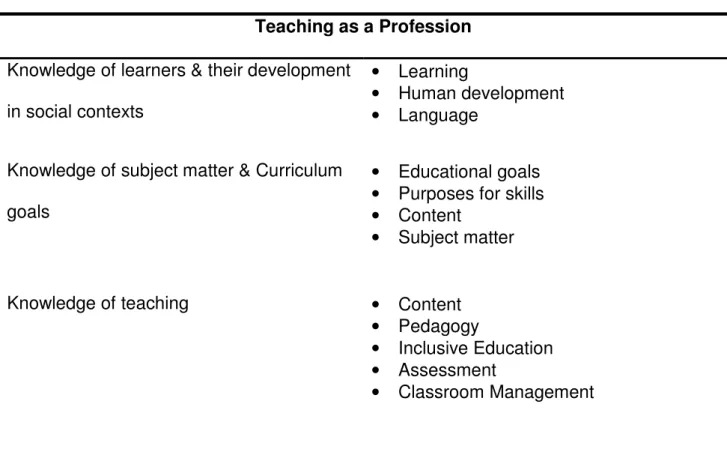
Professional classroom teaching is specialised work, which includes managing discussions in and outside the classroom, probing students’ answers, listening, explaining and interpreting, planning as well as creating and maintaining an orderly and supportive environment for learning (Loewenberg Ball & Forzani, 2009). Darling-Hammond (2006) highlights three distinct levels of development in teaching. These levels can be illustrated as follows:
32
TABLE 1 Adapted from Darling-Hammond (2006:5)
Teaching as a Profession
Knowledge of learners & their development in social contexts
• Learning
• Human development • Language
Knowledge of subject matter & Curriculum goals
• Educational goals • Purposes for skills • Content
• Subject matter
Knowledge of teaching • Content
• Pedagogy
• Inclusive Education • Assessment
• Classroom Management
Darling-Hammond (2006) states that teaching is primarily in the service of students. Teaching, she states, entails more than running from one lesson to another, but incorporates subject matter goals, knowledge of learning, as well as an appreciation for children’s development and needs.
Douglas (2005) cites Page and Thomas (1977), who portray teaching as one of the most prestigious occupations, founded on systematic knowledge, lengthy academic and practical training, high autonomy and a code of ethics. Ethics for teachers were more implicit than formalised, and teachers possessed far greater autonomy then in what and how they taught, than they do today. In fact, teacher autonomy was expected, but teachers were also expected to possess a sense of vocation similar to that of priests, nurses, social workers or other occupations regarded as professional, but characterised by low salaries, moderate status and high expectations of service.