TEACHING SOCIAL SKILLS TO STUDENTS WITH AUTISM TO INCREASE PEER INTERACTIONS INANINTEGRATED
FIRST-GRADE CLASSROOM
DEBRA M. KAmps, BETrY R. LEONARD, SUE VERNON, ERINP. DUGAN, AND JOSEPH C. DELQUADRI
UNIVERSITYOFKANSAS
AND
BETH GERSHON, LINDA WADE, AND LOUISE FoLK
SHAWNEEMISSION PUBUC SCHOOLS
Weinvestigatedthe useofsocialskillsgroups tofacilitate increased socialinteractionsforstudents with autism and their nonhandicapped peers in an integrated first-grade classroom. Socialskills groupsconsistedoftrainingstudents andpeers in initiating,responding, and keepinginteractions going; greeting others and conversing onavariety of topics; giving and accepting compliments; taking turns andsharing; asking for help and helping others; and including others in activities. Training occurred duringthefirst 10minof20-minplaygroups, fourtimesper week. Using a multiple baselineacross subjects design, resultsdemonstratedincreases in the frequency of, time engagedin,and durationofsocialinteractions,aswellastheresponsivity ofstudentsandpeers to each other. Results were maintained when studentsweremonitored andgivenfeedback onsocial performanceinplaygroupsandduringfollow-up.
DESCRIPTORS: autism,socialskills, integration,peersocial interaction
Studentswith autismexhibitamultitudeof
aso-cial and antisocial characteristics (Autism Society ofAmerica, 1990). By
definition,
appropriatesocialbehavior implies positive or atleast functional
in-teractionwith others. Consequently,therehasbeen
an increase inresearch investigations thatuse peer
strategies (e.g., modeling, prompting, tutoring) as a vehide for increasing learning and improving
social relationships of students with autism and
otherdevelopmental disabilities (e.g.,Carr& Dar-cy, 1990; Charlop,
Schreibman,
& Tryon, 1983;Kamps, Locke, Delquadri, & Hall, 1989; Odom & Strain,
1986;
Sasso, Hughes, Swanson, &No-vak, 1987; Shafer, Egel,&
Neef,
1984).Inaddition totheeffortstoincreasesocialskills
and interactions amongchildren with autism,
fur-ther consideration must be given to the effects of
This research wassupportedbyGrantH023C00024from theU.S.DepartmentofEducation.
Address correspondence and reprint requests to Debra Kamps,Juniper Gardens Children's Project, 1614 Wash-ingtonBlvd.,KansasCity, Kansas66102.
trainingin socialgroups andintegratedschool en-vironments (Brown, Ragland, & Fox, 1988;
McEvoyetal., 1988).These issuesareofparticular
concernforhigh-functioningstudents with autism.
Thissubgroupisoftenofnormal intelligence;thus,
expectationsarethatsocialskillsareatnear-normal levelsaswell.Yet manyhigh-functioningstudents with autism are typically quite ineffective socially. Like low-functioning children with autism, they
oftendesiretobealone, adhere rigidlytostructure
and schedules, are disinterested in others
(partic-ularlypeers), and perseverate on irrelevant objects
ortopics.
This study investigated the use of social skills
groups for high-fanctioningstudents with autism toimprove social interactionskillswithpeers. This
study differs from previous work in several ways.
Studentswere in anelementary school, totally
in-tegratedinto aregularfirst-gradedassroom. Treat-mentwas neither target- norpeer-oriented but was
conductedin agenericfashionforall group
mem-bers. Thus, treatment wasconsidered tobe part of
the first-gradecurriculum. Social skillsinstruction 281
was implemented using portions of published cur-ricula (McGinnis & Goldstein, 1984; Walker, Hops, &Greenwood, 1988).Theseprograms have
had limited testing among students with autism (Sasso, Melloy, & Kavale, 1990), with primary
investigationsconducted for students with behavior disorders and other mild disabilities (McConnell, 1987; Schloss, Schloss, Wood, & Kiehl, 1986).
METHOD
Subjects and Setting
Three malestudentswith autismparticipatedin thestudy.Allstudentswereconsideredhigh
func-tioning, asindicatedbyintellectualcapabilities, lan-guageskills, and academicperformance, but were
lacking in social skills (e.g., few interactions with
nonhandicapped peers, frequent periods of
isola-tion, limited spontaneous speech, and few initia-tions ofconversations). The first-grade dassroom
consisted of 11 nonhandicapped students, 3
stu-dents with autism, 2 students with physical dis-abilities, thefirst-grade teacher, and a
paraprofes-sional.
Mike was 7 years 5 months old, with an intel-ligence scoreof101 andfirst-grade academic skills.
Languageskillswereappropriate; however, he also used rote or"canned" phrasestocommunicateand
perseverated on inappropriate topics. Mike often
whinedandcomplainedin a loud,disruptivevoice
whenchanges in routineoccurred, andpreferredto
be alone,
frequently
ignoring initiationsby
peers and adults.Adamwas 7years 9 monthsof age, witha full scaleintelligence score of71. Language character-isticsindudedfrequentinitiationsofirrelevant top-ics with perseveration on the weather, dates,
ge-ography,andsoforth. He
performed
atfirst-grade
level, but had some difficulties in
comprehension
and taskcompletion.Adam
responded
toquestions
andinitiations,
although
hespentmoretimealone than withpeers duringgroups and at recess.Billwas 7 years 7 monthsold,with afull scale intelligence scoreof70. Deviant characteristics
in-duded perseveration on irrelevant
topics,
imma-turity,severemoodswings,andaggressionathome.
Billtypicallychose to be alone; however, he would remain in physical proximity to peers.
Dependent Measures
Socialinteraction. Observations were conduct-ed during play group sessions to determine the frequency of, time engaged in, and duration of social interactionsamong targetstudentsand their
nonhandicapped peers. Data were collected using the SocialInteraction Code developed by Niemeyer and McEvoy(1989) and NEC 8300 laptop com-puters using 5-min samples taken in random order. This code is a computerized system that records
social interactions with initiations, responses, and duration of interactions as variables. Initiations weredefined as motor or vocal behavior (e.g., shar-ing, assistshar-ing, touching), dearlydirected to a peer, that attempted to prompt a social response.
Re-sponses were defined as motor or vocal behavior
that acknowledged a replyto an initiation within 3 s. Interactions were thus defined as reciprocal
social behaviors that occurred as a result of an initiation-response sequence.
Social skills behavior. A 21-item social
skills
ratingscale was used to measure theoccurrenceof particular social behaviors by targets during the play group sessions. Items were scored using a 3-pointLikertscale(1 =never orseldomoccurring, 2 = sometimes, 3 = very often). Fourteen ofthe itemsmeasuredsocialskills, indudingsharing ma-terials;seekingorofferinghelp; initiating, listening,andresponding; interacting with one or more peers
(for
extendedperiods); giving andaccepting com-pliments; accepting peer ideas; and inviting others to join in activities. Seven of the items werede-scriptive ofappropriate behavior and responsiveness during the group, induding being nondisruptive,
having apleasant demeanor, not displaying autistic
behavior, displaying appropriate behavior (no whining), stayingingroup, and following
instruc-tions.
Interobserver agreement. Interobserver agree-ment was assessedby conducting twoobservations concurrentlyduringthe5-minsamples for 17% of
theplaygroup sessions. Agreementwas
computed
by dividingthenumber ofagreementsby
thenum-ber ofagreements plus
disagreements
and multi-plyingby 100. Agreementpercentagesfor thefre-quency of social interactions ranged from 33% to 100% across conditions, with an overall mean of
87.5%. Agreement percentages for the time en-gaged in social interactions ranged from 25% to
100%, with an overall mean of 80.6%.
Reliability for the social skills rating scale was
assessed by having observers
independently
com-pletethe scale for 32%ofthe sessions. Agreement was computed by scoring plus or minus for each
item, then calculating the number of agreements
divided by the total of agreements and disagree-ments. Reliability ranged from 52% to95%, with an overall mean of73%.
Experimental Design and Conditions
A multiple baseline design across
subjects
was used to evaluate theeffectivenessof the social skillstraining.
Baseline.Baselineconsistedof20-minplay
ses-sions four times per week during which a target
student and3
nonhandicapped
peers wereprovidedwith two activities(e.g.,
making
partyhats, creating collages, dressing up, playing house,making
pup-pets, or playing games). The entire dass partici-pated in the play groups; thus, four play groupsparticipatedsimultaneously
during
the 20-minses-sion. Instructions were given to stay in thegroup, be polite to
friends,
and playwith thedesignated
activities. Noprompts weregivenduring
baseline,
exceptto returnifastudent leftthegroup.Baselinelasted 2 weeks for Mike (eight sessions), 4 weeks forAdam (16 sessions), and 6 weeks forBill (24
sessions).
Socialskillstraining. Trainingwasconducted for individual groups during the first 10 min of the 20-min sessions.
Specific
skills were selected frompublished curricula(e.g., McGinnis& Gold-stein, 1984; Walker etal., 1988)andinduded
(a)initiating an interaction, responding to initiations,
andkeepinganinteraction going;(b)conversations, greetings, and topics; (c) giving and accepting com-pliments; (d) taking turnsandsharing;(e) helping
othersandaskingforhelp; and (f)
induding
others inactivities. Trainers werethe firstauthor,thedass-room
teacher,
thelearning
disabilitiesteacher,
and the dassroomparaprofessional
forMike,
Adam,
and Bill(with
theirpeers)
and a fourth group,respectively. Social skillstraining lasted for 2 to 3 weeksperskill.
Feedback
for
social skills. This conditionwasimplemented
following
the completion of social skillstraining
and consisted of 20min of freeplay
withteachermonitoring(i.e.,
astarwas placedby
thestudent'snameon amonitoring formifhewas
engaged
insocial interactionat 1-min checks) andfeedback
(i.e.,
students wereshown the formonceduring
the session and again at theend).
Follow-up. Inthefinalmonthof the school year (1 month after the feedback condition)
free-play
groupswereheldtwotothree times perweek. The
classroom teacher restated the social skills at the
beginning
ofplay.
Monitoringwasreducedtotwo5-minchecks for social interaction per group, with
feedback
provided
to thewhole dass. RESULTSResults indicated improved social
performance
for targetstudentsand peers. Positive changeswere
noted for social interactions among students and social skill behaviors.
SocialInteractions
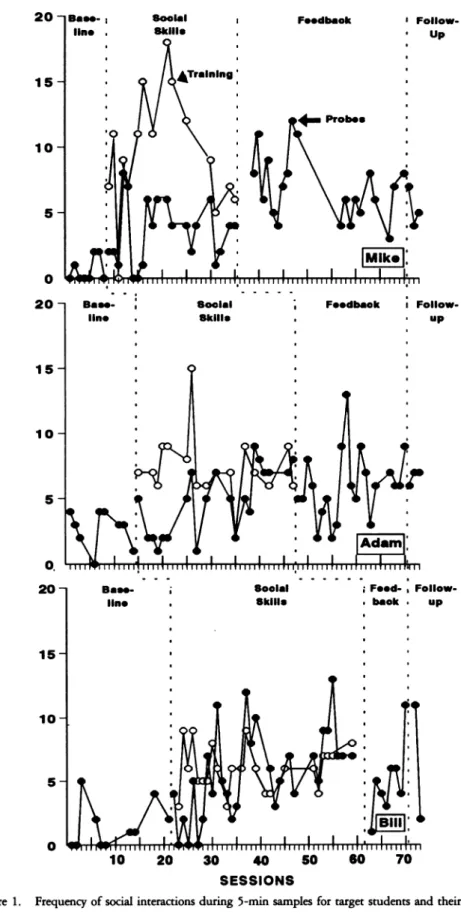
Thefrequencyof socialinteractionsinvolvingthe
3 targetstudents (i.e., as initiator or responder) is presented in Figure 1. The average numbers of social interactions per 5 min during baseline
con-ditions were 0.6, 2.7, and 1.5 for Mike, Adam, andBill,respectively. During social skills training, the average frequencies were 9.5, 7.4, and 6.1.
During the last half of the play group (posttraining
probes), the average numbers of interactions were 3.5,4.8, and5.6,respectively. During thefeedback andfollow-upconditions, interactions occurred on the average of five to six times.
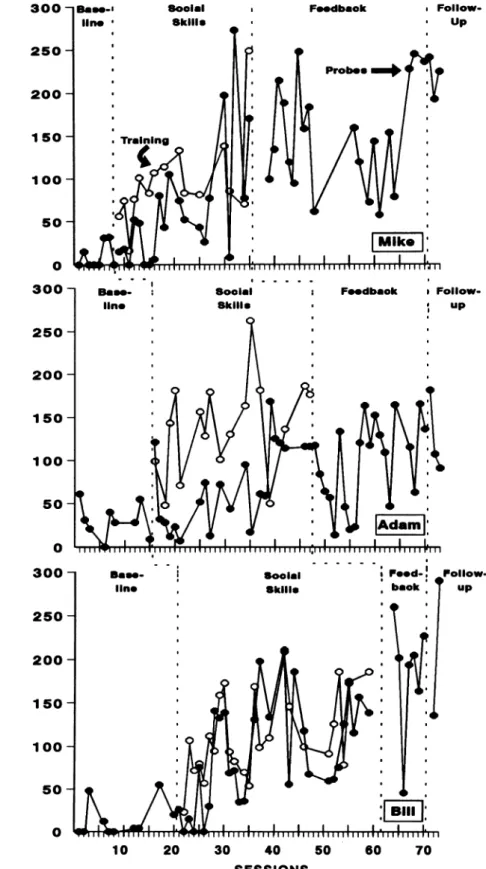
Theduration of socialinteractions involving the target students is depicted in Figure 2, with in-creases following implementation oftraining and feedback conditions. Thebaseline means of dura-tion per 5-min samples (300 s) were 9.8 s, 30.3
20-Bse- Social Feedback Follow-line Skills Up 15 . A
A~~~,Tralning'
4= Probes 10 5-IMIkel:
20 Base- Social Feedback i
Follow-line . Skills . up 'ID z 0 F 15 I -10 UA cc ~~~~~~~~~Adam: 0.
20 Base- Social Feed-
Follow-line SSkills bock up
15 10 5 -0 . 10 20 30 40 50 60 70 SESSIONS
300 ase-i Soolial Feedbaok , Follow-line Skills Up 250 Probes ME 200 150 Training 100 0A 50 Z
IMike]:
C) 0U. 300 Base- I Sooiai Feedback I
Foiiow-Figure2.lTime engagedin s i iisd an p
Z 250-0 200-z
0&
1 50-z 0co
10 Ixj~~~~~~~~~~Adami:
Z 300 Base- ooiai Feed-
Foiiow-iine *Skilis *back up
250 200-1 50-1 00 50-10 20 30 40 50 60 70 SESSIONS
Table 1
Duration, Initiation,andResponseRatios for Baseline (BL),SocialSkills(SS), Feedback forSocialSkills(FB),
andFollow-Up(FU)
Partici-pant BL SSl SS2b FB FU
Durationof interaction(inseconds)
Mike 6 8 29 24 42 Adam 10 12 15 16 19 Bill 5 12 19 66 79 Peers 15 14 23 15 34 Initiationsbystudents Mike 0.5 2 2 5 4 Adam 2 3 5 4 6 Bill 0.9 4 3 3 6 Peers 4 5 4 8 5 Initiationstostudents Mike 3 6 5 5 3 Adam 4 5 4 4 5 Bill 2 3 5 3 3 Peers 3 2 3 4 2
Responsivityof studentsto initiationsfromothers
Mike .28 .30 .76 .80 1.0
Adam .50 .56 .80 .67 .67
Bill .49 .56 .76 .90 .88
Peers .59 .50 .86 1.0 .88
Responsivityofothers tostudents' initiations
Mike .00 .63 .69 .95 .67
Adam .33 .30 .60 .72 .70
Bill .61 .61 .87 .93 .90
Peers .56 .75 .43 .79 1.0
* Meanofthefirst halfofsocialskillstraining condition. bMeanof the second halfofthe socialskillstrainingcondition. s, and 14.3s.Social interaction time
averaged
96.6to 140.6 s
during
social skillstraining
and 65 to93 s
during
posttraining probes.PeerSocial Interactions
Socialinteractiondatawere
occasionally
collected for nonhandicapped peers (a total of 46 probesacross conditions) for comparison purposes. The
frequencyof peerinteractions
averaged
3.8during
baseline,
5.8during
training,4.2during
posttrain-ing probes, 10.2 during the feedback
condition,
and 5.9
during
follow-up.
The duration of social interactionsfor peersaveraged
69.7
s inbaseline,
94.0 sduring training, 72.0 s
during posmaining
probes, 147.2 sduringfeedback,
and 185sduring
follow-up.
Additional Data
Analyses
Duration
of
social interaction. An additional analysis ofsocialinteraction consistedof computing the average duration of each interaction for the target students and their peers. The duration of interactions rangedfrom 5 to 15 s duringbaseline and initial trainingconditions, with increases to42s, 19 s, and 79 s forthe target students and 34 s
for peers
during follow-up (Table
1).Initiation andresponsepatterns.Baseline initi-ations
by
the targetstudentsrangedfroman average of 0.5 to 2 initiations, with increases to means of4to6during follow-up, equaling initiationsmade
by
peers(M
= 5). Fewchangeswerenotedin thenumberof peer-to-target initiations or peer-to-peer initiations across conditions.
Response ratios (seeTable 1) were computedby
dividing
the number of responses into thenumberofinitiations, with a ratioof 1.0 depicting a
one-to-onecorrespondence (i.e., allinitiations were
an-swered). The responsivityofthe target studentsto
peersincreased frombaselinelevelsof less than .50
to .67to 1.00 in follow-up, equalingthe response levelsof peers. The levelofresponsivityfrom peers
tothe targetstudentsalsoincreasedtoratiosof.67 to 1.0
during
follow-up.
SocialSkills Ratings
The percentageof socialskillsrated as occurring sometimes oroften (i.e., a scoreof 2 or 3)
during
baseline averaged 18% to 36% for the targetstu-dents. The percentage of socialskillsobserved
dur-ing traindur-ing ranged from 38% to 61%, with peer ratings averaging 57%. During feedback, ratings ofskills ranged from 54% to 100%, withincreases
to92% to97%duringfollow-upfortarget students and peers. Appropriate behaviors were generally
observed duringplay groups, with baseline mean
ratings ranging from 73% to 85%, and means of 85% to 100% during follow-up.
DISCUSSION
Thefindingsindicated that social skills training
for students with autism conducted concurrently withnonhandicappedpeers was a viableprocedure
for increasing the frequency of, time engaged in, and duration of social interaction for children in play groups. Perhaps as important were increases inlevelsofinitiationsand responsesbytargets and the responsivity of the peers to targets.
These results add to our current knowledge in several ways. First, the results demonstrated the benefits of socialskills training as a dasswide cur-riculum area (Neel, 1988), instead oflimiting in-struction to students with handicaps (e.g.,
Gaylord-Ross, Haring, Breen, & Pitts-Conway, 1984) or using peer-mediated procedures (e.g., Knapczyk,
1989; Strain &Odom, 1986).This supportsother studies illustrating the social effects of interactive group instruction, suchas the use of affection ac-tivities (McEvoy et al., 1988), peer tutoring(e.g.,
Greenwood, Delquadri, & Hall, 1989; Kamps et al., 1989), and cooperative learning (Johnson & Johnson, 1984).
A second finding is that rather than focus on structuredlearning of many social behaviors as dic-tated by published curricula (e.g., McGinnis &
Goldstein, 1984), the groups were moresuccessful
when focusingonfewer behaviorswith more prac-ticeopportunitiesforthosebasic skills.This reliance on more concrete behaviorswithrepeated practice was probably a moreefficient approach, and
con-tributed to the successoftheprogram forthe stu-dents with autism who might otherwise have had
difficulty in processing more abstract social skills
(e.g., negotiating,
problem
solving) into appropri-ate behaviors (Sasso et al., 1990).Despitefavorable findings and recommendations for future use of social skills training for these
children, there remains aneed to examine the
qual-ity of interactions, the effects ofsocial skills pro-grams longitudinally, and generalization of skills.
For example, experimental effectswereimmediate
during training, but were slower (approximately seven to eight sessions) during posttrainingprobes offree play (see Figures 1 and 2).
To summarize,these findings support the use of socialskills instruction in small-group formats that
indude nonhandicapped peers and students with autism. Inaddition, more research needs to be done in instruction and measurement of the quality of
socialinteraction,isolationofthespecificsocialskills and/or training components from identified
cur-ricula responsible for increased interactions, longi-tudinal study of socialization in integrated
envi-ronments, and replication of social skills training for moreseverely impaired children with autism.
REFERENCES
Autism Society of America. (1990). Autismfact sheet (NIH PublicationNo. 83-1877). Bethesda, MD: U.S. DepartmentofHealthand Human Services.
Brown, W.H.,Ragland,E.U.,&Fox,J.J. (1988). Effects ofgroupsocializationproceduresonthesocialinteractions ofpreschool children.Researrh in Developmental Dis-abilities, 9, 359-376.
Carr, E.G.,&Darcy,M. (1990). Settinggenerality ofpeer modeling in children with autism.Journal ofAutism andDevelopmental Disorders, 20,45-60.
Charlop, M. H., Schreibman, L., & Tryon, A. (1983). Learning throughobservation: Theeffects ofpeer mod-eling on acquisition and generalizationin autistic chil-dren.Journal ofAbnormal ChildPsychology, 11, 355-365.
Gaylord-Ross, R.J., Haring, T. G., Breen, C., & Pitts-Conway, V. (1984). Thetraining andgeneralization ofsocial interactionskillswith autisticyouth.Journal of
Applied Behavior Analysis, 17, 229-247.
Greenwood, C. R., Delquadri, J., & Hall, R. V. (1989). Longitudinal effectsof classwidepeertutoring.Journal of Educational Psychology, 81, 371-383.
Johnson, D. W., &Johnson,R. T. (1984). Cooperation in the classroom. Edina, MN: Interaction Book Com-pany.
Kamps,D.,Locke,P.,Delquadri,J.,&Hall,R. V. (1989). Increasingacademicskillsof studentswithautismusing fifthgrade peersastutors.Education and Treatmentof Children, 12, 38-5 1.
Knapczyk, D. R. (1989). Peer-mediated training of co-operativeplay between special and regularclassstudents inintegrated play settings. Education and Training of the Mentally Retarded, 24, 255-264.
McConnell, S. R. (1987). Entrapment effects and the gen-eralization and maintenanceofsocial skillstrainingfor elementaryschoolstudentswithbehavioral disorders. Be-havioral Disorders, 12, 252-263.
McEvoy, M.A.,Nordquist,V.M.,Twardosz, S.,Heckaman, K.A., Wehby,J. H., &Denny, R. K. (1988). Pro-moting autistic children's peer interaction in an integrated earlychildhood setting usingaffectionactivities.Journal of AppliedBehaviorAnalysis, 21, 193-200. McGinnis, E., & Goldstein, A.P. (1984). Skill-streaming
in the elementary schoolchild: Aguide for teaching prosocial skills. Chicago:Research Press.
Neel,R. S. (1988). Implementing social skills instruction inschools.Behaviorin OurSchools,3, 13-18. Niemeyer,J. A.,&McEvoy, M.A. (1989). Observational
assessment of reciprocal socialinteraction: Social in-teraction code (SIC). Vanderbilt/Minnesota Social In-teraction Project,VanderbiltUniversityandthe Univer-sityofMinnesota.
Odom, S. L., & Strain, P. S. (1986). A comparison of peer-initiation and teacher-antecedentinterventions for promoting reciprocal social interaction ofautistic pre-schoolers.JournalofApplied Behavior Analysis, 19, 59-71.
Sasso, G. M., Hughes, G. G., Swanson, H. L., &Novak, C.G. (1987). A comparisonofpeerinitiation inter-ventions in promoting multiple peer initiators.Education and TraininginMentalRetardation, 22, 150-155. Sasso, G. M., Melloy, K. J., & Kavale, K. A. (1990).
Generalization,maintenance,and behavioralcovariation associatedwith socialskillstrainingthrough structured learning. BehavioralDisorders, 16,9-22.
Schloss, P.J.,Schloss, C. N.,Wood,C. E., &Kiehl,W. S. (1986). A critical reviewofsocialskillsresearch with
behaviorally disordered students. BehavioralDisorders, 12, 1-14.
Shafer, J., Egel, A., &Neef, N. (1984). Trainingmildly handicapped peers to facilitate changes in the social in-teraction skills of autistic children. Journal of Applied Behavior Analysis, 17,461-476.
Strain, P., & Odom, S. (1986). Peer social initiations: Effective intervention for social skill development of ex-ceptionalchildren. ExceptionalChildren, 52, 543-5 52. Walker, H.M., Hops, H., & Greenwood, C. R. (1988). Socialskills tutoring andgames: Aprogram to teach socialskills toprimarygrade students. Delray Beach, FL:Educational Achievement Systems.
ReceivedJuly 8, 1991
Initialeditorial decision October31, 1991 RevisionreceivedJanuary 20, 1992 Final acceptance February20, 1992 ActionEditor, Samuel Odom