Edinburgh Research Explorer
Deep Graph Convolutional Encoders for Structured Data to Text
Generation
Citation for published version:
Marcheggiani, D & Perez-Beltrachini, L 2018, Deep Graph Convolutional Encoders for Structured Data to Text Generation. in Proceedings of the 11th International Conference on Natural Language Generation . Association for Computational Linguistics, Tilburg University, The Netherlands , pp. 1-9, 11th International Conference on Natural Language Generation , Tilburg, Netherlands, 5/11/18.
Link:
Link to publication record in Edinburgh Research Explorer
Document Version:
Publisher's PDF, also known as Version of record
Published In:
Proceedings of the 11th International Conference on Natural Language Generation
General rights
Copyright for the publications made accessible via the Edinburgh Research Explorer is retained by the author(s) and / or other copyright owners and it is a condition of accessing these publications that users recognise and abide by the legal requirements associated with these rights.
Take down policy
The University of Edinburgh has made every reasonable effort to ensure that Edinburgh Research Explorer content complies with UK legislation. If you believe that the public display of this file breaches copyright please contact [email protected] providing details, and we will remove access to the work immediately and investigate your claim.
1
Deep Graph Convolutional Encoders for
Structured Data to Text Generation
Diego Marcheggiani1,2 Laura Perez-Beltrachini1 1ILCC, School of Informatics, University of Edinburgh
2ILLC, University of Amsterdam
[email protected] [email protected]
Abstract
Most previous work on neural text gen-eration from graph-structured data relies on standard sequence-to-sequence meth-ods. These approaches linearise the input graph to be fed to a recurrent neural net-work. In this paper, we propose an alterna-tive encoder based on graph convolutional networks that directly exploits the input structure. We report results on two graph-to-sequence datasets that empirically show the benefits of explicitly encoding the in-put graph structure.1
1 Introduction
Data-to-text generators produce a target natu-ral language text from a source data representa-tion. Recent neural generation approaches (Mei et al., 2016; Lebret et al., 2016; Wiseman et al.,
2017;Gardent et al.,2017b;Ferreira et al.,2017;
Konstas et al., 2017) build on encoder-decoder architectures proposed for machine translation (Sutskever et al.,2014;Bahdanau et al.,2015).
The source data, differently from the machine translation task, is a structured representation of the content to be conveyed. Generally, it describes attributes and events about entities and relations among them. In this work we focus on two genera-tion scenarios where the source data is graph struc-tured. One is the generation of multi-sentence de-scriptions of Knowledge Base (KB) entities from RDF graphs (Perez-Beltrachini et al., 2016; Gar-dent et al., 2017a,b), namely the WebNLG task.2 The number of KB relations modelled in this sce-nario is potentially large and generation involves
1
Code and data available at github.com/diegma/ graph-2-text.
2Resource Description Frameworkhttps://www.w3.
org/RDF/
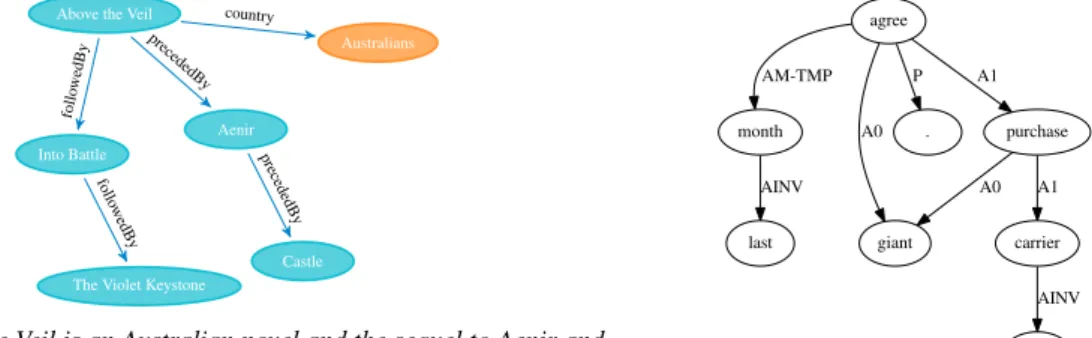
solving various subtasks (e.g. lexicalisation and aggregation). Figure (1a) shows and example of source RDF graph and target natural language de-scription. The other is the linguistic realisation of the meaning expressed by a source dependency graph (Belz et al., 2011), namely the SR11Deep generation task. In this task, the semantic rela-tions are linguistically motivated and their number is smaller. Figure (1b) illustrates a source depen-dency graph and the corresponding target text.
Most previous work casts the graph structured data to text generation task as a sequence-to-sequence problem (Gardent et al.,2017b;Ferreira et al., 2017;Konstas et al., 2017). They rely on recurrent data encoders with memory and gating mechanisms (LSTM; (Hochreiter and Schmidhu-ber,1997)). Models based on these sequential en-coders have shown good results although they do not directly exploit the input structure but rather rely on a separate linearisation step. In this work, we compare with a model that explicitly encodes structure and is trained end-to-end. Concretely, we use a Graph Convolutional Network (GCN; (Kipf and Welling,2016;Marcheggiani and Titov,
2017)) as our encoder.
GCNs are a flexible architecture that allows explicit encoding of graph data into neural net-works. Given their simplicity and expressiveness they have been used to encode dependency syntax and predicate-argument structures in neural ma-chine translation (Bastings et al.,2017; Marcheg-giani et al.,2018). In contrast to previous work, we do not exploit the sequential information of the input (i.e., with an LSTM), but we solely rely on a GCN for encoding the source graph structure.3
The main contribution of this work is show-ing that explicitly encodshow-ing structured data with
3Concurrently with this work, Beck et al. (2018) also encoded input structures without relying on sequential en-coders.
2
Above the Veil
Aenir precededBy Castle precededBy Australians country Into Battle follo wedBy
The Violet Keystone follo
wedBy
(a)Above the Veil is an Australian novel and the sequel to Aenir and Castle . It was followed by Into the Battle and The Violet Keystone .
giant agree A0 month AM-TMP . P purchase A1 last AINV A0 carrier A1 the AINV
(b)Giant agreed last month to purchase the carrier .
Figure 1: Source RDF graph - target description (a). Source dependency graph - target sentence (b). GCNs is more effective than encoding a linearized
version of the structure with LSTMs. We eval-uate the GCN-based generator on two graph-to-sequence tasks, with different level of source con-tent specification. In both cases, the results we ob-tain show that GCNs encoders outperforms stan-dard LSTM encoders.
2 Graph Convolutional-based Generator
Formally, we address the task of text generation from graph-structured data considering as input a directed labeled graph X = (V,E) where V is a set of nodes and E is a set of edges between nodes in V. The specific semantics of X de-pends on the task at hand. The output Y is a natural language text verbalising the content ex-pressed byX. Our generation model follows the standard attention-based encoder-decoder archi-tecture (Bahdanau et al.,2015;Luong et al.,2015) and predicts Y conditioned on X asP(Y|X) =
Q|Y|
t=1P(yt|y1:t−1, X).
Graph Convolutional Encoder In order to ex-plicitly encode structural information we adopt graph convolutional networks (GCNs). GCNs are a variant of graph neural networks (Scarselli et al.,
2009) that has been recently proposed byKipf and Welling (2016). The goal of GCNs is to calcu-late the representation of each node in a graph considering the graph structure. In this paper we adopt the parametrization proposed by Marcheg-giani and Titov (2017) where edge labels and di-rections are explicitly modeled. Formally, given a directed graph X = (V,E), where V is a set of nodes, andE is a set of edges. We represent each nodev ∈ V with a feature vectorxv ∈ Rd. The
GCN calculates the representation of each nodeh0v
in a graph using the following update rule:
h0v=ρ X u∈N(v)
gu,v Wdir(u,v)hu+blab(u,v)
,
where N(v) is the set of neighbours of v,
Wdir(u,v) ∈ Rd×d is a direction-specific
param-eter matrix. As Marcheggiani and Titov (2017);
Bastings et al. (2017) we assume there are three possible directions (dir(u, v) ∈ {in, out, loop}): self-loop edges ensure that the initial representa-tion of nodehv affects the new representationh0v.
The vector blab(u,v) ∈ Rd is an embedding of
the label of the edge(u, v) . ρ is a non-linearity (ReLU).gu,vare learned scalar gates which weight the importance of each edge. Although the main aim of gates is to down weight erroneous edges in predicted graphs, they also add flexibility when several GCN layers are stacked. As with stan-dard convolutional neural networks (CNNs, ( Le-Cun et al., 2001)), GCN layers can be stacked to consider non-immediate neighbours.4
Skip Connections Between GCN layers we add skip connections. Skip connections let the gradi-ent flows more efficigradi-ently through stacked hidden layers thus making possible the creation of deeper GCN encoders. We use two kinds of skip connec-tions: residual connections (He et al., 2016) and dense connections (Huang et al., 2017). Resid-ual connections consist in summing input and out-put representations of a GCN layer hrv = h0v+
hv. Whilst, dense connections consist in the
con-catenation of the input and output representations
hdv = [h0v;hv]. In this way, each GCN layer is
directly fed with the output of every layer before itself.
Decoder The decoder uses an LSTM and a soft attention mechanism (Luong et al., 2015) over
4We discovered during preliminary experiments that with-out scalar gates the model ends up in poor local minima, es-pecially when several GCN layers are used.
the representation induced by the GCN encoder to generate one word y at the time. The pre-diction of word yt+1 is conditioned on the pre-viously predicted words y1:t encoded in the
vec-tor wt and a context vector ct dynamically
cre-ated attending to the graph representation in-duced by the GCN encoder asP(yt+1|y1:t, X) = sof tmax(g(wt,ct)), where g(·) is a neural
net-work with one hidden layer. The model is trained to optimize negative log likelihood: LN LL = −P|Y|
t=1log P(yt|y1:t−1, X) 3 Generation Tasks
In this section, we describe the instantiation of the input graphXfor the generation tasks we address.
3.1 WebNLG Task
The WebNLG task (Gardent et al.,2017a,b) aims at the generation of entity descriptions from a set of RDF triples related to an entity of a given cate-gory (Perez-Beltrachini et al.,2016). RDF triples are of the form (subject relation object), e.g., (Aenir precededBy Castle), and form a graph in which edges are labelled with relations and ver-tices with subject and object entities. For instance, Figure (1a) shows a set of RDF triples related to the bookAbove the Veiland its verbalisation. The generation task involves several micro-planning decisions such as lexicalisation (followedBy is verbalised assequel to), aggregation (sequel to Aenir and Castle), referring expressions (subject of the second sentence verbalised as pronoun) and seg-mentation (content organised in two sentences). Reification We formulate this task as the gener-ation of a target descriptionY from a source graph
X = (V,E)whereX is build from a set of RDF triples as follows. We reify the relations (Baader,
2003) from the RDF set of triples. That is, we see the relation as a concept in the KB and introduce a new relation node for each relation of each RDF triple. The new relation node is connected to the subject and object entities by two new binary rela-tions A0 and A1 respectively. For instance, ( pre-cededBy A0 Aenir) and (precededBy A1 Cas-tle). Thus,Eis the set of entities including reified relations andV a set of labelled edges with labels {A0, A1}. The reification of relations is useful in two ways. The encoder is able to produce a hidden state for each relation in the input; and it permits to model an arbitrary number of KB relations effi-ciently.
3.2 SR11Deep Task
The surface realisation shared task (Belz et al.,
2011) proposed two generation tasks, namely shal-low and deep realisation. Here we focus on the deep task where the input is a semantic depen-dency graph that represents a target sentence using predicate-argument structures (NomBank; ( Mey-ers et al.,2004), PropBank; (Palmer et al.,2005)). This task covers a more complex semantic repre-sentation of language meaning; on the other hand, the representation is closer to surface form. Nodes in the graph are lemmas of the target sentence. Only complementizersthat, commas, andto infini-tive nodes are removed. Edges are labelled with NomBank and PropBank labels.5 Each node is also associated with morphological (e.g. num=sg) and punctuation features (e.g. bracket=r).
The source graphX = (V,E)is a semantic de-pendency graph. We extend this representation to model morphological information, i.e. each node in V is of the form (lemma, features). For this task we modify the encoder, Section2, to repre-sent each input node ashv = [hl;hf], where each
input node is the concatenation of the lemma and the sum of feature vectors.
4 Experiments
We tested our models on the WebNLG and SR11Deep datasets. The WebNLG dataset con-tains 18102 training and 871 development data-text pairs. The test dataset is split in two sets, test Seen (971 pairs) and a test set with new unseen categories for KB entities. As here we are inter-ested only in the modelling aspects of the struc-tured input data we focus on our evaluation only on the test partition with seen categories. The dataset covers 373 distinct relations from DBPe-dia. The SR11Deep dataset contains 39279, 1034 and 2398 examples in the training, development and test partitions, respectively. It covers 117 dis-tinct dependency relations.6
Sequential Encoders For both WebNLG and SR11Deep tasks we used a standard sequence-to-sequence model (Bahdanau et al., 2015; Lu-ong et al.,2015) with an LSTM encoder as base-line. Both take as input a linearised version of
5There are also some cases where syntactic labels appear in the graphs, this is due to the creation process (see (Belz et al.,2011)) and done to connect graphs when there were disconnected parts.
4
the source graph. For the WebNLG baseline, we use the linearisation scripts provided by (Gardent et al.,2017b). For the SR11Deep baseline we fol-low a similar linearisation procedure as proposed for AMR graphs (Konstas et al.,2017). We built a linearisation based on a depth first traversal of the input graph. Siblings are traversed in random or-der (they are anyway shuffled in the given dataset). We repeat a child node when a node is revisited by a cycle or has more than one parent. The base-line model for the WebNLG task uses one layer bidirectional LSTM encoder and one layer LSTM decoder with embeddings and hidden units set to 256 dimensions . For the SR11Deep task we used the same architecture with 500-dimensional hid-den states and embeddings. All hyperparameters tuned on the development set.
GCN Encoders The GCN models consist of a GCN encoder and LSTM decoder. For the WebNLG task, all encoder and decoder embed-dings and hidden units use 256 dimensions. We obtained the best results with an encoder with four GCN layers with residual connections. For the SR11Deep task, we set the encoder and decoder to use 500-dimensional embeddings and hidden units of size 500. In this task, we obtained the best development performance by stacking seven GCN layers with dense connections.
We use delexicalisation for the WebNLG dataset and apply the procedure provided for the baseline in (Gardent et al., 2017b). For the SR11Deep dataset, we performed entity anonymi-sation. First, we compacted nodes in the tree cor-responding to a single named entity (see (Belz et al., 2011) for details). Next, we used a name entity recogniser (Stanford CoreNLP; (Manning et al.,2014)) to tag entities in the input with type information (e.g. person, location, date). Two entities of the same type in a given input will be given a numerical suffix, e.g. PER 0 and PER 1.
A GCN-based Generator For the WebNLG
task, we extended the GCN-based model to use pre-trained word Embeddings (GloVe ( Penning-ton et al.,2014)) andCopy mechanism (See et al.,
2017), we name this variant GCNEC. To this end,
we did not use delexicalisation but rather repre-sent multi-word subject (object) entities with each word as a separate node connected with special Named Entity (NE) labelled edges. For instance, the book entityInto Battleis represented as(Into
Encoder BLEU METEOR TER
LSTM .526±.010 .38±.00 .43±.01 GCN .535±.004 .39±.00 .44±.02 ADAPT .606 .44 .37 GCNEC .559±.017 .39±.01 0.41±.01 MELBOURNE .545 .41 .40 PKUWRITER .512 .37 .45
Table 1: Test results WebNLG task.
Encoder BLEU METEOR TER
LSTM .377±.007 .65±.00 .44±.01
GCN .647±.005 .77±.00 .24±.01
GCN+feat .666±.027 .76±.01 .25±.01
Table 2: Test results SR11Deep task. NE Battle). Encoder (decoder) embeddings and hidden dimensions were set to 300. The model stacks six GCN layers and uses a single layer LSTM decoder.
Evaluation metrics As previous works in these tasks, we evaluated our models using BLEU ( Pa-pineni et al., 2002), METEOR (Denkowski and Lavie, 2014) and TER (Snover et al., 2006) au-tomatic metrics. During preliminary experiments we noticed considerable variance from different model initialisations; we thus run 3 experiments for each model and report average and standard deviation for each metric.
5 Results
WebNLG task In Table 1 we report results on the WebNLG test data. In this setting, the model with GCN encoder outperforms a strong base-line that employs the LSTM encoder, with .009 BLEU points. The GCN model is also more sta-ble than the baseline with a standard deviation of.004vs.010. We also compared the GCNEC
model with the neural models submitted to the WebNLG shared task. The GCNEC model
out-performs PKUWRITER that uses an ensemble of 7 models and a further reinforcement learning step by.047BLEU points; and MELBOURNE by.014 BLEU points. GCNEC is behind ADAPT which
relies on sub-word encoding.
SR11Deep task In this more challenging task, the GCN encoder is able to better capture the structure of the input graph than the LSTM en-coder, resulting in .647 BLEU for the GCN vs.
.377 BLEU of the LSTM encoder as reported in Table 2. When we add linguistic features to the GCN encoding we get.666BLEU points. We also
WebNLG (William Anders dateOfRetirement 1969 - 09 - 01) (Apollo 8 commander Frank Borman) (William Anders was a crew member of Apollo 8) (Apollo 8 backup pilot Buzz Aldrin)
LSTM William Anders was a crew member of the OPERATOR operated Apollo 8 and retired on September 1st 1969 .
GCN William Anders was a crew member of OPERATOR ’ s Apollo 8 alongside backup pilot Buzz Aldrin and backup pilot Buzz Aldrin .
GCNEC william anders , who retired on the 1st of september 1969 , was a crew member on apollo 8 along with commander frank borman and backup pilot
buzz aldrin .
SR11Deep (SROOT SROOT will) (will P .) (will SBJ temperature) (temperature A1 economy) (economy AINV the) (economy SUFFIX ’s) (will VC be) (be VC take) (take A1 temperature) (take A2 from) (from A1 point) (point A1 vantage) (point AINV several) (take AM-ADV with) (with A1 reading) (reading A1 on) (on A1 trade) (trade COORD output) (output COORD housing) (housing COORD and) (and CONJ inflation) (take AM-MOD will) (take AM-TMP week) (week AINV this)
Gold The economy ’s temperature will be taken from several vantage points this week , with readings on trade , output , housing and inflation .
Baseline the economy ’s accords will be taken from several phases this week , housing and inflation readings on trade , housing and inflation .
GCN the economy ’s temperatures will be taken from several vantage points this week , with reading on trades output , housing and inflation .
Table 3: Examples of system output.
BLEU SIZE
Model none res den none res den
LSTM .543±.003 - - 4.3 - -GCN 1L .537±.006 - - 4.3 - -2L .545±.016 .553±.005 .552±.013 4.5 4.5 4.7 3L .548±.012 .560±.013 .557±.001 4.7 4.7 5.2 4L .537±.005 .569±.003 .558±.005 4.9 4.9 6.0 5L .516±.022 .561±.016 .559±.003 5.1 5.1 7.0 6L .508±.022 .561±.007 .558±.018 5.3 5.3 8.2 7L .492±.024 .546±.023 .564±.012 5.5 5.5 9.6
Table 4: GCN ablation study (layers (L) and skip-connections: none, residual(res) and dense(den)). Average and standard deviation of BLEU scores over three runs on the WebNLG dev. set. Number of parameters (millions) including embeddings. compare the neural models with upper bound re-sults on the same dataset by the pipeline model of
Bohnet et al.(2011) (STUMBA-D) and transition-based joint model ofZhang et al.(2017) (TBDIL). The STUMBA-D and TBDIL model obtains re-spectively .794 and .805 BLUE, outperforming the GCN-based model. It is worth noting that these models rely on separate modules for syn-tax prediction, tree linearisation and morphology generation. In a multi-lingual setting (Mille et al.,
2017), our model will not need to re-train some modules for different languages, but rather it can exploit them for multi-task training. Moreover, our model could also exploit other supervision sig-nals at training time, such as gold POS tags and gold syntactic trees as used inBohnet et al.(2011).
5.1 Qualitative Analysis of Generated Text We manually inspected the outputs of the LSTM and GCN models. Table 3 shows examples of source graphs and generated texts (we in-cluded more examples in Section A). Both mod-els suffer from repeated and missing source con-tent (i.e. source units are not verbalised in the output text (under-generation)). However, these phenomena are less evident with
GCN-based models. We also observed that the LSTM output sometimes presents hallucination (over-generation) cases. Our intuition is that the strong relational inductive bias of GCNs (Battaglia et al.,
2018) helps the GCN encoder to produce a more informative representation of the input; while the LSTM-based encoder has to learn to produce use-ful representations by going through multiple dif-ferent sequences over the source data.
5.2 Ablation Study
In Table4(BLEU) we report an ablation study on the impact of the number of layers and the type of skip connections on the WebNLG dataset. The first thing we notice is the importance of skip con-nections between GCN layers. Residual and dense connections lead to similar results. Dense connec-tions (Table4(SIZE)) produce models bigger, but slightly less accurate, than residual connections. The best GCN model has slightly more parame-ters than the baseline model (4.9M vs.4.3M).
6 Conclusion
We compared LSTM sequential encoders with a structured data encoder based on GCNs on the task of structured data to text generation. On two different tasks, WebNLG and SR11Deep, we show that explicitly encoding structural informa-tion with GCNs is beneficial with respect to se-quential encoding. In future work, we plan to apply the approach to other input graph repre-sentations like Abstract Meaning Reprerepre-sentations (AMR; (Banarescu et al., 2013)) and scoped se-mantic representations (Van Noord et al.,2018).
Acknowledgments
We want to thank Ivan Titov and Mirella Lapata for their help and suggestions. We also gratefully acknowledge the financial support of the European Research Council (award number 681760) and the Dutch National Science Foundation (NWO VIDI 639.022.518). We thank NVIDIA for donating the GPU used for this research.
6 References
Franz Baader. 2003. The description logic handbook: Theory, implementation and applications. Cam-bridge university press.
Dzmitry Bahdanau, Kyunghyun Cho, and Yoshua Ben-gio. 2015. Neural Machine Translation by Jointly Learning to Align and Translate. InProceedings of the International Conference on Learning Represen-tations, ICLR.
Laura Banarescu, Claire Bonial, Shu Cai, Madalina Georgescu, Kira Griffitt, Ulf Hermjakob, Kevin Knight, Philipp Koehn, Martha Palmer, and Nathan Schneider. 2013. Abstract meaning representation for sembanking. InProceedings of the 7th Linguis-tic Annotation Workshop and Interoperability with Discourse, pages 178–186.
Joost Bastings, Ivan Titov, Wilker Aziz, Diego Marcheggiani, and Khalil Simaan. 2017. Graph convolutional encoders for syntax-aware neural ma-chine translation. InProceedings of the 2017 Con-ference on Empirical Methods in Natural Language Processing, EMNLP, pages 1957–1967.
Peter W. Battaglia, Jessica B. Hamrick, Victor Bapst, Alvaro Sanchez-Gonzalez, Vin´ıcius Flores Zam-baldi, Mateusz Malinowski, Andrea Tacchetti, David Raposo, Adam Santoro, Ryan Faulkner, C¸ aglar G¨ulc¸ehre, Francis Song, Andrew J. Ballard, Justin Gilmer, George E. Dahl, Ashish Vaswani, Kelsey Allen, Charles Nash, Victoria Langston, Chris Dyer, Nicolas Heess, Daan Wierstra, Push-meet Kohli, Matthew Botvinick, Oriol Vinyals, Yu-jia Li, and Razvan Pascanu. 2018. Relational in-ductive biases, deep learning, and graph networks.
CoRR, abs/1806.01261.
Daniel Beck, Gholamreza Haffari, and Trevor Cohn. 2018. Graph-to-sequence learning using gated graph neural networks. InProceedings of the 56th Annual Meeting of the Association for Computa-tional Linguistics (Volume 1: Long Papers), pages 273–283.
Anja Belz, Michael White, Dominic Espinosa, Eric Kow, Deirdre Hogan, and Amanda Stent. 2011. The first surface realisation shared task: Overview and evaluation results. In Proceedings of the 13th Eu-ropean workshop on natural language generation, pages 217–226.
Bernd Bohnet, Simon Mille, Benoˆıt Favre, and Leo Wanner. 2011. Stumaba : From deep representation to surface. InENLG 2011 - Proceedings of the 13th European Workshop on Natural Language Genera-tion, pages 232–235.
Michael Denkowski and Alon Lavie. 2014. Meteor universal: Language specific translation evaluation for any target language. InProceedings of the ninth workshop on statistical machine translation, pages 376–380.
Thiago Castro Ferreira, Iacer Calixto, Sander Wubben, and Emiel Krahmer. 2017. Linguistic realisation as machine translation: Comparing different mt mod-els for amr-to-text generation. InProceedings of the 10th International Conference on Natural Language Generation, pages 1–10.
Claire Gardent, Anastasia Shimorina, Shashi Narayan, and Laura Perez-Beltrachini. 2017a. Creating train-ing corpora for nlg micro-planners. In Proceed-ings of the 55th Annual Meeting of the Association for Computational Linguistics (Volume 1: Long Pa-pers), pages 179–188. (ACL 2017).
Claire Gardent, Anastasia Shimorina, Shashi Narayan, and Laura Perez-Beltrachini. 2017b. The WebNLG challenge: Generating text from rdf data. In
Proceedings of the 10th International Conference on Natural Language Generation, pages 124–133. (INLG 2017).
Kaiming He, Xiangyu Zhang, Shaoqing Ren, and Jian Sun. 2016. Deep residual learning for image recog-nition. InProceedings of the IEEE Conference on Computer Vision and Pattern Recognition, CVPR, pages 770–778.
Sepp Hochreiter and J¨urgen Schmidhuber. 1997.
Long Short-Term Memory. Neural Computation, 9(8):1735–1780.
Gao Huang, Zhuang Liu, Laurens van der Maaten, and Kilian Q. Weinberger. 2017. Densely connected convolutional networks. In2017 IEEE Conference on Computer Vision and Pattern Recognition, CVPR 2017, pages 2261–2269.
Diederik P. Kingma and Jimmy Ba. 2015. Adam: A method for stochastic optimization. InProceedings of the International Conference on Learning Repre-sentations, ICLR.
Thomas N. Kipf and Max Welling. 2016. Semi-supervised classification with graph convolutional networks. InProceedings of the International Con-ference on Learning Representations, ICLR. Guillaume Klein, Yoon Kim, Yuntian Deng, Jean
Senellart, and Alexander M. Rush. 2017. Opennmt: Open-source toolkit for neural machine translation. InProceedings of the 55th Annual Meeting of the As-sociation for Computational Linguistics, ACL 2017, pages 67–72.
Ioannis Konstas, Srinivasan Iyer, Mark Yatskar, Yejin Choi, and Luke Zettlemoyer. 2017. Neural amr: Sequence-to-sequence models for parsing and gen-eration. In Proceedings of the 55th Annual Meet-ing of the Association for Computational LMeet-inguistics (Volume 1: Long Papers), pages 146–157.
R´emi Lebret, David Grangier, and Michael Auli. 2016. Neural text generation from structured data with ap-plication to the biography domain. InProceedings of the 2016 Conference on Empirical Methods in Natural Language Processing, pages 1203–1213.
Yann LeCun, Leon Bottou, Yoshua Bengio, and Patrick Haffner. 2001. Gradient-based learning applied to document recognition. InProceedings of Intelligent Signal Processing.
Thang Luong, Hieu Pham, and Christopher D. Man-ning. 2015. Effective approaches to attention-based neural machine translation. InProceedings of the 2015 Conference on Empirical Methods in Natural Language Processing, pages 1412–1421.
Christopher Manning, Mihai Surdeanu, John Bauer, Jenny Finkel, Steven Bethard, and David McClosky. 2014. The Stanford CoreNLP natural language pro-cessing toolkit. InProceedings of the 52nd Annual Meeting of the Association for Computational Lin-guistics: System Demonstrations, pages 55–60. Diego Marcheggiani, Joost Bastings, and Ivan Titov.
2018.Exploiting semantics in neural machine trans-lation with graph convolutional networks. In Pro-ceedings of NAACL-HLT.
Diego Marcheggiani and Ivan Titov. 2017. Encoding sentences with graph convolutional networks for se-mantic role labeling. InProceedings of the 2017 Conference on Empirical Methods in Natural Lan-guage Processing, EMNLP, pages 1506–1515. Hongyuan Mei, Mohit Bansal, and Matthew R. Walter.
2016. What to talk about and how? selective gener-ation using lstms with coarse-to-fine alignment. In
Proceedings of the 2016 Conference of the North American Chapter of the Association for Computa-tional Linguistics: Human Language Technologies, pages 720–730.
Adam Meyers, Ruth Reeves, Catherine Macleod, Rachel Szekely, Veronika Zielinska, Brian Young, and Ralph Grishman. 2004. Annotating noun argu-ment structure for nombank. InProceedings of the Fourth International Conference on Language Re-sources and Evaluation, LREC 2004.
Simon Mille, Bernd Bohnet, Leo Wanner, and Anja Belz. 2017. Shared task proposal: Multilingual sur-face realization using universal dependency trees. In
Proceedings of the 10th International Conference on Natural Language Generation, pages 120–123. Martha Palmer, Daniel Gildea, and Paul Kingsbury.
2005. The proposition bank: An annotated cor-pus of semantic roles. Computational linguistics, 31(1):71–106.
Kishore Papineni, Salim Roukos, Todd Ward, and Wei-Jing Zhu. 2002. Bleu: a method for automatic eval-uation of machine translation. In Proceedings of 40th Annual Meeting of the Association for Compu-tational Linguistics, pages 311–318.
Jeffrey Pennington, Richard Socher, and Christopher Manning. 2014. Glove: Global vectors for word representation. InProceedings of the 2014 confer-ence on empirical methods in natural language pro-cessing (EMNLP), pages 1532–1543.
Laura Perez-Beltrachini, Rania SAYED, and Claire Gardent. 2016. Building RDF Content for Data-to-Text Generation. InProceedings of COLING 2016, the 26th International Conference on Computational Linguistics: Technical Papers, pages 1493–1502. Franco Scarselli, Marco Gori, Ah Chung Tsoi, Markus
Hagenbuchner, and Gabriele Monfardini. 2009. The graph neural network model. IEEE Trans. Neural Networks, 20(1):61–80.
Abigail See, Peter J. Liu, and Christopher D. Manning. 2017.Get to the point: Summarization with pointer-generator networks. InProceedings of the 55th An-nual Meeting of the Association for Computational Linguistics (Volume 1: Long Papers), pages 1073– 1083.
Matthew Snover, Bonnie Dorr, Richard Schwartz, Lin-nea Micciulla, and John Makhoul. 2006. A study of translation edit rate with targeted human annotation. In Proceedings of association for machine transla-tion in the Americas, volume 200.
Nitish Srivastava, Geoffrey E. Hinton, Alex Krizhevsky, Ilya Sutskever, and Ruslan Salakhutdi-nov. 2014. Dropout: a simple way to prevent neural networks from overfitting. Journal of Machine Learning Research, 15(1):1929–1958.
Ilya Sutskever, Oriol Vinyals, and Quoc V Le. 2014. Sequence to sequence learning with neural net-works. InAdvances in neural information process-ing systems, pages 3104–3112.
Rik Van Noord, Lasha Abzianidze, Hessel Haagsma, and Johan Bos. 2018. Evaluating scoped meaning representations. InProceedings of the Eleventh In-ternational Conference on Language Resources and Evaluation (LREC 2018).
Sam Wiseman, Stuart Shieber, and Alexander Rush. 2017. Challenges in data-to-document generation. In Proceedings of the 2017 Conference on Empiri-cal Methods in Natural Language Processing, pages 2243–2253.
Yue Zhang, Manish Shrivastava, and Ratish Pudup-pully. 2017. Transition-based deep input lineariza-tion. InProceedings of the 15th Conference of the European Chapter of the Association for Computa-tional Linguistics, EACL 2017, Volume 1: Long Pa-pers, pages 643–654.
8 A Supplemental Material
A.1 Training details
We implemented all our models using OpenNMT-py (Klein et al., 2017). For all experiments we used a batch size of 64 and Adam (Kingma and Ba,2015) as the optimizer with an initial learning rate of 0.001. For GCN models and baselines we used a one-layer LSTM decoder, we used dropout (Srivastava et al., 2014) in both encoder and de-coder with a rate of 0.3. We adopt early stopping on the development set using BLEU scores and we trained for a maximum of 30 epochs.
A.2 More example outputs
Table 5 shows additional examples of generated texts for source WebNLG and SR11Deep graphs.
WebNLG (Acharya Institute of Technology sportsOffered Tennis) (Acharya Institute of Technology established 2000) (Tennis sportsGoverningBody International Tennis Federation)
LSTM The Acharya Institute of Technology was established in 2000 and is governed by the International Tennis Federation .
GCN The sport of tennis , governed by the International Tennis Federation , is offered at the Acharya Institute of Tech-nology which was established in 2000 .
GCNEC the acharya institute of technology was established in 2000 and is governed by the international tennis federation .
WebNLG (Acharya Institute of Technology officialSchoolColour Blue , White and Orange) (Acharya Institute of Technology was given the ’ Technical Campus ’ status by All India Council for Technical Education)
LSTM The Archarya Institute of Technology are blue , white and was given the Acharya Institute of Technology . GCN The Acharya Institute of Technology was given the ’ Technical Campus ’ status by the All India Council for
Technical Education in LOCATION . The Institute was given the ” Technical Campus ” status by the Acharya Institute of Technology .
GCNEC acharya institute of technology was given the ’ technical campus ’ status by the all india council for technical
education which has blue , white and orange .
WebNLG (Saranac Lake , New York isPartOf Harrietstown , New York) (Saranac Lake , New York isPartOf Essex County , New York) (Adirondack Regional Airport cityServed Lake Placid , New York) (Adirondack Regional Airport cityServed Saranac Lake , New York) (Saranac Lake , New York country United States)
LSTM Adirondack Regional Airport serves the cities of Lake Placid and Saranac Lake ( Harrietstown ) in the United States .
GCN Adirondack Regional Airport serves the city of Saranac Lake , which is part of Harrietstown , Essex County , New York , United States .
GCNEC adirondack regional airport serves the cities of lake placid and saranac lake , essex county , new york , united states
. adirondack regional airport serves the city of saranac lake , essex county , new york , united states .
WebNLG (Adisham Hall location Sri Lanka) (Adisham Hall architecturalStyle Tudor Revival architecture) (Adisham Hall completionDate 1931) (Adisham Hall buildingStartDate 1927)
LSTM Adisham Hall was built in 1927 and completed in 1931 . It was built in the Tudor Revival architecture style and is located in Sri Lanka .
GCN Construction of Adisham Hall , Sri Lanka began in 1927 and was completed in 1931 .
GCNEC adisham hall , sri lanka , constructed in 1931 , is located in sri lanka . the hall has the architectural style ’ tudor
revival ’ .
SR11Deep (SROOT SROOT say) (say A0 economist) (say A1 be) (be SBJ export) (be VC think) (think A1 export) (think C-A1 have) (have VC rise) (rise A1 export) (rise A2 strongly) (strongly COORD but) (but CONJ not) (not AINV enough) (not AINV offset) (offset A1 jump) (jump A1 in) (in A1 import) (jump AINV the) (offset A2 export) (not AINV probably) (strongly TMP in) (in A1 august) (say P .)
Gold Exports are thought to have risen strongly in August , but probably not enough to offset the jump in imports , economists said .
LSTM exports said exports are thought to have rising strongly , but not enough to offset exports in the imports in august . GCN exports was thought to have risen strongly in august but not probably to offset the jump in imports , economists said
.
SR11Deep (SROOT SROOT be) (be P ?) (be SBJ we) (be TMP be) (be SBJ project) (project A1 research) (be VC curtail) (cur-tail A1 project) (cur(cur-tail AM-CAU to) (to A1 cut) (cut A0 government) (cut A1 funding) (funding A0 government) (to DEP due) (to R-AM-TMP when) (be VC catch) (catch A1 we) (catch A2 with) (with SUB down) (down SBJ grant) (grant AINV our) (catch P ”) (catch P “)
Gold When research projects are curtailed due to government funding cuts , are we “ caught with our grants down ” ? LSTM is when research projects is supposed to cut “ due ” projects is caught with the grant down .
GCN when research projects are curtailed to government funding cuts due to government funding cuts , were we caught “ caught ” with our grant down ?