VerbAtlas: a Novel Large-Scale Verbal Semantic Resource and Its
Application to Semantic Role Labeling
Andrea Di Fabio♦♥, Simone Conia♦, Roberto Navigli♦ ♦Department of Computer Science
♥Department of Literature and Modern Cultures Sapienza University of Rome, Italy {difabio,conia,navigli}@di.uniroma1.it
Abstract
We present VerbAtlas, a new, hand-crafted lexical-semantic resource whose goal is to bring together all verbal synsets from Word-Net into semantically-coherent frames. The frames define a common, prototypical argu-ment structure while at the same time pro-viding new concept-specific information. In contrast to PropBank, which defines enumer-ative semantic roles, VerbAtlas comes with an explicit, cross-frame set of semantic roles linked to selectional preferences expressed in terms of WordNet synsets, and is the first resource enriched with semantic information about implicit, shadow, and default arguments. We demonstrate the effectiveness of VerbAtlas in the task of dependency-based Semantic Role Labeling and show how its integration into a high-performance system leads to im-provements on both the in-domain and out-of-domain test sets of CoNLL-2009. VerbAtlas is available athttp://verbatlas.org.
1 Introduction
During the last two decades, we have witnessed increased attention to Natural Language Under-standing, a core goal of Natural Language Pro-cessing (NLP). Several challenges, however, are yet to be overcome when it comes to performing sentence-level semantic tasks (Navigli,2018). In order to understand the meaning of sentences, the semantics of verbs plays a crucial role, since verbs define the argument structure roughly in terms of "who" did "what" to "whom", with the arguments being the constituents that bear a semantic relation (called semantic role) with the verb. In the fol-lowing example, "Joe" and "lunch" are arguments of "eat", whose argument structure identifies them, respectively, as theAgent and thePatientof the scenario evoked by the verb:
[Joe]Agentis [eating]Verbhis [lunch]Patient
The automatic identification and labeling of ar-gument structures is a task pioneered by Gildea and Jurafsky(2002) called Semantic Role Label-ing (SRL). SRL has become very popular thanks to its integration into other related NLP tasks such as machine translation (Liu and Gildea,
2010), visual semantic role labeling (Silberer and Pinkal, 2018) and information extraction ( Bas-tianelli et al.,2013).
In order to be performed, SRL requires the fol-lowing core elements: 1) a verb inventory, and 2) a semantic role inventory. However, the current verb inventories used for this task, such as Prop-Bank (Palmer et al.,2005) and FrameNet (Baker et al.,1998), are language-specific and lack high-quality interoperability with existing knowledge bases. Furthermore, such resources provide low to medium coverage of the verbal lexicon (cf. Ta-ble 1), with PropBank showing the best figures, but still lower than other lexical inventories like WordNet (Fellbaum et al., 1998). Finally, the informativeness of the semantic roles defined in the various resources ranges from underspecified, as in PropBank’s roles, to overspecified, as in FrameNet’s frame elements. This poses multiple issues in terms of interpretability or cross-domain applicability.
To overcome the above limitations, in this paper we present VerbAtlas, a manually-crafted inven-tory of verbs and argument structures which pro-vides several contributions: 1) full coverage of the English verbal lexicon, 2) prototypical argument structures for each cluster of synsets that define a semantically-coherent frame, 3) cross-domain ex-plicit semantic roles, 4) the specification of refined semantic information and selectional preferences for the argument structure of frames, 5) linkage to WordNet and, as a result, to BabelNet (Navigli and Ponzetto,2010) and Open Multilingual Word-net (Bond and Foster, 2013), which in turn en-able scalability across languages. Furthermore, to
Cluster types # Argument roles # Meaning units #
FrameNet Frames 1,224 Frame elements 10,542 Lexical units 5,200
VerbNet Levin’s classes 329 Thematic roles 39 Senses 6,791
PropBank Verbs 5,649 Proto-roles 6 Framesets 10,687
WordNet – – – – Synsets 13,767
VerbAtlas Frames 466 Semantic roles 25 Synsets 13,767
Table 1: Quantitative analysis of popular verbal resources. Since each of these resources is based on different linguistic assumptions, in the top row we use general labels to encompass resource-specific terms that can be viewed as homologous: cluster type, argument roles and meaning units. WordNet does not provide argument structures except for sentence frames which, however, are syntactic and do not specify any roleset.
make VerbAtlas suitable for NLP tasks that rely on PropBank, we also provide a mapping to its frame-sets. Finally, we prove through an SRL experiment that VerbAtlas is robust and enables state-of-the-art performances on the CoNLL-2009 dataset. 2 Related work
The most popular English verbal resources are FrameNet (Baker et al.,1998), PropBank (Palmer et al.,2005), and VerbNet (Kipper-Schuler,2005). Each resource is based on a different linguistic theory, which leads to different information being provided for each verb (cf. Table 1). FrameNet, in particular, was the first resource to be used for SRL (Gildea and Jurafsky, 2002): it is based on frame semantics, theorized by Fillmore (1976), which assumes different roles, i.e., frame ele-ments, for different frames1. This led to a prolif-eration of thousands of roles for only 5200 verbs. Such domain specificity makes it difficult to scale to open-text SRL (Hartmann et al.,2017).
PropBank challenges the issue of FrameNet’s roles with a repository of only 6 different core roles plus 19 modifiers for 10,687 framesets2. This resource is the most widely adopted for SRL, as also attested by the popularity of datasets such as CoNLL-2005 (Carreras and Màrquez, 2005) and CoNLL-2009 (Hajiˇc et al., 2009). PropBank’s methodology was also used for other languages, such as Arabic (Palmer et al.,2008), Chinese (Xue and Palmer, 2003), Spanish and Catalan (Taulé et al., 2008), Hindi-Urdu (Bhatt et al., 2009), Brazilian Portuguese (Duran and Aluísio, 2011), Finnish (Haverinen et al., 2015), Turkish (¸Sahin and Adalı,2018), Basque (Aldezabal et al.,2010),
1"By the term ‘frame’ I have in mind any system of
con-cepts related in such a way that to understand any one of them you have to understand the whole structure in which it fits." (Fillmore,1982).
2"A frameset corresponds to a coarse-grained sense of the
verb which has a specific set of semantic arguments." ( Babko-Malaya,2005).
among others. Its application goes well beyond the annotation of corpora: in fact, it was also adopted for the Abstract Meaning Representa-tion (Banarescu et al.,2013), a semantic language that aims at abstracting away from cross-lingual syntactic idiosyncrasies, and NomBank (Meyers et al.,2004), a resource which provides argument structures for nouns. However, PropBank’s major drawback is that its roles do not explicitly mark the type of semantic relation with the verb, instead they just enumerate the arguments (i.e., Arg0,
Arg1, etc.). Due to this, role labels do not pre-serve the same type of semantic relation across verbs, e.g., the first arguments of "eat" and "feel" are both labeled withArg0 even if they express different relations (Agent and Experiencer, respectively).
VerbNet addresses this limit by providing ex-plicit, human-readable roles such as Agent,
Patient, Experiencer, etc. Yet, VerbNet suffers from low coverage, in that it includes only 6791 verbs, which makes it a suboptimal re-source for wide-coverage SRL. Another drawback of VerbNet is its organization into Levin’s classes (Levin,1993), namely, 329 groups of verbs shar-ing the same syntactic behavior, independently of their meaning. As a consequence, its classes can-not be used straightforwardly in a semantic task.
On top of their individual limitations, the above resources also have some common drawbacks. One of these is language specificity, which implies a considerable amount of work will be needed for the creation of a corresponding resource for each new language of interest. Another common prob-lem is the lack of coverage, as shown in Table
1. The highest-coverage inventory is PropBank, with its 10,687 framesets and 5,649 verbs. How-ever, PropBank’s coverage is still limited when compared to computational lexicons like Word-Net, which contains 13,767 verbal concepts and 11,529 distinct verbs.
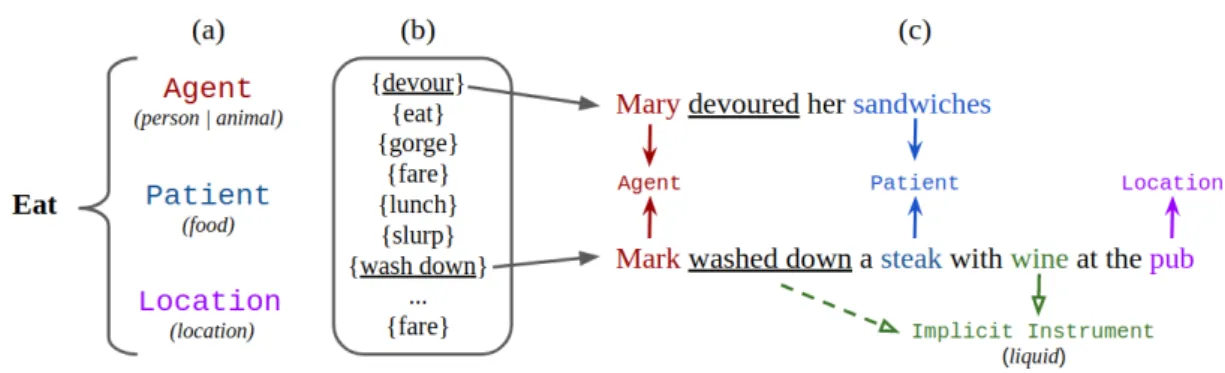
Figure 1: Structure of the EATframe. The colored roles on the left (a) constitute the Predicate Argument Structure of the frame and their respective selectional preferences within round brackets. Box (b) shows a sample of the frame’s synsets (a synonym per synset is shown). In the example sentences (c), we show the head words colored according to their semantic roles. While in the first sentence the synset {devour} does not project theLocation, the synset {wash down} projects an implicitInstrumentwith its synset-level selectional preference(liquid).
To get the best of the three worlds, there have been attempts to map the aforementioned re-sources to each other. To our knowledge the most popular endeavors are SemLink (Palmer, 2009;
Bonial et al.,2013) and Predicate Matrix (De La-calle et al., 2014), the latter being an extension of the former via automatic methods. However, while the main drawback of SemLink is coverage, the Predicate Matrix suffers from quality issues.
Both the foregoing limitations are addressed in VerbAtlas, the manually-curated resource that we present in this paper. With VerbAtlas we pro-vide the community with a resource that improves the main features of the existing inventories of verbs, while also adding new semantic informa-tion. Compared to FrameNet, VerbAtlas has fewer frames and roles while at the same time present-ing full coverage in terms of concepts (cf. Table
1). VerbNet’s roles, instead, provided inspiration for our role repository, but we reduced the num-ber of roles from 39 to 25 in order to alleviate data sparsity issues. PropBank was mapped to VerbAtlas synsets and roles in order to enable SRL systems to exploit its additional semantic infor-mation and improve verb coverage. Moreover, in contrast to the other resources, the use of Word-Net synsets makes VerbAtlas able to scale multi-lingually through resources such as BabelNet.
In Section3we introduce VerbAtlas and its fea-tures; in Section4 we explain how this resource was built and organized. Finally, Section 5 vali-dates VerbAtlas experimentally in the SRL task. 3 VerbAtlas
We now introduce VerbAtlas, a new verbal se-mantic resource structured into frames which
group semantically-coherent synsets from Word-Net (v3.0). A VerbAtlas frame is a cluster of verb meanings expressing similar semantics, which ex-pands upon the frame notion of FrameNet. Each frame is provided with an argument structure that generalizes over all the synsets in the frame plus preferential selections for each semantic role. Fur-thermore, synsets are enriched with novel seman-tic information. In Figure1we show the structure of the EAT frame in VerbAtlas, which we use as a running example to illustrate the new features in our work and compare them with current verbal resources.
3.1 Frame organization
We define a frame in VerbAtlas as a cluster of WordNet synsets that, with different shades of meaning, express a certain scenario. For instance, the EAT frame, an excerpt of which is shown in Figure1(b), comprises all the synsets specializing the general scenario of "eating", including synsets such as {eat}, {devour, guttle, raven, pig}, etc.
This organization of frames is intended to overcome the limitations affecting VerbNet and FrameNet. In fact, while the former organizes verbs by syntactic rather than semantic behavior, the latter is affected by the sparsity of 5,200 ver-bal senses (i.e., lexical units) distributed across frames. Instead, PropBank’s framesets corre-spond to a coarse-grained sense of a verb, but each frameset expresses its own separate argument structure.
Differently from the other resources, VerbAtlas frames are organized into 466 wide-coverage and semantically-coherent clusters (cf. Table1) which provide cross-frame argument structures.
3.2 Semantic roles
A limit in PropBank is its inventory of so-called proto-roles (Arg0, Arg1, etc., with the first two roughly corresponding, respectively, to a proto-agent and a proto-patient (Dowty, 1991)), which does not provide human-readable labels and is predicate-specific (i.e., the same label does not necessarily depict the same semantic relation across predicates).
While PropBank roles do not provide clear explicit semantics, FrameNet roles are ex-plicit but frame-specific (e.g., Ingestor and
Ingestibles for the "Ingestion" frame, or
Impactor and Impactee for the "Impact" frame). This produces a fine-grained role inven-tory that makes it difficult for SRL systems to generalize across frames. In VerbAtlas we follow VerbNet and take a middle-ground approach: our inventory of 25 semantic roles is inspired by Verb-Net, whose 39 labels (like Agent, Patient,
Time, etc.) are explicit, cross-frame and domain-general. The rationale is that these features enable neural networks employed in the SRL task to gen-eralize across frames in a consistent way, as we show in Section5.2. For example, we can tag the arguments of different VerbAtlas frames – such as EAT, HIT and CONQUER – with just two roles, namely:AgentandPatient.
3.3 Prototypical Argument Structure
Each VerbAtlas frame expresses a Prototypical Ar-gument Structure (PAS) that generalizes over all the synsets in a particular frame. The PAS speci-fies a roleset that defines the frame’s overall mean-ing (e.g., in Figure 1(a) Agent, Patient and
Location). In Figure 1(c) we show two sen-tences annotated with argument roles.
Since we do not distinguish between core roles and adjuncts, we decided to also include in the various PAS roles which might be projected op-tionally by argument structures that are nonethe-less present in the scenario evoked by the frame. For instance, the inclusion of theLocationrole in the PAS of the EAT example ensures a robust descriptiveness of the PAS across synsets in the same frame.
3.4 Selectional preferences
To narrow down the number of candidates for a particular argument slot and provide further se-mantic structure, the sese-mantic role of the PAS
has been manually labeled with selectional pref-erences from a set of 116 macro-concepts. Our selectional preferences are defined by WordNet synsets whose hyponyms are expected to be likely candidates to the corresponding argument slot, a strategy similar to that of Agirre and Martinez
(2002) which, instead, was algorithm-based. Consider again the EAT frame and its PAS:
Agent,Patient,Location(Figure1(a)). In this frame, most of the example sentences from the WordNet synsets express aPatientlike "cake", "meat" or "banana", thus, since their common hy-pernym is "food", we provided the PAS with the information that thePatientprototypically ex-pects hyponyms of the {food, solid food} synset. The Locationrole is labeled with its homony-mous {location} synset given its generality. 3.5 Synset-level semantic information
To enrich the semantic representation of synsets, VerbAtlas provides semantic and pragmatic (English-specific) information regarding implicit (1,028 labels), shadow and default arguments (2,979 labels) inspired byPustejovsky(1995) and inferred from synset’s glosses and examples. To our knowledge, the following information is new in a large-scale verbal resource such as ours:
• implicit arguments, i.e., implicit in the ar-gument structure of the verb but not always syntactically expressed. Consider the synset {overleap, vault} in our JUMP frame: since its gloss is "Jump across or leap over (an ob-stacle)", we know that thePatientof this verb can be a hyponym of {obstacle}, there-fore implying a selectional preference on the role with the {obstacle} synset.
• shadow and default arguments: the former is incorporated in the meaning of the verb but not syntactically expressed. An exam-ple from the EAT frame is {eat in, dine in} ("Eat at home"). This synset is tagged with the shadow argumentLocation= {home}, since the latter is not expressed syntactically. On the other hand, default arguments are log-ically implied but not syntactlog-ically expressed. These are also tagged as shadow arguments. For instance, the synset {deliver} (as in "Our local supermarket delivers") has the label
Patient= {grocery} to provide the com-monsense information that what a supermar-ket usually delivers is groceries.
We are aware of the problems raised about Pustejovsky’s framework of analysis (Fodor and Lepore,1998), but we believe that this new infor-mation, if properly exploited, would be fruitful for better meaning representations.
3.6 Linkage to PropBank and multilingual resources
To allow a straightforward applicability to and evaluation of VerbAtlas on semantic tasks based on PropBank, such as SRL, each frameset and roleset in the CoNLL-2009 dataset was mapped to the corresponding VerbAtlas frame and roleset. This mapping was done starting from the Predicate Matrix (De Lacalle et al., 2014) and then manu-ally corrected and augmented. Finmanu-ally, we aligned PropBank’s roles with the corresponding roles in VerbAtlas PAS (e.g., Arg0 and Arg1 of Prop-Bank’s eat.01 frameset were mapped, respectively, to the VerbAtlas PAS rolesAgentandPatient
of the frame EAT).
Moreover, thanks to the use of WordNet and its semantic nature, VerbAtlas can easily scale to ar-bitrary languages. This can be achieved by lever-aging BabelNet (Navigli and Ponzetto, 2010), a lexical-semantic resource that provides multilin-gual synsets in 284 different languages linked to WordNet itself. As a result, VerbAtlas can be used in virtually any language, in contrast to Prop-Bank and other resources which are inherently language-specific and require considerable human intervention in each new language.
Finally, the above implies that if there is a ver-bal repository for one of the languages linked to the aforementioned resources, its argument struc-tures can be seamlessly aligned with the PAS of VerbAtlas, as well as with VerbAtlas frames. 4 Methodology
4.1 Bottom-up approach
The manual construction of VerbAtlas was per-formed in a bottom-up fashion. Rather than forc-ing synsets into a predetermined set of frames, we started the clustering process from the full inven-tory of 13,767 WordNet synsets, which represent the building blocks of VerbAtlas frames. This al-lowed us to induce the semantics of 466 frames (with an average of 29.5 synsets per frame) and make VerbAtlas consistent both in terms of lexical semantics and the frame’s argument structures.
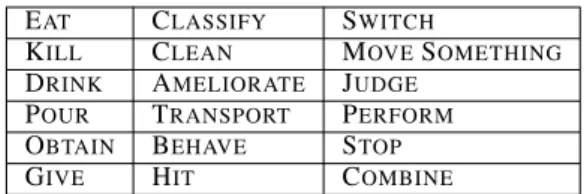
EAT CLASSIFY SWITCH
KILL CLEAN MOVESOMETHING
DRINK AMELIORATE JUDGE
POUR TRANSPORT PERFORM
OBTAIN BEHAVE STOP
GIVE HIT COMBINE
Table 2: Frames with the highest number of synsets.
4.2 Creation of frames
VerbAtlas frames were induced via semantic sim-ilarity between synsets. During multiple iterations over the verb inventory, if two or more synsets were perceived as similar, namely, if they shared features like the purpose of the action and the participants in the action (Hill et al.,2015) (e.g., "dine" and "lunch"), they were clustered together to form a new semantically-coherent frame. A one-synset-one-frame strategy was used to avoid any future mapping problem with other resources. The process is based on synset-by-synset human inspection. Two synsets are clustered together in the same frame if they express semantically-similar scenarios. For example, the verbs “kill” and “slaughter” share similar participants in the action (an Agent who kills/slaughters; a
Patientwho is killed/slaughtered) and purpose (Agent makesPatientdie), so they are clus-tered into the KILLframe.
At the end of the first iteration, we checked the resulting frames and named them according to the common action implied by the synsets contained therein. For example, the EATframe (Figure1(b)) is composed of synsets that depict different kinds of action implying eating, like {devour, . . . , pig} and {gorge, . . . , glut}. In Table2 we report the frames with the highest number of verb synsets.
To validate the resulting frames we adopted a strategy similar toHovy et al.(2006): we provided 3 linguists not involved in the clustering with a random sample of 1000 frame-synset pairs and asked them if the action expressed by the synset was implied by that expressed by the frame. We it-erated over the inventory various times and moved the synsets from one frame to another until the Co-hen’s Kappa coefficient (Eugenio and Glass,2004) of their (yes or no) agreement wasκ≥0.80. Once this value was attained, we finalized the overall clustering and the resulting frames.
4.3 Establishing explicit semantic roles Inspired by existing research on semantic roles (Bonial et al., 2011; Allen and Teng, 2018),
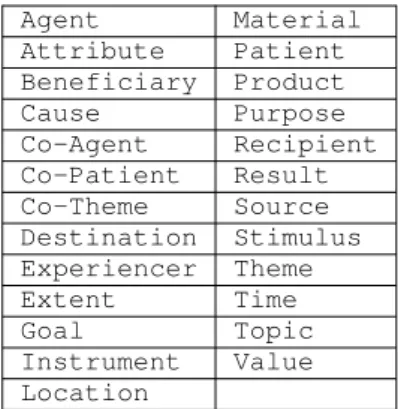
Agent Material Attribute Patient Beneficiary Product Cause Purpose Co-Agent Recipient Co-Patient Result Co-Theme Source Destination Stimulus Experiencer Theme Extent Time Goal Topic Instrument Value Location
Table 3: List of VerbNet roles which make up the VerbAtlas role inventory.
Affector Manner Axis Path Context Pivot Duration Precondition Final_Time Predicate Initial_Location Reflexive Initial_State Trajectory
Table 4: List of VerbNet roles unused in VerbAtlas.
VerbAtlas implements VerbNet’s human-readable role labels across its frames and merges together some VerbNet roles which can be seen as comple-mentary. For example, Initial_Location
and Initial_State are subsumed by
Source. The hunch is that we can consider them as playing the same role but in different scenarios: the former is the Sourcefor verbs of change of location, while the latter is theSourcefor verbs of change of state. Furthermore, in VerbAtlas we did not want to use poorly instantiated roles (e.g.,
Affector), therefore 14 of the roles (Table 4) were subsumed by coarser and more common roles (e.g., Agent in place of Affector, see Table3).
4.4 Rationale of a Prototypical Argument Structure
We defined as "prototypical" an argument struc-ture capable of being applied to all the synsets in a frame. To achieve this, each PAS was de-fined at the end of the first iteration over the in-ventory of synsets and constantly adjusted until the last iteration. The initial PAS was inspired by the argument structure of the common verbal con-cept implied by the synsets constituting the frame. For instance, in the case of BETRAY,Agentand
Patient. The PAS was later expanded due to synsets inside the frame that projected additional arguments (e.g., theGoalrole of {defect, desert}
as in the sentence "The reporter defected to an-othernetwork").
4.5 Rationale of selectional preferences Each semantic role of a PAS was provided with selectional preferences from a set of 116 synsets. The set was created by generalizing across the ar-guments in the example sentences of each synset in a given frame. The result for each PAS argu-ment was one or more hypernyms in the WordNet taxonomy which were common across the frame synsets.
In contrast to VerbNet selectional restrictions, the selectional preferences in VerbAtlas do not re-strict the occurrence of words with a particular fea-ture (e.g., solid, liquid, etc.), rather, they suggest the most prototypical hypernym(s) for a given ar-gument. We opted for preferences instead of re-strictions to not exclude the potential metaphorical use of a verb.
5 Experiments
In previous sections we discussed the qualitative and structural advantages of VerbAtlas compared to existing resources. Because, in principle, a new linguistic resource might seem to provide an arbi-trary contribution, we also provide here an experi-mental validation of its usefulness in an SRL task. First, we present our experimental setup (Section
5.1) and then discuss our results (Section5.2). 5.1 Experimental setup
Goal We argue that the quality and wealth of information in VerbAtlas can effectively improve the performance of an existing, high-performance SRL system likeCai et al.(2018).
Datasets We performed our experiments on the English part of CoNLL-2009 in-domain and out-of-domain datasets (Hajiˇc et al., 2009) designed for the dependency-based SRL task and whose annotations concern predicate argument structures from PropBank and nominal argument structures from NomBank (Meyers et al.,2004). The dataset consists of 39,279 sentences and 958,167 tokens (18.7% of which are argument bearers).
Through this experiment we aim to show that the additional information provided by VerbAtlas frames and semantic roles improves the perfor-mance of a neural network on the in-domain test set. We also aim to demonstrate a better ability to generalize on the out-of-domain dataset.
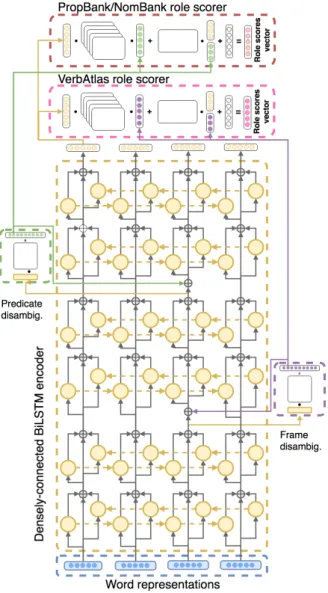
Figure 2: Overview of the model architecture. From bottom to top, a sequence of word embeddings is fed to a densely-connected BiLSTM encoder where the out-put of each encoding layer is concatenated with its in-put. The predicate hidden representation from the sec-ond BiLSTM layer is used for VerbAtlas frame disam-biguation (right), whereas the predicate hidden repre-sentation from the fourth BiLSTM layer is used for PropBank predicate disambiguation (left). The top-most output of the BiLSTM encoder is used together with the output of the PropBank predicate disambigua-tion layer to obtain a PropBank-style SRL output, and together with the output of the VerbAtlas frame disam-biguation layer to obtain a VerbAtlas-style SRL output.
Baseline model Our baseline model in Figure2
is built on top of the syntax-agnostic model pro-posed byCai et al.(2018) in that it is mainly com-posed of a word representation layer, a sequence encoder and a biaffine attentional role scorer. A key difference is that our model features a multi-output layer that returns PropBank (PB) and Nom-Bank (NB) labels (i.e., framesets and their roles)
and, if the predicate is a verb, also VerbAtlas la-bels (i.e., frames and their roles). With this design choice, the output of our model can be directly compared to the output of previous SRL models. At the same time, our model achieves a deeper and more general understanding of the relations be-tween a PB or NB predicate and its arguments by learning from the corresponding VerbAtlas frame and its semantically-coherent roles.
Formally, our model is built on top of the fol-lowing components:
• A word representation layer that, given a sentence s = hw1, w2, . . . , wni, builds a sequence of word representations x =
hx1,x2, . . . ,xni where xi is an embedding representing wi. Each xi is the result of the concatenation of a pre-trained word em-beddingept, and the following trainable vec-tors: a word embedding ew, a lemma em-bedding el, a POS embedding epos, and a predicate lemma embedding epred (ac-tive only if wi is a predicate). Formally: xi=ept⊕ew⊕el⊕epos⊕epred. We use GloVe embeddings (Pennington et al.,2014) as our underlying pre-trained word embed-dings.
• A densely-connected BiLSTM encoder that, given a sequencex of word representa-tions, returns a sequence of encodings y =
hyi = BiLSTM(xi;x) : ∀i ∈ {1, . . . , n}i, where yi is a dynamic representation of xi with respect to the context defined by the whole sequence x. In a densely-connected BiLSTM encoder, the output of each layer is concatenated with the input of the same layer to mitigate the vanishing gradient prob-lem. Ifhki is the encoding of thek-th layer for xi, thenhki+1 =hki ⊕LSTMf(hki;hk1:i−1)⊕ LSTMb(hki;hki+1:n), and yi = hmi where
m = 6 is the final BiLSTM layer, while LSTMf and LSTMb are the forward and backward LSTM transformations.
• A frame disambiguation layer that, given the BiLSTM encoding yipred of a predicate
wpred at thei-th encoder layer (withi = 2), disambiguateswpredwith a VerbAtlas frame
f, returning a trainable frame embeddingef: hipred=ReLU(W0·yipred+b0)
• A predicate disambiguation layer that, given the BiLSTM encodingyjpredof a pred-icate wpred at the j-th encoder layer (with
j = 4) and the frame embeddingef, disam-biguateswpred with a PB or NB framesetp, returning a trainable predicate embeddingep:
hjpred=ReLU(W00·(yjpred⊕ef) +b00) p=argmax(Wp·hjpred+bp)
• A biaffine attentional PB and NB role scorerthat, given a BiLSTM encodingyifor a wordwi and a predicate embeddingep, re-turns a vectorspi of PB/NB role scores forwi with respect top in a similar fashion to Cai et al.(2018). Formally:
spi =y>i ·WrolePB ·ep+UrolePB (yi⊕ep) +brolePB • A biaffine attentional VerbAtlas role scorerthat, given a BiLSTM encodingyifor a wordwiand a frame embeddingef, returns a vector sfi of VerbAtlas role scores for wi with respect tof. Formally:
sfi =y>i ·WroleVA ·ef+UroleVA (yi⊕ef) +broleVA We found it beneficial to interleave the frame disambiguation layer and the predicate disam-biguation layer within the BiLSTM encoder ers, enhancing the input of the upper encoder lay-ers with the corresponding frame and predicate embeddings. Finally, our model loss is defined as:
ltotal =lPropBank/NomBank roles + lVerbAtlas roles+ lpredicate disambiguation + lframe disambiguation
Since the choice of hyperparameters for an LSTM-based model can significantly affect results (Reimers and Gurevych, 2017), we trained our baseline using the same values as in Cai et al.
(2018) unless otherwise stated. 5.2 Results
In-domain SRL Table 5 reports the results of our syntax-agnostic baseline model on the CoNLL-2009 in-domain test set. Not only does our model outperform the syntax-agnostic model of Cai et al. (2018) by a significant margin (ac-cording to a χ2 test, p < 0.05, on precision and recall) with a 0.4% F1 improvement, but it also slightly outperforms the syntax-aware model ofLi
Syntax-aware system P R F1
Roth and Lapata (2016) 88.1 85.3 86.7 Marcheggiani and Titov (2017) 89.1 86.8 88.0 He et al. (2018) 89.7 89.3 89.5 Li et al. (2018) 90.3 89.3 89.8 Syntax-agnostic system P R F1 Marcheggiani et al. (2017) 88.7 86.8 87.7 He et al. (2018) 89.5 87.9 88.7 Cai et al. (2018) 89.9 89.2 89.6 This work 90.5 89.5 90.0
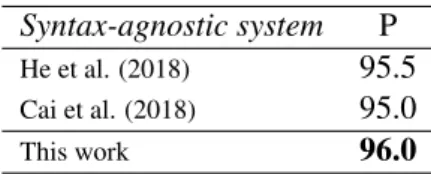
Table 5: Results on the English in-domain test. Syntax-agnostic system P He et al. (2018) 95.5 Cai et al. (2018) 95.0
This work 96.0
Table 6: Predicate disambiguation results on the En-glish in-domain test. In CoNLL-2009 predicates are already identified, hence we only report predicate dis-ambiguation precision. Syntax-agnostic system P R F1 Marcheggiani et al. (2017) 79.4 76.2 77.7 He et al. (2018) 81.7 76.1 78.8 Cai et al. (2018) 79.8 78.3 79.0 This work 81.1 78.4 79.7
Table 7: Results on the English out-of-domain test.
et al.(2018) with a 0.2% F1improvement. We re-call that the main difference between our baseline model and that ofCai et al.(2018) lies in the addi-tional VerbAtlas frame disambiguation layer and role scorer. This demonstrates the boost provided by VerbAtlas in PropBank/NomBank-based SRL. In-domain predicate disambiguation Remark-ably, as shown in Table6, our model outperforms the previously reported best scores in the predicate disambiguation subtask, scoring 96.0% in preci-sion for the in-domain test set and reporting a 1.0% improvement over Cai et al. (2018) and a 0.5% improvement overHe et al.(2018).
Out-of-domain SRL The results of our baseline model on the out-of-domain SRL CoNLL-2009 dataset are shown in Table 7. Our system im-proves the results reported byCai et al.(2018) by 0.7% F1, proving that using VerbAtlas improves the model’s ability to generalize across domains.
F1evaluated on verbs + nouns only verbs
This work 90.0 91.1
withoutVerbAtlas 89.5 90.5
withoutPBnorNB – 90.9
Table 8: The model shows a significant F1 decrease when it is trained without exploiting VerbAtlas frames and roles (second row) falling in line with Cai et al. (2018) (89.5% vs 89.6%, respectively). On the con-trary, removing the PropBank role scorer leads to a neg-ligible performance drop (last row).
5.3 Analysis
Our main experiment proved that a semantics-focused resource for verbal predicates such as VerbAtlas can be successfully employed for CoNLL-like SRL datasets that include a mix of nominal and verbal predicates. But what is the contribution of VerbAtlas (i.e., of its clustered frames and semantically-coherent roles) to the overall performance? How does a VerbAtlas-only model fare when evaluated solely on verbal predicates against a PropBank-only model? To answer these questions, we evalu-ated the model in two further settings.
A first study aimed at quantifying the boost in performance the model gets from the use of VerbAtlas. Removing the VerbAtlas frame dis-ambiguation layer and role scorer from our model significantly decreases (according to a χ2 test, p < 0.05, on precision and recall) the overall per-formance in F1 score by 0.5%, as reported in Ta-ble8(left column), with results that are compara-ble to those ofCai et al.(2018) (89.5% vs 89.6% F1, Tables 8 and 5, respectively). This proves that the model with VerbAtlas achieves a better understanding of semantic roles, thanks to using the VerbAtlas frame disambiguation layer and role scorer.
A second study aimed at comparing PropBank and VerbAtlas on their common ground, i.e., their coverage and organization of verb meanings into framesets and frames, respectively. Table8(right column) shows that removing the PropBank bi-affine role scorer leads to a negligible performance drop (0.2% F1) in how it performs on argument labeling of verb predicates using only the seman-tic roles of VerbAtlas mapped at the output layer to PropBank roles (see Section3.6); we note that the higher number of roles in VerbAtlas makes the argument labeling problem potentially harder. In contrast, when VerbAtlas is removed, the drop in
performance is noteworthy, with a 0.6% decrease in F1on SRL of verbal predicates.
6 Conclusions and Future Work
In this paper we presented VerbAtlas, a new large-scale verbal semantic resource which pro-vides generalizing argument structures with cross-frame semantic roles. The resource is available at
http://verbatlas.org.
In contrast to other verb repositories, VerbAtlas offers full coverage of the English verbs and ad-dresses the issues of current predicate resources, while at the same time providing linkage to Word-Net and PropBank. This makes the resource fully compatible with previous datasets and scalable to arbitrary languages thanks to BabelNet.
While the frame creation process resulted in a strong agreement between annotators, we further validated the quality of VerbAtlas experimentally by showing that the integration of its frame infor-mation together with its explicit semantic roles en-ables a neural architecture to improve its perfor-mance on the Semantic Role Labeling task. This improvement translates across domains, demon-strating the robustness and variety of the knowl-edge provided in our resource.
As future work, we plan to take full advan-tage of the novel semantic features available in VerbAtlas, such as wide-coverage selectional pref-erences and synset-level information, by exploit-ing them in multilexploit-ingual SRL and Word Sense Dis-ambiguation tasks. Our plans include integrating the selectional preferences from SyntagNet (Maru et al., 2019), a new, large-scale lexical-semantic combination resource. We also plan to extend our methodology to nouns and adjectives, in a similar fashion to (O’Gorman et al.,2018) and connect the resulting frames to those in VerbAtlas.
Acknowledgments
The authors gratefully acknowledge the support of the ERC Consolida-tor Grant MOUSSE No. 726487 and the ELEXIS project No. 731015 un-der the European Union’s Horizon 2020 research and innovation pro-gramme.
This work was supported in part by the MIUR under grant “Dipartimenti di eccellenza 2018-2022” of the Department of Computer Science of Sapienza University.
References
Eneko Agirre and David Martinez. 2002. Integrating selectional preferences in WordNet. InProceedings of First International WordNet Conference. Mysore (India), pages 1–9.
Izaskun Aldezabal, María Jesús Aranzabe, Arantza Díaz de Ilarraza Sánchez, and Ainara Estarrona. 2010. Building the Basque PropBank. In
Proceedings of LREC.
James Allen and Choh Man Teng. 2018. Putting se-mantics into semantic roles. In Proceedings of the Seventh Joint Conference on Lexical and Computa-tional Semantics, pages 235–244.
Olga Babko-Malaya. 2005. PropBank annotation guidelines. URL: http://verbs.colorado.edu. Collin F. Baker, Charles J. Fillmore, and John B. Lowe.
1998. The Berkeley FrameNet project. In Proceed-ings of the 17th International Conference on Com-putational Linguistics, pages 86–90. Association for Computational Linguistics.
Laura Banarescu, Claire Bonial, Shu Cai, Madalina Georgescu, Kira Griffitt, Ulf Hermjakob, Kevin Knight, Philipp Koehn, Martha Palmer, and Nathan Schneider. 2013. Abstract Meaning Representation for Sembanking. InProceedings of the 7th Linguis-tic Annotation Workshop and Interoperability with Discourse, pages 178–186.
Emanuele Bastianelli, Giuseppe Castellucci, Danilo Croce, and Roberto Basili. 2013. Textual inference and meaning representation in human robot interac-tion. InProceedings of the Joint Symposium on Se-mantic Processing. Textual Inference and Structures in Corpora, pages 65–69.
Rajesh Bhatt, Bhuvana Narasimhan, Martha Palmer, Owen Rambow, Dipti Sharma, and Fei Xia. 2009. A multi-representational and multi-layered treebank for Hindi-Urdu. In Proceedings of the Third Lin-guistic Annotation Workshop (LAW III), pages 186– 189.
Francis Bond and Ryan Foster. 2013. Linking and extending an open multilingual Wordnet. In Pro-ceedings of the 51st Annual Meeting of the Associa-tion for ComputaAssocia-tional Linguistics, volume 1, pages 1352–1362.
Claire Bonial, William Corvey, Martha Palmer, Volha V Petukhova, and Harry Bunt. 2011. A hier-archical unification of LIRICS and verbnet semantic roles. In2011 IEEE Fifth International Conference on Semantic Computing, pages 483–489. IEEE. Claire Bonial, Kevin Stowe, and Martha Palmer. 2013.
Renewing and revising SemLink. In Proceedings of the 2nd Workshop on Linked Data in Linguistics (LDL-2013): Representing and linking lexicons, ter-minologies and other language data, pages 9–17.
Jiaxun Cai, Shexia He, Zuchao Li, and Hai Zhao. 2018. A full end-to-end semantic role labeler, syntactic-agnostic over syntactic-aware? In Proceedings of the 27th International Conference on Computational Linguistics, pages 2753–2765.
Xavier Carreras and Lluís Màrquez. 2005. Introduc-tion to the CoNLL-2005 Shared Task: Semantic Role Labeling. In Proceedings of the Ninth Con-ference on Computational Natural Language Learn-ing, CONLL ’05, pages 152–164, Stroudsburg, PA, USA. Association for Computational Linguistics. Maddalen Lopez De Lacalle, Egoitz Laparra, and
Ger-man Rigau. 2014. Predicate Matrix: extending Sem-Link through WordNet mappings. InProceedings of LREC, pages 903–909.
David Dowty. 1991. Thematic proto-roles and argu-ment selection.Language, 67(3):547–619.
Magali Sanches Duran and Sandra Maria Aluísio. 2011. PropBank-Br: a Brazilian Portuguese corpus annotated with semantic role labels. InProceedings of the 8th Brazilian Symposium in Information and Human Language Technology.
Barbara Di Eugenio and Michael Glass. 2004. The kappa statistic: A second look. Computational lin-guistics, 30(1):95–101.
Christiane Fellbaum et al. 1998. WordNet: An elec-tronic database. MIT Press, Cambridge, MA. Charles J. Fillmore. 1976. Frame semantics and the
na-ture of language. Annals of the New York Academy of Sciences, 280(1):20–32.
Charles J. Fillmore. 1982. Frame semantics. Linguis-tics in the Morning Calm, pages 111–137.
Jerry A. Fodor and Ernie Lepore. 1998. The empti-ness of the lexicon: reflections on James Puste-jovsky’s The Generative Lexicon. Linguistic In-quiry, 29(2):269–288.
Daniel Gildea and Daniel Jurafsky. 2002. Automatic labeling of semantic roles. Computational linguis-tics, 28(3):245–288.
Jan Hajiˇc, Massimiliano Ciaramita, Richard Johans-son, Daisuke Kawahara, Maria Antònia Martí, Lluís Màrquez, Adam Meyers, Joakim Nivre, Sebastian Padó, Jan Štˇepánek, et al. 2009. The CoNLL-2009 shared task: Syntactic and semantic dependencies in multiple languages. InProceedings of the Thir-teenth Conference on Computational Natural Lan-guage Learning: Shared Task, pages 1–18. Associa-tion for ComputaAssocia-tional Linguistics.
Silvana Hartmann, Ilia Kuznetsov, Teresa Martin, and Iryna Gurevych. 2017. Out-of-domain FrameNet semantic role labeling. InProceedings of the 15th Conference of the European Chapter of the Associa-tion for ComputaAssocia-tional Linguistics: Volume 1, Long Papers, pages 471–482.
Katri Haverinen, Jenna Kanerva, Samuel Kohonen, Anna Missilä, Stina Ojala, Timo Viljanen, Veronika Laippala, and Filip Ginter. 2015. The Finnish proposition bank. Language Resources and Eval-uation, 49(4):907–926.
Shexia He, Zuchao Li, Hai Zhao, and Hongxiao Bai. 2018. Syntax for semantic role labeling, to be, or not to be. InProceedings of the 56th Annual Meeting of the Association for Computational Linguistics (Vol-ume 1: Long Papers), volume 1, pages 2061–2071. Felix Hill, Roi Reichart, and Anna Korhonen. 2015.
Simlex-999: Evaluating semantic models with (gen-uine) similarity estimation. Computational Linguis-tics, 41(4):665–695.
Eduard Hovy, Mitchell Marcus, Martha Palmer, Lance Ramshaw, and Ralph Weischedel. 2006. Ontonotes: the 90% solution. InProceedings of the human lan-guage technology conference of the NAACL, Com-panion Volume: Short Papers, pages 57–60. Associ-ation for ComputAssoci-ational Linguistics.
Karin Kipper-Schuler. 2005. VerbNet: A broad-coverage, comprehensive verb lexicon. University of Pensylvania.
Beth Levin. 1993. English verb classes and alterna-tions: A preliminary investigation. University of Chicago press.
Zuchao Li, Shexia He, Jiaxun Cai, Zhuosheng Zhang, Hai Zhao, Gongshen Liu, Linlin Li, and Luo Si. 2018. A unified syntax-aware framework for seman-tic role labeling. InProceedings of the 2018 Con-ference on Empirical Methods in Natural Language Processing, pages 2401–2411.
Ding Liu and Daniel Gildea. 2010. Semantic role features for machine translation. In Proceedings of the 23rd International Conference on Computa-tional Linguistics, pages 716–724.
Marco Maru, Federico Scozzafava, Federico Martelli, and Roberto Navigli. 2019. SyntagNet: Challeng-ing Supervised Word Sense Disambiguation with Lexical-Semantic Combinations. InProceedings of EMNLP-IJCNLP 2019.
Adam Meyers, Ruth Reeves, Catherine Macleod, Rachel Szekely, Veronika Zielinska, Brian Young, and Ralph Grishman. 2004. The NomBank project: An interim report. In Proceedings of the Work-shop Frontiers in Corpus Annotation at HLT-NAACL 2004.
Roberto Navigli. 2018. Natural Language Under-standing: Instructions for (present and future) use. InProceedings of the Twenty-Seventh International Joint Conference on Artificial Intelligence (IJCAI 2018), pages 5697–5702, Stockholm, Sweden. Roberto Navigli and Simone Paolo Ponzetto. 2010.
BabelNet: Building a very large multilingual se-mantic network. InProceedings of the 48th Annual
Meeting of the Association for Computational Lin-guistics, pages 216–225. Association for Computa-tional Linguistics.
Tim O’Gorman, Sameer Pradhan, Martha Palmer, Ju-lia Bonn, Kathryn Conger, and James Gung. 2018. The new Propbank: Aligning Propbank with AMR through POS unification. InProceedings of LREC. Martha Palmer. 2009. Semlink: Linking Propbank,
VerbNet and FrameNet. InProceedings of the gen-erative lexicon conference, pages 9–15. GenLex-09, Pisa, Italy.
Martha Palmer, Olga Babko-Malaya, Ann Bies, Mona T. Diab, Mohamed Maamouri, Aous Man-souri, and Wajdi Zaghouani. 2008. A pilot arabic Propbank. InLREC.
Martha Palmer, Daniel Gildea, and Paul Kingsbury. 2005. The Proposition Bank: An annotated cor-pus of semantic roles. Computational linguistics, 31(1):71–106.
Jeffrey Pennington, Richard Socher, and Christo-pher D. Manning. 2014. Glove: Global vectors for word representation. In Proceedings of the 2014 Conference on Empirical Methods in Natural Lan-guage Processing, EMNLP 2014, pages 1532–1543. ACL.
James Pustejovsky. 1995. The Generative Lexicon. MIT Press, Cambridge MA.
Nils Reimers and Iryna Gurevych. 2017. Report-ing score distributions makes a difference: Perfor-mance study of LSTM-networks for sequence tag-ging. In Proceedings of the 2017 Conference on Empirical Methods in Natural Language Process-ing, EMNLP 2017, Copenhagen, Denmark, Septem-ber 9-11, 2017, pages 338–348.
Gözde Gül ¸Sahin and E¸sref Adalı. 2018. Annotation of semantic roles for the Turkish proposition bank.
Language Resources and Evaluation, 52(3):673– 706.
Carina Silberer and Manfred Pinkal. 2018. Ground-ing semantic roles in images. InProceedings of the 2018 Conference on Empirical Methods in Natural Language Processing, pages 2616–2626.
Mariona Taulé, Maria Antònia Martí, and Marta Re-casens. 2008. Ancora: Multilevel annotated corpora for Catalan and Spanish. InProceedings of LREC. Nianwen Xue and Martha Palmer. 2003.
Annotat-ing the propositions in the Penn Chinese Treebank. In Proceedings of the Second Workshop on Chi-nese Language Processing, SIGHAN 2003, Sapporo, Japan, July 11-12, 2003.