Technische Berichte Nr. 60
des Hasso-Plattner-Instituts für
Softwaresystemtechnik
an der Universität Potsdam
Understanding Cryptic
Schemata in Large
Extract-Transform-Load
Systems
Technische Berichte des Hasso-Plattner-Instituts für
Softwaresystemtechnik an der Universität Potsdam
Technische Berichte des Hasso-Plattner-Instituts für
Softwaresystemtechnik an der Universität Potsdam | 60
Alexander Albrecht | Felix Naumann
Understanding Cryptic Schemata in
Large Extract-Transform-Load Systems
Die Deutsche Nationalbibliothek verzeichnet diese Publikation in der
Deutschen Nationalbibliografie; detaillierte bibliografische Daten sind
im Internet über http://dnb.de/ abrufbar.
Universitätsverlag Potsdam 2012
http://verlag.ub.uni-potsdam.de/
Am Neuen Palais 10, 14469 Potsdam
Tel.: +49 (0)331 977 2533 / Fax: 2292
E-Mail: [email protected]
Die Schriftenreihe Technische Berichte des Hasso-Plattner-Instituts für
Softwaresystemtechnik an der Universität Potsdam wird herausgegeben
von den Professoren des Hasso-Plattner-Instituts für Softwaresystemtechnik
an der Universität Potsdam.
ISSN (print) 1613-5652
ISSN (online) 2191-1665
Das Manuskript ist urheberrechtlich geschützt.
Online veröffentlicht auf dem Publikationsserver der Universität Potsdam
URL http://pub.ub.uni-potsdam.de/volltexte/2012/6125/
URN urn:nbn:de:kobv:517-opus-61257
http://nbn-resolving.de/urn:nbn:de:kobv:517-opus-61257
Zugleich gedruckt erschienen im Universitätsverlag Potsdam:
ISBN 978-3-86956-201-8
Understanding Cryptic Schemata in
Large Extract-Transform-Load Systems
Alexander Albrecht and Felix Naumann Hasso Plattner Institute for Software Systems Engineering,
Prof.-Dr.-Helmert-Straße 2-3, 14482 Potsdam, Germany
{alexander.albrecht,felix.naumann}@hpi.uni-potsdam.de
Abstract. Extract-Transform-Load (Etl) tools are used for the cre-ation, maintenance, and evolution of data warehouses, data marts, and operational data stores.Etlworkflows populate those systems with data from various data sources by specifying and executing a DAG of trans-formations. Over time, hundreds of individual workflows evolve as new sources and new requirements are integrated into the system. The main-tenance and evolution of large-scaleEtlsystems requires much time and manual effort. A key problem is to understand the meaning of unfamiliar attribute labels in source and target databases andEtltransformations. Hard-to-understand attribute labels lead to frustration and time spent to develop and understandEtlworkflows.
We present a schema decryption technique to supportEtl developers in understanding cryptic schemata of sources, targets, andEtl trans-formations. For a given Etl system, our recommender-like approach leverages the large number of mapped attribute labels in existing Etl
workflows to produce good and meaningful decryptions. In this way we are able to decrypt attribute labels consisting of a number of unfamiliar few-letter abbreviations, such asUNP PEN INT, which we can decrypt to
UNPAID PENALTY INTEREST. We evaluate our schema decryption approach on three real-world repositories ofEtlworkflows and show that our ap-proach is able to suggest high-quality decryptions for cryptic attribute labels in a given schema.
Keywords: Etl, Data Warehouse and Repository, Data Integration
1
Cryptic Schemata
Etlsystems are visual programming tools that allow the definition of complex
workflows to extract, transform, and load heterogeneous data from one or more sources into a target database. Designing and maintaining Etl workflows re-quires significant manual work; the effort is up to 70% of the development cost in a typical data warehouse environment [8].Etlworkflows are stored in repos-itories to be executed periodically, e.g., daily or once a week. In the course of a complex data warehousing project up to several hundred Etl workflows are created by different individuals [1] and stored in such repositories. Moreover, the
createdEtlworkflows get larger and more complex over time. Cryptic schemata are a well-known problem in the context of data warehousing. The main reason for cryptic schemata is the tendency to assign compact attribute labels consisting of a number of domain-specific abbreviations and acronyms.
Example 1 (Cryptic Attribute Labels).Consider a repository ofEtlworkflows to extract, transform, and load data of anOltpsystem with attribute labels from the well-known Tpc-eschema [19]. With the to-be-generated decryption pairs hCO≈COMPANYiandhSP≈STANDARD, POORi, it would be easier for a developer who is unfamiliar with this schema to identify the semantics of attribute labels, such asCO SP RATE.
Manually finding decryption pairs is ineffective and time consuming. To illus-trate this problem, consider the attribute labelCO SP RATEfrom the previous ex-ample. As this attribute label is too specific to have a directly mapped attribute label as decryption in the givenEtlrepository, the developer has to look up all pairs of mapped attribute labels that give a hint on an appropriate decryption of tokensCOandSP. With over ten thousand pairs of mapped attribute labels in the evaluated Etlrepositories, manual schema decryption becomes infeasable. Readers are referred to Sec. 4 for a comprehensive overview of schema andEtl workflow characteristics in the given real-worldEtlrepositories.
In this paper, we regardEtlworkflows as transformation graphs of the well-known model introduced by Cui and Widom [7]. This model is generally appli-cable toEtlworkflows from commonEtltools: AnEtlworkflow is a directed acyclic transformation graph (DAG) and the topologically ordered graph struc-ture determines the execution order of the connected transformations. InEtl, most transformations are a generalization of relational operators supporting mul-tiple inputs and outputs. Two transformations are connected in the graph if one transformation is applied to the output obtained by the other transformation. Accordingly, attributes in the output schema of a transformation are connected to the corresponding attributes in the input schema of the subsequent trans-formations. We leverage these connected attribute labels in the existing Etl workflows as valuable source of information for automated schema decryption. We have observed that connected attributes with different labels often contain reasonable decryptions – often not for the entire label but for tokens within the labels. As cryptic attribute labels are often too specific to have a connected at-tribute label as decryption in the given Etlrepository, the problem is to pair portions of the cryptic attribute label with portions of more descriptive attribute labels to produce reasonable decryptions.
Example 2 (Connected Attribute Labels).Consider theEtlrepository from Ex-ample 1. Within someEtlworkflows, extracted source attributes were renamed in the succeeding transformation to provide a better readability. For exam-ple, the attribute labelCP COMP CO IDwas renamed toCOMPETITOR COMPANY ID
and CO CEO to COMPANY CEO. Thus, labels CO CEO and COMPANY CEO and labels
Understanding Cryptic Schemata in Large ETL Systems 3 As Etl tools allow the developer to drag-and-drop attribute labels from output to input schemata, there are many connected attributes with identical labels. But in large Etlrepositories there is also a large number of connected attributes having different labels. There are several reasons for this, such as (1) source-, lookup-, and target-schemata used in an Etl workflow are often created independently and thus contain different attribute labels; (2) a data warehouse schema based on instances of cryptic source schemata uses attributes consisting of more descriptive tokens to provide a better readability; (3) copy-and-paste of entire transformations is a common practice in Etldevelopment, which results in Etl sub-workflows connected to intermediate attributes with different labels.
In this paper, we focus only on attribute pairs between connected transforma-tions for schema decryption. We ignore the connectransforma-tions among attribute labels within a singleEtltransformation, because we observed that developers use no synonyms within a single transformation. Furthermore, our approach overcomes weaknesses in existing approaches, such as string and schema matching tech-niques. These methods lead to poor decryption results due to domain-specific abbreviations, acronyms, and tokens inEtlschemata. Moreover, it is infeasible to exploit data redundancies between different schemata to find pairs of corre-sponding attribute labels: The data created in the intermediateEtlprocessing steps is not persisted and we lack this helpful information. Re-executing and storing data from intermediate processing steps is an unrealistic assumption in a typical data warehouse scenario.
We make the following contributions: First, we introduce the concept of de-cryption pairs, as a practical approach for schema dede-cryption. Second, we identify desirable characteristics of decryption pairs to efficiently find decryption pairs leveraging the large number of mapped attribute labels in a given Etl reposi-tory. Third, experiments on three real-worldEtlrepositories show the accuracy and efficacy of our approach. Finally, we introduce a generalized technique for tokenization of attribute labels.
2
Using Connected Attributes for Decryption
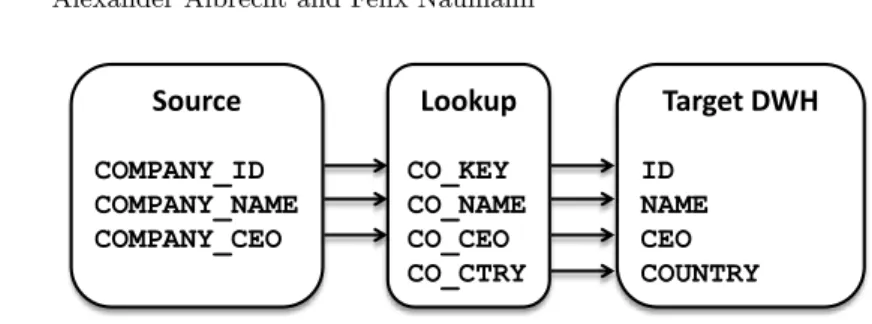
To illustrate our approach upfront we introduce a toy example of anEtl work-flow in Fig. 1. The Etlworkflow loads company data into a dimension table of a data warehouse. The extracted source data is the input of a lookup trans-formation. There, a company record is assigned a country from a lookup table using the company identifier as lookup key. Finally, the data is loaded into the data warehouse (DWH).
We observe that (1) attributes can be tokenized based on special characters. We also observe that (2) no two connected attributes have the same label. This is a typical situation if source, lookup, and target schemata were developed inde-pendently or for different purposes. Finally, we observe that (3) some attributes use abbreviations that appear in extended form in connected attribute labels. These observations were made repeatedly in our analysis of three real-worldEtl
Source COMPANY_ID COMPANY_NAME COMPANY_CEO Lookup CO_KEY CO_NAME CO_CEO CO_CTRY Target DWH ID NAME CEO COUNTRY
Fig. 1.An exemplaryETLworkflow
repositories, each with up to several hundred Etl workflows containing thou-sands of connected attribute pairs with different labels.
Our decryption approach finds reasonable decryptions within the givenEtl repository by making use of all three observations: For each Etlworkflow in theEtlrepository, we first break all labels into tokens, based on case-change or non-alphabetical separators. In the example, we tokenize using the underscore as separator. The second observation allows us to identify attribute labels with same or similar semantics. If data from an attribute in the source or preceding transformation is used as input for some attribute in the target or subsequent transformation, it is reasonable to assume that their two labels are semantically related – in most cases they are semantically equivalent. For instance,CO CTRY
andCOUNTRYin Fig. 1 are suchconnected attribute labels. Finally, using the third observation, we realize that the tokensCOandCOMPANYco-occur in multiple pairs of connected attribute labels, leading us to believe that they are synonymous (and not for instanceCOandCOUNTRY).
With the identified decryptions from the Etl repository, we can suggest decryptions for cryptic attribute labels of a given schema. For instance, given a schema with the cryptic attribute label CO ID, it is decrypted to COMPANY ID
using the decryptionhCO≈COMPANYiderived fromEtlworkflow in Fig. 1.
3
Schema Decryption
Our goal is to suggest “decryption pairs” to provide developers with a better understanding of cryptic schemata andEtlworkflows.
Definition 1 (ETL Workflow). An Etlworkflow comprises a set of trans-formations T with input and output schemata, interconnected with each other forming a directed acyclic graph (DAG). Let W = (V, E) be a DAG represent-ing an Etl workflow consisting of a set of vertices V representing the involved transformations. The edges e∈ E ⊆V ×V connect the output schema of one transformation with the input schema of another transformation, i.e., an edgee
Understanding Cryptic Schemata in Large ETL Systems 5 Input Schema DEBT RT,RESID VAL AT RISK,UNP PEN INT
Top-5 Decryption Pairs hUNP≈UNPAIDi,hINT≈INTERESTi,hPEN≈PENALTYi, hRT≈RATEi,hRESID, VAL≈RESIDUAL, VALUEi
Table 1.Sample results for a SpanishEtlrepository from the finance industry domain.
In this section we explain how to find decryptions for cryptic schemata lever-aging the large number of connections among attribute labels in the givenEtl repository.
Definition 2 (Connected Attribute Labels). Two attribute labels are con-nected if there exists at least one Etlworkflow in which a direct linkis estab-lished between the corresponding attributes in the output and input schemata of two connected transformations.
3.1 Our Schema Decryption Approach
For a given schema consisting of a set of cryptic attribute labels, our algorithm returns a ranked list of decryptions in descending order of their frequency of occurrence in the given Etl repository. We regard an attribute label as a set of tokens and represent a decryption as a pair of corresponding token sets that appear to be used synonymously within theEtlrepository. The algorithm iter-ates over all attribute labels l from the given schema and returns the set of all applicable decryptions to decryptl. Thus, for each attribute labell, we create all possible decryptions leveraging the large number of connected attribute labels in the givenEtlrepository (see Sec. 3.2). Each decryption is then added to the result. Finally, the algorithm returns a compact list of decryptions, ranked in descending order of their frequency of occurrence in theEtlrepository.
LetTi and Tj be disjoint sets of tokens, i.e., Ti∩Tj = ∅. We define a
de-cryption pair hTi ≈Tji, where Ti and Tj are synonyms. We regard token sets
and not single tokens, because a decryption often applies to multiple tokens or even contains multiple tokens. Table 1 shows a sample schema decryption in which individual tokens but also token sets are decrypted. A decryption pair is applicable to an attribute label only if either all tokens from Ti, or all tokens
fromTj occur in the (tokenized) attribute label. Tokens fromTiorTjmay occur
in any order in the attribute label.
Definition 3 (Decryption Pair).LetTi andTj be disjoint sets of tokens. We callhTi≈Tjia decryption pairif the token set denoted byTi is synonymous to the token set denoted byTj.
Finally, to suggest a compact list of decryption pairs, we remove all subsumed decryption pairs from the result list, retaining only maximal decryption pairs.
Definition 4 (Maximal Decryption Pair). LetL ={(lm,ln)} be the set of pairs of connected attribute labels containing decryption pairhTi≈Tji. We call
hTi≈Tjia maximal decryption pairif there is no decryption pairhTi0≈Tj0ifor every {(lm, ln)} ∈Lwith Ti⊆Ti0 andTj ⊆Tj0.
Example 3 (Maximal Decryption Pair). Consider the three created decryption pairshSP≈STANDARDi, hSP≈POORi, hSP≈STANDARD, POORiderived from the same pairs of connected attribute labels. We only suggesthSP≈STANDARD, POORi and remove the other two subsumed decryption pairs from the result list.
3.2 Finding Decryption Pairs
We now describe how we identify decryption pairshTi ≈Tji: Given an attribute
label and some contained tokens Ti, we want to find all applicable decryption
pairs forTi. To this end, we search among all connected attribute labels in the
given Etlrepository for those that contain Ti. More formally, we consider all
attribute labels l that contain Ti and are connected to some attribute label
containing no subset of Ti. Using these pairs of connected attribute labels, we
choose candidate decryption pairshTi≈Tji, whereTj is some subset of tokens
from the other attribute label. For the given real-worldEtlrepositories, tokens are delimited by the underscore character. For the general case, it may happen that tokens of attribute labels are not always delimited with a special character. We will consider the general problem of attribute label tokenization later in Sec. 5. A candidate decryption is added to the result if all three of the following observations hold.
Our first observation is that connected attribute labels often share tokens, i.e., such tokens appear in both connected attribute labels. In Example 2 in Sec. 1, connected attribute labels CP COMP CO ID and COMPETITOR COMPANY ID
share token ID and connected attribute labels CO CEO and COMPANY CEO share tokenCEO. Considering shared tokens for decryption makes no sense, since their counterpart is the same token in the other label. Thus, we do not create de-cryption pairs containing a shared token. In the example we would not create a decryption pair such as hCO ≈ CEOi; the token CEOis already ‘taken’ by its counterpartCEOin the other attribute label.
Our second observation (and assumption) is that synonymous token sets are never used together in a single attribute label, as it would be useless to label a single attribute with synonyms. That is, if tokens x and y appear together in one attribute label, there is no decryption pair hTi ≈ Tji with x ∈ Ti and
y ∈ Tj or vice versa. Considering the attribute labels in Example 2 in Sec. 1,
we do not create decryption pair hCO ≈ COMPi from a corresponding pair of connected attribute labels, because both tokens appear together in the attribute labelCP COMP CO ID and thus are very unlikely to represent synonyms.
Our last observation is that a decryption is consistently used between two connected transformations. To determine the consistency of a decryption pair derived from a pair of connected attribute labels, we determine its correctness (confidence) and frequency of occurrence (hit-ratio) throughout the correspond-ing schemata of the two connected transformations: LetLTi ={(lm,ln)}be the set of pairs of connected attribute labels in which all tokens ofTi appear either
in lm or ln (but not both, as these are the trivial cases). These pairs represent
thepositive class for the decryption ofTi. Further, letLTi,Tj be the set of pairs of connected attribute labels in whichTiappears in one label andTj in the other
Understanding Cryptic Schemata in Large ETL Systems 7 label. These pairs represent thetrue positive class for the decryption. Note that LTi,Tj ⊆LTi. Then we define confidence as
confidenceTi,Tj =
|LTi,Tj| |LTi|
and we define the hit-ratio for decryption pairhTi≈Tjias
hit-ratioTi,Tj =
|LTi,Tj| |LTj|
.
Note that both confidence and ratio have to be considered. A high hit-ratio may result in a poor confidence, i.e., the decryption from Ti to Tj may
occur frequently, but Ti also occurs frequently with other tokens in connected
attribute labels. Similarly, a high confidence, e.g., achieved by returning only correct decryptions producing no false positives, may result in a poor hit-ratio.
Example 4 (Quality of Decryption Pairs). Consider the connected attribute la-bels from Example 2 in Sec. 1. DecryptingCOtoCOMPETITORmight have a high hit-ratio in the corresponding schemata of the two connected transformations, ifCOMPETITORoften co-occurs withCO. AsCOalso occurs frequently with tokens different from COMPETITOR, such as COMPANY, decrypting COto COMPETITOR re-sults in a poor confidence. On the other hand, decryptingCOMPtoCOMPANYmight have a high confidence: labels with the tokenCOMPare almost always connected to labels containing COMPANY, but labels containing COMPANY might also often be connected with labels containingCO(but not COMP). Thus the decryption of
COMP toCOMPANYhas a low hit-ratio.
As the quality of a decryption pair depends on both measures, we choose the harmonic mean of confidence and hit-ratio to determine the quality of a decryption pair. The harmonic mean is a typical way to aggregate measures:
harmonicMean= 2·confidence·hit-ratio
confidence+hit-ratio
As the reverse decryption of Tj to Ti results in the same harmonic mean
value, we can ignore order. In our experiments, we choose a threshold value of 80% for the harmonic mean to suggest consistent decryptions from pairs of connected attribute labels.
4
Experimental Study
We evaluated our schema decryption approach on three real-worldEtl reposi-tories. These repositories were created separately by different departments of a banking organization in Switzerland (CH), Germany (DE), and Spain (ES) using Informatica PowerCenter1. Informatica providesEtlworkflow specifications in
1
Repository CH DE ES
Etlworkflows 45 131 167
Schemata 1591 3687 1994
Avg. attributes / schema 14 12 9
Min. attributes / schema 1 1 1
Max. attributes / schema 155 270 143
Pairs of connected attribute labels 11108 23076 10183 Distinct pairs of connected attribute labels 2502 3589 2483 Distinct pairs of connected attribute with different labels 1343 1798 984
Table 2.Characteristics of test ETL repositories
Repository CH DE ES
Distinct attribute labels 2015 3045 2211 Distinct tokens used in attribute labels 1015 1393 1237 Avg. tokens / attribute label 2 3 3 Min. tokens / attribute label 1 1 1 Max. tokens / attribute label 4 10 6 Table 3.Characteristics of attribute labels in test ETL repositories
a proprietary Xmlformat, which our schema decryption algorithm takes as in-put. Schemata and connections between attribute labels are pre-indexed offline and are used to compute schema decryptions in an online fashion. Our algorithm operates efficiently and typically returns a ranked list of decryption pairs for a given schema in under 1 second.
4.1 Real-world ETL repositories
Table 2 shows the characteristics of the three Etl repositories to emphasize that Etldevelopment results in many and complexEtlworkflows. EachEtl
workflow consists of many source, target, and transformation schemata, some of which contain several hundred attributes. There are many connected attribute labels, but for schema decryption we are only interested in pairs of connected attributes with different labels. The number of distinct pairs is shown in the last line of Table 2 and confirms our observation from the beginning that there is indeed a large number of connected attributes with different labels.
Table 3 gives an overview of the characteristics of the attribute labels in the
Etlrepositories. It is apparent that in all threeEtlrepositories there is a large
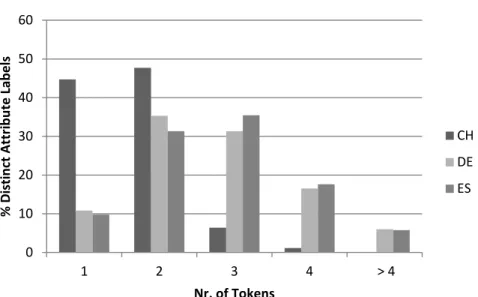
number of distinct tokens used for the large number of distinct attribute labels. Figure 2 shows the distribution of the number of tokens used in distinct attribute labels. In the DE and ES repository for more than fifty percent of all distinct labels more than two tokens were used by the developers. The attribute labels in the CH repository contain almost always fewer than three tokens. Figure 3 gives an overview on the average number of tokens used to label attributes in a schema.
Understanding Cryptic Schemata in Large ETL Systems 9 0 10 20 30 40 50 60 1 2 3 4 > 4 % D ist in ct A tt rib ut e L ab el s Nr. of Tokens CH DE ES
Fig. 2.No. of tokens in distinct attribute labels
0 10 20 30 40 50 60 70 80 1 2 3 4 >4 % S ch ema s
Average No. of Tokens
CH DE ES
Fig. 3.Average No. of tokens per attribute in schemata
4.2 Evaluation Technique
We have successfully tested our schema decryption approach on all Etl work-flows from the three given Etl repositories. To evaluate the accuracy of our schema decryption, we randomly selected from each repository three schemata
Rank Decryption Pairrel(i)Precision 1 hUNP≈UNPAIDi 1 1 2 hINT≈OUTPUTi 0 1/2 3 hPEN≈PENALTYi 1 2/3
Table 4.Calculating average precision for top-3 decryption pairs
consisting of at least 20 attribute labels and use schema decryption to generate ranked lists of decryption pairs for the selected nine schemata.
In our evaluation we consider the top-k decryption pairs pi in the ranked
list. Letibe the position ofpi in the ranked list, i.e.,i≤k. Then, we manually
determine whether pi is relevant/correct or not for the given schema, i.e., we
setrel(i) to 0 or 1, respectively. We consider a decryption pair to be accurate if it helps to understand the underlying semantic domain of the original attribute label. Then, we calculate the average precision for the top-k decryption pairs. The average precision is the average of the precision values for the seen accurate decryption pairs [3]:
Definition 5 (Average Precision). Let P(i) be the precision of the first i
suggested decryption pairs. Then, the average precision at positionk is
AvPk=
Pk
i=1P(i)·rel(i) Pk
i=1rel(i)
where precision is defined as P(i) =
Pi
j=1rel(j) i
Example 5 (Average Precision).Table 4 shows an illustrative top-3 example of ranked decryption pairs. The examples are from theEtlrepository from Spain (ES). The precision values after each new accurate decryption is observed are 1 and 23. Thus, theaverage precision of the top 3 results (with two seen accurate decryptions) is given by (1 + 23) / 2 = 83%.
4.3 Results
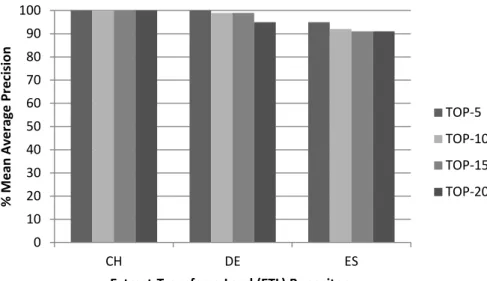
Figure 4 shows the accuracy of our schema decryption approach. We measure the mean average precision for each of the experiments and show the top-5, top-10, top-15, and top-20 results. For all three repositories the algorithm achieves an accuracy of above 90%. For the CH repository the algorithm provides the best accuracy. This is expected, because if there is a pair of connected attributes with different labels in the CH repository, it often contains an accurate decryption. The experiments demonstrate the advantages of identifying decryption pairs based on tokens and based on their characteristics. Additional experiments con-firmed that our approach results in a significantly lower number of incorrect, conflicting, and redundant decrpytion pairs compared to other approaches. We compared our approach to a straightforward alternative of choosing entire labels
Understanding Cryptic Schemata in Large ETL Systems 11 0 10 20 30 40 50 60 70 80 90 100 CH DE ES % M ea n A ver ag e Pr ec isi on
Extract-Transform-Load (ETL) Repository
TOP-5 TOP-10 TOP-15 TOP-20
Fig. 4.Schema Decryption Accuracy forEtlRepositories (CH), (DE), (ES)
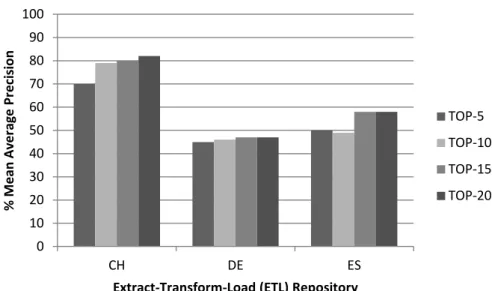
of two connected attributes as decryption pair. In addition, we compared our approach against different string-similarity measures, such as Levenshtein dis-tance [10]. Figure 5 shows the accuracy of the simple strategy of choosing entire labels of two connected attributes as decryption. This simple approach often leads to a large number of incorrect and conflicting suggestions. Furthermore, a large number of correct suggestions contain redunant decryptions, as frequent pairs of connected attributes with different labels often contain the same correct decryption for the same portion of tokens.
5
A Generalized Technique for Tokenization
For our given real-world Etlrepositories, the tokens are delimited by the un-derscore character. The experiments have shown that the simple tokenization strategy based on special characters already yields good results. For the general case, it may happen that tokens of attribute labels are not always delimited with a special character. Our schema decryption solution needs a set of tokens that belong to some standard vocabulary to perform effectively. Therefore, we con-sider in this section the general problem of attribute label tokenization, apart from the simple tokenization strategy.
Our tokenization approach segments attribute labels of a given schema into a set of “meaningful” tokens. A meaningful token has a semantics of its own or it modifies the semantics of another token. For instance, the attribute label
ORDERSTATUS from the well-known Tpc-h schema [20] should be tokenized to the meaningful tokensORDERandSTATUS. We supply a more formal definition of
0 10 20 30 40 50 60 70 80 90 100 CH DE ES % M ea n A ver ag e Pr ec isi on
Extract-Transform-Load (ETL) Repository
TOP-5 TOP-10 TOP-15 TOP-20
Fig. 5.Schema Decryption Accuracy for using entire attribute labels as decryption
a good tokenization later. Our tokenization approach is based on the discovery of token patterns for attribute labels making use of any pre-existing separators and tokens in only some of the attributes of the given schemata.
5.1 Discovery of Token Patterns
Attribute labels almost always contain tokens that belong to some standard vo-cabulary. When choosing an attribute label for a relational schema, often several tokens from this standard vocabulary are chosen, describing the underlying at-tribute domain. We call these tokens frequent tokens. These tokens frequently occur in different attribute labels, which means that the same token, or more generally the same pattern containing this token (and potentially more tokens), is used in several different contexts. For instance,ORDER,STATUS, andPRICEare frequent tokens often used for labeling attributes of transactional data records.
Definition 6 (Frequent token). Given a setAof attribute labels and a min-imum supports∈N, a tokent is frequentif there exists a subsetA0⊆A, such that tis a token in all attribute labels ai ∈A0 and|A0| ≥s.
Definition 7 (Standard vocabulary). Given a set A of attribute labels and a minimum supports∈N, the standard vocabularyVsis the set of all frequent tokens forA ands.
There are also tokens that do not have the minimum-support. These tokens are used during schema creation when no combination of standard tokens is
Understanding Cryptic Schemata in Large ETL Systems 13 suitable or known to unambiguously describe an attribute label. We call these tokensnon-standard tokens; an example is the attribute labelMFGRfrom the well-knownTpc-hschema.MFGRis an abbreviation for manufacturer and appears in only one attribute label of theTpc-hschema.
It should be noted that, in analogy to tables in relational databases, pro-cessed data records inEtlworkflows may contain only distinct attribute labels. Thus, multiple tokens are possibly concatenated with a delimiter character to create the final attribute label, such asC AREA 1,C AREA 2, and C AREA 3 from theTpc-eschema. In other cases tokens are concatenated without a delimiter, such as EXTENDEDPRICE in the Tpc-h schema. The simple form of tokenizing attribute labels is to parse them into tokens based on known delimiter charac-ters. The experiments have shown that this simple tokenization strategy already yields good results. In general, however, this na¨ıve strategy may result in an inappropriate standard vocabulary: The delimiter character may be used incon-sistently in a schema, i.e., the delimiter character is omitted when tokenization is intuitively clear.
Example 6 (Tokenization). Given a schema with attribute setA. Assume that the set A of given attribute labels consists of only the threeTpc-h attributes
ORDERKEY, ORDER STATUS, and LINESTATUS. With a minimum support s > 1, by Definition 7 the standard vocabulary is empty. Therefore, all four tokens are regarded as non-standard tokens.
For tokenization, we can regardORDER STATUSas a reliable source of informa-tion, since this tokenization is meaningful to some human. The whole attribute label is of no use for tokenization in this example, but the tokens{ORDER,STATUS} are applicable in different contexts, i.e., the adjacent substrings or tokens might differ. The idea of using these two tokens astoken patternsallows us to deduce a meaningful tokenization using the underscore as separator character:ORDER KEY,
ORDER STATUS, andLINE STATUS.
Given a schema with attribute set A, we want to iteratively populate an attribute set AT, which contains tokenized attribute labels. We initialize AT with the set of attribute labels that contain at least one separator character. Additionally, AT contains all frequent tokens that also appear as an individual attribute label.
To derive meaningful tokenizations, we use so-calledtoken patterns, which consist of frequent tokens and their well-defined matching positions in an at-tribute label, defined below. We derive these patterns from the set AT of
al-ready tokenized attribute labels and attribute labels representing a standard token. Whenever a pattern match is found in a non-standard token of an at-tribute label, the atat-tribute label is tokenized accordingly. In the example above, the patterns[(ORDER)F]and[(STATUS)L]are derived from the tokenized attribute label ORDER STATUS. To indicate the position of the matched tokens in the at-tribute label, we use superscripts:F,I, orLrepresent the matched token pattern to be prefix, infix, or suffix respectively. Tokens that are neither first nor last are defined as being in-between. In our example, the pattern matching results in
the tokenized attribute labels ORDER KEY andLINE STATUS. With the following definition, we formalize how to obtain candidate token patterns in general:
Definition 8 (Candidate Token Pattern). We obtain the set of candidate token patterns[pl] from all possible token sequences in an attribute labela∈AT and we set l =F, l =I or l =L, if p occurs as prefix, as infix, or as suffix in AT, respectively. Note that up to 4 token patterns can be produced from one token sequence, i.e.,[pF],[pI],[pL]and [pF,L].
We take into account that someEtlworkflows already contain a number of tokenized attribute labels. So we incorporate this valuable source of information into our approach to obtain candidate patterns. To obtain all possible candidate patterns [pl] from a given attribute label consisting ofk tokens, we generate all possible 2k−1 token sequences and create candidate patterns comparable to a
regular expressions.
Example 7 (Candidate Token Pattern).Consider the attribute label for the start date of a quarter from the Tpc-e schema, FI QTR START DATE. From this at-tribute label we create candidate token patterns, such as [(FI)F], [(
DATE)L],
[(QTR)(START)I], and [(FI)(.+)(DATE)F,L]. Among these candidates the next step
is to choose the most meaningful ones.
5.2 Choosing Token Patterns
To reduce the very large number of candidate patterns to a set of meaningful
token patterns, we require a token pattern to occur in different contexts. We search for matches of a token pattern p in all non-standard tokens. For each match we collect the token pattern-context, i.e., all substrings adjacent to the tokens specified in the token pattern. For a given pattern p all these contexts form a setNp of neighborhood strings.
Additionally, there are already neighborhood tokens for a0 ∈ AT, ifa0
con-tains token pattern p. From the set of candidate token patterns, we consider only those token patterns p with no neighborhood t that frequently occurs in Np. All candidate token patterns with at least one frequent neighborhood are
regarded as incomplete. We model this property with the conditional probability of tgiven p. We favor patterns with a low probability, i.e., they occur in many different contexts. We discard all candidates with a probability higher than a 50% threshold. All other are regarded as meaningful token patterns.
Example 8 (Choosing Token Patterns). Consider the pattern p1 = [(L)I]
ex-tracted from attribute label C L NAME from the Tpc-e schema in Fig. 6. The neighborhood tokens of p1 are{AP, C, NAME}, because the pattern occurs not only inC L NAME, but also inAP L NAME. As the conditional probabilityP(NAME|p1) = 1, the candidate pattern p1 is discarded: Apparently, the token Lalways oc-curs together with a token NAME and is thus not meaningful on its own. But p2 = [(NAME)L] is considered a meaningful token pattern, because the pattern occurs next to 14 different tokens (CO, IN, TX, etc.) in the Tpc-e schema, and thus no conditional probability exceeds the value of 12.5%.
Understanding Cryptic Schemata in Large ETL Systems 15
TPC-E
Meaningful token patterns [(1)L], [(2)L]
AD CTRY, AD ID, AD LINE 1 , AD LINE 2 ,
AD ZC CODE, AP ACL, AP CA ID, AP F NAME, AP L NAME,
AP TAX ID, B COMM TOTAL, B ID,B NAME,B NUM TRADES,
B ST ID, CA BAL, CA B ID, CA C ID, CA ID, CA NAME,
CA TAX ST, CH CHRG, CH C TIER, CH TT ID, CO AD ID,
CO CEO, CO DESC, CO ID, CO IN ID, CO NAME,
CO OPEN DATE, CO SP RATE, CO ST ID, CP COMP CO ID,
CP CO ID,CP IN ID,CR C TIER,CR EX ID,CR FROM QTY,
CR RATE,CR TO QTY,CR TT ID,CT AMT,CT DTS,CT NAME,
CT T ID, CX C ID, CX TX ID, C AD ID, C AREA 1,
C AREA 2, C AREA 3, C CTRY 1, C CTRY 2, C CTRY 3,
C DOB, C EMAIL 1, C EMAIL 2, C EXT 1, C EXT 2, C EXT 3,C F NAME,C GNDR,C ID,C LOCAL 1,C LOCAL 2,
C LOCAL 3, C L NAME, C M NAME, C ST ID, C TAX ID,
C TIER,DM CLOSE,DM DATE,DM HIGH,DM LOW,DM S SYMB,
DM VOL, EX AD ID,EX CLOSE, EX DESC, EX ID, EX NAME,
EX NUM SYMB, EX OPEN, FI ASSETS, FI BASIC EPS,
FI CO ID,FI DILUT EPS,FI INVENTORY,FI LIABILITY,
FI MARGIN, FI NET EARN, FI OUT BASIC,FI OUT DILUT,
FI QTR, FI QTR START DATE, FI REVENUE, FI YEAR,
HH AFTER QTY, HH BEFORE QTY, HH H T ID, HH T ID,
HS CA ID, HS QTY,HS S SYMB,H CA ID, H DTS,H PRICE,
H QTY, H S SYMB, H T ID, IN ID, IN NAME, IN SC ID,
LT DTS, LT OPEN PRICE, LT PRICE, LT S SYMB, LT VOL,
NI AUTHOR, NI DTS, NI HEADLINE, NI ID, NI ITEM,
NI SOURCE, NI SUMMARY, NX CO ID, NX NI ID, SC ID,
SC NAME, SE AMT, SE CASH DUE DATE, SE CASH TYPE,
SE T ID, S 52WK HIGH, S 52WK HIGH DATE, S 52WK LOW,
S 52WK LOW DATE, S CO ID, S DIVIDEND, S EXCH DATE,
S EX ID, S ISSUE, S NAME, S NUM OUT, S PE,
S START DATE, S ST ID, S SYMB, S YIELD, TH DTS,
TH ST ID, TH T ID, TR BID PRICE, TR B ID, TR QTY,
TR S SYMB, TR TT ID, TR T ID, TT ID, TT IS MRKT,
TT IS SELL, TT NAME, TX ID, TX NAME, TX RATE,
T BID PRICE, T CA ID, T CHRG, T COMM, T DTS,
T EXEC NAME,T ID,T IS CASH,T LIFO, T QTY,T ST ID,
T S SYMB, T TAX, T TRADE PRICE, T TT ID, WI S SYMB,
WI WL ID,WL C ID,WL ID,ZC CODE,ZC DIV,ZC TOWN
TPC-H Meaningful token patterns [(DATE)L], [(KEY)L], [(LINE)F], [(ORDER)F], [(PRICE)L], [(PRIORITY)L], [(SHIP)F], [(STATUS)L], [(SUPP)F] ACCTBAL,ADDRESS,
AVAILQTY,BRAND,CLERK,
COMMENT, COMMIT DATE ,
CONTAINER, CUST KEY ,
DISCOUNT, EXTENDED PRICE, LINE NUMBER , LINE STATUS, MFGR,MKTSEGMENT,NAME, NATION KEY , ORDER DATE , ORDER KEY , ORDER PRIORITY , ORDER STATUS , PART KEY , PHONE,QUANTITY, RECEIPT DATE , REGION KEY , RETAIL PRICE , RETURNFLAG, SHIP DATE , SHIP INSTRUCT , SHIP MODE , SHIP PRIORITY ,
SIZE, SUPP KEY ,
SUPP LYCOST ,TAX,
TOTAL PRICE ,TYPE
Fig. 6.Boxes highlight new deduced tokenizations using a minimum-support greater than 1 for standard tokens.Tpc-eis already well-tokenized to begin with, butTpc-h
Given a candidate token patternpand its setNpof neighborhood substrings
and tokens, we more formally define its choice as token pattern as follows:
Definition 9 (Meaningful Patterns). Let P(p) be the fraction of attribute labels containing the pattern p, and let P(pkt)be the fraction of attribute labels containing the patternpadjacent to stringt∈Np. Token patternpis meaningful if and only if arg max t∈Np P(t|p) = arg max t∈Np P(pkt) P(p) ≤50% (1) To summarize, given the initial set of tokenized attribute labelsAT, we are
able to use it as a bootstrap corpus for iteratively deriving token patterns. At every iteration new meaningful token patterns are created considering attribute labels in AT. Then, meaningful token patterns are used for tokenizing
non-standard tokens. The resulting tokenizations are added to AT. We stop the
iteration when no new tokenization is added toAT. At the end,AT contains all meaningful tokenization of the given schema.
Fig. 6 shows the result using the wholeTpc-eschema asAT and the sample set of already tokenized attribute labelsAT ={LINE STATUS,EXTENDED PRICE} for the Tpc-h schema. For the Tpc-e schema, tokenization stops after two iteration steps. Tokenization of theTpc-h schema requires five iteration steps. In Fig. 6, boxes highlight all created tokenizations and the first line shows all meaningful token patterns that were applied to at least one attribute label during iterations.
6
Related work
Although the practical importance of Etlin data integration is significant [22], only little research on Etl at a meta-level has been performed. Most related research results improveEtlworkflow modeling [13, 14, 21], and there are only a few implementations that support further processing on Etlworkflows. Ex-amples include the optimization ofEtlworkflows [16, 17] and the generation of
Etlworkflow reports [15].
Our work is mainly related to research on schema normalization in the field of data integration [18] and attribute-synonym finding for relational tables and spreadsheet data in web pages [6]. There is also some work on schema normaliza-tion in the area of schema matching [4]. The authors of [11] introduced schema normalization as an important pre-processing step in schema matching to im-prove the discovery of semantically similar schema elements. Therefore, labels of schemata are tokenized based on case-change or non alphabetical characters. For tokens, an approximate lookup in a global dictionary, such as WordNet [12], is performed to find a common representation. String matching techniques, such as Levenshtein distance [10], are used to perform the approximate lookups.
The authors of [6] point out that distance metrics and global dictionaries, as used in schema matching, are not appropriate to automatically find synonyms for arbitrary attribute labels. This observation is supported by our experimental
Understanding Cryptic Schemata in Large ETL Systems 17 results: Common distance metrics result in poor decryptions and global dic-tionaries lead to a relatively poor coverage of domain-specific abbreviations, acronyms, and tokens. Furthermore, we propose a generalized technique for to-kenization. In contrast, schema matching approaches perform tokenization only with the simple strategy of tokenizing attribute labels based on case-change or known delimiters.
The authors of [6] propose a large-scale discovery method to automatically find synonyms for attribute labels. The source of information is a corpus of 125 million independently created relational tables extracted from 14.1 billion
Htmltables. Their approach is based on pairs of attribute labels co-occurring with same context attributes. As already pointed out in the introduction, this type of web-scale analysis is infeasible forEtlsystems: With our approach we can identify accurate decryptions from a substantially smaller corpus of examples compared to approaches that rely on a large set of web-scale example data. In addition, we regard tokens and not entire attribute labels in order to achive a high quality for schema decryption.
Sorrentino et al. present a semi-automatic technique for schema normaliza-tion and motivate the importance of incorporating individual examples in the process of schema normalization [18]. This work describes the importance of us-ing labels from correspondus-ing attribute labels in schema normalization. Pairs of corresponding attribute labels are extracted fromcomplementary schemata con-nected by primary key to foreign key relationships. In contrast, ours is the first work that incorporates corresponding attribute labels as source of information for fully-automated, token-based schema decryption.
The methods in [2] use the Minimum Description Length (MDL) principle [9] to capture regularities between two matching strings. In particular, the authors address the related scenario of matching textual dissimilar strings motivated by the fact that common distance metrics, such as Levenshtein distance, are inappropriate in such a scenario. Similar to [6], the introduced techniques rely on a large set of web-scale example data. Hence, these techniques to identify synonyms cannot be applied to the schema decryption problem we consider in this paper. There is also MDL based work on word segmentation [5] that is related to our tokenization approach. In general, we consider a comparison of our approach with MDL based approaches to be very promising for further work.
7
Conclusion
With this paper we presented a fully-automated schema decryption method leveraging the large number of mapped attribute labels in a givenEtlrepository. Our work is motivated by observing the need of easy-to-understand schemata during Etl development and maintenance. Cryptic schemata significantly in-crease the amount of time to understand unfamiliar data, as many readers might have experienced themselves.
We introduced a novel approach for schema decryption to find high-quality decryptions for cryptic attribute labels. Our suggested approach is intended to
support and improve manualEtlworkflow development and maintencance: An
Etl developer is now able to quickly grasp the underlying semantics of data records in cryptic schemata.
We demonstrated that our schema decryption approach provides helpful sug-gestions for three different real worldEtl repositories. An experimental study shows the high average precision of our schema decryption approach.
Acknowledgment
This research was funded by InfoDyn AG; we want to thank Benjamin B¨ohm and Dieter Radler of InfoDyn AG for supplying real-world data.
References
1. Agrawal, H., Chafle, G., Goyal, S., Mittal, S., Mukherjea, S.: An Enhanced Extract-Transform-Load System for Migrating Data in Telecom Billing. In: Proceedings of the International Conference on Data Engineering (ICDE). Canc´un, M´exico (2008) 2. Arasu, A., Chaudhuri, S., Kaushik, R.: Learning String Transformations from Ex-amples. In: Proceedings of the International Conference on Very Large Databases (VLDB). Lyon, France (2009)
3. Baeza-Yates, R.A., Ribeiro-Neto, B.: Modern Information Retrieval. Addison-Wesley, Boston, MA, USA (1999)
4. Bernstein, P.A., Madhavan, J., Rahm, E.: Generic Schema Matching, Ten Years Later. VLDB Journal 4 (2011)
5. Brent, M.R., Cartwright, T.A.: Distributional Regularity and Phonotactic Con-straints are Useful for Segmentation. In: Cognition, vol. 61, pp. 93–125. Elsevier Science Publishers (1996)
6. Cafarella, M.J., Halevy, A., Wang, D.Z., Wu, E., Zhang, Y.: WebTables: Exploring the Power of Tables on the Web. In: Proceedings of the International Conference on Very Large Databases (VLDB). Auckland, New Zealand (2008)
7. Cui, Y., Widom, J.: Lineage Tracing for General Data Warehouse Transformations. VLDB Journal 12(1) (2003)
8. Dayal, U., Castellanos, M., Simitsis, A., Wilkinson, K.: Data Integration Flows for Business Intelligence. In: Proceedings of the International Conference on Extending Database Technology (EDBT). Saint Petersburg, Russia (2009)
9. Gr¨unwald, P.: A Minimum Description Length Approach to Grammar Inference. In: Connectionist, Statistical and Symbolic Approaches to Learning for Natural Language Processing, Lecture Notes in Computer Science, vol. 1040, pp. 203–216. Springer Verlag (1996)
10. Levenshtein, V.I.: Binary Codes Capable of Correcting Deletions, Insertions and Reversals. Soviet Physics Doklady. 10(8), 707–710 (1966)
11. Madhavan, J., Bernstein, P.A., Rahm, E.: Generic Schema Matching with Cupid. In: Proceedings of the International Conference on Very Large Databases (VLDB). Rome, Italy (2001)
12. Miller, G.A.: WordNet: A Lexical Database for English. Communications of the ACM 38(11), 39–41 (1995)
13. Poole, J., Chang, D., Tolbert, D.: Common Warehouse Metamodel, Developer’s Guide (OMG). Wiley & Sons, Indianapolis, IN, USA (2003)
Understanding Cryptic Schemata in Large ETL Systems 19 14. Simitsis, A.: Mapping Conceptual to Logical Models for ETL Processes. In: Proceedings of the International Workshop on Data Warehousing and OLAP (DOLAP). Bremen, Germany (2005)
15. Simitsis, A., Skoutas, D., Castellanos, M.: Natural Language Reporting for ETL Processes. In: Proceeding of the International Workshop on Data Warehousing and OLAP (DOLAP). Napa Valley, CA, USA (2008)
16. Simitsis, A., Vassiliadis, P., Sellis, T.: Optimizing ETL Processes in Data Ware-houses. In: Proceedings of the International Conference on Data Engineering (ICDE). Tokyo, Japan (2005)
17. Simitsis, A., Wilkinson, K., Dayal, U., Castellanos, M.: Optimizing ETL work-flows for Fault-Tolerance. In: Proceedings of the International Conference on Data Engineering (ICDE). Long Beach, CA, USA (2010)
18. Sorrentino, S., Bergamaschi, S., Gawinecki, M., Po, L.: Schema Normalization for Improving Schema Matching. In: Proceedings of the International Conference on Conceptual Modeling (ER). Gramado, Brazil (2009)
19. TPC Benchmark E. TP Council. (2010),http://www.tpc.org/tpce/
20. TPC Benchmark H. TP Council. (2012),http://www.tpc.org/tpch/
21. Trujillo, J., Luj´an-Mora, S.: A UML Based Approach for Modeling ETL Processes in Data Warehouses. In: Proceedings of the International Conference on Concep-tual Modeling (ER). Chicago, IL, USA (2003)
22. Vassiliadis, P., Karagiannis, A., Tziovara, V., Simitsis, A.: Towards a Benchmark for ETL Workflows. In: Proceedings of the International Workshop on Quality in Databases (QDB). Vienna, Austria (2007)
Aktuelle Technische Berichte
des Hasso-Plattner-Instituts
Band
ISBN
Titel
Autoren / Redaktion
59
978-3-86956-193-6 The JCop Language Specification Malte Appeltauer, Robert Hirschfeld
58
978-3-86956-192-9 MDE Settings in SAP: A Descriptive Field Study Regina Hebig, Holger Giese
57
978-3-86956-191-2 Industrial Case Study on the Integration of SysML and AUTOSAR with Triple Graph Grammars
Holger Giese, Stephan Hildebrandt, Stefan Neumann, Sebastian Wätzoldt
56
978-3-86956-171-4 Quantitative Modeling and Analysis of Service-Oriented Real-Time Systems using Interval Probabilistic Timed Automata
Christian Krause, Holger Giese
55
978-3-86956-169-1 Proceedings of the 4th Many-core Applications Research Community (MARC) Symposium
Peter Tröger, Andreas Polze (Eds.)
54
978-3-86956-158-5 An Abstraction for Version Control Systems Matthias Kleine, Robert Hirschfeld, Gilad Bracha
53
978-3-86956-160-8 Web-based Development in the Lively Kernel Jens Lincke, Robert Hirschfeld (Eds.)
52
978-3-86956-156-1 Einführung von IPv6 in Unternehmensnetzen: Ein Leitfaden Wilhelm Boeddinghaus, Christoph Meinel, Harald Sack
51
978-3-86956-148-6 Advancing the Discovery of Unique Column Combinations Ziawasch Abedjan, Felix Naumann
50
978-3-86956-144-8 Data in Business Processes Andreas Meyer, Sergey Smirnov, Mathias Weske
49
978-3-86956-143-1 Adaptive Windows for Duplicate Detection Uwe Draisbach, Felix Naumann, Sascha Szott, Oliver Wonneberg
48
978-3-86956-134-9 CSOM/PL: A Virtual Machine Product Line Michael Haupt, Stefan Marr, Robert Hirschfeld
47
978-3-86956-130-1 State Propagation in Abstracted Business Processes Sergey Smirnov, Armin Zamani Farahani, Mathias Weske
46
978-3-86956-129-5 Proceedings of the 5th Ph.D. Retreat of the HPI Research School on Service-oriented Systems Engineering
Hrsg. von den Professoren des HPI
45
978-3-86956-128-8 Survey on Healthcare IT systems: Standards, Regulations and Security Christian Neuhaus, Andreas Polze,
Mohammad M. R. Chowdhuryy
44
978-3-86956-113-4 Virtualisierung und Cloud Computing: Konzepte, Technologiestudie, Marktübersicht
Christoph Meinel, Christian Willems, Sebastian Roschke, Maxim Schnjakin
43
978-3-86956-110-3 SOA-Security 2010 : Symposium für Sicherheit in Service-orientierten Architekturen ; 28. / 29. Oktober 2010 am Hasso-Plattner-Institut
Christoph Meinel, Ivonne Thomas,