Wolves and Coyotes
RICHARD J. FREDRICKSON
∗AND PHILIP W. HEDRICK
School of Life Sciences, Arizona State University, Tempe, Arizona 85287-4601, U.S.A.
Abstract: Hybridization and introgression are significant causes of endangerment in many taxa and are considered the greatest biological threats to the reintroduced population of red wolves (Canis rufus) in North Carolina (U.S.A.). Little is known, however, about these processes in red wolves and coyotes (C. latrans). We used individual-based simulations to examine the process of hybridization and introgression between these species. Under the range of circumstances we considered, red wolves in colonizing and established populations were quickly extirpated, persisted near the carrying capacity, or had intermediate outcomes. Sensitivity analyses suggested that the probabilities of quasi extinction and persistence of red wolves near the carrying capacity were most affected by the strength of two reproductive barriers: red wolf challenges and assortative mating between red wolves and coyotes. Because model parameters for these barriers may be difficult to estimate, we also sought to identify other predictors of red wolf population fate. The proportion of pure red wolves in the population was a strong predictor of the future probabilities of red wolf quasi extinction and persistence. Finally, we examined whether sterilization can be effective in minimizing introgression while allowing the reintroduced red wolf population to grow. Our results suggest sterilization can be an effective short-term strategy to reduce the likelihood of extirpation in colonizing populations of red wolves. Whether red wolf numbers are increased by sterilization depends on the level of sterilization effort and the acting reproductive barriers. Our results provide an outline of the conditions likely required for successful reestablishment and long-term maintenance of populations of wild red wolves in the presence of coyotes. Our modeling approach may prove generally useful in providing insight into situations involving complex species interactions when data are few.
Keywords: Canis rufus, hybridization, introgression, persistence, reproductive barriers, sensitivity analysis Din´amica de la Hibridaci´on e Introgresi´on en Lobos Rojos y Coyotes
Resumen: La hibridaci´on y la introgresi´on son causas significativas de peligro en muchos taxa y son con-sideradas como las mayores amenazas biol´ogicas para las poblaciones reintroducidas de lobos rojos (Canis rufus) en Carolina del Norte (E.U.A.). Sin embargo, se conoce poco sobre estos procesos en lobos rojos y coy-otes (C. latrans). Utilizamos simulaciones basadas en individuos para examinar los procesos de hibridaci´on e introgresi´on entre estas dos especies. Bajo el rango de circunstancias que consideramos, los lobos rojos eran ex-tirpados r´apidamente de poblaciones colonizadoras y establecidas, persist´ıan cerca de la capacidad de carga, o ten´ıan resultados intermedios. Los an´alisis de sensibilidad sugirieron que las probabilidades de cuasi ex-tinci´on y persistencia de lobos rojos cerca de la capacidad de carga se vieron afectadas por la fortaleza de dos barreras reproductivas: retos de los lobos rojos y apareamiento concordante entre lobos rojos y coyotes. Debido a que la estimaci´on de los par´ametros de estas barreras en el modelo puede ser dif´ıcil, tambi´en buscamos identificar otros predictores de las probabilidades futuras de la cuasi extinci´on y persistencia de lobos rojos. Finalmente, examinamos si la esterilizaci´on puede ser efectiva para minimizar la introgresi´on y al mismo tiempo permita que crezca la poblaci´on reintroducida de lobos rojos. Nuestros resultados sugieren que la esterilizaci´on puede ser una estrategia efectiva a corto plazo para reducir la probabilidad de extirpaci´on en poblaciones de lobos rojos colonizadoras. El incremento del n´umero de lobos rojos debido a la esterilizaci´on
∗email [email protected]
Paper submitted April 15, 2005; revised manuscript accepted September 13, 2005. 1272
depende del nivel de esfuerzo de esterilizaci´on y de las barreras reproductivas activas. Nuestros resultados proporcionan un bosquejo de las condiciones requeridas para el reestablecimiento exitosos y mantenimiento a largo plazo de poblaciones de lobos rojos silvestres en presencia de coyotes. Nuestro modelo puede ser ´util para el entendimiento de situaciones que involucran interacciones complejas entre especies y los datos son escasos.
Palabras Clave: an´alisis de sensibilidad, barreras reproductivas,Canis rufus, hibridaci´on, introgresi´on, persis-tencia
Introduction
Hybridization and introgression occur naturally among many plants, insects, fishes, birds, and other organisms and are thought to be an important aspect of evolution-ary change (Smith et al. 2003). However, they may also be a significant cause of endangerment in other taxa (Rhymer & Simberloff 1996; Levin 2002). Hybridization and introgression can cause the elimination of one or both parental species when no genetically “pure” individ-uals remain. In some cases, extinction of parental species can occur in only a few generations (Wolf et al. 2001). The recent increase in species threatened by hybridiza-tion and introgression is largely a result of formerly al-lopatric species that are closely related becoming sym-patric through direct transport of one species by humans or by human-caused habitat change facilitating range ex-pansion (Rhymer & Simberloff 1996).
Whether hybridization and introgression are limited to a zone between species ranges or act to eliminate one or both parental species is largely determined by the strengths and types of reproductive barriers operating in a system (Wolf et al. 2001; Coyne & Orr 2004). Among species that hybridize, either multiple prezygotic ers or a combination of prezygotic and postzygotic barri-ers are generally necessary to prevent the loss of one or both parental species. If substantive reproductive barri-ers are lacking, there may be little hope of maintaining in the wild a species threatened by hybridization (Rosen-feld et al. 2004). Knowledge of and quantitative data for these barriers, however, are commonly lacking for species threatened by hybridization. This and the complexity of species interactions can make the likely outcome of hy-bridization difficult to predict.
Red wolves (Canis rufus) occurred historically throu-ghout southeastern North America from eastern Texas into Pennsylvania and perhaps through Maine (Nowak 2002). Prior to European settlement of North America, the geographic range of red wolves had little overlap with that of coyotes (C. latrans), whose eastern limits largely coincided with the westerly plains (Nowak 2002). By the early 1900s the combination of direct persecution, forest clearing, road building, and perhaps the decline of deer herds had eliminated red wolves from most of their his-toric range (USFWS 1989), and hybridization between red
wolves and coyotes had begun in central Texas (Nowak 2002). By the 1960s red wolves were confined to a single small population in Louisiana and Texas, encompassed by coyotes that had expanded their range eastward (USFWS 1989).
Upon learning that few red wolves remained in the wild and that they were interbreeding with coyotes, the U.S. Fish and Wildlife Service (USFWS) listed red wolves as endangered in 1967 and initiated a captive breeding pro-gram for them in 1973 (Riley & McBride 1975; USFWS 1989). Over the next 7 years, more than 400 wild canids were captured from the area of the remaining red wolf population. Fewer than 10% of the canids captured were determined to be pure red wolves, underscoring the pre-carious status of the species in the 1970s. Ultimately 14 of the red wolves brought into captivity founded the current population of red wolves. Reintroduction efforts began in 1986, and wolves were first released into northeastern North Carolina (NENC) in 1987. By the early 1990s coyo-tes began to colonize the reintroduction area, and pairings between wolves and coyotes and the production of hy-brid offspring were subsequently observed (Phillips et al. 2003). Introgression of coyote ancestry is considered the greatest biological threat to the reintroduced population of red wolves (Kelly et al. 1999), which currently numbers about 100 individuals (B. Fazio, unpublished data).
Hybridization between wolves and other canids is not exclusive to red wolves. Analyses of mitochondrial DNA indicate past introgression of coyote ancestry into gray wolves (Canis lupus lycaon) in Minnesota and southeast-ern Canada (Lehman et al. 1991). Other information in-dicates hybridization is ongoing in Ontario (Kolenosky & Standfield 1975). Hybridization with domestic dogs is also considered a factor in the decline of Ethiopian wolves, where dogs (C. familiaris) outnumber wolves by as much as 10 to 1 (Gottelli et al. 1994).
We use individual-based simulations with a focus on the effects of reproductive barriers to explore the dynamics of hybridization and introgression in the wild population of red wolves in NENC and for red wolves more generally. Little quantitative data exist on red wolf and coyote de-mography and reproductive barriers, and the range of re-productive barriers operating is unknown. Consequently, we also focused on elucidating the factors with the great-est potential effects on hybridization and the conditions
under which red wolves are likely to persist in the pres-ence of coyotes. We addressed four questions: (1) What are the potential effects of introgression on small popula-tions of red wolves? (2) What parameters (and reproduc-tive barriers) most strongly affect the probabilities of red wolf extinction and maintenance of population numbers near the carrying capacity? (3) Is it possible to predict the fates of red wolf populations using metrics readily estimated in the field? and (4) Is sterilization effective in minimizing introgression while allowing the red wolf population to grow? We believe that our modeling ap-proach may be generally useful in providing new insights into situations involving complex interactions between species when data are few.
Methods
To explore the dynamics of hybridization between red wolves and coyotes, we used individual-based simula-tions implemented in the Visual Basic programming lan-guage. In the simulations, individual red wolves, hybrids, and coyotes chose mates, reproduced, survived, and dis-persed in time steps of 1 year. The simulations assumed that interactions between the two populations were consistent with a continent-island model of gene flow (Hedrick 2005), where red wolves form a small “island” population adjacent to a much larger “continental” popu-lation of coyotes. The island habitat space was occupied by red wolves, immigrant coyotes, and hybrids, whereas the overall coyote population occupied separate but ad-jacent habitats not explicitly modeled in the simulations. With this model of gene flow, there will be ongoing coy-ote immigration and hybridization even if red wolf pairs fill all the island habitat space, but immigration of hy-brids into the large continental population of coyotes is assumed to have a negligible effect on allele frequencies. The effects of reproductive barriers on red wolf persis-tence or extinction, however, will differ little from that in standard hybrid zones.
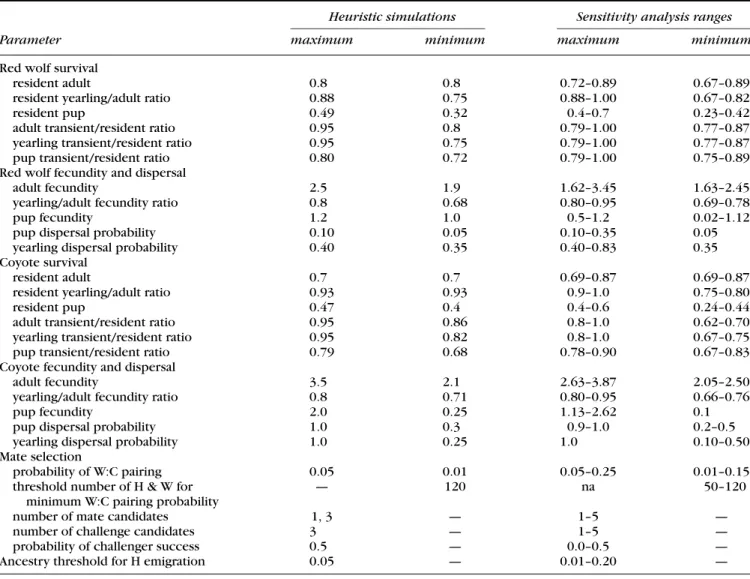
For colonizing populations we started simulations with eight pairs of wolves and a carrying capacity of 50 pairs. This approximated the number of red wolf pairs present when hybridization with coyotes was thought to have be-gun (Phillips et al. 2003). Although the carrying capacity for red wolf pairs in and around the recovery area is un-known, it likely does not exceed about 50 pairs (Kelly et al. 1999; Phillips et al. 2003). To simulate established populations, we started with 50 pairs of red wolves and allowed these populations to equilibrate for 25 years be-fore pairing with coyotes began. These simulations then ran for 100 additional years. To explore the mechanistic causes of red wolf extirpation and the utility of steriliza-tion in limiting introgression, we used several sets of 1000 simulations with a range of starting conditions and param-eter values (heuristic simulations Table 1).
(Supplemen-tal information on mating decisions, demographic rates, sensitivity analysis, parameterization, and management of hybridization is available [see Supplementary Materials below].)
Mating Decisions
In the simulations, coyote gene flow into the red wolf population was controlled by red wolf and hybrid mate selection. Molecular data suggest that hybridization be-tween wild red wolves and coyotes in NENC is bidi-rectional and that hybrids backcross with both parental species (Adams et al. 2003). Consequently, pairing rules did not differ by sex and hybrids were able to backcross with red wolves and coyotes in our simulations. We as-sumed that the probability of a red wolf pairing with a coyote (PWC) declines as the number of red wolves and hybrids increase. We modeled this decrease with the ex-ponential function
PWC= PmaxeNrW, (1) wherePmaxis the maximum probability of a red wolf pair-ing with a coyote,Nis the number of red wolf and hybrid individuals in the population, andrW is a constant
affect-ing the rate of change inPWC. WhenN=0,PWC=Pmax. The value ofrWfor a set of simulations can be calculated
as
rW =
ln (Pmin/Pmax)
Nthresh ,
(2) wherePminis the minimum probability of a red wolf pair-ing with a coyote andNthreshis the threshold number of red wolves and hybrids in the population at whichPminis reached. To calculate the probability of a hybrid pairing with a coyote (PHC), the probability of a coyote pairing with a coyote (PCC) must first be calculated
PCC=(1−Pmax)eNrC, (3) where rC = ln[(1−Pmin)/(1−Pmax)] Nthresh . Finally PHC=PWC+(1−AH)×(PCC−PWC), (4) where AH is the proportion of red wolf ancestry of the
hybrid. This proportion ranges from 0 for coyotes to 1 for pure red wolves; F1 hybrids have red wolf ancestry of 0.5. Therefore, the increased probability of a hybrid pairing with a coyote relative to that of a red wolf was proportional to the ancestry difference between a red wolf and the hybrid. In short, the probability of a red wolf or hybrid pairing with a coyote was determined by their abundance, the pairing parameters, and the ancestry of hybrids. Coyotes entered the simulations only when a red wolf or hybrid chose to pair with a coyote, and they
Table 1. Parameter values and ranges used in heuristic simulations and sensitivity analysis for red wolves (W), coyotes (C), and hybrids (H).∗ Heuristic simulations Sensitivity analysis ranges
Parameter maximum minimum maximum minimum
Red wolf survival
resident adult 0.8 0.8 0.72–0.89 0.67–0.89
resident yearling/adult ratio 0.88 0.75 0.88–1.00 0.67–0.82
resident pup 0.49 0.32 0.4–0.7 0.23–0.42
adult transient/resident ratio 0.95 0.8 0.79–1.00 0.77–0.87
yearling transient/resident ratio 0.95 0.75 0.79–1.00 0.77–0.87
pup transient/resident ratio 0.80 0.72 0.79–1.00 0.75–0.89
Red wolf fecundity and dispersal
adult fecundity 2.5 1.9 1.62–3.45 1.63–2.45
yearling/adult fecundity ratio 0.8 0.68 0.80–0.95 0.69–0.78
pup fecundity 1.2 1.0 0.5–1.2 0.02–1.12
pup dispersal probability 0.10 0.05 0.10–0.35 0.05
yearling dispersal probability 0.40 0.35 0.40–0.83 0.35
Coyote survival
resident adult 0.7 0.7 0.69–0.87 0.69–0.87
resident yearling/adult ratio 0.93 0.93 0.9–1.0 0.75–0.80
resident pup 0.47 0.4 0.4–0.6 0.24–0.44
adult transient/resident ratio 0.95 0.86 0.8–1.0 0.62–0.70
yearling transient/resident ratio 0.95 0.82 0.8–1.0 0.67–0.75
pup transient/resident ratio 0.79 0.68 0.78–0.90 0.67–0.83
Coyote fecundity and dispersal
adult fecundity 3.5 2.1 2.63–3.87 2.05–2.50
yearling/adult fecundity ratio 0.8 0.71 0.80–0.95 0.66–0.76
pup fecundity 2.0 0.25 1.13–2.62 0.1
pup dispersal probability 1.0 0.3 0.9–1.0 0.2–0.5
yearling dispersal probability 1.0 0.25 1.0 0.10–0.50
Mate selection
probability of W:C pairing 0.05 0.01 0.05–0.25 0.01–0.15
threshold number of H & W for — 120 na 50–120
minimum W:C pairing probability
number of mate candidates 1, 3 — 1–5 —
number of challenge candidates 3 — 1–5 —
probability of challenger success 0.5 — 0.0–0.5 —
Ancestry threshold for H emigration 0.05 — 0.01–0.20 —
∗Details on the bases for parameter values and ranges are available (see Supplementary Material).
were terminated from the simulation when the coyote or its mate died. We assumed that there were always single coyotes available for pairing.
If a wolf or hybrid chose not to pair with a coyote, then one or more unpaired individuals (singles) of the opposite sex were randomly drawn and the single clos-est in red wolf ancclos-estry was selected as its mate. Pairings among single red wolves and hybrids were random when one mate candidate (a single considered for pairing) was specified at program start (Table 1) because mate candi-dates were selected at random from singles of the oppo-site sex. When more than one mate candidate was spec-ified, red wolves tended to mate with other red wolves over hybrids (assortative mating), depending on the pro-portion of red wolves of the opposite sex in the singles pool. Similarly, hybrids tended to mate with other hybrids of like ancestry rather than red wolves, slowing the rate of introgression.
Although patterns of mate selection by hybrids and red wolves in NENC are unknown, assortative mating
among hybrids and red wolves based on levels of red wolf ancestry and mate availability is a conservative first hy-pothesis. Prezygotic reproductive barriers are common among hybridizing species (Coyne & Orr 2004), and as-sortative mating is a common prezygotic barrier among formerly allopatric species. Also, assortative mating based on ancestry (or body size) may be advantageous for male and female red wolves because it would allow red wolf pairs to retain territories and minimize risk to their off-spring in the presence of strong intraspecific aggression. Prezygotic and extrinsic postzygotic barriers, however, become weaker in F2 and backcross generations as hy-brids become more like pure species (Coyne & Orr 2004), suggesting that hybrids with high levels of red wolf an-cestry may be the second-most desired mate choice by red wolves. Assortative mating among red wolves may enforce assortative mating among hybrids to an extent when few red wolves are willing to pair with hybrids, particularly those with low or moderate levels of red wolf ancestry.
In recent years, single red wolves or wolf pairs in NENC have challenged and displaced paired and single hybrids on at least eight occasions, taking over their home ranges (B. Fazio, unpublished data). In these incidents all dis-placed individuals were hybrids, except in one incident when a pair of red wolves displaced a pair consisting of a hybrid and a red wolf. No coyotes or hybrids are known to have displaced red wolves. Displacements and mortality from intraspecific aggression are also relatively common among red wolves in the colonizing population in NENC (Phillips et al. 2003; A. Beyers, unpublished data).
Consequently, red wolves in simulated populations could challenge paired coyotes and hybrids for their mates. For each individual challenger, one or more mixed pairs (those including a coyote or hybrid) were randomly chosen (“challenge candidates” Table 1). The red wolf challenged for the canid of the opposite sex with the highest ancestry among the randomly chosen pairs, pro-vided that it was higher than that of its current mate or
>0.5 for single challengers. The probability of the chal-lenging wolf dropping its current mate and pairing with the potential new mate was the product of the probability of challenger success (Table 1) and the absolute value of the ancestry difference between the potential new mate and its current mate. Therefore challengers were more likely to pair with animals of high red wolf ancestry. Demographic Rates
In simulations, survival, fecundity, and dispersal rates were stochastic and density dependent. Maximum demo-graphic rates were reached when there were no canid pairs, and minimum rates were reached when there were 50 pairs. The ancestry threshold for hybrid emigration (Table 1) was the ancestry level at which hybrids were assumed to immigrate to the coyote population (Table 1). Sensitivity Analysis
We conducted sensitivity analyses to determine which bi-ological parameters (Table 1) in our simulations had the greatest effects on persistence of red wolves in the pres-ence of hybridization and introgression. To do this, we first generated 5000 parameter sets with each parameter value randomly drawn from uniform distributions of plau-sible ranges (see Table 1 and Supplementary Material).
We used results from half of the sensitivity simulations to construct logistic regression models to identify the pa-rameters that most affected the probabilities of quasi ex-tinction and persistence of red wolves at year 50 (Mc-Carthy et al. 1995; Cross & Beissinger 2001). Logistic reg-ression uses one or more independent variables to esti-mate the probability of occurrence of a binary outcome (e.g., quasi extinction or not). Regression coefficients standardized by their standard errors, a measure of their uncertainty, can be used to identify the parameters with the greatest effects on the probability of quasi extinction
or persistence (McCarthy et al. 1995). We used forward stepwise selection procedures to identify an initial set of parameters of potential importance. From this initial set, we identified the most important parameters by examin-ing their standardized regression coefficients, their levels of significance in the regression, the change in model log-likelihood values if dropped, the contribution to Nagelk-erke R2, and their ability to improve the classification accuracy of the model.
We constructed separate logistic regression models to estimate the probabilities of quasi extinction (<10 red wolf pairs) and of persistence (>40 red wolf pairs) at year 50. Simulation results indicated that all populations with
<10 red wolf pairs at year 50 were extirpated by year 100. Simulations not used in model construction were used to assess the ability of logistic regression models to correctly predict the fates of simulated populations.
Parameterization
Little quantitative information exists on demographic rat-es, pairing decisions, and other possible reproductive bar-riers between red wolves and coyotes in NENC. To set demographic rate ranges for red wolves, we used all avail-able information from the reintroduced and captive popu-lations (Phillips et al. 2003; Waddell 2003). Because these data were limited, we also used information from stud-ies of gray wolf populations at or near saturation densi-ties and colonizing or intensively controlled populations (see Supplementary Materials). Red wolves in NENC are ecologically and behaviorally similar to gray wolves and dissimilar to coyotes in important aspects, including the routine formation of packs by delayed dispersal of off-spring even in a population well below carrying capac-ity, the use of primarily large- and medium-sized prey, and in high levels of intraspecific aggression resulting in displacements and mortalities among red wolves (Andelt 1985; Harrison 1992; Gese 2001; Mech & Boitani 2003; Phillips et al. 2003). Consequently, the use of information from studies of gray wolves to guide parameterization for our simulations is justified. Demographic rates for coy-otes on the recovery area are also unknown. Therefore, we based demographic parameters on studies of coyotes at high densities and on studies contrasting populations with and without population control programs (see Sup-plementary Material).
For sensitivity analysis we chose parameter ranges that would likely capture the actual values in NENC and incor-porate a plausible range of values for red wolf and coy-ote populations generally. Parameter ranges also reflected the level of uncertainty associated with parameter values. For example, because the strength of assortative mating among red wolves and hybrids is unknown, the range for the number of mate candidates (1 to 5) allows for simula-tions with random-to-strong assortative mating (Table 1). In contrast, available information on survival of adult red
and gray wolves (see Supplementary Material) allowed us to set a relatively narrow range.
Management of Hybridization
The primary management method used to control hy-bridization in NENC is to sterilize paired hybrids and coy-otes in the recovery area (B. Fazio unpublished data). Identifying hybrids with more than 50% red wolf ances-try, however, can be difficult based on appearance alone. Consequently, assignment tests based on microsatellite loci are used to help identify hybrid individuals (Miller et al. 2003).
To explore the effectiveness of sterilization in limiting introgression while allowing the population of red wolves to grow, we simulated two sterilization regimes, high and low effort, under which paired hybrids and coyotes were sterilized with assignment errors based on those found by Miller et al. (2003). For simulations with high steril-ization effort, sterilsteril-ization was initiated each year that the proportion of nonsterilized mixed pairs exceeded 0.10 of total pairs. At these times, hybrids and coyotes in 75% of nonsterilized mixed pairs were sterilized. For simulations with low sterilization effort, hybrids and coyotes in 50% of nonsterilized mixed pairs were sterilized, when the proportion of mixed pairs exceeded 0.40. These levels of sterilization are possible in NENC.
Results
Dynamics of Introgression
Following the onset of hybridization with coyotes, three changes occurred quickly in simulated populations of col-onizing red wolves. First, there was a rapid increase in hy-brids, with a wide range of red wolf ancestry levels (Table 2). Second, the proportion of simple hybrids (those with red wolf ancestry proportions of 0.25, 0.5, and 0.75) was quickly exceeded by the proportion of complex hybrids (all other hybrids) such that by year 20 (less than four gen-erations) complex hybrids were on average 6–10 times more numerous than simple hybrids (Table 2). Complex hybrids increased in frequency and number fastest when reproductive barriers between red wolves and coyotes were weak and slowest when they were strong (Table 2). Thus, the increase of complex hybrids in simulated pop-ulations was indicative of the increase in introgression. Finally, the proportion of pure red wolves in the popu-lation was decreased (Table 2). The rapidity and depth of the decline in the frequency of red wolves was also symptomatic of the extent of introgression.
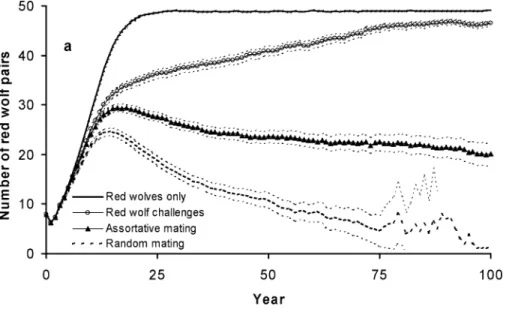
Without coyotes present, red wolf pairs increased quickly to carrying capacity in about 25 years on average (Fig. 1a) with no red wolf pair extirpations among the 1000 simulated populations. When coyotes were present and pairing among red wolves and hybrids was random,
Table 2. Mean proportions of red wolves, simple hybrids, complex hybrid backcrosses, and coyotes over time in all colonizing
populations with different reproductive barriers.a
Simple Complex Red
Year Coyotes hybrids hybrids wolves Random mate selection
0 0 0 0 1 10 0.066 0.085 0.106 0.744 20 0.094 0.042 0.344 0.520 30 0.122 0.023 0.538 0.317 50 0.193 0.006 0.733 0.068 100 0.380 0 0.62 0.001
Weak assortative matingb
0 0 0 0 1 10 0.061 0.077 0.082 0.781 20 0.083 0.041 0.235 0.641 30 0.094 0.024 0.337 0.545 50 0.134 0.015 0.506 0.345 100 0.233 0.004 0.656 0.107
Red wolf challenges and weak assortative matingb
0 0 0 0 1 10 0.056 0.067 0.081 0.796 20 0.059 0.017 0.172 0.751 30 0.051 0.006 0.171 0.773 50 0.051 0.003 0.179 0.766 100 0.059 0.004 0.150 0.787
aSimple hybrids have proportions of red wolf ancestry equal to 0.25,
0.5, or 0.75; complex hybrids include all other hybrid types. Standard errors ranged from 0.06% to 11.5% of mean values.
bRed wolves not pairing with coyotes select mates from three
randomly chosen singles.
however, the increase in red wolf pairs was quickly re-versed and red wolf pairs were quickly extirpated in many simulated populations. By year 20, the number of red wolf pairs averaged 21.9 in nonextirpated populations, drop-ping to 16.2 by year 30 (Fig. 1a). Although red wolf pairs were extirpated in only 4% of simulated populations by year 20, introgression resulted in rapid extirpation of pairs thereafter with 13% and 80% of populations lacking red wolf pairs by years 25 and 50, respectively (Table 3 no sterilization). Rapid extirpation of red wolf pairs occurred in these simulations despite low rates of pairing between the parental species. The probability of a red wolf choos-ing to pair with a coyote averaged 0.044 at the start of these simulations and dropped to 0.01 as red wolf and hybrid numbers increased.
In these simulations, the rapid decline in red wolf pair numbers and proportions resulted primarily from the backcrossing of hybrids with red wolves rather than from hybridization between red wolves and coyotes. This is in-dicated by the rarity of simple hybrids relative to complex hybrids (Table 2). It is also indicated by the percentage of red wolf pairs over time; after 5 years, red wolf pairs comprised on average only 82% of total canid pairs, drop-ping to an average of 61% of canid pairs by year 10. This increase in the proportion of mixed pairs is much faster
Figure 1. Mean numbers of red wolf pairs in extant wolf populations over time when coyotes are not present, there is random mating, there is weak assortative mating between red wolves and hybrids, and there is weak assortative mating with red wolf challenges for (a) colonizing red wolf populations and ( b) established red wolf populations ( broken lines are 95% confidence intervals).
than would be expected from the rate of hybridization alone.
Introgression occurred much more slowly when each wolf and hybrid not pairing with a coyote selected as its mate the individual most similar in ancestry to itself from three randomly chosen singles (weak assortative mating). Complex hybrids arose more slowly in the population. At year 20 their mean proportion, 0.235, was two-thirds of that found in random mating populations at year 20 (Table 2). As a result red wolf pairs were extirpated in only 3.3% of populations by year 25, roughly a quarter of that found among random mating populations (Table 3 no sterilization). Also, the mean number of red wolf pairs in nonextirpated populations, 27.6, was almost 50% greater than that in random mating populations (Fig. 1). Introgres-sion, however, was not limited. By year 50, red wolf pairs were extirpated in 35% of populations and averaged only
23.6 in extant populations. Mixed pairs averaged 26.0 in extant red wolf populations, indicating that extirpations resulting from introgression would continue.
When there was weak assortative mating among red wolves and hybrids and red wolves challenged paired coy-otes or hybrids for mates with higher ancestry, introgres-sion was eventually stabilized. In these populations, red wolf pairs were extirpated in 1.1% and 10% of populations by years 25 and 50, respectively (Table 3 no sterilization). Over the same period their numbers increased in extant populations from 36.2 to 40.9 pairs on average (Fig. 1a). The mean proportion of hybrids in extant populations dropped over the same time period from 0.173 in year 25 to 0.123 in year 50 and 0.028 in year 100. In contrast, the mean proportion of hybrids in extant populations in-creased over time with random or weak assortative mat-ing without red wolf challenges. With random matmat-ing,
Table 3. Percentage of colonizing populations in which red wolf pairs are extirpated.
Year 25 Year 50 Year 100 No sterilization
random mating 12.7 79.9 99.9
weak assortative matinga 3.3 35.2 81.9
red wolf challenges 1.1 10 23.7
High sterilization effortb,d
random mating 0.4 16.8 —
weak assortative matinga 0 0.1 —
red wolf challenges 0.1 0.1 —
Low sterilization effortc,d
random mating 2.9 59.5 —
weak assortative matinga 0.4 4.7 —
red wolf challenges 0.1 0.3 —
aRed wolves not pairing with coyotes select mates from three
randomly chosen singles.
bCoyotes and perceived hybrids are sterilized in 75% of
nonsterilized mixed pairs each year that nonsterilized mixed pairs exceed 10% of total pairs.
cCoyotes and perceived hybrids are sterilized in 50% of nonsterilized
mixed pairs each year that nonsterilized mixed pairs exceed 40% of total pairs.
dPopulations with sterilization were simulated for only 50 years.
hybrids averaged 0.434 of extant populations in year 25, increasing to 0.596 in year 50. With weak assortative mat-ing, hybrids averaged 0.305 in year 25, reaching 0.403 by year 50.
The simulations described above used the parameter values for “heuristic simulations” (Table 1). Simulations with lower but equal maximum net reproductive rates for red wolves and coyotes resulted in increased rates of introgression. Hybrids accumulated in populations more rapidly and reached higher proportions, and complex hy-brids were more common relative to simple hyhy-brids. In-creases in red wolf pair numbers were slower, and de-clines were faster, resulting in increased extirpation rates (results not shown).
The same patterns were evident in established popu-lations of red wolves with random or weak assortative mating once they came into contact with coyotes.
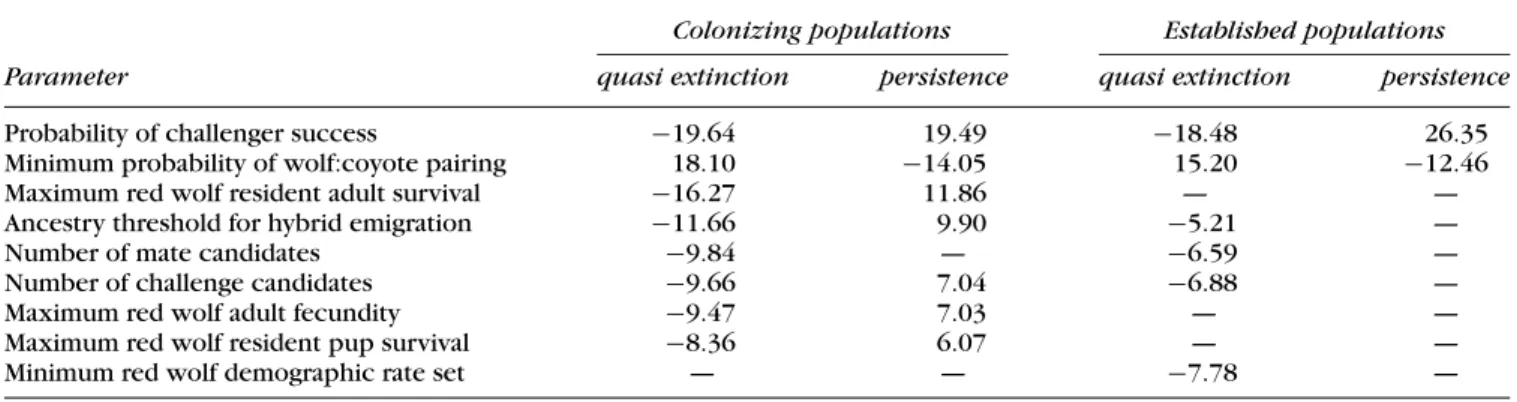
Num-Table 4. Standardized regression coefficients from logistic regressions for quasi-extinction (<10 red wolf pairs) and persistence (>40 red wolf
pairs) probabilities of simulated red wolf populations at year 50.
Colonizing populations Established populations
Parameter quasi extinction persistence quasi extinction persistence
Probability of challenger success −19.64 19.49 −18.48 26.35
Minimum probability of wolf:coyote pairing 18.10 −14.05 15.20 −12.46
Maximum red wolf resident adult survival −16.27 11.86 — —
Ancestry threshold for hybrid emigration −11.66 9.90 −5.21 —
Number of mate candidates −9.84 — −6.59 —
Number of challenge candidates −9.66 7.04 −6.88 —
Maximum red wolf adult fecundity −9.47 7.03 — —
Maximum red wolf resident pup survival −8.36 6.07 — —
Minimum red wolf demographic rate set — — −7.78 —
bers of red wolf pairs immediately began to decrease (Fig. 1b) as hybrids became established in the populations. The proportion of hybrids in extant, random mating popula-tions increased from 21% in year 25 to 59% and 75% in years 50 and 100, respectively. Concurrently, red wolf pairs were extirpated in 46.3% of populations in year 50 and 99.7% in year 100. Similarly, the proportion of hy-brids in extant populations with weak assortative mating increased from 8% in year 25 to 23% and 46% in years 50 and 100, respectively. Although red wolves pairs were extirpated in only 0.6% of populations in year 50, they were absent in 53.7% of populations by year 100.
In contrast, populations with red wolf challenges dif-fered little from red wolf populations with no coyote con-tact (Fig. 1b). After 100 years, populations with red wolf challenges averaged 46.6 red wolf pairs. Hybrids averaged 1.3% of individuals, and red wolf pairs had not been ex-tirpated in any populations.
Sensitivity Analysis
Forward stepwise logistic regressions identified 12 pa-rameters of potential importance to the probability of quasi extinction and 11 parameters of potential impor-tance to persistence in year 50 for colonizing red wolf populations. Of these parameters, 8 were most impor-tant in determining the probability of quasi extinction, and 7 were most important in determining the probabil-ity of persistence (Table 4). All parameters included in the persistence model were also included in the quasi-extinction model, and the parameter importance rank-ings based on standardized regression coefficients were identical. All but one of the identified parameters speci-fied components of reproductive barriers or the red wolf population growth rate.
The two most important parameters, the probability of challenger success and the minimum probability of a red wolf pairing with a coyote, both relate to reproductive barriers. The third most important parameter, maximum resident red wolf adult survival, is an important determi-nant of the growth rate of the red wolf population. The
one parameter not related to isolating mechanisms or red wolf population growth was the ancestry threshold for hybrid emigration. None of these parameters and only 1 of the 23 parameters included in stepwise regressions were related to the growth rate of the coyote population. This suggests that within the range of values included in our simulations the outcome of hybridization between red wolves and coyotes is little affected by the growth rate of the coyote population.
To explore whether the wide ranges assigned to the two most important parameters were the source of their importance, we eliminated the upper halves of their ranges and ran new simulations. The probability of chal-lenger success and the minimum probability of a red wolf pairing with a coyote were still the two most important parameters in all steps of forward stepwise logistic regres-sions for quasi extinction and persistence.
For established populations of red wolves, the proba-bility of challenger success and the minimum probaproba-bility of a red wolf pairing with a coyote were also the most important parameters affecting quasi extinction and per-sistence (Table 4). These were the only two parameters strongly affecting the probability of persistence, with the former being twice as important as the latter. Of the six parameters strongly affecting the probability of quasi ex-tinction, only one related to red wolf demography, the minimum red wolf demographic rate set, and no parame-ters associated with red wolf or coyote population growth were included in either of these models.
Predicting Population Fate
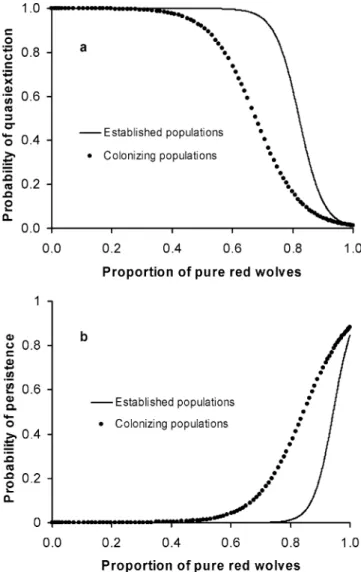
Because many of the parameters that were important in determining the probability of red wolf quasi extinction and persistence may be difficult to estimate in the field, we also examined the ability of two state variables at year 20, the proportion of pure red wolves in the population and mean ancestry of hybrids, to predict the outcome of hybridization at year 50 with logistic regression. Of these variables, only the proportion of pure red wolves had strong predictive ability of population fates. This variable correctly identified 95% of colonizing and es-tablished populations that reached the quasi-extinction threshold and correctly predicted 80.6% and 86.9% of colonizing and established populations, respectively, that did not reach the threshold.
The proportion of pure red wolves at year 20 was less able to accurately predict population persistence (>40 red wolf pairs) and nonpersistence at year 50. Among colonizing populations, 95% of populations that dropped below the persistence threshold were correctly identi-fied, but only 61.9% of populations that remained above the threshold were correctly identified. The proportion of pure red wolves at year 20 was marginally effective in pre-dicting persistence among established populations, but at year 25 this variable correctly identified 95% of
pop-ulations below the persistence threshold and 73.2% of populations above it. We prioritized correct identification of populations that ultimately dropped below the quasi-extinction and persistence thresholds at year 50 when choosing probability cutpoints. Plots of mean probabil-ities of quasi extinction and persistence from the logis-tic regression models suggested that populations that fail to support high proportions of pure red wolves after 20 years had elevated risks of quasi extinction and reduced likelihood of persistence by year 50 (Fig. 2).
Management of Hybridization
With high sterilization effort, the numbers of red wolf pairs maintained in extant colonizing populations were substantially increased relative to populations without
Figure 2. Mean probabilities of (a) quasi extinction and ( b) persistence in year 50 as predicted from the proportion of pure red wolves in the population at year 20 for colonizing and established populations of red wolves.
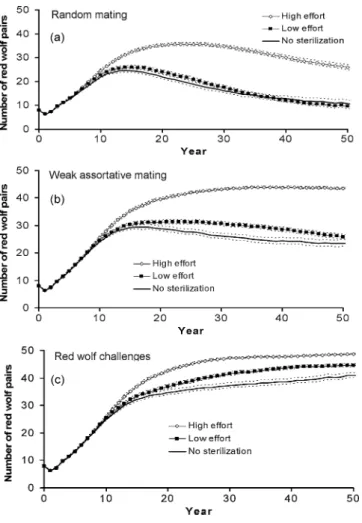
Figure 3. Mean numbers of red wolf pairs in
nonextirpated wolf populations over time when there is high or low sterilization effort for populations with (a) random mating, ( b) weak assortative mating, and (c) red wolf challenges ( broken lines are 95%
confidence intervals).
sterilization (Fig. 3) and red wolf pair extirpations were greatly reduced in the first 50 years (Table 3). For popu-lations with weak assortative mating and those with red wolf challenges, extirpations in the first 50 years were nearly eliminated.
When assignment errors were made in deciding which canids should be sterilized, some red wolves were mistak-enly sterilized, and some hybrids were identified as red wolves and escaped sterilization. As a result, hybrids were allowed to enter what was perceived to be the breeding population of red wolves. When mate selection was ran-dom and sterilization effort was high, the mean number of perceived red wolf pairs exceeded actual pair numbers (Fig. 3) by 50% at year 50 (39.3 vs. 26.0), and the mean proportion of individuals in “red wolf” pairs that were actually hybrids reached 0.373. As a result, red wolf pairs were perceived to be extirpated in only 0.2% of popula-tions but were actually extirpated in 16.8% of populapopula-tions by year 50 (Table 3). For populations with weak
assorta-tive mating and those with red wolf challenges, the mean perceived numbers of red wolf pairs in extant populations were similar to the actual red wolf pair numbers, and the proportion of hybrids in “red wolf” pairs remained low, 0.023 and 0.001, respectively, for the first 50 years. De-spite the undetected entrance of hybrids into the breed-ing populations of red wolves in each of the three types of populations, the mean ancestry of perceived red wolf pairs exceeded 0.99 through year 50 in all cases, and the introgression of coyote ancestry into the red wolf breed-ing population was minimal.
When there was low sterilization effort, the rate of ex-tirpation of red wolf pairs was still reduced relative to pop-ulations with no sterilization (Table 3). However, red wolf population growth was inhibited (Fig. 3). Mean numbers of red wolf pairs were similar to or only slightly higher than those in populations with no sterilization. Also, the mean proportions of members of red wolf pairs that were actually hybrids increased. By year 50, hybrids accounted for 0.74, 0.22, and 0.03 of perceived members of red wolf pairs among populations with random mating, weak as-sortative mating, and red wolf challenges, respectively. For random mating populations perceived to be extant, the proportion of red wolf ancestry among perceived red wolf pairs dropped to 0.98.
Discussion
Despite a general paucity of quantitative data on demog-raphy, pairing decisions, and other possible mechanisms acting to reproductively isolate red wolves and coyotes in NENC, we gained considerable information relevant to restoring red wolf populations. First, our simulations provide insight into the likely process of hybridization and introgression that is ongoing in NENC. Second, us-ing sensitivity analyses, we identified two reproductive barriers—red wolf challenges and assortative mating be-tween red wolves and coyotes—that appear to have large effects on the likelihood of persistence and extinction of colonizing and established red wolf populations and a number of other parameters that may have lesser effects. These analyses also suggest that the conditions necessary for red wolf populations to simultaneously have a low probability of quasi extinction (<0.05) and a high proba-bility of persistence (≥0.80) are restrictive. For colonizing populations, either the probability of challenger success must be high and the minimum probability of a red wolf pairing with a coyote low or these parameters must have moderate values and the values of remaining parameters must be high relative to their ranges. For established pop-ulations, either the probability of challenger success must be high or the minimum probability of a red wolf pairing with a coyote must be low.
Displacement behavior by red wolves appears to be critical in determining the fate of the red wolf population
in NENC. The level of aggression among red wolves ap-pears to be a fundamental life-history difference between the two parental species that forms the basis for a poten-tially important extrinsic reproductive barrier that may act prezygotically and postzygotically. Although it has not been observed, hybrids with high red wolf ancestry may be expected to at times display this type of competitive behavior. If it occurs, hybrids may be less successful chal-lengers than red wolves, and displacement of red wolves by hybrids may be rare. Other factors not included in our simulations may also be important in determining the out-come of hybridization between red wolves and coyotes, including the fitness of hybrids and inbreeding among red wolves.
Low reproductive fitness or viability of hybrids rela-tive to parental species combined with prezygotic bar-riers may in some cases confine hybridization to a zone of interspecific overlap. However, even greatly reduced hybrid fitness may not prevent a parental species from being replaced by hybrids or the other parental species, if other reproductive barriers are weak (Wolf et al. 2001). Fitness of hybrids in NENC is unknown, but observation suggests that if their fitness differs from red wolves, the differences are probably not large. Simulations including sterilization indicate that large decreases in hybrid repro-ductive fitness would be needed to qualitatively change the outcome of our simulations for colonizing popula-tions. Because established populations of red wolves do not appear to be sensitive to variation in demographic rates (Table 4), it is unlikely that small changes in hybrid fitness would notably affect these populations. A small increase or decrease in hybrid fitness, therefore, likely would not qualitatively change the outcome of our simu-lations and the conditions necessary for a low probability of quasi extinction and a high probability of persistence may not be appreciably expanded.
Inbreeding among red wolves would be expected to lower demographic rates and perhaps competitive abili-ties, possibly affecting displacement behavior (Meagher et al. 2000; Keller & Waller 2002) thereby hastening in-trogression and the extirpation of red wolves. Wild-born wolves with inbreeding coefficients as high as 0.305 have been observed in NENC, although most wolves have substantially lower inbreeding levels ( Waddell 2003). If inbreeding depression becomes severe and common among red wolves, partially outbred hybrids may have increased relative fitness, which could accelerate the in-trogression of coyote alleles into the red wolf population (Ebert et al. 2002; Vil`a et al. 2003). Among red wolves in NENC some genetic management of the population may be prudent in minimizing introgression and ensuring a fit red wolf population.
Our simulations also suggest that the proportion of pure red wolves in the population is a strong predictor of future red wolf population failure and a reasonably good predictor of persistence that improves over time. This metric is readily estimated for actual populations through
the combination of ongoing management and monitoring activities in NENC and genetic assignment tests (Miller et al. 2003) and may be useful in monitoring the status of red wolf populations over time.
Finally, our simulations suggest that sterilization can be an effective short-term strategy to reduce the likeli-hood of red wolf extirpation in colonizing populations. Whether the red wolf component of the population is increased with sterilization depends on the level of steril-ization effort and the reproductive barriers acting in the population. Although it may be difficult to establish a pop-ulation of wild red wolves with no introgression of coyote ancestry, the level of introgression may be similar to that occurring naturally in some populations of gray wolves (Lehman et al. 1991).
Hybridization and introgression threaten the persiste-nce of many species and populations (Rhymer & Simber-loff 1996). In many cases, the future outcome of hybridiza-tion and the effectiveness of potential management op-tions are unclear. Also, quantitative data on reproductive barriers, demographic rates, and other potentially impor-tant biological considerations are often lacking. Because the dynamics of hybridization and introgression between species are typically influenced by multiple reproductive barriers (Coyne & Orr 2004), simple models may be inad-equate to provide useful insights. However, more realistic (and complex) models often include many parameters for which little data exist.
We approached this problem by developing a simu-lation model incorporating known and potential repro-ductive barriers and realistic life histories of parental species. We incorporated uncertainty in parameter values and used sensitivity analysis to identify biological factors that likely have the greatest effects on hybridization and introgression. Our findings provide an outline of the con-ditions likely required for successful reestablishment and long-term maintenance of populations of wild red wolves in the presence of coyotes. Our approach may be gener-ally useful in other cases where quantitative data are in short supply and there is (1) at least a qualitative under-standing of the life histories of the species involved, (2) enough quantitative information on demographic param-eters from other populations or a closely related species with similar ecological characteristics to set ranges for demographic parameters that will likely capture the true values, and (3) some knowledge of the reproductive bar-riers that may be operating. Our modeling approach may also prove useful in situations involving complex species interactions other than hybridization (e.g., the effects of invasive species or in situations where inclusion of sub-stantial biological detail into models is important).
Our findings and those of others (Wolf et al. 2001; Rosenfield et al. 2004) indicate that for species threatened by hybridization, management efforts to increase popula-tion numbers will fail to prevent their demise if substan-tive barriers to hybridization do not exist. In these cases, preventing or stopping contact between the hybridizing
species is the only course of action likely to prevent their loss. If substantive reproductive barriers do exist, man-agement to increase the size of small, threatened popula-tions may allow these species to persist in the presence of ongoing hybridization. In many cases, the specific set of reproductive barriers operating and their strengths may be unique to the hybridizing species pair. Thus, general-ization from one case of hybridgeneral-ization to another may not prove useful in predicting outcomes or suggesting appro-priate management options, even among closely related species (Echelle & Echelle 1994; Rosenfield et al. 2004). Identification of the factors likely important in determin-ing the outcome of hybridization and introgression can focus research and monitoring efforts and potentially pro-vide guidance for appropriate management responses.
Acknowledgments
We thank K. Scribner and three anonymous reviewers for their constructive comments on earlier drafts of this manuscript. Financial support was provided by the U.S. Fish and Wildlife Service (R.J.F.) and the Ullman Distin-guished Professorship (P.W.H.).
Supplementary Material
The following supplementary material is available as part of the online article from http://www.blackwell-synergy.com:
Appendix S1.Supplemental information on the meth-ods used in “Dynamics of Hybridization and Introgression in Red Wolves and Coyotes.”
Literature Cited
Adams, J. R., B. T. Kelly, and L. P. Waits. 2003. Using faecal DNA sampling and GIS to monitor hybridization between red wolves (Canis rufus) and coyotes (Canis latrans). Molecular Ecology12:2175–2186. Andelt, W. F. 1985. Behavioral ecology of coyotes in south Texas. Wildlife
Monographs 94.
Coyne, J., and H. A. Orr. 2004. Speciation. Sinauer Associates, Sunder-land, Massachusetts.
Cross, P. C., and S. R. Beissinger. 2001. Using logistic regression to ana-lyze the sensitivity of PVA models: a comparison of methods based on African wild dogs. Conservation Biology15:1335–1346. Ebert, D., et al. 2002. A selective advantage to immigrant genes in a
Daphniametapopulation. Science295:485–488.
Echelle, A. F., and A. A. Echelle. 1994. Assessment of genetic introgres-sion between two pupfish species, Cyprinodon elegans and C. Var-iegatus (Cyprinodontidae), after more than 20 years of secondary contact. Copeia1994:590–597.
Gese, E. M. 2001. Territorial defense by coyotes (Canis latrans) in Yel-lowstone National Park, Wyoming: who, how, where, when, and why. Canadian Journal of Zoology79:980–987.
Gottelli, D., C. Sillero-Zubiri, G. D. Applebaum, M. S. Roy, D. J. Girman, J. Garcia-Moreno, E. A. Ostrander, and R. K. Wayne. 1994. Molecular genetics of the most endangered canid: the Ethiopian wolfCanis simensis. Molecular Ecology3:301–312.
Harrison, D. J. 1992. Social ecology of coyotes in northeastern North America: relationships to dispersal, food, resources, and human ex-ploitation. Pages 51–72 in A. H. Boer, editor. Ecology and manage-ment of the eastern coyote. Wildlife Research Unit, University of New Brunswick, Fredericton, New Brunswick.
Hedrick, P. W. 2005. Genetics of populations. 3rd edition. Jones and Bartlett, Sudbury, Massachusetts.
Keller, L. F., and D. M. Waller. 2002. Inbreeding effects in wild popula-tions. Trends in Ecology & Evolution17:230–241.
Kelly, B. T., P. S. Miller, and U. S. Seal. 1999. Population and habitat viability assessment workshop for the red wolf (Canis rufus). Con-servation Breeding Specialist Group (SSC/IUCN), Apple Valley, Min-nesota.
Kolenosky, G. B., and R. O. Standfield. 1975. Morphological and ecolog-ical variation among gray wolves (Canis lupus) of Ontario, Canada. Pages 62–72 in M. W. Fox, editor. The wild canids their systemat-ics, behavioral ecology and evolution. Van Nostrand Reinhold, New York.
Lehman, N., A. Eisenhawer, K. Hansen, L. D. Mech, R. O. Peterson, P. J. P. Gogan, and R. K. Wayne. 1991. Introgression of coyote mitochon-drial DNA into sympatric North American gray wolf populations. Evolution45:104–119.
Levin, D. A. 2002. Hybridization and extinction. American Scientist 90:254–261.
McCarthy, M. A., M. A. Burgman, and S. Ferson. 1995. Sensitivity analysis for models of population viability. Biological Conservation73:93– 100.
Meagher, S., D. J. Penn, and W. K. Potts. 2000. Male-male competition magnifies inbreeding depression in wild house mice. Proceedings of the National. Academy of Sciences97:3324–3329.
Mech, L. D., and L. Boitani. 2003. Wolf social ecology. Pages 1–34 in L. D. Mech and L. Boitani, editors. Wolves behavior, ecology and conservation. University of Chicago Press, Chicago.
Miller, C. R., J. Adams, and L. P. Waits. 2003. Pedigree-based assignment tests for reversing coyote (Canis latrans) introgression into the wild red wolf (Canis rufus) population. Molecular Ecology12:3287– 3301.
Nowak, R. M. 2002. The original status of wolves in eastern North Amer-ica. Southeastern Naturalist1:95–130.
Phillips, M. K., V. G. Henry, and B. T. Kelly. 2003. Restoration of the red wolf. Pages 272–288 in L. D. Mech and L. Boitani, editors. Wolves behavior, ecology and conservation. University of Chicago Press, Chicago.
Rhymer, J. M., and D. Simberloff. 1996. Extinction by hybridization and introgression. Annual Review of Ecology and Systematics27:83– 109.
Riley, G. A., and R. T. McBride.1975. A survey of the red wolf (Canis rufus). Pages 263–277 in M.W. Fox, editor. The wild canids: their systematics, behavioral ecology and evolution. Van Nostrand Rein-hold, New York.
Rosenfield, J. A., S. Nolasco, S. Lindauer, C. Sandoval, and A. Kodric-Brown. 2004. The role of hybrid vigor in the replacement of Pecos pupfish by its hybrids with sheepshead minnow. Conservation Biol-ogy18:1589–1598.
Smith, P. F., A. D. Konings, and I. R. V. Kornfield. 2003. Hybrid origin of a cichlid population in Lake Malawi: implications for genetic variation and species diversity. Molecular Ecology12:2497–2504.
United States Fish and Wildlife Service (USFWS). 1989. Red wolf recov-ery/species survival plan. USFWS, Atlanta, Georgia.
Vil`a, C. et al. 2003. Rescue of a severely bottlenecked wolf (Canis lupus) population by a single immigrant. Proceedings of the Royal Society of London Series B270:91–97.
Waddell, W. 2003. Red wolf,Canis rufus: International studbook. Point Defiance Zoo and Aquarium, Tacoma, Washington.
Wolf, D. E., N. Takebayashi, and L. H. Riesberg. 2001. Predicting the risk of extinction through hybridization. Conservation Biology15:1039– 1053.