Technology (IJRASET)
Comparative Study of Various Routing Protocols
for Wireless Sensor Networks
Shilpa Gambhir
Assistant Professor, ECE Department MM University, Ambala, Haryana
Abstract: Wireless Sensor Networks (WSN) are intended for monitoring an environment by sensing it, then collecting data, processing it and finally transmitting it to final destination. These sensor nodes have some constraints due to their limited energy, storage capacity and computing power. Data are routed from one node to other using different routing protocols. There are a number of routing protocols for wireless sensor networks. We know that the energy possessed by a node is limited and frequent communication between nodes may cause the nodes to deplete there energy resources quickly. Therefore, we need appropriate routing protocols. Routing protocols are in charge of discovering and maintaining the routes in the network. This paper presents a review of four routing protocols proposed for wireless sensor networks.
Keywords: Wireless Sensor Network, Routing Protocol, GPSR, LEACH, GAF, Clustering.
I. INTRODUCTION
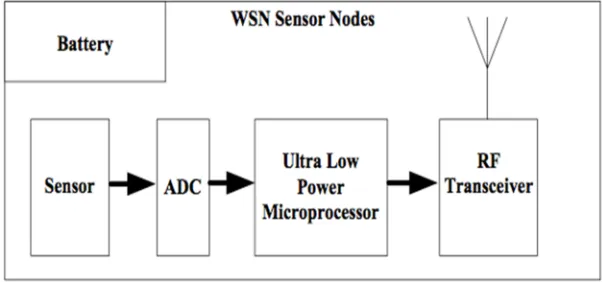
[image:2.612.164.465.451.592.2]A Wireless sensor network (WSN) is composed of a large number of sensor nodes deployed in an ad hoc manner. Each sensor node senses phenomena in the environment in which it is deployed, performs a local processing on the sensed data, and then transmits it to a sink. WSNs have been used in many application domains such as intelligent houses, intelligent agriculture, battlefield surveillance, integrated patient monitoring, environment monitoring, chemical/biological detection and other commercial applications. The main task of a wireless sensor node is to sense and collect data from a certain domain, process them and transmit it to the sink where the application lies [1]. Fig. 1 shows the internal architecture of WSN sensor nodes. Each Wireless Sensor node consists of sensor, Analog to Digital Conversion, a microprocessor unit and a RF transceiver. It is also connected to a battery for providing power to it when it is placed in the field.
Figure 1: WSN sensor node internal structure.
Signal conditioning, and
Analog-to-digital conversion.
There are three categories of sensor nodes: (i) Passive, Omni Directional Sensors: passive sensor nodes sense the environment without manipulating it by active probing. In this case, the energy is needed only to amplify their analog signals. There is no notion of “direction” in measuring the environment.
Passive, narrow-beam sensors: these sensors are passive and they are concerned about the direction when sensing the environment.
Active Sensors: These sensors actively probe the environment.
II. RELATED WORK
In sensor networks, several routing approaches have been proposed, giving rise to several classifications. Flooding was the old routing mechanism used in sensor networks. In flooding, a node sends out the received data or the management packets to its neighboring nodes by broadcasting, unless a maximum number of hops for that packet are reached or the destination of the packets is arrived [4]. However, its simplicity brings about significant drawbacks. Firstly, an implosion is detected because nodes redundantly receive multiple copies of the same data message. Then, as the event may be detected by several nodes in the affected area, multiple data messages containing similar information are introduced into the network. Moreover, the nodes do not take into account their resources to limit their functionalities. This paper aims at describing two routing protocols in order to facilitate the understanding of the different routing techniques that could be applied into wireless sensor networks.
Depending on the network structure, we find flat-based routing, hierarchical based routing and location-based routing.
Depending on the protocol operation these protocols can be classified into multipath-based, query-based, negotiation-based, QoS-based, or coherent-based routing techniques.
According to [3], routing protocols are divided into the following seven classes: Location-based Protocols, Data-centric Protocols, Hierarchical Protocols, Mobility-based Protocols, Multipath-based Protocols, Heterogeneity-based Protocols and QoS-based protocols.
A. GPSR
Technology (IJRASET)
Figure 2: Greedy forwarding example. y is x’s closest neighboring nodes to D.
GPSR suffers from many drawbacks. Since the nodes are mobile and due to this high mobility, a node may not receive updated location information from its neighboring nodessince the neighboring nodes has gone out of range [7]. Hence, when a node has data to forward, it may make wrong forwarding decisions that leads to packet loss. Secondly, whenever a node broadcasts the HELLO message periodically to its neighboring nodes, there is a probability that HELLO message may be lost due to congestion or channel impairment. This will lead to the assumption that the neighboring node has failed or gone out of range. This leads to the improper removal of a neighboring node from the neighboring nodes list. To tackle these problems we use the concept of lifetime in GPSR. Lifetime is the amount of time a node exists in the range of another node. Every node will maintain a lifetime timer, based on lifetime value. By doing this, the neighboring nodeslist can be efficiently maintained, thus leading to correct forwarding decisions. Another mechanism called OD-GPSR (On demand GPSR) was proposed[8]. OD-GPSR is a routing protocol and only those nodes over which data is flowing seek neighboring nodes information for making routing decision.
B. Rumor Routing
Rumor routing [9] is a kind of directed diffusion and is used for applications where geographic routing is not feasible. It combines query flooding and event flooding protocols in a random way. It has the following assumptions:
The network is composed of densely distributed nodes. Only bi-directional links exits.
Only short distance transmissions are allowed. It has fixed infrastructure.
In case of directed diffusion flooding is used to inject the query to the entire network. Sometimes the requested data from the nodes are very small and thus the flooding is unnecessary, so we can use another approach which is to flood the events when the number of events is small and the number of queries is large. The queries are rooted to that particular nodes that are belongs to the interested region. In order to flood events through the network, the rumor routing algorithm employs long-lived packets, called agents. When a node detects an event, it adds such event to its local table (events table), and generates an agent. Agents travel the network on a random path with related event information. Then the visited nodes form a gradient towards the event. When a node needs to initiate a query, it routes the query to the initial source. If it gets some nodes lying on the gradient before its TTL expires, it will be routed to the event, else the node may need to retransmit, give up or flood the query. Unlike directed diffusion, where data can be routed through multiple paths at low rates, Rumor routing only maintains one path between source and destination [10]. Rumor routing performs well only when the number of events is small. For a large number of events, the cost of maintaining agents and event-tables in each node becomes infeasible if there is not enough interest in these events from the BS. Moreover, the overhead associated with rumor routing is controlled by different parameters used in the algorithm such as time-to-live (TTL) pertaining to queries and agents.
Nodes in each zone have different functionalities and each node uses its GPS-indicated location to associate itself with a point in the grid. Nodes which are positioned at the same point on the grid are considered equivalent in terms of the cost of packet routing. Such equivalence is exploited in keeping some nodes located in a particular grid area in a sleeping state in order to save energy. Thus GAF can increase the network lifetime as the number of nodes increases. GAF conserves energy by turning off unnecessary nodes in the network without affecting the level of routing fidelity. GAF defines three states: discovery, active, sleep. The ‘discovery’ state is used for determining the neighbors in the grid; the ‘active’ state participates in routing process and at the time of ‘sleep’ state, the radio is turned off. In order to handle the mobility, each node in the grid estimates it’s leaving time of grid and sends this to its neighbors. The sleeping neighbors adjust their sleeping time accordingly in order to keep the routing fidelity. Before the leaving time of the active node expires, sleeping nodes wake up and one of them becomes active.
C. LEACH
Low Energy Adaptive Clustering Hierarchy is a self-organizing, adaptive clustering-based protocol that uses randomized rotation of cluster-heads to evenly distribute the energy load among the sensor nodes in the network. The idea behind LEACH is to form clusters of the sensor nodes depending on the received signal strength and use local cluster heads as routers to route data to the base station. The sensor nodes are usually battery-powered and operate without attendance for a relatively long period of time. Therefore, energy efficiency becomes critical importance. So, Clustering has been proposed to group a number of sensors, usually within a geographic neighboring nodes hood, to form a cluster that is managed by a cluster head. A fixed or adaptive approach may be used for cluster maintenance.In a fixed maintenance scheme, cluster membership does not change over time, whereas in adaptive clustering scheme, sensors may change their associations with different clusters over time[13]. In Static Clustering protocol[14], for the entire network life cycle, the clusters and cluster-head nodes are fixed, and the local base station is assumed as a high-energy nodes situation. In most cases, the local base station is an energy constrained node. The entire network may die soon because of excessive using about local base station node. So an adaptive clustering protocol was proposed called LEACH.
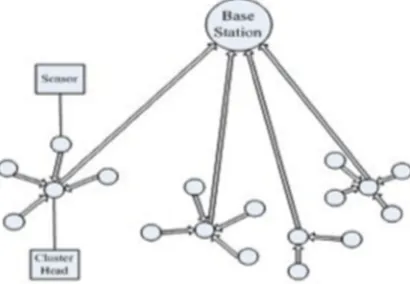
[image:5.612.210.415.541.683.2]Figure 3: Adaptive clustering of the network. (‘•’ indicates Cluster Head )
Technology (IJRASET)
Base station is fixed and located far away from the sensors.All nodes in the network are homogeneous and energy constrained.
Figure 3 shows the adaptive clustering scheme in which there is randomized rotation of cluster-heads to evenly distribute the energy load among the sensor nodes in the network. The main idea of LEACH protocol is that all nodes are chosen to be the cluster heads periodically, and each period contains two stages with construction of clusters as the first stage and data communication as the second stage[15]. The architecture of the model is shown in Figure 4.
In LEACH, sensors elect themselves to be local cluster heads at any given time with a certain probability. These cluster heads then broadcast their status to the other sensors in the network. Each sensor node determines to which cluster it wants to belong by choosing the cluster head that requires the minimum communication energy. Once all the nodes are organized into clusters, each cluster head creates a schedule for the nodes in its cluster. This allow the radio components of each non-cluster head node to be turned off at all times except during it’s transmit time, thus minimizing the energy dissipated in the individual sensors. Once the cluster head has all the data from the nodes in its cluster, the cluster head node aggregates the data and then transmits the compressed data to the base station. The whole operation is divided into the following different phases [16].
Advertisement phase: In this phase, nodes elect themselves to be a cluster-heads for the current round through a cluster-head advertisement message. For this cluster-head advertisement, the cluster heads use CSMA MAC protocol. After the completion of this phase, and depending on the received advertisement signal strength; the non-cluster-head nodes determine the cluster to which they will belong to for this current round.
Cluster set-up phase: after each non-cluster-head node has decided to which cluster it belongs, it informs the cluster-head node that it will be a member of the cluster. So, each node transmits this information back to the cluster head using CSMA MAC protocol.
Schedule Creation phase: The cluster-head node receives all the messages for nodes that would like to be included in the cluster. Based on the number of nodes in the cluster, the cluster-head node creates a TDMA schedule telling each node when it can transmit. This schedule is broadcast back to the nodes in the cluster.
Data Transmission phase: after the creation of both the clusters and the TDMA schedule, nodes in the cluster start transmitting the data they already have during their allocated transmission time to the cluster-head (cluster-head node keeps its receiver on all the time to receive the sent data). Once all the data (sent by nodes in the cluster) have been received by the cluster-head node, it will perform signal processing function to compress the data into a single signal. LEACH reduces the number of nodes that communicate directly with the base station by forming dynamic clusters[16].So this protocol can reduce the energy dissipation as compared to direct communication with the base station. In addition to reducing energy dissipation, LEACH successfully distributes energy usage among the nodes in the network such that the nodes die randomly and at essentially the same rate. Later on, extension to LEACH Protocol called LEACH-C (Leach Centralized) and LEACH-F (Leach with Fixed Clusters) were also proposed [17].
III. RESULTS
Comparison of Various Routing Protocols:
PROTOCOL MOBILITY POWER
MANAGEMENT
CLASSIFICATION DATA
AGGREGATION
MULTIPATH
GSPR Limited Limited Location No Yes
RR Very limited Not support Hybrid/ Flat Yes No
GAF Limited Limited Location No No
LEACH Fixed BS Maximum Clustering No No
IV. CONCLUSION
functioning and type of target applications. Further, these routing protocols are classified as direct communication, flat and clustering protocols, according to the participating style of nodes. Depending on the network structure, the routing protocols are categorized as hierarchical, data centric and location based.In this paper, a comparative study of various Routing protocols i.e. GSPR, RR, GAF and LEACH for WSN is presented. Different aspects for these algorithms are considered. Since the sensor networks are application specific, we can’t say any particular protocol is better than other. Future perspectives of this work are focused towards modifying one of the above routing protocols such that the modified protocol could minimize more energy for the entire WSN.
REFERENCES
[1] Luis Javier GarcíaVillalba , Ana Lucila Sandoval Orozco, Alicia Triviño Cabrera and CláudiaJacyBarenco Abbas “Routing Protocols in Wireless Sensor Networks” Sensors 2009, 9, 8399-8421; doi:10.3390/s91108399.
[2] Yazeed Al-Obaisat, Robin Braun “On Wireless Sensor Networks: Architectures, Protocols, Applications, and Management”. [3] S A Rao, ManoharaPai M.M, “GPSR-L: Greedy Perimeter Stateless Routing with Lifetime for VANETS”.IEEE 2008.
[4] L. Nithyanandan, G. Sivarajesh and P. Dananjayan, “Modified GPSR Protocol for Wireless Sensor Networks”. International Journal of Computer and Electrical Engineering, 2010.
[5] Mark A. Perillo and Wendi B. Heinzelman, “ Wireless Sensor Network Protocols”
[6] Brad Karp, H. T. Kung “GPSR: Greedy Perimeter Stateless Routing for Wireless Networks”. Mobicom 2000.
[7] J. Chen,Y. Guan and U. Pooch, “Customizing a Geographical Routing Protocol for Wireless Sensor Networks”.Proceedings of the International Conference on Information Technology: Coding and Computing (ITCC’05).
[8] Zhang Jian-wu, Ji Ying-ying, Zhang Ji-ji, Yu Cheng-lei “A Weighted Clustering Algorithm Based Routing Protocol in Wireless Sensor Networks”.ISECS 2008.
[9] GeRan,Huazhong Zhang, Shulan Gong “Improving on LEACH Protocol of Wireless Sensor Networks Using Fuzzy Logic”. Journal of Information & Computational Science 2010, pp. 767–775.
[10] W R Heinzelman, A Chandrakasan, and H Balakrishnan, “Energy Efficient communication protocol for Wireless MicrosensorNetworks”.Proceeding of the 33rd Hawaii International Conference on System Sciences 2000.
[11] G. Santhosh Kumar, “Evaluation of the Power Consumption of Routing Protocols for Wireless Sensor Networks”. IEEE 2006.
[12] N. Israr , I. U. Awan , “Multilayer Cluster Based Energy Efficient Routing Protocol for Wireless Sensor Networks”. International Journal of Distributed Sensor Networks, 2008.
[13] Schurgers, C.; Srivastava, M.B. Energy efficient routing in wireless sensor networks. In The MILCOM Proceedings on Communications for Network-Centric Operations: Creating the Information Force, McLean, VA, USA, 2001.
[14] Shah, R.; Rabaey, J. Energy aware routing for low energy ad hoc sensor networks. In Proceedings of the IEEE Wireless Communications and Networking Conference (WCNC), Orlando, FL, USA, March 2002.
[15] Rodoplu, V.; Meng, T.H. Minimum energy mobile wireless networks. IEEE J. Sel. Area Commun.1999, 17, 133344.
[16] Barati, H.; Movaghar, A.; Barati, A.; AziziMazresh, A. A review of coverage and routing for wireless sensor networks. World Acad. Sci. Eng. Tech. 2008, 37, 296-302.
[17] Goodman, D. Wireless Personal Communications Systems; Addison-Wesley: Reading, MA, USA, 1997.
[18] Heinzelman, W.B. Application-Specific Protocol Architectures for Wireless Networks. PhD. thesis, Massachusetts Institute of Technology. Cambridge, MA, USA, June 2000.
[19] Jiang, Q.F.; Manivannan, D. Routing protocols for sensor networks. In Proceedings of Conference on Consumer Communications and Networking, Las Vegas, NV, USA, January 5–8, 2004; pp. 93-98.
[20] Lindsey, S.; Raghavendra, C.S. PEGASIS: Power Efficient gathering in sensor information systems. In Proceedings of IEEE Aerospace Conference, Big Sky, MT, USA, March 2002.
[21] Martorosyan, A.; Boukerche, A.; NelemPazzi, R.W. A taxonomy of cluster-based routing protocols for wireless sensor networks. In International Symposium on Parallel Architectures, Algorithms, and Networks, Sydney, NSW, Australia, May 7–9, 2008; pp. 247-253.
[22] Jamal, N.; E. Kamal, A.-K.A. Routing techniques in wireless sensor networks: A survey. IEEE Wirel. Commun. 2004, 11, 6-28.
[23] Intanagonwiwat, C.; Govindan, R.; Estrin, D. Directed difusion: A scalable and robust communication paradigm for sensor networks. In Proceedings of ACM MobiCom' 00, Boston, MA, USA, 2000; pp. 56-67.
[24] Braginsky, D.; Estrin, D. Rumor routing algorithm for sensor networks. In Proceedings of the First Workshop on Sensor Networks and Applications (WSNA), Atlanta, GA, USA, October 2002.
[25] Akkaya, K.; Younis, M. A survey on routing protocols for wireless sensor networks. J. Ad Hoc Netw. 2005, 3, 325-349.