Technology (IJRASET)
Facial Expression Detection using Correlation in
Image Processing
Namrata Mahajan1, Prof. Nilesh Bodne2, Prof. Vinay Keswani3 Electronics Engineering Department, Nagpur University
Abstract: Emotion intelligence in human computer interaction is increasing day by day. Human easily detect emotion can see as they are associated with mood, temperament, personality and disposition but for computer its difficult tasks. Computer can detect emotions using digital image analysis. Human can detect emotion using speech with different parameters tone, pitch etc. But emotion detection using digital image analysis is unique technique. In this paper we proposed software which uses digital image to recognize different emotions like angry, happy, sad, surprise etc. This software is divided into two phases 1. Train the software about emotions. 2. Detect the emotions. In this first we preprocessed an image to detect face, and then we select our region of interest using some thresholding. On cropped face, we then applied lip detection algorithm and this lips are stored in database as template with corresponding emotion name. In second phase, we processed give image till lip detection and then we co-relate it with our stored templates. This is simple and in-expensive method to detect facial expression than that of using brain activity or speech.
Keywords: Facial Expression, Emotion Recognition,Correlation
I. INTRODUCTION
It is widely accepted from psychological theory that human emotions can be classified into six archetypal emotions: surprise, fear, disgust, anger, happiness, and sadness. Facial movements and the tone of the speech are important in expressing these emotions. In our day to day life, we interact with people and it’s quite necessary that one should aware about the expressions of the person he is interacting. The muscles of the face can be changed and the tone and the energy in the production of the speech can be intentionally modified to communicate different feelings. Human beings can recognize these signals even if they are subtly displayed, by simultaneously processing information acquired by ears and eyes. Based on psychological studies, which show that visual information modifies the perception of speech [7], it is possible to assume that human emotion perception follows a similar trend. This paper analyzes the software for 5 different emotions i.e. Sad, Angry, Neutral, Happy and Surprise.
II. IMPLEMENTATION
In order to implement this software there 5 major steps as defined below:
A. Face Detection
B. Cropping Face
C. Lip Detection
D. Lip Segmentation
E. Template Creation (Phase I of software)
F. Template matching (Phase II of software)
A. Face Detection
Technology (IJRASET)
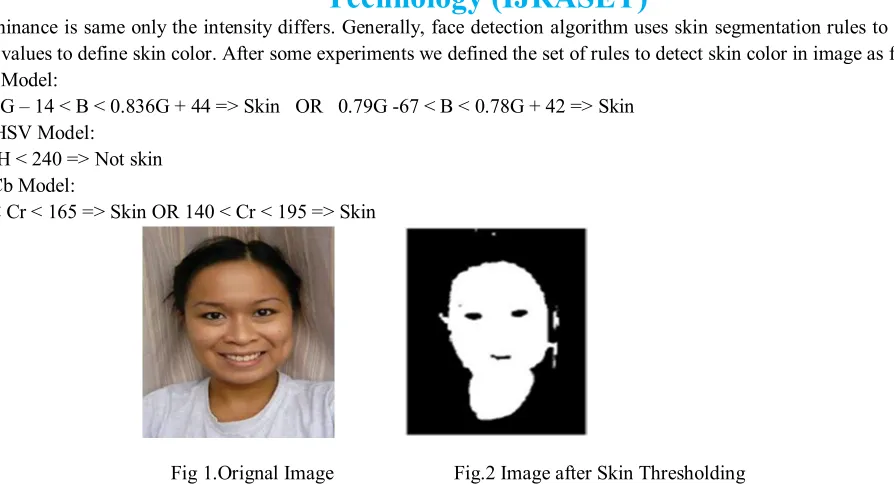
chrominance is same only the intensity differs. Generally, face detection algorithm uses skin segmentation rules to define range of color values to define skin color. After some experiments we defined the set of rules to detect skin color in image as follows. RGB Model:
0.836G – 14 < B < 0.836G + 44 => Skin OR 0.79G -67 < B < 0.78G + 42 => Skin HIS/HSV Model:
19 < H < 240 => Not skin YCrCb Model:
140 < Cr < 165 => Skin OR 140 < Cr < 195 => Skin
[image:3.612.63.510.69.311.2]
Fig 1.Orignal Image Fig.2 Image after Skin Thresholding For fast processing, after skin thresholding we convert our image into binary. The noise in this black and white image is removed with suitable skin particles. To remove non skin particles we perform morphological operations on binary image. First we erode the image and then dilate it.
B. Face Cropping
After detecting face, our next step is to detect lip. For lip detection we are going to apply red color thresholding but if image contains red color in background except lips, then probability of detecting lips falsely increases. Hence first we select our region of interest from whole image i.e. face. Hence we performed Cropping of face before moving to lip detection, so that we can concentrate on limited area. For cropping, our goal is to find four boundary point i.e. top, bottom, left and right. And on the basis of these points we found the height and width of required rectangle.
C. Detection of lip
After face detection, we applied lip detection algorithm on our area of interest. Human face reflects changes of expression in eyes and in lip region. But maximum changes are visible in lip region rather in eye region. Hence we selected lip detection for more accurate results. Again the process of lip segmentation is same as face detection .In which we need to define first four boundary points i.e. top, bottom, left and right points of detected lip. From this point we will find width and height of lip region which is further used to create rectangle and extract lip region. To avoid any confusion between lips and any other area of face we applied fact i.e. Width of lips is 3 times greater than the height.
D. Template Database Generation And Emotion Detection
Technology (IJRASET)
in the similar manner used for face cropping and lip cropping i.e. finding four points and creating rectangle and finally cropping.[5] In second phase, we actually recognize the emotion. In this step we performed cross correlation on the input image with the template present in the database, as cross correlation is generally used to fine degree of similarity between to objects.
III. RESULTS
We have different steps involved in this emotional detection software. So for better conclusion and to outline the performance as well as areas of improvement we studied different steps of this algorithm at individual level. We provide all types of inputs to the system and come across the following different studies with their result sets.
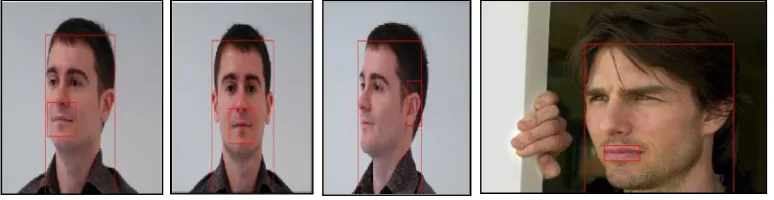
Study I: Face Detection: In the process of face detection, the challenges associated with face detection can be attributed to the following factors: pose, presence of structural component like glasses, faces may be partially occluded by other objects, image orientation, Image lightning conditions etc. So we provided different types of inputs to test accuracy of face detection process. Different inputs provided and their result sets are as follows:
Fig 3: Faces in Different Angle Fig 4 : Face with other skin
[image:4.612.77.464.275.375.2]
Fig 5 : Multiple Faces
Input Parameter Successful Detection Rate % Faces with different Angles 100
Images with multiple faces 22 Faces with Skin 60
Table 1Study I: Results
Technology (IJRASET)
Image 4: Lip detection for different color lips Input Parameter Successful Detection Rate % Lips of different colours 96
[image:5.612.74.495.37.194.2]Lips with similar emotions 50 Table 2- Study II: Results
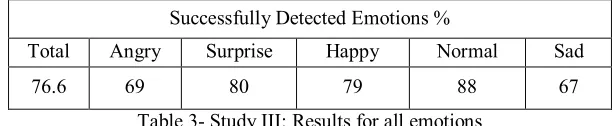
Study III: Emotion Detection: This section consists of overall accuracy of the system. In above section we analyzed results of individual processes but there are many scenarios which insist us to analyze the overall system accuracy. The following table consists of statistics which are calculated for all images with single face given to the system for different emotions.
Successfully Detected Emotions %
[image:5.612.151.459.357.420.2]Total Angry Surprise Happy Normal Sad 76.6 69 80 79 88 67
Table 3- Study III: Results for all emotions
Study IV: Performance Analysis: In this section we observed the response of our system of emotion detection for images of different sizes. These readings are taken from system with 2 GB RAM and Dual-To Core Processor.
Image Size Time for face detection Time for Lip Detection 192x163 0.79 0.663 259x194 0.746 0.529 1720x1290 73.483 73.483
[image:5.612.128.486.478.585.2]437x480 3.536 2.771 133x197 0.502 0.391
Table 4 - Study IV- Results for performance analysis
IV. CONCLUSION
After testing this software on different images, We conclude that this algorithm is faster and easy to implement than existing algorithm based on speech recognition and by ECG in which physical contact with human brain is needed which is quite expensive than this. We worked on five emotions i.e. .happiness, grief, anger, surprise and neutral. These emotions give us successful results on majority of images.
REFERENCES
Technology (IJRASET)
[3] Bernhard Fink, K.G., Matts, P.J.: Visible skin color distribution plays a role in the perception of age, attractiveness, and health in female faces. Evolution and Human Behavior 27(6) (2006) 433–442
[4] Jones, M.J., Rehg, and J.M.: Statistical color models with application to skin detection. International Journal of Computer Vision (IJCV) 46(1)(2002) 81–96 [5] http://www.mathworks.in/help/images/ref/roipoly.html
[6] “Human Emotion Recognition using Frequency &Statistical Measures of EEG Signal” , Monira Islam, Tazrin Ahmed, Sheikh Shanawaz Mostafa*, Md. Salah Uddin Yusuf, and Mohiuddin Ahmad
[7] “Human Emotion Recognition using Frequency &Statistical Measures of EEG Signal”, Monira Islam, Tazrin Ahmed, Sheikh Shanawaz Mostafa*, Md. Salah Uddin Yusuf, and Mohiuddin Ahmad