5
III
March 2017
Technology (IJRASET)
©IJRASET: All Rights are Reserved
1301
An Algorithm for Association Rules Mining using
Apriori based on Genetic Algorithm
Bhanupriya
Department of Computer Science and Engineering DAV University, Jalandhar, Punjab, India
Abstract: Presently Apriori algorithm plays an essential role in deriving frequent itemsets and then extracting association rules out of it. It is one of the classical algorithms for finding association rules, and is widely used in various applications such as market basket analysis, fraud detection, and early warning of equipment failure etc. To reduce the limitation of Apriori algorithm of generating large number of association rules, we proposed an algorithm in this research work. In this paper we applied Apriori algorithm in order to generate frequent item-sets and then frequent item-sets are used to generate association rules. After getting association rules from Apriori algorithm we applied Genetic Algorithm (GA) to obtain reduced number of association rules. The implementation of the proposed algorithm is easier than other popular algorithm for association rule mining. The proposed algorithm performs much better when compared to Apriori algorithm and other previous technique used to optimize association rule mining. The implementation of the proposed algorithm is easier than other popular algorithm for association rule mining. The proposed algorithm performs much better when compared to Apriori algorithm and other previous technique used to optimize association rule mining.
Index Terms: Data Mining, Apriori Algorithm, Genetic Algorithm, Association Rules.
I. INTRODUCTION
The explosive growth of many business, government and scientific databases has far outpaced our ability to interpret and digest this data, creating a need for a new generation of techniques for automated and intelligent database analysis [1]. The size of data stored in database is growing rapidly and the development of new and efficient methods for extracting the useful information from this huge amount of data is one of the key research areas in which most of the researchers are working. Different users need different sort of knowledge depending on their respective usage [2]. Therefore, efficient data techniques are required to find and analyze the required information. The various techniques of data mining help in building a better understanding of the data and in building characterization of the data that can be used as a basis for further analysis to extract valuable information from a large volume of data[3].
Mining association rules is one of the several data mining tasks, has a big share in the data mining research. It aims to extract interesting correlations, frequent patterns, associations or casual structures among sets of items in the transactional databases or other data repositories. This is attributed to its wide area of applications [4]. Applications of association rule mining span a wide area of business from market basket analysis to analysis of promotion and catalogue design, and from designing store layout to customer segmentation based on buying patterns. Other applications include health insurance, fraudulent discovery and loss-leader analysis, telecommunication networks market and risk management, inventory control etc. Various association mining techniques and algorithms are briefly introduced and compared later. Association rule mining has the same challenges which are being faced by data mining.
Technology (IJRASET)
©IJRASET: All Rights are Reserved
1302
become large or frequent are called candidate itemsets.
II. FREQUENT PATTERNS & ASSOCIATION RULES
Frequent patterns are the patterns (such as itemsets, subsequences, and substructures) that appear in a data set frequently. For example
A. Bread, Butter] is the set of items which appears frequently together in the transaction data set is a frequent itemset.
B. PC, Digital camera, Memory card] is a subsequence such as buying PC, digital camera, and then a memory card, if it occurs frequently in a shopping history database then it is called a sequential pattern [8].
A substructure refers to different structural forms, such as sub graphs, sub trees, or sub lattices, which may be combined with itemsets or subsequences. If a substructure occurs frequently then it is called structured patterns.
The association rules represent the associations between the data variables. An association rule is an implication of the form written below [1].
X Y [Support= S%, Confidence=C%], where X, Y ⊂ I and X ∩ Y = Φ, and
C. I is an Itemset.
D. X is called as the Antecedent or body and E. Y is called as Consequent or head of the rule.
Each rule has two measures of value support and confidence.
The computation of support and confidence can be defined by the following equations: Support (X Y) = P (XUY)
Confidence (X Y) =P(Y/X) = support_count (XUY) / support_count(X)
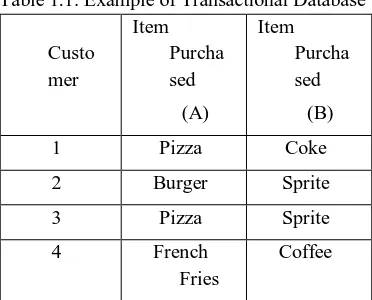
[image:3.612.213.399.411.561.2]Where support S is the probability that rule contains {X, Y} and confidence C is the conditional probability that specify the C% of the transaction of database considered must specify X Y. Minimum support and Minimum confidence are needed to eliminate the unimportant association rules.
Table 1.1: Example of Transactional Database
Custo mer
Item Purcha sed (A)
Item Purcha sed (B)
1 Pizza Coke
2 Burger Sprite
3 Pizza Sprite
4 French
Fries
Coffee
The association rule holds if it has the support and confidence value greater than or equal to minimum support (min_sup) and minimum confidence (min_conf) threshold value. An example of calculating support and confidence for transactional database given in Table 1.1 is described below. If A is “purchased pizza” and B is “purchased soda” then
Support = P (A and B) = ¼ Confidence = P (B / A) = ½
Confidence does not measure if the association between A and B is random or not.
A. Association Rule Mining Process
Association rule mining is a two-step process
1) Find All Frequent Item-Sets: First find all the sets of items whose support count value is equal to or more than minimum
support count value. All these item sets are termed as frequent itemsets [9].
Technology (IJRASET)
©IJRASET: All Rights are Reserved
1303
rules that have confidence value more than or equal to minimum confidence value [10].
III. RELATED WORK
This session discussed the various existing approaches that have been developed in recent years. Many surveys have been conducted on previously developed optimization techniques. In Kannika Nirai Vaani et al. [11] presented an integrated method to derive effective rules from Association Rule Mining using GA. Currently Apriori algorithm uses the conjunctive nature of association rules, and the single minimum support factor to generate the effective rules. However the above two factors are alone not adequate to derive useful rules effectively hence authors have taken Apriori Algorithm as a reference and included disjunctive rules [12],[13] and multiple minimum supports also to capture all possible useful rules. The concept is to integrate all into one that lead to a robust algorithm. And the salient feature of their work is introducing GA in deriving possible Association Rules from the frequent item set in an optimized manner. Besides authors have taken one more add-on factor ‘Lift Ratio’ which is to validate the generated Association rules are strong enough to infer useful information.
Technology (IJRASET)
©IJRASET: All Rights are Reserved
1304
algorithm can not only realize programming easily but also improve the efficiency of mining association rules. The authors presented an Apriori’s optimization algorithm based on reducing transaction. The algorithm is prone to programming and implementation and no additional storage space. M. Ramesh Kumar et al. [23] designed a novel GA based association rule mining algorithm. Prioritization of the rules has been discussed with the help of GA. Fitness function is designed based on the two measures like all confidence and the collective strength of the rules, other than the classical support and the confidence of the rules generated. This algorithm significantly reduces the number of rules generated in the data sets. The fitness function is designed in such a way that to prioritize the rules based on the user preference.
IV. PERFORMANCE PARAMETERS
Different methods and approaches have been developed for the optimization of the association rule mining using GA. But an important question that arises in the mind for optimization using proposed GA is “how can we measure and analyze it”? To evaluate the performance of optimization using proposed GA, a number of evaluation criteria or performance metrics were used.
A. Confidence
A measure to predict the association rule precision X → Y is the confidence. This measures the reliability of inference made by the rule which is defined in (Eq.1) [9].
=| ∪ |
| | (1)
Where |X| is the number of examples that satisfies every condition in the antecedent X and | X ∪ Y | is the number of examples both of which satisfy the antecedent X and it has the class predicted by the consequent Y.
B. Support
Due to the fact that confidence favours the rules over fitting the data [8], it is necessary to determine the way a rule is applicable in dataset, such as, support. Support is defined as (Eq.2):
= | ∪ |
| | (2)
where, │N│ is the total number of transactions, and │X∪Y│is the number of transactions containing both X and Y. Support is
often used to eliminate non interesting rules and can be considered as an indication of how often a rule occurs in a dataset [9].
C. Comprehensibility
A value which represents a number of rules and the number of these rules conditions can be taken for the characteristic of comprehensibility. The Comprehensibility (Comp) measure is needed to make the discovered rules are easy to understand. The comprehensibility of the rule can be defined by the number of attributes on the left hand side of the rule (antecedent part) and tries to quantify the understandability of the rules. Comprehensibility of an association rule is quantified by the (Eq.3.) [4]:
Comp = log (1 + |Y|
log (1 + |X∪Y| (3)
Where |Y| and | X∪Y│are the number of attributes involved in the consequent part and the total rule, respectively. This measure helps to generate simpler and more concise association rules.
D. Fitness Function
Fitness functions are used to measure the quality of rule. It is very important to define a good fitness function that rewards the right kinds of individuals. The fitness function is always problem dependent. The value of fitness is normalized in the range of [0..1]. The Above measures are very important for calculating the fitness function. Fitness fuction can be different for different approaches in our case. The function fitness (Eq. 4) can be calculated as
=( × Sup) + ( × Conf) + ( × Comp)
( + + ) (4)
Where , and are user-defined weights.
E. Tools Used
Technology (IJRASET)
©IJRASET: All Rights are Reserved
1305
application. It is not a computer language in the normal sense but it does most of the work of a computer language, writing a computer code is not a straightforward job, typically boring and time consuming for beginners. One most attractive aspect of MATLAB is that it is relatively easy to learn [10]. It is written on an intuitive basis and it does not require in-depth knowledge of operational principles of computer programming like compiling and linking in most other programming languages. This could be regarded as a disadvantage since it prevents users from understanding the basic principles in computer programming. The interactive mode of MATLAB may reduce computational speed in most applications. The power of MATLAB is represented by the length and simplicity of the code. For example, one page of MATLAB source codes. Numerical calculation in MATLAB uses collections of well-written scientific/mathematical subroutines such as LINPACK and EISPACK. MATLAB provides Graphical User interface (GUI) as well.
1) Matlab Genetic Algorithm Toolbox: The Genetic Algorithm and Direct Search Toolbox includes routines for solving
optimization problems using a) Genetic Algorithm
b) Direct search
All the toolbox functions are MATLAB M-files, made up of MATLAB statements that implement specialized optimization algorithms.
To use the Genetic Algorithm and Direct Search Toolbox, you must first write an M-file that computes the function you want to optimize. The M-file should accept a row vector, whose length is the number of independent variables for the objective function and return a scalar. Calling the function ga at the Command line to use the genetic algorithm at the command line, call the genetic algorithm function ga with the syntax.
[x.fval]=ga@(fitnessfun,nvars,options)
2) Using the Genetic Algorithm GUI Tool: The Genetic Algorithm Tool is graphical user interface that enables you to use the
genetic algorithm without working at the command line. To open the Genetic Algorithm Tool, enter gaoptim. To use the Genetic Algorithm tool, you must first enter the values of parameters
Fitness Function- The objective function you want to minimize.
Number of variables- the length of the input vector to the fitness function.
To run the GA, click the start button. The tool displays the results of the optimization in the status and result pane. You can change the options for the GA in the options pane.
Fitness function is a particular type of objective function that is used to summarize as how close a given design solution is to achieving the set aims. In particular, in the fields of GAs, each design solution is represented as a string of numbers (referred to as a chromosome) [10]. After each round of testing, the idea is to delete the 'n' worst design solutions, and to introduce ‘n' new ones from the best design solutions. Each design solution is indicate how close it came to meeting the overall specification, and this is generated by applying the fitness function to the test results obtained from that solution.
V. RESULT ANALYSIS AND DISCUSSION
To evaluate the performance of the proposed algorithm, Extensive simulation experiments have been performed in this section. The goal is to optimize the number of generated association rules. In this research work, the performance of proposed algorithm is compared with that of Apriori algorithm and previous work in terms of number of association rules generated.
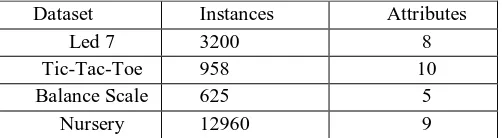
We use four datasets in this research work for generating association rules and to evaluate the performance of the resulting rules with previous done research work. These four datasets are collected from UCI Machine Learning Repository. Summary of each used dataset has been given in Table 5.1.
[image:6.612.183.434.646.715.2]The description of each used dataset is explained in brief below
Table 5.1: Summary of Used Datasets
Dataset Instances Attributes
Led 7 3200 8
Tic-Tac-Toe 958 10
Balance Scale 625 5
Technology (IJRASET)
©IJRASET: All Rights are Reserved
1306
The summarized description of attributes nursery dataset is given in Table 5.2.
Table 5.2: Description of Attributes of Nursery Dataset
A. Results on LED 7 Dataset
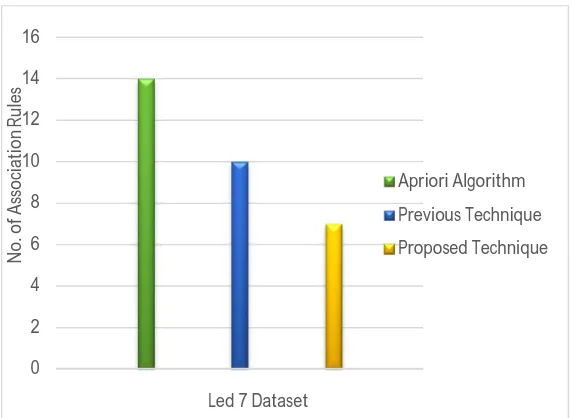
We applied our proposed algorithm on LED 7 dataset. We obtained 7 association rules and we calculated support, confidence, simplicity and fitness for each generated rule using eq. (1 - 4). The lowest value in the sup column is 0.197 and the lowest value in the confidence column is 0.900. So, these two values are used as the threshold values of the minimum support and minimum confidence in the Apriori algorithm respectively. Based on these constraints, the Apriori algorithm would generate 14 association rules from the Led 7 dataset. The evaluated performance measures for LED 7 dataset have been compared with Apriori algorithm and previous technique has been shown in Figure 1.
B. Results on Tic-Tac-Toe Dataset
[image:7.612.164.450.491.700.2]This experiment was carried out on the Tic-Tac-Toe dataset (958 instances and 10 attributes). 6. The Apriori algorithm with minimum support=0.200 and minimum confidence=0.560 would generate 16 association rules from the same dataset. The performance of the proposed approach on Tic- Tac-Toe dataset with compared to Apriori algorithm and previous technique has been shown in Figure 2.
Figure 1: Comparison of performance for LED 7 Dataset
0 2 4 6 8 10 12 14 16
N
o.
of
As
soc
ia
ti
on
R
u
le
s
Led 7 Dataset
Apriori Algorithm
Previous Technique
Proposed Technique
Attributes Values
Parents Usual, Pretentious, Great_Pret
Has_nurs Proper, Less_Proper, Improper, Critical,Very_Crit
Form Complete, Completed, Incomplete, Foster
Children 1,2,3 and More
Housing Convenient, Less_Conv, Critical
Finance Convenient, Inconv
Social Non-Prob, Slightly_Prob, Problematic
Technology (IJRASET)
[image:8.612.156.453.73.285.2]©IJRASET: All Rights are Reserved
1307
Figure 2: Comparison of performance for Tic- Tac- Toe Dataset
C. Results on Nursery Dataset
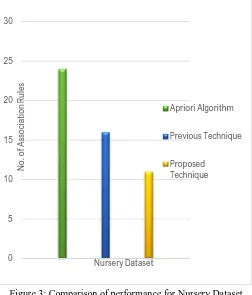
This experiment was carried out on the Nursery (12960 instances and 9 attributes). With minimum support=0.111 and minimum confidence=1.000, the Apriori algorithm would generate 24 association rules form the same dataset.
The evaluated performance measures for nursery dataset have been compared with Apriori algorithm and previous technique has been shown in Figure 3.
Figure 3: Comparison of performance for Nursery Dataset
D. Results on Balance Scale Dataset
The evaluated performance measures for balance scale dataset have been compared with Apriori algorithm and previous technique has been shown in Figure 4.
0 2 4 6 8 10 12
N
o.
of
As
soc
ia
ti
on
R
u
le
s
Tic-Tac-Toe Dataset
Apriori Algorithm
Previous technique
proposed Technique
0 5 10 15 20 25 30
N
o.
of
As
soc
ia
ti
on
R
u
le
s
Nursery Dataset
Apriori Algorithm
Previous Technique
[image:8.612.181.433.378.673.2]Technology (IJRASET)
[image:9.612.179.436.334.663.2]©IJRASET: All Rights are Reserved
1308
Figure 4: Comparison of performance for Balance Dataset
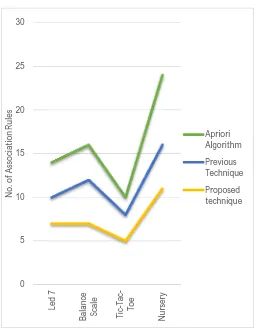
Figure 5: Comparative Performance Analysis of Proposed Technique
As evident from the above results, it has been observed that the proposed algorithm is more efficient than Apriori algorithm and previous techniques in terms of finding optimized number of association rules. A comparative performance analysis has been shown in Figure 5. The proposed algorithm was terminated when the satisfying criteria have been fulfilled or the maximum number of
0 2 4 6 8 10 12 14 16 18 N o. of As soc ia ti on R u e ls
Balance Scale Dataset
Technology (IJRASET)
©IJRASET: All Rights are Reserved
1309
generations has reached.
VI. CONCLUSION AND FUTURE SCOPE
Association rule mining is one of the most popular techniques of data mining methods whose aim is to extract associations among sets of items in transaction databases. Comparison of the results obtained from proposed technique and other techniques shows that our approach is more efficient in terms of performance as compared to other previous algorithms. It is found that this algorithm finds the association rules in much easier and efficient. After applied Apriori algorithm on datasets, the process of optimization of association rules obtained from Apriori is performed using proposed GA.
REFERENCES
[1] Jiawei Han, Micheline Kamber, “Data Mining: Concepts and Techniques”, Morgan- Kaufmann Publishers, 2000.
[2] R. Agrawal, R. Srikant, “Fast Algorithm for Mining Association Rules”, Proc. of theInt. Conf on Very Large Database, pp. 487- 499, 1994.
[3] J. Han, J. Pei, Y. Yin, “Mining Frequent Patterns without Candidate Generation”. Proc. of the ACM SIGMOD Int. Conf. on Management of Data, pp.1-12, 2000.
[4] J. Han, J. Pei, Y. Yin and R. Mao, “Mining Frequent Patterns without Candidate Generation: A Frequent Pattern Tree Approach”, In Data mining and Knowledge Discovery, Vol. 8, pp.53-87, 2004.
[5] S.Vijayarani, P.Sathya, “Mining Frequent Item Sets over Data Streams using Éclat Algorithm”, Proceedings published in International Journal of Computer Applications (IJCA), 2000.
[6] B. Patel, V. K. Chaudhari, R. K. Karan, Y. K. Rana. "Optimization of Association Rule Mining Apriori Algorithm Using ACO." International Journal of Soft Computing (IJSC), Vol. 1, Issue 1, 2011.
[7] G. Serban, I. G. Czibula, A. Campan, "A Programming Interface For Medical diagnosis Prediction", Studia Universitatis, "Babes-Bolyai", Informatica, LI(1), pp 21-30, 2006.
[8] M. Dorigo, T. Stutzle, “Ant Colony Optimization”, 2nd Edition, 2004.
[9] R.J. Kuo, C.M. Chao, Y.T. Chiu, “Application Of Particle Swarm Optimization To Association Rule Mining”, Applied Soft Computing, pp 326–336, 2011 [10] A. A. Frietas, “Data Mining and Knowledge Discovery with Evolutionary Algorithms”, Springer-Verlag Berlin Heidelberg, 2002
[11] M. Kannika Nirai Vaani, E. Ramaraj.“An Integrated Approach To Derive Effective Rules From Association Rule Mining Using Genetic Algorithm” Pattern Recognition, Informatics and Medical Engineering (PRIME), International Conference , pp 90 – 95, 2013.
[12] Y. C. Lee, T. P. Hong, W. Yang Lin, “Mining Association Rules with Multiple Minimum Supports Using Maximum Constraints,” Elsevier Science, 2004. [13] Michelle Lyman, “Mining Disjunctive Association Rules Using Genetic Programming,” The National Conference on Undergraduate Research (NCUR), 2005. [14] S. Rangaswamy, Shobha G., “Optimized Association Rule Mining Using Genetic Algorithm,” Journal of Computer Science Engineering and information
Technology Research (JCSEITR), Vol.2, Issue 1, pp 1-9, 2012.
[15] K. Poornamala, B. Lawrence, “A Frequent Pattern Tree Algorithm For Mining Association Rule Mining Using Genetic Algorithm,” International Conference of Computing and Control Engineering, 2012.
[16] S. Jain, S. Kabra. "Mining & Optimization of Association Rules Using Effective Algorithm," International journal of Emerging Technology and Advanced Engineering (IJETAE), Vol.2, Issue 4, 2012.
[17] M. Wang, Z. Qin, L. Caihui, "Multi-Dimension Association Rule Mining Based on Adaptive Genetic Algorithm.", IEEE International Conference , Vol. 2, pp. 150-153, 2011.
[18] P. Wakabi-Waiswa, V. Baryamureeba, K. Sarukesi. "Optimized Association Rule Mining with Genetic Algorithms", In Natural Computation (ICNC), Seventh International Conference on, Vol. 2, pp. 1116-1120, 2011.
[19] D. Corne and J. Knowles, “Techniques For Highly Multi-Objective Optimisation: Some Nondominated Points Are Better Than Others,” Genetic and Evolutionary Computation Conference (GECCO) ACM Press, London, UK, Vol. 1, pp. 773–780, 2007.
[20] R. Haldulakar, J. Agrawal. "Optimization of Association Rule Mining through Genetic Algorithm." International Journal of Computer Science and Engineering (IJCSE), Vol. 3, 2011.
[21] W. Soto, A. Olaya-Benavides. "A Genetic Algorithm for Discovery of Association Rules." In Computer Science Society (SCCC), pp. 289-293. IEEE, 2011. [22] H. Qiu-yong, T. Ai-long, S. Zi-guang. "Optimization Algorithm of Association Rule Mining Based on Reducing the Time of Generating Candidate Itemset." In
Control, Automation and Systems Engineering (CASE), pp. 1-4. IEEE, 2011.
[23] M. Ramesh Kumar, Dr. K. Iyakutti, “Application Of Genetic Algorithms For The Prioritization Of Association Rules”, IJCA Special Issue on Artificial Intelligence Techniques - Novel Approaches & Practical Applications.AIT, pp. 1-3, 2011.
[24] H. Guo, Ya Zhou. "An Algorithm for Mining Association Rules Based on Improved Genetic Algorithm and its Application." In Genetic and Evolutionary Computing. IEEE, pp. 117-120. 2009.