Technology (IJRASET)
Analysis of Different Types of Domino Logic: A
Review
Eesh Mittal1, Nagendra Sah2
Electronics and Communication Department, PEC University of Technology, Chandigarh, India
Abstract—Power and area will remain the main constraints in the designing of VLSI circuits. Dynamic CMOS logic circuits are broadly designed for high performance circuits due to their high speed. Conversely, the demerit of dynamic logic style is its high noise sensitivity. The main cause of this is the sub-threshold leakage current flowing through the pull down network and with continuous technology scaling, this problem is getting more and more severe. Compared to static CMOS circuits which have larger capacitance and offers more delay , Dynamic circuits are used to reduce those parameters of design. In that area lot of work has been done to improve the noise immunity and to make more power efficient without sacrificing the speed of the dynamic circuits. Domino with keeper, Domino with footer and keeper, High speed domino logic, Conditional keeper domino logic and several other techniques have been employed to improve the performance of the domino logic. Simulations were done in cadence earlier in order to visualize the different types of domino logic at different technology nodes and power supply for comparison purpose.
Keywords—domino logic, leakage power, noise immune, wide fan in.
I. INTRODUCTION
In comparison with static CMOS circuits, dynamic CMOS circuits have various advantages such as less number of transistors, low-power, higher speed, no short-circuit power and glitch-free operation Because of the above properties, high performance systems are realized using dynamic CMOS circuits. With the need of low power and higher speed processors and the use of portable devices have resulted in very fast growth in VLSI circuit designs [1]. In modern VLSI circuits dynamic domino logic is widely used due to its high performance compared to static logic. But the major drawbacks of dynamic logic are high power dissipation and less immunity to noise. As the technology is scaling down continuously, it results in the increase of leakage current which is dependent on parameters like gate oxide thickness, doping profile, channel dimension, sub-threshold conduction, gate oxide tunneling, and reverse bias junction. And as a result of this, the lower noise margin and higher static power dissipation becomes the dominant factors in the design of VLSI circuits and for the high fan-in dynamic OR gates. Wide fan-in OR gates play an important role in microprocessors so to achieve higher performance operation.
II. TYPESOFDOMINOLOGIC
In recent years, different logic styles have been proposed to implement domino logic which can be further used to implement several circuits including the memory designs, wide-fan in OR gates .In this paper brief discussion of various domino logic styles having least efficient designs to high efficient designs have been discussed.
A. Conventional domino logic
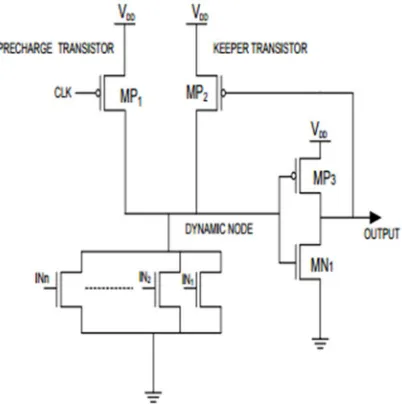
Conventional domino logic achieves better immunity to noise due to the stacking effect when compared to footless domino style . To achieve the improvement in robustness of the Conventional domino circuits, keeper upsizing can be done[1][2]. But upsizing of keeper transistor results in contention between dynamic node and pull down network(PDN) which increases power consumption and delays during evaluation period.
Fig (b) Footless Domino Logic C. Conditional keeper domino logic(CKD)
When we design a high fan-in gates In deep sub-micron technology the Leakage current associated with that Design is quite significant therefore there is a need of strong keeper that will compensate for the loss of charge[2], although these types of strong Keepers have contention problem but are quite good for the circuits in noisy in environments when gate inputs are not protected[5].
Fig(c) Conditional keeper domino logic D. High speed domino logic(HSD)
[image:3.612.212.413.150.357.2] [image:3.612.213.415.455.633.2]Technology (IJRASET)
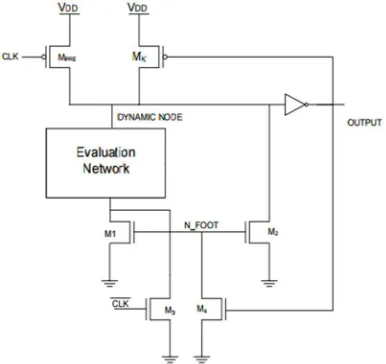
Fig (d) High speed domino logic E. Diode footed domino logic
The diode footer (M1) results in lowering the sub threshold leakage by the use of stacking effect[14] . But there is performance degradation due to presence of diode footer that’s why the mirror transistor [M2] is used that increases the performance characteristics[7].
Fig (e). Diode footed domino logic
F. Controlled keeper by current comparison domino(CKCCD)
[image:4.612.220.413.320.502.2] [image:4.612.205.402.602.705.2]In the CCD circuit, the current of the Pull up network is mirrored by transistor M2 and compared with the reference current, which replicates leakage current of Pull up network. The topology of the keeper transistors and the reference circuit, which is shared for all gates, which successfully tracked the process, voltage and temperature variations[11]. The CCD circuit employs pMOS transistors to implement logical function, as shown in figure (h). This circuit is similar to Replica Leakage Circuit, in which a series diode-connected transistor M6 similar to M1 has been added. Using the N-well , source and body terminals of the pMOS transistors are tied together such that the body effect is eliminated.
Fig (g) Current comparison domino
H. Dynamic logic using leakage current replica keeper(LCR)
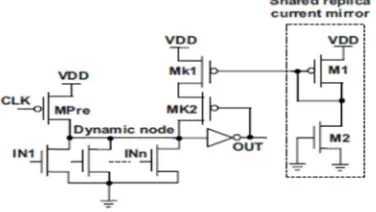
In the case of wide fan-in gates, the capacitance of the dynamic node is large therefore the speed is decreased dramatically. In addition, noise immunity of gates is reduced due to many parallel leakage paths in wide input gates. Although keeper transistor can improve the noise robustness but at the cost of power consumption and delay which gets increased due to large contention[9] . A domino logic that is implemented by Leakage current replica(LCR) keeper uses an analog current mirror to replicate the leaking current of a dynamic pull-down stack and tracks process, voltage, and temperature variations. The proposed keeper has one field-effect transistor per gate plus a portion of a shared current mirror fig(h).
Fig (h) LCR keeper based domino logic
I. High speed domino logic circuit for improved performance
[image:5.612.197.426.174.302.2] [image:5.612.223.411.435.541.2]Technology (IJRASET)
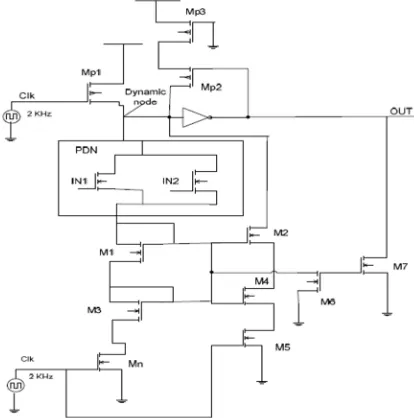
Fig(I) High Speed Domino Logic Circuit for Improved Performance
III. RESULTS
The Table 1 [13] shows the comparison of different domino logics. The Table 2 shows the simulations performed on cadence tool with 90nm technology node for High speed domino logic circuit of fig(I)
TABLE 1. comparison of different domino logics
Parameters FLD FD HSD CKD DFD LCR CCD
Power(µW) 2.203 2.964 375.49 205.52 3.320 2.259 1.98
Delay(ps) 16.55 29.615 16.152 19.05 27.88 16.91 18.13
Power-delay
product(aJ) 36.45 87.64 6064.1 3915.1 92.56 38.19 35.89
TABLE 2(a) Simulations with varying supply voltage
Supply Voltage
1v 0.9v 0.8v 0.7v 0.6v
Power (nW) 333.74 121.66 179.05 73.592 72.895 Delay
(ps)
172.88 245.60 441.41 867.73 2046.9
PDP (10^-18) 57.695 29.879 79.036 63.858 149.21
[image:6.612.211.418.84.293.2] [image:6.612.159.455.604.700.2]180n 576.95
240n 407.62
300n 322.22
360n 276.03
420n 249.85
480n 234.29
IV. CONCLUSION
New designs were necessary to obtain desired noise robustness because in dynamic logic circuits the evaluation network consumes a lot power in the earlier designs and also there was a problem of leakage power dissipation and these problems became more and more severe as we moved into the nanometer regime and as with the development of wide fan in gates as well . Moreover, increasing the fan-in resulted not only in reducing worst case delay but also increased the contention between the keeper transistor and the evaluation network. The main purpose of above mentioned techniques was to make domino circuits more noise immune and with reduced leakage power dissipation. The recent techniques developed are doing it by comparing the evaluation current of the gate with the leakage current in the current comparison domino circuit technique recently developed and by the use of current mirror circuits to produce stacking effect[14] .
REFERENCES
[1] R. H. Krambeck, C. M. Lee and H. F. S. Law, "High-speed compact circuits with CMOS,"IEEE Journal of Solid State Circuits, vol. 17, p. pp. 614–619, Jun.
1982.
[2] A. S. Sedra and K. C. Smith, Microelectronic Circuits, Fourth Edition.
[3] A. Alvandpour, R. K. Krishnamurthy, K. Soumyanath, and S. Y. Borkar, "A conditional keeper technique for sub-130nm wide dynamic gates," in Proceedings
of Intertional Symposium on VLSI Circuits, pp. 29–30, 2001.
[4] M. H. Anis et al, "Energy-efficient noise-tolerant dynamic styles for scaled-down CMOS and MTCMOS technologies," IEEE Transaction on VLSI
Systems,vol. 10, p. pp. 71–78, Apr. 2002.
[5] M. H. Anis, M.W. Allam, and M. I. Elmasry, "High-speed dynamic logic styles for scaled-down CMOS and MTCMOS technologies," in Proceedings of International Symposium on Low- Power Electronics and Design, pp. 155–160, 2000
[6] Atila Alvandpour,, Ram K. Krishnamurthy, K. Soumyanath and Shekhar Y. Borkar, “A Sub-130-nm Conditional Keeper Technique”, IEEE JOURNAL OF
SOLIDSTATE CIRCUITS, VOL. 37, NO. 5, MAY 2002 633
[7] H. Mahmoodi-Meimand and K. Roy, "Diode-footed domino: a leakage-toleranthigh fan-in dynamic circuit design style," in IEEE Transactions on Circuits and
Systems I: Regular Papers, vol. 51, no. 3, pp. 495-503, March2004.
[8] L. Ding and P. Mazumder, "On circuit techniques to improve noise immunityof CMOS dynamic logic," IEEE transactions on very large scale integration (VLSI) systems,vol. 12, pp.pp. 910-925, Sep. 2004.
[9] Y. Lih, N. Tzartzanis and W. W. Walker, "A Leakage Current Replica Keeper for Dynamic Circuits," in IEEE Journal of Solid-State Circuits, vol. 42, no. 1, pp.
48-55, Jan. 2007
[10] A. Peiravi and M. Asyaei, “Robust low leakage controlled keeper by current-comparison domino for wide fan-in gates, integration,” VLSI J., vol. 45, no. 1, pp.
22–32, 2012
[11] A. Peiravi and M. Asyaei, "Current-Comparison-Based Domino: New Low-Leakage High-Speed Domino Circuit for Wide Fan-In Gates," in IEEE
Transactions on Very Large Scale Integration (VLSI) Systems, vol. 21, no. 5, pp. 934-943, May 2013.
[12] Shiksha and K. K. Kashyap, "High speed domino logic circuit for improved performance," 2014 Students Conference on Engineering and Systems, Allahabad,
2014, pp. 1-5.
[13] Ankit Kori,MohammedArif"Comparative Analysis of Domino Logic Circuits for Better Noise and Delay Performance", International Journal of Engineering
Trends and Technology (IJETT), V30(3),138-141 December 2015. ISSN:2231-5381.