101
A Review on QoS Aware Routing Protocols for
Wireless Sensor Networks
Priya Chauhan1, Dr. Sanjay Kumar Malik2 M.Tech (CSE), Hindu College of Engineering, Sonepat, India
CSE Deptt, Hindu College of Engineering, Sonepat, India.
Abstract: Wireless Sensors Network is used to monitor agriculture field, traffic signal management & Health Monitoring, Pollution control, Military applications etc. with limited energy resources. Various energy efficient routing schemes are available to send sensed information to Base Station (BS). The sensor nodes have a limited transmission range, and their processing and storage capabilities as well as their energy resources are also limited. Routing protocols for wireless sensor networks are responsible for maintaining the routes in the network and have to ensure reliable multi-hop communication under these conditions. In this paper, i have done a survey of routing protocols for WSNs by summarizing the work on QoS based routing protocols that has already been published and by highlighting the QoS issues that are being addressed. The performance comparison of QoS based routing protocols such as SAR, MMSPEED, MCMP, LEACH, and SPEED has also been analyzed for various parameters.
I. INTRODUCTION
A generic wireless sensor network is composed of a large number of sensor nodes. Each of them has the capability of collecting data about an ambient condition, such as temperature, pressure, humidity, noise, lighting condition etc., and sending data reports to a sink node. Wireless networks of smart sensors have become feasible for many applications because of technological advances in semiconductor, energy efficient wireless communications and reduced power budgets for computational devices, as well as the development of novel sensing material [1]. WSNs provide efficient and reliable means for the observation of some physical phenomena which are otherwise very difficult, if not impossible, to observe, and initiation of right actions based on the collective information received from sensor nodes [2].
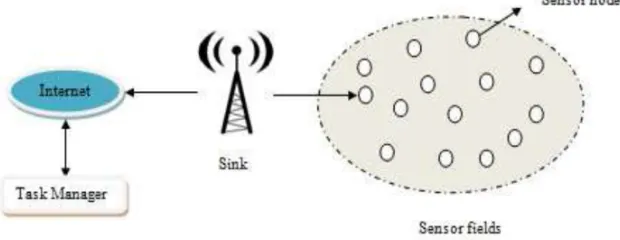
[image:2.612.149.459.511.631.2]These sensor nodes communicate over short distance via a wireless medium and collaborate to accomplish a common task. As the Internet has revolutionized our life via the exchange of diverse forms of information readily among a large number of users, WSNs may, in the near future, be equally significant by providing information regarding the physical phenomena of interest and ultimately being able to detect and control them or enable us to construct more accurate models of the physical world. Potential applications of WSNs include environmental monitoring, industrial control, battlefield surveillance and reconnaissance, home automation and security, health monitoring, and asset tracking. for example, health monitoring environment monitoring, military surveillance, and industrial process control [4].
Figure 1: Wireless Sensor Networks Model
The key components of sensor networks:
Sensor Field: A sensor field is vicinity where the nodes can be positioned.
Sensor Nodes: Sensors nodes are the heart of the network. It is the responsibility of the sensor nodes to gather information and transmit to the sink or base station; it is engineered for the network.
102
correspondences between nodes are diminished because of the sink thereby decreasing energy conditions of the entire network. Task Manager: The tasks Manger acts as a gateway to other networks. The base station also called the centralized control room for data extraction, spread information back and forth to the networks, data processing and storage center with user access controls. The figure 1 above is the general view of sensor network made by task manager, internet, base station and sensor fields.
A. Hardware Components of Sensor Node
In wireless sensor network every node can autonomously carry out processing and sensing schedules as well as communicate with each other and transferring of sense data to the Central Processing Unit (CPU). Sensor nodes are a small device that has a micro-sensor technology, low power signal processing, low power computation and a short-range communications capability. The hardware components for sensor node consist of Radio Transceiver, Embedded Processor, Memory, Power source and Sensor(s).
Each sensor node in WSNs usually consists of one or multiple sensors, an embedded processor or DSP, a lower power radio transceiver, and a battery [5]. A single wireless sensor node senses physical phenomena in the environment, such as temperature, humidity, pressure, and so on. After sensing, it converts analog signal into digital signal using Analog Digital converter (ADC), and then the embedded CPU, micro controller, or DSP processes the signal and transfer the data in packets to neighbouring nodes. The radio transceiver in sensor node architecture operates at different levels namely; Transmit, Receive, Idle and Sleep. Transmit: refers to the sending of data among nodes and to the base station. Receive: collecting transmitted packets from various sections of the sensor networks. Idle: available to receive incoming packets, but not ready to start. Some techniques are used to switch off the functions of the hardware in order to diminish the consumption of energy to lesser levels. Sleep: the process entails switching off considerable sections of the transceiver so limiting its ability to receive any forms of data or information. Memory: Sensor node has in-built memories that include chip flash memory, a RAM of a microcontroller and external flash memory These two types are mainly for storage; in-built memories such as RAM and chips for program storage and external for storing private data. Power Source: The consumption of energy in sensor nodes is through sensing data, processing of data and communication.
Embedded Processor The operations of an embedded processor are for programming tasks, process data and manage various areas of hardware components. Various kinds of embedded processors can be applied in sensor nodes, and these are Digital Signal Processor (DSP), Microcontroller, Application Specific Integrated Circuit (ASIC) and Field Programmable Gate Array (FPGA) Sensors are hardware which generates measurable reaction signal due to changes in environments like weather conditions, pressure, humidity and temperature.
B. Challenges for QoS Support in WSNs
WSNs inherit most of the QoS challenges from general wireless networks, their particular characteristics pose unique challenges as follows.
1) Severe resource constraints: The constraints on resources involve energy, bandwidth, memory, buffer size, processing capability, and limited transmission power. Among them, energy is a primary concern since energy is severely constrained at sensor nodes and it may not be feasible to replace or recharge the battery for sensor nodes that are often expected to work in a remote or inhospitable environment [6].
©IJRASET 2015: All Rights are Reserved
103
3) Redundant Data: WSNs are characterized by high redundancy in the sensor data. However, while the redundancy in the data does help loosen the reliability/robustness requirement of data delivery, it unnecessarily spends much precious energy..
4) Network dynamics: Network dynamics may arise from node failures, wireless link failures, node mobility, and node state transitions due to the use of power management or energy efficient schemes. Such a highly dynamic network greatly increases the complexity of QoS support.
5) Energy balance: In order to achieve a long-lived network, energy load must be evenly distributed among all sensor nodes so that the energy at a single sensor node or a small set of sensor nodes will not be drained out very soon. QoS support should take this factor into account.
6) Scalability: A generic wireless sensor network is envisioned as consisting of hundreds or thousands of sensor nodes densely distributed in a terrain. Therefore, QoS support designed for WSNs should be able to scale up to a large number of sensor nodes, i.e.QoS support should not degrade quickly when the number of nodes or their density increases.
7) Multiple Sinks or Base Stations: There may exist multiple sink nodes, which impose different requirements on the network. For instance, one sink may ask sensor nodes located in the northeast of the sensor field to send a temperature report every one minute, while another sink node may only be interested in an exceptionally high temperature event in the southwest area. WSNs should be able to support different QoS levels associated with different sinks.
8) Less Reliable Medium: The communication medium in WSN is radio. This wireless medium is inherently less reliable. The wireless links are also very much affected by different environmental factors such as noise and cross signal interference [3]
9) Multiple traffic types: Inclusion of heterogeneous sets of sensors raises challenges for QoS support. For instance, some applications may require a diverse mixture of sensors for monitoring temperature, pressure, and humidity, thereby introducing different reading rates at these sensors. Such a heterogeneous environment makes QoS support more challenging.
C. QoS Aware Routing Protocols
There are several issues to be considered during the design of the QoS based routing algorithms for multi-hop wireless sensor networks. Those are: 1) QoS state propagation and maintenance 2) metric selection (e.g., bandwidth, delay etc) and route computation 3) scalability and 4) domain of QoS such as reliability or timeliness. A QoS aware routing scheme for multi-hop WSNs should also balance efficiency and adaptability while maintaining low control overhead in the system. In recent years, several routing algorithms have been proposed by research communities// which aim to provide QoS in Wireless Sensor Networks. Some of these algorithms are briefly discussed below:
Sequential Assignment Routing (SAR) is the first routing protocol to provide QoS supportin WSNs. This is a multi path, table driven routing protocolwhich tries to achieve both faulttolerance and recovery [3]. Assumingmultiple paths to the sink node, each sensor uses a SARalgorithm for path selection. It takes into account the energyand QoS factors on each path, and the priority level of a packet [7]. This protocol creates a tree of sensor nodeshaving root at one hop neighbour of the sink node. Using the createdtree, multiple paths are selected based on the energy resourceand QoS on each path. The shortcomings of the protocol are the overhead of maintaining routing tables andstates at each sensor node particularly when the numberof sensor nodes deployed is large.
LEACH is the most popular hierarchical model which works by forming the clusters. It is based on the idea of an iterative randomized selection of CH in order to distribute the load of CH among nodes. Thus, it maximize the lifetime of the network. In which nodes transmit information to their cluster heads, and the cluster heads aggregate and compress the data and forward it to the base station (sink). Each node uses a stochastic algorithm at each round to determine whether it will become a cluster head in this round [2]. LEACH assumes that each node has a radio powerful enough to directly reach the base station or the nearest cluster head, but that using this radio at full power all the time would waste energy.Nodes that have been cluster heads cannot become cluster heads again for P rounds, where P is the desired percentage of cluster heads. Thereafter, each node has a 1/P
probability of becoming a cluster head in each round. At the end of each round, each node that is not a cluster head selects the closest cluster head and joins that cluster. The cluster head then creates a schedule for each node in its cluster to transmit its data [4]. All nodes which are not cluster heads only communicate with the cluster head in a TDMA fashion, according to the schedule created by the cluster head. Nodes do so by using the minimum energy needed to reach the cluster head, and only need to keep their radios on during their time slot.LEACH also uses CDMA so that each cluster uses a different set of CDMA codes, to minimize interference between clusters.
©IJRASET 2015: All Rights are Reserved
104
regulating the traffic sent to the MAC layer locally. To some extent, it achieved the end-to-end transmission rate guarantee, network congestion control and load balancing [3].
Multi-path and Multi-SPEED (MMSPEED) is across-layer routing protocol, it achieved routing based on reliability and the minimum packet time of arrival, and proposed a routing metric called On-Time Reachability [8]. This protocol is an extension of SPEED providing multi path multi speed of packets across the network. MMSPEED routing protocol supports probabilistic QoS guarantee by provisioning QoS in two domains, timeliness and reliability. The protocol involves data being allocated to the correct speed layer to be positioned in the best queue in accordance to own speed classification. Then data are employed in the FCFS policy, to enable high priority packets are executed first before low priority packets takes their turn [5]. MMSPEED might use its redundant path selection scheme for load balancing, which is not only for reliability enhancement, but also to improve the overall network lifetime.
MCMP Protocol: A Multi Constrained QoS Multi-Path routing (MCMP) protocol uses braided routes todeliver packets to the sink node according to certain QoS requirements that are expressed interms of reliability and delay. The problem of end-to-end delay is formulated as an optimizationproblem, and then an algorithm based on linear integer programming is applied to solve theproblem [7]. The protocol objective is to utilize the multiple paths to augment network performancewith moderate energy cost. The protocol always routes the information over the paththat includes the minimum number of hops to satisfy the required QoS, which leads to moreenergy consumption in some cases.
Flooded forward ant routing (FF) argues the fact that ants even augmented with sensors, can be misguided due to the obstacles or moving destinations. The protocol is based on flooding of antsfrom source to the sink [9]. In the case where the specific destination is not known at thebeginning by the ants, or cost cannot be estimated (e.g., address-based destination),the protocol reduces to basic ant routing, and the problem of wandering around thenetwork to find the destination exist. This is the case where FF exploits the network with the broadcast channel of wireless sensor networks i.e. the protocol simply uses the broadcast method of sensor networks so as to route packets to the destination. The idea is to flood forward ants to the destination. If the search is successful, forwardants will create backward ants to traverse back to the source. Multiple paths are updated by one flooding phase. Probabilities are updated in the same way as in thebasic ant routing. The flooding can be stopped if the probability distribution is goodenough for the data ants to the destination. The rate for releasing the flooding ants, when a shorter path is traversed is reduced.
Ad hoc on demand distance vector (AODV) routing protocol [10] is a popular classical routingprotocol for mobile ad hoc networks. It is a demand-driven and reactive protocol, which discovers routes when a node has data to transmit. Addressing is handled using IP addressing. Since each node acts as both a source node and routing node, each must maintain a Routing Table (RT) that contains information about known destination nodes. AODV indicates that the transport layer protocol is User Datagram Protocol (UDP), which offers a best effort delivery of packets, and does not support either error recovery or flow control. When a node has some data to send to a destination and it does not have the validrouting table entry, it generates a route request (RREQ) packet and broadcasts it to allits neighbours. When an intermediate node receives this RREQ, it searches its localrouting table for a valid route to the requested destination. If the search is successful,it generates a route reply (RREP) packet, which is sent as a unicast message back tothe source node using the reverse links. Onreception of an RREP packet, each intermediate node updates its routing table to setup a forward pointer and relays the RREP message to the next hop using the reversepointer. The process continues till RREP is received by the source node. AODV in itsoriginal form uses periodic HELLO messages to check the validity of links with its neighbours. If a link involved in an active route fails, a route error (RERR), message is generated which is unicast back to the node where the message was initiated, and it flushes the corresponding routing table entries for the intermediate nodes. The source node is likely to get more than one RREP packet and it selects the one with the least number of hops. The version of AODV implemented in this paper for evaluation process is an energy optimized version of AODV for wireless sensor networks that is distributed with RMASE [11]. This does not use HELLO packets to detect link failures rather it uses feedback from the link layer to achieve the same objective. Intermediate nodes do not generate reply RREP, even if, they have a valid route which avoids the overhead of multiple replies. This version of AODV also employs cross layer techniques to avoid paths which involve high packet loss.
©IJRASET 2015: All Rights are Reserved
105
Hamid et al. [13] proposed a timeliness and reliability QoS aware, localized, multi-path and multi-channel protocol, where routing decision is made according to the dynamic adjustment of the required bandwidth and path length based proportional delay differentiation for real time data. The proposed protocol works in a distributed manner to ensure bandwidth and end to-end delay requirements of real time data. At the same time, the throughput of non real time data is maximized by adjusting the non-real time data. The delay bound is calculated based on propagation delay, transmission delay and the switching delay and the hop count is used for dynamic bandwidth adjustment to boost up the time critical real-time traffic so that they can meet the deadline. This protocol experiences less average delay for real time packets and maximizes the throughput of non-real time traffic exploiting multiple paths. The limitation is that it does not adopt any alternative mechanism to handle the delay, whenever, the buffer size increases and switching overhead affects the performance of the protocol.
Hamid Rafiei Karkvandi et al, presents Effective Lifetime-Aware Routing in Wireless Sensor Networks [15]. It determines the network resource specifications such as the number of available nodes and their sensing spatial coverage. The sensing problem is addressed and analysed for various layers of the network, by using the solutions of various linear programming equations, normalized network lifetime can be calculated for various network environments.
Routing Protocols
Type Classification Architecture Energy efficiency Location Awareness Data delivery model
SAR Hybrid Classical Flat No No Query
driven SPEED Hybrid Classical Flat No No Query driven MMSPEED Hybrid Classical Flat No No Query driven AODV Reactive Classical Flat No No Query driven RPAR Reactive Classical Flat Yes No Query driven Hamid et al. Reactive Classical Flat No No Query driven
LEACH Proactive Classical Hierarchical Yes No Query driven FF Hybrid Swarm Hierarchical No No Event
driven
II. CONCLUSION
In this survey paper, we analyzed the QoS requirements imposed by main applications of WSNs, and highlighted some of the challenges posed by the unique characteristics of wireless sensor networks. We have reviewed some of the QoS aware routing protocols for WSNs. A comparative study of some of QoS aware routing protocols and taking few important parameters in context of WSNs is done. Finally, we are convinced that the QoS support in WSNs should also include QoS control besides QoS assurance mechanisms, and some exciting open issues are identified in order to stimulate more creative research in the future.
REFERENCES
[1] I. F. Akyildiz, S. Weilian, Y. Sankarasubramaniam and E. Cayirci, “A Survey on Sensor Networks”, IEEE Communications, vol. 40, no. 8, pp. 102-116, 2002
[2] Shio Kumar Singh, M P Singh, and D K Singh, “Routing Protocols in Wireless Sensor Networks –A Survey”, International Journal of Computer Science & Engineering Survey (IJCSES) Vol.1, No.2, pp.63-83, 2010
[3] Bhaskar Bhuyan, Hiren Kumar Deva Sarma, Nityananda Sarma, Avijit Kar, Rajib Mall, “Quality of Service (QoS) Provisions in Wireless Sensor Networks and Related Challenges”, vol. 2, no.11, pp. 861-868, 2010.
[4] Neha Rathi, Jyoti Saraswat and Partha Pratim Bhattacharya, “A Review on Routing Protocols for Application in WSNs”, International Journal of Distributed and Parallel Systems (IJDPS), Vol.3, No.5, pp.39-58,September 2012
[5] 1adulaleem Ali Almazroi, Ma Ngadi, “A Review on WSNs Routing Protocol: Challenges in Multipath Techniques” Journal of Theoretical and Applied Information Technology,Vol. 59 No.2, pp. 469-509,2014
(ICWN),pp-©IJRASET 2015: All Rights are Reserved
106
227-233,2004
[7] R.Sumathi* and M.G.Srinivas**, “A Survey of QoS Based Routing Protocols for Wireless Sensor Networks”, J Inf Process Syst, Vol.8, No.4, December 2012
[9]Y. Zhang, L. D. Kuhn, and M. P. J. Fromherz, “Improvements on Ant Routing for Sensor Networks”, Proceedings of 4th International Workshop on Ant
Colony Optimization and Swarm Intelligence (ANTS’04),LNCS, pp. 289-313, 2004.
[10] C.E. Perkins and E. M. Royer, “Ad hoc On-Demand Distance Vector Routing”, IEEE Workshop on Mobile Computing Systems and Applications, New Orleans, LA, pp. 90-100, 1999.
[11] Y. Zhang, M. Fromherz and L. Kuhn, “RMASE: Routing Modeling Application Simulation Environment”, http://www.parc.com/era/nest/Rmase, 2009. [12] T. He, J. A. Stankovic, C. Lu and T. Abdelzaher, “SPEED: A Stateless 168 Protocol for Real-Time Communication in Sensor Networks”, Proceedings of the 23rd International Conference on Distributed Computing Systems, Providence, RI, USA, pp. 46-55, 2003.
[13] M. Hamid, M. Alam and C. S. Hong, “Design of a QoS-Aware Routing Mechanism for Wireless Multimedia Sensor Networks”, Proceedings of IEEE
International Conference Global Telecommunications (GLOBECOM’08),New Orleans, LA, USA, pp. 800-805, 2008.
[14] O. Chipara, Z. He, G. Xing, Q. Chen, X. Wang, C. Lu, J. Stankovic and T. Abdelzaher, “Real-time Power-Aware Routing in Sensor Networks”,IEEE International Workshop on Quality of Service(IWQoS’06), New Haven, CT, USA, pp. 83-92, 2006.