International Journal of Emerging Technology and Advanced Engineering
Website: www.ijetae.com (ISSN 2250-2459, ISO 9001:2008 Certified Journal, Volume 7, Issue 11, November 2017)
420
Durability Study of M35 Grade CC Paver Blocks Using Fly
Ash
M. C. Chaoudhary
1, Vanita Aggarwal
21
Research Scholar, Civil Engineering Department, MM Engineering College, Mullana, Ambala, India
2Professor and Head, Civil Engineering Department, MM Engineering College, Mullana, Ambala, India
Abstract- Precast cement concrete paver blocks are used for road surfacing. The performance of road surfacing is better than asphalt and rigid concrete pavements. These are made as small elements from plain cement concrete with zero slumps. An attempt has been made to replace OPC by fly ash for manufacture of paver blocks of M35 grade and thickness 60mm & 80mm. Fly ash is a byproduct of thermal power plant which is a waste material. OPC has been replaced by fly ash in varying proportions of 0%, 20%, 30% and 40%. This paper presents the study of freeze-thaw resistance and water absorption of paver blocks. The optimum replacement of OPC by fly ash was found to be 40%.
Keywords- Paver Blocks, OPC, fly ash, water absorption and freeze-thaw resistance.
I. INTRODUCTION
Cement concrete paver blocks are precast solid products made out of cement concrete [5]. The raw material required for manufacture of products is Portland cement and aggregates which are available locally in every part of the country. In addition to basic raw
materials admixturesare also used to maintain
workability, alter curing time and to increase their performance in term of strength and durability. Paver blocks are manufactured from zero slump concrete. These are made in different shapes and sizes. In Holland, paver blocks were used at first in fifties as replacement of paver bricks which became scarce due to boom in building construction industries after the war [10]. Paver blocks are used for road surfacing. The interlocking paver blocks make up the bearing surface and are a major load spreading of pavement. These are generally made with M30 to M55 grade concrete with varying thickness from 50mm to 120mm. These are used for non-traffic, light traffic, medium traffic and heavy duty traffic conditions.
II. LITERATURE REVIEW
T. Uygungloet al., 2012 [3], studied the influence of
flyash content and replacement of crushed sand stoneaggregate with concrete waste and marble waste
inprefabricated concrete interlocking blocks
andconcluded that water absorption of paving
blocksincreased on increment in replacement ratio of fly ash and freeze-thaw durability of blocks decreased with increase in fly ash ratio. Fly ash replacements of 40% fulfill the required strength of freeze thaw resistance
G. Nader et al, [2], evaluated the prediction offreezing and thawing durability of concrete pavingblocks. Mass loss correlated with cement content.Test result indicated
that minimum cementitiouscontent of 395kg/m3
corresponding water absorptioncapacity of 3.8% can provide an acceptable level ofstrength and frost durability for concrete pavingblocks. Block samples of higher cement contentwithstood a greater number of freezing and thawingcycles.
A. J. Clark, 1980 [1], studied concrete paving blockspecimens and concluded that specimen of
cementcontent below 380kg/m3 suffered considerable
surfacedamage. It was reported that 380kg/m3 was theabsolute minimum level of cement content that couldbe permitted to obtain a reasonable level of durability.
III. OBJECTIVE OF THE STUDY
1. To evaluate water absorption and freeze-thaw
resistance of paver blocks using fly ash F-type as partial replacement of OPC in varying percentages of 20%, 30 % and 40 %.
2. To assess the relative suitability of paver block with
International Journal of Emerging Technology and Advanced Engineering
Website: www.ijetae.com (ISSN 2250-2459, ISO 9001:2008 Certified Journal, Volume 7, Issue 11, November 2017)
421
IV. MATERIALS USED AND THEIR PROPERTIES
4.1 Cement:
Ordinary Portland cement (43 grades) has been used for present study confirming to IS 8112:1989[8]. OPC whose normal consistency 31%, IST and FST 88min., 203min. respectively, fineness 5.0,soundness 2.4,specific gravity 3.14 and 28 days strength 45.2Mpa was used.
4.2 Aggregates:
Aggregates are classified into two types namely: Fine aggregate and coarse aggregate.The properties of both fine and coarse aggregate such as shape, size, hardness, surface texture, strength, water absorption, pore structure and gradation effect the performance of concrete.
4.2.1 Fine Aggregates
The aggregate which passes through 4.75mm sieve and lower size limit of 0.07mm are known as fine aggregates. Natural river sand with 4.75mm maximum size procured from Pathankot was used as fine aggregate for the present study. Its physical properties and sieve analysis are given in Table 1. Fine aggregate of fineness modulus 2.70, confirming to Zone-II as per IS: 383-1970[6] has been used to manufacture for paver blocks the present study.
Table 1:
Physical Properties of Fine Aggregates
Properties Observed
Value
Bulk Density (Loose) Kg/m3 1560
Bulk Density(Compacted) Kg/m3 1680
Specific gravity 2.63
Water Absorption % 0.90
4.2.2 Coarse Aggregates
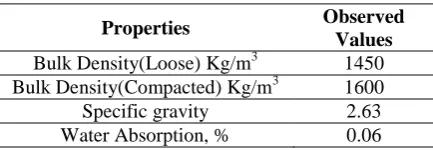
[image:2.595.329.526.538.578.2]Crushed stone with 10 mm size were used for the present study procured from Handesra (Punjab). Physical properties of coarse aggregate are given in Table. Coarse aggregate of FM 6.86 confirming to IS: 383-1970 [6]has been used for the present study.
Table 2:
Physical properties of Coarse Aggregate
Properties Observed
Values
Bulk Density(Loose) Kg/m3 1450
Bulk Density(Compacted) Kg/m3 1600
Specific gravity 2.63
Water Absorption, % 0.06
4.3 Chemical Admixture
Concrete paving blocks are manufactured from semi-dry mixtures which possess poor flow properties even under vibration. BASF Master Glenium SKY 8233 chemical admixture has been used for manufacture of
paver blocks,confirming to IS: 9103-1999[9]
specifications.
Table 3:
Physical properties of BASF Master Glenium SKY 8233
Aspect Light brown liquid
Relative Density 1.08 + 0.01 at 25° C
pH > 6
Chloride ion content < 0.2 %
The recommended dosage of selected admixture is 500ml to 1500ml per 100 kg of cementations material.
4.4 Fly Ash
Fly ash is a residue of coal burning in thermal power plants. Fly ash is removed from the flue gas by electrostatic precipitators. Fly ash as per ASTM C618 is classified as class C and class F Fly ash. Class F ashes are produced from bituminous coals and that class C ashes are produced from lignite coals
Today there is a general trend to replace higher levels of OPC with fly ash in concrete. In this study F-type fly ash has been used for manufacture of cement concrete paver blocks using different proportions of fly ash as replacement of OPC which has been procured from D.B.C.R Thermal Plant, Yamuna Nagar. The physical properties of the samples of Fly ash collected from D.B.C.R. Thermal Power Plant, Yamuna Nagar are as per Table 4.
Table 4:
Physical properties of Fly ash
Property Observed Value
Specific gravity 2.1
Class F-type
4.5 Water
Potable tap water was used for casting specimens. The water confirms to the requirements of IS: 456-2000[7].
V. MIX DESIGN AND PROPORTIONING
[image:2.595.56.273.631.706.2]International Journal of Emerging Technology and Advanced Engineering
Website: www.ijetae.com (ISSN 2250-2459, ISO 9001:2008 Certified Journal, Volume 7, Issue 11, November 2017)
422
The concrete mixes were designed with cement, water, fine aggregate, coarse aggregate and super plasticizer with varying percentages of fly ash 0%,20%, 30% and 40% as part replacement of OPC.The paver blocks were manufactured with M35 grade of concrete of thicknesses 60mm and 80mm. [image:3.595.64.528.236.319.2]Maximum nominal size of the coarse aggregate as per IS: 15658-2006 [5] is 12mm, in the present study is has been kept as 10mm. The mix design adopted for the study has been shown in Table 5. The IS codes followed for mix design are IS: 456-2000, IS: 10262-2009 and IS: 15658-2006.
Table 5:
Proportions of Constitutions of Mix Design
Mix Fly-Ash
kg
Cement kg
Water kg
Fine (Agg) Kg/m3
Coarse (Agg.) Kg/m3
Super Plasticizer
Kg/m3
Water/Ce Ma Ratio
M-35 FA0 00 360.0 161.41 702.87 1196.78 1.836 0.45
M35 FA20 79.2 316.8 161.41 679.5 1157.0 1.94 0.407
M35 FA30 118.8 277.2 161.41 673.4 1146.6 1.94 0.407
M35 FA40 158.4 237.6 161.41 666.8 1135.3 1.94 0.407
VI. CASTING OF SPECIMEN
The paver blocks of M35 grade concrete with 0% fly ash, as a reference mix and with 20%, 30% and 40% OPC replacement by fly ash, were cast with thickness 60mm and 80mm. The cast specimenswere cured for 28 daysforwater absorption and freeze-thaw resistance tests.
VII. DURABILITY TEST
7.1 Water Absorption Durability Test
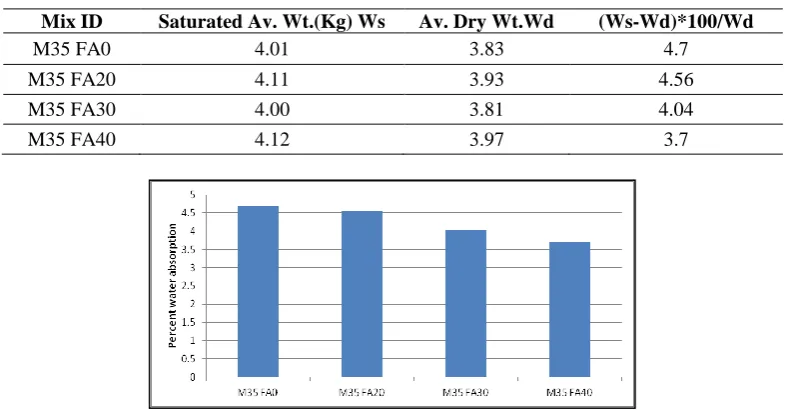
[image:3.595.101.494.442.647.2]The water absorption of paver blocks was determined to assess their durability. The test was conducted in accordance with IS: 15658-2006 [5]. The test results are shown in Table 6, 7 and shown graphically in Figure 1 and 2.
Table 6:
Water absorption results of paver blocks M 35 grade 60 mm thick
Mix ID Saturated Av. Wt.(Kg) Ws Av. Dry Wt.Wd (Ws-Wd)*100/Wd
M35 FA0 4.01 3.83 4.7
M35 FA20 4.11 3.93 4.56
M35 FA30 4.00 3.81 4.04
M35 FA40 4.12 3.97 3.7
Figure 1: Percent water absorption for various M 35 Grade, 60mm thick paver blocks
Table 7:
Water absorption results of paver blocks M 35 grade 80 mm thick
Mix ID Saturated Av. Wt. (Kg) Ws Av. Dry Wt. Wd (Ws-Wd)*100/Wd
M35 FA0 5.44 5.22 4.27
M35 FA20 5.41 5.19 4.22
M35 FA30 5.26 5.10 3.81
International Journal of Emerging Technology and Advanced Engineering
Website: www.ijetae.com (ISSN 2250-2459, ISO 9001:2008 Certified Journal, Volume 7, Issue 11, November 2017)
[image:4.595.177.420.143.266.2]423
Figure 2: Percent water absorption for various M 35 Grade, 80 mm thick paver blocks
7.2 Freeze-thaw durability test
This test was conducted for the observation of the resistance of concrete paver blocks to the repeated cycles of freezing and thawing after being submerged in 03 percent sodium chloride solution for 24 hours. The containers were filled with a 03 percent sodium chloride solution at a temperature of 23±3 degree centigrade for 24 hours. The specimen were submersed by maintaining 2mm solution above the surface of specimens.
3 paver block specimens were taken for testing at 28 days as per IS 15658:2006 [5] for each thickness of the block for freeze thaw resistance test.
Following the 24 hours saturation period, the specimens shall be subjected to continuous freeze-thaw cycles.
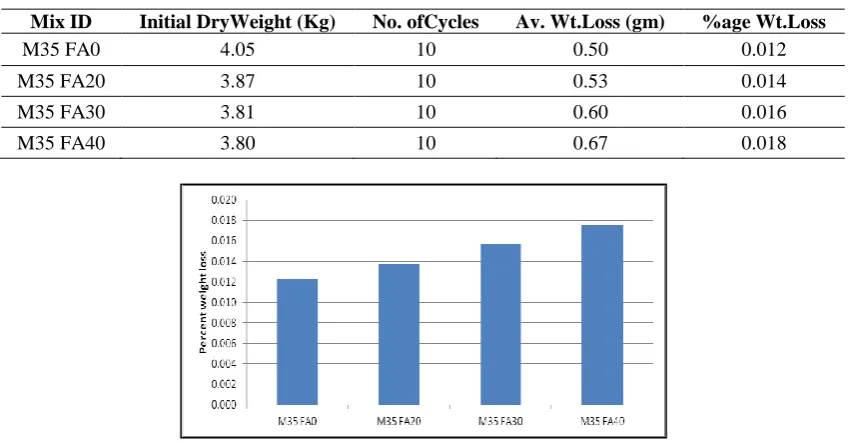
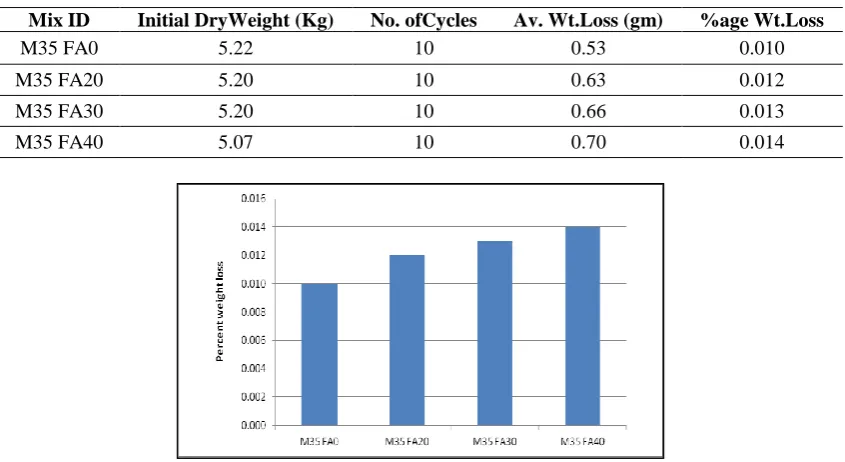
[image:4.595.86.511.454.675.2]One freeze-thaw cycle shall be completed every 24 hours. The cycle shall consist of 16±1 hour of freezing, followed by 8±1 hour of thawing. The freezing apparatus consisted of a suitable cabinet with control to reach and maintain an air temperature of -15±2 degree centigrade within 1 hour of the introduction of specimens. The test results are shown in Table 8, 9 and Figure 3 and 4.
Table 8:
Freeze-thaw results of M 35 grade, paver blocks 60 mm thick
Mix ID Initial DryWeight (Kg) No. ofCycles Av. Wt.Loss (gm) %age Wt.Loss
M35 FA0 4.05 10 0.50 0.012
M35 FA20 3.87 10 0.53 0.014
M35 FA30 3.81 10 0.60 0.016
M35 FA40 3.80 10 0.67 0.018
International Journal of Emerging Technology and Advanced Engineering
Website: www.ijetae.com (ISSN 2250-2459, ISO 9001:2008 Certified Journal, Volume 7, Issue 11, November 2017)
[image:5.595.87.510.155.386.2]424
Table 9:
Freeze-thaw results of M 35 grade, paver blocks 80 mm thick
Mix ID Initial DryWeight (Kg) No. ofCycles Av. Wt.Loss (gm) %age Wt.Loss
M35 FA0 5.22 10 0.53 0.010
M35 FA20 5.20 10 0.63 0.012
M35 FA30 5.20 10 0.66 0.013
M35 FA40 5.07 10 0.70 0.014
Figure 4: Percent weight loss by 10 freeze-thaw cycles for M 35 Grade, 80 mm thick paver blocks
VIII. CONCLUSION
In the present study the effect of varying proportions of fly ash as partial replacement to OPC on durability properties of paver blocks were investigated. In general, the presence of fly ash in paver blocks is found to affect the durability proprieties of paver blocks favorably. However the properties of fly ash and the level of replacement of OPC by fly ash are the controlling factors for achieving best combination of strength and durability.
1.The water absorption at 28 days decreases with
increase in percentage of fly ash in both the thicknesses of paver blocks.
2.The reduction in water absorption at 28 days with
replacement of OPC by fly ash indicates better performance of paver blocks.
3.The freeze thaw resistance test result did not show
any significant effect of replacement of OPC by fly ash after 10 cycles.
4.The freeze thaw resistance test result shows that the
percentage loss of weight after 10 cycles is very insignificant.
5.On replacement of OPC by fly ash in varying
proportions, the loss of weight of paver blocks increases at early age of 28 days after 10 cycles. However, this percentage loss of weight for fly ash mixes is very similar to that of reference mixes.
6.As the proportions of fly ash increases the
percentage weight loss increase.
7.The small loss of weight of paver block result in
better performance of paver blocks while using for road surfacing during alternatively changing Indian climatic conditions. Hence, it is feasible to use even up to 40% fly ash in paver blocks from durability point of view.
REFERENCES
Journal Articles
[1] A. J. Clark, “Freeze-Thaw Durability Tests Upon Concrete Paving
Block Specimens”, Cement and Concrete Association, UK, pp 106-112, 1980.
[2] N. Ghafoori and R. Mathis, “Prediction of Freezing and Thawing
Durability of Concrete Paving Blocks”, American Society of Civil IEsnsugein 1eerpsp, 4J5. –M 5a1t, e1r9. 9C8i.vil Engineering, Vol. 10,
[3] T. Uygunglo, I. B. Topcu, O. Gencel and W. Brostow, “The
Effect of Fly Ash Content and Types of Aggregates on the Properties of Pre-Fabricated Concrete Interlocking (PCIBs)”, Construction and Building Materials, Vol. 30, pp 180-187, 2012.
IS Codes
[4] IS: 10262 (2009), “Concrete Mix Proportioning – Guidelines
(First Revision)”, Bureau of Indian Standards, New Delhi, India.
[5] IS: 15658 (2006), “Pre-cast Concrete Blocks for Paving –
Specifications”, Bureau of Indian Standards, New Delhi, India.
[6] IS: 383 (1970), “Specification for Coarse and Fine Aggregates
from Natural Sources for Concrete”, Bureau of Indian Standards, New Delhi, India.
[7] IS: 456 (2000), “Plain and Reinforced Concrete Code of
International Journal of Emerging Technology and Advanced Engineering
Website: www.ijetae.com (ISSN 2250-2459, ISO 9001:2008 Certified Journal, Volume 7, Issue 11, November 2017)
425
[8] IS: 8112-1989, “43 grade ordinary Portland Cement –
Specifications”, Bureau of Indian Standards New Delhi, India
[9] IS: 9103 (1999), “Concrete Admixtures Specification”, Bureau of
Indian Standards, New Delhi, India.
Thesis
[1] V. Aggarwal, “Experimental investigations on High Performance
Fly Ash Cement Concrete for Pavements”, Ph.D. Thesis, 2012.
IX. IMAGES OF EXPERIMENTATION
Image 1: Constant weight of paver block being taken.
Image 2: Specimens of paver blocks immersed in 3% concentration of NaCl solution for 24 hours
Image 3: 16 Hours freezing of paver block specimen
Image 4: 08 Hours thawing of paver blocks