comm
en
t
re
v
ie
w
s
re
ports
de
p
o
si
te
d r
e
se
a
rch
refer
e
e
d
re
sear
ch
interacti
o
ns
inf
o
rmation
Transcript copy number estimation using a mouse whole-genome
oligonucleotide microarray
Mark G Carter
*
, Alexei A Sharov
*
, Vincent VanBuren
*
,
Dawood B Dudekula
*
, Condie E Carmack
†
, Charlie Nelson
†
and
Minoru SH Ko
*
Addresses: *Developmental Genomics and Aging Section, Laboratory of Genetics, National Institute on Aging, National Institutes of Health,
333 Cassell Drive, Baltimore, MD 21224, USA. †Agilent Technologies, Deer Creek Rd, Palo Alto, CA 94304, USA.
Correspondence: Minoru SH Ko. E-mail: [email protected]
© 2005 Carter et al.; licensee BioMed Central Ltd.
This is an Open Access article distributed under the terms of the Creative Commons Attribution License (http://creativecommons.org/licenses/by/2.0), which permitsunrestricted use, distribution, and reproduction in any medium, provided the original work is properly cited.
Transcript copy number estimation by microarray
<p>An <it>in-situ</it>-synthesized 60-mer oligonucleotide microarray designed to detect transcripts from all mouse genes is presented. Exogenous RNA controls derived from yeast allow quantitative estimation of absolute endogenous transcript abundance</p>
Abstract
The ability to quantitatively measure the expression of all genes in a given tissue or cell with a single assay is an exciting promise of gene-expression profiling technology. An in situ-synthesized 60-mer oligonucleotide microarray designed to detect transcripts from all mouse genes was validated, as well as a set of exogenous RNA controls derived from the yeast genome (made freely available without restriction), which allow quantitative estimation of absolute endogenous transcript abundance.
Background
One of the most tantalizing promises of gene-expression pro-filing technology has been to develop assays that measure expression of all genes in a given species [1]. This is especially important for the mouse, which is a standard model for vari-ous human diseases. The early and rapid development of murine bioinformatics resources such as the draft genome assembly [2] and numerous expressed sequence tag (EST) projects have bolstered the feasibility of developing such microarray platforms for the mouse. However, because it has been difficult to identify all murine genes and correctly group genomic and expressed sequences into genes and transcripts, microarray platforms intended to cover all mouse genes are only now being made widely available, long after the draft assembly was released.
Relatively recent microarray technologies, which require sequence information instead of clones as input, allow
investigators to design microarray platforms to detect genes without having to obtain clones, including genes which have yet to be cloned or confirmed as an expressed transcript [3]. Platforms that utilize long oligonucleotides give high sensitiv-ity, with the potential for transcript specificity sufficient to distinguish transcripts from the same locus or closely related gene-family members [4,5].
While microarray-based methods can provide very accurate relative (ratio-based) expression measurements, they usually do not provide absolute expression measurements (that is, transcript copy number). One notable exception described in the literature does provide absolute expression measure-ments in yeast, but not as copy numbers [6]. That method relies on labeled oligonucleotides complementary to common sequence in each cDNA probe, which are hybridized against each slide as the reference target. In the case of long-oligonu-cleotide-based microarrays, there is no sequence common to Published: 30 June 2005
Genome Biology 2005, 6:R61 (doi:10.1186/gb-2005-6-7-r61)
Received: 31 December 2004 Revised: 27 April 2005 Accepted: 25 May 2005 The electronic version of this article is the complete one and can be
all probes, so such a strategy is not feasible. An appropriate approach for such microarray platforms is to monitor the hybridization behavior of a few spiked-in RNA controls with sequence derived from yeast or other genomes. Control tran-script probe intensity data can be used to create a generalized dose-signal model and applied to endogenous transcript intensity data to give transcript abundance estimates. Not only would such absolute expression measurements from microarrays help determine what level of sensitivity is required for downstream validation methods, but they would also allow direct comparison of expression data generated using different methods, as well as a valuable mechanism to compare performance between slides, platforms, or experi-ments [7]. Most importantly, global absolute expression measurements can be used to more fully describe a given transcriptome, perhaps identifying mRNAs present at less than one copy per cell as candidates for heterogeneous or cell-type-specific expression, or subdividing groups of genes in Gene Ontology (GO) nodes [8] based on transcript abundance.
The work described here is focused on two goals, aimed at facilitating standardization and comparison among mouse microarray studies: first, to create a long-oligonucleotide-based microarray platform covering all identified mouse genes, which can be made widely available; and second, to develop exogenous RNA controls which will allow quantita-tive estimation of absolute endogenous transcript abundance. The microarray will be made available to the community through Agilent Technologies and exogenous control plasmid vectors will be available upon request from the authors and the American Type Culture Collection (ATCC) (ATCC MBA-201 to -207) without restriction, to be used with the design presented here or incorporated into any non-yeast micro-array platform.
Results and discussion
The development of a mouse whole-genome microarray in our laboratory has been an ongoing effort, and each new design has been derived in part from its predecessor (see Additional data files 1 and 2 and Materials and methods for details) [9]. Development of the National Institute on Aging (NIA) Mouse Gene Index [10] facilitated more complete, less redundant microarray design than EST clustering alone for the following reasons. First, clustering was mapped to the genome assembly, improving consolidation of transcriptional units. Second, transcript selection is no longer restricted to library contents, allowing genes absent from NIA cDNA clone collections [11] to be included from other public sequence col-lections. Finally, all potential splice variants were solved from EST alignments with genomic sequence, so that probes can be designed to common regions in a transcript family, minimiz-ing the effect of differential splicminimiz-ing. Therefore the index has been the basis of gene/transcript identification and sequence selection for all oligonucleotide array designs subsequent to
the NIA Mouse 22K Microarray v1.1. During the preparation of this paper, assembly of a long-oligonucleotide microarray platform with full coverage of the mouse genome was reported by Zhang et al. [12] using a sequence selection pro-tocol that incorporated all National Center for Biotechnology Information (NCBI) RefSeq entries, including all mRNA tran-scripts based solely on prediction algorithms, without exper-imental evidence of expression (XM sequences). In contrast, our protocol included only a minority of the XM sequences (only those annotated as an identified gene).
As our oligonucleotide probe design and selection process dif-fered slightly from protocols previously used with ink-jet microarrays, we first established that our oligonucleotide probes perform as well as or better than those designed with standard protocols [5,9,13]. To assess the overall perform-ance of the oligonucleotide probes, we carried out a mixing experiment, combining total RNA from E12.5 mouse embryos and placentas to produce a range of gene-expression ratios for each transcript, using a preliminary microarray design (NIA Mouse 22K Microarray v2.0, see Additional data files 1 and 2 for details). In a comparison of E12.5 mouse embryo and pla-cental RNA, statistically significant differential expression was detected for 8,461 of the test array's 21,044 oligonucle-otide probes. These differential targets were then examined in the mixtures to calculate observed placental RNA fractions. Figure 1 shows that the distributions of the observed placental RNA fractions at each input level were closely matched with the input placental RNA fractions (median observed fraction = input fraction ± 0.075), and the boundaries of 95% confi-dence regions were 0.121 to 0.405 from the median. These distributions were consistent with, although narrower than, those seen in a similar study [13] using standard oligonucle-otide design procedures, suggesting that our design protocol produces comparable results. More importantly, these data suggest that the oligonucleotide probes are capable of highly quantitative, proportional measurements of transcript abun-dance, a property required for transcript abundance estimation.
Exogenous RNA control transcripts were developed from
comm
en
t
re
v
ie
w
s
re
ports
refer
e
e
d
re
sear
ch
de
p
o
si
te
d r
e
se
a
rch
interacti
o
ns
inf
o
rmation
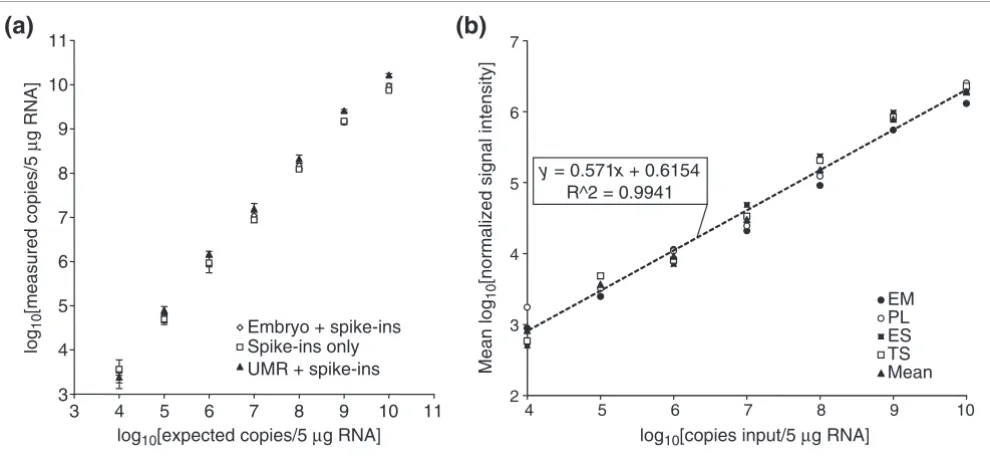
(Figure 2a), with a very tight correlation (r2 ≥ 0.99) between
expected and measured values over seven orders of magnitude.
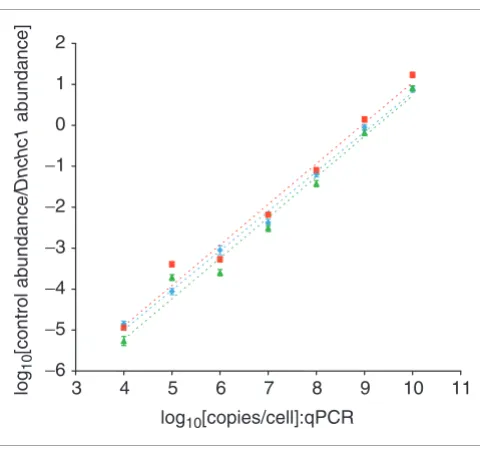
One basic assumption made in our experimental design is that amplification efficiencies are approximately equal between endogenous mouse transcripts and exogenous yeast control transcripts. To test this, transcript abundances were determined by qPCR for cDNA pools synthesized from total RNA with spike-in controls added, as well as labeled cRNA target mixtures amplified from the same total RNA/spike-in control mixtures, and transcript abundances were deter-mined by qPCR. After linear amplification, individual ratios of each control transcript to the endogenous transcript
Dnchc1 (Table 3) were within 3.5-fold (average = 1.98-fold) of those prior to amplification (Figure 3), and the slopes of regression lines for pre- and post-amplification datasets were 0.967 and 0.992, respectively. Results were consistent whether using amplification yield versus input or the increase
in Dnchc1 transcripts as measured by qPCR to calculate the fold amplification and fraction of the original sample repre-sented by each qPCR well. The stability of the relationship holds over seven orders of magnitude, suggesting that ampli-fication of transcripts during cRNA microarray target synthe-sis is not a source of significant bias. In previous attempts using control transcripts with short (20-40 nucleotides) vec-tor-derived poly(A) tails, exogenous controls amplified one or two orders of magnitude less efficiently than endogenous messages (data not shown), indicating that sufficient polya-denylation of controls is critical for efficient amplification.
Microarray expression profiles were generated for three dis-tinct samples each of total RNA from E12.5 whole embryos (EM), E12.5 placenta (PL), R1 embryonic stem cells (ES), and GFP-Exe trophoblast stem cells (TS) [16]. For each microar-ray, linear regression analysis on mean normalized log10[intensity] values for seven yeast spike-in control probes was used to define a standard curve relating signal intensity to copy number (Figure 2b) for estimation of endogenous transcript abundances. Correlations were very strong between log10[intensity] and log10[input copy number], with r2 ≥ 0.95.
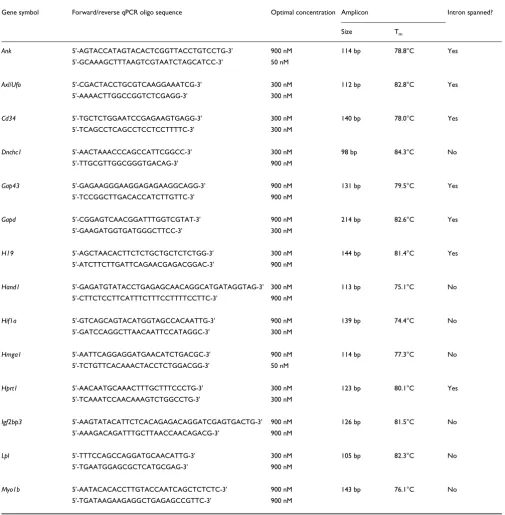
To test the accuracy of estimating transcript abundance in this way, we compared the results with qPCR measurements for a panel of 13 endogenous transcripts (Figure 4). Most (36 of 52, or 69.2%) of the microarray-based transcript copy-number estimates for a panel of 13 endogenous genes were within fivefold of qPCR measurements. Furthermore, trend-ing for each transcript across the four tissue types was con-sistent between the two methods for all ten non-housekeeping genes showing differential expression.
Many factors are likely to affect the accuracy of transcript abundance estimates. Measurements at or near the microar-ray's detection limit, but still above that of qPCR assays (Fig-ure 4, Lpl and Axl in TS, filled arrows), tend to overestimate transcript abundance, and these data suggest that the lower limit of microarray-based transcript abundance measure-ment is approximately 0.05 to 0.06 copies per cell in this experiment. Differential transcript splicing can also have an effect: note that for Ank, H19, Hand1, and Igf2bp3 (Figure 4, open arrows), only one tissue out of four shows greater than a tenfold discrepancy, whereas the other measurement pairs are more closely matched. Given the preceding discussion, we present this method as a way to estimate transcript abun-dances for groups of genes. Accuracy of the estimates for each gene/probe may be further improved in the future by study-ing the effects of various probe-selection parameters on measured fluorescence intensity.
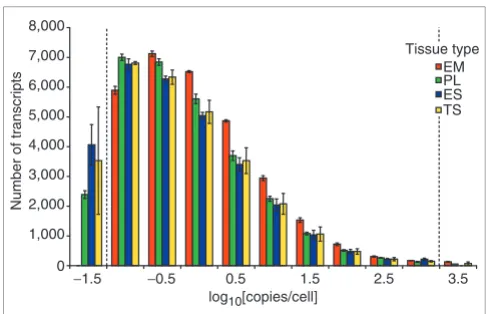
Using conservative estimates of the total RNA content recov-ered from mammalian cells (2.0-3.0 pg/cell in this case, see Materials and methods), transcript abundances were expressed on a copies-per-cell basis (Figure 5). The analysis
[image:3.612.55.297.86.384.2]60-mer oligonucleotide probe linearity testing
Figure 1
60-mer oligonucleotide probe linearity testing. To test the performance of 21,044 60-mer oligonucleotide probes, E12.5 embryo RNA and placenta RNA were combined to form five pairs of duplicate samples containing from 0 to 100% placental RNA. Box-plot distribution data for each placental RNA input level is shown above, with median values labeled. The boxes show the 25-75 percentile range, with the mean and median indicated by the central straight line and diamond, respectively. Upper and lower bars show the 2.5 to 97.5 percentile range. Observed fraction medians are within 0.075 of input values, and 95% of values are within 0.405 of input values.
0.00 0.25 0.50 0.75 1.00
Median = 0.053 0.239
0.425
0.698 1.068
Observed fraction of placental RNA
Known fraction of placental RNA −0.25
revealed two striking properties of these transcript-abun-dance distributions. First, mRNA populations in mammalian tissues are highly complex, which is consistent with previous observations [17,18]. Many transcripts were measured at less than one copy per cell in each tissue (EM = 40.1 ± 0.6%, PL = 46.9 ± 1.3%, ES = 48.2 ± 1.9%, TS = 47.4 ± 3.4%) (Figure 5).
A log10[intensity] value of 2.5 was used as a lower cutoff, which corresponds to about one copy in 26 cells, so it appears that measured values from 0.038 to one copy per cell repre-sent transcripts prerepre-sent at very low measurable copy num-bers, rather than nonexpressed transcripts. Indeed, quantitative RT-PCR studies in yeast have shown that many Table 1
Yeast controls used in this study with corresponding qPCR primers
Yeast intronic/intergenic control transcript
Vector name ATCC number GenBank
Accession
Insert size (bp)
Copies spiked/5
µg total RNA
Forward/reverse qPCR oligo sequence Optimal
concentration
Amplicon Intron
spanned?
Size Tm
YPL075W_16_412249_41 5357_INTRON_9_759
pNIAysic-1 MBA-201 DQ023287
630 1.00E+04
5'-CCTACTTGATAAAGCCACATACCTCTA CCTCTTCTATTAG-3'
5'-TTGCGTTACTCTATTAATAATCCATAG TTGGAAC-3'
300 nM 50 nM
134 bp 73.4°C No
YPL081W_16_404945_40
6039_INTRON_8_508 pNIAysic-2 MBA-202 DQ023288 400 1.00E+05 5'-CGACACTTCAGGTAAAGCGTTCCGAA
GTAATTCAAC-3'
5'-TCTCAAACCTAACACATTTCTGTATTA AGCCTAG-3'
300 nM
300 nM 129 bp 75.8°C No
NOT:D_1493031-1494574_553-1543 pNIAysic-3 MBA-203 DQ023289 997 1.00E+06 5'-TTACCATTCACTCCATGATGTCGTACC
TGTTACACTAC-3'
5'-CGGTACATGTTATTACCAGAAAAAGAT GTATATCC-3'
300 nM
300 nM 145 bp 79.8°C No
YER133W_5_432491_433 954_INTRON_178_702
pNIAysic-4 MBA-204 DQ023290
428 1.00E+07
5'-GTCGAGATAGCCGAGATAATGTGTGT G-3'
5'-GCAAGGGGGATTTTTCTGAATATGG-3' 300 nM 300 nM
136 bp 76.5°C No
YNL162W_14_331319_3
32151_INTRON_5_516 pNIAysic-5 MBA-205 DQ023291 367 1.00E+08 5'-TGCAGCAACAGAGTATCATATGCATG
G-3'
5'- CACTGCACAATCTGAAGATAGCGAGG-3'
300 nM
300 nM 145 bp 77.7°C No
YNL302C_14_62942_619
57_INTRON_21_571 pNIAysic-6 MBA-206 DQ023292 416 1.00E+09 5'-ATTTCCCATTACCTGATAAATTGAAGT
TCATC-3'
5'-TTTGTATAGTTGGCTCAAAATATTCTC TCCAC-3'
900 nM
300 nM 100 bp 73.8°C No
YBL087C_2_60732_5981 5_INTRON_43_546
pNIAysic-7 MBA-207 DQ023293
436 1.00E+010
5'-GCAGATGAAGTGATACCTGTCAATATT CATG-3'
5'-AGAAATAACATTTCGATGGTTATCCAT TAGTATG-3'
300 nM 300 nM
[image:4.612.59.555.115.453.2]128 bp 76.2°C No
Table 2
Yeast controls with corresponding in situ-synthesized 60-mer oligonucleotide probes
Control transcript NIA probe ID 60-mer oligonucleotide microarray probe sequence
NIA yeast control 1 Z10000036-1 5'-TTCAAGGGACAAATAACAGGATAAAACGTAATGTCAGGACACAAAGTGTGCCATCAACTT-3'
NIA yeast control 2 Z10000039-1 5'-TCTTCATAGAATACTTTTTTTTTCGGAGAAAACCTTTACACTGAACTCCCGACACTTCAG-3'
NIA yeast control 3 Z10000041-1 5'-TTTAATTATTCTTATTTCGCTTTTTTTCTCAAGGTGACCTGTTGTATCACGTTAGCTGAA-3' NIA yeast control 4 Z10000020-1 5'-TCATCCGGCCGGCGCCTCCCATATTCAGAAAAATCCCCCTTGCTCACACTAAAAAAAGAA-3'
NIA yeast control 5 Z10000021-1 5'-TCAGATTGTGCAGTGATATTCTTTGAGGAAGGAAACGTAGAGGGGATAAGTTGGATAACT-3'
comm
en
t
re
v
ie
w
s
re
ports
refer
e
e
d
re
sear
ch
de
p
o
si
te
d r
e
se
a
rch
interacti
o
ns
inf
o
rmation
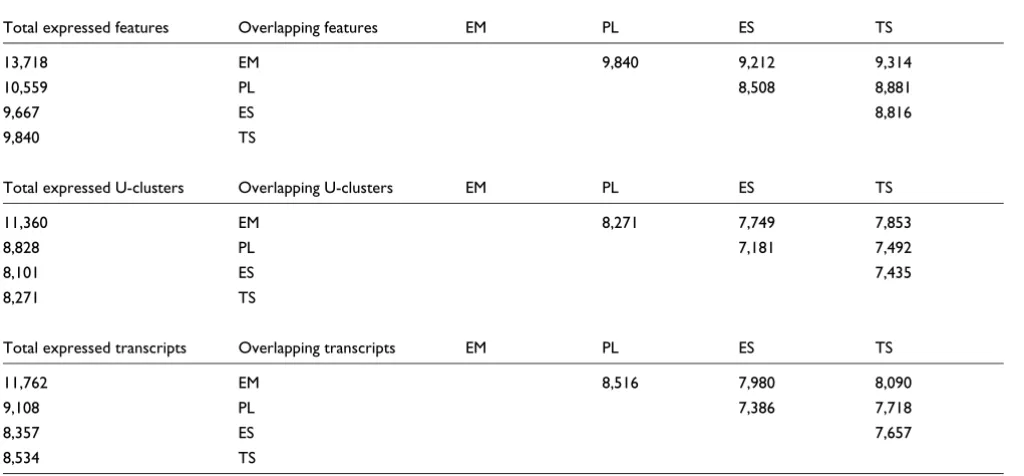
genes, particularly transcription factors, are expressed at less than one copy per cell [19]. Furthermore, our estimates of numbers of expressed genes/transcripts and mRNA message content per cell (519,688 to 851,087 mRNAs per cell, 8,357 to 12,739 transcripts, expressed from 8,101 to 11,360 genes, Table 4) compare well with previous estimates ranging from 200,000 to 600,000 mRNAs per cell [20,21], consisting of 11,500 to 15,000 diverse mRNA species [18,20], transcribed from as many or more genes up to 17,000 [18,20,22]. Second, a majority of transcripts expressed in one tissue or cell type are commonly expressed in other diverse cell and tissue types. The number of expressed genes in each tissue was estimated by counting the number of microarray features measuring absolute expression of at least one copy per cell, and convert-ing this set of microarray probes to U-clusters (loci) and tran-scripts via the NIA Mouse Gene Index (Table 4). Examination of the overlap between each cell type's roster of expressed genes and transcripts reveals that the majority are expressed in common (Tables 4 and 5), as suggested by previous assess-ments of mRNA complexity [18,20,22]. For example, 93% of expressed placental transcripts are also expressed in embryo, and this group represents 72% of the expressed transcripts in embryo (Table 5). The same relationship holds true for
pair-ings of cultured cells with embryo, with 95% of expressed transcripts in cultured cells also found in embryo, covering 69% of embryonic transcripts.
When comparing frequency distributions for complex, in vivo
samples and less complex in vitro cultured cells, we might expect to see large differences, particularly in the case of genes expressed at less than one copy per cell. Transcripts present at less than one copy per cell cannot be present in every cell, and therefore must be expressed heterogeneously. As might be expected, whole embryos had the most distinc-tive frequency distribution of the four samples examined: embryos had significantly fewer transcripts in the range log10[copies per cell] = -1.0 (0.1 copies per cell), but signifi-cantly more in the 0-2 (1 to 100 copies per cell) range. This difference, combined with the higher estimate of total tran-scripts per cell for whole embryos (Table 4), may reflect the activation, within the context of the very high transcriptional activity present in developing embryos, of many developmen-tal pathways that are normally inactive or minimally active.
In contrast, the high degree of similarity between the fre-quency distributions for placenta, ES, and TS cells (Figure 5)
[image:5.612.59.554.87.318.2]Relating yeast spike-in RNA control copy number to qPCR measurements and microarray signal intensity
Figure 2
Relating yeast spike-in RNA control copy number to qPCR measurements and microarray signal intensity. (a) To verify abundances of yeast sequence RNA transcripts in a control mixture, cDNA was transcribed from the control mixture alone (open boxes), as well as E12.5 whole-mouse embryo total RNA (open diamonds) and Universal Mouse RNA (filled triangles) with added spike-in control mixture. The cDNA was used as template for real-time PCR quantitation of each yeast sequence RNA, using a separately prepared standard of cDNA transcribed from the yeast sequences. Expected and measured copy numbers are closely matched (r2 ≥ 0.99), with maximum measured/observed ratios of 1.5, 1.5, and 2.6, respectively. (b) Expression profiles were generated for triplicate total RNA samples from E12.5 embryo (filled circles), E12.5 placenta (open circles), ES cells (filled boxes), and TS cells (open boxes) with yeast sequence control transcripts spiked-in prior to target labeling. For the seven control transcripts, mean log10[intensity] is shown for each tissue type, as well as the mean across all samples (filled triangles), and these data were used to perform linear regression analysis and relate signal intensity to transcript copy number, allowing abundance estimation for endogenous transcripts. The regression line for the average of all tissues (dashed line) and its equation is shown. Intensity-copy number correlations for individual tissues were very strong, with r2 values of 0.98 - 0.99.
3 4 5 6 7 8 9 10 11 4 5 6 7 8 9 10
Embryo + spike-ins Spike-ins only UMR + spike-ins
log
10
[measured copies/5
µ
g RNA]
Mean log
10
[normalized signal intensity]
EM PL ES TS Mean
y = 0.571x + 0.6154 R^2 = 0.9941
3 4 5 6 7 8 9 10 11
log10[expected copies/5 µg RNA] log10[copies input/5 µg RNA]
2 3 4 5 6 7
suggests that levels of expression heterogeneity can be similar for complex tissues and cultured cells. In fact, there is evi-dence in ES cells that gene expression within a culture is not as uniform as previously supposed, and even key differentiation markers such as Oct4 and cKit are expressed in cellular subpopulations within cultures [23]. Taken together, these observations suggest that cultured ES and TS cells, although clonally isolated, are quite heterogeneous in terms of their gene-expression patterns, with a transcrip-tional complexity similar to that of E12.5 placenta. Further study, perhaps using in situ hybridization or single-cell RT-PCR methods, will be required to address this issue, but it does beg the question of whether or not this heterogeneity is common to all cultured cells, or a feature specific to pluripo-tent stem cells.
Conclusion
Here we present an oligonucleotide microarray for gene-expression profiling with representation of the entire mouse genome, according to the NIA Mouse Gene Index version 2.0 [24]. An integral feature of this new whole-genome microar-ray design is a set of probes detecting yeast spike-in control
transcripts, which will be available to the community without restriction. Using qPCR, we have shown that this control sys-tem allows the reproducible estimation of absolute transcript levels. A valuable tool for the mammalian functional genom-ics community, this system is a step towards standardization of microarray results by using exogenous RNA control sys-tems that are compatible with multiple microarray platforms and model organisms.
Materials and methods
Microarray design: target sequence selection
The NIA Mouse 44K Microarray v2.0 (Whole Genome 60-mer Oligo) design was based on the NIA Mouse Gene Index v2.0 [24]. Like the first version of the NIA Mouse Gene Index [10], it combines data from multiple transcript databases (RefSeq, Ensembl, Riken, GenBank, and NIA) to construct gene/transcript models which represent all possible tran-scripts. Briefly, 249,200 ESTs developed at NIA were clus-tered using clustering tools from The Institute for Genome Reserach (TIGR) [25], generating 58,713 consensus and sin-gleton sequences which were then combined with the other datasets. The major difference in version 2 from version 1 is the use of a clustering method based on genome alignments rather than sequence homology between NIA EST clusters and public sequences. Individual sequences were aligned to the mouse genome [2] using BLAT [26], then clustered by an algorithm similar to the one described by Eyras et al. [27], to be published elsewhere. Our assembly included 30,796 primary genes and 1,318 gene copies or pseudogenes, as well as 28,928 clusters that did not match our criteria for high-confidence genes (open reading frame (ORF) of more than 100 amino acids or multiple exons). There were 65,477 tran-scripts associated with primary genes. Because trantran-scripts were built from sequence alignments to the mouse genome, they match published genomic sequences [2] (February 2003 edition) exactly.
Microarray design: oligonucleotide probe design and selection
In designing a mouse whole-genome microarray, we began by examining existing designs - the NIA Mouse 22K Microarray v1.1 (Development 60-mer Oligo) [9], which became commercially available from Agilent as the Agilent Mouse (Development) Oligonucleotide Microarray (see Additional data files 1 and 2), and the National Institute of Environmen-tal Health Sciences (NIEHS) Toxicogenomics Consortium mouse array (Agilent Mouse Microarray). Criteria for select-ing previously designed probes included a good match to the target gene's major transcript with the longest ORF, mini-mum predicted cross-reactivity with other expressed sequences, and nonredundancy. Although a perfect match of all 60 base-pairs (bp) of the oligonucleotide was preferred, we also accepted up to two mismatches to the genome if the oli-gonucleotide matched perfectly to the RefSeq sequence, and oligonucleotide sequences that did not match 100% to the
[image:6.612.58.298.83.308.2]Exogenous control and endogenous transcript amplification rates are closely matched over seven orders of magnitude
Figure 3
Exogenous control and endogenous transcript amplification rates are closely matched over seven orders of magnitude. Transcript abundance of each spike-in control transcript was measured by qPCR before and after linear amplification labeling, and compared to amounts of the exogenous transcript Dnchc1. After amplification, individual ratios of each control transcript to the endogenous transcript were within 3.5-fold (average = 1.98-fold) of those prior to amplification. Blue diamonds = log10[ratio mean control/Dnchc1 transcripts] of three E12.5 embryo and three E12.5 placenta samples before amplification. Red boxes, green triangles = log10[ratio mean control/Dnchc1 transcripts] for the same samples after amplification, using yield versus input (red boxes) or the increase in Dnchc1 transcripts as measured by qPCR (green triangles) to calculate the fraction of the original sample represented by each qPCR well.
log
10
[control abundance/
Dnchc1
abundance]
log10[copies/cell]:qPCR
−6 −5 −4 −3 −2 −1 0
3 4 5 6 7 8 9 10 11
comm
en
t
re
v
ie
w
s
re
ports
refer
e
e
d
re
sear
ch
de
p
o
si
te
d r
e
se
a
rch
interacti
o
ns
inf
o
rmation
RefSeq entry were corrected. An oligonucleotide was consid-ered cross-reactive if its last 43 bp (solution end) matched to a non-target gene with less than five mismatches. Deletion placement studies using in-situ synthesized 60-mer oligonu-cleotide probes suggest that the 17 bp at the support surface have a negligible effect on hybridization intensity [5]; thus only the external 43 bp were considered important. While the cross-reactivity criterion is easily satisfied for unique genes with low similarity to other genes, many gene families had high sequence similarity between member transcripts, and it was impossible to find regions with low predicted cross-reac-tivity. In this case we considered the whole gene family as a target; then the oligonucleotide was considered cross-reac-tive only if it matched to genes outside the family. Gene fam-ilies were assembled using a 30% transcript length alignment
as a threshold of similarity; alignments for each pair of tran-scripts were generated using BLAT [26]. According to the nonredundancy criterion, we left only one oligonucleotide that matched to each gene or gene family, and when probes from both the NIA Mouse 22K v1.1 and NIEHS Toxicogenom-ics arrays matched well to the same gene, preference was given to the NIA oligonucleotide.
After filtering with the above criteria, we obtained 6,563 probes from the NIA Mouse 22K Microarray v1.1 and 9,551 probes from the NIEHS Toxicogenomics array. Among these oligonucleotides, 3,327 did not match the target gene's major transcript with the longest ORF, so we generated an addi-tional 3,327 probes for major transcripts of the same genes. Then we generated 22,850 probes for the best transcripts of
[image:7.612.54.559.85.471.2]Validation of transcript abundance estimation for endogenous transcripts
Figure 4
Validation of transcript abundance estimation for endogenous transcripts. qPCR primer sets were designed for selected genes so that amplicons were upstream of 60-mer oligonucleotide probes when possible, or less than 650 bp downstream, and copy number was estimated using serial dilutions of RNA, in vitro transcribed from mouse cDNAs, at known copy numbers as standards. Error bars represent one standard deviation across three replicate samples for each tissue. Dotted diagonal lines represent five- and tenfold differences between the two datasets. Each gene's official symbol, along with the unique identifier for the 60-mer oligonucleotide probe it was measured with, are listed in the key. Data was normalized to Gapd expression for both methods. EM = E12.5 embryo, PL = E12.5 placenta, ES = embryonic stem cells, TS = trophoblast stem cells.
−3 −2 −1 0 1 2 3
log
10
[copies/cell]:microarray
log10[copies/cell]:qPCR Color Gene Oligo ID
Ank Z00013595-1
Axl Z00030401-1
Cd34 Z00011405-1
Gap43 Z00013064-1
Gapd Z00027268-1
H19 Z00005273-1
Hand1 Z00046756-1 Hif1a Z00000975-1 Hmga1 Z00034677-1
Hprt Z00035388-1
Igf2bp3 Z00010932-1
Lpl Z00023659-1
Myo1b Z00012962-1
Shape Tissue type EM PL ES TS
primary genes in the gene index that were not represented in the NIA Mouse 22K Microarray v1.1 (Development 60-mer Oligo) and NIEHS Toxicogenomics arrays, for a total of 42,291 non-control oligonucleotide probes (see Additional data file 2). For each transcript we generated ten probes using ArrayOligoSelector [28], then selected the best oligonucle-otide on the basis of minimum predicted cross-reactivity,
proximity to the 3' end, and degree of matching to RefSeq or GenBank sequences. The latter criterion was important only in cases of mismatches between genomic sequence and Ref-Seq or GenBank.
[image:8.612.56.561.119.634.2]All microarray data described in this report were generated using the NIA Mouse 44K Microarray v2.1 (Whole Genome Table 3
qPCR primer pairs used to quantitate endogenous transcripts in this study
Gene symbol Forward/reverse qPCR oligo sequence Optimal concentration Amplicon Intron spanned?
Size Tm
Ank 5'-AGTACCATAGTACACTCGGTTACCTGTCCTG-3' 900 nM 114 bp 78.8°C Yes
5'-GCAAAGCTTTAAGTCGTAATCTAGCATCC-3' 50 nM
Axl/Ufo 5'-CGACTACCTGCGTCAAGGAAATCG-3' 300 nM 112 bp 82.8°C Yes
5'-AAAACTTGGCCGGTCTCGAGG-3' 300 nM
Cd34 5'-TGCTCTGGAATCCGAGAAGTGAGG-3' 300 nM 140 bp 78.0°C Yes
5'-TCAGCCTCAGCCTCCTCCTTTTC-3' 300 nM
Dnchc1 5'-AACTAAACCCAGCCATTCGGCC-3' 300 nM 98 bp 84.3°C No
5'-TTGCGTTGGCGGGTGACAG-3' 900 nM
Gap43 5'-GAGAAGGGAAGGAGAGAAGGCAGG-3' 900 nM 131 bp 79.5°C Yes
5'-TCCGGCTTGACACCATCTTGTTC-3' 900 nM
Gapd 5'-CGGAGTCAACGGATTTGGTCGTAT-3' 900 nM 214 bp 82.6°C Yes
5'-GAAGATGGTGATGGGCTTCC-3' 300 nM
H19 5'-AGCTAACACTTCTCTGCTGCTCTCTGG-3' 300 nM 144 bp 81.4°C Yes
5'-ATCTTCTTGATTCAGAACGAGACGGAC-3' 900 nM
Hand1 5'-GAGATGTATACCTGAGAGCAACAGGCATGATAGGTAG-3' 300 nM 113 bp 75.1°C No
5'-CTTCTCCTTCATTTCTTTCCTTTTCCTTC-3' 900 nM
Hif1a 5'-GTCAGCAGTACATGGTAGCCACAATTG-3' 900 nM 139 bp 74.4°C No
5'-GATCCAGGCTTAACAATTCCATAGGC-3' 300 nM
Hmga1 5'-AATTCAGGAGGATGAACATCTGACGC-3' 900 nM 114 bp 77.3°C No
5'-TCTGTTCACAAACTACCTCTGGACGG-3' 50 nM
Hprt1 5'-AACAATGCAAACTTTGCTTTCCCTG-3' 300 nM 123 bp 80.1°C Yes
5'-TCAAATCCAACAAAGTCTGGCCTG-3' 300 nM
Igf2bp3 5'-AAGTATACATTCTCACAGAGACAGGATCGAGTGACTG-3' 900 nM 126 bp 81.5°C No
5'-AAAGACAGATTTGCTTAACCAACAGACG-3' 900 nM
Lpl 5'-TTTCCAGCCAGGATGCAACATTG-3' 300 nM 105 bp 82.3°C No
5'-TGAATGGAGCGCTCATGCGAG-3' 900 nM
Myo1b 5'-AATACACACCTTGTACCAATCAGCTCTCTC-3' 900 nM 143 bp 76.1°C No
comm
en
t
re
v
ie
w
s
re
ports
refer
e
e
d
re
sear
ch
de
p
o
si
te
d r
e
se
a
rch
interacti
o
ns
inf
o
rmation
60-mer Oligo) and NIA Mouse 22K Microarray v2.0 (Devel-opment 60-mer Oligo). We have slightly modified the probe content of the NIA Mouse 44K v2.0 array by including Agilent's standard QC probe set, removing candidate spike-in control probes which were not used, and including additional probes for known genes that have existing probes with poor performance or ambiguous targeting. The updated version (NIA Mouse 44K Microarray v2.1 (Whole Genome 60-mer Oligo) will be made available to the community (see Addi-tional data file 1).
Yeast spike-in controls
Yeast (S. cerevisiae) sequences were selected from public repositories [14,15] to produce exogenous RNA control tran-scripts, commonly referred to as 'spike-in' controls. Fourteen candidates (ten intergenic and four intronic) were selected on the basis of sequence length and the absence of restriction endonuclease cleavage sites important for our cloning strategy. Sequences with significant matches to transcripts in the NIA mouse Gene Index v2.0 [10] were discarded, and ten of the 14 remaining candidates were successfully cloned from genomic DNA, with one sequence divided into two clones for a total of 11 potential controls. Yeast sequences were ampli-fied with added 5' SalI and 3' XbaI sites from S. cerevisiae
genomic DNA (ATCC 2601D) using Sigma RedTaq, and cloned directly into pCR4-TOPO (Invitrogen). TA-TOPO clones were verified by sequencing on an Applied Biosystems 3100 capillary DNA sequencer, and inserts were directionally subcloned into pSP64 Poly(A) (Promega Catalog number P1241) using the introduced SalI and XbaI sites. A total of 63 60-mer oligonucleotide 'sense-strand' probes were selected for the 14 candidate sequences using both ArrayOligoSelector software [28] and arbitrary manual selection. Oligonucle-otide probes were compared to NIA Gene Index transcripts, and no significant matches were found. Control probes were spotted ten times each in various locations throughout the slides.
Spike-in RNA was transcribed, polyadenylated, and purified using Ambion mMessage mMachine, poly(A) tailing, and MegaClear kits, then sized and quantitated by RNA 6000 Nano assay on an Agilent Bioanalyzer 2100. Spike-in RNAs were pooled to create tenfold concentration differences, from 104 to 1010 copies per microliter (Table 1). Before preparation
of microarray targets, 1 µl of this control transcript mixture
was added to 5-µg aliquots of each total RNA sample,
[image:9.612.55.558.117.219.2]including the reference RNA. A separate pool with all yeast control transcripts present at the same copy number was added to reference RNA and converted to cDNA for use as a standard in qPCR assays.
Table 4
Expressed genes and transcripts in developing mouse tissues and cultured stem cells
EM PL ES TS Any tissue All tissues
mRNAs/cell 851,087 519,688 400,045 568,196
Features ≥ 1 CpC 13,718 10,559 9,667 9,840 14,908 8,073
U-clusters ≥ 1 CpC 11,360 8,828 8,101 8,271 12,264 6,838
Transcripts ≥ 1 CpC 11,762 9,108 8,357 8,534 12,739 7,037
Mean copies per cell 1.09 0.63 0.51 0.56
Median copies per cell 0.79 0.45 0.36 0.40
U-clusters and transcripts from the NIA mouse gene index were considered expressed if microarray features measured absolute expression estimated at one copy per cell or more. Copy-number estimates from expressed transcripts were summed to estimate the number of mRNA molecules per cell for each tissue, as well as the mean and median copy numbers. Microarray features corresponding to expressed genes and transcripts were mapped to the NIA Gene Index to calculate the number of U-clusters (loci) and transcripts expressed in each tissue.
Distribution of mouse transcript abundances in E12.5 embryo and placenta, and cultured ES and TS cells
Figure 5
Distribution of mouse transcript abundances in E12.5 embryo and placenta, and cultured ES and TS cells. Transcript abundances are expressed as log10[copies per cell], varying over six orders of magnitude. The distributions are highly similar, despite the significant differences between the four tissues (for example, monolayer culture versus tissue, placenta versus embryo), suggesting that such distributions are not heavily skewed according to tissue structure or function. The percentage of transcripts present at less than one copy per cell ranged from 40.1 to 48.2% in the four tissues. Bins were centered on indicated values, and the dotted lines indicate values corresponding to mean upper and lower signal intensity reliability limits of one copy per 26 cells to 2,188 copies per cell. For definitions of tissue type see Figure 4 legend.
log10[copies/cell]
Number of transcripts
EM Tissue type
PL ES TS
−1.5 −0.5 0.5 1.5 2.5 3.5
[image:9.612.53.296.292.449.2]RNA collection/preparation
Total RNA was prepared using TriZol reagent (Invitrogen) from E12.5 C57BL/6J embryos, pooled by litter, and corre-sponding E12.5 C57BL/6J placenta pools [9]. Total RNA was also prepared from R1 ES cells passaged briefly on gelatin to remove feeder cells, and GFP-Exe TS cells grown on plastic in conditioned medium as previously described [16]. Total RNA quantity and quality were assessed by RNA 6000 Nano assay. For oligonucleotide signal linearity testing, E12.5 embryo and placenta total RNA were pooled, based on this quantitation, to produce duplicate samples with 0, 25, 50, 75, and 100% placental RNA content.
cRNA target labeling
Fluorescently labeled microarray targets were prepared from 2.5 µg aliquots of total RNA samples with yeast sequence con-trol mixtures added as described above, using a Low RNA Input Fluorescent Linear Amplification Kit (Agilent). A refer-ence target (Cy5-CTP-labeled) was produced from Stratagene Universal Mouse Reference RNA, and all other targets were labeled with Cy3-CTP. Targets were purified using an RNeasy Mini Kit (Qiagen) as directed by Agilent's clean-up protocol, and quantitated on a NanoDrop scanning spectrophotometer (NanoDrop Technologies).
Microarray hybridization
All hybridizations compared one Cy3-CTP-labeled experi-mental target to the single Cy5-CTP-labeled reference target. Microarrays were hybridized and washed according to Agi-lent protocol G4140-90030 (AgiAgi-lent 60-mer oligo microarray processing protocol - SSC Wash, v1.0). Slides were scanned on an Agilent DNA Microarray Scanner, using standard set-tings, including automatic PMT adjustment.
Real-time quantitative RT-PCR
[image:10.612.56.568.118.356.2]Primer sets were designed and tested for SYBR Green chem-istry using an established in-house protocol [9]. Total RNA was used to prepare cDNA as described previously [9]. Because the microarray targets were oligo(dT) primed, all cDNA synthesis reactions were oligo(dT) primed as well, and qPCR primer sets were designed so that amplicons were upstream of 60-mer oligonucleotide probes when possible, or less than 650 bp downstream. These steps were taken to min-imize the effects of 3' end-labeling bias from microarray target synthesis. Yeast spike-in standard curve cDNA was prepared by mixing equal copy numbers of each synthetic yeast RNA with Mouse Universal Reference total RNA, followed by cDNA synthesis. A standard for copy-number measurement of endogenous mouse genes was prepared by transcribing cDNA clones and adding these transcripts in equal numbers to yeast total RNA, followed by cDNA synthe-sis. A BioMek 2000 liquid-handling system (Beckman) was Table 5
Pairwise comparison of expressed transcript sets in developing mouse tissues and cultured cells
Total expressed features Overlapping features EM PL ES TS
13,718 EM 9,840 9,212 9,314
10,559 PL 8,508 8,881
9,667 ES 8,816
9,840 TS
Total expressed U-clusters Overlapping U-clusters EM PL ES TS
11,360 EM 8,271 7,749 7,853
8,828 PL 7,181 7,492
8,101 ES 7,435
8,271 TS
Total expressed transcripts Overlapping transcripts EM PL ES TS
11,762 EM 8,516 7,980 8,090
9,108 PL 7,386 7,718
8,357 ES 7,657
8,534 TS
comm en t re v ie w s re ports refer e e d re sear ch de p o si te d r e se a rch interacti o ns inf o rmation
used to aliquot cDNA into 96- and 384-well plates, then assemble and aliquot PCR master mix into 20-25 µl reactions. Plates were run on ABI 7700 or ABI 7900 HT Sequence Detection Systems using the default cycling program, and data was processed using SDS 1.9 or SDS 2.2 software (Applied Biosystems) and Microsoft Excel.
Data analysis
Microarray images were processed with Agilent Feature Extractor A.7.5.1 software to generate normalized, back-ground-subtracted feature intensities. Dye normalization was performed by applying a LOWESS algorithm to all significant, non-control and non-outlier features. Analysis of variance (ANOVA) and replicate averaging was performed as previ-ously described [9] using NIA Array Analysis Tool software [29], which normalizes each probe according to reference RNA signals.
For each probe identified as differentially expressed in mixing experiments (false discovery rate < 0.05) [9], linear regres-sions of ratios against pure placental RNA across the five lev-els of placental RNA content were calculated, and observed ratios were back-calculated for population analysis as
where Poi is the observed fraction placental RNA content cal-culated from a given probe i, Ipi and I100i are the normalized log10[intensity] values for the probe i at placental RNA per-centages p and 100, respectively, and ai and bi are the
intercept and slope of the ratios versus the input
pla-cental RNA fraction for probe i. For the population of
observed fractions at each input placental RNA fraction, the mean and median were calculated, along with the 2.5, 25, 75, and 97.5 percentile boundaries (Figure 1).
For endogenous transcript abundance estimation experi-ments, linear regression analysis was performed on seven yeast spike-in probe mean normalized log10[intensity] values for each microarray and the results were used to back-calcu-late estimated copy numbers for endogenous transcripts as
where Chmi is the microarray-estimated number of copies per hybridization for probe i, Ii is the normalized log10[intensity] for probe i, and a and b are the intercept and slope of spike-in control probe microarray signal intensities versus. input spike-in transcript copy numbers. Dividing these values by the estimated number of cells represented in each hybridization,
converts them to estimates of transcript copies per cell. Amounts of total RNA extracted per cell for the four tissue types (EM 3.0 pg/cell, PL 2.0 pg/cell, ES 2.3 pg/cell, TS 3.0 pg/cell) were estimated from cell counts, RNA yields, and in the case of E12.5 embryo and placenta, our estimate that the average cell volume in these tissues is approximately 1.5 × 10 -9 cm3 per cell (data not shown).
For measurement of abundances of mouse endogenous gene and spiked-in yeast transcripts in total RNA and labeled/ amplified target mixtures by qPCR, linear regression of threshold cycle (Ct) values versus input spike-in transcript copy numbers in a standard was used to back-calculate copy numbers per well of the transcripts in the total RNA samples and labeled/amplified target mixtures. These results were converted to copies per cell as follows:
In the case of endogenous mouse transcript measurements, results from both the microarray and qPCR were normalized to Gapd expression.
All microarray data will be deposited to the public repositor-ies Gene Expression Omnibus at NCBI [30,31] and ArrayEx-press at EBI [32,33] as soon as possible.
Additional data files
The following additional data are available with the online version of this paper. Additional data file 1 is a table contain-ing a standardized namcontain-ing scheme for NIA oligonucleotide microarray platforms. Additional data file 2 is a table contain-ing additional information on previous NIA microarray plat-forms and how they relate to that presented in this work. Additional data file 3 contains annotation of all probes in the NIA 44K Mouse Microarray v2.1.
Additional File 1
A standardized naming scheme for NIA oligonucleotide microarray platforms.
A standardized naming scheme for NIA oligonucleotide microarray platforms.
Click here for file Additional File 2
Additional information on previous NIA microarray platforms and how they relate to that presented in this work.
Additional information on previous NIA microarray platforms and how they relate to that presented in this work.
Click here for file Additional File 3
Annotation of all probes in the NIA 44K Mouse Microarray v2.1 Annotation of all probes in the NIA 44K Mouse Microarray v2.1 Click here for file
Acknowledgements
The authors thank Peter Webb at Agilent Technologies for his assistance in preparing the microarray design for production, and his colleague Paul Wolber for advice in constructing the yeast spike-in control constructs. Yong Qian of the NIA provided invaluable bioinformatics and computa-tional support for many aspects of this work. We also thank Janet Rossant and Tilo Kunath for providing ES and TS cell RNA. DNA microarrays pro-duced according to NIA designs are available commercially from Agilent Technologies. However, The National Institutes on Health and The National Institute on Aging do not endorse these products or make any claims or guarantees as to their quality or performance.
References
1. Ko MS: An 'equalized cDNA library' by the reassociation of short double-stranded cDNAs. Nucleic Acids Res 1990, 18:5705-5711.
Poi =
−
II a b pi i i i 100 ,
I
I
pi i 100C
I
a
b
hmi
=
i−
,
N
x
h= ×
0 750 1
1 . g target hybridization
target labeling g ta
µ
µ rrget yield
g total RNA target labeling
pg 1 g
1 c
× yµ × ×
µ
1
106 eell
pg total RNA
z ,
C
w
z
cqi = × × ×
copies well
1 well ng total RNA
1 ng 1000 pg
pg totall RNA
2. Waterston RH, Lindblad-Toh K, Birney E, Rogers J, Abril JF, Agarwal P, Agarwala R, Ainscough R, Alexandersson M, An P, et al.: Initial sequencing and comparative analysis of the mouse genome.
Nature 2002, 420:520-562.
3. Schadt EE, Edwards SW, GuhaThakurta D, Holder D, Ying L, Svetnik V, Leonardson A, Hart KW, Russell A, Li G, et al.: A comprehensive transcript index of the human genome generated using microarrays and computational approaches. Genome Biol 2004, 5:R73.
4. Singh-Gasson S, Green RD, Yue Y, Nelson C, Blattner F, Sussman MR, Cerrina F: Maskless fabrication of light-directed oligonucle-otide microarrays using a digital micromirror array. Nat Biotechnol 1999, 17:974-978.
5. Hughes TR, Mao M, Jones AR, Burchard J, Marton MJ, Shannon KW, Lefkowitz SM, Ziman M, Schelter JM, Meyer MR, et al.: Expression profiling using microarrays fabricated by an ink-jet oligonu-cleotide synthesizer. Nat Biotechnol 2001, 19:342-347.
6. Dudley AM, Aach J, Steffen MA, Church GM: Measuring absolute expression with microarrays with a calibrated reference sample and an extended signal intensity range. Proc Natl Acad Sci USA 2002, 99:7554-7559.
7. van Bakel H, Holstege FC: In control: systematic assessment of microarray performance. EMBO Rep 2004, 5:964-969. 8. Ashburner M, Ball CA, Blake JA, Botstein D, Butler H, Cherry JM,
Davis AP, Dolinski K, Dwight SS, Eppig JT, et al.: Gene ontology: tool for the unification of biology. The Gene Ontology Consortium. Nat Genet 2000, 25:25-29.
9. Carter MG, Hamatani T, Sharov AA, Carmack CE, Qian Y, Aiba K, Ko NT, Dudekula DB, Brzoska PM, Hwang SS, Ko MS: In situ-synthe-sized novel microarray optimized for mouse stem cell and early developmental expression profiling. Genome Res 2003, 13:1011-1021.
10. Sharov AA, Piao Y, Matoba R, Dudekula DB, Qian Y, VanBuren V, Falco G, Martin PR, Stagg CA, Bassey UC, et al.: Transcriptome analysis of mouse stem cells and early embryos. PLoS Biol 2003, 1:E74.
11. Carter MG, Piao Y, Dudekula DB, Qian Y, VanBuren V, Sharov AA, Tanaka TS, Martin PR, Bassey UC, Stagg CA, et al.: The NIA cDNA project in mouse stem cells and early embryos. C R Biol 2003, 326:931-940.
12. Zhang W, Morris QD, Chang R, Shai O, Bakowski MA, Mitsakakis N, Mohammad N, Robinson MD, Zirngibl R, Somogyi E, et al.: The func-tional landscape of mouse gene expression. J Biol 2004, 3:21. 13. Parrish ML, Wei N, Duenwald S, Tokiwa GY, Wang Y, Holder D, Dai
H, Zhang X, Wright C, Hodor P, et al.: A microarray platform comparison for neuroscience applications. J Neurosci Methods 2004, 132:57-68.
14. Grate L, Ares M Jr: Searching yeast intron data at Ares lab web site. Methods Enzymol 2002, 350:380-392.
15. Ares Lab Yeast Intron Database [http://www.cse.ucsc.edu/ compbio/yeast_introns/currentDB/stuff.html]
16. Tanaka S, Kunath T, Hadjantonakis AK, Nagy A, Rossant J: Promo-tion of trophoblast stem cell proliferaPromo-tion by FGF4. Science 1998, 282:2072-2075.
17. Van Ness J, Hahn WE: Sequence complexity of cDNA tran-scribed from a diverse mRNA population. Nucleic Acids Res 1980, 8:4259-4270.
18. Axel R, Feigelson P, Schutz G: Analysis of the complexity and diversity of mRNA from chicken liver and oviduct. Cell 1976, 7:247-254.
19. Holland MJ: Transcript abundance in yeast varies over six orders of magnitude. J Biol Chem 2002, 277:14363-14366. 20. Hastie ND, Bishop JO: The expression of three abundance
classes of messenger RNA in mouse tissues. Cell 1976, 9:761-774.
21. Bishop JO, Morton JG, Rosbash M, Richardson M: Three abun-dance classes in HeLa cell messenger RNA. Nature 1974, 250:199-204.
22. Jongeneel CV, Iseli C, Stevenson BJ, Riggins GJ, Lal A, Mackay A, Har-ris RA, O'Hare MJ, Neville AM, Simpson AJ, Strausberg RL: Compre-hensive sampling of gene expression in human cell lines with massively parallel signature sequencing. Proc Natl Acad Sci USA 2003, 100:4702-4705.
23. Hubner K, Fuhrmann G, Christenson LK, Kehler J, Reinbold R, De La Fuente R, Wood J, Strauss JF 3rd, Boiani M, Scholer HR: Derivation of oocytes from mouse embryonic stem cells. Science 2003, 300:1251-1256.
24. NIA Mouse Gene Index 2.0 [http://lgsun.grc.nia.nih.gov/
geneindex1/index.html]
25. Pertea G, Huang X, Liang F, Antonescu V, Sultana R, Karamycheva S, Lee Y, White J, Cheung F, Parvizi B, et al.: TIGR Gene Indices clus-tering tools (TGICL): a software system for fast clusclus-tering of large EST datasets. Bioinformatics 2003, 19:651-652.
26. Kent WJ: BLAT - the BLAST-like alignment tool. Genome Res 2002, 12:656-664.
27. Eyras E, Caccamo M, Curwen V, Clamp M: ESTGenes: alternative splicing from ESTs in Ensembl. Genome Res 2004, 14:976-987. 28. Bozdech Z, Zhu J, Joachimiak MP, Cohen FE, Pulliam B, DeRisi JL:
Expression profiling of the schizont and trophozoite stages of Plasmodium falciparum with a long-oligonucleotide microarray. Genome Biol 2003, 4:R9.
29. NIA Array Analysis Tool [http://lgsun.grc.nia.nih.gov/ANOVA/ index.html]
30. Gene Expression Omnibus [http://www.ncbi.nlm.nih.gov/geo] 31. Edgar R, Domrachev M, Lash AE: Gene Expression Omnibus:
NCBI gene expression and hybridization array data repository. Nucleic Acids Res 2002, 30:207-210.
32. ArrayExpress [http://www.ebi.ac.uk/arrayexpress]