ISSN: 1992-8645 www.jatit.org E-ISSN: 1817-3195
A COMPREHENSIVE REVIEW OF THE MULTI-SENSOR
DATA FUSION ARCHITECTURES
1EHSAN AZIMIRAD, 2JAVAD HADDADNIA AND 3ALI IZADIPOUR
1PHD Student, Department of Electrical and Computer Engineering, Hakim Sabzevari University,
Sabzevar, Iran
2Associate Professor, Department of Electrical and Computer Engineering, Hakim Sabzevari University,
Sabzevar, Iran
3PHD Student, Department of Electrical Engineering, Isfahan University of Technology, Isfahan, Iran
E-mail: 1[email protected], 2[email protected], 3[email protected]
ABSTRACT
With the development of computer science and hardware implementation instrumentation in various areas of industry, more and more diverse data have become available. Multi-sensor Data fusion is a technology that contains the combining and analysis of data and information from multiple sensors in order to form a more accurate situation awareness and determine how to respond to it. Data fusion technologies emerged in various military and non-military applications such as battlefield surveillance, guidance and control of autonomous vehicles, monitoring of complex machinery, medical diagnosis, and smart buildings. Applications for multi-sensor data fusion are widespread, thus a common (universal or unique) data fusion implementation framework isn't possible and unique data fusion architecture don’t recommended in diverse areas of applications. This paper present a comprehensive review of data fusion architecture, and exploring its conceptualizations, benefits, and challenging aspects, as well as existing architectures.
Keywords: fusing data, target tracking, data fusion architectures, data fusion framework
1. INTRODUCTION
Information about an object or event, by any definition, represents the set of fact that must be modeled. In this paper, a review of the basic definitions of architecture in data fusion is typically used to describe the data fusion. There exist three
substantial parts for data fusion: models,
architectures and frameworks [19].
Model or process model is defining as a collection of processes that act altogether to form a unique goal, while the architecture is known as physical structure of system. The architecture is the arrangement of components, communication and flow of data between them, and the evaluation procedure. Finally, a framework is defined as a set of rules that implemented in reasoning system to modify object in the environment. Some important requirement that must be done in process model, are: measure of evaluation and measure of performance. Computational complex, execution time and level of transparency are some of these measures [18]. For implementation, configuration of the sensor network and network feedback are some architectural issues.
Applications for multi-sensor data fusion are
widespread, thus a common data fusion
implementation framework isn't possible and unique data fusion architecture don’t recommended in diverse areas of applications. Data fusion is one of the key technologies that used to fuse data from various sensors in complex framework that have
common characteristics. Today, numerous
architectures have been presented in multi-target multi-sensor data fusion.
This paper is organized as follows: at the first a brief history of the previous work in the data fusion architecture will be discussed. Then, we describe the comprehensive review about data fusion architectures. The third section, one by one,
describes some of the advantages and
disadvantages of these architectures. Finally, a full comparison between the most commonly one is presented and subsequently, the comparative table between them is mentioned.
2. HISTORY AND RELATED WORKS
of America. The first Architecture was proposed by Mr. Bowman in 1980 [1, 2]. Mr. Luo and Kay offered a public data structure based on multi sensor data fusion in 1988[3]. Pau in the same year presented a hierarchical architecture and model for knowledge-based data combination [4]. Also Durrant-Whyte data fusion model is presented in the field of robotic systems in 1988. The main characteristic of this model is the use of a common presentation format.
The data obtained from all the sensors are converted to this format by high-level data fusion models or the decision level combination [5]. In 1993 the DF & RM (Data Fusion and Resource Management) model was developed by Bowman to study the response of management. In this model, the software components, interfaces, and software development engineering methodology has been provided for DF & RM. In 1998, an integrated architecture for the design and implementation of a mobile robot in real time and reusable, with name LAAS were presented [6, 7]. The LAAS architecture combines low-level and mid-level sensor data to modeling functional level. In this architecture, a high-level decision-sensor data fusion is displayed.
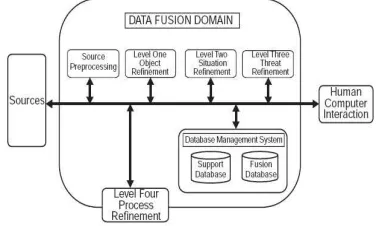
[image:2.595.98.287.523.636.2]In 1985, Joint Director of Laboratories Group in the Department of Defense of America began an effort to create a culture in terms of the JDL data fusion. Process model [8] JDL introduces processes, functions, classes, different techniques, and special techniques that are used in data fusion. Figure 1 shows the basic model of the JDL.
Figure 1: Primitive Model of JDL
Combining the data in the above figure by factors such as resources, human computer interaction, database management, preprocessing source and the following four key processes in the
following order, the image is drawn.
1) Level 1 Processing (Object Refinement): trying to combine sensor data to achieve a more accurate and reliable estimates of position, velocity,
properties, and identity of individual objects;
2) Level 2 processing (Situation Refinement): trying to dynamically create a current expression of relationships between entities and events to build a
picture of the environment around them.
3) Level 3 processing (Threat Refinement): This level relates the current situation into the future and draws conclusions about enemy threats, weapon assignment, intent evaluation, vulnerability friend and foe, and opportunities for conducting operations[20-23];
4) Level 4 Processing (Process Refinement): This level is a hyper process to monitoring the whole of data fusion process to evaluate and improve the performance of real-time systems;
For data fusion in one level of JDL model, proposed a wide variety of architectures that divided to different two general categories of the kinetic data fusion and the identity data fusion. The first batch of Architecture can be Centralized, Autonomous and Hybrid Architectures and among the second batch architecture can be data, feature and decide cited [9]. Interpreted and explained that is in the combined assessment of the situation and threat assessment model, JDL, requiring automated reasoning techniques that are in the field of artificial intelligence. In this regard, knowledge-based systems or expert systems have been developed for explain the one level processing system, analyzing issues such as the content of the observed data, the observed relationships between objects, hierarchical grouping of objects and forecasting objectives or objects. A technique that often used for data fusion is representation knowledge-based system architecture based on Blackboard [9].
ISSN: 1992-8645 www.jatit.org E-ISSN: 1817-3195
Figure 2: Two Level Architecture Based On Bowman Model
One of the techniques and methods of data synthesis is AI methods. Mr. Bedworth in [12] introduced neural network architecture (Multilayer Perceptron) to get an exchange between local optimization and combines the features of a combined system of payment. The neural network training is performed using conjugate gradient optimization algorithms. In [15] have been studied military and civilian applications of data fusion and its architecture and then, is explained three different architectures for multi sensor data fusion involves centralized combination, automatic combination
and hybrid combination. Knowledge-based
methods and blackboard architecture has also been studied for high level composition. One application of data fusion is the problem of marine observation and care. The paper [16] describes the architecture of the data fusion to surveillance of the marine area. In the paper [17], has represented a data fusion framework for threat assessment consists of two parts: threat classification and a data fusion framework of decision level.
3. TYPES OF ARCHITECTURE
This section describes the general architectures of data fusion:
3.1. Bowman Df & Rm Architecture
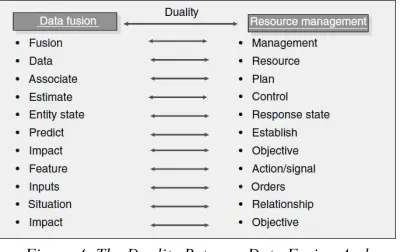
The architecture designed in 1980 and was presented by Mr. Bowman to combine data [1,2]. In this architecture, the process refinement function that is one of the parts resource management function, in the new version of the JDL model has to be considered as Level 4. As there is the duality between estimation and control, there is a greater duality between data fusion and resource management. Also there is the duality between dependence and planning. The data fusion and resource management systems can be implemented using the composition and management of the interaction between the network nodes. The following figure shows the duality of these two nodes.
Figure 3: The Duality Between Data Fusion And Resource Management Nodes
[image:3.595.312.512.351.477.2]
Both levels of the architecture provide understanding the techniques to design each level. These levels are classified because of the meaning of differences in data types, sources, models, and conclusions for each of the levels. The following figure shows the duality of fusion and resource management.
Figure 4: The Duality Between Data Fusion And Resource Management
Bowman argued that the JDL model is useful but has not helped in developing architecture for a real system. This researcher has developed the concept of a hierarchical tree of data fusion to divide fusion problems to nodes. Conceptually, each node involved the functions as data link, estimation and correlation. The figure 3 is an example of the tree node of data fusion provided by bowman.
3.2. The Luo And Kay Architecture
Figure 5: The Luo And Kay Architecture
In this system, the data from multiple sources are combined inside embedded centres in a hierarchical manner. They are created the clearly distinction of between multi-sensor integration and multi-sensor fusion. Their model stated the integration of multiple sensors in four levels involving to signal, pixel, feature and symbol levels order to from low to high levels.
In this architecture, the data collected in sensor level is transmitted to the fusion centers for doing operation fusion process in hierarchical and sequentional manner. As the data combined in data centers in various methods, the data representation level are increased the raw data to the decision level.
3.3. The Durrant-Whyte Architecture
Durrant-Whyte presented architecture for
[image:4.595.339.482.418.614.2]application of robotic systems in 1988. The main characteristic of this model is the use of a common presentation format. Data obtained from the sensor is converted to this format by a combination of high level models. Each sensor must do it itself. So there will be a need for a sensor model. The following figure shows the architecture [5].
Figure 6: The Durrant-Whyte Architecture
3.4. The Pau Architecture
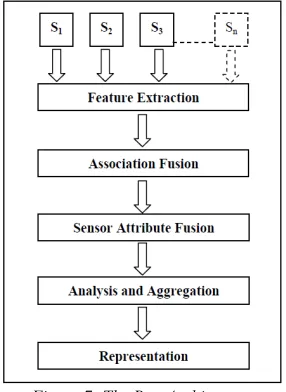
This architecture that has been introduced in 1988 is a hierarchical architecture that provides a model for combining of data based on behavioral knowledge [4]. In this model, instead of a blackboard architecture that can be seen in a knowledge-based system, a hierarchical approach is composed of three levels of display. At the lowest level, for each sensor there is a vector space with coordinate dimensions and measuring parameters. The next level extracts the appropriate features of the vectors and connects labeling to them. The third level relates the feature vectors to events and defines the model of environment.
In the pau architecture, a feature vector is extracted from the raw data. Then this vector is aligned and associated with defined attributes. The combination is performed in attribute sensor level and data analysis. The end phase is made of a series of behavioral rules that can be extracted by showing of the combining output. In this regard, there are examples in the field of diagnostics and
human identification. The following figure
illustrates this architecture.
Figure 7: The Pau Architecture
3.5. The Laas Architecture
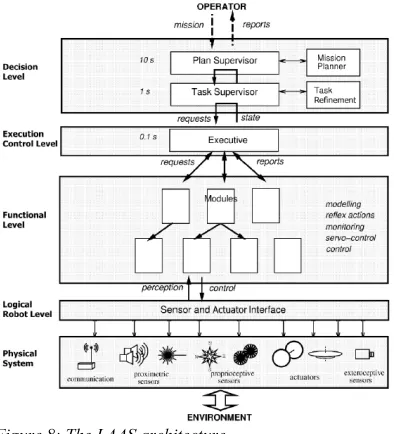
[image:4.595.92.295.589.714.2]ISSN: 1992-8645 www.jatit.org E-ISSN: 1817-3195
architecture consists of the following levels:
1) Logical Robot Level: This level relates
between the hardware and physical sensors and actuators and functional surface.
2) Functional Level: This level includes all
the features of the conceptual and practical building robot. Arithmetic operations such as image processing, obstacle avoidance and control loop to control the communication module can be classified separately.
3) Level Control: This module provides the
functions related to control and coordinate the work requirements.
4) Decision Level: This level includes the
ability of generation program and monitors its implementation. Timing requirements are at the decision level and the various functional levels.
[image:5.595.94.291.376.593.2]The LAAS architecture compared with the JDL, guides designers to implement modules that can be used as part of the real-time system. The following figure shows the LAAS architecture.
Figure 8: The LAAS architecture
3.6. The Jdl Model Architectures(Level One)
One of the key issues in developing a multi-sensor data fusion system is the answering to this question that where be done combining in the flowing of data? In the paper [9] are expressed two situations for the one level JDL fusion model. Firstly, the local data fusion such as viewing ranges, azimuth and elevation to determine the position and velocity of a moving object. Secondly, the parametric of data fusion such as the infrared
and radar data for determine the identity of an observed object.
3.6.1. The local data fusion architecture
There are three methods for describing the above one situation that can be stated for combining local data in order to determine the position and speed of the object. These methods are following below:
• The raw observed data fusion • The combination of state vectors
• Hybrid method (combination of the previous two states)
Based on these three methods, three data fusion
architectures are proposed: Centralized,
Autonomous and Hybrid Architecture.
1) The Centralized Architecture
[image:5.595.308.509.535.626.2]The data from each sensor that has the self particular units and coordinates be changed to the same of units and coordinates for central processing. Then, the dependence and correlation stages are performed the measure of similarity between the data. In fact, the similarity between two data is determined based on whether there is such a threshold criterion or not. In this architecture, the data fusion is performed using sequential estimate techniques such as kalman filter. The centralized combination method is the most accurate method in between of other methods. In this method, the raw data must be transferred to a central processing device through communication networks or other mechanisms. The following figure shows an example of the centralized architecture [9].
Figure 9: The centralized architecture
2) The Autonomous Architecture
are in autonomous method, but in state vector level not in data level.
The combined distributed architecture reduces
the communication between sensors and
combination processor. The reason for this is that the sensor data is compressed into a state vector. Moreover, the dependence and correlation between the state vectors is easier data level fusion. The process of state vector fusion in this architecture
has low accuracy toward the centralized
[image:6.595.93.293.326.399.2]architecture. The reason for this is losing information in transferring between the sensors and fusion process. Specifically, the main data include information about the signal quality that in this method isapproximated the only by the state vector and its associated covariance matrix. The following figure shows the architecture [9].
Figure 10: The Autonomous Architecture
3) The Hybrid Architecture
The third architecture for the local data fusion is including the combining of data level fusion and state vector fusion. In this way, during normal operation, the state vector fusion is done for reducing the computational workload and demands
of the communication. Under certain
[image:6.595.311.512.578.651.2]circumstances, when more accuracy is required, or we are in the dense of tracking environments, the data level fusion is done. The hybrid architecture provides greater flexibility. This architecture also is required a human expert to monitoring the process of fusion and the selection of between data fusion and state vector. The following figure shows this architecture [9].
Figure 11: The hybrid architecture
The selection between these three local data
fusion architectures refer to the System
Engineering. In data fusion applications, there is no single optimal and unique architecture in all applications and the selective architecture must be
tradeoff between some characteristic such as the
computational resources, the communication
bandwidth, the desired accuracy, capability sensors and financial estimates.
Sizing of Graphics
3.6.2. The identity data fusion architecture
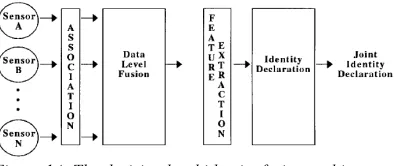
The second position in level one JDL model is called an identity fusion. In fact, in this combination parametric data obtained from various sensors such as radar, infrared and etc. is used to determine the identity of an observed object. In this combination, the observed target attributes in several sensors be changed to the shared expression of object identity. There are various architectures for identity fusion. Some of these architectures are data level fusion, feature level fusion and decision level fusion.
1) The Data Level Fusion Architecture
In this architecture, the data level fusion is done. Each sensor has detected an object and the raw sensor data can be combined. Then the identified of notification process is done. In this process with extracting the feature vectors obtained from sensor data fusion, a transformation is performed between this vector and the declaration of identity. There are attribute-based methods to declare an identity including neural networks, pattern recognition
techniques such as clustering algorithms.
To combine the raw data, the original sensor data must fit together and be able to connect properly. In comparison with local data fusion, the identity fusion of raw data by assuming having the correct alignment and dependence provides the most accurate results. The following figure shows the architecture [9].
Figure 12: The data level identity fusion architecture
2) The Feature Level Fusion Architecture
[image:6.595.92.293.598.680.2]ISSN: 1992-8645 www.jatit.org E-ISSN: 1817-3195
[image:7.595.95.291.227.323.2]
algorithm. The output of this architecture is a joint announcement of the target identity that is based on the combination of feature vectors of all the sensors. In this architecture the data alignment functions, dependence and correlation must are performed before connecting disparate sensors the feature vectors into a single larger feature vectors. The following figure shows the architecture [9].
Figure 13: The feature level identity fusion architecture
3) The Decision Level Fusion Architecture
In this architecture, each sensor does identity declaration process based on a single source of data itself. These sensors convert observed object characteristics to the initial declaration of the object identity.
It can be performed either declare the identity or feature extraction methods such as neural networks or pattern recognition techniques based on features. In this architecture the identity declaration that is provided by the sensor separately, is combined using decision level fusion techniques such as Classical inference, Bayesian inference, weighted decision-making procedures or Dempster-Shafer methods.
The data dependence and correlation is required as well as other data architecture to ensure a correct composition and point to the same physical object or purpose. The following figure shows the architecture [9].
Figure 14: The decision level identity fusion architecture
The choose between these architectures is a systems engineering problem that related to topics such as available communication bandwidth, the characteristics of sensors, available computing resources, and other topics.
3.7. The Knowledge-Based Systems Architecture
Interpret and explain data fusion in the situation and threat assessment of JDL model is requiring automated reasoning techniques that they are in the field of artificial intelligence. In this regard, the knowledge-based systems or expert systems have been developed in order to explain the level one processing system, analyze issues such as the content of the observed data, the observed relationships between objects, objects and purposes hierarchical grouping or forecasting of objects or purposes future. Such reasoning is normally done by humans, but may be approximated by automated
reasoning techniques.
One of the most useful methods for the synthesis
of knowledge-based systems is blackboard
[image:7.595.314.507.422.539.2]architecture [9]. This architecture divides the problem to related subsystems and uses interactive reasoning techniques for solving the problem. Also, the combining of the obtained results for each sub problem, gives a solution evolved. This is similar to the experts may be gathered around a blackboard to solve a problem. An example of blackboard architecture is shown in the following figures.
Figure 15: The blackboard architecture
[image:7.595.95.292.588.671.2]Based on the knowledge, an inference or evaluation process should be developed for the use of that knowledge. For example there are fuzzy logic, probabilistic reasoning, template methods,
sample-based reasoning, and many other
techniques.
Automated reasoning is required a control program to implement reasoning process. There are techniques such as Search methods, control theory and hierarchical decomposition. Each of these programs includes the assumptions and approach for an evolutionary argues process control. Control programs lead the search through knowledge for exploration and dynamic multi-sensor data fusion. In this architecture is used the view knowledge fusion, process evaluation, inference and automated reasoning to control the program. The best known technique in this field includes the knowledge- systems based on rules and techniques based on fuzzy rules [9].
4. THE COMPARISON OF DATA FUSION
ARCHITECTURES
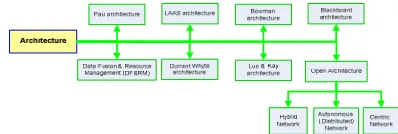
[image:8.595.94.293.559.626.2]The different architectures of data fusion can be classified into hard and soft architectures. The soft architecture deal with implementation of an application, and don't explain that how to use the operating system, hardware, communication system and database. The hard architecture guides the engineers to implementation of architecture as one well as possible. The LAAS architecture is an example of this architecture. With the soft architecture, the designer can design the system with higher degree of freedom than the hard one. The following figure shows some of the most usable architectures in various applications.
Figure 16: The Diagram Of Presented Architectures
We describe several applicable architectures in data fusion previously. In this section, we compare some of them with four features:
1. The real time applications of data fusion architectures.
2. The difference between of multi sensor fusion and integration.
3. Using of hierarchical data fusion method in architectures.
4. The trade-off between computational
resources, available communication bandwidth, resolution, finance and the sensor capability.
The LAAS architecture is used in low and middle-level sensor fusion that is known as the sections of functional level, and the high-level sensor fusion is known as a decision level. Although, LAAS architecture is a good tool for the discrimination of large scale systems into small ones, but it can't provide a real time suitable communication and it can't present data in high levels of functional level. With the comparison of JDL model, the LAAS architecture helps designer to implement the usable one as a part of a real time system. Also, The LAAS architecture also would be provide the real-time implementation.
In the Luo and Kay architecture, there exists
clear distinction between multiple sensors
integration and multi sensor fusion. In this architecture, the data that is collected in sensor level is transmitted to sensor fusion center. In this center, the integration of fusion process has be done by sequential and hierarchical issues.
In knowledge-based system, the Blackboard architecture is used, whereas in the Pau architecture, the hierarchical approach is used.
The common architecture in marine application is open architecture. In open architecture design, this architecture provides a technical strategy for the production and maintenance of such system. Naval open architecture is classified into three categories: centralized, autonomous and hybrid. Centralized architecture is the most accurate method theoretically. In this architecture, the raw observable data such as local information is combined from each sensor together; while the autonomous architecture uses the state vectors for local fusion. In this combination, each sensor estimates the position and velocity of the object based on the data from the sensor by generating a state vector. Data alignment, and correlation functions are some functions that common in centralized and autonomous architecture, but in the centralized architecture, these functions perform in data level whereas in autonomous architecture perform in state vector level. With the contrast of centralized architecture, in autonomous architecture the communication between sensors and fusion center and also, the computational load are reduced.
ISSN: 1992-8645 www.jatit.org E-ISSN: 1817-3195
autonomous architecture has lower accuracy than centralized one, because of losing information in transferring between the sensors and fusion center. In contrast with other architectures, the hybrid architecture is the most flexible one.
There don't exist common desired architecture in data fusion applications. The architecture selection is the tradeoff between some features such as: computing resources, communication bandwidth, desired accuracy, capability of sensors and available budget.
The identity raw data fusion architecture provides the most accurate results in comparison with the local data fusion by assuming having the right alignment and dependence process. In the knowledge based system architecture can be used from the automated reasoning techniques. In this regard, knowledge-based systems or the blackboard architecture have been developed to describe one level of processing system, analyzing issues such as the content of the observed data, the observed relationships between objects, the hierarchical grouping of objects, and the prediction of objectives or objects future.
The following table shows the comparison between the different levels of fusion that are classified by view knowledge.
Table 1: The comparison of different levels of fusion in Luo and Kay architecture
Table 2: The comparison of different levels of fusion in the Identity data fusion architectures
5. CONCLUSION
In this paper, an overall review of data fusion architectures was present and the benefit of each of them was mentioned. Dependency of the data fusion architecture with platform, cause to architecture data fusion assign problem; thus an universal architecture isn't verified and unique data
fusion architecture don’t recommended totally. Therefore this paper is present a comprehensive review of various available architectures in data fusion technologies, in spite of platform, and comparison of them is provided. Furthermore, to date, the various architectures are expressed for multi sensor data fusion framework. A common characteristic of them, in naval vehicle, is debated. The sensors are combining the several data processing levels with data fusion process. In this research, the different architectures are reviewed, and the advantages and disadvantages of each with various applications are presented especially with the approach used in a naval carrier.
The results of investigations show that the marine open architecture is the best architecture for defense applications. The reason is the high resolution of architecture in data fusion and using it for the marine defense applications.
REFRENCES:
[1] Bowman, C.L. and Murphy, M.S.,
“Description of the VERAC N-Source
Tracker/Correlator”, Naval Res Lab. Report
R-010-80, March 1980.
[2] Bowman, C.L. and Morefield, C.L.,
“Multi-sensor Fusion of Target Attributes and
Kinematics”, 19th IEEE Conference on
Decision and Control, December, 1980.
[3] Luo, R., and Kay, M., “Multisensor integration
and fusion: Issues and approaches.”, SPIE
Sensor Fusion, 931: 42-49, 1988.
[4] Pau, L. F., “Sensor data fusion.”, Journal of
Intelligent and Robotic Systems, pp: 103-116,
1988.
[5] B. Dasarathy, “Sensor Fusion Potential
Exploitation– Innovative Architectures and
Illustrative Applications”, Proceedings of
IEEE, Volume 85, Number 1, pp 24-38 (1997).
[6] Wilfried Elmenreich, A Review on System
Architectures for Sensor Fusion Applications, Springer 2007.
[7] Wilfried Elmenreich, “Sensor Fusion in
Time-Triggered Systems”, Oktober 2002.
[8] Franklin E. White, Jr., Data Fusion Lexicon,
Joint Directors of Laboratories, Technical Panel for C3, Data Fusion Sub-Panel, Naval Ocean Systems Center, San Diego, 1987. [9] Llinas, J. & Hall, D. L., “An introduction to
multi-sensor data fusion.”, Proceedings of the
[10]Avison DE, Fitzgerald G., “Information
Systems Development: Methodologies,
Techniques and Tools”, 2nd edition. London: McGraw-Hill Book Company; 1995. 168 p.
[11]Jaime Esteban, Andrew Starr, Robert Willetts,
Paul Hannah, Peter Bryanston-Cross, “A
Review of Data Fusion Models and
Architectures: Towards Engineering
Guidelines”, p50c 10-November-2004.
[12]Mark D Bedworth, “Source Diversity and
Feature-Level Fusion”, 1999.
[13]Wilfried Elmenreich, “Sensor Fusion in
Time-Triggered Systems”, Oktober 2002.
[14]Van Delft JH, Schuffel H, Human factors
onderzoek voor toekomstige commando
centrales KM. Soesterberg: TNO-TM;.Report nr TNO-TM A-19. In Dutch. 1995.
[15]Amanda Erhard and Sovay McGalliard,
“Advances in Military Multi-Sensor Data Fusion Technology and Applications for
Civilian Use”, Eleventh Annual Freshman
Conference, April 9, 2011.
[16]Ahmed Gad M. Farooq, “Data Fusion
Architecture for Maritime Surveillance”, ISIF
2002.
[17]Justin M. Beaver, Ryan A. Kerekes and Jim N.
Treadwell, “An Information Fusion Framework
for Threat Assessment”, Oak Ridge National
Laboratory, P.O. Box 2008, Oak Ridge,
Tennessee 37831-6285.
[18]Mark Bedworth and Jane O’Brien, “The
Omnibus Model: A New Model of Data Fusion?”, 1999.
[19]P. Valin, E. Bosse, and A. Jouan. “Airborne
application of information fusion algorithms to classification.”, Technical Report TR
2004-282, Defense Research and Development
Canada – Valcartier, May 2006.
[20]Y. Liang. “An Approximate Reasoning Model
for Situation and Threat Assessment.” In
Proceedings of the 4th International
Conference on Fuzzy Systems and Knowledge
Discovery, 2007.
[21]S.J. Yang, J. Holsopple, and M. Sudit.
“Evaluating Threat Assessment for Multi-Stage
Cyber Attacks.” In Proceedings of the 2006
Military Communications Conference.
Washington, DC. Oct. 23-25, 2006.
[22]R. Chinchani, A. Iyer, H.Q. Ngo, and S.
Upadhyaya. “Towards a theory of insider threat
assessment.” In Proceedings of the 2005
International Conference on Dependable
Systems and Networks, 2005.
[23]L. Yang, J.H. Yang, E. Feron, and V. Kulkarni.
“Development of a performance-based
approach for a rear-end collision warning and
avoidance system for automobiles.” In
Proceedings of the IEEE Intelligent Vehicles
![figure shows the architecture [9].](https://thumb-us.123doks.com/thumbv2/123dok_us/8911284.959418/6.595.93.293.326.399/figure-shows-the-architecture.webp)