S T U D Y P R O T O C O L
Open Access
Cluster randomized trial of a mHealth
intervention
“
ImTeCHO
”
to improve
delivery of proven maternal, neonatal,
and child care interventions through
community-based Accredited Social Health
Activists (ASHAs) by enhancing their
motivation and strengthening supervision
in tribal areas of Gujarat, India: study
protocol for a randomized controlled trial
Dhiren Modi
1, Shrey Desai
1*, Kapilkumar Dave
1, Shobha Shah
1, Gayatri Desai
1, Nishith Dholakia
2, Ravi Gopalan
3and Pankaj Shah
1Abstract
Background:To facilitate the delivery of proven maternal, neonatal, and child health (MNCH) services, a new cadre of village-based frontline workers, called the Accredited Social Health Activists (ASHAs), was created in 2005 under the aegis of the National Rural Health Mission in India. Evaluations have noted that coverage of selected MNCH services to be delivered by the ASHAs is low. Reasons for low coverage are inadequate supervision and support to ASHAs apart from insufficient skills, poor quality of training, and complexity of tasks to be performed. The proposed study aims to implement and evaluate an innovative intervention based on mobile phone technology (mHealth) to improve the performance of ASHAs through better supervision and support in predominantly tribal and rural communities of Gujarat, India.
Methods/design:This is a two-arm, stratified, cluster randomized trial of 36 months in which the units of randomization will be Primary Health Centers (PHCs). There are 11 PHCs in each arm. The intervention is a newly built mobile phone application used in the public health system and evaluated in three ways: (1) mobile phone as a job aid to ASHAs to increase coverage of MNCH services; (2) mobile phone as a job aid to ASHAs and Auxiliary Nurse Midwives (ANMs) to increase coverage of care among complicated cases by facilitating referrals, if indicated and home-based care; (3) web interface as a job aid for medical officers and PHC staff to improve supervision and support to the ASHA program. Participants of the study are pregnant women, mothers, infants, ASHAs, and PHC staff.
Primary outcome measures are a composite index made of critical, proven MNCH services and the proportion of neonates
(Continued on next page)
* Correspondence:[email protected]
1Community Health Department, SEWA-Rural, Jhagadia, District, Bharuch,
Gujarat 393110, India
Full list of author information is available at the end of the article
(Continued from previous page)
who were visited by ASHAs at home within the first week of birth. Secondary outcomes include coverage of selected MNCH services and care sought by complicated cases. Outcomes will be measured by conducting household surveys at baseline and post-intervention which will be compared with usual practice in the control area, where the current level of services provided by the government will continue. The primary analysis will be intention to treat.
Discussion:This study will help answer some critical questions about the effectiveness and feasibility of implementing an mHealth solution in an area of MNCH services.
Trial registration:Clinical Trial Registry of India, CTRI/2015/06/005847. Registered on 3 June 2015.
Keywords:mHealth, ASHAs, cRCT, Maternal health, Neonatal health, Acceptability, Tribal health, Implementation research, India
Background
India carries the largest burden of maternal, neonatal and infant mortality, and malnutrition in the world [1–3]. Many of the deaths can be prevented with the help of proven, cost-effective, community-based services [4, 5]. Some of the proven maternal, neonatal, and child health (MNCH) services include antenatal examination, supple-mentation of iron and folic acid during pregnancy, promo-tion of skilled birth attendance, home-based neonatal care, and early and exclusive breast feeding during the first 6 months, initiation of complementary feeding at the completion of 6 months, supplementation of vitamin A among infants, case management of pneumonia, and oral rehydration therapy for diarrhea [4–6].
To increase the coverage of proven MNCH services, a new cadre of village-based frontline workers, called the Accredited Social Health Activists (ASHAs), was created by the Government of India in 2005 [7]. An ASHA is a native of a particular village and is selected by the village council with help of local government health staff. ASHAs are expected to be literate and to have an educa-tional qualification of at least 8th grade. After training,
an ASHA is expected to contribute 3–5 hours every day
for her activities. There is one ASHA for approximately every 1000 members of a rural population, and there were 863,503 ASHAs in India in 2013 [8]. ASHAs are supported and supervised by the staff of Primary Health Centers (PHCs). A PHC is an operational and adminis-trative unit which provides curative and public health services for all of its designated villages. Each PHC has a team of two medical officers (doctors) and four to six Auxiliary Nurse Midwives (ANMs) along with one Lady Health Visitor and several male multi-purpose workers. ASHAs receive a performance-based incentive [9].
Unfortunately, coverage of some of the most impactful MNCH services to be delivered by ASHAs has remained low, especially in hard-to-reach tribal areas [10–13]. Some important reasons for the suboptimal performance of the ASHA program are common implementation bottlenecks such as inadequate training leading to suboptimal skills
and knowledge, along with a lack of institutional capacity leading to insufficient supervision, support, and motivation of ASHAs [10, 11, 14]. To overcome these problems, an mHealth-based intervention, called "ImTeCHO," was cre-ated. ImTeCHO is a mobile phone application which aims to increase the performance of the ASHAs and PHC staff by creating a platform to improve supervision, support, and motivation. Detailed information about the develop-ment and components of the ImTeCHO intervention is described in another publication [15].
The aim of this protocol is to test the effectiveness of the ImTeCHO intervention in improving coverage of proven MNCH services through a cluster randomized trial in tribal areas of Gujarat, India. The primary object-ive of the trial is to examine the effect of ImTeCHO in the form of job aid to ASHAs during their scheduled home visits to increase coverage of selected MNCH services provided by the ASHAs in tribal and rural areas of Gujarat, India compared to a control area where usual care will be continued. The secondary objective is to examine the effect of ImTeCHO intervention to increase coverage of care among complicated maternal, neonatal, and child cases by facilitating referrals to health facilities and managing at home for those cases that cannot be referred. Another secondary objective is to examine the effect of ImTeCHO intervention in the form of job aid to medical officers and PHC staff to improve the support and supervision of ASHAs.
Methods/design
Study design
and public health services for all its covered villages. Each PHC has a team of two medical officers, four to six ANMs, one Lady Health Visitor, and several male multi-purpose workers. Of the two medical officers, one has an MBBS degree and is in charge of the PHC, including clinical services. The other medical officer is usually an Ayurveda, Yoga and Naturopathy, Unani, Siddha, and Homoeopathy (AYUSH) practitioner and is involved in field-based duties. Each ANM is in charge of one subcen-ter which serves a population of 3000–4000. On an
aver-age, there are 20–25 ASHAs per PHC. There is one
ASHA Facilitator for approximately every 10 ASHAs. The average size of the population per PHC is approximately 20,000 in tribal areas [16].
Study setting
This study will be conducted by SEWA Rural, which is a voluntary organization located in the Jhagadia block of Gujarat. SEWA Rural has been involved in health and development activities in rural, tribal areas of Gujarat, India since 1980 [17]. The study area belongs to the tri-bal belt which stretches along the Satpura mountain range located along the eastern part of Gujarat. Some of the study area is covered by thick forest. The tribal population residing in the study area is called “Vasava” or “Bhil.” As with other tribal communities, the Vasava tribe has its own language and customs which are differ-ent from the mainstream culture, though this is chan-ging rapidly as they become increasingly connected with
today’s more modern culture. Agriculture is the main
occupation, with a large number of the population work-ing as landless laborers [18]. The rate of industrialization is much slower in these areas. Dediyapada, Nandod, and Sagbara belong to the Narmada district which was named one of themost backward districtsby the Ministry of Panchayati Raj in 2006 due to its lack of development and difficult terrain [19]. The literacy rate of the study area was 65%, and the proportion of scheduled tribe population was 75% in a 2011 census of India.
Study participants ASHA
A detailed description of the ASHA is provided in the Background. Most of the ASHAs belong to the scheduled tribe community.
ASHA Facilitator (AF)
The AF is responsible for monitoring, facilitating, and providing supportive supervision of the ASHAs. The AF performs these duties during her regular field visits.
There is one AF for every 10–20 ASHAs. The AF is the
link between the ASHAs and the block-level support structure [20].
Auxiliary Nurse Midwife (ANM)
The ANM is a qualified health provider of vital primary health care services including those related to MNCH. In regard to the ASHA program, the ANM has the following role: she makes home visits and provides care to those complicated cases for persons who are unable to go to a health facility. Such care will include confirm-ing the diagnosis, encouragconfirm-ing referral, counselconfirm-ing, and administering drugs, including oral antibiotics. The ANM conducts a monthly Village Health and Nutrition Day (VHND) in each of her coverage villages during which she provides important MNCH services including vaccination, antenatal examination, and growth monitoring. Along with the AF, the ANM also provides supportive supervi-sion and support to the ASHAs. The ANM verifies the ASHA’s performance report which is used for calculating the ASHA’s performance-based incentive [16, 21].
Medical officer
The medical officer is overall in charge of a PHC. The medical officer’s main responsibilities are to provide curative service, manage promotive and preventive pro-grams, give training, monitor field-level health workers, and oversee administrative tasks [16].
mHealth facilitator (mHF)
The mHF is an employee from SEWA Rural who facili-tates and assists the people described above in using ImTeCHO. There is one mHF for every two PHCs; the mHF is stationed at a block health office for streamlining coordination with the government's health team [15].
The mHF's job responsibilities are as follows:
Be the first contact person in case of any technology-related problems encountered by any users of ImTeCHO
Use the Facilitator dashboard available through the ImTeCHO web interface for monitoring adherence to the ImTeCHO intervention through the use of innovative process indicators and undertaking housekeeping functions for dealing with migration of mothers, duplication in registering a case, and verification of death reported by ASHAs
Attend monthly PHC meetings
Make an occasional field visit to provide ongoing training/supervision/motivation to those ASHAs whose performance parameters within ImTeCHO are consistently poor
PHC support staff
Along with the medical officers, ANMs, and AF, other members of the PHC staff play supporting roles in the ASHA program. These staff members are data-entry operators, a pharmacist, supervisors, and multi-purpose male health workers. The PHC support staff are involved in calculation of the ASHA’s performance-based incentives and replenishment of supplies [16].
Helpline to provide telephone care
A helpline has been established at SEWA Rural. An ex-perienced counselor provides telephone care which aims to support ASHAs and families to manage com-plicated cases over the phone, usually after receiving alerts from the ASHAs. The support involves the con-firmation of a diagnosis made by the ASHA, promotion of household-level practices to care for complications, advising the ASHAs for optimal management of complications, counseling of families to seek care at a higher referral facility if required, and alerting the med-ical officer in case of emergencies [15].
Pregnant women and mothers of infants
Pregnant women and mothers of infants will be the dir-ect beneficiaries of the intervention. They will be re-spondents for the baseline and endline surveys.
Intervention
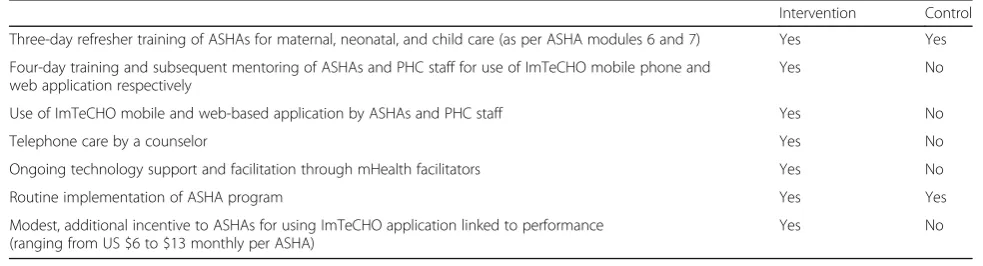
Detailed information about the intervention is de-scribed in another publication [15]. Table 1 shows the service delivery by study arm. This is followed by a brief description of the main component of the inter-vention which is use of the ImTeCHO mobile and web-based application by the ASHAs, medical officers, and PHC staff.
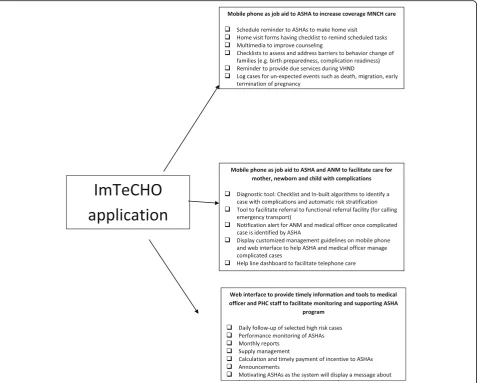
Every ASHA is given a low-cost smartphone which will be General Packet Radio Service (GPRS)-enabled, with a multi-media feature. The mobile phone appli-cation will have the following features: home visit forms, log of case details, work log, announcements, and SMS information channel. The ASHA fills out
forms on her mobile during home visits which will be sent to a server using the GPRS network. Similarly, the ANMs will be given a tablet to track high-risk cases and monitor the performance of the ASHAs. Each medical officer views a web interface which is a computer screen where organized data is available on-line. The ImTeCHO software organizes the data into useful information (based on predefined logic) for the PHC staff. The web interface will have features to track high-risk cases, see reports, and manage incen-tives and supplies. No other concomitant care and in-terventions, apart from that mentioned above, will be delivered by the trial team; however, other organiza-tions cannot be prohibited from introducing new public health programs, considering the nature of the trial and implementation research. See Fig. 1 for a diagram of the three main components of the mobile and web-based application.
Outcome measures
Primary outcomes of interest
There are two primary outcomes of interest as follows:
[image:4.595.52.544.602.735.2]1. Proportion of neonates/mothers who were visited at home by ASHA at least twice within the first week of delivery: As most of the neonatal deaths occur during the first few days of life, it is recommended that neonates should be visited three times during the first week including the day of delivery, the third day, and preferably the seventh day [22]. However, most (78% according to a coverage evaluation survey of UNICEF in 2009) of the deliveries in Gujarat now occur in a facility where the ASHA’s role is limited in the presence of the facility-based, more qualified health workers [20]. Also, the ASHA’s visit on the day of delivery is influenced by various factors with a limited role of the ImTeCHO intervention. Hence, we decided to focus on coverage of the ASHA’s two home visits within the first week of delivery after the mother and neonate return home after discharge from the facility.
Table 1Service delivery by study arm
Intervention Control Three-day refresher training of ASHAs for maternal, neonatal, and child care (as per ASHA modules 6 and 7) Yes Yes Four-day training and subsequent mentoring of ASHAs and PHC staff for use of ImTeCHO mobile phone and
web application respectively
Yes No Use of ImTeCHO mobile and web-based application by ASHAs and PHC staff Yes No Telephone care by a counselor Yes No Ongoing technology support and facilitation through mHealth facilitators Yes No Routine implementation of ASHA program Yes Yes Modest, additional incentive to ASHAs for using ImTeCHO application linked to performance
(ranging from US $6 to $13 monthly per ASHA)
2. Modified ASHA-centric composite coverage index (MACCI): The MACCI will be calculated using the following formula and rationale.
Modified ASHA-centric composite coverage index (MACCI) = 0 · 25 × (0.33 × [Complete ASHA home visits during antenatal period + Full ANCS + FD] + [Complete HBNC] + 0 · 5 × [DPT3 + EBF] + 0 · 33 × [Care seeking for neonatal complications + ORT + ARI/febrile illness])
Explanation of MACCI services
1. Maternal care services
Complete ASHA home visit during antenatal period = proportion of mothers who were visited at home by ASHAs at least three times during last pregnancy
Full antenatal care service (ANCS) = proportion of mothers with full antenatal examination (at least three antenatal examinations by qualified
health personnel, one tetanus toxoid injection (Inj.TT), and consumption of 100 iron-folic acid (IFA) tablets) [12]
Facility delivery (FD) = proportion of mothers who delivered in a facility as most of the deliveries attended by skilled attendant are those taking place at a facility in Gujarat
2. Neonatal care services
Complete HBNC = proportion of neonates who received the recommended number (five) of postnatal visits and at recommended times within first month of delivery by an ASHA [23]
3. Young infant care services
DPT3 = proportion of infants (6–8 months old) who received three doses of diphtheria, pertussis, and tetanus vaccine or three doses of pentavalent vaccine
EBF = proportion of infants (6–8 months old) who were exclusively breast fed for first 6 months
[image:5.595.61.539.88.471.2]4. Care seeking during complications
Care seeking for neonatal complications = proportion of neonates who had complications within first month of last delivery and sought care from the ASHA
ORT = proportion of infants (6–8 months) who had diarrhea within last 2 weeks and received oral rehydration salts (ORS) from the ASHA
ARI/fever = proportion of infants (6–8 months) with acute respiratory infection (ARI)/fever within last 2 weeks where family sought care from the ASHA
The same weight was given to each of the four main domains of interventions throughout the continuum of care: maternal, neonatal, young infant care, and care seeking for complications.
A composite outcome was required to reflect the effectiveness of ImTeCHO because the scope of the intervention is throughout the continuum of care in-cluding maternal, neonatal, and young infants up to 2 years of age. We were guided by the composite cover-age index (CCI), which is now widely used to measure the coverage of key MNCH interventions and strength of the health system [24–26]. The formula for calculat-ing the CCI was modified to develop a modified ASHA-centric composite coverage index (MACCI) for this study to focus on (1) the coverage of MNCH interven-tions to be provided by the ASHAs in India, (2) the scope of the ImTeCHO intervention, and (3) the rele-vance in India. Subsequently, ASHA visitations during antenatal and postnatal periods, exclusive breast feeding, and care seeking to the ASHAs for maternal, neonatal, and childhood complications were included, and family planning need satisfaction was omitted from the CCI formula.
Secondary outcomes of interest
Most of the secondary outcomes of interest are coverage of proven MNCH services to be delivered or facilitated by the ASHAs throughout the continuum of care and process indicators to assess adherence to the ImTeCHO intervention. See Table 2 for the list of primary and secondary outcomes.
Control arm (comparator)
The control area will continue to receive usual health services from the government and other providers. All ASHAs in the control and intervention area will receive the refreshers' training described above.
Sample size calculation
Based on the information available for a sample of the study area before baseline and earlier surveys, we
assumed there will be 25 ASHAs (cluster size) in a PHC and the MACCI will be 36%. In the absence of existing information regarding the intra-class correlation, we assumed the intra-class correlation coefficient (ICC) to be 0.02. Assuming a loss of one cluster per arm and three ASHAs per PHC, for detecting 15% absolute im-provement in the MACCI in the intervention arm com-pared to the control arm at the endline survey with 80% power and a 5% two-sided significance level, we esti-mated the required sample size per arm to be 11 PHCs/ clusters. Similarly, we assumed that 46% of neonates/ mothers would receive at least two postnatal home visits within the first week of delivery by the ASHA in the control arm based on earlier surveys. Assuming the loss of one cluster per arm and three ASHAs per PHC, we estimated the required sample size per arm to be six PHCs/clusters for detecting 20% absolute improvement in the proportion of neonates/mothers who received at least two postnatal home visits within the first week of delivery by the ASHA in the intervention arm compared to the control arm at the endline survey with 80% power and a 5% two-sided significance level.
Randomization
Stratification was done to ensure that the prevalence of primary outcomes would be similar in the intervention and control groups along with almost equal selection of PHCs from the most backward Dediyapada block. The randomization was done after a baseline survey. The allocation ratio was 1:1. The stratified randomization was performed by a statistician at All India Institute of Medical Sciences (AIIMS, New Delhi) who was not in-volved in implementation of the intervention. The base-line variable used for stratification was the primary outcome indicator; the assessment will be described in detail in a later section. The mean value of the primary outcome indicator was used as a cut-off to divide each PHC into one of the two strata. The PHCs in each of the two strata were randomly allocated into an interven-tion and a control group. The randomizainterven-tion was done
using the software nQuery. Due to the nature of the
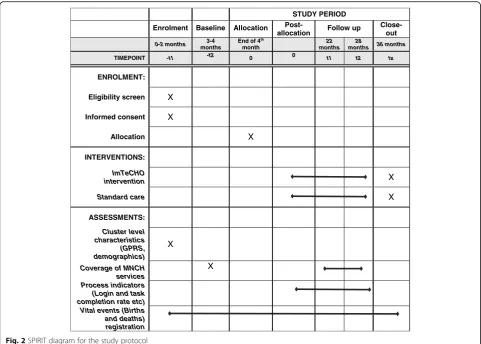
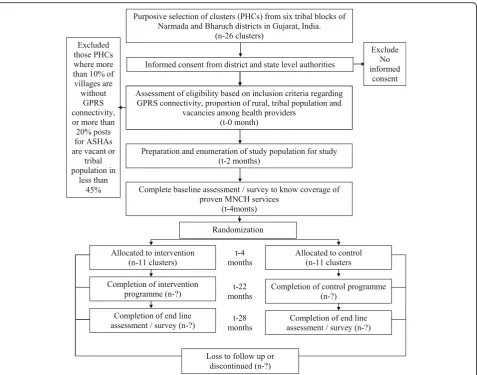
community-based intervention, blinding was not pos-sible. See the Standard Protocol Items: Recommenda-tions for Interventional Trials (SPIRIT) diagram (Fig. 2), the Consolidated Standards of Reporting Trials (CON-SORT) study flow chart (Fig. 3), and the SPIRIT check-list (Additional file 1). Additional file 2 is a copy of the information sheet and consent form. Additional file 3 shows the statistical analysis plan.
Enrollment of clusters
already as part of another project) having a 100% rural population and predominantly scheduled tribe popula-tion (at least 45%) were eligible to be included. Bharuch and Narmada districts were selected because both are predominantly tribal districts with several hard-to-reach, high-priority areas identified by the state government and with proximity to the lead organization conducting this study. Those PHCs were excluded where all medical officer posts and more than 20% of posts for ASHAs were vacant at the time of initiation of the study. PHCs that had more than 10% villages without GPRS (mobile connectivity) most of the time were excluded. Although the ImTeCHO mobile application can function without a GPRS signal, the lack of this signal in large areas of intervention will affect components of the intervention to a significant extent.
Recruitment of respondents, measurement of outcomes, and follow-up
Household surveys will be used for assessing the above-mentioned outcomes of interest. The household survey tools are based on the District Level Household and Facility Survey (DLHFS-4) [27]. Table 3 briefly describes the measurement of outcomes.
All pregnancy registrations, their outcomes, and any neonatal and infant deaths in all clusters throughout the study period will be counted as part of the ongoing pregnancy and mortality surveillance by a separate team of data collectors. Subsequently, all respondents who will be eligible during the survey period will be enrolled for a household survey using information from the ongoing
pregnancy registration and mortality surveillance,
[image:7.595.57.287.104.720.2] [image:7.595.305.535.105.269.2]whether or not they received the intervention. The data collection team will enter data into smartphones which will be loaded with a data collection tool with built-in checks for missing data and logical inconsistency. Data will be uploaded to a central server using the GPRS. A
Table 2Primary and secondary outcomes of interest
1. Primary outcomes of interest
1.1 Proportion of neonates/mothers who were visited at home by ASHA at least twice within first week of delivery 1.2 Modified ASHA-centric Composite Coverage Index (MACCI) 2. Secondary outcomes of interest
Maternal outcomes. Proportion of:
2.1 Mothers who had first antenatal examination within first trimester 2.2 Mothers who had four or more ANC examinations by ANM/
doctor including at least one examination in last trimester 2.3 Mothers with full antenatal checkup (at least three antenatal
examinations, one Inj.TT, and 100 IFA tablets)
2.4 Mothers who were visited at home by ASHA at least three times during last pregnancy including at least one visit during last trimester
2.5 Mothers who had complications during last pregnancy and sought care from ASHA
2.6 Mothers who had complications within first month of last delivery and sought care from ASHA
2.7 Mothers who had serious complications during last pregnancy or within 6 weeks of last delivery and sought care from qualified health personnel
2.8 Mothers who delivered in a facility Neonatal outcomes. Proportion of:
2.9 Mothers who initiated breast feeding within an hour of last delivery
2.10 Neonates/mothers who were visited by ASHA at home within 24 hours of delivery (in case of home delivery) or within 24 hours of return to home from hospital in case of hospital delivery
2.11 Neonates/mothers who received the recommended number of postnatal visits and at recommended times within first month of delivery by ASHA
2.12 Mothers who received satisfactory counseling about caring for neonatal baby from ASHA during her home visits after last delivery
2.13 Neonates who were satisfactorily examined by ASHA during her home visits after last delivery
2.14 Mothers who adopted selected neonatal care practices during first month after delivery
2.15 Neonates who had complications within first month of last delivery and sought care from ASHA
Young infant outcomes. Proportion of:
2.16 Mother who exclusively breast fed infant for first 6 months 2.17 Infants (6–8 months of age) who received solid, semi-solid,
or soft foods during the previous day
2.18 Infants (6–8 months) who had received all three doses of pentavalent vaccine
2.19 Infants (6–8 months) who had diarrhea within last 2 weeks and received ORS from ASHA
2.20 Infants (6–8 months) with ARI/fever within last 2 weeks and family sought care from ASHA
2.21 Any harm suffered due to treatment or advice provided by the ASHA
Table 2Primary and secondary outcomes of interest
(Continued)
Selected process indicators
2.22 Proportion of days ASHAs and medical officers logged in ImTeCHO mobile phone and web-based application respectively (login rate)
2.23 Proportion of scheduled tasks completed by ASHAs and medical officers in ImTeCHO mobile phone and web-based application respectively (task completion rate)
2.24 Number of pregnancies registered using mobile phones against expected number of registration
2.25 Number of complicated maternal, newborn, and child cases identified against expected
2.26 Stock-out rate (proportion of times when a drug or equipment was not available when required, e.g.,
data administrator will check for any inaccuracies, and these will be clarified during a review meeting with the data collectors. Five percent of households will be ran-domly selected and re-interviewed by an independent quality assurance team using a truncated questionnaire.
Timeline and duration of the study
This study is of 3 years’ duration from March 2015 to
February 2018. Table 4 shows the timeline for the study. The development of the ImTeCHO intervention and formative evaluation is already completed and documented [15].
Administrative structure
The implementation will be delivered by an implementa-tion team, and evaluaimplementa-tion will be done by an evaluaimplementa-tion team; the teams will work independently of each other. Both teams are supervised by the principal investigator through meetings held twice a month. An advisory com-mittee consisting of independent researchers, technical experts, academicians, and government administrators meets on a regular basis.
Implementation team
The implementation team consists of:
Government staff which includes ASHAs, and PHC staff
A program manager and program associate from SEWA Rural who supervise and support ImTeCHO facilitators and the helpline counselor, intervene in emergency situations, and also coordinate with medical officers and higher level government health officials
Software developers from Argusoft India Ltd. who maintain the ImTeCHO software
Evaluation team
The evaluation team consists of:
Data collectors who conduct surveillance activities to record vital events
Supervisors who supervise the data collection team
A data manager and statistician
A research coordinator and a research associate from SEWA Rural who plan, execute, and oversee the evaluation efforts
STUDY PERIOD
Enrolment Baseline Allocation
Post-allocation Follow up
Close-out
0-2 months months3-4 End of 4 th
month
22 months
28
months 36 months
TIMEPOINT -t1 -t2 0 0 t1 t2 tx
ENROLMENT:
Eligibility screen X
Informed consent X
Allocation X
INTERVENTIONS:
ImTeCHO
intervention X
Standard care X
ASSESSMENTS:
Cluster level characteristics
(GPRS, demographics)
X
Coverage of MNCH services
X
Process indicators (Login and task completion rate etc) Vital events (Births and deaths) registration
[image:8.595.57.539.87.431.2]Data Safety and Monitoring Board
The Data Safety and Monitoring Board comprises inde-pendent scientists, ethicists, community members, and a statistician, and they meet on a regular basis. As the out-come measurements will be done at baseline and endline only, there is no plan to do an interim analysis. There is no plan to audit the conduct of the trial.
Analysis plan
Data analysis will be done as per the statistical analysis plan (see Additional file 3). The primary analysis will be intention to treat, and the secondary analysis would be per protocol. Data will be analyzed taking into account cluster randomization. In case of any imbalance in any of the characteristics at the cluster or at the beneficiary level, adjustments will be done using the generalized es-timating equation approach. For each of the primary and secondary outcomes, the effect size (95% confidence interval), after adjustment if required, would be com-puted. Each outcome will be compared between the
intervention and control groups at the endline. Add-itionally, the difference in differences technique will be used for those outcomes which were measured at base-line and endbase-line. A before and after analysis will also be done. STATA 13.0 will be used for data analysis. The re-sults will be presented as per the statistical analysis plan.
Ethics approval and consent to participate
The Multi-institutional Ethics Committee (Mumbai), Institutional Ethics Committee of SEWA Rural, and
Ethics Review Committee of the World Health
Organization (Protocol ID number: MCA00615) have approved the study. Informed consent will be obtained by trained data collectors from all respondents prior to a household survey. A copy of the information sheet and consent form can be found in Additional file 2. All personally identifiable information will be removed, and unique numbers will be assigned to the participants. Only the investigators will have access to data linking personally identifiable information with the unique
[image:9.595.61.539.86.461.2]numbers. The proposed application will contain medical information of individuals and hence demands high levels of data security. In view of this, the application shall accept, transmit, process, and store data using prudent se-curity and data encryption practices. The database will be protected by a password. The study is registered at the Clinical Trial Registry of India (http://www.ctri.nic.in/ Clinicaltrials/pdf_generate.php?trialid=11820&EncHid=&-modid=&compid=%27,%2711820det%27), and the regis-tration number for the submitted application is CTRI/ 2015/06/005847. We will disseminate findings of the study with all stakeholders through various strategies, including meetings and printed and visual media and publications. The final report will follow the CONSORT 2010 guide-lines and its extension for cluster trials published in 2012 and non-pharmacologic treatment interventions [28].
Problems anticipated
We need to assess the risk of some unplanned events during the course of the study which can have an impact on it. Some of the possibilities are:
New schemes from the government such as starting a hotline, a voice messaging system, or another mHealth intervention, etc.
A new service provider/non-governmental organization (NGO) starting to serve either the control or
intervention area, which can impact outcomes
New regulations regarding the use of mobiles from the government
Major staffing issues at PHCs, which can impact outcomes
If there is a major reorganization of the PHCs by the government, then dropout of selected PHCs might be inevitable. Appropriate decisions will be taken on a case-by-case basis, and records will be maintained to docu-ment actions taken.
SEWA Rural is closely working with the government and other stakeholders to mitigate or minimize these and other unanticipated risks while preserving ethical and moral values.
Organizations involved in this study
SEWA Rural is the lead organization. The Department of Health and Family Welfare, Government of Gujarat is implementing the intervention within the primary health care system with active facilitation by SEWA Rural. Argu-soft India Ltd. and SEWA Rural are leading efforts towards development and maintenance of the ImTeCHO software.
Nested studies
A few nested studies are being planned during the course of the trial as follows:
Examine the effect of ImTeCHO intervention in the form of job aid to ASHAs, ANMs, medical officers, and PHC staff to reduce neonatal mortality rate, infant mortality rate, and undernutrition in tribal areas of Gujarat
Examine cost-effectiveness of ImTeCHO interven-tion in the form of job aid to ASHAs, ANMs, and medical officers to increase coverage of selected MNCH interventions and care to be provided for complicated maternal, neonatal, and child cases in tribal areas of Gujarat
Improve the coverage of proven interventions for caring of neonates with low birth weight using an innovative mHealth intervention
Examine the effectiveness of mHealth intervention on skills and knowledge of ASHAs
Compare the coverage of proven MNCH services between areas using ImTeCHO within a government health system and a voluntary organization
Discussion
Insufficient evidence regarding effectiveness in im-proving outcomes, cost-effectiveness, and feasibility has been one of the most important barriers for scal-ing mHealth solutions [29]. This study will help an-swer some critical questions about the effectiveness and feasibility of implementing mHealth solution in area of MNCH. Reducing maternal, neonatal, and in-fant mortality is one of the Sustainable Development Goals [30]. If ImTeCHO is found to be effective and feasible, then investment of resources at a scale for replicating this model can be justified. More research after appropriate modification to the proposed inter-vention will be advised if the interinter-vention is found to be not effective and/or not feasible in real-life situa-tions. Some of the specific areas of impact are listed below. The web interface can be easily integrated into existing medical information systems. This study and its deliverables will provide an exact road map to be followed for implementing mHealth solutions for community-based MNCH. Deliverables of this study such as mobile phone applications, implementation plan, training modules, and process indicators can be adapted in other states immediately for wider use, as these will be based on existing policies and the health system in place. The endline survey will begin in the summer of 2017, and results will be available by the end of 2017.
Trial status
Additional files
Additional file 1:SPIRIT checklist. (DOC 97 kb)
Additional file 2:Information sheet and consent form. (DOC 35 kb)
Additional file 3:Statistical analysis plan. (DOC 267 kb)
Abbreviations
ANC:Antenatal care; ANCS: Antenatal care service; ANM: Auxiliary Nurse Midwife; ASHA: Accredited Social Health Activist; AYUSH: Ayurveda, Yoga and Naturopathy, Unani, Siddha, and Homoeopathy; BCG: Bacillus Calmette-Guérin; CCI: Composite coverage index; DLHFS: District Level Household and Facility Survey; DPT: Diphtheria, pertussis and tetanus; EBF: Exclusive breast feeding for 6 months; FD: Facility delivery; GPRS: General Packet Radio Service; ICMR: Indian Council of Medical Research; IFA: Iron-folic acid; Inj.TT: Tetanus toxoid injection; MACCI: Modified ASHA-centric composite coverage index; MNCH: Maternal, neonatal, and child health; MSL: Measles vaccination; NGO: Non-governmental organization; NRHM: National Rural Health Mission; PHC: Primary Health Center; PNC: Postnatal care; SBA: Skilled birth attendance; SC: Scheduled caste; SEWA Rural: Society for Education, Welfare and Action - Rural; SMS: Short Message Service; ST: Scheduled tribe; URL: Uniform Resource Locator; VHND: Village Health and Nutrition Day; WHO: World Health Organization
Acknowledgements
We thank the communities of the Bharuch and Narmada districts, especially the pregnant women, mothers, and children, for participating in the trial. We are grateful to the Indian Council of Medical Research (Grant ID number 5/7/ 589/Gujarat/2011-RCH), the John D. and Catherine T. MacArthur Foundation (Grant number G-108398-0), and the Department of Maternal, Neonatal, Child and Adolescent Health at the World Health Organization (Grant number MCA-00615) for funding this project. We would like to acknowledge the participants of the trial including the community members, ASHAs, PHC staff, and government health administrators at various levels. We are thankful to the team at SEWA Rural and Argusoft India Ltd. for facilitating the development, delivery, and evaluation of the intervention. The development of protocol benefited from the technical input from experts at the Implementation Research Proposal Development Workshop organized by the Indian Council of Medical Research (ICMR) and the World Health Organization (WHO) at New Delhi, India during 14–19 May 2012. Subsequently, the trial has received technical support from experts from the ICMR and WHO on an ongoing basis. We are grateful to Prof. R.M. Pandey for his invaluable help in sample size calculation and in preparation of the statistical analysis plan. We acknowledge the input from the advisory committee.
Funding
The following agencies are funding this study:
1. Indian Council of Medical Research (Grant ID number 5/7/589/Gujarat/ 2011-RCH)
2. John D. and Catherine T. MacArthur Foundation (Grant number G-108398-0) 3. Department of Maternal, Neonatal, Child and Adolescent Health at the World Health Organization (Grant number MCA-00615)
Availability of data and materials Not applicable.
Authors’contributions
PS is principal investigator of the study. PS, DM, SS, GD, and SD conceived the study and participated in the study design. PS, RG, DM, GD, SS, and SD participated in development of the intervention. DM, SD, KD, ND, and RG piloted the intervention. DM, ND, and RG are coordinating the delivery of the intervention. SD and KD are coordinating the evaluation of the intervention including data collection and statistical analysis. SD drafted the first version of the manuscript. All authors have read, commented on, and approved the final manuscript.
Authors' information Not applicable.
Competing interests
The authors declare that they have no competing interests.
Consent for publication Not applicable.
Ethics approval and consent to participate
The Multi-institutional Ethics Committee (Mumbai), Institutional Ethics Com-mittee of SEWA Rural, and Ethics Review ComCom-mittee of the World Health Organization (Protocol ID number: MCA00615) have approved the study. In-formed consent will be obtained by trained data collectors from all respon-dents prior to a household survey.
Role of funding agency
Experts from the Indian Council of Medical Research and the World Health Organization have provided technical guidance towards the evaluation methodology.
Publisher’s Note
Springer Nature remains neutral with regard to jurisdictional claims in published maps and institutional affiliations.
Author details
1Community Health Department, SEWA-Rural, Jhagadia, District, Bharuch,
Gujarat 393110, India.2Commissionerate of Health, Government of Gujarat,
Block 5, Dr. Jivraj Mehta Bhavan, Gandhinagar, Gujarat 382010, India.
3
Argusoft India Ltd., GIDC electronic estate, Sector 25, Gandhinagar 382016, Gujarat, India.
Received: 14 July 2016 Accepted: 19 May 2017
References
1. Black RE, Cousens S, Johnson HL, et al. Global, regional, and national causes of child mortality in 2008: a systematic analysis. Lancet. 2010;375:1969–87. 2. Hogan MC, Foreman KJ, Naghavi M, et al. Maternal mortality for 181
countries, 1980–2008: a systematic analysis of progress towards Millennium Development Goal 5. Lancet. 2010;375:1609–23.
3. IIPS and Macro International. National Family Health Survey (NFHS-3), 2005– 06: India: volume I. Mumbai: International Institute for Population Sciences and Macro International; 2007.
4. Darmstadt GL, Bhutta ZA, Cousens S, et al. Evidence-based, cost-effective interventions: how many newborn babies can we save? Lancet. 2005; 365(9463):977–88.
5. Campbell OM, Graham WJ, on behalf of The Lancet Maternal Survival Series steering group. Strategies for reducing maternal mortality: getting on with what works. Lancet. 2006;368:1284–99.
6. USAID, MCHIP. India’s Reproductive, Maternal, Newborn, Child, and Adolescent Health (RMNCH+A) Strategy. 2014.http://www.mchip.net/sites/ default/files/RMNCH+A%20in%20India.pdf. Accessed 5 June 2017. 7. Columbia University. Improving the performance of Accredited Social
Health Activists in India: Working papers series. Mumbai: Columbia University; 2011.
8. National Rural Health Mission. Update on the ASHA program 2013. National Rural Health Mission: New Delhi; 2013.
9. National Rural Health Mission. About Accredited Social Health Activist (ASHA). http://nhm.gov.in/communitisation/asha/about-asha.html. Accessed 5 June 2017.
10. Bajpai N, Dholokia R. Improving the performance of accredited social health activists in India, Working papers series. Mumbai: Columbia University; 2011. 11. National Health Systems Resource Centre (NHSRC) and National Rural
Health Mission. ASHA: which way forward…? Evaluation of ASHA programme. New Delhi: National Rural Health Mission; 2011. 12. International Institute for Population Sciences (IIPS) (2010). District level
household and facility survey (DLHS-3), 2007–08: India. IIPS. 2010. http:// www.rchiips.org/pdf/INDIA_REPORT_DLHS-3.pdf. Accessed 8 Jun 2016. 13. SEWA Rural. Report on family centered safe motherhood and newborn care
14. NHSRC. Evaluation theory and evaluation practice—in the NRHM context. 2014. http://cega.berkeley.edu/assets/cega_events/38/Evaluations_of_the_ National_Rural_Health_Mission.pdf. New Delhi: Accessed 8 Jun 2016. 15. Modi D, Gopalan R, Shah S, Venkatraman S, Desai G, Desai S, et al.
Development and formative evaluation of an innovative mHealth intervention for improving coverage of community-based maternal, newborn and child health services in rural areas of India. Glob Health Action. 2015;8:26769. doi:10.3402/gha.v8.26769.
16. The Ministry of Health and Family Welfare. Indian Public Health Standards (IPHS) For Primary Health Centres. New Delhi. 2012. http://nhm.gov.in/ images/pdf/guidelines/iphs/iphs-revised-guidlines-2012/primay-health-centres.pdf. Accessed 5 June 2017.
17. SEWA Rural. Jhagadia: Society for Education, Welfare and Action—Rural. www.sewarural.org. Accessed 8 Jun 2016.
18. Lal RB, Padmanabham SV, Mohideen A, editors. People of India: vol. XXII: Gujarat. Bombay: Popular Prakashan; 2003.
19. Ministry of Panchayati Raj, Government of India. About Backward Regions Grant Fund [BRGF]. 2009. http://www.panchayat.gov.in/documents/10198/0/ BRGFFINALGUIDELINES.pdf. Accessed 5 June 2017.
20. National Health Mission. Handbook for ASHA Facilitators. http://nhm.gov.in/ images/pdf/communitisation/asha/Handbook_for_ASHA_Facilitators.pdf. Accessed 5 June 2017.
21. Government of Gujarat. Government resolution regarding roles of ASHA, Anganwadi worker and ANM. Issued on 24/9/2012 by the Government of Gujarat. https://nrhm.gujarat.gov.in/images/pdf/Working-Conditions-of-ASHAA-WW-and-ANM.pdf. Accessed 5 June 2017.
22. WHO and UNICEF. Home visits for the newborn child: a strategy to improve survival: WHO and UNICEF joint statement. Geneva: WHO; 2009.
23. NRHM. Home based newborn care, operational guidelines. NRHM: New Delhi; 2011.
24. Victora CG, Barros AJ, Axelson H, Bhutta ZA, Chopra M, França GV, Kerber K, Kirkwood BR, Newby H, Ronsmans C, Boerma JT. How changes in coverage affect equity in maternal and child health interventions in 35 Countdown to 2015 countries: an analysis of national surveys. Lancet. 2012;380(9848):1149– 56. doi:10.1016/S0140-6736(12)61427-5.
25. Boerma JT, Bryce J, Kinfu Y, Axelson H, Victora CG. Mind the gap: equity and trends in coverage of maternal, neonatal, and child health services in 54 Countdown countries. Lancet. 2008;371:1259–67.
26. Barros AJ, Ronsmans C, Axelson H, et al. Equity in maternal, neonatal, and child health interventions in Countdown to 2015: a retrospective review of survey data from 54 countries. Lancet. 2012;379:1225–33.
27. International Institute for Population Sciences District Level Household and Facility Survey (DLHS-4). Bid Document. http://www.rchiips.org/pdf/ DLHS4%20Bid%20for%20field%20agency%20at%201IIPS,Mumbai..pdf. Accessed 7 Jun 2012.
28. Campbell MK, Piaggio G, Elbourne DR, Altman DG, for the CONSORT Group. Consort 2010 statement: extension to cluster randomised trials. BMJ. 2012;4: 345. e5661.
29. Center for Global Health and Economic Development Earth Institute, Columbia University. Barriers and gaps affecting mHealth in low and middle income countries: Policy white paper. New York: Columbia University; 2010. 30. United Nations. Sustainable development goals. http://www.un.org/
sustainabledevelopment/sustainable-development-goals/. Accessed 9 Jun 2016.
• We accept pre-submission inquiries
• Our selector tool helps you to find the most relevant journal
• We provide round the clock customer support • Convenient online submission
• Thorough peer review
• Inclusion in PubMed and all major indexing services
• Maximum visibility for your research
Submit your manuscript at www.biomedcentral.com/submit