STUDY ON GRADUATE SECOND-ROUND EXAMINATION
EVALUATION SYSTEM BASED ON AHP FUZZY
COMPREHENSIVE EVALUATION
1HUILAN LI, 2LEI ZHOU, 3CHUNLING SUN, 4JIANHUI WU,5YU SU
1Assoc. Prof, Department of Graduate, Hebei United University, Tang Shan 063009, Hebei, China 2
Lecturer. Prof, Department of Graduate, Hebei United University, Tang Shan 063009, Hebei, China
3Prof, Department of Foreign Languages, Hebei United University, Tang Shan 063009, Hebei, China 4 Lecturer, Hebei Province Key Laboratory of Occupational Health and safety for Coal Industry, Division
of Epidemiology and Health Statistics, Hebei United University, Tang Shan 063009, Hebei, China
5
Lecturer, Hebei Province Key Laboratory of Occupational Health and safety for Coal Industry, Division of Epidemiology and Health Statistics, Hebei United University, Tang Shan 063009, Hebei, China
E-mail: [email protected]
ABSTRACT
In order to evaluate the graduates attending second-round examination objectively, this study established graduate second-round examination evaluate system based on Analytic Hierarchy Process (AHP) and Fuzzy comprehensive evaluation method. Evaluation indexes in the system included knowledge structure, scientific research ability and comprehensive quality of graduates attending second-round examination. At first, AHP was used to determine the weight of each index in the evaluation system and calculated the combination weight of measure indexes. And then according to the amount of index weight and expert’s evaluation scores. Fuzzy comprehensive evaluation method was used to evaluate graduates attending second-round examination. Owing to qualitative indexes quantified in the evaluation, evaluation results reflected graduates’ real level more objectively and reasonably. Graduate second-round examination evaluation system provided theoretical basis for graduate second-round examination reform in local colleges and universities.
Keywords: Analytic Hierarchy Process, Fuzzy Comprehensive Evaluation, Graduate, Second-Round
Examination, Evaluation System
1. INTRODUCTION
China’s graduate education does not get rid of the shackles of examination-oriented education and the core status of ability education fails to be established in graduate education. The existing enrollment mode can’t evaluate the examinee’s practical ability, and the established “short-term promotion” employment guidance mode doesn’t view improving graduate career choice and adoption ability as its aim and objective, which couldn’t meet the individual graduate and social diversified demands. So it is urgent to reform graduate enrollment, employment and entrepreneurship mode [1-6]. Existing researches
on graduate enrollment, employment and
entrepreneurship are only limited in simple discussions on either enrollment or employment, lacking integrated and systematic understanding, splitting the inner link of ability education between graduate enrollment and employment, disfavoring
2. THE PRINCIPLE OF AHF FUZZY COMPREHENSIVE EVALUATION MODEL
AHP fuzzy comprehensive evaluation model included two parts---- Analytic Hierarchy Process (AHP) and Fuzzy comprehensive evaluation (Fuzzy). In short, AHP was the core part of the model, in which the evaluation object was regarded as a system, and was evaluated by several different questions. Then according to the nature of these questions and the ultimate goal, every question was decomposed into some different composition elements which were divided into different layers according to the subordinate relations between the elements [15-19]. Then the weight of every factor was obtained through certain methods, thus forming a multi-level hierarchical structure system. This process made a complex problem well organized and more hierarchical which was easier to make quantitative analysis. Fuzzy was a common means in comprehensive evaluation, which calculated the membership degree of indexes of every layer based on the weight of every element calculated by AHP. Maximum membership degree principle was used to evaluate the ultimate attributes of every evaluation object. Following AHP analysis, Fuzzy was used to make fuzzy evaluation. Only the combination of the two methods could effectively improve the accuracy and reliability of the evaluation model.
2.1. AHP Was Used To Determine The Weights Of Every Element
AHP was a systematic analysis method using the qualitative analysis and quantitative analysis at the same time. This method could make the complicated question systematic, quantitative and modeling. That is to say, for a complicated question, first of all, it was decomposed into several composition elements, and these elements were further divided into more definite, specific and quantifiable small elements---indexes. Then the weights of every factor were determined according to the importance of the various factors within the same layer. At last a multi-goal and multi-level statistical mode was established after connecting each layer by using weights. The basic steps were as followed.
2.1.1 Establishing a multi-level hierarchical structure to form the target tree diagram
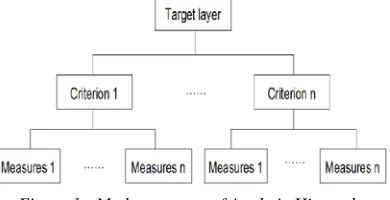
Hierarchical analysis model generally consisted of three layers, namely, top, middle layer and the lowest layer (figure 1). The top was the target layer,
[image:2.612.325.520.174.274.2]namely the general objective in hierarchy analysis. The middle, called constraint layer was one of main factors influencing the total goal; the lowest, called measure layer was the final measure to solve the questions [20-21]. All of these were quantifiable indexes.
Figure 1: Mode structure of Analytic Hierarchy Process(AHP)
2.1.2 Establishing pairwise comparison judgment matrix and calculating the weight value
Saaty 's weight method was used. At first, every index was compared and scores were given, and scoring standard was shown inTable 1. Then every index was compared and scores were obtained.
= nn n2 n1 2n 22 21 1n 12 11 r r r r r r r r r R
(1) . , , 2 , 1 , , , r ) 3 ( ; , , 2 , 1 , , 1 r ) 2 ( ; , , 2 , 1 , 5 . 0 r ) 1 ( ij ij ii n k j i r r n j i r n i jk ik ji = − = = − = = = = + + + − = + − + − − − − − = + − − − − + − − = + − − − − −
∑
∑
∑
= = = 1 ) ( ) 1 ( 2 2 2 2 ) ( 2 2 ) 1 ( 2 2 ) ( 2 2 2 ) 1 ( 2 2 1 1 2 3 2 2 2 1 2 1 2 2 2 3 2 2 2 1 2 1 1 1 2 3 2 2 2 1 2 n n j jn nj n n j j j n n j j j n r r a n a a a a r r a a a n a a r r a a a a n a ω ω ω λ ω ω ω ω λ ω ω ω ω λ ω ω ω ω (2) At last, matrix was evaluated according to the established scores, and the weight of every index was got. The approximate weight of each index was
m
a i i i a a im
The approximate weight was treated with normalized processing according to the following formula:
∑ =
1 =
m
i i i i
W W
W
(4) [image:3.612.100.294.628.737.2]
The weight of index referred to different scores.
Table 1: Scoring Standard Of Different Layers By AHP
Importance
Scale aij Importance degree
1 equally important 3 slightly important 5 basically important 7 really important 9 absolutely important 2,4,6,8 The middle value of two adjacent degree
countdo wn
If the importance ratio between element i and element j is aij,the importance ratio between element j and element ii is
ij ji
a a = 1
2.1.3 Consistency test
Consistency index
1
-= max
m m λ
CI
(5)
∑ / 1 =
1 = max
m
i i m λ n
λ (6)
∑ =
1
= /
m
j ijW W i a j i
λ (7)
Ratio of calculation random consistency
CI CR
RI
=
(8)
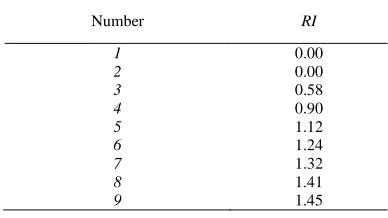
RI referred to average order random consistency index. Its score in different order was shown in table 2
Table 2: Average Random Consistency Index Scoring
Number RI
1 0.00 2 0.00 3 0.58 4 0.90 5 1.12 6 1.24 7 1.32 8 1.41 9 1.45
If CR value was less than 0.1, you could think of the consistency of judgment matrix as good.
2.1.4 Using multiplication to calculate combination weight
Combination weight referred to coefficient obtained by weight multiplication according to the weight of each index in different layers.
2.2.Fuzzy comprehensive evaluation
Using AHP to calculate the weight of each index, it was needed to evaluate the comprehensive level of the evaluation object. Based on fuzzy set theory, Fuzzy comprehensive evaluation considered the function of every evaluating factor and made the evaluation process to the evaluation object. Owing to this method’s fuzziness in classifying numbers, fuzzy mathematics’ principle and methods made the evaluation results to things more reasonable and reliable. The process of Fuzzy comprehensive evaluation was shown below:
1)determining the main factors of evaluation
X =( ,x x1 2,,xn)
(7)
2)using the AHP to calculate the secondary evaluation index weight set
W =(ω ω1, 2,,ωn) (9)
3)determining the level of evaluation
Y =( ,y y1 2,,yn) (10)
4)determining the standard membership degree of each
Level u
u=( ,u u1 2,,um) (11)
5) Constructing fuzzy evaluation matrix R to the evaluation object
11 12 1
21 22 2
1 2
r r r r r r
m
m
n n nm
r r R
r
=
(12)
6)For fuzzy comprehensive membership degree set B
B= •R uT (13)
7)For the total comprehensive membership degree
Comprehensive membership degree U was the total score obtained by fuzzy evaluation to the evaluation object and according to this total score, evaluation was made to every evaluation object.
3. MODEL CONSTRUCTION OF JUDO ATHLETE SELECTING EVALUATION BASED ON THE AHP FUZZY COMPREHENSIVE EVALUATION
3.1. Selecting The Evaluation Index And Constructing Hierarchical Level Structure
[image:4.612.315.525.208.353.2]
After reading a large number of literature and consulting teachers long engaged in the work of graduate enrollment in combination with my working experience for many years, the author decided to make evaluation to graduate second-round examination from the following three aspects, namely knowledge structure, scientific research ability and comprehensive quality. And every aspect was evaluated according to different evaluation indexes. At last three-layered hierarchical level structure was shown in Table 3.
Table 3: Graduate second-round evaluation index system
A level B level C level
Comprehens
ive level of
graduates’
attending
second-round
examination
A
knowledge structure B1
basic knowledge C1 academic knowledge C2
scientific research ability B2
thinking ability C3
research ability C4
comprehensive quality B3
foreign language C5 computer ability C6 scientific research potential C7 adaption ability C8
language ability C9
A
B1 B2 B3
C1 C2 C3 C4 C5 … C9
A
B1 B2 B3
C1 C2 C3 C4 C5 … C9
Figure 2: The hierarchical level structure
3.2. Establishing Judgment Matrix And Calculating Weight
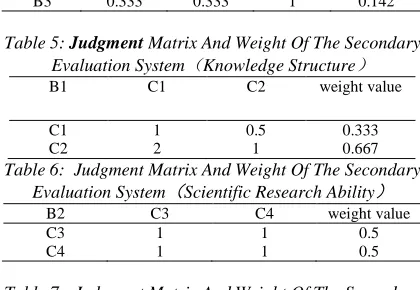
Sati’s weight method was used to establish judgment matrix of indexes in every level and the weight of every index, the results were shown below
Table 4: Judgment Matrix And Weight Of The First Level Evaluation System
A B1 B2 B3 weight value
B1 1 1 3 0.429 B2 1 1 3 0.429 B3 0.333 0.333 1 0.142
Table 5: Judgment Matrix And Weight Of The Secondary Evaluation System(Knowledge Structure)
B1 C1 C2 weight value
C1 1 0.5 0.333 C2 2 1 0.667
Table 6: Judgment Matrix And Weight Of The Secondary Evaluation System(Scientific Research Ability)
B2 C3 C4 weight value C3 1 1 0.5 C4 1 1 0.5
Table 7: Judgment Matrix And Weight Of The Secondary Evaluation System(Comprehensive Quality )
B3 C5 C6 C7 C8 C9 weight value
C5 1 2 0.5 2 2 0.241 C6 0.5 1 0.333 1 1 0.124 C7 2 3 1 3 3 0.387 C8 0.5 1 0.333 1 1 0.124 C9 0.5 1 0.333 1 1 0.124
3.3 Consistency test
Formula 3 to 6 were used to calculate random consistency ratio CR value of the first level matrix and each secondary matrix. The results were shown below.
Table 8: Consistency Test Results
matrix CR Consistency results first level matrix 0.015 satisfied secondary matrix
B1 0.020 satisfied secondary matrix
B2 0.031 satisfied secondary matrix
B3 0.028 satisfied
3.4 Using Multiplication To Calculate Combination Weight Of The Lowest Index
Combination weight of the lowest index was shown in table 9.
Table 9: Combination Weight Value Of The Lowest Index
[image:4.612.98.295.388.661.2]graduates’ attending second-round examination
) academic knowledge(
0.667) 0.286 scientific research ability (
0.429)
thinking ability(0.5) 0.215 research ability(0.5) 0.215
comprehensive quality(0.142 )
foreign language(0.241
) 0.034 computer ability(0.124
) 0.018 scientific research
potential(0.387) 0.055 adaption ability(0.124
) 0.018 language ability(0.124
) 0.018
3.5 The evaluation results of Fuzzy comprehensive evaluation
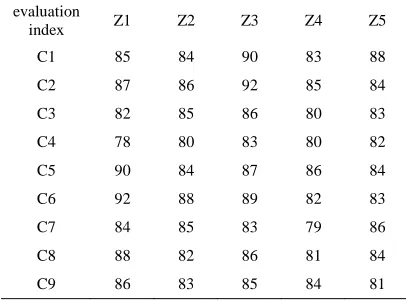
[image:5.612.89.524.85.310.2]In the process of graduate second-round examination, the judges were composed of 5 experts, each responsible for scoring the graduate in the terms of the above 3 aspects respectively. After score conversion, 5 experts presented the accurate score of the graduate attending second-round examination. The data were shown in Table 10.
Table 10: Summary Of 5 Experts’ Scoring To The Graduate Attending Second-Round Examination
evaluation
index Z1 Z2 Z3 Z4 Z5
C1 85 84 90 83 88
C2 87 86 92 85 84
C3 82 85 86 80 83
C4 78 80 83 80 82
C5 90 84 87 86 84
C6 92 88 89 82 83
C7 84 85 83 79 86
C8 88 82 86 81 84
C9 86 83 85 84 81
In scoring, 85 scores or more than 85 were considered as excellent; the score from 75 to 84 good; the score from 60 to 74 qualified; the score under 60 unqualified. The scores in Table 9 were classified and summarized according to the level. The results were shown in Table 11.
Table 11: Rating Summary Of Evaluation Score Of The Graduate Attending Second-Round Examination
evaluation rate
index
excellent good qualified unqualified
C1 3 2 0 0
C2 4 1 0 0
C3 2 3 0 0
C4 0 5 0 0
C5 3 2 0 0
C6 3 2 0 0
C7 2 3 0 0
C8 2 3 0 0
C9 2 3 0 0
According to the rating results, Fuzzy comprehensive evaluation method was used to evaluate.
1)Determining the main factors evaluated
X =(Knowledge structure, scientific research ability, comprehensive quality )
2)The weight of the secondary index
Based on the above calculation results, the weights of evaluation index set in this study were
W=(0.429, 0.429, 0.142)
3)Determining evaluation level Y:
Y= (excellent, good, qualified, unqualified) 4)Determining the standard membership U of evaluation set
u=(1/excellent,0.8/good,0.6/qualified, 0.1/unqualified )
In the actual calculation, taking
1, 0.8, 0.6, 0.1
[image:5.612.95.298.410.561.2]5) Establishing fuzzy evaluation matrix R on the evaluation objects
From table 9, it was seen that the evaluation matrix of knowledge structure(B1)、scientific research ability (B2)and comprehensive quality (B3)as followed
= 0 0 1/5 4/5 0 0 2/5 3/5 1 B = 0 0 5/5 0 0 0 3/5 2/5 2 B = 0 0 3/5 2/5 0 0 3/5 2/5 0 0 3/5 2/5 0 0 2/5 3/5 0 0 2/5 3/5 3 B
6) Calculating fuzzy comprehensive membership degree u = • = = 96 . 0 92 . 0 1 . 0 6 . 0 8 . 0 1 0 0 1/5 4/5 0 0 2/5 3/5 1 1 T u B u = • = = 8 . 0 88 . 0 1 . 0 6 . 0 8 . 0 1 0 0 5/5 0 0 0 3/5 2/5 2 2 T u B u = • = = 88 . 0 88 . 0 88 . 0 92 . 0 92 . 0 1 . 0 6 . 0 8 . 0 1 0 0 3/5 2/5 0 0 3/5 2/5 0 0 3/5 2/5 0 0 2/5 3/5 0 0 2/5 3/5 3 3 T u B u
7) Calculating the total comprehensive membership U
Calculating the total comprehensive membership U1, U2, U3 of evaluation objects B1, B2, B3 respectively 946 . 0 96 . 0 92 . 0 ) 667 . 0 , 333 . 0 ( 1 1
1 =
• = • = u U ω 84 . 0 8 . 0 88 . 0 ) 5 . 0 , 5 . 0 ( 2 2
2 =
• = • = u U ω 895 . 0 88 . 0 88 . 0 88 . 0 92 . 0 92 . 0 ) 124 . 0 , 124 . 0 , 387 . 0 , 124 . 0 , 241 . 0 ( 3 3 3 = • = • = u U ω
Finally calculating the total comprehensive membership U
1 2 3 4
( , , , )
u = U U U U
(0.406,0.360,0.127)
) 142 . 0 , 429 . 0 , 429 . 0 ( 895 . 0 84 . 0 946 . 0 = • = • = u U ω
According to membership degree maximum principle, evaluation results were presented
Analysis to evaluation results showed that due to
406 . 0 1=
u (this value was the biggest), the result of second-round examination of the graduate was “excellent”.
4. CONCLUSION
This study combined Analytic Hierarchy Process (AHP) and Fuzzy comprehensive evaluation methods to establish the evaluation system model of graduate second-round examination. AHP calculated the weights of each evaluation index
from the global perspective while Fuzzy
comprehensive evaluation method used the fuzzy mathematics to make comprehensive evaluation to the graduate attending second-round examination. This method quantified the evaluation indexes and got rid of the deficiency of the traditional qualitative evaluation method. The evaluation results were more accurate and reasonable. At the same time, this method made up for insufficient evaluation in the process of graduate second-round examination, so it was worthwhile to popularize it in graduate second-round examination and other secondary interviews.
REFRENCES:
[1] KatherineVolgt, “Real estate investments offer diversificantio”, American MedicalNews, Vol.46, No.10, 2003, pp.30-38.
[2] Alvaro J. Arce-Ferrer, Irene Borges Castillo, “Investigating Postgraduate College Admission Interviews: Generalizability Theory Reliability and Incremental Predictive Validity”, Journal of Hispanic Higher Education, No.6, 2007, pp.34-45.
Evaluation ---Taking Urumqi Vocation College
as An Example”, Xinjiang Vocational
Education Research, No.4, 2011, pp.15-17. [4] Li GuoJie, “Study on Teacher Performance
Evaluation in Higher Vocational Colleges Based on Distinct Analytic Hierarchy Process (AHP)”, Xinjiang Vocational Education Research, No.4, 2011, pp.121-123.
[5] Shang Jing etc, “Application of Analytic Hierarchy Process (AHP) on Scientific Research Evaluation in Higher Vocational
Colleges”, China Power Education,
No.11,2011,pp. 31-33.
[6] Victoria L. O'Donnell, Jane Tobbell, “Transition to postgraduate study: Practice, participation and the widening participation agenda”, Active Learning in Higher Education, No.10, 2009, pp.110-117.
[7] Shi Haosu etc, “Study on College Students' Comprehensive Quality Evaluation Based on Fuzzy Analytic Hierarchy Process (AHP)”,
Journal of Modern Electronic Technology, No.6, 2011,pp. 66-68.
[8] Wu Shuqin, “Application of Analytic Hierarchy Process (AHP) on University Teacher Recruitment Model Construction”, Science and Technology Management Research, No.3, 2011, pp.159-161.
[9] Traintaphyllou E and Sabchez A, “SensitiVity anaIysls approach for some deterministic muIticrjteria decision-making methods”,
Decjsion Sciences, Vol.28, No.1, 1997, pp.151-187.
[10] Li Qing etc, “Analysis to the Reasons Why College Students Take the Graduate Entrance Examination by Using Analytic Hierarchy Process (AHP)”,Journal of Gansu Lianhe University, No.3, 2011, pp. 30-32.
[11] Zhong Shengyan etc, “Determining the Hospital Evaluation Index Weight by Using Analytic Hierarchy Process (AHP)”, Science and Technology Intelligence Journal of Preventive Medicine, No.9, 2012, pp.663-666. [12] Sun Yulan. “Application of Analytic Hierarchy
Process (HAP) in College Students' Career Choice”. Value Engineering, No.2, 2012, pp. 232-233.
[13]http://news.cnwest.com/content/2009- 10/30/content_2528654_2.htm
[14] Richard M Heller, “Reverse real estatee xchanges-inside and outside the safe harbor”,
Journal of Financial Service Professionals, Vol.57, 2003, pp.12-20.
[15] Zeng Shangyao etc, “Current Situation and Countermeasures of Local Colleges’ and Universities’ Shortage in Schooling Funds”,
Financial Economy, No.8, 2009, pp.93.
[16] Zhai Yajun etc, “Analysis to Mechanism of Graduate Entrance Examination”, Journal of Hebei university (philosophy and social science edition), No.6, 2004, pp.111-112.
[17] Gabriel A-Petersen, Arjun Singh,
“Performance of hotel investment in a mulit-property commercial real estate portfolio: Analysis of results from 1 982 to 2001. Gabriel A-Petersen, Arjtm Singh”, Journal of Retail&Leisure Property, Vol.3, 2003, pp.158-175.
[18] Xu Miao, “Research on Standardized Index System of Graduate Retrial Examination”,
Journal of Hubei Institute for Nationalities (philosophy and social science edition), No.3, 2008, pp.137.
[19] Li Chungen etc, “From The Employment Guidance to Career Planning Education – A
New Exploration to China Graduate
Employment Promotion”, Journal of Degree Education and Graduate Education, No.12, 2008, pp.30-32.
[20] Li Guangrui, “The Employment Service Center and Its Operation Mode in Virginia, U.S.A”,
Journal of Shandong Labor Safeguard, No.2, 2004, pp. 49.