© 2017, IRJET | Impact Factor value: 5.181 | ISO 9001:2008 Certified Journal
| Page 1620
Performance and Comparative Evaluation of Ad-hoc Routing Protocols
for IEEE 802.11ad Network Using QualNet
Chetankumar Meti
1, Mohammed Suhaib
2, Akhila S
3, Kedareeswari G
41,2
PG Student, Dept. of ECE, BMS College of Engineering, Bangalore, Karnataka, India
3
Professor, Dept. of ECE, BMS College of Engineering, Bangalore, Karnataka, India
4
Software Engineer, Nihon Communication Solutions Private Ltd, Bangalore, Karnataka, India
---***---Abstract -
This paper gives a comparative investigation ofwireless ad hoc routing protocols for IEEE 802.11ad network. IEEE 802.11ad is an alteration to 802.11 standards i.e. wireless local area network (WLAN) standards which improves the throughput up to 7 Gbps by using 60 GHz band and 2.16 GHz channel bandwidth for its operation. In this paper four wireless ad hoc routing protocols namely, Ad hoc Demand Distance Vector (AODV), Dynamic MANET On-Demand (DYMO), Fisheye State Routing (FSR) and Zone Routing Protocol (ZRP) protocols have been compared based on their standard performance measurements (performance metrics) under the 802.11ad network scenario created using QualNet Simulator. Different performance metrics used for comparative evaluation of routing protocols are throughput, total data received, total messages received, average jitter and average end-to-end delay.
Key Words: IEEE 802.11ad, AODV, DYMO, ZRP, FSR, QualNet 7.4
1. INTRODUCTION
The IEEE 802.11ad is a modification to 802.11 (Wi-Fi) standards to improve the throughput of the wireless ad hoc networks up to 7Gbps, hence it is also called as Wi-Gig (Wireless Giga bit Alliance) [1]. 802.11ad standard provides new applications to users which includes the cable replacement for high-definition uncompressed streaming of video (HD Video), interactive gaming, high-speed large files transfer and high speed media files (video, audio) conversation between mobile devices operated in infrastructure less network (Ad-hoc Network). With these new application features, IEEE 802.11ad radio used in mobile ad hoc networks (MANET). Where absence of conventional infrastructure for central management, continuously varying network topology and movement of nodes leads to choosing of suitable routing protocols for MANET is very important and challenging task [7]. Routing is a serious consideration in case MANET, so more active and consistent routing protocols are required for efficient route detection [9]. Routing problems in MANET can be handled by various protocols; some of those protocols are comparatively discussed in this paper. The present rapid progressing in wireless technology has motivated great growth in mobile devices (Wi-Fi devices) which are operated in WLAN. Devices which uses 802.11ad technology will provide very high throughput in the range of Gbps. Considering of best
routing protocols for these kind of MANETs is an important task might be necessary to route the traffic through a multiple hops [11][10] [8].
In this paper attention is given on comparative learning of the performance metrics like throughput, total messages received, total data received, and average0end-to-end delay and0average jitter for the network which uses IEEE 802.11ad the latest WLAN standard using QualNet 7.4 simulator for different routing0protocols namely0AODV, FSR, DYMO and ZRP. In this paper attention is given on comparative learning of the performance metrics like throughput, total messages received, total data received, average end to end delay and average jitter for the network which uses IEEE 802.11ad the latest WLAN standard using QualNet 7.4 simulator for different routing protocols namely AODV, FSR, DYMO and ZRP.
The further sections of this paper are arranged as:
Section-2 contains an overview of routing protocols and IEEE 802.11ad; Section-3 contains proposed method and simulation setup; Section-4 contains Results and Discussion; which consists of performance comparison for various routing protocols. Finally, the paper is concluded in Section-5.
2. OVERVIEW OF ROUTING PROTOCOLS AND IEEE
802.11ad
In this section attention is given on overview of reactive, proactive and hybrid routing protocols such as of AODV, DYMO, FSR and ZRP protocols. The brief introduction of all the four protocols is explained below.
2.1 Ad-hoc On-demand Distance Vector:
© 2017, IRJET | Impact Factor value: 5.181 | ISO 9001:2008 Certified Journal
| Page 1621
destination is required. A RREP control message is transmitback to the client, if the destination node is either the node using the demanded address or it has an effective path to the demanded address (server address). The main cause for one can transmit the control message back to source node, is that every route forwarding a RREQ stores a route back to the client. Every intermediate node receives the requests and forwards a route reply to the client, so that the RREP can be transmitted back from destination along a path to that client (source). Nodes always display the connection status of next hops which are present in active routes. Whenever a connection break arises in an active route, the RERR control message is used to report other nodes of the network and RERR control message identifies those destinations which are no longer accessible through the path of the broken connection [3]. In order to allow this reporting of link break mechanism in an active route, each node has a "precursor list", these lists holding the IP address for each and every neighbours that are likely to use in route discovery it as a subsequent hop towards each endpoint or destination node.
2.2 Dynamic MANET On-demand:
The DYMO protocol comes under reactive routing protocol (on-demand) class for wireless MANET. The operations of the DYMO protocol is as similar as AODV protocol which comprises of route discovery, route maintenance and simplifies the operation [4]. Whenever the source node demands to communicate to a particular destination node it transmit a route requesting control messages to all intermediate nodes this control message contain information of its own address and its sequence number, destination sequence number, destination address, next hop address, hop count which is incremented before it is added to the RREQ. During this hop-by-hop broadcasting process, every intermediate nodes of network registers a route to the source. When the destination node receives the RREQ control message, destination node responds with a RREP control message directed hop-by-hop towards the source node. Every intermediate node which receives the RREP, registers a route to destination and the RREP control message is transmits hop-by-hop toward the source. Paths are established between the transmit node and receiving node after transmit node receives the RREP control message.
To make routes always stay active in the network DYMO protocol increases the lifespan routes by effectively forwarding packets. DYMO protocol overcomes the problem of changes in network topology by displaying or monitoring the connection over which traffic is moving. Whenever a particular route from the source to the destination is destroyed or broken, then a route error (RERR) control message is sent toward source node to indicate the current route to a specific destination node is damaged. Later receiving the RERR control message source node removes the current route and it must again carry out a route discovery mechanism to find destination.
2.3 Fisheye State Routing:
The FSR protocol is comes under link state, proactive routing protocol (table driven) class. In FSR routing nodes have the capability of updating the information regarding network topology constantly and providing route information when required to achieve shortest path to destination node present in network. Fisheye scope method permits exchanging the link state announcement (LSA) messages at different intervals for nodes which are present at different fisheye scope distance, this technique will decreases the LSA message size [5].
FSR routing operations incorporate three undertakings which include neighbor node discovery, information broadcasting and route calculation.
Whenever a node or link breaks occurs in the network, temporary loops are created in the network because of HELLO messages are sent with a higher rate than LSA messages, so if a node fails, its neighbor nodes sense the broken link way before the other nodes present in the network. Further optimization allows FSR to transmit topology message (LSA) to neighbour nodes in order to decrease the flood overhead. FSR tacitly decreases the topology exchange overhead and scales well to large size networks [5].
2.4 Zone Routing Protocol:
The ZRP protocol is comes under hybrid routing protocol class and ZRP is operated as a proactive routing protocol whenever the destination node present within certain distance from client node (within routing zone of client node) and transmits the packets to destination node by using routing table, Which store a detailed and fresh information of each nodes present in routing zone at the local level topology [6]. ZRP protocol is operated as reactive routing protocol when the destination node present at outside of the routing zone where client node exists. In such situation to escape from the overhead due to checking routing tables along the routing path, ZRP uses the on-demand routing to check whether each routing zone contains the receiving node or not. It decreases the control overhead for lengthier routes in case, if it uses table-driven routing protocols all over the route, whereas removing the delays in routing zone, are created due to the route-discovery methods of on-demand routing protocols [7].
2.5 IEEE 802.11ad Overview
© 2017, IRJET | Impact Factor value: 5.181 | ISO 9001:2008 Certified Journal
| Page 1622
usage, mainly inside (Indoor) the corporate working areasand home entertainment. The 802.11ad uses both single carrier multiplexing for low performance application and multi carrier orthogonal frequency-division multiplexing (OFDM) for high performance applications which required a maximum data rates, which yields truthful net possible throughput i.e. Very High Throughput (VHT). 802.11ad physical layer (PHY) supports three different modulation techniques such as CPHY, SCPHY and OFDMPHY In addition to these PHY specification, IEEE 802.11ad MAC layer network architecture is called as Personal Basic Service Set (PBSS), The stations (STAs) present in PBSS are capable of connect with each other without any dependency on the access points (AP) a STA is essentially act as the role of PBSS central point (PCP) this PCP helps in allocating contention based periods and the service periods. 802.11ad MAC defines a Directional Band (DBandCTS) CTS frame, a Directional Band Denial-To-Send (DBandDTS) frame and a Directional Band CF- End frame instead of Clear-to-send (CTS) and Contention-Free end frames which are no longer active in 802.11ad MAC. The frame format of DBandCTS is as same as CTS but it contains an additional field namely Transmitter Address (TA) field, TA field contain address information of both transmitter and receiver to STAs that did not receive the RTS frame. 802.11ad MAC several MSDUs or MPDUs are combined to form a single packet named as Aggregated MSDU (A-MSDU) or Aggregated MPDU (A-MPDU) [2].
3. PROPOSED METHODOLOGY AND SIMULATION
SETUP
3.1
Proposed methodology:
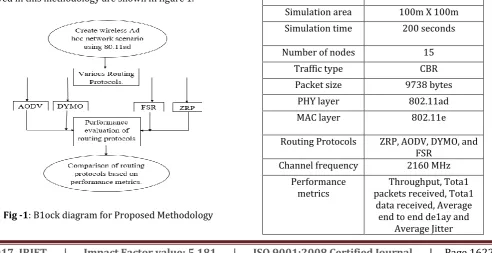
[image:3.595.321.558.285.462.2]Here we discuss the purposed methodology to create the scenario for wireless Ad hoc network by using 802.11ad PHY radio and MAC layer in QualNet7.4 simulator. The steps involved in this methodology are shown in figure 1.
Fig -1: B1ock diagram for Proposed Methodology
3.2
Simulation Setup:
The simulation for this project work is carried out using QualNet version 7.4. The wireless network scenario for the simulation is created on designer window of the QualNet by considering the simulation parameters and its values are listed in the table 1.
The wireless ad hoc network scenario which is shown in figure 2. Consists of 15 nodes where the node no. 6 and node no.14 are considered as client node and server node respectively of the network, over an area of 100 m × 100 m, the traffic load Constant Bit Rate (CBR) is connected between client and server node. Simulation results are described in next section.
[image:3.595.60.553.534.787.2].
[image:3.595.70.270.556.727.2]Fig -2: The Network Scenario for simulation
Table -1: Parameters and values for simulation setup
Parameter Values Simulation area 100m X 100m Simulation time 200 seconds
Number of nodes 15
Traffic type CBR
Packet size 9738 bytes
PHY layer 802.11ad
MAC layer 802.11e
Routing Protocols ZRP, AODV, DYMO, and FSR
Channel frequency 2160 MHz Performance
metrics packets received, Tota1 Throughput, Tota1 data received, Average
© 2017, IRJET | Impact Factor value: 5.181 | ISO 9001:2008 Certified Journal
| Page 1623
4. RESULTS AND DISCUSSIONS
The network scenario shown in figure 2. Is run by using QualNet 7.4 simulator then the simulated results are compared and evaluated for various routing protocols based on their performance standard parameters. The results are plotted by using excel graph for better understand comparison between routing protocols.
[image:4.595.319.543.156.282.2]4.1 Throughput :
Figure 3 shows the unicast throughput received in Mbps of the network for different routing protocols.
Chart -1: Throughput (Mbps).
[image:4.595.40.263.264.444.2]4.2 Data Received :
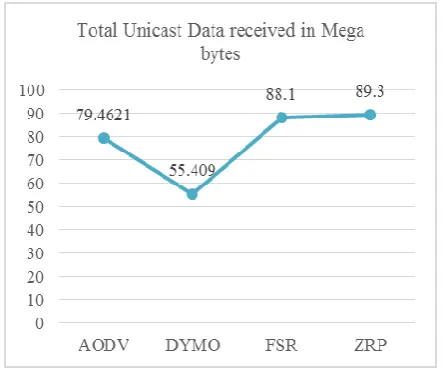
Figure 4 shows the total unicast data received at server of the network for different routing protocols.
Chart -2: Data received (Mega Bytes).
[image:4.595.319.544.379.489.2]4.3 Total Number of Messages(Packets) Received :
Figure 5 shows the total number of messages received at the server ofthe network for different routing protocols.
Chart -3: Total Number of Messages Received
4.4 Average End to End de1ay :
Figure 6 shows the average unicast end to end delay in milliseconds at server ofthe network for different routing protocols.
Chart -4: Avg. End to End De1ay (milliseconds)
4.5 Average Jitter :
Figure 7 shows the average unicast jitter in micro seconds at server ofthe network for different routing protocols.
[image:4.595.41.263.536.720.2] [image:4.595.324.542.594.702.2]© 2017, IRJET | Impact Factor value: 5.181 | ISO 9001:2008 Certified Journal
| Page 1624
5.
CONCLUSION
This work presents a performance and comparative evaluation of reactive, proactive and hybrid routing protocols like AODV, DYMO, FSR and ZRP in 802.11ad network based on their standard performance evaluation parameters. From the simulated result charts shown in 1, 2, 3, 4 and 5 we come into conclusion that the better throughput in the network can be achieved using DYMO, Total number of packets (messages) received is more at the server of the network by using FSR, Total data received at server is comparatively highest by using ZRP, The network average end to end delay is found to be less in FSR when compared to other routing protocols and the lowest average jitter in the network can be achieved by using ZRP.
REFERENCES
[1] IEEE 802.11 working group, “IEEE 802.11ad, Amendment 3: Enhancements for Very High Throughput in the 60 GHz Band,” December 2012.
[2] Eldad Perahia, Carlos Cordeiro, Minyoung Park, and L. Lily Yang, “IEEE 802.11ad: Defining the Next Generation Multi-Gbps Wi-Fi.”, IEEE Communications Society subject matter experts for publication in the IEEE CCNC 2010 proceedings.
[3] Dharam Vir, Dr. S.K.Agarwal, Dr. S.A.Imam “Productivity Analysis of Reactive Routing Protocol for IEEE 802.11e standard using QualNet Simulator” International Journal of Engineering Research and Applications (IJERA) ISSN: 2248-9622 www.ijera.com Vol. 3, Issue 3, May-Jun 2013, pp.1190-1196.
[4] IETF draft <draft-ietf-manet-dymo-09>, "Dynamic MANET On-demand (DYMO) Routing", C. Perkins, I. Chakeres. May 2007.
[5] Draft-ietf-manet-fsr-03. "Fisheye State Routing Protocol (FSR) for Ad Hoc Networks." Mario Gerla, Xiaoyan Hong, Guangyu Pei. June 17, 2002.
[6] Draft-ietf-manet-zone-zrp-04, "The Zone Routing Protocol (ZRP) for Ad Hoc Networks." Zygmunt J. Haas, Marc R. Pearlman, Prince Samar. July 2002.
[7] Nirmalkumar S Benni, Sunilkumar S Manvi, Anup T H, Member, IEEE, “Performance Analysis1of Hybrid Routing Protocols in1Wireless Mesh Networks Using Variation in1Maximum Speed.”, IEEE ICCSP 2015 conference.
[8] Sheeraz Ahmed, Muhammad Bilailr, Umer Farooq, Fazl-e-Hadi “Performance Analysis1of various routing strategies in Mobile Ad hoc Network using1QualNet simulator”, International1Conference on Emerging Technologies1 (ICET 2007), 12th-13th1November 2007, DOI: 10.1109/ICET.2007.4516317.
[9] Nitin0Arora and Suresh Kumar “Simulation analysis of proactive, reactive and hybrid routing protocols in mobile ad hoc network using QualNet0simulator 5.0.2”, International0Journal of Computer0Engineering
Research Vol. 3(4), pp. 63-68, November, 2012 DOI:10.5897/IJCER12.022, ISSN 2141- 6494 ©2012 Academic Journals.
[10] Gayatree Rana, Bikram Ballav, Dr. Binod Kumar Pattanayak, “Performance Analysis0of Routing prtocols in Mobile Adhoc networks”, 2015 International Conference0on Information Technology, DOI 10.1109/ICIT.2015.45.