© 2017, IRJET | Impact Factor value: 5.181 | ISO 9001:2008 Certified Journal
| Page 632
Improvement of Power Quality in PMSG Based Wind Integrated System
Using FACTS Controller
Lekshmi M
1, Vishnu J
21
PG Scholar,
2Assistant Professor
1,2
Dept. of Electrical and Electronics Engineering
Sree Buddha College of Engineering, Pattoor, Alappuzha, Kerala, India
---***---Abstract – Wind Energy Conversions Systems (WECS) has
gained importance in the recent years as a prime source of distributed generation, in which variable speed wind turbine with direct driven PMSG and power electronic interface is the most commonly used system exhibiting variability in the output power as a result of change in the prime mover (wind speed). When such a configuration is interconnected to the grid it introduces various challenges to the network in terms of power quality issues, stability and voltage regulation. It can cure by providing modern power electronic devices known as FACTS (Flexible AC Transmission System) devices, along with their controllers. These devices are operated either by supplying or absorbing active and reactive power or by altering the grid parameters by controlling either line reactance or voltage control. FACTS controllers have been mainly used for solving various power system steady state control problems. This paper proposes stability enhancement of WECS using a FACTS device called Static Synchronous Series Compensator (SSSC) when incorporated with a Frequency Oscillation Controller.
Keywords –FACTS, Power oscillation damping controller, PMSG, SSSC, WECS.
1. INTRODUCTION
The generators used for the wind energy conversion system are commonly either doubly fed induction generator (DFIG) or permanent magnet synchronous generator (PMSG). DFIG have less cost, weight and size but its application is limited due to the unreliability associated with the gear box, slip rings and brushes [1]. But PMSG does not have a gear box so its reliability is high and it require only less maintenance. Also, due to the presence permanent magnet it has high power density. So its efficiency is also high when compared to all other types of WECS generators [2].
Due to the stochastic nature of wind input power the output from a WECS is not much reliable. Also the output contains power quality problems like voltage sag, harmonics [3], etc. High level penetration of WECS into grid causes the
migration of the above stated power quality problems into the power grid. Also the interconnection of WECS with power grid causes voltage fluctuations, power system operation and control, regulation of power system stability [4].
Flexible AC Transmission System (FACTS) devices can solve the above stated power quality problems[5]. FACTS is defined as ‘Alternating current transmission systems incorporating power electronic based and other static controllers to enhance controllability and increase power transfer capability’ [6]. The FACTS controller is defined as “A power electronic based and other static equipment that provide control of one or more AC transmission system parameters” [7]. Flexible AC transmission systems (FACTS) controllers have been mainly used for solving various power system steady state and transient state control problems. These devices are operated either by supplying or absorbing reactive power or by altering the grid parameters by controlling either line reactance or voltage control. Various types of FACTS devices are available for effective compensation and improving stability. The FACTS controllers can be classified as
1. Shunt connected controllers. 2. Series connected controllers.
3. Combined series – series controllers. 4. Combined shunt – series controllers.
Depending on the power electronic devices used in the control, the FACTS controllers can be classified as
A) Variable impedance type.
B) Voltage Source Converter (VSC) based.
Volume: 04 Issue: 08 | Aug -2017 www.irjet.net p-ISSN: 2395-0072
© 2017, IRJET | Impact Factor value: 5.181 | ISO 9001:2008 Certified Journal
| Page 633
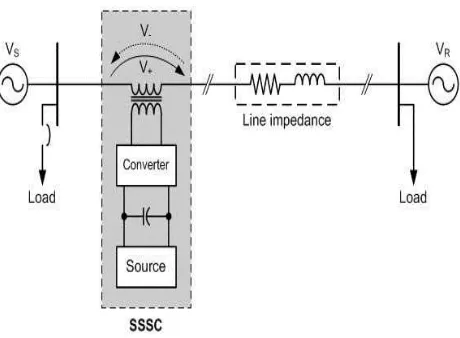
2. STATIC SYNCHRONOUS SERIES COMPENSATORFig.1. Static synchronous series compensator.
SSSC provides series compensation to the line. It can also be implemented by injecting a voltage source in series with transmission line as represented in fig 2.
Fig.2. Representation of AC system with series compensation.
The voltage source can inject a voltage of controllable magnitude and phase to the transmission line. When the injected voltage is in phase Quadrature leading to line current, series compensation behaves like an inductor, and when injected voltage lagging to line current it behaves as a capacitor. The result obtained with series compensation through a voltage source, which has been adjusted again to obtain unity power factor operation at voltage V2. In this
case, voltage VCOMP has been added between the line and the
load to change the angle of V2, which is now the voltage at
load side. VCOMP generates a voltage with opposite direction
to the voltage drop in line inductance because it lags line current.
The basic schematic diagram of SSSC is shown in fig.1. As its name, it is connected in series with the transmission line via a transformer. The SSSC injects voltage that lags or lead behind the line current by 90 degree. This means that SSSC can be operated in both inductive and capacitive modes [8]. The following fig.3. gives the three modes of operation of SSSC.
Fig.3. Different modes of operation of SSSC.
3. SIMULINK MODELS
[image:2.612.48.278.119.288.2]Fig. 4. Modelling of PMSG based wind integrated system in
MATLAB.
[image:2.612.347.553.229.381.2]
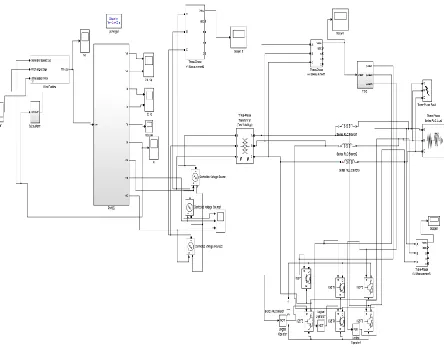
Fig. 4.shows the modelling of PMSG based wind integrated
system in MATLAB/SIMULINK and fig.
[image:2.612.39.274.370.424.2] [image:2.612.337.572.440.605.2]© 2017, IRJET | Impact Factor value: 5.181 | ISO 9001:2008 Certified Journal
| Page 634
Fig. 5. Modelling of PMSG based wind integrated system with SSSC and POD in MATLAB.4. POD CONTROLLER
The SSSC injected voltage reference is normally set by a controller whose output is connected to the Vqref input of the SSSC. Power Oscillation Damping (POD) controller is also a suggestion to adjust Vqref.
Fig. 6. POD Controller.
The POD controller composed of a transfer function block which is made by a transducer with a gain K, which is followed by a washout filter. The signal obtained at the output is limited using a saturation block. The other transfer function constitutes lead-lag filters which can be used for phase compensation in transmission lines [8]. A POD controller is developed which is tuned to provide necessary damping to stabilize the power system after severe disturbances. POD controller is shown in fig. 6. In this figure, the gain K is multiplied with transfer function block.
5. RESULTS
Volume: 04 Issue: 08 | Aug -2017 www.irjet.net p-ISSN: 2395-0072
© 2017, IRJET | Impact Factor value: 5.181 | ISO 9001:2008 Certified Journal
| Page 635
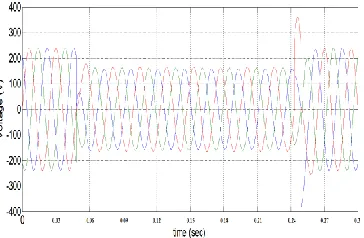
modelled same system with Static Synchronous Series Compensator and Power Oscillation Damping Controller and a similar three phase fault is created at the load side. Three phase fault of fault resistance 0.001 Ω is applied in a transition period from 0.04 sec to 0.2 sec. The obtained waveforms are shown below:
[image:4.612.348.553.179.326.2]Fig. 7. Output voltage without fault.
Fig. 8. Output voltage with fault before compensation.
Fig. 9. Output voltage with fault after compensation by SSSC with POD.
From Fig. 8 and Fig. 9, it is clear that during fault condition, a voltage sag occurs and SSSC provide necessary voltage compensation to the system.
[image:4.612.68.255.181.322.2]The Total Harmonic Distortion is found out for before and after compensation. There results are shown below:
[image:4.612.344.559.360.512.2] [image:4.612.77.247.366.508.2]Fig. 10. THD before compensation by SSSC.
Fig. 11. THD after compensation by SSSC.
Before compensation the THD is 54.63% and after compensation the THD is reduced to 4.57%.
6. CONCLUSION
[image:4.612.71.253.549.668.2]© 2017, IRJET | Impact Factor value: 5.181 | ISO 9001:2008 Certified Journal
| Page 636
REFERENCES[1]. N. Ramesh babu, P. Arul mozhivarman, “Wind energy conversion systems – A technical review”, Journal of Engineering Science and Technology Vol. 8, No. 4 (2013) 493 – 507.
[2].Suji Muhammed, Krishnakumari V, “Performance Analysis of a PMSG Based Wind Energy Conversion System”, International Journal of Engineering Research & Technology (IJERT) Vol. 3 Issue 8, August - 2014 IJERT ISSN: 2278-0181.
[3].Rajveer Mittal, K.S.Sandhu and D.K.Jain, “An Overview of Some Important Issues Related to Wind Energy Conversion System”, International Journal of Environmental Science and Development, Vol. 1, No. 4, October 2010 ISSN: 2010-0264.
[4].Lalit Kumar Gautam, Mugdha Mishra, “Permanent Magnet Synchronous Generator Based Wind Energy Conversion System”, International Journal of Electrical Electronics & Computer Science Engineering Volume 1, Issue 1 (February 2014), ISSN : 2348 2273.
[5].Bhushan D. Deotale, Dr. Sudhir R. Paraskar, “Transient Stability Improvement using Thyristor Switched Series Capacitor (TSSC) FACTS Device ”, IEEE students conference on electrical,Electronics and Computer science 2016.
[6].Narain G. Hingorani, “Understanding FACTS : Concepts and Technology of Flexible AC Transmission Systems”, Wiley-Blackwell, 1999.
[7]. K.R.Padiyar, “FACTS Controllers in Power Transmission and Distribution” New Age International Private Limited, 2007.
[8].Yahya Naderi, Tohid Rahimi, Babak Yousefi, Seyed Hossein Hosseini P, “Assessment Power and Frequency Oscillation Damping Using POD Controller and Proposed FOD Controller”,International Journal of Electrical, Computer, Energetic, Electronic and Communication Engineering Vol:8, No:11, 2014 .
BIOGRAPHIES
Lekshmi M completed her B. tech degree in Electrical and Electronics Engineering in the year 2015 from UKF College of Engineering and Technology under Kerala University and completed Masters of Technology in Electrical Machines from SreeBuddha College of Engineering in the year 2017 under APJ Abdul Kalam Technological University, Kerala.