© 2017, IRJET | Impact Factor value: 5.181 | ISO 9001:2008 Certified Journal | Page 90
Study Of Mechanical Properties Of Concrete With Nano Zirconia
umarajyadav
1, Prof. vahini M
21
PG student, Dept. of Civil Engineering, Government Engineering College, Haveri, Karnataka, India
2
Professor, Dept. of Civil Engineering, Government Engineering College, Haveri, Karnataka, India
---***---ABSTRACT:
Concrete is the one of the powerfulingredient for construction field , this concrete can improved by adding some extra additives like nano powders which helps to increases the strength in the concrete, but nano powder of zirconia is very advantageous in reducing temperature effects and high hardness property, so it used in highly temperature condition as a coatings and paints, the requirement of journals by using nano zirconia powder in concrete is minimum,
In this present work nano zirconia used as energy booster to increase the strength of the concrete, nano zirconia powder is added into the concrete with different percentage of 0%, 0.2%, 0.4%, 0.6%, 0.8%, 1.0% and 1.2%, which are mixed separately for each specimen with water and 1% of conaplast SP430 is mixed by using mixer for 2 min in order to get the uniform dispersion of nano powder in the concrete, the specimens with nano zirconia gives the high compressive, tensile, impact strength when compared to normal concrete at each different percentage of nano zirconia and it increases the strength after 28 days.
1.0 INTRODUCTION
Concrete is a important ingredient used in construction, now a days need of concrete is increased very high in construction field, because of increasing population and life style of people in the society. The demands of construction of school buildings, residential buildings and office buildings etc. where expectations are more from engineers in the design and strength factors. Strength and design are the two important consideration in the construction, but irregular alignment of beams and columns for design purpose does not give the expected strength. In that case some alteration should be done for strength, so in order to increase the strength of the elements of the structure some materials are introduced in the concrete to develop the quality and mechanical properties of the concrete. The materials are of various types they are rubber, fiber, synthesized fly ash aggregates, polymerized materials, super plasticizers and nano materials, etc. These materials are good in some mechanical properties of concrete and they are helpful for increasing the strength of concrete.
1.1 Concrete
Concrete is one of the world wide using common construction material, which is manufactured by mixing locally available aggregates, water and cement in a specified proportion. The concrete is brittle in nature having good compressive strength when compared to tensile strength and it produces a homogeneous mix, which will help to improve the workability of concrete. Workability means easy to batching, mixing, transporting, placing and compacting of concrete, it is achieved by maintaining the water content in concrete otherwise it become stiff and unworkable. If water content increases the workability of concrete decreases due to more liquidity in concrete causes the flow of concrete, so water content is the main factor to alter the workability of concrete.
The concrete becomes stiff and hard when it losses water content and attains the strength to resist the compressive forces in harden state. It becomes impermeable and free from segregation and bleeding. Segregation is the process of separation of aggregates from the cement paste and bleeding is separation of cement paste from the mass. It causes the dry shrinkage due to movement of water through the pores which leads to volume changes in the concrete causing shrinkage problems. The main factor for shrinkage problem is water variation in the concrete, because of temperature variation, water movement and entry of alkalies in to the surface of concrete. In order to avoid the shrinkage problems the pores ratio and void ratio should be minimized with proper compaction and by taking safety measurements to avoid entry of alkalies materials in the concrete.
In present situation construction is changing it’s way of construction by adding new techniques, machines, tools and materials. Materials are the life of the structure, so concrete should be improved by adding different materials like smart materials, composite materials and nano materials
2
. Materials and methodology
© 2017, IRJET | Impact Factor value: 5.181 | ISO 9001:2008 Certified Journal | Page 91
a b c
d e
Fig 2.1Materials required in this work
[image:2.595.55.270.99.232.2]a.
Fine aggregates:
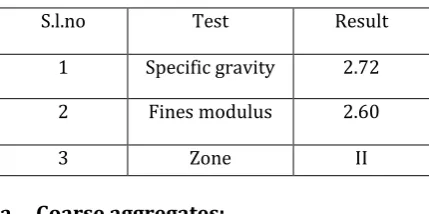
Table 2.1 Properties Of Fine Aggregates
S.l.no Test Result
1 Specific gravity 2.72
2 Fines modulus 2.60
3 Zone II
[image:2.595.54.269.319.426.2]a.
Coarse aggregates:
Table 2.2 Properties Of Coarse Aggregates
S.l.no. Test Result
1 Specific gravity 2.74 2 Bulk density 1448.69g/ cm3
b.
Cemen
t: in this work ordinary Portland cement OPC 43 usedc.
Conaplast SP430:
Table 2.3 physical properties of conaplast SP430
S.l.no. Properties Description 1 Specific gravity 1.2 to 1.21 2 Chloride content Nil. To
IS:9103-1999 and BSS:5075 3 Air interment Approx. 1.5%
addition air over control
4 color brown
d.
Nano zirconia powder:
Table 2.4 Physical Properties Of Zirconium Oxide
S.l no Physical
Properties Zirconium oxide
1 Purity 99.9%
2 APS 30-50nm
3 SSA 40-45 m2/g
4 Appearance White
5 True density 5.89 kg/m3
6 Morphology Spherical
7 Melting point 27150 C
Table 2.5 chemical composition of zirconium
oxide
S.l.
no Zro2 Al Fe Pb
1 >99.9% <0.09% <0.02% <0.02%
3. METHODOLOGY
In this methodology, concrete is designed for M30 grade of ratio 1:1.52:2.62 with the addition of zirconium oxide at (0%, 0.2%, 0.4%, 0.6%, 0.8%, 1.0% and 1.2%) with the use conaplast SP430 superplasticizer amount, by using moulds of size 150 x 150 x 150 mm for compressive strength test, for flextural strength test, d2 mm for impact
strength test and test the specimemens were casted and tested after 28 days
3.1 Priliminary Test Methods
In starting stage the find out specific gravity of fine aggregates by using pycnometer, specific gravity of coarse aggregates by wire basket and confirming the zone of sand by seive analysis method were carried out as per Indian code as per IS 383.
3.2 Secondary Test Methods
First step is cleaning the moulds and applying oil before filling the concrete mixtutre into the moulds
Weight the aggregates (15.96 kg), sand(27.37 kg) and cement (10.43 kg) according to design, are mixed well in dry condition
Then weigh 1% of conaplast SP430 weigth (104.3 ml solution) poured in the jar and then weigh the 0.2% of nano zirconia of ( weight 20.86 g) with water mixed well in the mixer.
[image:2.595.40.284.469.522.2]© 2017, IRJET | Impact Factor value: 5.181 | ISO 9001:2008 Certified Journal | Page 92
The above procedure is done for each % of ( 0%, 0.2%, 0.4%, 0.6%, 0.8%, 1.0% and 1.2%). Nano zirconia sepeartly.
Moulds are filled with prepared concrete mix.
The moulds are in room temperature for one day, then they are demoulded.
Keep the mould in water tank for 28 days for curing
Remove the moulds after 28 days keep it for surface drying.
Tests the moulds to check the mechanical properties.
Fig 2.2 demoulded nano zirconia specimens
3. RESULTS AND DISCUSSIONS
Workability results
Table 3.1 workability test results
S.l.
no nano % of zirconia
Slump
in mm Vee bee test in seconds
Compaction factor test
in %
Flow table test in %
1 0% 105 3 0.95 52
2 0.2% 100 8.69 0.92 20
3 0.4% 95 9.30 0.85 14
4 0.6% 92 27 0.85 12.8
5 0.8% 84 28 0.85 10
6 1% 81 29 0.84 8.8
7 1.2% 70 30 0.81 6
Table 3.2 water absorption and soroptivity
results
S.l.no % of nano zirconia
Water absorption
test in %
Soroptivity test
1 0% 0.35 6.6
2 0.2% 0.11 6.5
3 0.4% 0.23 8.1
4 0.6% 0.23 8.9
5 0.8% 0.23 9.8
6 1% 0.23 9.8
7 1.2% 0.35 9.8
Table3.3 compressive strength test results
S.l.no. % of nano
zirconia strength in Mpa Compressive
1 0% 33
2 0.2% 43.2
3 0.4% 41.4
4 0.6% 41.3
5 0.8% 38.4
6 1% 38.3
7 1.2% 28.1
0 10 20 30 40 50
c
o
m
p
r
e
ss
iv
e
s
tr
e
n
g
th
M
p
a
% of nano zirconia
Fig 3.1 compresion test results
Table 3.4 Splitting tensile strength test
S.l.no. % of nano
zirconia Spliting tensile strength test
1 0% 3.2
2 0.2% 3.4
3 0.4% 2.8
4 0.6% 2.7
5 0.8% 2.7
6 1% 2.5
7 1.2% 2.6
© 2017, IRJET | Impact Factor value: 5.181 | ISO 9001:2008 Certified Journal | Page 93
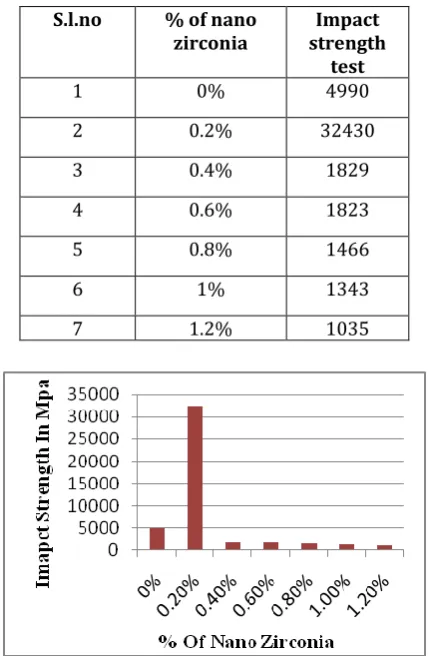
Table 3.5 Impact strength test results
S.l.no % of nano
zirconia strength Impact test
1 0% 4990
2 0.2% 32430
3 0.4% 1829
4 0.6% 1823
5 0.8% 1466
6 1% 1343
7 1.2% 1035
Fig 3.3 impact strength results
CONCLUSIONS
The works on these experiments are conducted to know the better results when compared with reference concrete.
In workability results, the 0.2% of nano zirconia gives the good flow percent, reduced permeability and better compaction ratio when compared to other percentage of nano concrete at 0.2% of nano zirconia specimen.
Compressive strength is maximum in 0.2% of nano zirconia specimen when compared with all other percentage of nano zirconia specimens, it gives good result when compared to reference concrete and also split tensile, impact strength are checked with reference concrete gives the high result when compared with reference concrete at 0.2% of nano zirconia specimen.
The numbers of pores are reduced by good compaction and addition of nano zirconia at 0.2% in the specimen
By knowing overall results of experiment, it conclude that 0.2% of nano zirconia in concrete is very advantageous for improving the mechanical properties and also reducing in temperstural effects on the concrete with porosity.
REFERENCES
1. Nazari.et.al [2010]: study on the “ The effects of incorporation Fe2o3 nanoparticles on tensile and
flextural strength of concrete concrete mixing matrix”. Department of technical and engineering science, islamic Azad university (saveh branch)., felestain Sq., islamic republic iran. [email protected]
2. Latifi et al.[2011] Their paper study on the“ Experimental study of the effect of addition of nano sillica on the behaviour of cement mortar”. 1877-7058 @ published by elsevier Ltd. In 10( 2011) 900-905
3. Apsari et al.[2011] Their paper studied on the “Study the effect of adding nano fly ash and nano lime to compressive strength of mortar” 2nd
international conference on sustainable civil engineering structures and construction materials 2014, published by elsevier Ltd, in 95(2014) 426-432
4. Shekari et al.[2011] Their paper investigated on “ Influence of nano particles on durability and mechanical properties of high performance concrete”. the twelth east asia-pacific conference on structural engineering and construction published by elsevier Ltd, in 14(2011) 3036-3041 [email protected]
5. Farzad soleymani [2012]. The journal studied on the “The effect of zirconia powders on compressive damage and pore structure properties of concrete specimens”. in this experiment
6. Shaikh et al[2014]. Investigated on the “ Effect of nano- caco3 on compressive strength development
of high volume fly ash mortars and concretes” journals of asian ceramic societies 4(2016) 19-28 7. Masound negahdary et al[2014]. research article
“Synthesis of zirconia nano particles and their ameliorative roles as additive concrete structures”. Hindawi publishing corporation journal of chemistry volume 2013, article ID 314862
8. Mohamed et al.[2014] their journals is about “Effect of Zirconium Oxide Nano-Fillers Addition On The Flextural Strength, Fracture Toughness, And Of Heat –Polymerized Acrylic Resin”. HBRC journals (2013)9, 210-215
© 2017, IRJET | Impact Factor value: 5.181 | ISO 9001:2008 Certified Journal | Page 94 10. Kowsari et al. [2015] investigated on the “
investigation of mechanical and durability properties of concrete infiuenced by hybrid nano sillica and micro zeolite”. 2211-8128 @ 2015 published by elsevier Ltd. 11(2015) 594-599. 11. Sakthivel [2016]. Investigates the “ Experimental
investigation on behaviour of nano concrete”. 12. Thomas et al [2017] their paper study on the “ The
effect of nano and micro particle additives on the durability and mechanical properties of mortars exposed to internal and external sulfate attack”. 2211-3797/@ 2017 the authors, published by elsevier B.V. results in physics 7 (2017) 834-851, www.journals.elsevier.com
13. Hola et al[2017] their paper study on “ Microstructural analysis of self-compacting concrete modified with the addition of nanoparticles”. modren building materials, structures techniques, MBST (2016), @2017 authors, published by elsevier Ltd. Procadia engineering (2017) 172 776-783
14. Harbiuk et al [2017] their paper investigate on the “The influence of natural and nano-additives on early shear strength of cement motars”. modren building material structures and techniques, MBMST 2016, @2017 authors, published by elsevier Ltd, procadia engineeering 172 (2017) 127-134. 15. Hola et al [2015] their paper study on “ The
influence of an additive in the form selected nanoparticles on the physical and mechanical characteristics of self-compacting concrete” XXIV R-S-P seminar, theoretical foundation of civil engineering [24 RSP] [TFO CE2015], @2015 published by elsevier Ltd. Procadia engineering 111(2015) 601-606.
16. Fadlillah et al [2014] their paper study on the “ The effect of nano-cement content to the compressive strength of mortar” 2nd conference on sustainable
civil engineering. Procadia engineering 95(2014) 386-395.