2018 International Conference on Communication, Network and Artificial Intelligence (CNAI 2018) ISBN: 978-1-60595-065-5
Missile Testability Evaluation Based on Improved
Bayes Statistical Theory
Ke-jian CHEN
1, Rui-qi WANG
2and Jian-gong ZHAO
31People 's Liberation Army 91245 Troops, Huludao Liaoning 125000, China
2Naval Aeronautical and Astronautical University, Yantai Shandong 264001, China
3People 's Liberation Army 91183 troops, Qingdao Shandong 266100, China
Keywords: Testability, Bayes, Missile, Uncertainty, Testability evaluation.
Abstract. The strong subjectivity and lack of practice of the traditional Bayes statistics theory was improved. More effective and reasonable mathematical model is proposed. By making full use of the data of testability evaluation, Testability evaluation conclusion is more reliable and accurate. The parameters calculation is optimized for easy and convenient to calculate. The effectiveness of the method is illustrated by simulation.
Introduction
Fault detection rare(FDR),fault alarm rate(FIR) and false alarm rate(FAR) are three indexes for testability evaluation of missile equipment[1].
Missile equipment testability evaluation need base on testability experiment to acquire missile equipment various performance parameters, and then evaluating missile equipment testability. In testability experiment, can be found effectively missile equipment all kinds of defects in the design, or individual components flaw on stream. Thus judging the missile equipment testability achieve troops’ actual use requirement[2].
Testability experiment is the method of demonstration test and fault isolation, evaluate the missile which has been developed whether achieve regulated testability request. In the testability experiment, we need inject enough quantity of fault samples. Then, carry out fault detect and fault isolation procedure for equipment, to achieve corresponding the result of fault. For achieving corresponding data, confirming corresponding math model evaluate and analyze.
Testability Evaluation Based on Binomial Distribution
In the development history of equipment testability evaluation, classics approach occupy important status. Classics approaches of testability evaluation is easy and learnable. It has strong universality of general equipment. For the last century the weaponry was not high scientific and technological content. Test data and data structure is simple, and the sample size is huge. They fit classical approach for test data’s demand just in time. So, for the normal weaponry, it is important to classical approach of testability evaluation[3].
In the testability evaluation, for the fault detection rare, fault alarm rate and false alarm rate three indicators, their math models are nearly the same and mutual analogy. So, just have to study one metric. In this article, taking the FDR for example to carry on research.
Before Equipment test we need to assess the fault injection test equipment, that will be equipped with all kinds of fault injection into the equipment. The result is directly related to equipment testability evaluation conclusion.
0
1 1
f k k n k L n L L
k
P C P P (1)
Where f is failure detection frequency,nis the number of failure detection tests,is given
confidence level.
When f ,n,are known, it is very tedious to calculate the estimate directly. In particular when n is very big, k
n
C is very hard to solve.
When the estimated confidence limit is greater than or equal to the lowest acceptable value given by the index, it can be judged as qualified; Otherwise unqualified; If the confidence limit is not specified in the index, interval estimation can be carried out, and the indicator can be judged to be qualified within the confidence interval. In the confidence interval estimation, the confidence interval
P PL, U
of the test parameters is:
0
1
1 1
2
f k n k L L kP P (2)
1
1
1
2
nk n k U U k f
P P (3)
Testability Evaluation Based on Normal Distribution
In GJB 2072-94, The corresponding evaluation method is provided for the basic normal distribution.
When the 0.1<P<0.9,the confidence level is (1
)the detection rate and the confidence limitL
P of the isolation rate are.
1
L
P P
P P Z
n (4)
Where P is the point estimation of fault detection rate or isolation rate,Pk n, kis the
number of successful times in n trial; Z is the coefficient associated with the confidence level.
When P0.1 or P0.9, the confidence level is (1
), the detection rate and the confidencelimit of isolation rate are
2
, 0.9
2 1
, 0.1
L
P n k
P
n k P n k
(5) From the above formula inference process, we know the testability evaluation based on the classical approach using the sample overall information provided by the testability verification.
Testability Evaluation Based on Bayes Statistical Theory
Testability evaluation based on Bayes statistical theory mainly divided into analyzing prior information, determining prior distribution, calculating the posterior integral, receiving/rejecting determination and model robustness analysis[4,5].
The test evaluation process based on Bayes theory is given below, and the confidence limit is obtained under the condition of a given confidence level. Assuming the fault detection rate of missile equipment (FDR) isP , the prior distribution of the index should be
1
1 ,
1
f n f
P P
P
Where0 P 1,nis the number of fault detection tests, f is failure detection test failure
frequency.
For the test with multiple test phases, the test data and information are synthesized. The posterior distribution is obtained by using the Bayes statistical theory.
1
1
( ) 1
1 1 1 1 | ,
N N i i i i in f n f
f f
N N
i i i
i i
P P
P D
n f n f f f
(7)
When nis the number of test phases of a test evaluation, D
n f,
is test data andinformation.
In the case of confidence
, the confidence limit of the fault detection rate (FDR) can be obtained
0 | 1
PLP D dP (8)
Theoretically based on the theory of Bayes statistics on the test evaluation of missile equipment to type can corresponding testability evaluation conclusion, but in actual test evaluation of the missile, due to the above evaluation when determining prior distribution is used in the process of theoretical formula method. At the same time in the posterior distribution is regular, it is based on the actual test data is concluded on the basis of the prior distribution of before, that is to say, the actual test the experiment information and theoretical information to assess overall, as did the same to meet the same distribution. It is obvious that this hypothesis has a strong subjectivity and lacks practical basis, so that the test results obtained are not very reliable and accurate. Especially in for testing the assessment test samples of the smaller cases, due to the test data is less, lead to actual experimental data and theory have larger gap, its distribution will be different [6]. In order to more effective and reasonable use of tests to assess the data in the test, the testability evaluation conclusion is more reliable and accurate, and needs to be integrated more data related to the missile test. Based on this, the mixed Beta distribution is introduced in Bayes evaluation of the reliability of success and failure products[7].
1
1
1 1 1 1 1 ,
N
N n fi i fii i o i o
i i i i i
P P
P P P P
n f f (9)
Inntimes failure injection test, the failure frequency is f , the likelihood function is
; ;
f n f
1
fn
L P n f C P P (10)
According to Bayes statistical theory, combined with equation (9) and equation (10), the posterior distribution of the calculation was
1 0 1 1 1 1 1 ; ; | D ; ; 1 1 1 , ,1 , 1
,
ii i f f
n f n f N
f n f
i
i i i i
N
i i i
i
i i i i
L P n f P
P
L P n f P dP
P P
P P
n f f
n f n f f f
n f f
n f f
(11)
In equation (11), we found that inheritance factors play a key role in the whole equation. Its value determines the orientation of equation (11). The conclusion of the final test evaluation of missile equipment has a great impact, so it is necessary to be cautious in evaluating the values. The usual values can be given by a development expert who is tested on the missile's equipment. On this basis, can be based on CaiHong in “Bayes test analysis and evaluation” ,the proposed hierarchical Bayes method is calculated. But in the practical calculation, this method is relatively cumbersome, and unavoidably exists subjectivity when according to the experience of the experts, the final evaluation conclusion increased uncertainty[8].
WangWei in the “The use of mixed Bayes distribution and Bayes method” is given out a method based on a historical test sample and a field test sample from an overall fit test[9].
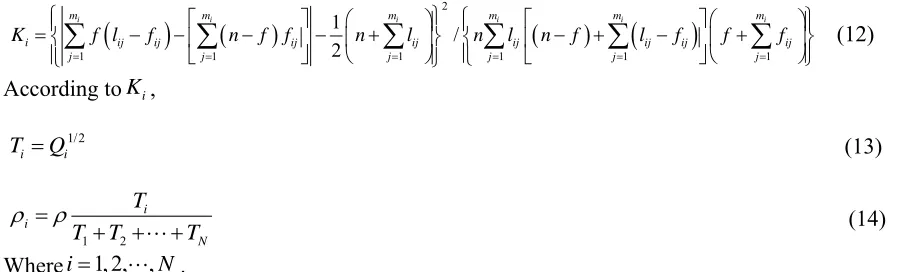
Choose theKi as
2
1 1 1 1 1 1
1
/ 2
i i i i i i
m m m m m m
i ij ij ij ij ij ij ij ij
j j j j j j
K f l f n f f n l n l n f l f f f (12)
According toKi,
1/2
i i
T Q (13)
1 2
i
i
N
T
T T T (14)
Wherei1, 2, , N .
The test evaluation method based on the theory of Bayes statistics. Relevant parameters was optimized. The data calculation is relatively simple, convenient, more satisfy the testability evaluation mathematical model of missile equipment requirements.
Numerical Simulation
Through JMP data statistics software carries on the preliminary statistical analysis of test data, and then compare the advantages and disadvantages of each method.
[image:4.612.89.538.227.363.2]Assume that this type of tactical missile in the process of testability evaluation only two phase of the testability verification, the testability of separate units in each phase fault detection data shown in the table below
Table 1. A certain type of navy tactical missile test verification test data. Test unit Test number success
number failure number
First stage
unit A 23 23 0
unit B 25 24 1
unit C 16 15 1
unit D 22 21 1
Second stage unit E unit F 22 20 21 18 1 2 Statistical
item
average 23 22 1
sum 138 132 6
In the case of a given confidence level 0.9, respectively using the classical evaluation method, the traditional the theory of Bayes statistics evaluation method, the improved Bayes method to analyze the test data the results are as follows:
The traditional Bayes statistics theory evaluation method, get the conjugate prior distribution
136,6
, by equation (7) and equation (8), confidence lower limit is obtained.0.9210 L
P .
Using the improved Bayes assessment method, S53.3601 F2.9174 , K 0.0618 ,to
calculate the parameter
0.8965.Using equation (12), (13), (14) can get confidence lower limit.0.9183 L
P
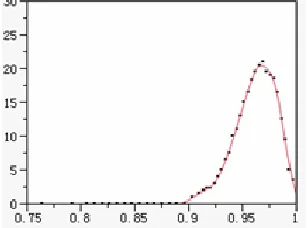
In order to be able to more direct comparison of the advantages and disadvantages of three methods, prior marginal distribution of the three methods are simulated used JMP software. The results are as follows:
Choose parameter as (ay,by,cy,ky,hy) (1 0, 4 0, 2 .5,1, 4 ), and the initial state of response system is ( , , ) (1, 1,2)y y y1 2 3 , use above robust adaptive strategy, the simulation result without
considering the nonlinear functions is as follows:
[image:5.612.344.493.260.374.2] [image:5.612.118.494.265.373.2] [image:5.612.229.383.407.521.2]
Figure 1. Classical method prior marginal distribution. Figure 2. Bayes method prior marginal distribution.
Figure 3. Improved Bayes method prior marginal distribution.
So we can make a conclusion that the improved Bayes method calculated FDR confidence lower limit between the above two methods. The result is more reasonable, the method makes full use of the missile in various stages of the test information and to develop the expert's experience. In the condition of small sample size, the method can also get higher reliability test evaluation conclusion compared with the other two methods.
Conclusion
References
[1] Chunhe Chang, Jiangping Yang, Liang Hu, Trigonometric Study on testability evaluation method for complex equipment based on bayes theory, Fire Control and Command Control, 11(2012)pp. 173–176.
[2] Junyou Shi, Testability Design and validation, National defend industry press Bei Jing, 2011. [3] Tianmei Li, Xinyu Gao, Jing Qiu.A failure sample selection method considering failure pervasion intensity in testability demonstration test, Chinese Journal of Acta Armamentar, 3(2009) pp. 228–233.
[4] Xishan Zhang, Kaoli Huang, Pengcheng Yan, Method of confirming prior parameters value during complexity equipment system testability evaluation with small sample, 8(2014) pp. 1968–1973.
[5] Tianmei Li, Jing Qiu, Guanjun Liu, Research on testability field statistics verification based on bayes inference theory of dynamic population, 2(2010) pp. 336–341.
[6] Jianye Wu, Haiyin Zhou, Assessment of missile fight reliability based on mixed prior distribution, 1(2008) pp. 26–29.
[7] Shifeng Zhang, Shujiang Fan, Jinhuai Zhang, Bayesian assessment for product reliability using pass-fail data, 2(2001) pp. 238–240.
[8] Hongcai, Shifeng Zhang, Jinhuai Zhang, Bayes test analysis and evaluation, National university of defence technology press, Changsha, 2004.