RED BLOOD CELL SEGMENTATION AND CLASSIFICATION METHOD USING MATLAB
ABDULLAH SALEH ALI ALGAMILI
A thesis submitted in partial
fulfillment of the requirement for the award of the Degree of Master of Electrical Engineering
Faculty of Electrical and Electronic Engineering Universiti Tun Hussein Onn Malaysia
DEDICATION
ACKNOWLEDGEMENT
Alhamdulillah, I am grateful to ALLAH SWT on his blessing and mercy for making this project successful.
First of all, I would like to express my heartiest appreciation to my supervisor,
Prof. Muhammad Mahadi Abdul Jamil for his effort, guidance and support throughout this project. Without his advices, suggestions and guidance, the project would have not been
successful in achieving the objectives.
My deepest appreciation also dedicated to my family, who are always there when it matters most.
ABSTRACT
Red blood cells (RBCs) are the most important kind of blood cell. Its diagnosis is very important process for early detection of related disease such as malaria and anemia before suitable follow up treatment can be proceed. Some of the human disease can be showed by counting the number of red blood cells. Red blood cell count gives the vital information that help diagnosis many of the patient’s sickness. Conventional method under blood
smears RBC diagnosis is applying light microscope conducted by pathologist. This method is time-consuming and laborious. In this project an automated RBC counting is proposed to speed up the time consumption and to reduce the potential of the wrongly identified RBC. Initially the RBC goes for image pre-processing which involved global thresholding. Then it continues with RBCs counting by using two different algorithms which are the watershed segmentation based on distance transform, and the second one is the artificial neural network (ANN) classification with fitting application depend on regression method. Before applying ANN classification there are step needed to get feature extraction data that are the data extraction using moment invariant. There are still weaknesses and constraints due to the image itself such as color similarity, weak edge boundary, overlapping condition, and image quality. Thus, more study must be done to
handle those matters to produce strong analysis approach for medical diagnosis purpose. This project build a better solution and help to improve the current methods so that it can
ABSTARK
Sel darah merah merupakan sel darah yang sangat penting. Ia merupakan diagnosis yang amat penting dalam melakukan proses awalan untuk mengesan penyakit seperti demam malaria dan anemia sebelum rawatan selanjutnya di berikan kepada pesakit. Sesetengah manusia penyakit boleh di kesan melalui kiraan bilangan sel darah merah. Kiraan sel darah merah memberi informasi penting dalam membantu diagnosis terhadap ramai pesakit. Kaedah konvensyen terhadap diagnosis sapuan darah RBC ialah dengan menggunakan
microskop yang dikendalikan oleh patologi. Kaedah ini memerlukan proses dalam tempoh masa yang lama serta kajian dan penyelidikan. Dalam projek ini kiraan RBC automatik mencadangkan untuk melajukan tempoh masa dan mengurangkan potensi berlakunya kesilapan untuk mengenal pasti RBC. Pertama sekali RBC akan melalui pra-proses gambar dimana ia melibatkan global pengambangan. Seterusnya ia di teruskan dengan kiraan RBC dengan menggukan dua algoritma yang berbeza dimana titik perubahan pengsengmanan adalah perdasarkan jarak pertukaran, dan kedua adalah (rangkaian saraf buatan ) “artificial neural network” (ANN) dengan memasukkan applikasi bergandung
dengan kaedah regrasi.Sebelum menggunakan ANN klasifikasi terhadap langkah-langkah adalah diperlukan untuk mendapatkan data seterusnya dengan menggunakan pergerakan pegun. Masih terdapat kelamahan dan kekangan terhadap gambar berkenaan seperti ketepatan warna, butiran kurang tepat, pertindihan kondisi dan kualiti gambar.Oleh itu banyak kajian perlu di jalankan untuk mengendalikan masalah untuk menghasilkan analisis yang kuat untuk mencapai diagnosis untuk kegunan perubatan. Projek ini di laksanakan dengan penyelesaian yang baik dan membantu untuk menambah baikkan kaedah semasa supaya ia dapat memperbanyakkan berkebolehan, berkeupayaan tinggi dan berkesan. Akhir sekali projek ini akan di laksanakan dengan membuat perbandingan sekurang-kurangnya 20 keping contoh gambar darah yang di ambil daripada makmal
TABLE OF CONTENTS
CHAPTER TITLE PAGE
TITLE PAGE i
DECLARATION ii
DEDICATION iii
ACKNOWLEDGEMENT iv
ABSTRACT v
ABSTRAK vi
TABLE OF CONTENTS vii
LIST OF TABLES xi
LIST OF FIGURES xii
LIST OF SYMPOLES AND ABBREVIATIONS xv
1 INTRODUCTION 1
1.1 Project Background 1
1.2 Problem Statement 3
1.3 Aim and Objectives 4
1.4 Scope of works 4
1.5 Outline of thesis 4
2 LITERATURE REVIEW
2.2 Complete blood count (CBC) 8 2.3 Image Acquisition and Enhancement 8
2.4 Image Conversion 9
2.5 Cell Detection 10
2.6 Feature Extraction 10
2.7 Morphological Operation 11
2.8 Image Segmentation 12
2.8.1 Watershed transform 14
2.9 Image Classification 18
2.9.1 Artificial Neural Network (ANN) classifier 19
2.10 Summary 20
2.11 Related Works 20
3 METHODOLOGY
3.1 Introduction 21
3.2 Image acquisition 22
3.3 Pre-processing 23
3.3.1 Global Thresholding 23 3.3.2 Global Color Thresholding 23
3.3.3 Binary Image 24
3.3.4 Morphological Operation 24 3.3.5 Remove Border Object 25
3.3.6 Erosion 26
3.4 RBC Segmentation using Watershed Algorithms 28
3.5 RBC Classification method 31
3.5.1 RBC Features Extraction 31
3.5.1.1 Textural 32
3.5.1.2 Geometrical 32
3.5.1.3 Statistical 32 3.5.1.4 Morphological 32 3.5.2 Classification using Artificial Neural
Network ‘ANN’
33
3.5.3 Fit Data with a Neural Network 34
3.6 Graphical user interfaces 36
3.6.1 Creating a MATLAB Applications with Applications Designer
36
3.6.2 Creating a MATLAB GUI with GUIDE 37
3.7 Summary 38
4 RRESULTS AND ANALYSIS
4.1 Introduction 39
4.2 RBCs & WBCs Separation 39
4.3 RBC Image Pre-processing 41
4.4 RBC Watershed Segmentation Result 45 4.5 RBC Classification Result
4.5.1 RBC Features Extraction
50
4.5.2 Classification using Artificial Neural Network (ANN) in Matlab
4.5.2.1 Using the Neural Network Fitting Tool
52
4.6 Graphical User Interface ‘GUIs’ 62
5 CONCLUSION 63
FUTURE WORK 65
LIST OF TABLES
Table No TITLE PAGE
LIST OF FIGURES
FIGURE NO.
TITLE PAGE
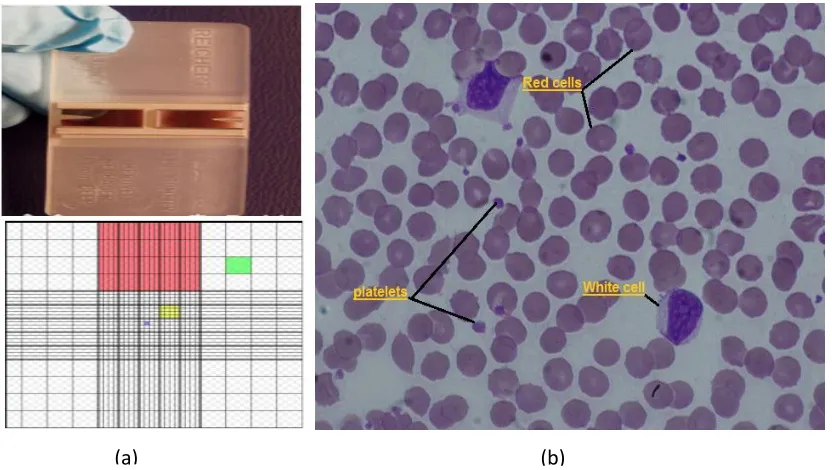
1.1 (a) Haemocytometer, and (b) blood cells type image in blood sample
3
2.1 Image Acquisition Equipment 9
2.2 Flooding process in watershed transform 15 2.3 Example results from previously proposed methods
which confront with overlapping cells (dash-line circle) (a) Masking and Watershed algorithm
(b) Morphological Watershed Transformation algorithm
17
3.1 RBC counting and classification flow diagram 21 3.2 Original image of blood for 40X objective 22 3.3 conversion from (a) RGB to, (b)binary image 24 3.4 (a) Before remove border object
(b) after remove border object
25
3.5 (a) Binary image, (b) Eroded binary image 26 3.6 (a) Before fill hole, (b) After fill hole 27 3.7 Structure of Feed-Forward network for problem
classification
34
3.9 Graphic user interface of RBCs segmentation and classification methods
37
4.1 (a) The saturation component with HSV colour space (b) Segmented WBC nucleus
40
4.2 (a) Superimpose Separated WBCs on original image, (b) thresholding the Separated WBCs result
41
4.3 Image pre-processing flow diagram 42
4.4 Dataset images RBC-1: RBC-20 43
4.5 (a) Original Image, (b) Thresholding, (c) After
Thresholding, (d) Remove small object, (e) Reverse, (f) Fill hole, (g) Remove border and (h) Reverse
44
4.6 Image after prepressing step 45
4.7 calculate the transform distance 46
4.8 watershed transform 47
4.9 The watershed ridge lines 47
4.10 superimposed mask on the original image 48 4.11 Final watershed segmentation result 49 4.12 The result of watershed segmentation in MatLab 49 4.13 The result of one image feature extraction 51
4.14 Training results 53
4.15 Bar chart of image 1-5 classifier accuracy result 55 4.16 Bar chart of image 6-10 classifier accuracy result 56 4.17 Bar chart of image 11-15 classifier accuracy result 56 4.18 Bar chart of image 16-20 classifier accuracy result 57 4.19 [a] Before, [b] after classification and [c] after
segmentation result of (1) RBC_1: (5) RBC_5
4.20 [a] Before, [b] after classification and [c] after segmentation result of (6) RBC_6: (10) RBC_10
59
4.21 [a] Before, [b] after classification and [c] after segmentation result of (11) RBC_11: (15) RBC_15
60
4.22 [a] Before, [b] after classification and [c] after segmentation result of (16) RBC_16: (20) RBC_20
61
4.23 The result of RBCs segmentation and classification using GUI (a) actual image loaded, (b) segmented image, (c)actual image tested,(d)classified image, and (e) classified image tested
LIST OF SYMPOLES AND ABBREVIATIONS
RBC Red Blood Cells
WBC White Blood Cells
CBC Complete blood count"
CAD Computer-aided diagnosis
MCV mean corpuscular volume
MCH mean corpuscular hemoglobin
MSE mean square error
PCNN pulse coupled neural network
HT Hough Transform
CHT Circular Hough Transform
SEM scanning electron microscope
ANN Artificial Neural Network
CCL connected-component labelling
GUI Graphical user interfaces
CHAPTER 1
INTRODUCTION
1.1 Project Background
In recent years, there has been an increasing interest in development of various algorithms for automated analysis of medical images in conjunction with advanced artificial intelligent, image processing and computer graphics techniques [1]. Blood cells are classified as erythrocytes (Red Blood Cells), leukocytes (White Blood Cells) and platelets (not considered real cells). The resultant count is the total number of erythrocytes and leukocytes expressed in a volume of blood [2]. Image segmentation and classification in natural and medical images is one of the most important topics in medical diagnosis [3]. As consequences, several automatic medical diagnosis systems have been developed to help doctors to diagnose disease particularly in red blood (RBC) and white blood (WBC) cells of human that provides valuable information to pathologists [1]. RBCs make up about 40% by blood volume. WBCs are fewer but larger in size than RBCs. Platelets are cell-like particles which are smaller than RBCs and WBCs [4]. Red blood cells are the most important kind of blood cell. Human beings use red blood cells as the main carriers that send oxygen to the all the human body’s tissues via the blood flow tin the human being’s circulatory system. Some of the human disease can be showed by counting the number of red blood cells, some of the human disease can be found by the measurement of the size of the cell or by the analysis of red blood cell’s shape. The counting of the number of red blood cells is also an important item in normal blood examination [5]. Automatic counting systems have been available in the medical laboratories for the last
anemia, blood loss, leukemia and malnutrition in People who have a less number of red blood cells.
Pathologists can get valuable information regarding various blood oriented disorders through red blood cells counting in a blood sample. In the conventional method of red blood examination in a blood sample done by manpower; hence it has deficiencies such as less accuracy, poor reliability, and strong subjectivity. The diagnosis is defined as the process of finding out what kind of disease a certain patient has and those diagnosed must always be accurate. Sometimes a wrong diagnosis may lead to situation that wrong dosage of drugs given to the patient, some cases it may lead to loss of patient life [6]. The conventional method is not suitable for telemedicine system, In order to overcome these kind of situations. Nowadays, research in image processing have developed a wide variety of segmentation algorithms. Image segmentation technology separate image regions by using techniques that include edge detection and tracking, image gray-value threshold of the image, region growth and separation, fitting statistic models, pixel clustering, classification using neural networks, and so on [5]. some research have done some useful works especially in classifying blood cells from other cells, for example, classifying red blood cells from other cells such as white blood cells and platelets. Most of the researches have concentrated on the classification of white blood cells since most of the diseases are easy to determine by analyzing the change in white blood cells. However, red blood cells also provides some
information about the abnormal condition in our body [6].
1.2 Problem Statement
The conventional device used to count blood cell is the haemocytometer. It was originally designed for the counting of blood cells. In order to count blood cell, physician must view haemocytometer through a microscope and count blood cells using hand tally counter. The
overlapped blood cells cannot be counted by using haemocytometer. Furthermore, other cells
besides normal RBC such as WBC, irregular shape of RBC and platelet are also elements that
interfere during RBC counting as shown in figure 1.1. Normally, the counting task is
time-consuming and laborious [7].
This project investigates automated counting of red blood cells and describes a method
to classify the different shapes of clustered RBCs using the image processing techniques.
Development of automated system that can identify or classify each of single clustered cells
in the blood samples will help to overcome the burden of a manual process. This automated
system will really helpful for hematologists or medical practitioner. Any abnormal reading of
complete blood count (CBC) can give a sign of infection or disease. The result can influence
physician to make the best response and monitor the drug effectiveness from the blood
[image:17.612.128.544.430.665.2]analysis.
Figure 1.1: (a) Haemocytometer, and (b)blood cells type image in blood sample
1.3 Aim and Objectives
The aim of this project is to automate the counting process of Red Blood Cells using
Segmentation and Classification methods, ease the working of the pathologist, to help the doctor make a better diagnosis. The following are the formulated objectives:
i. To develop automated RBCs counting system using segmentation and classification method.
ii. To test the segmentation and classification performance for system accuracy and reliability towards the RBCs count process.
1.4 Scope of works
This project is concerned with the scopes as following:
i. To develop RBC pre-processing image, measuring and feature extraction of red blood cells.
ii. To test the RBC image segmentation and classification system performance.
iii. To produce the summary of analyses for the comparison of the segmentation and classification performance for system accuracy and suitability judgment towards the RBCs count project.
1.5 Outline of thesis
Chapter II is about the literature review, in which previous studies and theories related to this project are discussed and reviewed. It is also describe about RBC image segmentation
and classification using several methods such as neural network and nearest mean. Literature review provides a background of this project and also gives and direction in this project.
Chapter III deals with a project methodology. It describes the detailed methods that have been used to conduct this project. This chapter proposes the method that involved in this project including image pre-processing using morphological, WBCs separation, threshold method, and feature extraction. The segmentation method that is proposed is watershed algorithm depends on Distance transform. The classification method that is proposed is ANN classification depend on regression fitting application in Matlab.
Chapter IV is for the results and discussion. This chapter will highlight the result of each method that is proposed in this project also the each of the performance evaluation conducted to find the most suitable method that provides by Matlab that suits with this RBC counting project.
CHAPTER 2
LITERATURE REVIEW
2.1 Introduction
RBC analysis through image processing method has been subject of interest of many researchers recently because of conventional method using haemocytometer is quite tedious and time consuming. Most of the previous work using MATLAB image
processing toolbox as their main tool for analyses the RBC image because of its convenient for evaluating newly developed algorithm [7].
Complete blood count "CBC " process can be automated by computerized techniques
MCV (mean corpuscular volume) refers to the size of erythrocyte and MCH (mean corpuscular hemoglobin) refers to the concentration of hemoglobin in red blood cells. One
decade after, the first fully automated processing of blood smear slides was introduced by Rowan [01] in 1986.
Many combination of method has been tested in the RBC image processing. The main challenge of such process is identification of normal RBC in the blood sample since the variety in shape of such cell may exist. It will become worse if the cell is clump and overlap in a group. Such a problem is a main challenge for a researcher to identify or to classify single RBC in this region.
2.2 Complete blood count (CBC)
CBC consists of several counts of the major components in the blood cells. Everyone has
a standard quantitative range as a reference for healthy women and men. Any counting value out of the range is considered as abnormal and physician will take the result for further action. In addition, the difference count also includes the division of WBC counts as five different types of WBCs in the measurement of CBC. They are neutrophils,
[image:22.612.140.517.340.554.2]lymphocytes, monocytes, eosinophils and basophils. The standard count for them is 60%, 30%, 5%, 4% and below 1% respectively from the total WBC counts. The below table 1.1 shows the standard CBC for the healthy person divided by gender [8].
Table 1.1: Normal blood count differentiated by gender [8]
Blood cell Gender types
Gender
Men Women
RBC 4.5 - 6.0
million/microliter
4.0 - 5.0 million/microliter
WBC 4.5 - 11 thousand/ microliter
4.5 - 11 thousand/ microliter
platelet 150 - 450 thousand/ microliter
150 - 450 thousand/ microliter
Hematocrit 42% to 50% 36% to 45%
Hemoglobin 14 - 17 grams/100 milliliters
12 - 15 grams/100 milliliters
2.3 Image Acquisition and Enhancement
optical image with 40 times (40X) objective which equal to approximately 400 magnification [3].
[image:23.612.164.491.123.338.2]
Figure 2.1: Image Acquisition Equipment [3]
The images are then being filtered to reduce or minimize noise. Several filtration techniques are used such as average filter and median filter [11][16][17]. Average filter is a linear spatial domain filter and function to decrease all noises in sample. It uses a defined filter mask to average grey level pixel in the neighborhood.
While median filter is a nonlinear spatial filter that changes the gray value at the center
pixel with median value of the gray value of the pixel group. Edge detection reduces amount of data, filters useless information and preserves important structural details. Histogram equalization is used to adjust intensity value of image [18][14][19]. Contrast and brightness adjustment is a step that has been used in image processing. Both adjustments used histogram of interested image to display the range of intensity value of image [7].
2.4 Image Conversion
Previous method has been done on image conversion from original image to gray image [20][21][16][22]. The classification of images by gray-level pixels can reduce and
Light microscope Camera
simplify some image processing operations such as edge detection, edge smoothing, feature extraction, image processing and image registration [21].
RGB image conversion into binary image also has been done on previous work [23][30].
Conversion to binary image is helpful to identify foreground and background of the image.
Since the binary image is in the black-and-white mode, the image can be easily recognized.
This process will continue through the threshold method, the threshold will be used as a
reference to identify the object and its background.
2.5 Cell Detection
Cell detection is one of the methods to identify the perimeter or boundary cell. One of the most popular cell detection that been used is edge detection method. Most edge detection methods such as Canny or Sobel edge detectors use image intensity gradient size to identify object boundaries in an image [12][14]. Edges in images are regions with very high contrast in intensity of pixels; detection of edges reduces the amount of data, filters useless information and preserves important structural details. This method is multi-step procedure; it first finds edges by looking for local maxima of the gradient of image.
The gradient is calculated using the derivative of a Gaussian filter which smooth the image in order to reduce noise and unwanted details as well as textures [25]. Edge detection does not work well between two overlapping cell. This is due to the change of intensity between two overlapping cells is very slow. That’s why it not suitable for detection of
inter-cell-boundaries.
2.6 Feature Extraction
of an image. Natural features include the luminance of a region of pixels and gray scale textural regions. Image amplitude histograms and spatial frequency spectra are examples
of artificial features. Image features are of major importance in the isolation of regions of common property within an image and subsequent identification or labeling of such regions [25].
2.7 Morphological Operation
Morphology is a broad set of image processing operations that process images based on shapes [22]. Morphological operations apply a structuring element to an input image, creating an output image of the same size. In a morphological operation, the value of each pixel in the output image is based on a comparison of the corresponding pixel in the input image with its neighbors. The number of pixels added or removed from the objects in an image depends on the size and shape of the structuring element used to process the image
[14][24]. This adding and removing object is also called ‘dilation’ and ‘erosion’.
Morphological operation is used to separate overlapped image. But there is only certain condition where morphological operation can be used. It is normally works to separate minor overlapped image. This method is not suitable to separate overlapped image. All morphological processing operations are based on two simple ideas, hit and fit. Fit stands for the condition when all pixels in the structuring element cover on pixels in the image whereas hit signifies the condition when any of the pixels in the structuring element covers on a pixel in the image.
Next, morphological opening is the combination process of erosion and continued by dilation while morphological closing is using the concept of dilation and continued by erosion. In other words, the functions of morphological opening are to removes, break and diminished the connection or objects which not contain the structure elements. In contrary, morphological closing functions to join, fill and build connection and objects in the image [8].
for filling holes and clearing border objects with the combination of marker and mask function [8].
2.8 Image Segmentation
Segmentation is one of the most crucial tasks in image processing and computer vision [29]. As mentioned earlier blood cell contains RBC, WBC, platelet and sickle RBC. To identify each of this item, there are several method of image processing has been done. Initial success on segmentation of medical imaging and blood segmentation was obtained with graph theory [26 [27] [28] which was used to navigate around edge pixels in an available image. However this approach has involved images of single objects manually located in an image. Further, it does not address the problems of multiple objects in the image. Therefore, object location, removal of extraneous edges (internal to the cell), or the selection of suitable starting and ending points for the graph search are the initial steps which are should considered. These arguments rely too heavily on quantitative analysis of manual aforementioned preprocessing steps where it is always an inconsistency with this argument. There is no consensus among researchers regarding what method can be applied for different conditions, and there is no general agreement about these initial steps. Due to complexity of the problem at hand some of the papers are limited to image-based comparisons based on red cells segmented either manually [30] [31], or semi-automatically[32] [33] [34][35] they proposed a framework with three steps to identify
algorithm [13].The line operator with 20 line segments in various directions over a global Otsu threshold image has been applied. One of the previous work employed a K-means
classification to detect of leukocyte and then counting RBC was addressed using watershed [40].
The distance transform is a useful tool employed in conjunction with the watershed transform. It computes the distance from every pixel to the nearest non-zero valued pixel. On previous work, distance transform is used combined with watershed for splitting clumped cells. The main function of distance transform is it detects the cell central point. Thus if the image is inconsistent in shape or overlapped, by using this method it can detect cell image based on the central point’s [20].
The other recent common methods used for overlapping and clumped cells are concavity analysis and template matching [11]. On the other hand, concavity analysis is used to measure split lines for an overlapped cells. Nevertheless, it is only applicable for a pair of cells but useless against multiple overlapping cells. Plus, a very accurate segmentation is needed to apply this method. Other technique template matching which uses a template of RBC or clumping area to be matched to the object in the image able to separate small cell in shape and size. However, it is computationally expensive.
In a research, template matching method was combined with pulse coupled neural network (PCNN) since PCNN cannot cope with overlapped cells. However the accuracy decreases whenever the RBCs are overlapped totally because the area of one cell is considered as a
template and the algorithm works only in 100x microscope scale [21].
Hough transform method also been used in previous work. The Hough Transform (HT) has been recognized as a very powerful tool for the detection of parametric curves in images [15][16][37]. It implements a voting process that maps image edge points into manifolds in an appropriately defined parameter space. The Circular Hough Transform (CHT) is one of the modified versions of the HT. The CHT concentrates to find circular patterns within an image. The Circle Hough Transform is designed to find a circle characterized by a center point.
framework [38]. Consequently, the RBC segmentation of SEM image utilized shape reconstruction and multi-scale surface based on shape from shading technique combined
with linear approximation [17]. Other than that, classification of RBC has been done through depth map and surface feature for different surface shapes [39].
2.8.1 Watershed transform
The algorithm introduced by Luc Vincent and Pierre Soille is based on the concept of “immersion”. Each local minima of a gray-scale image I which can be regarded as a
surface has a hole and the surface is immersed out into water. Then, starting from the minima of lowest intensity value, the water will progressively fill up different catchment basins of image (surface) I. Conceptually, the algorithm then builds a dam to avoid a situation that the water coming from two or more different local minima would be merged. At the end of this immersion process, each local minimum is totally enclosed by dams
[image:28.612.137.519.406.670.2]corresponding to watersheds of image (surface) Figure 2.2 shows this procedure graphically [22].
The watershed transform has been widely used in many fields of image processing, including medical image segmentation, due to the number of advantages that it possesses: it is a simple intuitive method, it is fast and can be parallelized and an almost linear speedup was reported for a number of processors up to 64) and it produces a complete division of the image in separated regions even if the contrast is poor, thus avoiding the need for any kind of contour joining. It is appropriate to use this method to segment the high-resolution remote sensing image [22].
Watershed segmentation is one of the most potential algorithms that have been used for cell segmentation because of its adaptability to segment complex images [11]. The performance of watershed segmentation depends on how the correct markers are chosen, otherwise it suffers from over segmentation. The main advantage of the marker controlled watershed method over other previously developed remedies in segmentation methods is that it allows segmentation of particular objects and is thus applicable for counting applications [15].
Hemant et.al [15] used marker controlled watershed segmentation for counting of WBCs, RBCs and platelets. The blood images were pre-processed to filter noise, and then converted in to binary for colour distinction between the cells and to create a marker, finally watershed transform was applied. Although the blood cells were segmented, the overlapped RBCs were considered as one cell in their work. The accuracy of the segmentation is hence decreased. Karunakar [18] proposed an algorithm to automatically count RBCs using windows based applications in mobile phones. The basic segmentation algorithm is based on Otsu’s threshold, morphological operations like opening, closing
and filtering and also marker controlled watershed segmentation. They obtained a minimum accuracy of 80%; however the overlapping cells were not considered. Sharif et.al [24] proposed an algorithm to segment RBCs, by removing WBCs and platelets using masking and morphological operations, and then applying marker controlled watershed segmentation. The algorithm is capable of handling only touched cells but not overlapping
cells.
transform on them. Their algorithm was simple and robust. Sun and Luo [45] proposed an algorithm to segment overlapping binary particle images using distance transform and
then applied watershed segmentation. The overlap parameter was defined and a criterion was built to merge the spurious local minima and hence over segmentation was avoided. Other than watershed segmentation, other methods like clustering, contour tracing, Hough Transform and Distance Mapping have also been proposed for RBCs count. Nasution and Suryaningtyas [46] have tried to compare RBCs count using Connected Component Labelling and Backprojection of Artificial Neural Network and obtained an accuracy of 87.74% and 86.97% respectively. The image was first pre-processed, and then the watershed segmentation was applied next. Region of interest was determined for clumping and unclumping cells. Edge detection was applied for clumping cells, and then the outer boundaries were removed. The separated clumping and unclumping cells were superimposed for the counting process [46]. Maitra, Gupta and Mukherjee [47] presented to segment and count RBCs in microscopic blood images using Hough Transform. Hough transform was used as a feature extraction tool to extract RBCs based on their shapes and sizes by detecting circles in the image after the pre-processing step [47]. However, the result of Hough transform depended on the image quality and object shapes.
WBCs and RBCs separation. Cells in their work were finally counted using Immersion watershed algorithms. The methods still confront with the overlapping cells caused the
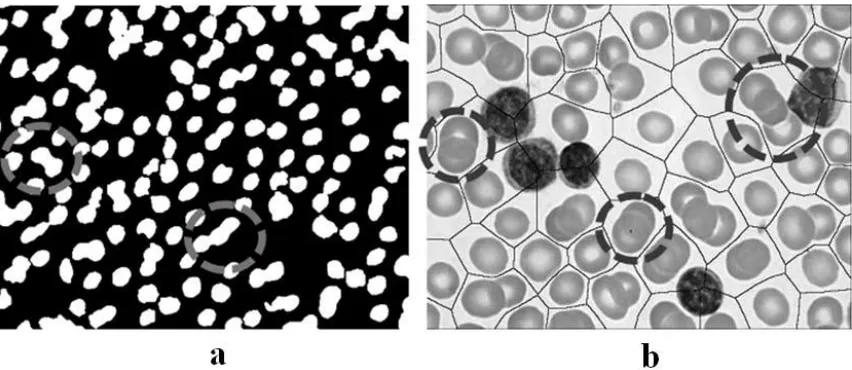
estimation size of cells fail and then effects the accuracy results of counting cells. Li et al. [31] presented an algorithm to segment touching cell nuclei of zebra fish using gradient vector flow tracking and separated the image into smaller regions with nucleus and applied adaptive thresholding. The paper provided a good algorithm to depress over segmentation and under segmentation. Vromen and McCane [48] presented a model to segment Scanning Electron Microscope Image of RBCs using contour tracing approach. Their results were satisfactory but still needed some improvement in removing falsely detected contours for minimally occluded cells. Figure 2.3 shows the limitations of the previously proposed algorithms confront with overlapping cells.
[image:31.612.115.541.304.489.2]Khan and Maruf [49] presented a framework for cell segmentation by detection of centroids in microscopic images facilitated by computing template based pattern matching on the distance transform called distance mapping. The accuracy obtained was relatively higher than compared to other methods of segmentation. However this method over counted the cells since it had false positives. Nguyen, Duong and Vu [50] also employed
Figure 2.3: Example results from previously proposed methods which confront with overlapping cells (dash-line circle) (a) Masking and Watershed algorithm proposed in
distance transform for splitting clumped cells by detecting central points and estimating the cell size for cell count. In order to increase the accuracy of detecting central points,
boundary-covering degree was applied to each point. Their algorithm had limitations on segmenting large number of overlapped cells.
2.9 Image Classification
A neural network is a computational structure inspired by the study of biological neural processing. There are many different types of neural networks, from relatively simple to very complex, just as there are many theories on how biological neural processing works. In image classification, Multilayer perceptron artificial neural network (ANN) is most common method used to identify and count RBC [18][14]. It performed by adjusting the value of the weight between the elements and the mean square error is calculated from there. The weight value is used to separate abnormal RBC and Normal RBC, thus the quantity of normal RBC is counted. In some other research, back projection of ANN compared with connected-component labelling (CCL) has been proved. Haematology analyser Sysmex KX-21 was used as benchmark for the comparison. The average accuracy of the CCL is 87.74% and the back projection ANN produced 86.97% of
accuracy [41]. One of the previous study use method of Artificial Neural Network (ANN) classifier to classified RBCs as normal/abnormal it is Levenberg Marquardt algorithm with mean square error (MSE) cost function [3].
2.9.1 Artificial Neural Network (ANN) classifier
In order to be able to discriminate between RBCs clustering types in the image by using the selected features, a robust classifier should be used. The classification module is performed by using artificial neural network (ANN) classifier. The ANNs are a mathematical approximation of a biological brain, and have been identified as a useful framework for precise modelling of nonlinear response. It comprises a number of neurons connected together to form a network. The weights that linked between the neurons, i.e.
2.10 Summary
RBC classification using image processing has been done in many previous works. As we know RBC analysis using image processing is not a new thing in medical diagnosis. Researchers focus on the improvement of the accuracy and promising result in their research by using many different methods. A framework for automatically classify the RBC into many type of cluster is proposed.
There are still weaknesses and constraints due to the image itself such as color similarity, weak edge boundary, overlapping condition, image quality, contrast, brightness, illumination and noise. Thus, more study must be done to handle those matters to produce strong analysis approach for medical diagnosis purpose. This project is hoped to can build a better solution and help to improve the current methods so that it can be more capable, robust, and effective whenever any sample of blood cell is analyzed.
2.11 Related Works
A Number of works have been conducted in the area of general segmentation and classification methods, Edge and border detection, region growing, filtering, mathematical morphology, and watershed clustering. Chen,Yang, and Petriu pointed out that the Watershed segmentation is an effective method for gray level image segmentation. Watershed
algorithm is a method used to segment RBC in overlapping area [11][12][22]. However, it
cannot handle when the overlapping area contain important information and it is hard to ensure
the accuracy of segmentation due to the large error. The improvement has been done by
combining mathematical morphology using corrosion and expansion algorithm with the
principle of watershed algorithm [13] Thresholding is the simplest method of image segmentation. It can be used to create binary images from a grayscale image [23]. Marques stated that the Segmentation is one of the most crucial tasks in image processing and computer
CHAPTER 3
[image:35.612.115.505.157.694.2]METHODOLOGY 3.1 Introduction
Figure 3.1: project framework Image acquisition using light microscope
Image Enhancement, noise filter, and convert into gray scale
Colour space reduction
Subtract WBC and small particles
Normal/abnormal RBC classification and counting Morphological operations
Adjust contrast and smoothen image
Masking operation
WBC nucleus and small particles segmentation
Figure 3.1: RBC counting flow diagram Global Thresholding
Remove small object
Fill hole Reverse
Reverse
Remove border object
RBC Features Extraction ANN Training RBC Counting Random image testing RBCs Classification
Particle area size
There are several steps taken in for RBC counting system. The problem domain in this case is to count RBC from a blood cell image automatically. Whereby, the goal is to
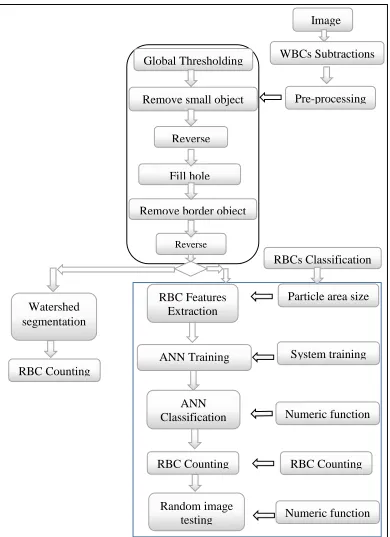
segment and classify RBC between many types of shape. The foundation methods that are taken in digital image processing will be similar one to another. Image pre-processing is not a one-step process: most solutions follow a sequential processing scheme whose main steps are described in this project. The complete RBCs counting flow diagram is shown in Figure 3.1.
3.2 Image acquisition
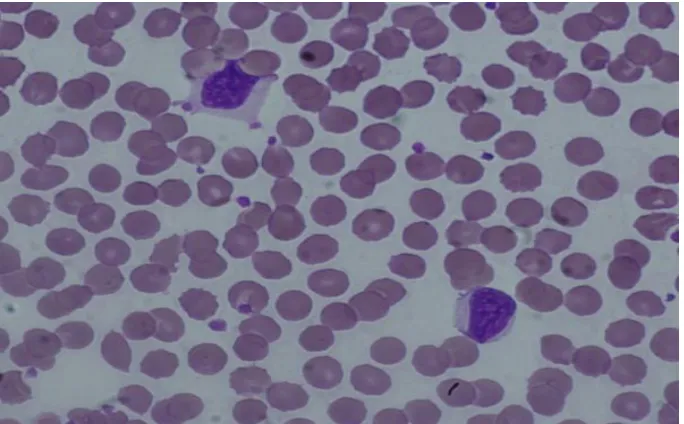
The blood cell image is taken from the medical electronic laboratory in Universiti Tun Hussein Onn Malaysia (UTHM). After preparing the slide of blood cell, it is been observed under conventional microscopy for 40 times (40X) objective which equal to approximately 400 magnification. The chosen image consists of all blood cell types and the aim of the study is to segment RBC from a subtracted WBC and platelet and classify
[image:36.612.143.485.438.650.2]it to get the exact counting number of all RBCs cell. Figure 3.2 shows the blood cell image for 40X objective.
3.3 Pre-processing
The goal of the pre-processing stage is to improve the quality of the acquired image. In image processing step the image is being enhance in term of quality level to be prepared for the next process. It is because the produced image may have some artifacts and illumination issue and this will be handled in the next process. As described earlier, blood cell contains RBC, WBC and platelet.
During pre-processing, unwanted image need to be removed. This process will remain RBC as the remaining object to be analyzed for next process. Possible algorithms to be employed during this stage including border image removal, removing small objects and filling holes of the RBC images.
3.3.1 Global Thresholding
The cells are separated from the background using global thresholding. The optimum
threshold is calculated using the well-known Otsu’s method. Otsu’s method is a histogram based image thresholding method that separates the image pixels into two classes with minimal intra-class variance. In this project, global colour thresholding process is applied to convert the image from RGB to binary image.
3.3.2 Global Color Thresholding
Colour thresholding converts a colour image into a binary image. To threshold a colour image, specify a threshold interval for each of the three colour components. A pixel in the output image is set to 1 if and only if its colour components fall within the specified ranges. Otherwise, the pixel value is set to 0.
3.3.3 Binary Image
Binary images are encoded as a 2D array, typically using 1 bit per pixel, where a 0 usually means “black” and a 1 means “white” (although there is no universal agreement on that).
The main advantage of this representation usually suitable for images containing simple graphics, text, or line art is its small size.
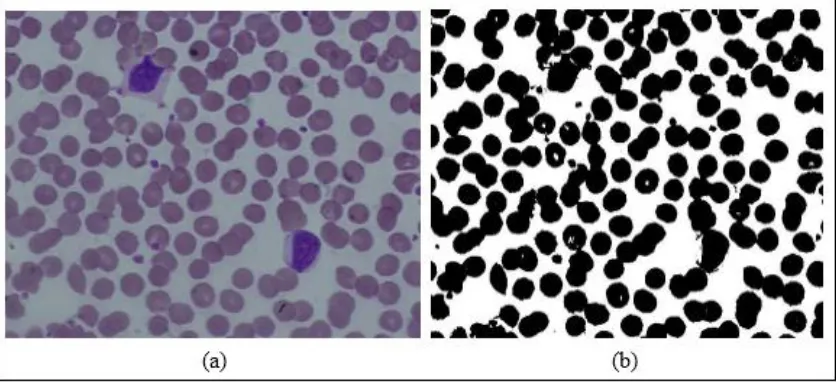
img1=imread('myrbcs11.jpg');
img2=rgb2gray(img1);
[image:38.612.116.534.301.492.2]img3=im2bw(img2,graythresh(img1)); figure, imshow(img3)
Figure 3.3: conversion from (a) RGB to (b) binary image
3.3.4 Morphological Operation
REFERENCES
[1] Tomari, R., Zakaria, W. N. W., Jamil, M. M. A., Nor, F. M., & Fuad, N. F. N. (2014). Computer aided system for red blood cell classification in blood smear image. Procedia Computer Science, 42, 206-213.
[2] Habibzadeh, M. (2015). Automatic Segmentation and Classification of Red and White Blood cells in Thin Blood Smear Slides (Doctoral dissertation, Concordia University).
[3] Yang, L. (2009). Robust segmentation and object classification in natural and
medical images. Rutgers University.
[4] Kareem, S., Morling, R. C., & Kale, I. (2011, May). A novel method to count the red blood cells in thin blood films. In Circuits and Systems (ISCAS), 2011 IEEE International Symposium on (pp. 1021-1024). IEEE.
[5] Cai, R., Wu, Q., Zhang, R., Fan, L., & Ruan, C. (2012, October). Red blood cell segmentation using Active Appearance Model. In Signal Processing (ICSP), 2012 IEEE 11th International Conference on (Vol. 3, pp. 1641-1644). IEEE.
[6] Venkatalakshmi, B., & Thilagavathi, K. (2013, April). Automatic red blood cell counting using Hough transform. In Information & Communication Technologies (ICT), 2013 IEEE Conference on (pp. 267-271). IEEE.
[7] Lias, J. (2015). Analysis of red blood cell (RBC) classification using Ni vision builder Ai (Doctoral dissertation, Universiti Tun Hussein Onn Malaysia).
[8] Sharif, J. M., Miswan, M. F., Ngadi, M. A., Salam, M. S. H., & Jamil, M. M. B. A. (2012, February). Red blood cell segmentation using masking and watershed algorithm: A preliminary study. In Biomedical Engineering (ICoBE), 2012 International Conference on (pp. 258-262). IEEE.
[9] Bentley, S. A., & Lewis, S. M. (1975). The use of an image analysing computer for the quantitation of red cell morphological characteristics. British journal of
[10] Rowan, R., & England, J. M. (1986). Automated examination of the peripheral blood smear. Automation and quality assurance in hematology,
129-177.
[11] Lepcha, P., Srisukkham, W., Zhang, L., & Hossain, A. (2014, December). Red Blood based disease screening using marker controlled watershed segmentation and post-processing. In Software, Knowledge, Information Management and Applications (SKIMA), 2014 8th International Conference on (pp. 1-7). IEEE.
[12] Karunakar, Y., & Kuwadekar, A. (2011, September). An unparagoned application for red blood cell counting using marker controlled watershed algorithm for Android mobile. In Next Generation Mobile Applications, Services and Technologies (NGMAST), 2011 5th International Conference on (pp. 100-104). IEEE.
[13] Huang, J. (2010, October). An improved algorithm of overlapping cell division. In Intelligent Computing and Integrated Systems (ICISS), 2010 International Conference on (pp. 687-691). IEEE.
[14] Poomcokrak, J., & Neatpisarnvanit, C. (2008). Red blood cells extraction and counting. In The 3rd International Symposium on Biomedical Engineering (pp. 199-203).
[15] Tulsani, H., Saxena, S., & Yadav, N. (2013). Segmentation using
morphological watershed transformation for counting blood cells. IJCAIT, 2(3), 28-36.
[16] Mahmood, N. H., Lim, P. C., Mazalan, S. M., & Razak, M. A. A. (2013). Blood cells extraction using color based segmentation technique. International journal of life sciences biotechnology and pharma research, 2(2), 233-240. [17] Wang, R., MacCane, B., & Fang, B. (2010, December). RBC image
[18] Karunakar, Y., & Kuwadekar, A. (2011, September). An unparagoned application for red blood cell counting using marker controlled watershed
algorithm for Android mobile. In Next Generation Mobile Applications, Services and Technologies (NGMAST), 2011 5th International Conference on (pp. 100-104). IEEE.
[19] Di Rubeto, C., Dempster, A., Khan, S., & Jarra, B. (2000). Segmentation of blood images using morphological operators. In Pattern Recognition, 2000. Proceedings. 15th International Conference on (Vol. 3, pp. 397-400). IEEE. [20] Nguyen, N. T., Duong, A. D., & Vu, H. Q. (2010, October). A new method
for splitting clumped cells in red blood images. In Knowledge and Systems Engineering (KSE), 2010 Second International Conference on (pp. 3-8). IEEE. [21] Adagale, S. S., & Pawar, S. S. (2013, December). Image segmentation
using PCNN and template matching for blood cell counting. In Computational Intelligence and Computing Research (ICCIC), 2013 IEEE International Conference on (pp. 1-5). IEEE.
[22] Kaur, A. (2014). Aayushi.: Image segmentation using watershed transform. Int. J. Soft Comput. Eng.(IJSCE), 4(1), 5-8.
[23] B. Bobier and M. Wirth.(2008) Evaluation of binarization algorithms. Technical report,Department of Computing and Information Science, University of Guelph,Guelph, ON, 2008.
[24] Chen, Q., Yang, X., & Petriu, E. M. (2004, October). Watershed segmentation for binary images with different distance transforms. In Proceedings of the 3rd IEEE International Workshop on Haptic, Audio and Visual Environments and Their Applications (pp. 111-116).
[25] Jambhekar, N. D. (2011). Red blood cells classification using image processing. Science Research Reporter, 1(3), 151-154.
[27] Osowski, S., Siroić, R., Markiewicz, T., & Siwek, K. (2009). Application of support vector machine and genetic algorithm for improved blood cell
recognition. Instrumentation and Measurement, IEEE Transactions on, 58(7), 2159-2168.
[28] Fleagle, S. R., Johnson, M. R., Wilbricht, C. J., Skorton, D. J., Wilson, R. F., White, C. W., ... & Collins, S. M. (1989). Automated analysis of coronary arterial morphology in cineangiograms: geometric and physiologic validation in humans. Medical Imaging, IEEE Transactions on, 8(4), 387-400.
[29] Marques, O. (2011). Practical image and video processing using MATLAB. John Wiley & Sons.
[30] Li, G., Liu, T., Nie, J., Guo, L., Chen, J., Zhu, J., ... & Wong, S. T. C. (2008). Segmentation of touching cell nuclei using gradient flow tracking. Journal of Microscopy, 231(1), 47-58.
[31] Albertini, M. C., Teodori, L., Piatti, E., Piacentini, M. P., Accorsi, A., & Rocchi, M. B. (2003). Automated analysis of morphometric parameters for accurate definition of erythrocyte cell shape. Cytometry part A, 52(1), 12-18. [32] Robinson, R. D., Benjamin, L. J., Cosgriff, J. M., Cox, C., Lapets, O. P.,
Rowley, P. T., ... & Wheeless, L. L. (1994). Textural differences between AA and SS blood specimens as detected by image analysis. Cytometry, 17(2), 167-172. [33] Costin, H., Rotariu, C., Zbancioc, M., Costin, M., & Hanganu, E. (2001).
Fuzzy rule-aided decision support for blood cell recognition. Fuzzy Systems & Artificial Intelligence, 7(1-3), 61-70.
[34] Gering, E., & Atkinson, C. T. (2004). A rapid method for counting nucleated erythrocytes on stained blood smears by digital image analysis. Journal of Parasitology, 90(4), 879-881.
[35] Dong, G., Ray, N., & Acton, S. T. (2005). Intravital leukocyte detection using the gradient inverse coefficient of variation. Medical Imaging, IEEE Transactions on, 24(7), 910-924.
Emerging Trends and Applications in Information Communication Technologies (pp. 373-384). Springer Berlin Heidelberg.
[37] Xiong, W., Ong, S. H., Kang, C., Lim, J. H., Liu, J., Racoceanu, D., & Foong, K. (2009, October). Cell clumping quantification and automatic area classification in peripheral blood smear images. In Biomedical Engineering and Informatics, 2009. BMEI'09. 2nd International Conference on (pp. 1-5). IEEE. [38] Vromen, J., & McCane, B. (2009, November). Red blood cell
segmentation from SEM images. In 2009 24th International Conference Image and Vision Computing New Zealand. IEEE (pp. 44-49).
[39] Wang, R., & McCane, B. (2008, December). Red Blood Cell Classification through Depth Map and Surface Feature. In Computer Science and Computational Technology, 2008. ISCSCT'08. International Symposium on (Vol. 2, pp. 339-342). IEEE.
[40] Wei, X., Cao, Y., Fu, G., & Wang, Y. (2015). A counting method for complex overlapping erythrocytes-based microscopic imaging. Journal of Innovative Optical Health Sciences, 8(06), 1550033.
[41] Nasution, A. M. T., & Suryaningtyas, E. K. (2008, December). Comparison of red blood cells counting using two algorithms: Connected component labeling and backprojection of artificial neural network. In PhotonicsGlobal@ Singapore, 2008. IPGC 2008. IEEE (pp. 1-4). IEEE.
[42] Nasution, A. M. T., & Suryaningtyas, E. K. (2008, December). Comparison of red blood cells counting using two algorithms: Connected component labeling and backprojection of artificial neural network. In PhotonicsGlobal@ Singapore, 2008. IPGC 2008. IEEE (pp. 1-4). IEEE.
[43] Jha, K. K., Das, B. K., & Dutta, H. S. (2014, March). Detection of abnormal blood cells on the basis of nucleus shape and counting of WBC. In Green Computing Communication and Electrical Engineering (ICGCCEE), 2014 International Conference on (pp. 1-5). IEEE.
[45] Sun, H. Q., & Luo, Y. J. (2009). Adaptive watershed segmentation of binary particle image. Journal of microscopy, 233(2), 326-330.
[46] Nasution, A. M. T., & Suryaningtyas, E. K. (2008, December). Comparison of red blood cells counting using two algorithms: Connected component labeling and backprojection of artificial neural network. In PhotonicsGlobal@ Singapore, 2008. IPGC 2008. IEEE (pp. 1-4). IEEE.
[47] Maitra, M., Gupta, R. K., & Mukherjee, M. (2012). Detection and counting of red blood cells in blood cell images using Hough transform. International journal of computer applications, 53(16).
[48] Vromen, J., & McCane, B. (2009, November). Red blood cell segmentation from SEM images. In 2009 24th International Conference Image and Vision Computing New Zealand. IEEE (pp. 44-49).
[49] Khan, H. A., & Maruf, G. M. (2013, May). Counting clustered cells using distance mapping. In Informatics, Electronics & Vision (ICIEV), 2013 International Conference on (pp. 1-6). IEEE.
[50] Nguyen, N. T., Duong, A. D., & Vu, H. Q. (2010, October). A new method for splitting clumped cells in red blood images. In Knowledge and Systems Engineering (KSE), 2010 Second International Conference on (pp. 3-8). IEEE. [51] Rahmani, M. K. I., Pal, N., & Arora, K. (2014). Clustering of Image Data
Using K-Means and Fuzzy K-Means. International Journal of Advanced Computer
Science and Applications, 5(7), 160-163.
[52] Bradley, P. S., & Fayyad, U. M. (1998, July). Refining Initial Points for K-Means Clustering. In ICML (Vol. 98, pp. 91-99).
![Table 1.1: Normal blood count differentiated by gender [8]](https://thumb-us.123doks.com/thumbv2/123dok_us/8759306.893610/22.612.140.517.340.554/table-normal-blood-count-differentiated-gender.webp)
![Figure 2.1: Image Acquisition Equipment [3]](https://thumb-us.123doks.com/thumbv2/123dok_us/8759306.893610/23.612.164.491.123.338/figure-image-acquisition-equipment.webp)
![Fig 2.2: Flooding process in watershed transform [22]](https://thumb-us.123doks.com/thumbv2/123dok_us/8759306.893610/28.612.137.519.406.670/fig-flooding-process-watershed-transform.webp)