
Towards performance related decision support for Model Driven
Engineering of Enterprise SOA applications
Mathias Fritzsche, Wasif Gilani
SAP Research CEC Belfast
[mathias.fritzsche | wasif.gilani]@sap.com
Ivor Spence, T. John Brown, Peter Kilpatrick, Rabih Bashroush
Queen’s University Belfast
[i.spence | tj.brown | p.kilpatrick | r.bashroush]@qub.ac.uk
Abstract
Model Driven Performance Engineering (MDPE) enables early performance feedback in a MDE process, in order to avoid late identification of performance problems which could cause significant additional development costs. In our past work we argued that a synchronization mechanism between development and performance analysis models is required to adequately integrate analysis results into the development process enabling performance related decision support. In this paper we present a solution for this requirement. We present a new multi-view based approach and its implementation enabling systematic performance related decision support. We apply our research on the model driven engineering of process orchestrations on top of SAP’s Enterprise Service Oriented Architecture (Enterprise SOA).
1. Introduction
Increasingly complexity of software systems, characterized here in terms of attributes such as size, distribution, heterogeneity and dynamicity, create a high need for an early identification of possible performance problems in order to avoid significant additional development effort. We deal with providing a solution for addressing the performance related issues in the earlier stages of software development, and applying our work to highly distributed applications built on top of SAP’s SOA platform called Enterprise SOA [13], [14].
In our previous work [1], we proposed Model-Driven Performance Engineering (MDPE) for early performance feedback. The process supports earlier initial performance feedback with minimal effort as
well as maximal performance feedback with extended (but still cost-efficient) effort by utilization of Model Driven Engineering (MDE) concepts. Hence, MDPE enables earlier performance feedback to address the challenges of short time to market by taking into account the increased complexity in software development.
We identified the requirement of a synchronization mechanism, between the development models1 and performance analysis models, in order to adequately integrate the performance analysis results into the development process. This requirement is extended here with the notion of providing performance related decision support based on analysed performance view models.
An example of a performance view model is the Core Scenario Model (CSM) proposed in [2], which combines performance relevant model knowledge and performance measurements of a usage scenario. This information has still to be interpreted, as mentioned in
[3]:“We must […] learn how to combine measurement
data interpretation with model interpretation and to get the most out of both”. A first step towards this kind of interpretation is taken in [4], in which a metric is introduced for the detection of bottleneck sources for decision support, in order to apply improvements and realistically estimate their effectiveness. The decision support in that work is based on a metric called “bottleneck strength” providing a first step towards combining measurement interpretation and model interpretation.
1
The contribution of this work is to propose an approach enabling systematic performance related decision support for non-performance experts in terms of what in a design has to be changed to get better results with regard to performance objectives and modification constraints. The approach combines three different performance related views enabling effective performance assessments. The approach is presented as an extension of our previous idea of MDPE by providing stepwise performance assessment and is described in section 3. We implemented the approach by utilizing an Eclipse based implementation of a systematic model annotation approach (see section 4) and currently apply our research for the MDE of process orchestrations (see section 2), where a systematic approach for traceability of performance objectives is required.
2. Application
[image:2.612.72.306.358.504.2]We apply our research on the Enterprise SOA architecture [13], [14]. A simplified view of this architecture is depicted in Figure 1.
Figure 1: Enterprise SOA high-level architecture conforming to the Fundamental Modeling Concepts (FMC) methodology [10]
As can be seen in the figure, the architecture is structured in layers accessible as software resources. The functionality provided by the different layers can be deployed in one or several instances of the SAP NetWeaver Application Server which are running on physical resources which areProcessors.
The Persistence layer uses distributed data repositories that may consist of multiple databases using physical memories.
Business Objects on top of the persistence layer encapsulate semantic data, such as Sales Order data,
and provide methods to manipulate them. Business Objects enable Business Processes and provide one or
more Enterprise Services which are technically
implemented as WebServices extended with proprietary features [14]. Enterprise Services can be provided not only by SAP specific Business Objects but also by 3rd party objects.
The Process Orchestration Layer defines the business control logic. It is the role of Enterprise Services to provide access to business specific data or functionality that can be used to compose business processes. In the current architecture two kinds of process orchestrations are possible depending on the lifecycle of the orchestrated process. Back-end process orchestration is done to define processes with longer lifecycles, such as sales order processing, whereas front-end orchestration is done to compose processes with shorter lifecycles. In our current work we deal with the model driven engineering of processes with minimum user interaction.
Following models specify the orchestrated processes and the underlying architecture:
Models of orchestrated front-end processes Models of underlying back-end processes Models specifying resource usage of Enterprise Services
Based on these models and measured performance data for Enterprise Services, we are able to perform performance analysis conforming to the MDPE process, [1] or other processes utilizing MDE for performance engineering such as [15] and [16]. We identified the problem that it is difficult to deal with the interpretation of performance analysis results for orchestrated processes on top of the complex Enterprise SOA architecture. One reason for that is the layered architecture consisting of the Persistence, Business Objects, Enterprise Service, Process Orchestration and User Interface Layer, where a bottle neck in one layer may in fact result in a bottle neck in another layer by push-back which makes interpretation difficult [4]. Additionally, the high degree of flexibility for deploying the system on physical resources and the integration of 3rd party services complicates performance analysis.
orchestrated processes on top of Enterprise SOA. Therefore, the approach should provide decision support for non-performance experts in terms of what in a design has to be changed to get better results with regard to performance objectives. We have refined this requirement in terms of the following issues addressed in this paper:
Information filtering: We should only provide relevant information with respect to the modification constraints and performance objectives provided by users of our approach. In this paper we define performance objectives as performance requirements and performance improvements. Performance improvements are concerned with maximizing the resource utilization and mimizing the response time of the modeled system.
Information interpretation: We are required to provide help in interpreting measurement data, performance models, and performance prediction results related to performance objectives and modification constraints by providing intelligent performance related metrics.
Systematic model synchronization: We should provide an approach for systematic integration of
performance metrics and patterns into development models in the MDE process.
Assessment visualization: The solution should enable visualization support for graphical representation of identified performance metrics and patterns on development models.
3. Proposed multi-view based approach
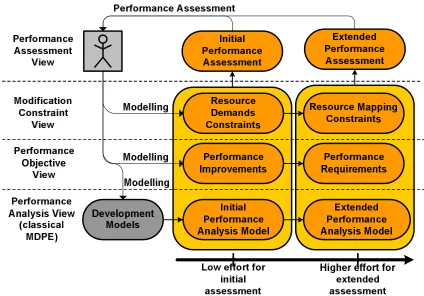
We propose utilization of different views for calculating metrics of interest to the user. Figure 2
depicts all views considered in our approach.
A short description of the semantics of the different performance related views is given below:
Performance Analysis View: This is a viewpoint on the system encapsulating performance-related characteristics and execution parameters of a system.
Hence, the Performance Analysis View is used to
[image:3.612.95.519.69.365.2]calculate the metrics providing performance related decision support. Based on the stepwise MDPE approach we consider theInitial Performance Analysis Modeland theExtended Performance Analysis Model. The first is based on development models annotated with resource demands and probabilities of paths. It enables initial performance feedback in terms of upper
and lower bounds in the absence of factors due to contention of resources. In order to give performance related decision support, we use the Initial Performance Analysis Model as one input for Initial
Performance Assessment. The Extended Performance
Analysis Model requires more detailed information and hence more effort by the modeller. In more detail, it additionally takes into account factors due to contention for resources, enabling more detailed scenario specific performance prediction, including prediction of resource utilization. We consider here that the Extended Performance Analysis Model has already been simulated or analytically solved and it therefore contains information about utilization of resources. The Extended Performance Analysis Model is used as one input for Extended Performance Assessment.
Modification Constraint View: This view specifies the configuration options/constraints in the design in order to provide decision support which is realizable and hence useful.
We currently employ Resource Demand
Constraints as input for Initial Performance
Assessment and Resource Mapping Constraints as input for Extended Performance Assessment. With Resource Demand Constraints we currently consider resource demands as fixed, e.g. for the specification of resource demands of third party services, or as variable. Resource Mapping constraints consider resources as duplicable or single-only resources.
The Modification Constraint View is used to filter
the resulting performance assessment view for user needs.
Performance Objective View: This view concerns how the modeled system should perform. This view can be split into the specification of
Performance Requirements and Performance
Improvement. Performance Improvements are
concerned with maximizing the resource utilization and mimizing the response time of the modeled system. We consider specifying the Performance Improvements in the first step as an input for Initial Performance Assessment. Specifications of Performance Requirements, which are specific for factors due to contention of resources, are considered as an input for Extended Performance Assessment.
The Performance Objective View is also used to
filter the resulting performance assessment view for user needs and, in addition, toselect metrics of interest for the user. In the current implementation we only support one metric for Initial Performance Assessment and one metric for Extended Performance Assessment. This implies that we currently only use the
Performance Objective View to filter the assessment. In the future we anticipate using the Performance Objective View also tocompute metrics of interest by calculating dependencies between performance objectives and design decisions within development models.
We claim that the combination of these views enables calculation of performance related metrics and patterns, thereby enabling decision support by automatically taking performance objectives and modification constraints into account. Hence, the approach enables the automatic generation of a Performance Assessment View from the information provided by other views.
Performance Assessment View: This view provides performance related decision support for non-performance experts in terms of what in a design has to be changed to get better results with regard to performance objectives and modification constraints. It therefore provides help in information interpretation and filtering as stated in section 1. Conforming to the stepwise MDPE approach we consider Initial Performance Assessment which provides performance related decision support in the absence of concrete usage scenarios including information about factors due to contention of resources. In the second step we consider Extended Performance Assessment taking additional factors due to contention of resources, resource related requirements and resource related constraints into account.
For both steps of Performance Assessment we calculate metrics from the other three views to provide decision support. In order to gain first hand experience with our approach we currently support only one metric per assessment step: Step Performance Importance (SPI) as Initial Performance Assessment and Bottle Neck Strength as defined in [12] as Extended Performance Assessment.
The results are shown only for these steps which are defined as variable in the Modification Constraint view and which are marked as Improvable in the Performance Objective View. Bottle neck strength can be calculated if models showing layered use of resources, such as shown in section 2, are available and if they are containing information about resource utilization. For our current implementation we use a refined and slightly extended version of the Core Scenario Model (CSM) [2] to have an instance of an Extended Performance Analysis Model. The Bottle Neck Strength (BStrength) metric is defined in [12]:
BStrength enables bottle neck characterization for layered resource consumption. A description is also provided in [12] about how this metric has to be interpreted to support design and deployment decisions. The Modification Constraint View and the Performance Objective View will be used in the future to automatically propose concrete design and deployment alternatives. Currently we use these views to filter the visualization of BStrength values. Consistent with the SPI metric we only visualize BStrength for those parts in a model that are not fulfilling Performance Requirements defined within the Performance Objectives or which are marked as Improvable in the Performance Improvements and where the Resource Mapping Constraint does not prevent the use of more resources.
To summarize, the Performance Analysis view is mainly used to fulfill the requirement of information interpretation because it is mainly about interpreting measurement data, performance models, and performance prediction results.
The requirement of information filtering is currently mainly fulfilled based on the Performance Objective and Modification Constraint View.
Systematic model synchronization and assessment visualization is fulfilled by the profile based model
annotation approach which is described in the following section. This section introduces the architecture of our approach that enables systematic performance related decision support for non-performance experts in terms of what in a design has to be changed to get better results with regard to performance objectives.
4. Proposed implementation
To gain initial experience with our approach we implemented an extension of MDPE for performance related decision support by utilizing a systematic model annotation approach. The following subsections give an overview of the proposed architecture.
4.1 Overall architecture
depicts the high-level architecture of the proposed approach. The three performance assessment related views (Performance Objectives, Modification Constraints and Performance Analysis) are integrated by a Composition Engine to an Assessment
Computation Model which is used internally within
Decision Support Engine. This model is technically a composite model of the original Development Models
and the performance assessment related views. The Composition Engine and Assessment Computation Engine are described in more detail in subsection 4.3. The internally used Assessment Computation Model is used as input for theAssessment Computation Engine
calculating thePerformance Assessment View.
Development Models
Modification Constraint
Model
Performance Analysis Model
Performance Assessment
Model
Performance Analysis View Performance
Objective View Performance
Objective Model
Modification Constraint View
Composition Engine Assessment Computation Model Assessment Computation Engine
Visua-lization Tooling
Performance Assessment View
R
Decision SupportEngine
Figure 3: High-level Architecture of our approach conforming to the FMC methodology [10]
realize user centric design decision support based on the original development models.
[image:6.612.77.297.168.279.2]Figure 4 depicts the information flow from specification of different views (1), merging them to compute customized performance metrics (2) and visualize them for users of the approach (3).
Figure 4: Information Flow as diagram conforming to the FMC methodology [10]
The following subsection delineates the concrete models we used to specify view points.
4.2 Currently used view-point models
For our initial implementation we support UML2.0 models as development models. In our current example we used UML Activity Diagrams modeling Process Orchestrations on top of Enterprise Services as introduced in section 2, and Deployment Diagrams. Both types of models are annotated with performance data conforming to the UML SPT profile [17]. In addition to the SPT profile we applied another simple profile which we defined (using UML) in order to specify Enterprise SOA specific semantic, such as the expression of Enterprise Services.
In order to obtain an Initial Performance Analysis View, we annotated the UML Activity Diagram with resource demands of Actions and probabilities of paths.
Following this, we added information concerning contention of resources to the Activity Diagram and the Deployment Diagram to transform them via ATL transformation [11] to the Extended Performance Analysis Model. In more detail, we generated stepwise two kinds of Extended Performance Analysis Model: A Tool Independent Performance Model (TIPM) and a Tool Specific Performance Model (TSPM) as described in [1]. The TIPM is defined as a refined and slightly extended version of the Core Scenario Model
(CSM) [2]. The TSPM has been used as input for the simulation tool AnyLogic [12]. In the future we anticipate generating input for other simulation tools as well to get a broader set and therefore more useful simulation results [1]. The resulting information from the simulation about utilization of resources has been annotated back to the TIPM which has been then used as input to the Extended Performance Assessment View.
In order to specify the Modification Constraints View and Performance Objective View we defined initial UML profiles.
The Modification Constraints Profile consists of two stereotypes which can be attached on
UML.ExecutableNodes: ResourceDemandsConstraint
which is defined by the value that can be fixed or
changeable andResourceMappingConstraint which is defined by the integer values minMultiplicity and
maxMultiplicity. In the future we anticipate extending this profile to be more expressive.
In order to express Performance Requirements as part of the Performance Objectives we could have used the UML SPT profile [17] since it is possible to express all performance values as required. Since we do not need the full expressiveness of SPT, and would like to merge the view points of Performance Objectives and the Performance Analysis into one profile and also to express Performance Improvements, we defined a UML Profile containing the Stereotypes ExecutionTimeRequirement and
ResourceRequirement which can be applied on
UML.ExecutableNodes. ExecutionTimeRequirement
specifies the overall time to execute an ExecutableNode. The stereotype is specified by its
maximumExecutionTime and the Boolean value
Improvable, which specifies if the value should still be reduced if the maximumExecutionTime criteria has been reached. The stereotype ResourceRequirement
specifies the range of resource utilization to be achieved (maxUtilization and minUtilization). To express future improvements the Boolean values
improveTowardsMaxUtilization and
improveTowardsMinUtilization are needed. 4.3 Systematic model annotation
an extremely time consuming and error prone process. Additionally, it does not adhere to the separation of concerns principle in order to manage complexity by treating each concern in its own space; see also [9]. We apply model modification constraints and performance objectives to development models by specifying them in our Query and Annotation Language (QUAL) [7]. The language enables us to specify model extensions centrally. An Eclipse based infrastructure enables us to perform UML annotations specified in QUAL for a number of model elements related to a number of models in a model repository such as SAP’s Modeling Infrastructure (MOIN) [9]. QUAL consists of a model querying part in order to select model elements to annotate, and an execution part to specify the annotation itself. For queries we support syntactic, type and semantic queries. Semantic queries allow us to select model elements which have already been applied with other profiles. This concept has been outlined as very useful to select, for instance, those model elements which have been annotated with the
SPT.Resource stereotype and specify the utilization of them.
The QUAL approach also includes an extension mechanism in order to perform model annotations that conform to an algorithm specified in Java. This extension mechanism can be used to calculate (see Assessment Computation in Figure 3) metrics as input for the Performance Assessment View.
Hence, QUAL as a systematic model annotation approach has been used as implementation of the Composition Engine and of the Assessment Computation Engine (see Figure 3) as well.
5. Related Work
A number of approaches [15, 16, 20, 21, 22, 23, 24 and 25] are available for generating performance analysis models from development models by utilization of model driven techniques. Almost all these approaches follow the approach of deriving performance models from the annotated UML models.
However, these approaches differ in terms of the type of development models they take as input, and the performance models they output, which are then employed for performance prediction. They further differ in terms of the automation degree they offer. A very comprehensive survey of the different performance engineering tools/techniques is provided in [26] and [27].
Most of the available approaches demand performance expertise from their users. Our work addresses this need by integrating performance objectives and modification constraints, thereby
providing decision support for non-performance experts, based on development models. Our approach enables that each of the design decision is translated in terms of a performance metric, which enables the direct identification of the impact of design decision with regard to the performance objectives by taking modification constraints into account. Furthermore, in our proposed architecture, the performance assessment results are visualized based on the development models. Theoretically we could use bidirectional model transformations [18] for integrating performance assessment results into development models, but our approach requires calculation of metrics and therefore the functionality provided by the QUAL approach (see section 4.2) is employed. QUAL completely automates the annotation of behavior models and calculation of performance assessment metrics, which has largely to be done manually in the existing approaches.
6. Conclusion and future work
We presented an approach enabling performance related decision support for non-performance experts in terms of what in a design has to be changed to get better results with regard to performance objectives and modification constraints. We additionally proposed an architecture integrating this approach in MDE. The approach has been applied for the MDE of process orchestrations on top of SAP’s Enterprise Service Oriented Architecture (Enterprise SOA).
Our approach utilizes the Performance Analysis View, the Modification Constraint View and the Performance Objective View in order to give modelers valuable feedback about how design decisions are related to performance objectives.
The approach enables information filtering to only provide information which is relevant for the user by taking performance objectives and modification constraints into account. We proposed initial performance assessment metrics enabling information interpretation for non-performance experts to support design decisions taking the performance into account. In order to provide a systematic synchronization between the performance assessment and development models we proposed architecture based on a systematic model annotation approach called QUAL.
In order to realize user centric visualization of performance assessment we anticipate using a GIS-like representation of metrics such as proposed and implemented by [19].
and performance objectives into account. This especially includes the definition of metrics computed out of the Performance Analysis View and the Performance Objective View in order to directly visualize dependencies between performance objectives and design decisions based on development models.
In order to gain more experiences with our approach for different domains we plan a case study to assess different hosting scenarios of SAP Business By Design applications and a case study to assess business performance.
7. References
[1] Mathias Fritzsche, Jendrik Johannes, “Putting Performance Engineering into Model-Driven Engineering: Model-Driven Performance Engineering”, MoDeVVa’07 at the Model Driven Engineering Languages and Systems, ISBN 2-7261-1294 3, 2007, pp. 77–87, (selected to appear in Springer-Verlag LNCS format).
[2] A Dorin B. Petriu, Murray Woodside, “An intermediate metamodel with scenarios and resources”, Software and Systems Modeling, Springer-Verlag, pp. 163–184, 2007.
[3] Murray Woodside, Greg Franks, Dorina C. Petriu, “The Future of Software Performance Engineering”, 29th Int. Conference on Software Engineering, IEEE, 2007.
[4] Greg Franks, Dorina Petriu, Murray Woodside, Jing Xu, Peter Tregunno, “Layered Bottlenecks and Their Mitigation”, Conference on Quantitative Evaluation of Systems (QUEST), IEEE, 2006.
[5] Bézivin, J., Devedži , V., Djuri , D., Favreau, J., Gaševi , D., Jouault, F., “An M3-Neutral infrastructure for bridging model engineering and ontology engineering.”, First International Conference on Interoperability of Enterprise Software and Applications, Springer, 2005, pp. 159-171.
[6] Farid Mehr, Ulf Schreier, “Modelling of Message Security Concerns with UML”, 9th International Conference on Enterprise Information Systems, 2007.
[7] Farid Mehr, Mathias Fritzsche, Ulf Schreier, “QUAL: A Query and Annotation Language for the UML models of Service-oriented Applications”, submitted to the International Journal of Business Process Integration and Management (IJBPIM).
[8]D.L. Parnas, “On the Criteria to be Used in Decomposing Systems into Modules”, Communication of the ACM, Vol.15, N°12, 1972.
[9] Michael Altenhofen, Thomas Hettel, Stefan Kusterer, “OCL Support in an Industrial Environment”, LNCS Volume 4364, Springer-Verlag, 2007, pp. 169-178.
[10] Knopfel, A., Grone, B., Tabeling, P., “Fundamental Modeling Concepts: Effective Communication of IT Systems”, John Wiley & Sons, 2006.
[11] ATLAS Group, “ATLAS transformation language“ URLhttp://www.eclipse.org/m2m/atl/, 2007.
[12] XJ Technologies, “AnyLogic — multi-paradigm simulation software” URL http://www.xjtek.com/anylogic/, 2007.
[13] Dan Woods, Thomas Mattern, “Enterprise SOA: Designing IT for Business Innovation”, O’Reilly Media Inc, 2006.
[14] Robert Heidasch, “Get ready for the next generation of SAP business application based on Enterprise Service-Oriented Architecture (Enterprise SOA)”, SAP Professional Journal, 2007.
[15] Cortellessa, V., Marco, A.D., Inverardi, P., “Software performance model-driven architecture.” SAC ’06: Proceedings of the 2006 ACM symposium on Applied computing, ACM Press, 2006, pp. 1218–1223.
[16] D’Ambrogio, A. “A model transformation framework for the automated building of performance models from UML models.”, WOSP ’05: Proceedings of the 5th international workshop on Software and performance, ACM Press, 2005, pp. 75–86.
[17] OMG, “UML profile for schedulability, performance,
and time specification”, URL
http://www.omg.org/docs/formal/03-09-01.pdf, 2005
[18] Perdita Stevens, “Bidirectional Model Transformations in QVT: Semantic Issues and Open Questions.”, Model Driven Engineering Languages and Systems, 2007, pp. 1-15.
[19] Christian Lange, Michel Chaudron, “Combining Metrics Data and the Structure of UML Models using GIS Visualization Approaches”, International Conference on Information Technology: Coding and Computing, 2005
[20] Wagh Ramrao, “Transformation of UML design model into performance model: A model driven framework”, ECOOP Student Workshop, 2006.
[21] Williams Lloyd G., Smith Connie U., “PASA: An architectural approach to fixing software performance problems “, In Software Engineering Research and Performance Engineering Services, 2002
[22] Andrew Bennett, A. J. Field, “Performance Engineering with the UML Profile for Schedulability, Performance and Time: a Case Study”, 12th IEEE International Symposium on Modeling, Analysis, and Simulation of Computer and Telecommunications Systems (MASCOTS'04), 2004
Conference on Quantitative Evaluation of Systems (QEST), 2004
[24]V. Cortellessa, M. Gentile, and M. Pizzuti., “XPRIT: An XML-based tool to translate UML diagrams into execution graphs and queueing networks”, In IEEE First International Conference on Quantitative Evaluation of Systems (QEST), 2004.
[25] Elena Gómez-Martínez and José Merseguer, “ArgoSPE: Model-Based Software Performance Engineering”, In 27th International Conference on Applications and Theory of Petri Nets and Other Models of Concurrency, 2006
[26] S. Balsamo, A. Di Marco, P. Inverardi, M. Simeoni, “Model-Based Performance Prediction in Software Development: A Survey”, IEEE Transactions on Software Engineering, vol. 30, 2004.
![Figure 1: Enterprise SOA high-level architectureconforming to the Fundamental Modeling Concepts(FMC) methodology [10]](https://thumb-us.123doks.com/thumbv2/123dok_us/451338.1044753/2.612.72.306.358.504/figure-enterprise-level-architectureconforming-fundamental-modeling-concepts-methodology.webp)
![Figure 4: Information Flow as diagram conformingto the FMC methodology [10]](https://thumb-us.123doks.com/thumbv2/123dok_us/451338.1044753/6.612.77.297.168.279/figure-information-flow-diagram-conformingto-fmc-methodology.webp)
