R E S E A R C H
Open Access
Texture based features for robust palmprint
recognition: a comparative study
R. Raghavendra
*and Christoph Busch
Abstract
Palmprint is a widely used biometric trait deployed in various access-control applications due to its convenience in use, reliability, and low cost. In this paper, we propose a novel scheme for palmprint recognition using a sparse representation of features obtained from Bank of Binarized Statistical Image Features (B-BSIF). The palmprint image is characterized by a rich set of features including principal lines, ridges, and wrinkles. Thus, the use of an appropriate texture descriptor scheme is expected to capture this information accurately. To this extent, we explore the idea of B-BSIF that comprises of 56 different BSIF filters whose responses on the given palmprint image is processed independently and classified using sparse representation classifier (SRC). Extensive experiments are carried out on three different large-scale publicly available palmprint databases. We then present an extensive analysis by comparing the proposed scheme with seven different contemporary state-of-the-art schemes that reveals the efficacy of the proposed scheme for robust palmprint recognition.
Keywords: Biometrics; Palmprint; Comparative study; Texture features
1 Introduction
Biometric systems are widely used in access control and security-based applications. The goal of the biometric sys-tem is to utilize physical and/or behavior characteristics to identify/verify the subject of interest. There exist vari-ous kinds of biometric systems that are based on physical and/or behavioral cues such as the face, iris, speech, key-stroke, palmprint, retina, and so on. Among these, the palmprint-based biometric system that has been investi-gated for over 15 years has demonstrated its applicability as a successful biometric modality. Palmprints exhibit a unique characteristic that can be characterized using tex-ture featex-tures that are contributed due to the presence of palm creases, wrinkles, and ridges. Furthermore, the palmprints can be captured using low-cost sensors with a very low-resolution imaging of 75 dots-per-inch (dpi) [1, 2]. Further, recent work [3] has demonstrated the anti-spoofing nature of palmprints that places the palmprint as a highly reliable biometric characteristic.
The increasing popularity of the palmprint biometrics has resulted in various feature extraction techniques
*Correspondence: [email protected]
Norwegian Biometric Laboratory, Gjøvik University College, 2815 Gjøvik, Norway
that have contributed to boosting the accuracy of palmprint verification. The available techniques can be broadly classified into the following five types, namely: (1) local feature-based approaches, (2) statistical-based approaches, (3) appearance based approaches, (4) tex-ture based approaches, and (5) hybrid approaches. The local feature extraction techniques are based on extracting the feature such as ridges that include both delta points, minutiae, and palm creases (or principle lines). The local features from the palmprint can be extracted using various techniques that includes line segment approach [4], mor-phological median wavelet [5], Sobel operator [6], Canny operators [6], Plessy operator [7], and wide-line detection operator [8]. Even though the local features are proven to achieve the accurate performance, these methods demand very high-resolution palmprint images to be captured and thereby increases the cost of the sensor. The statistical-based approaches are statistical-based on extracting the features that correspond to mean, variance, moments, and energy. There exist various techniques to capture the statistics of the palmprint that includes wavelet transform [9], Fourier transform [10], Cepstrum energy [11], sub-block energy based on Gabor transform [12, 13], micro-scale invariant Gabor [14], Zernike moments [15]. However, the use of the statistics-based approaches are not robust against the
[23]. Even though the use of the appearance model can perform equally well with the statistics approach, it still lacks the robustness against variation in noise as well as variation in palmprint templates with time. The texture-based schemes normally extract the global pat-terns of lines, ridges, and wrinkles that constitute for the robust palmprint recognition. Among the available tex-ture extraction schemes, the use of local binary patterns (LBP) [24], Gabor transform [13], palmcode [25], ordi-nal code [26], fusion code [27], competitive code [28], and contour code [29] have shown to perform accurately even on low-resolution palmprint images. The hybrid scheme [30, 31] combines more than one of the above-mentioned schemes so that it can address shortcomings of individual schemes. When compared to all five differ-ent types of schemes, the hybrid schemes appear to be more robust and accurate for the palmprint recognition. Table 1 shows the characteristics of the existing palmprint feature extraction schemes in terms of computation com-plexity and accuracy. The detailed survey on the palmprint recognition can be found in [32, 33].
In this work, we propose a simple and novel approach for palmprint verification based on the sparse represen-tation of features derived from the Bank of Binarized Statistical Image Features (B-BSIF) [34]. BSIF [34] is a texture descriptor similar to the LBP, but the difference lies in the way the filters are learned. In the case of BSIF, filters are learned from the natural images while the LBP filters are manually predefined. To the best of our knowledge, no work has been reported in the literature which uses Binarized Statistical Image Features (BSIF) for palmprint verification. With this backdrop, in our previ-ous work [35], we made an initial attempt towards the
Table 1Characteristics of palmprint recognition approaches
Feature type Complexity Accuracy
Local feature approach High High
Statistical approach Low Low
Appearance-based approach Low Medium
Texture-based method (or) texture coding Medium High
Hybrid method High High
following three different palmprint databases, namely: PolyU contact palmprint database [36] with 356 subjects, IIT Delhi contactless palmprint database [37] with 236 subjects, and Multispectral palmprint PolyU database [3] with 500 subjects.
• Comprehensive analysis by comparing the proposed scheme with seven different state-of-the-art
contemporary schemes based on LBP [24], palmcode [25], ordinal code [26], fusion code [27], Gabor transform with KDA [13], Gabor transform with sparse representation [38], and also with our previously proposed technique based on the sparse representation of BSIF [35].
All in all, the proposed framework, being a simple, novel, and first of its kind in the literature of palmprint verification/recognition, is expected to open up a new dimension for further research in the field of palmprint biometrics.
The rest of the paper is structured as follows: Section 2 presents the proposed scheme for robust palm-print recognition, Section 3 discusses the experimental setup, protocols, and results, and Section 4 draws the conclusion.
2 Proposed method
Figure 1 shows the block diagram of the proposed Bank of BSIF and sparse representation classifier (SRC) based scheme for palmprint recognition. The proposed scheme can be structured in two main steps.
2.1 Region of interest extraction
Fig. 1Block diagram of the proposed method
databases (MSPolyU and IITD) have already provided the RoI images.
2.2 Bank of BSIF features and sparse representation classifier
The idea behind the proposed B-BSIF is to construct a bank of filters that is trained using a set of natural images. Traditionally, one can train B-BSIF filters in an unsupervised manner using the most popular techniques, namely: Restricted Boltzmann Machines (RBMs) [39, 40], auto-encoders [41], sparse coding [42], and independent component analysis [43, 44]. Among these schemes, the use of ICA is a more appealing choice as it overcomes the tuning of large sets of hyper-parameters and can also pro-vide a statistically independent basis that in turn can be used as the filter to extract the features from the given image. Thus, given the natural images, we first normalize to have a zero mean and unit variance [34]. Then, we sam-pleNImnumber of patches to learn the BSIF filters using ICA. Thus, the size of the image patch sampled from nat-ural images will fix the size of the BSIF filter to be learned and the selection of the number of top ICA basis will indi-cate the length of the BSIF filter. For instance, BSIF filter with the size 5×5 and length 8 corresponds to the top 8 basis of the ICA algorithm learned using an image patch size of 5× 5 sampled from the natural image. Thus, by varying both size and length, one can learn some BSIF fil-ters from the natural images. In this work, we consider 56 different pre-learned filters with varying size and length that can constitute a Bank of BSIF (B-BSIF) filter.
In this work, we have employed the open-source filters [34] that are learned using 50,000 image patterns ran-domly sampled from 13 different natural images [45]. The learning process to construct these statistically indepen-dent filters has three main steps (1) mean subtraction of each patch, (2) dimensionality reduction using principle component analysis (PCA), (3) estimation of statistically independent filters (or basis) using independent com-ponent analysis (ICA). Thus, given the palmprint image
IP(m,n) and a BSIF filter Wik×k, the filter response is obtained as follows [34]:
ri=
m,n
IP(m,n)∗Wik×k(m,n) (1) Where×denotes convolution operation,mandndenote the size of the palmprint image patch, andWik×k,∀i =
{1, 2,. . .,L}denotes the length of the BSIF filter andk×k indicates the size of the BSIF filter, whose response can be computed together and binarized to obtain the binary string as follows [34]:
bi=
1, ifri>0
0, otherwise (2)
Finally, the BSIF features are extracted by considering each single pixel (m, n) as a set of binary values obtained from theL number of linear filters. Mathematically, for a given pixel (m, n) and its corresponding binary repre-sentationbi(m,n), BSIF encoded features are obtained as follows:
BSIFik×k(m,n)= L
i=1
bi(m,n)×(2i−1)
(3)
The whole procedure of BSIF extraction is illustrated in Fig. 2 by considering a BSIF filter W817×17 which is of length 8 and size of 17×17. Figure 2a indicates the input ROI of the palmprint image. Figure 2b shows the learned BSIF filter with a size 17×17 and of length 8. Figure 2c shows the results of the individual convolution of the palmprint image with BSIF filter as mentioned in Eq. 1. Figure 2d shows the final BSIF feature encoded using Eq. 3 obtained on the palmprint ROI shown in Fig. 2a.
Fig. 2Illustration of BSIF extraction. (a) ROI of the palmprint image (b) BSIFfilter with a size 17X17 and of length 8 (c) BSIF features (d) final BSIF feature encoded
The filter size is varied from 5×5 to 17×17 in steps of two such that we have filters of seven different sizes. In a similar manner, we also vary the length of the filter (or a number of the independent components) from 5 till 12 in steps of 1 to get 8 different lengths. Thus, our ensemble has 7×8 = 56 filters such that the response for palm-print image is obtained independently. Given a palmpalm-print sampleP(m,n), we get 56 independent BSIF coded images RP= {RP1,RP2,. . .,RP56}.
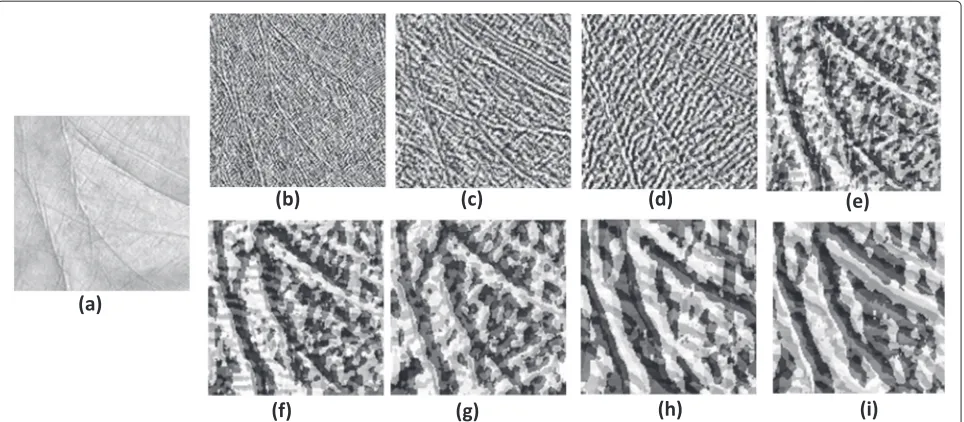
Figure 3 illustrates various BSIF filters that are included in the proposed B-BSIF scheme. Figure 4 shows the quali-tative results on the example palmprint with varying filter size with a fixed bit length of 8. It is interesting to observe
here that as the filter size increases the distinctive infor-mation about the coarse palm lines also increases. Thus, the use of the various lengths of filters will also result in capturing various information from the palmprint. Fur-thermore, the variation in wrinkles and ridges among different palmprints can be accurately characterized using a bank of BSIF filter rather than using a single BSIF filter.
Given the palmprint sample IP(m,n), we obtain the response of IP(m,n) to all BSIF filters in B-BSIF; we then perform the sparse representation of these obtained response individually on each filter. Thus, the sparse rep-resentation of features obtained from each filter in the B-BSIF can be carried out as follows:
Fig. 4Qualitative results of BSIF with different path size and fixed bit length of 8 bits.aInput palmprint image,b3×3,c5×5,d7×7,e9×9,
f11×11,g13×13,h15×15,i17×17
1. Given the reference palmprint samples, we first extract the BSIF features (corresponding to one filter) and construct a trainingTrfor allC classes (or subjects) as follows:
Tr=[Tr1,Tr2,. . .,TrC]∈ N×(nu.C) (4) Where,nudenotes the number of reference samples for each class andN indicates the dimension of the BSIF features obtained onnureference samples from C classes (or subjects).
2. Given that the test (or probe) sampleTeobtains the BSIF features (corresponding to same filter as above) that can be considered as a linear combination of the training vectors as:
Te=Trα (5)
Where,
α=α1,. . .,α1nu|,α2,. . .,α2nu|,. . .,|αC1,. . .,αCnu
(6)
3. Solvel1minimization problem [46] as follows:
ˆ
α=arg min
α∈Nα
1Te=Trα
(7)
4. Calculate the residual as follows:
rc(y)= Te−C(α
)2 (8)
5. Finally, obtain the comparison score as the residual errors to compute the performance of the overall system.
Finally, we repeat the above mentioned steps 1–5 on all 56 different BSIF filters in the bank and obtain the final
comparison score that corresponds to the minimum of residual errors obtained on all 56 filters in the bank.
3 Experimental results and discussion
This section presents the experimental results obtained on the proposed scheme for palmprint recognition. Exten-sive experiments are carried out on three different large-scale publicly available palmprint databases such as: (1) PolyU palmprint database [36], (2) IIT Delhi palmprint database [37], and (3) Multispectral palmprint PolyU database [3]. All the experimental results are presented in terms of equal error rate (EER), and we also present the statistical validation of the results with 90 % confi-dence interval [13]. In the following section, we present the experimental protocol adopted in this work.
3.1 Assessment protocol
This section describes the evaluation protocol adopted in this work on three different palmprint databases that are the same with our previous paper [35].
PolyU palmprint database This database comprises of 352 subjects such that each subject has ten sam-ples collected in two different sessions. For our experi-ments, we consider all ten samples from the first session as a reference and all samples from the second ses-sion as probe samples. The database is available for research purposes at http://www4.comp.polyu.edu.hk/~ biometrics/MultispectralPalmprint/MSP.htm.
Multi-Spectral PolyU palmprint database This database consists of 500 subjects whose palmprint samples are captured in two different sessions in four dif-ferent spectra: blue, red, green, and near infrared (NIR). Each session has six samples per subject. Thus, we select samples from first session as reference samples while we select second session samples as a probe. We repeat this procedure for all four spectral bands, and results are presented independently. The database is available for research purposes at http://www4.comp.polyu.edu.hk/~ biometrics/MultispectralPalmprint/MSP.htm.
3.2 Results and discussion
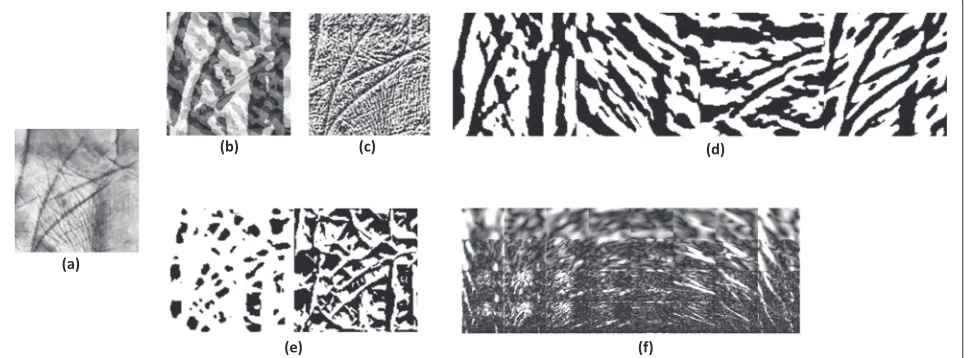
Figure 5 shows the qualitative results of the proposed scheme along with the five different state-of-the-art schemes employed in this work. It can be observed here that, the use of BSIF features appears to capture more accurate palmprint features that are characterized in terms of ridges and wrinkles. This qualitative result shows the superiority of the proposed BSIF features for palmprint recognition.
Table 2 shows the performance of the proposed scheme based on B-BSIF and SRC on the PolyU palmprint database. It can be observed here that, the proposed scheme shows the best performance with an EER of 4.06 %
indicates the performance improvement of over 1 % com-pared to our previous scheme [35] based on single BSIF features. This further justifies the applicability of the pro-posed scheme for palmprint recognition on yet another kind of database where palmprint samples are captured in a contactless fashion.
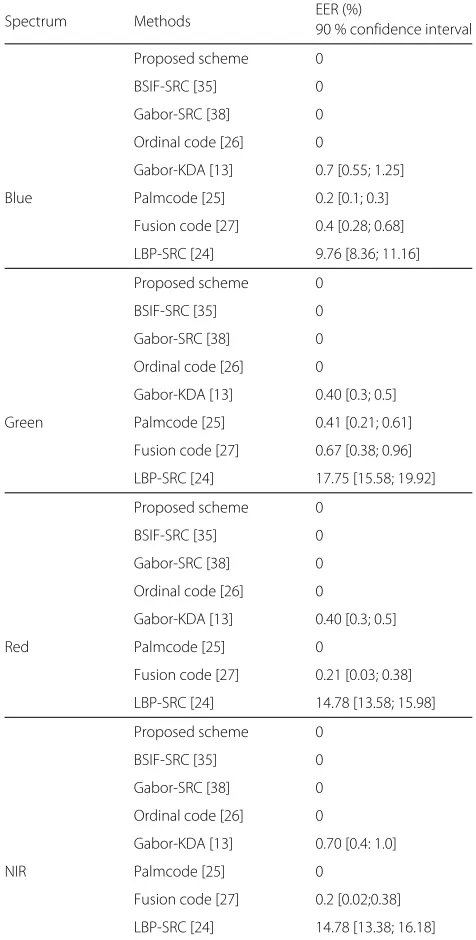
Table 4 shows the performance of the proposed scheme on the multi-spectral PolyU palmprint database. Here also it can be noted that the proposed scheme has achieved the outstanding performance with an EER of 0 %. These results further justify the applicability of the proposed scheme on different palmprint samples that are captured with different spectral bands.
Thus, from the above experiments, it can be observed that the proposed scheme has shown the best perfor-mance when compared with five well-established state-of-the-art schemes for the palmprint recognition. Further, the performance achieved using the proposed scheme on three different databases justifies its robustness and applicability of the palmprint recognition.
Table 5 shows the computation time of the various algorithms used in this work. All the algorithms are devel-oped in a Matlab software running on a PC with Intel i7 processor—8 Gb RAM and Windows 7. Note that all the described algorithms are implemented and not
Table 2Performance of the proposed method on PolyU palmprint database
Methods EER (%) with
90 % confidence interval
Proposed scheme 4.06 [3.56; 4.56]
BSIF-SRC [35] 6.19 [5.09; 7.29]
LG-SRC [38] 7.67 [6.47; 8.87]
LG-KDA [13] 7.96 [6.56; 9.36]
Palm Code [25] 14.66 [13.26; 16.06]
Ordinal Code [26] 7.66 [6.46; 8.86]
Fusion Code [27] 14.51 [13.21; 15.81]
LBP-SRC [24] 46.22 [43.84; 48.62]
optimized to run fast hence computation time provided in the Table 5 is just a reference.
4 Conclusions
Accurate representation of the features plays a vital role in improving the accuracy and reliability of the palmprint recognition. In this paper, we have introduced a novel approach for the palmprint recognition based on B-BSIF and SRC. The main idea of the proposed method is to use multiple BSIF filters with various size and length to con-stitute an ensemble (or bank of BSIF filters). Since each of these BSIF filters are learned on the natural images using the independent component analysis (ICA), they
Table 3Performance of the proposed method on IIT Delhi palmprint database
IIT Delhi DB Methods EER (%)
90 % confidence interval
Proposed scheme 0.12 [0.05;0.19]
BSIF-SRC [35] 0.42 [0.32;0.52]
Gabor-SRC [38] 1.23 [0.93; 1.53]
Ordinal code [26] 0.20 [0.15; 0.25]
Left hand Gabor-KDA [13] 2.34 [1.54; 3.14]
Palmcode [25] 2.67 [1.97; 9.37]
Fusion code [27] 2.34 [1.54; 3.14]
LBP-SRC [24] 10.41 [8.81;12.10]
Proposed scheme 0.72 [0.32; 1.12]
BSIF-SRC [35] 1.31 [0.91; 1.71]
Gabor-SRC [38] 1.42 [1.02; 1.82]
Ordinal code [26] 1.89 [1.59; 2.19]
Gabor-KDA [13] 7.82 [6.42; 9.22]
Right hand Palmcode[25] 3.41 [2.91; 3.91]
Fusion code [27] 3.39 [2.89; 3.89]
LBP-SRC [24] 13.38 [11.49; 15.28]
Table 4Performance of the proposed method on MS PolyU palmprint database
Spectrum Methods EER (%)90 % confidence interval
Proposed scheme 0
BSIF-SRC [35] 0
Gabor-SRC [38] 0
Ordinal code [26] 0
Gabor-KDA [13] 0.7 [0.55; 1.25]
Blue Palmcode [25] 0.2 [0.1; 0.3]
Fusion code [27] 0.4 [0.28; 0.68]
LBP-SRC [24] 9.76 [8.36; 11.16]
Proposed scheme 0
BSIF-SRC [35] 0
Gabor-SRC [38] 0
Ordinal code [26] 0
Gabor-KDA [13] 0.40 [0.3; 0.5]
Green Palmcode [25] 0.41 [0.21; 0.61]
Fusion code [27] 0.67 [0.38; 0.96]
LBP-SRC [24] 17.75 [15.58; 19.92]
Proposed scheme 0
BSIF-SRC [35] 0
Gabor-SRC [38] 0
Ordinal code [26] 0
Gabor-KDA [13] 0.40 [0.3; 0.5]
Red Palmcode [25] 0
Fusion code [27] 0.21 [0.03; 0.38]
LBP-SRC [24] 14.78 [13.58; 15.98]
Proposed scheme 0
BSIF-SRC [35] 0
Gabor-SRC [38] 0
Ordinal code [26] 0
Gabor-KDA [13] 0.70 [0.4: 1.0]
NIR Palmcode [25] 0
Fusion code [27] 0.2 [0.02;0.38]
LBP-SRC [24] 14.78 [13.38; 16.18]
Fusion code 12
LBP-SRC 10
that indicated the outstanding performance. The perfor-mance of the proposed scheme is compared with seven well-established state-of-the-art schemes. The obtained results justify that the proposed scheme has emerged as an efficient and robust tool for accurate palmprint recognition.
Competing interests
The authors declare that they have no competing interests.
Authors’ contributions
RR conceived, designed, and performed experiments. RR and CB contributed to the writing of the manuscript. All authors read and approved the final manuscript.
Acknowledgements
The authors extend their thanks to reviewers for the comments and suggestions which helped in improving the overall quality of this article. This work was funded by the EU 7thFramework Program (FP7) under grant agreementno284862 for the large-scale integrated project FIDELITY.
Received: 2 February 2015 Accepted: 30 July 2015
References
1. D Zhang,Palmprint authentication. (Springer-verlag, Guangzhou, China, 2004)
2. A Genovese, V Piuri, F Scotti,Advances in information security, vol. 60. Springer, (2014). doi:978-3-319-10365-5
3. D Zhang, Z Guo, G Lu, YLL Zhang, W Zuo, Online joint palmprint and palmvein verification. Expert Syst. Appl.38(3), 2621–2631 (2011) 4. W Shu, D Zhang, inPattern Recognition, 1998. Proceedings. Fourteenth
International Conference On. Palmprint verification: an implementation of biometric technology, vol. 1, pp. 219–221. Brisbane, Qld, 1998 5. D qingyun, Y yinglin, Z dapeng, A line feature extraction method based
on morphological median pyramid. J. South China Univ. Technol.29(5), 14–18 (2001)
6. C-C Han, H-L Cheng, C-L Lin, K-C Fan, Personal authentication using palm-print features. Pattern Recognit.36(2), 371–381 (2003) 7. JA Noble, Finding corners. Image Vis. Comput.6(2), 121–128 (1988) 8. L Liu, D Zhang, inIEEE International Conference on Image Processing (ICIP).
Palm-line detection, vol. 3, (2005), pp. 269–272. doi:10.1109/ICIP.2005. 1530380
9. J-Y Gan, D-P Zhou, inSignal Processing, 2006 8th International Conference On. A novel method for palmprint recognition based on wavelet transform, vol. 3, pp. 1–7. Beijing, 2006
10. X yuli, Palmprint feature extraction based on low frequency distribution. Microcomput. Appl.20(1), 40–43 (2011)
16. G Lu, D Zhang, K Wang, Palmprint recognition using eigenpalms features. Pattern Recognit. Lett.24(9–10), 1463–1467 (2003)
17. H Sang, W Yuan, Z Zhang, inAdvances in Neural Networks – ISNN 2009. Lecture Notes in Computer Science, ed. by W Yu, H He, and N Zhang. Research of palmprint recognition based on 2dpca, vol. 5552 (Wuhan China, 2009), pp. 831–838
18. W Zuo, K Wang, D Zhang, inImage Processing, 2005. ICIP 2005. IEEE International Conference On. Bi-directional pca with assembled matrix distance metric, vol. 2, (2005), pp. 958–61. doi:10.1109/ICIP.2005.1530216 19. X Pan, Q-Q Ruan, Palmprint recognition using Gabor feature-based
(2d)2pca. Neurocomputing.71(13–15), 3032–6 (2008)
20. G-M Lu, K-Q Wang, D Zhang, inMachine Learning and Cybernetics, 2004. Proceedings of 2004 International Conference On. Wavelet based independent component analysis for palmprint identification, vol. 6, (2004), pp. 3547–35506. doi:10.1109/ICMLC.2004.1380404 21. X Wu, D Zhang, K Wang, Fisherpalms based palmprint recognition.
Pattern Recognit. Lett.24(15), 2829–38 (2003)
22. M Ekinci, M Aykut, Gabor-based kernel pca for palmprint recognition. Electron. Lett.43(20), 1077–9 (2007)
23. R Raghavendra, A Rao, GK Hemantha, inInternational Conference on Advances in Computing, Control, Telecommunication Technologies. A novel three stage process for palmprint verification (Trivandrum, Kerala, 2009), pp. 88–92
24. X Wang, H Gong, H Zhang, B Li, Z Zhuang, inPattern Recognition, 2006. ICPR 2006. 18th International Conference On. Palmprint identification using boosting local binary pattern, vol. 3 (IEEE Hong Kong, 2006), pp. 503–6 25. A Kumar, H Shen, in3rd Int Conference on Image and Graphics, ICIG20.
Palmprint identification using palm codes (Hong Kong, pp. 258–261. doi:10.1007/978-3-642-04070-2_42
26. Z Sun, T Tan, Y Wang, SZ Li, inComputer Vision and Pattern Recognition, 2005. CVPR 2005. IEEE Computer Society Conference On. Ordinal palmprint represention for personal identification [represention read
representation], (2005), pp. 279–84. doi:10.1109/CVPR.2005.267 27. A Kong, D Zhang, M Kamel, Palmprint identification using feature-level
fusion. Pattern Recognit.39(3), 478–487 (2006)
28. J Wei, W Jia, H Wang, D-F Zhu, inEmerging Intelligent Computing Technology and Applications. Improved competitive code for palmprint recognition using simplified gabor filter, (2009), pp. 371–7.
ISBN:3-642-04069-1 978-3-642-04069-6
29. Z Khan, A Mian, Y Hu, inIEEE International Conference on Computer Vision. Contour code: Robust and efficient multispectral palmprint encoding for human recognition (Barcelona, 2011), pp. 1935–1942
30. A Kumar, D Zhang, Personal authentication using multiple palmprint representation. Pattern Recognit.38(10), 1695–1704 (2005)
31. W Li, J You, D Zhang, Texture-based palmprint retrieval using a layered search scheme for personal identification. Multimedia, IEEE Trans.7(5), 891–8 (2005)
32. A Kong, D Zhang, M Kamel, A survey of palmprint recognition. Pattern Recognit.42(7), 1408–18 (2009)
33. D Zhang, W Zuo, F Yue, A comparative study of palmprint recognition algorithms. ACM Comput. Surv.44(1), 2–1237 (2012)
34. J Kannala, E Rahtu, inPattern Recognition (ICPR), 2012 21st International Conference On. Bsif: Binarized statistical image features (IEEE, Tsukuba, 2012), pp. 1363–6
palmprint verification using sparse representation of binarized statistical features: a comprehensive study (ACM, New York, NY, USA, 2014), pp. 181–5
36. D Zhang, W-K Kong, J You, M Wong, Online palmprint identification. Pattern Anal. Mach. Intell. IEEE Trans.25(9), 1041–50 (2003) 37. A Kumar, inSixth Indian Conference on Computer Vision, Graphics Image
Processing (ICVGIP). Incorporating cohort information for reliable palmprint authentication (Bhubaneswar, 2008), pp. 583–90 38. R Raghavendra, C Busch, Novel image fusion scheme based on
dependency measure for robust multispectral palmprint recognition. Pattern Recognit.44(6), 2505–221 (2014)
39. H Lee, C Ekanadham, AY Ng, inAdvances in Neural Information Processing Systems. Sparse deep belief net model for visual area v2, (2008), pp. 873–80. www.eecs.umich.edu
40. G Hinton, S Osindero, Y-W Teh, A fast learning algorithm for deep belief nets. Neural Comput.18(7), 1527–54 (2006)
41. P Vincent, H Larochelle, Y Bengio, P-A Manzagol, inProceedings of the 25th International Conference on Machine Learning. Extracting and composing robust features with denoising autoencoders (ACM, New York, NY, USA, 2008), pp. 1096–1103
42. BA Olshausen, DJ Field, Sparse coding with an overcomplete basis set: A strategy employed by v1? Vision Res.37(23), 3311–25 (1997)
43. JH van Hateren, A van der Schaaf, Independent component filters of natural images compared with simple cells in primary visual cortex. Proc. R. Soc. London. Series B: Biol. Sci.265(1394), 359–66 (1998)
44. AJ Bell, TJ Sejnowski, The independent components of natural scenes are edge filters. Vis. Res.37(23), 3327–38 (1997)
45. A Hyvarinen, J Hurri, PO Hoyer,Natural Image Statistics. (Springer, Berlin, 2009)
46. J Mairal, F Bach, J Ponce, G Sapiro, Online learning for matrix factorization and sparse coding. J. Mach. Learn. Res.11, 19–60 (2010)
Submit your manuscript to a
journal and benefi t from:
7Convenient online submission 7Rigorous peer review
7Immediate publication on acceptance 7Open access: articles freely available online 7High visibility within the fi eld
7Retaining the copyright to your article