5458
A SYSTEMATIC STAKEHOLDERS AND TECHNIQUES
SELECTION FRAMEWORK FOR SOFTWARE
REQUIREMENTS ELICITATIONS
1FARES ANWAR, 2ROZILAWATI RAZALI
1Department of Computer Science, Faculty of Creative Media and Innovative Technology, Infrastructure
University Kuala Lumpur , 43000 Kajang, Selangor Darul Ehsan, Malaysiay
2Research Center for Software Technology and Management, Faculty of Information Science and
Technology,
Universiti Kebangsaan Malaysia, 43600, Bangi, Selangor, Malaysia
1E-mail: [email protected], 2E-mail: [email protected]
ABSTRACT
Requirements elicitation is the most critical phase in software requirements engineering. The process is indeed resource intensive, as it involves a number of dedicated stakeholders who are deliberately gathered to confer and stipulate software requirements. The effectiveness of the process is greatly influenced by the suitability of the stakeholders involved and the elicitation techniques used to gather the requirements. Previous studies indicate that improper stakeholder identification and technique selection normally lead to unsuccessful requirements elicitation process. Such phenomena would later cause serious impacts to projects such as costly rework, overrun schedule and poor quality software. Furthermore, the advancement of technology has introduced various requirements elicitation techniques. The existing technique options however are not always obvious. It is uncertain on how to select the right elicitation techniques for specific situations under certain constraints. This study addresses this issue by proposing a framework for selecting the suitable stakeholders and elicitation techniques to be used in the requirements elicitation process of a particular project. The study adopts qualitative data collection and analysis. The qualitative data were captured through individual and focus group interviews with experts. Through the analysis, the study formulates a set of criteria for choosing the right stakeholders, which later acts as the conditions to determine the suitable elicitation techniques to be used. In addition to the stakeholders’ characteristics, the study also considers technique features, requirements sources and project characteristics as the conditions to choose the elicitation techniques. The criteria and conditions form the systematic stakeholder and elicitation technique selection framework. The framework is useful for project managers to decide the appropriate stakeholders and elicitation techniques to be employed based on the stakeholder characteristics and project constraints.
Keywords: Stakeholders Selection; Techniques Selection; Requirements Elicitation.
1. INTRODUCTION
Requirements elicitation is the first stage in requirements engineering (RE). It involves identifying, gathering, and elaborating the requirements of stakeholders for a particular software system, from the context of requirements, goals, constraints, and features [1]. Usually, this process is carried out through investigation and exploration. Generally, it is agreed upon by experts that requirements elicitation is a very crucial part of the RE process [2] as it has a direct influence on software quality and cost [3]. Requirements elicitation itself is a very complex process involving many activities, with multiple techniques available to perform these activities.
The processes of requirements elicitation consist of identifying the key stakeholders and selecting the suitable techniques to gather requirements from those stakeholders [4].
5459 challenge that a manager has to face in a project [6]. In particular, the selection process has a big impact on the quality of the software requirements, namely their completeness, correctness and consistency [7].
In addition, due to the heterogeneity of stakeholders, the requirements elicitation activities must be carefully handled by effectively applying the appropriate elicitation techniques in dealing with the people involved [8], they have different ways of understanding and expressing their knowledge and of communicating with others. Thus, the requirements development processes can vary greatly depending on the people involved. A large number of techniques have been developed to acquire high-quality requirements from different types of people. However, due to an inadequate understanding of the techniques and the variety of the situations in which requirements are developed, it is difficult for organizations to identify a set of appropriate techniques to develop requirements in a structured and systematic way. Hence, requirements analysts need to be able proactively to identify and foresee the potential constraints that may exist in the requirements development process and select a proper technique to mitigate such problems. Therefore, it is important that analysts have an overall knowledge of the several requirements elicitation techniques to enable them to select a proper technique and gather the requirements. They should also be able to select techniques that fit the situational context and the characteristics of stakeholders. In summary, understanding requirements elicitation techniques and foreseeing the need to use them in different contexts are essential to the adequate performance of the process of requirements elicitation [9].
According to Pacheco & Garcia (2012), stakeholder selection in the requirements elicitation phase has received very little attention from the existing initiatives in software development such as Capability Maturity Model Integration (CMMi), Software Engineering Body of knowledge (SWEBOK), Business Analysis Body of Knowledge (BABOK) and International Organization for Standardization (ISO). They argued that these initiatives recognize the existence of different types of stakeholders in the area of requirements elicitation as well as suggest examples and categories of stakeholders. However, they do not provide examples of best practice or guidelines to help and guide requirement analysts in identifying those
stakeholders who need to be involved in a project [10].
5460 On the other hand, when the key stakeholders have been identified, there is a plethora of elicitation techniques from which to choose [15]. These include synthetic techniques such as Joint Application development (JAD), Rapid Application Development (RAD) and prototype that allow analysts and users to communicate collaboratively, analytic techniques like repertory grid, documentation studies and requirements reuse that capture requirements in indirect ways, observational techniques such as ethnographic study and protocol analysis that are a means to understand the application domain and tacit requirements and conversational techniques such as interviews, focus groups and brainstorming that work best at capturing non-tacit or explicit requirements [9]. These options are not always obvious. It is not clear how to select the appropriate techniques for specific situations under certain conditions. Furthermore, there is no ideal requirements elicitation technique that can satisfy the needs of every situation. Each works best in a specific scenario under certain conditions. Moreover, they often operate in concert and complementarily where the limitation of one technique is compensated by the strength of the other [16, 17]. However, several studies have proposed selection guidelines based on the requirements elicitation process. For instance, a pragmatic requirements elicitation strategy was introduced to manage the diverse views, information and proficiency brought by stakeholders during the requirements elicitation process [18]. The strategy focuses on objectives within a scope that is based on four principles: divide and conquer, communicate to promote, stimulate for innovation and unify diversity. The idea is to bring stakeholders together so that they can generate creative ideas for the future working practices of end users. The strategy adopts several requirements elicitation techniques. To comprehend contemporary working practices such as, scenario-based analysis is employed. For gathering visions from end users, user-stories seem to be appropriate. To allow in-depth discussion, workshops and online conferences are used to engage technical users.
A.M. Hickey and A.M. Davis (2003) investigated elicitation technique selection and state that a particular elicitation technique may be selected for a variety of reasons, which include (a)” the technique selected is the only one the analyst knows, (b) the technique selected is the analyst’s favourite,” (c) the selected technique is
the one prescribed by a specific methodology that is being followed for system development and (d) the choice of technique is governed solely by the intuition of the analyst that it will be effective in the current context [19]. The selection of requirements elicitation techniques could also be based on the nature of software project. For instance, a study has suggested the use of more than one requirements elicitation technique in high-volatility projects with extensive requirements such as supply-chain solutions [8]. Interviews, workshops and evolutionary prototyping techniques are combined to collect the needs from such projects because they are complicated and involve randomly varying requirements. For distributed or geographical software development however, groupware techniques such as voice conferencing, the question-and-answer method, use cases and brainstorming as well as efficient requirements management are recommended [20]. Although previous studies have proposed a number of possible approaches for selecting requirements elicitation techniques, they are mainly narrowly focused and hypothetical. Projects normally require pragmatic approaches that are workable under real-world conditions and constraints. Analysts therefore need practical guidance, which is best derived from practitioners’ experience and empirical evaluation. Therefore, there is a need make requirements analysts aware of the need for guidelines derived from empirical evidence to select the most appropriate techniques. However, there is no comprehensive practical guide on how to select the best techniques for a particular contextual situation within a software development project [21]. In addition, Aguirre-Urreta and Marakas (2009) argued that the literature has yet to converge on a framework prescribing the most effective use of specific techniques in a variety of situations [22]. In summary, both researchers and practitioners seem to recognize that poor stakeholder and techniques selection are almost guaranteed to result in a poor product. This study addresses this issue by identifying and integrating essential stakeholder and technique selection factors in a form of systematic framework. The framework is aimed to be as a guide for attaining an effective requirements elicitation process through selecting the right stakeholders and suitable techniques.
5461 Section 4 concludes the paper with a summary of the main findings and future work.
2. MATERIAL AND METHOD
The purpose of this paper is to provide a practical framework that could help practitioners particularly analysts and project managers to select the appropriate stakeholders and determine the suitable techniques to be used for a project. The framework contains a set of important factors that affect the selection of stakeholders and techniques, which were gathered from a series of empirical study. The field study involved in-depth individual and a focus group interviews with several experienced practitioners from software industry. In general, this study aimed to answer the following research questions (RQ):
RQ1: What are the required factors that need to be considered when selecting stakeholders for requirements elicitation purposes?
RQ2: What are the required factors that need to be considered when selecting suitable techniques for requirements elicitation purposes?
RQ3: How can the stakeholders for the requirements elicitation process be selected appropriately?
RQ4: How can the suitable requirements elicitation techniques be determined?
RQ5: How can the criteria of selecting stakeholders and techniques be integrated as a holistic and systematic framework for requirements elicitation process?
To answer this research questions, this study adopts a methodology that includes data collection and analysis using qualitative approaches. Qualitative research is best suited to address a research problem in which the variables are not known and need to be explored [23]. Merriam (2009) described qualitative researchers as individuals who are interested in understanding how people interpret their experiences, how they construct their worlds and what meanings they attribute to their experiences. As a result, qualitative techniques allow researchers to share in the understandings and perceptions of others and to explore how people structure and give meaning to their daily lives [24].
This empirical study comprised two phases. The first phase involved individual interviews. The interview technique was selected because allow investigator to gain access to the
subjective experience of individuals [25]. Moreover, interview is the most effective method for obtaining expert knowledge [26]. The researcher adopted the use of semi-structured interview questions to collect data for the study. The one-to-one interview was conducted. The questions were formulated based on the theoretical factors found in the literature. The questions consisted of eight open-ended questions, divided into three sections. In order to develop a context for understanding the participants’ perspectives, the first several questions in the interview focused on the experts’ experiences. The remaining questions asked the participants to reflect on their experiences in selecting stakeholders and techniques during requirements elicitation. The Open-ended questions were deemed to be the most suitable type for this study due to the high-level nature of the topics covered and the different expert experiences [27]. An interview protocol was developed for this study, which serves to remind the interviewer of the questions and it offers a means of recording notes. Prior to conducting the interviews, an initial version of the interview questions was internally piloted to determine any questions overlapping, the relevancy of the questions to the topics, phrasing consistency and clarity of explanation. The pilot study was conducted through a face-to-face interview using the created protocol with participants who were external to the research.
5462 However, the objective of focus groups is not primarily to elicit the group’s answers, but rather to stimulate discussion and thereby understand the meanings and norms which underlie those group answers. This study therefore encouraged the focus group participants to discuss issues regarding stakeholders and techniques selection during requirements elicitation based on the underlying norms, beliefs and values in their own settings.
As a qualitative research, a purposeful research sampling was used in this study. Purposeful sampling is meant to be used in exploring and understanding the “central phenomenon” [23]. In purposeful sampling, it is necessary to identify a sampling strategy, and this choice depends on the research problem and questions. Homogeneous sampling is one of the types of purposeful sampling, and was the strategy employed for this study. The next step was to establish the criteria for the participants based on the reasonable assumptions of what would constitute an expert and support the type of knowledge sought after. The criteria used in the study were the participants must possess at least 10 years’ experience in software development and have worked on a various sizes and types of projects. Several participants who matched the criteria were contacted by email or telephone to participate in the research. This study selected 12 practitioners as informants. A total of seven experts agreed to participate for interview while five experts agreed to participate in focus group session. A letter of invitation was emailed to the participants prior to individual and focus group interview. For the interview the participants were interviewed at their respective organisations. After the participants had agreed to sign a consent form in accordance with the university’s ethics requirements, brief sessions were conducted then the interview sessions were initiated. The experts were interviewed individually on weekdays. The number of questions asked was kept within approximately one hour. The interviews were conducted over a span of three months. The interview sessions were tape-recorded. On the other hand, the focus group session was conduct in hotel meeting room. The focus group session was video-recorded. In addition, the informants were from different organizations in Yemen and Malaysia. A participant possessed an average of twelve years of experience in RE. The types of projects that they had participated in included finance, human resources, telecommunications,
education, healthcare, electronic government, among others. Their roles in the projects included analyst, project manager, consultant and director.
Based on the discussion above, it is evident that qualitative research studies phenomena in their natural environment, concentrates on experiences and perceptions and attempts to understand people or attributes of things in the real world. It is also evident that qualitative research entails the use of descriptive data and inductive techniques for retrieval and understanding and for the expansion of meaning from a small group to a larger one with similar or identical characteristics. It is analytical and interpretative in style and employs many data sources to reach conclusions.
With regards to the various data analysis processes available, the data gathered from both phases were analysed by using content analysis. Content analysis was chosen because it performs thematic analysis that helps to identify factors and the relationships between them [31]. Furthermore, content analysis allows the discovery of trends in existing phenomena [32]. It enables the identification of significant themes in the responses of the experts in terms of existence, frequency and relations between keywords and concepts [33]. To initiate the process of content analysis, a coding procedure was conducted. The coding procedure began by giving a label to each text segment. A text segment may range from few words to a paragraph. The goal of coding is to rearrange and integrate the related words, sentences or paragraphs together in order to draw a meaningful description about the data [34]. The data then formed a major idea, which represents a specific theme. In this study, the themes are the factors that contribute to stakeholder and technique selection in requirements elicitation. The tool used to help organising and analysing the data was Nvivo 9 [35]. The decision to use a software tool for coding the data during content analysis was due to the relatively high volume of data collected and the effort required to perform the data analysis manually. Nvivo 9 provides an efficient way to handle unstructured data and facilitate the process of indexing, analysing, querying and visualising the data.
3. RESULTS AND DISCUSSION
5464
5465
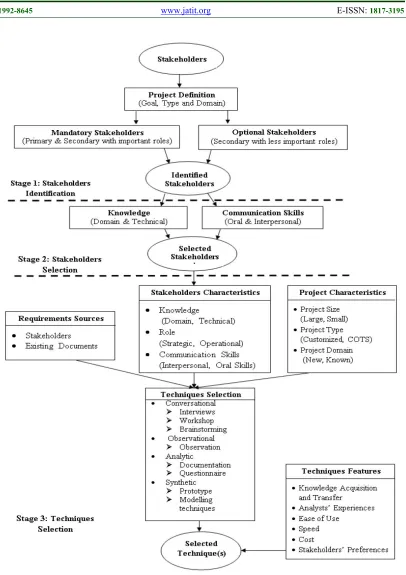
3.1 Stage 1 – Stakeholders Identification
At the beginning of any project, setting project definitions is considered the initial step that should be taken by the projects managers. Project definitions actually include goals and system descriptions, such as type and domain. Projects goals identify what is intended to be achieved during the project whereas type and domain identify the project features and environment that should be built. These project definitions result in identifying certain types of stakeholders. There are two types of stakeholders: primary and secondary stakeholders. The former have the direct impact on the project and individuals as they have the authority and power while the latter is affected by the project at the operational level as in system’s end users. The roles of the stakeholders vary in importance, influence and significance but those who have the most important roles must be selected. Primary stakeholders are considered more important than secondary ones as they affected more by the project outcomes. For instance, top management is considered as a primary stakeholder, as they are the ones who make the crucial decisions. On the other hand, the role of the secondary stakeholders may be important in some cases where their participation in certain tasks is highly required. Basically, to gain accurate results, secondary stakeholders must be taken into consideration as they contacted directly with the proposed system and/or use its results in daily business operations. However, this stage gathers as many potential stakeholders as possible who belong to the stipulated Types and Roles.
3.2 Stage 2 – Stakeholders Selection
Since the identified number of stakeholders can be massive in size, in this stage, some forms of analysis should be conducted. For that, stakeholders’ competency is taken into consideration where the selection standards are their knowledge and communication skills. The knowledge factor also can be divided into two types that are business/domain and technical knowledge. Business/ domain knowledge means that the stakeholders must obtain organizational information while stakeholders with technical knowledge means people who work on the project and deliver some products using their technical expertise and those who are needed to do the technical contact with the system.
In addition, requirements elicitation is indeed a collaborative process that requires
intensive communication and intervention between various parties. Communication skills are very important factor. Stakeholders should possess good communication skills such as oral and interpersonal in order to share that knowledge. Oral skills enables stakeholders to express ideas and thoughts clearly and in an effective way while interpersonal skills is important to settle down issues that may appear as approaching the ideas of two parties to avoid conflict. The output of this analysis is a list of shortlisted candidates who are eligible to be involved in the requirements elicitation process. Stages 1 and 2 were discussed in details in our previous research [36], [37].
3.3 Stage 3 – Techniques Selection
After selecting the suitable stakeholders, the process of applying requirements elicitation techniques selection is carried out by taking into consideration the following factors: Stakeholders Characteristics, Requirements Source and Project Characteristics as they are the accurate indicators of selecting the suitable requirements elicitation technique. Moreover, this stage consists of several techniques that have different and relative strengths and weaknesses, and may be more or less suited to a particular type of situation and environment.
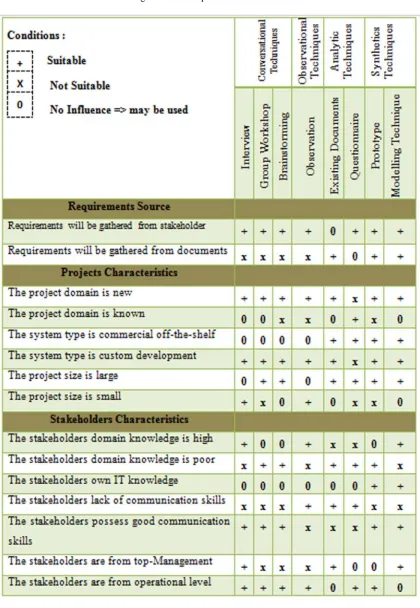
To conduct the techniques selection in proper way, this study has been proposed a matrix for requirements elicitation techniques selection which can help analysts in selecting the suitable elicitation techniques. Figure 2 illustrates the techniques selection matrix which consists of three categories with eight factors namely, Requirements Source (stakeholders and documents), Projects Characteristics (domain, type and size) and Stakeholders Characteristics (knowledge, role and communication skills). Moreover, the frameworks consists of eight techniques include interviews, workshops, brainstorming, ethnography, questionnaires, documentation, modelling and prototype.
Figure 2 below presents which of the selected core group of techniques are best suited for specific requirements elicitation activities. The matrix shows the final result, according to the following notations:
5466 technique therefore should be given higher priority over other techniques during selection.
0: The technique is neutral or no influence. It is uncertain whether by applying this technique the requirements elicitation would be better than those obtained using others. While this technique can be selected,
a more adequate technique such as (+) is preferable.
X: The technique is not suitable to be selected. It is not recommended to be used under the stated circumstances. If selected it is likely to produce worse results than other preferred techniques such as (+).
The following paragraphs demonstrate several cases on how the matrix is used to guide the selection of requirements elicitation techniques.
3.3.1 Requirements sources
To apply and use this matrix, the practitioners need to firstly select from the Requirements Source category which consists of two factors: Document and Stakeholders. If the selected source is Document, the practitioners can then choose from the Project Characteristics category only. Else, if the selected source is Stakeholders, the practitioners can select from both Stakeholders Characteristics and Project Characteristics categories. From the analysis, it is found that those two sources are used complementary. Stakeholders often become the main source, followed by documents. The knowledge of stakeholders is the most important source. Stakeholders’ ideas are necessary to define the requirements of a system. Documents consist of manuals, forms, job descriptions and corporate reports, which can provide analysts with useful information about the target system and the organisation. They can also be universal documents such as standards and legal documents. However, examining existing documents consumes a lot of time as analysts need to cautiously review and choose the ones that are directly related to the project.
3.3.1.1 Stakeholders
To ensure high quality requirements, identifying the relevant stakeholders is indeed a central task of requirements engineering.
It is therefore vital to select the right stakeholders systematically based on certain quality criteria. If users are cooperative and can be accessed easily, Conversational (interviews, brainstorming and
workshops), Observational (ethnography), Analytic (questionnaire) and Synthetic (modelling and prototype) techniques are preferred.
3.3.1.2 Documents:
This source is useful for capturing other knowledge, which cannot be directly acquired from stakeholders. In particular, it is good at exploring domain knowledge that is difficult to articulate and understand. Documentation techniques are particularly viable when the organization has clear policy and procedures that are properly documented. Below is the response from informant that supports this factor:
Informant C: “Documents, prototypes and
modelling techniques are suitable for companies that own clear policy, procedure, and documentation.”
3.3.2 Project characteristics:
Project characteristics also influence the selection of requirements elicitation techniques. The Project Characteristics category consists of 3 factors with 6 options. Each factor contains of two options which the practitioners can only select one of them. The first factor is related to Project Domain, either it is new or similar to previous projects. The second factor is System Type, either it is commercial off-the-shelf or custom development. The third factor is about the Project Size whether it is a big or small project based on the number of participants.
3.3.2.1 Project domain
When users are unable to express what they want and analysts have shallow domain understanding and system is new, Conversational (interview, group workshop and brainstorming), Analytical (documentation), Observational (ethnography) and Synthetic (prototype and modelling) techniques are used. Below are the responses from informants that support this factor:
Informant B: “We use interviews when the
wanted system is not stereotyped. For example, to build a financial system, we do not need to conduct interviews as the system is known and
customary.”
Informant F: “I like to utilize group discussion as
it helps to obtain required information when the domain of the system is new. This is because group discussion helps you to consider many disparate opinions and “two eyes always see better than one.”
Informant B: “You can use brainstorming as it
5467
Informant F: “We select the observation
technique if the project domain is new. For example, when I am asked to build a system that I am not familiar with and the domain is new to me, I first have to learn all the basic and essential things. Thus, I go to the organization in order to observe how the work is done.”
Informant E: “When we signed for a
development project which domain is new to us, we first acquire the documents from the organization that are being used at the present. Then, we try to comprehend the work flow and attempt to get an overall picture. Only after this, we meet the users.”
Informant C: “The prototype approach is used
with non-slandered systems and large project types where there is adequate budget.”
Informant E: “Diagrams is used in large projects
and if the project domain is new.”
In contrast, techniques like questionnaires are better if analysts have sufficient domain understanding and experience as they help users to say out what they want. Questionnaires however require predetermined questions and answers, which have to be carefully prepared.
Informant B: “We use questionnaire when the
required system is stereotyped.” 3.3.2.2 Project type
If the system is to be developed through Commercial-Off-The-Shelf (COTS), Analytical (questionnaire and documentation) and Synthetic (prototype) techniques are employed. Below are the responses from informants that support this factor:
Informant A: “Sometimes we want to build a
general product that can be used by several companies such as commercial off-the-shelf systems. In this case, the questionnaire approach will be suitable because we can obtain opinions from a random and large sample of people.”
Informant D: “Documents can be used to form
and construct a picture of the system and this helps to increase the analyst’s knowledge when the company wants to build a COTS system.”
Informant H: “From my previous experience, I
can state that there is no requirement for Commercial of the Shelf (COTS). Even if you select COTS, you need to customize it again. In this situation we will use prototype to get the required feedback. “
If the system is customized for a specific organization, all techniques are mainly needed except questionnaire.
Informant A: “Several techniques like interview,
workshop, observation, modelling, prototype, and
brainstorming could be used when the system is customized and consists of special and unique operations and processes. The advantage of these methods is that they help in knowledge transfer from the user to the analyst.”
Informant E: “We begin by taking documents
from the client in case the system is fixed and when the client wants to build a system with the same mechanism currently used in his company.” 3.3.2.3 Project size:
Project size in the study refers to the number of stakeholders involved. If the project involves many users who come from various units, Conversational (workshops and brainstorming), Analytical (documentation and questionnaires) and Synthetic (prototype and modeling) techniques seem to be more practical. Workshops are also conducted to resolve the discrepancies of information between users during interviews. Whenever workshops cannot be accomplished due to too large number of users required, questionnaires seem to be a viable option. Below are the responses from informants that support this factor:
Informant A: “When the project size is large and
we need to meet a large number of users from different departments; workshops and
brainstorming are conducted.”
Informant C: “We use questionnaire and
documents techniques in large projects.”
Informant E: “Diagrams is used in large projects
and if the project domain is new.”
Informant C: “The prototype approach is used
with non-slandered and large project types where there is adequate budget.”
On the other hand, interview and observation techniques found suitable for small projects.
Informant F: “Interviews are used with small
number of users.”
Informant B: “For projects with small size we
select the observation technique.”
3.3.3 Stakeholders characteristic
5468
5469 for projects that need stakeholders who have knowledge in IT. The third factor concerns Communication Skills, whether stakeholders possess good communication skills. Finally, the fourth factor is about the Stakeholders’ Role in the organization, either they are from top-management or operational level staff.
3.3.3.1 Stakeholders’ knowledge:
The analysis revealed that stakeholders’ knowledge in many ways influence the selection of requirement elicitation techniques. There are two types of knowledge involved during requirement elicitation, namely domain and technical knowledge. Domain knowledge means deep understanding about the system to be built and its business processes. On the other hand, technical knowledge refers to understanding of software development methods and tools. With deep domain knowledge among users, Conversational (interviews) techniques Observational (ethnography) and Synthetic (modelling) are preferred. This is because conversational techniques such as interviews allow two-way communication and in-depth discussions. Below are the responses from informants that support this factor:
Informant I: “Interviews will be suitable for
users with high domain knowledge. If low domain knowledge we use workshop”
Informant D: “We use observation when the user
has the required knowledge but cannot express what he wants.”
Informant D: “The modelling approach is
utilized when: the users have knowledge and comprehension of the business flow, grasp the possibilities and capabilities of the system concerned, understand what is implausible, and possess good communication skills.”
On the other hand, if the stakeholders have poor domain knowledge, techniques like workshop, brainstorming, document, questionnaire and prototype are advisable.
Informant G: “Sometimes customer wants system
but they don’t know how, they just show us some example for that, we use brainstorming to get some ideas.”
Informant B: “We use document when there is
lack of knowledge on the subject and also when the user cannot state his work in a meaningful way.”
Informant F: “The people concerned in an
organization influence the mode of selection. Sometimes, there is a case that the person I am interviewing is reluctant to share the required information or it can be that the interviewee lacks
the requisite knowledge. In addition, if the interviewee has poor communication skills, he or she may not be able to communicate well and the ensuing discussion may be ineffective. In these cases, the questionnaire is the best technique to use.”
Informant E: “Prototype is most beneficial to the
user because it formulates a preliminary version of the project and enables the user to understand how the system will be when the user does not know what he or she wants.”
If users have an adequate level of technical knowledge, Synthetic techniques (prototype and modelling) are applicable. This is due to the reason that such techniques require the use of certain notations and technology, which users have to comprehend and appreciate. In cases where users do not possess technical knowledge, Conversational, Observational, Analytical techniques are more suitable.
Informant B: “When we get to talk with users
who have idea about IT and have the ability to express and transfer information, prototype is useful. This is because this method helps to show the user the nature of the system and the type of information that we need from him.”
Informant F: “Diagrams were mainly used when
users have technical knowledge.”
3.3.3.2 Stakeholders’ communication skills:
Conversational (interviews, workshop and brainstorming) and Synthetic (prototype and modelling) techniques are also used if users possess good communication skills as users can efficiently transfer knowledge with better support from analysts. Below are the responses from informants that support this factor:
Informant G: “If the user has good
communication skills, then interview is preferred. Otherwise, we rely on observation.”
Informant H: “I think that group discussion is
better when the user’s communication skills are high because the user can transfer the knowledge to his or her colleague and the colleague can then transfer the knowledge to us.”
Informant G: “Communication skills of the
stakeholders are very important in brainstorming.”
Informant D: “The modelling approach is
utilized when: the users have knowledge and comprehension of the business flow, grasp the possibilities and capabilities of the system concerned, understand what is implausible, and possess good communication skills.”
5470 techniques are employed especially when Conversational techniques are ineffectual due to communication problems.
Informant C: “When the case is such that the
user lacks the requisite communication skills to verbalize his or her work in a meaningful way, then observation is the best alternative”
Informant D: “If the interviewee has poor
communication skills, he or she may not be able to communicate well and the ensuing discussion may be ineffective. In these cases, the questionnaire is the best technique to use.”
3.3.3.3 Stakeholders role:
Users’ role also influences analysts’ decisions on the techniques. It seems that Conversational (interviews), Analytical (document) and Synthetic (modelling) techniques are normally selected for eliciting requirements for systems that involve users from top-management while interview, workshop, brainstorming, observation, questionnaire and prototype techniques used with stakeholders from operational level. Below are the responses from informants that support this factor:
Informant A: “When we plan to meet individuals
in high level positions, like managers, we use individual interviews.”
Informant B: “We use context diagram with staff
in high level positions which contain general ideas about the system.”
Informant G: “For users in the operational level,
group sessions are used.”
Informant I: “Before we start any project we
plane for that project and from our planning we try to see who are targeted in our project like our employer, outside customers and the higher management. From this planning we contact the involved section or department in the organization to know who are the power users that we can depend on them to collect or gather the data.”
Informant I: “Brainstorming can be use to get
new ideas from the needed user or experts.”
Informant A: “It’s important to observe how the
staff works in order to understand the workflow and what the initial requirements are.”
Informant I: “This technique cannot be
implemented for eliciting information from top management as people in these positions are always very busy. Therefore, questionnaires are most effective when used for stakeholders in lower levels such as operational staff.”
Informant A: “Normally, an interview is
conducted when something needs to be clarified with user from operational level in order to know how the job is done. “
Informant G: “After getting the entire
requirements from the user we develop a prototype to show back to the user is this what you want as we understand from you.”
3.3.4 Technique features:
[image:13.612.311.529.429.593.2]For the Techniques Features factor, the findings of this study indicated that regardless of technique categories there are few factors impact the techniques selection which are: the ability of the technique to facilitate knowledge acquisition and transfer among users and analysts is the most important factor. The next important factor is the experience of the analysts. The ease of use is the third factor that affects the selection. Speed, cost and stakeholders’ preferences are other factors mentioned by the informants. Table 1 below illustrates the responses received from the informants. These factors are considered as supporting factors that may help analysts in techniques selection after obtaining the result from the proposed matrix based on the accurate factors (Stakeholders Characteristics, Requirements Source and Projects Characteristics). As a result, the selection based on the Techniques Features factor varies from one analyst to another and it’s highly affected by the analysts’ opinion specifically when there is more than one technique.
Table 1. Selection Factors Based On Techniques Features.
Techniques
Category Factor
Frequency (No. of Informant )
Conversational Observational Analytical Synthetic
Knowledge Acquisition and Transfer
10/12
Analysts’ Experiences
9/12
Ease of Use 7/12
Speed 6/12
Cost 5/12
Stakeholders’
Preferences 3/12
4. CONCLUSIONS
5471 requirements elicitation techniques should be selected for a project. In general, practitioners tend to select stakeholders that have certain characteristics values and support closely the environment of the project. They also choose techniques based on their stakeholders characters, project characteristics as well as the sources from which the requirements are gathered.
From these results, instantiating the framework for a particular case, analyst will be given several options of elicitation techniques that are suitable to be used in the next elicitation session. The framework can help practitioners to select the right stakeholders and what technique(s) to apply in a given elicitation session. To do this, the requirements analysts should be aware of Stakeholders Characteristics namely, Type, Role, Knowledge and Communication Skills as well as the projects context in terms of the Requirement Source, Project Characteristics and Techniques Features.
The output of this framework is a list of shortlisted stakeholders as well as techniques which are suitable for use in the requirements elicitation process. The framework provided by this study is seen as useful particularly to analysts who opt for realistic solutions. Unlike previous frameworks, it does not merely rely on what one believes. Rather, the framework is based on what is being practiced in industry that seems to be effective and feasible.
REFERENCES:
[1] Shams-Ul-Arif, Q. Khan and S. A. K.
Gahyyur, “Requirements engineering processes, tools/technologies & methodologies”, International Journal of
Reviews in Computing, vol.2, pp. 41-56. 2010.
[2] C. J. Davis, R. M. Fuller, M. C. Tremblayand
D. J. Berndt, “Communication challenges in requirements elicitation and the use of the repertory grid technique”, Journal of
Computer Information Systems, vol. 46, pp.
78, 2006.
[3] J. Cybulski and P. Sarkar, “Requirements engineering for web-based information systems”, Engineering and managing
software requirements, pp. 327-349, 2005.
[4] D. Zowghi and C. Coulin, Requirements elicitation: a survey of techniques,
approaches, and tools, Engineering and
Managing Software Requirements, C. W.
Aybüke Aurum, Ed., ed: Spriner,Verlag, 2005 19-46.
[5] S. Robertson, Project Sociology: Identifying and involving the stakeholders, The Atlantic
Systems Guild Ltd, 2000.
[6] J. McManus, “A stakeholder perspective within software engineering projects”, In Proc.
Engineering Management Conference, IEEE,
pp. 880-884, 2004.
[7] C. Pacheco and E. Tovar, “Stakeholder identification as an issue in the improvement of software requirements quality,” Advanced Information Systems Engineering. Springer
Berlin Heidelberg, pp. 370-380, 2007.
[8] D. Mishra, A. Mishra and A. Yazici,
“Successful requirement elicitation by combining requirement engineering techniques,” in Proc. of the First International Conference on the Applications of Digital
Information and Web Technologies, pp.
258-263, 2008.
[9] Z. Zhang, “Effective requirements development–a comparison of requirements elicitation techniques”, in Proc. Software Quality Management in the Knowledge
Society ,British Computer Society, pp.
225-240, 2007.
[10] C. Pacheco and I. Garcia, “A systematic literature review of stakeholder identification methods in requirements elicitation”,
Journal of Systems and Software, vol. 85, pp.
2171-2181, 2012.
[11] H. Sharp, A. Finkelstein, and G. Galal,
“Stakeholder identification in the requirements engineering process”, In Proc. Tenth International Workshop on IEEE, p. 387-391, 1999.
[12] M. Glinz and R. J. Wieringa, “Guest editors' introduction: stakeholders in requirements engineering”, Software, IEEE, vol. 24,
pp.18-20, 2007.
[13] L. C. Ballejos and J. M. Montagna, “Method for stakeholder identification in interorganizational environments”,
Requirements Engineering, vol.13
pp.281-297, 2008.
[14] S. M. Young, S. McDonald, H. M. Edwards
and J. B. Thompson, “Quality and people in the development of situationally specific methods”, In Proc. Second Asia-Pacific
Conference, pp. 199-203, 2001.
[15] B. Nuseibeh and S. Easterbrook, “Requirements engineering: a roadmap”, In
Proc. of the Conference on the Future of
Software Engineering, pp. 35-46, 2000.
5472
Behavioral Science, vol.23, pp. 543-551,
1987.
[17] A. Sutcliffe, “A technique combination approach to requirements engineering”, In
Proc. of the Third IEEE International
Symposium on Requirements Engineering,
pp. 65-74, 1997.
[18] F. Yang-Turner and L. Lau, “A pragmatic strategy for creative requirements elicitation: from current work practice to future work practice”, In Proc.Workshop on Requirements Engineering for Systems, Services and
Systems-of-Systems, IEEE, pp. 28-31, 2011.
[19] A. M. Hickey and A. M. Davis, “Elicitation technique selection: how do experts do it?”,
In Proc. of 11th IEEE International
Conference on Requirements Engineering,
pp. 169-178, 2003.
[20] W. J. Lloyd, M. B. Rosson and J. DArthur,
“Effectiveness of elicitation techniques in distributed requirements engineering”, In
Proc. of the IEEE Joint International
Conference on Requirements Engineering,
pp. 311-318, 2002.
[21] D. Carrizo, O.Dieste and N. Juristo, “Study
of elicitation techniques adequacy”, In Proc.
XI Workshop on Requirements Engineering,
pp. 104-114, 2008.
[22] M. I. Aguirre-Urreta and G. M. Marakas, “Requirements elicitation technique selection: a theory-based contingency model”, In. Keng, S. and John, E. (Keng, S. and John, E.). Advanced Principles for Improving Database Design, Systems Modeling, and Software Development,
Hershey, PA, USA: IGI Global, pp. 79-95, 2009.
[23] J. W. Creswell, Educational Research: Planning, Conducting, and Evaluating
Quantitative and Qualitative Research 4th
ed. Boston: Addison Wesley, 2012.
[24] S. B. Merriam, Qualitative research: A
guide to design and implementation: John
Wiley & Sons, 2009.
[25] P. M. Camic, J. E. Rhodes and L.Yardley,
Naming the stars: Integrating qualitative methods into psychological research, in
Qualitative Research in Psychology: Expanding Perspectives in Methodology and
Design, J. E. R. Paul Marc Camic, Lucy
Yardley, Ed., ed: American Psychological Association, 2003.
[26] R. Agarwal and M. R. Tanniru, Knowledge acquisition using structured interviewing: an empirical investigation, Journal of
Management Information Systems, vol. 7,
pp.123-140, 1990.
[27] M. Q. Patton, Qualitative Research &
Evaluation Methods, SAGE Publications,
2002.
[28] N. Robinson, The use of focus group methodology—with selected examples from sexual health research, Journal of Advanced
Nursing, val. 29, pp. 905-913, 1999.
[29] D. W. Stewart, P. N. Shamdasani, and D. W.
Rook, Focus groups: Theory and practice,
Sage Publications, Incorporated, 2006. [30] R. K. Merton, “The focussed interview and
focus groups: Continuities and discontinuities”, The Public Opinion
Quarterly, val.51, pp. 550-566, 1987.
[31] J. Coughlan, M. Lycett, and R. D. Macredie, ,
Communication issues in requirements elicitation: a content analysis of stakeholder experiences, Information and Software
Technology, val.45, pp. 525-537, 2003.
[32] E. Denton, “International news coverage of human trafficking arrests and prosecutions: a content analysis”, Women & Criminal
Justice, val.20, pp.10-26, 2010.
[33] C. R. Coulin, A situational approach and intelligent tool for collaborative requirements elicitation, University of
Technology, Sydney, 2007.
[34] U. Sekaran. and R. Bougie, Research Method For Business: A Skill Building
Approach, 5th ed. UK: John Wiley & Sons,
2010.
[35]http://www.qsrinternational.com/products_nvi vo.aspx.
[36] F. Anwar and R. Razali, “A Practical Guideline of Selecting Stakeholders for Requirements Elicitation–An Empirical Study”, International Journal of Software
Engineering and Its Applications, val.9,
pp.95-106, 2015.