R E S E A R C H A R T I C L E
Open Access
The importance of wellness among users of
complementary and alternative medicine:
findings from the 2007 National Health
Interview Survey
Dawn M. Upchurch
1*and Bethany Wexler Rainisch
2Abstract
Background:This study developed and tested a sociobehavioral wellness model of complementary and alternative medicine (CAM) to differentiate predisposing factors, enabling resources, need, and personal health practices according to use for wellness, for combined wellness and treatment, or for treatment alone.
Methods:Data were from the 2007 National Health Interview Survey (NHIS), a cross-sectional, nationally representative sample of 23,393 adult Americans. This analysis included people who used at least one CAM modality in the past 12 months (n= 7003 adult users). Prevalence estimates and multinomial logistic regression results were weighted and adjusted for complex sample design.
Results:Overall, 86 % of CAM users reported reason for use as wellness (51 %) or wellness combined with treatment (35 %). White women had the lowest (48 %) and Asian men (66 %) had the highest wellness use. Compared to treatment only users, wellness users were significantly more likely to be older, more educated, in better health, and engaged in multiple healthy behaviors. There was support that those with health conditions were using methods for both treatment and to maintain health.
Conclusions:The findings underscore the central role of CAM in health self-management and wellness lifestyle. At a time of national health care reform highlighting the importance of health and wellness and employers turning to wellness programs to improve worker performance and well-being, these findings suggest a central role of CAM in those public health endeavors.
Keywords:CAM, Wellness, Health promotion, Sociobehavioral wellness model, Lifestyle, Health care
Background
Use of CAM is increasingly part of Americans’ health care and health-seeking practices. Use is common and has significantly increased over the past decade, with close to 40 % in 2007 using some form of CAM in the past year [1–3]. CAM encompasses a range of products, practices, and providers [4], almost all of which have a wellness or health promotion component. Accordingly, individuals’ reasons and motivations for use are varied [5–7]. Some may use CAM for wellness and as part of a
healthy lifestyle while others with health conditions may use it for treatment of those conditions [5, 7, 8]. Histor-ically, researchers have framed reasons for use in the context of a problem-based, treatment focus. More re-cently, there is increasing recognition for the need to more fully elaborate the diversity of motivations and rea-sons for use. In particular, framing CAM use as health self-management and as a part of a wellness lifestyle is a useful approach [4, 6, 9–12]. Better understanding and characterizing use for wellness has considerable public health significance with respect to health promotion and disease prevention in light of the burden of lifestyle dis-eases in the United States.
* Correspondence:[email protected]
1
Department of Community Health Sciences, UCLA Fielding School of Public Health, 650 Charles Young Drive South, Los Angeles, CA 90095-1772, USA Full list of author information is available at the end of the article
Informed by earlier work [4, 12–16] we apply a socio-behavioral wellness model of CAM use to comprehen-sively evaluate the differences in reasons for use. Specifically, we ask: Can the sociobehavioral wellness model be used to further differentiate predisposing fac-tors, enabling resources, need, and personal health prac-tices among CAM users with regard to their reason for use? We distinguish the characteristics of those who use CAM for wellness, for both wellness and treatment combined, or for treatment only.
Sociobehavioral wellness model of CAM use
Variations of sociobehavioral models of CAM use, in-cluding our own, have been described and some empirically tested [4, 13–18]. These models are appli-cations and extensions of the well-known Andersen Behavioral Model of health services utilization of con-ventional care [19–21]. Here, we briefly review the components of our model. Use of CAM is influenced by four distinct domains. Predisposing factors include demographic characteristics as well as knowledge, at-titudes, and beliefs about CAM and about health and illness. Enabling resources reflect the ability to obtain and use health services, and include factors such as income, health insurance, and accessibility to conven-tional (and alternative) health services. Need includes subjective and objective assessment of medical need. Finally, personal health practices consist of individ-uals’ overall lifestyle and health practices and reflect behavioral manifestations of health beliefs. Our socio-behavioral wellness model of CAM proposes that pre-disposing factors are exogenous, enabling resources are necessary but not sufficient conditions for use, that some need (including desire for wellness and health promotion) must be defined for use to occur, and that personal health practices are influenced by factors in each of the previous domains. We also propose that these domains will inform and differenti-ate CAM users with respect to use for wellness, for wellness and treatment, or for treatment alone.
Previous research shows that many of the characteris-tics associated with the use of conventional care are also associated with use of CAM [4, 10, 12, 17, 18, 22–26], thus demonstrating the usefulness of a unified concep-tual approach to understanding a multiplicity of health-care seeking behaviors. In general, women, whites, those with higher socioeconomic status, with greater health needs, better access to conventional care, and those with healthier lifestyles are more likely to use CAM [4, 10, 12, 17, 18, 23–27]. Among users, a few studies have considered reasons for use, especially in the con-text of wellness [10, 12, 17, 18]. The current study extends the previous research by investigating the ef-fects of a multiple characteristics within each of the
four domains of the sociobehavioral wellness model to provide a comprehensive picture of users for wellness, both wellness and treatment, or for treatment alone. Be-cause the effects of gender on reason for use may depend on race/ethnicity, we also examine gender-by-race/ethni-city interactions.
CAM Use as health self-management
Our sociobehavioral wellness model also considers CAM as one aspect of healthy care [6, 8–13]. Health self-management refers to activities individuals engage in to maintain health and wellness, to prevent illness and dis-ease, or to manage illness and disease. Differentiating CAM use for wellness and health versus treatment is es-sential because factors that contribute to each type of use are likely to differ.
We view health as a biopsychosocial phenomenon, encompassing social, psychosocial, and physical compo-nents [28], not simply the absence of disease. Rather than conceptualize health as a neutral condition that is recognized only under conditions of threat (i.e., illness), we identify positive health as a dynamic asset with the potential capacity to resist illness [29]. Wellness has been described as a higher order construct [6]. Defini-tions vary, but there appears to be a growing consensus that wellness is a positive approach to living that is multidimensional, holistic, and consciously self-directed [30]. These ideas are in line with core tenets of many types of CAM that focus on balance and harmony in all aspects of one’s life, thus allowing the body to cope with life stressors and heal [6]. Many types also explicitly pro-mote self-care, self-monitoring, and empowerment. Thus, some users may engage in healthy lifestyle prac-tices not just for disease prevention but because im-proved wellness is viewed as an end in itself [5–7]. Thus, the notion of “wellness lifestyles” [6] that links healthy lifestyles and the use of CAM for wellness is an invalu-able component of our sociobehavioral wellness model of CAM. In this study we are especially interested in the extent to which perceived and evaluated health and the degree to which individuals engage in multiple healthy lifestyle behaviors contribute to their use for wellness.
Methods
National Health Interview Survey (NHIS), 2007
The NHIS is an annual, cross-sectional, in-person household interview survey of US civilian, non-institutionalized population [31]. The survey uses a multi-stage clustered sample design with oversamples of blacks, Asians, and Hispanics. Basic health information is collected on one randomly selected adult age 18 or over (Sample Adult Core) in each household. The adult response rate for the 2007 sample was 67.8 % [32]. The 2007 survey included a CAM supplement administered to the Sample Adult [2, 32]. Individuals in the Sample Adult Core (n= 23,393) were questioned about 36 types of specific CAM modalities [2]. For each of these 36 mo-dalities, individuals were asked if they had ever used it in their lives, and if yes, if they had used it in the past 12 months. A list of the specific CAM modalities is pro-vided in the Appendix. Individuals who reported race or ethnicity as “other” (n= 244) were excluded because of small sample size and heterogeneity (n= 23,149). The final analytic sample includes people who used at least one CAM modality in the past 12 months, and for whom there were valid data on reason for use (n= 7003). This research was approved by UCLA Office of the Human Research Protection Program.
Measures
CAM use measures
The use of any type of CAM in the past 12 months was defined as“recent use” and is what is analyzed here. Re-cent users were asked more detailed information regard-ing the nature and reasons for use. Specifically, they were asked if they use CAM for treatment of a specific health condition. They were also asked if they used CAM“to improve or enhance energy,” “for general well-ness or general disease prevention,” or “to improve im-mune function.” Mention of any one of these three reasons was coded as “wellness.” If a given user only mentioned wellness for all methods used, they were coded as “wellness only.” If a given user also mentioned use for treatment for some of the methods they used, they were coded as “both wellness and treatment.” If a given user only mentioned treatment for all methods used, they were coded as“treatment only.”The outcome measure was an assessment of reason for use and was coded as: wellness only (n= 3572), both treatment and wellness (n= 2458), and for treatment only (n= 973). It was coded as a trichotomous variable.
Predisposing factors
Demographics included gender, race/ethnicity (white, black, Hispanic, Asian), nativity status (US born or not), age (10-year age categories except for the youngest and oldest categories), education (less than high school,
high school, more than high school), and marital sta-tus (never married, married, cohabiting, divorced/ widowed). We also created an 8 category gender-by-race/ethnicity interaction variable.
Enabling resources
These included household income (≤$34,999, $35,000– 49,999, $50,000–74,999, $75,000–99,999, ≥$100,000), current health insurance status (public, private, unin-sured), whether conventional care was delayed or not re-ceived because of cost (yes, no), whether there was a usual place of care (yes, no), and US Census Bureau geo-graphic region (Northwest, Midwest, South, West).
Need
Subjective health was based on self-reported health sta-tus (excellent, very good, good, fair, poor), and objective health status based on number of diagnosed chronic health conditions (0, 1–2, 3–5, 6+).
Personal health practices
Four variables were considered and standard coding was used. Leisure time physical activity (regular activity: light or moderate activity performed at least 30 min 5 or more times per week and/or vigorous activity performed at least 20 min 3 or more times per week; some activity: less than regular, but more than none; and no activity). Smoking status (current: smokes every day or some days; former: smoked at least 100 cigarettes in life but not in past 30 days; never: smoked less than 100 ciga-rettes in lifetime). Alcohol consumption status (life-time abstainer: ≤12 drinks in lifetime; former: 0 drinks in past year, but ≥12 in lifetime; current infre-quent/light: ≤ 3 drinks per week; current moderate/ heavy: > 3 drinks per week). Body mass index (BMI) (underweight: <18.5; healthy: 18.5 to 24.9; overweight: 25.0 to 29.9; obese: >30). A healthy behavior index was constructed and was a summary measure of these four variables. First, each of the four variables were dichotomized, with 1 representing the “healthiest” cat-egory for each (some or regular leisure time physical activity, never or former smoker, abstainer, former or current light drinker, and healthy BMI). Then, the four dichotomous variables were summed and the final measured varied from 0 to 4.
Analysis
factors, enabling resources, need, and personal health prac-tices on use for treatment, wellness, or for both treatment or wellness. In this analysis, use for treatment is the refer-ent category. For ease of presrefer-entation, adjusted odds ratios (AORs) are presented. All analyses were performed using Stata 12.0 [33].
Results
Descriptive results: distributions of population and CAM users
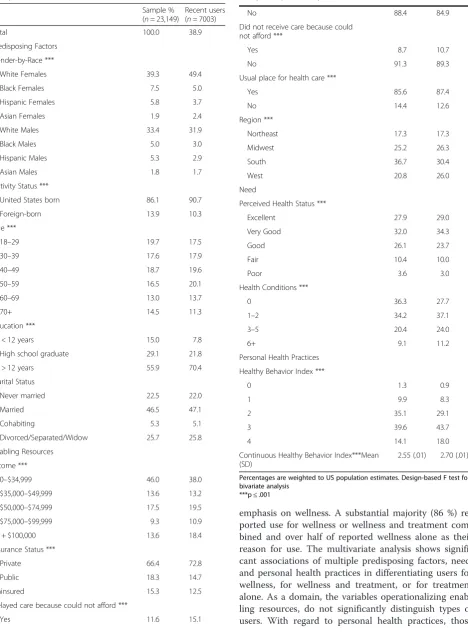
Close to 40 % reported using CAM in the past 12 months during 2007 (Table 1). Column 1 shows the weighted dis-tribution of the full sample of adults Column 2 shows the weighted distribution of recent users. Except for marital status, there were significant differences between the two groups for all other variables in each of the four model do-mains. Higher percentages of white women, native born, older, and those with higher education and income were recent users. Those with somewhat greater access to con-ventional care also had higher percentages of use. Higher percentages of those reporting better perceived or lower evaluated health were recent users. Last, those practicing greater number of healthy behaviors had higher percent-ages of recent use.
Comparison of reasons for Use: bivariate results
Over half of recent users reported using CAM for well-ness only (Table 2). Another third reported using CAM for both wellness and treatment of a specific health con-dition. Only 14 % of people used CAM for treatment only. At the bivariate level, all variables in each of the four domains were significantly associated with reason for use. Of all gender-by-race groups, white women had the lowest percentage of use for wellness alone; Asian men had the highest percentage, followed closely by Asian women and black men. White women had the highest percentage of combined users. A higher percent-age of foreign-born reported use for wellness and com-bined use was more common among native born. Almost two-thirds of the youngest adult users reported wellness as reason for use and the percentages were lower among older adults. The percentages reporting combined use was higher among older adults. Use for wellness was higher for both higher levels of education and income. For marital status, the highest percentage of wellness use was among never-married individuals. Individuals with greater access to conventional care re-ported highest percentages of use for wellness; there was little real difference in percentages of use for wellness by region. Wellness use was lower for lower perceived health status declined and for greater number of health conditions. Last, mean number of health behaviors was higher among wellness and combined users.
Comparisons of reasons for use: multivariate results
Predisposing factors
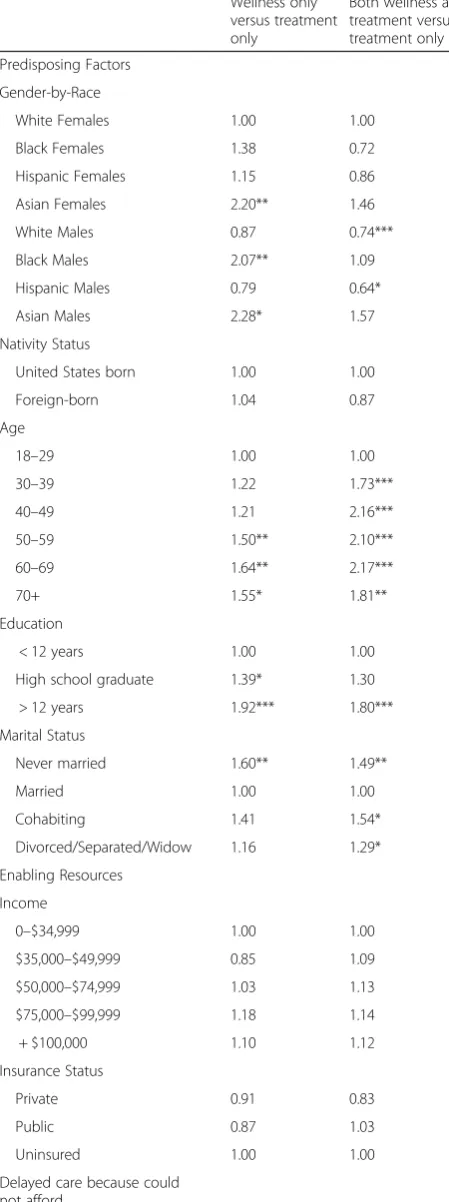
Compared to white women, Asian women and men and black men were more likely to report wellness use versus treatment alone. Compared to white women, white and Hispanic men were less likely to report combined use. Nativity status was not significant. When compared to the youngest age group, older ages, especially middle age and older were more likely to use CAM for wellness and for combined wellness and treatment rather than treat-ment alone. This was especially true for older individuals using CAM for combined wellness and treatment. Indi-viduals with the highest education were more likely than individuals with the least education to use CAM for wellness or combined wellness and treatment versus treatment alone. Never married persons were more likely than married to report use for wellness and com-bined wellness and treatment than treatment alone. Never-married, divorced, and cohabiting individuals were more likely than married to report use for both wellness and treatment.
Enabling resources
At the multivariate level, the majority of the enabling re-sources variables were not significantly associated with reason for use. However, compared to treatment alone, users who said they did not receive conventional care because of cost were more likely to use for combined wellness and treatment. Those living in the west were more likely to use for wellness and treatment combined versus treatment alone.
Need
Compared with persons reporting excellent health, those reporting good, fair, or poor were less likely to use CAM for wellness versus treatment alone. There was no health status difference between those reporting use for both wellness and treatment compared to treatment only. Similarly, compared to persons reporting no chronic health conditions those reporting health conditions were less likely to use CAM for wellness versus treatment alone. However, those with the more health conditions were somewhat more likely than those with none to re-port use for both wellness and treatment combined.
Personal health practices
Last, increasing numbers of healthy behaviors was sig-nificantly associated with a greater likelihood of using CAM for wellness alone, or for wellness in combination with treatment, versus treatment alone (Table 3).
Discussion
emphasis on wellness. A substantial majority (86 %) re-ported use for wellness or wellness and treatment com-bined and over half of reported wellness alone as their reason for use. The multivariate analysis shows signifi-cant associations of multiple predisposing factors, need, and personal health practices in differentiating users for wellness, for wellness and treatment, or for treatment alone. As a domain, the variables operationalizing enab-ling resources, do not significantly distinguish types of users. With regard to personal health practices, those Table 1Distributions of full sample and recent CAM users,
NHIS, 2007
Sample % (n= 23,149)
Recent users (n= 7003)
Total 100.0 38.9
Predisposing Factors
Gender-by-Race ***
White Females 39.3 49.4
Black Females 7.5 5.0
Hispanic Females 5.8 3.7
Asian Females 1.9 2.4
White Males 33.4 31.9
Black Males 5.0 3.0
Hispanic Males 5.3 2.9
Asian Males 1.8 1.7
Nativity Status ***
United States born 86.1 90.7
Foreign-born 13.9 10.3
Age ***
18–29 19.7 17.5
30–39 17.6 17.9
40–49 18.7 19.6
50–59 16.5 20.1
60–69 13.0 13.7
70+ 14.5 11.3
Education ***
< 12 years 15.0 7.8
High school graduate 29.1 21.8
> 12 years 55.9 70.4
Marital Status
Never married 22.5 22.0
Married 46.5 47.1
Cohabiting 5.3 5.1
Divorced/Separated/Widow 25.7 25.8
Enabling Resources
Income ***
0–$34,999 46.0 38.0
$35,000–$49,999 13.6 13.2
$50,000–$74,999 17.5 19.5
$75,000–$99,999 9.3 10.9
+ $100,000 13.6 18.4
Insurance Status ***
Private 66.4 72.8
Public 18.3 14.7
Uninsured 15.3 12.5
Delayed care because could not afford ***
Yes 11.6 15.1
Table 1Distributions of full sample and recent CAM users, NHIS, 2007(Continued)
No 88.4 84.9
Did not receive care because could not afford ***
Yes 8.7 10.7
No 91.3 89.3
Usual place for health care ***
Yes 85.6 87.4
No 14.4 12.6
Region ***
Northeast 17.3 17.3
Midwest 25.2 26.3
South 36.7 30.4
West 20.8 26.0
Need
Perceived Health Status ***
Excellent 27.9 29.0
Very Good 32.0 34.3
Good 26.1 23.7
Fair 10.4 10.0
Poor 3.6 3.0
Health Conditions ***
0 36.3 27.7
1–2 34.2 37.1
3–5 20.4 24.0
6+ 9.1 11.2
Personal Health Practices
Healthy Behavior Index ***
0 1.3 0.9
1 9.9 8.3
2 35.1 29.1
3 39.6 43.7
4 14.1 18.0
Continuous Healthy Behavior Index***Mean (SD)
2.55 (.01) 2.70 (.01)
Percentages are weighted to US population estimates. Design-based F test for bivariate analysis
Table 2Prevalence of use for wellness, for both wellness and treatment, or treatment only among CAM users NHIS, 2007 (n= 7003)
Wellness %
Both wellness and treatment %
Treatment only %
Total 51.0 35.1 13.9
Predisposing Factors
Gender-by-Race ***
White Female 48.4 38.5 13.1
Black Female 60.3 26.8 12.9
Hispanic Female 52.2 34.3 13.5
Asian Female 65.8 28.0 6.2
White Male 50.5 33.2 16.3
Black Male 63.1 27.7 9.2
Hispanic Male 50.5 30.9 18.6
Asian Male 66.2 27.9 5.9
Nativity Status ***
United States born 50.2 35.8 14.0
Foreign-born 58.3 29.4 12.3
Age ***
18–29 62.8 22.8 14.4
30–39 55.4 31.3 13.3
40–49 46.9 39.6 13.5
50–59 48.6 38.5 13.0
60–69 45.2 40.7 14.1
70+ 44.2 39.7 16.1
Education ***
< 12 years 38.6 38.2 23.1
High school graduate 45.9 36.6 17.4
> 12 years 54.0 34.3 11.3
Marital Status***
Never married 59.6 28.7 11.7
Married 50.6 34.3 15.1
Cohabiting 52.3 35.2 12.5
Divorced/Separated/ Widow
44.1 42.1 13.9
Enabling Resources
Income **
0–$34,999 48.7 36.4 15.0
$35,000–$49,999 46.4 38.4 15.2
$50,000–$74,999 52.0 34.7 13.3
$75,000–$99,999 55.1 32.4 12.5
+ $100,000 55.6 32.3 12.2
Insurance Status ***
Private 53.2 33.2 13.6
Public 40.0 44.6 15.5
Uninsured 51.4 34.9 13.8
Table 2Prevalence of use for wellness, for both wellness and treatment, or treatment only among CAM users NHIS, 2007 (n= 7003)(Continued)
Delayed care because could not afford ***
Yes 41.9 43.1 15.1
No 52.6 33.7 13.7
Did not receive care because could not afford ***
Yes 40.1 46.3 13.9
No 52.3 33.8 13.6
Usual place for health care ***
Yes 49.8 36.1 14.1
No 59.3 28.6 12.1
Region ***
Northeast 52.3 34.0 13.7
Midwest 48.7 34.3 17.1
South 53.7 32.5 13.8
West 49.4 39.8 10.9
Need
Perceived Health Status ***
Excellent 63.2 26.6 10.2
Very Good 54.1 32.7 13.4
Good 43.8 39.5 16.7
Fair 31.5 50.4 18.2
Poor 20.4 59.0 20.6
Health Conditions ***
0 65.8 22.9 11.3
1–2 52.4 33.8 13.8
3–5 41.6 43.5 14.9
6+ 30.0 51.6 18.4
Personal Health Practices
Healthy Behavior Index ***
0 45.4 28.2 26.4
1 42.4 37.7 19.8
2 47.4 36.0 16.6
3 51.5 36.4 12.1
4 59.2 30.0 10.8
Continuous Healthy Behavior Index ***
2.8 (0.02) 2.7 (0.02) 2.5 (0.03)
Mean (SD)
Percentages are weighted to US population estimates. Design-based F test for bivariate analysis
engaging in a greater number of healthy behaviors are more likely to use CAM for wellness or combined well-ness and treatment. Taken together, these findings dem-onstrate the potential usefulness of the sociobehavioral wellness model for CAM use and unequivocally point to the need to frame CAM use as health self-management and as part of a wellness lifestyle. Importantly, there is a critical need to continue to develop and empirically test measures that characterize the multidimensionality of the concept of“wellness”[30].
Predisposing factors
[image:7.595.304.534.127.524.2] [image:7.595.57.282.128.730.2]The effects of gender are contingent upon race and sur-prisingly, white women report the lowest percentage of wellness users while black and Asian men report some Table 3Adjusted odds ratios of multivariate analyses
comparing characteristics according to reason for use, NHIS, 2007 (n= 7003)
Wellness only versus treatment only
Both wellness and treatment versus treatment only
Predisposing Factors
Gender-by-Race
White Females 1.00 1.00
Black Females 1.38 0.72
Hispanic Females 1.15 0.86
Asian Females 2.20** 1.46
White Males 0.87 0.74***
Black Males 2.07** 1.09
Hispanic Males 0.79 0.64*
Asian Males 2.28* 1.57
Nativity Status
United States born 1.00 1.00
Foreign-born 1.04 0.87
Age
18–29 1.00 1.00
30–39 1.22 1.73***
40–49 1.21 2.16***
50–59 1.50** 2.10***
60–69 1.64** 2.17***
70+ 1.55* 1.81**
Education
< 12 years 1.00 1.00
High school graduate 1.39* 1.30
> 12 years 1.92*** 1.80***
Marital Status
Never married 1.60** 1.49**
Married 1.00 1.00
Cohabiting 1.41 1.54*
Divorced/Separated/Widow 1.16 1.29*
Enabling Resources
Income
0–$34,999 1.00 1.00
$35,000–$49,999 0.85 1.09
$50,000–$74,999 1.03 1.13
$75,000–$99,999 1.18 1.14
+ $100,000 1.10 1.12
Insurance Status
Private 0.91 0.83
Public 0.87 1.03
Uninsured 1.00 1.00
Delayed care because could not afford
Table 3Adjusted odds ratios of multivariate analyses comparing characteristics according to reason for use, NHIS, 2007 (n= 7003)(Continued)
Yes 0.74 0.86
No 1.00 1.00
Did not receive care because could not afford
Yes 1.18 1.56*
No 1.00 1.00
Usual place for health care
Yes 1.00 1.00
No 1.29 1.06
Region
Northeast 1.00 1.00
Midwest 0.82 0.83
South 1.12 0.96
West 1.17 1.42*
Need
Perceived Health Status
Excellent 1.00 1.00
Very Good 0.76* 0.93
Good 0.56*** 0.90
Fair 0.45*** 1.04
Poor 0.29*** 1.02
Health Conditions
0 1.00 1.00
1–2 0.76* 1.19
3–5 0.67** 1.41*
6+ 0.56*** 1.38
Personal Health Practices
Continuous Healthy Behavior Index
1.20*** 1.20***
of the highest percentages. In fact, black men are over twice as likely as white women to be wellness users. Asian men and women are also more likely to be well-ness users. And among combined users, only white and Hispanic men are less likely than white women. Few studies have examined gender-by-race interactions with regard to CAM use, let alone reasons for use. There is clearly non-random selection by gender and race with respect to use [2, 22, 34] as well as unobserved differ-ences among users and non-users. One study, using the 2002 NHIS and analyzing only African Americans, found that users of CAM were more likely to be older, female, better educated, insured, and have higher income [35]. However, they also found that the“majority”used CAM for treatment rather than health promotion, although they did not provide statistical analysis for this conclu-sion. Importantly, the 2002 NHIS did not explicitly ask specific questions pertaining to health and wellness, only about treatment, thus potentially underestimating use for wellness. Also, it does not appear that black users are more likely than white users to utilize modalities that might be thought of as more“wellness focused”(e.g., re-laxation techniques, yoga, supplements) [23]. Prayer for health was not included as a CAM modality in the 2007 NIHIS, and other research suggests it is commonly used among black men and women. The findings for Asian men and women are less surprising given the focus on prevention and wellness in Traditional East Asian Medi-cine and the commonality of practices such as tai chi and meditation in this population [36].
Unfortunately, the NHIS does not include information on specific motivations and beliefs known to be associ-ated with use which may be useful in understanding these gender and racial/ethnic differences [5, 7, 37]. An early, high-quality national survey found that users of CAM were more likely to have unconventional religious beliefs and be in a category the author called “cultural creative” [37]. Users also had greater desire for control over their health. In a more recent systematic review of beliefs among CAM users [5], the authors summarized both quantitative and qualitative studies. In general, users viewed CAM as part of self-management for those with chronic health conditions, believed psychological factors had a role in the origins of illness and the pro-motion of health, and had a desire for holistic treatment [5]. Clearly, given the high prevalence of CAM use in the United States, the increasing integration of alterna-tive and conventional medicine in health care settings, and the increasing consumer demand for insurance coverage for many CAM modalities, additional research on knowledge, motivations, and beliefs is a high priority.
Older users employ CAM to both manage existing health conditions and to promote wellness rather than use it for treatment alone. These findings reflect declines
of health with aging, but also that older adults tend to be more health conscious than younger adults [38]. The effects of education are in the expected directions, with the most educated more likely to report wellness or combined use versus treatment alone. These findings are probably also due to the differences in beliefs according to education level, as described above [5, 37].
Enabling resources
We find little support for net effects of enabling re-sources to distinguish reasons for use among CAM users. Other research documents that when comparing users to non-users, those with higher income and, in general, greater access to conventional medicine, are more likely to be users of CAM [2, 25–27]. And, a re-cent study by Davis and colleagues [17] that focused on just CAM users, found that wellness users had greater access to and use of conventional medical care and con-cluded that these individuals are high users of all types of care. Thus, it may be that our operationalization of enabling resources did not capture all of the necessary dimensions of the domain to differentiate reasons for use among CAM users. It may also be useful to ask indi-viduals directly if they used CAM instead of conven-tional care, and if so, to elaborate on the specific details.
Need
As expected, users with poorer perceived or evaluated health are much less likely to report use for wellness alone when compared to treatment alone. Contrary to our expectations, those with poorer health are not more likely to use for both wellness and treatment versus treatment alone, net of other factors. However, the bi-variate analysis revealed that higher percentages of those with poorer perceived or evaluated health reported using CAM for either combined user or for treatment alone. It is possible that in the multivariate model, part of the age effects described above are capturing this effect in the combined use group. Also, our model only captures clin-ically diagnosed health conditions and older persons may have several other health problems for which they use CAM for combined wellness and treatment. In other studies, use of CAM among those with chronic condi-tions is viewed as a form of self-management and a means to improve quality of life with these conditions [5, 7, 8]. Thus, our findings provide indirect support that those with health conditions are using CAM to improve wellness even when faced with health problems.
Personal health practices
drinking alcohol little or in moderation, having a normal BMI, and engaging in leisure-time physical activities are more common among CAM users versus non-users [2, 4, 22, 25, 39]. A more recent study [17] found that those engaging in these healthy lifestyles behaviors were more likely to be wellness users versus combined or treatment users. Our findings suggest those users engaging in mul-tiple healthy lifestyle behaviors may be incorporating CAM practices as part of their “wellness lifestyle” [6]. These new results also shed light on the many prior studies that reported the rather contradictory findings that users of CAM versus non-users were more likely to have poorer health but also report healthier lifestyle be-haviors [2–4, 24, 25, 39]. It appears that those with exist-ing health conditions tend to use CAM for treatment or to maintain and improve quality of life living with those health conditions. On the other hand, healthier users are inclined to engage in CAM practices to maintain posi-tive health and wellness.
Conclusions
The results from this study show that a sociobehavioral wellness model of CAM use has utility in distinguishing reasons for use according to wellness, combined well-ness and treatment, or treatment alone. Our finding that 5 out of 6 users report reason for use as wellness or wellness in combination with treatment points to the significance of CAM as part of health self-management and wellness lifestyle. Indeed, at a time of national health care reform highlighting the importance of health and wellness and employers turning to wellness to improve worker performance and well-being, these findings sug-gest a central role of CAM in those public health endeavors.
Appendix
List of CAM items in NHIS, 2007 Alternative Medical Systems
1. Acupuncture
2. Ayurveda
3. Homeopathic treatment
4. Naturopathy
5. Curandero
6. Espiritista
7. Hierbero or Yerbera
8. Shaman
9. Botanica
10.Native American health or Medicine Man
11.Sobador
Biologically based therapies
12.Chelation therapy
13.Nonvitamin, nonmineral natural products
14.Vegetarian diet
15.Macrobiotic diet
16.Atkins diet
17.Pritikin diet
18.Ornish diet
19.Zone diet
20.South Beach
Manipulative and body based therapies
21.Chiropractic or osteopathic manipulation
22.Massage
23.Feldenkreis
24.Alexander technique
25.Pilates
26.Trager Psychophysical Integration
Mind-body therapies
27.Biofeedback
28.Meditation
29.Guided imagery
30.Progressive relaxation
31.Deep breathing exercises
32.Hypnosis
33.Yoga
34.Tai chi
35.Qi gong
36.Energy healing/Reiki
Competing interests
The authors declare that they have no competing interests.
Authors’contributions
DMU conceptualized the article, directed the analysis and wrote the manuscript drafts. BWR managed and cleaned the data, executed the analysis, and contributed to the writing of the manuscript drafts. All authors read and approved of the final manuscript.
Authors’information
Dr. Upchurch is professor of public health and has published extensively on CAM use in the US, with an emphasis on CAM use for wellness and women’s use of CAM. She is especially interested in developing integrative strategies to improve women’s health and well-being, especially the under-served. She is also a licensed acupuncturist and herbalist in the state of California.
Dr. Rainisch is an assistant professor with an interest in adolescent health, including use of CAM.
Acknowledgments
Funding for this research was provided by the National Center for Complementary and Alternative Medicine (NCCAM) of the National Institutes of Health (NIH) to Dr. Upchurch (grant number AT002156).
Author details 1
Department of Community Health Sciences, UCLA Fielding School of Public Health, 650 Charles Young Drive South, Los Angeles, CA 90095-1772, USA.
2
Received: 19 December 2014 Accepted: 2 October 2015
References
1. Barnes PM, Powell-Griner E, McFann K, Nahin RL. Complementary and alternative medicine use among adults: United States, 2002. Semin Integr Med. 2004;2:54–71.
2. Barnes PM, Bloom B, Nahin RL. Complementary and alternative medicine use among adults and children: United States, 2007. National Health Statistics Report. 2008. http://www.cdc.gov/nchs/data/nhsr/nhsr012.pdf. Accessed September 15, 2014.
3. Eisenberg DM, Davis RB, Ettner SL, Appel S, Wilkey S, Van Rompay M, et al. Trends in alternative medicine use in the United States, 1990–1997. JAMA. 1998;280:1569–75.
4. Upchurch DM, Rainisch BKW. A sociobehavioral model of complementary and alternative medicine providers, products, and practices: findings from the National Health Interview Survey, 2007. J Evid Based Complement Alternat Med. 2012;18:100–7.
5. Bishop FL, Yardley L, Lewith GT. A systematic review of beliefs involved in the use of complementary and alternative medicine. J Health Psychol. 2007;12:851–67.
6. Schuster TL, Dobson M, Jauregui M, Blanks RH. Wellness lifestyles I: a theoretical framework linking wellness, health lifestyles, and complementary and alternative medicine. J Altern Complement Med. 2004;10:349–56. 7. Sirois FM, Gick ML. An investigation of the health beliefs and motivations of
complementary medicine clients. Soc Sci Med. 2002;55(6):1025–37. 8. Thorne S, Paterson B, Russell C, Schultz A. Complementary/alternative
medicine in chronic illness as informed self-care decision making. Int J Nurs. 2002;39:671–83.
9. Arcury TA, Quandt SA, McDonald J, Bell RA. Faith and health self-management of rural older adults. J Cross Cult Gerontol. 2000;15:55–74. 10. Grzywacz JG, Lang W, Suerken C, Quandt SA, Bell RA, Arcury TA. Age, race,
and ethnicity in the use of complementary and alternative medicine for health welf-management: evidence form the 2002 National Health Interview Survey. J Aging Health. 2005;17:547–72.
11. Grzywacz JG, Suerken CK, Neiberg RH, Lang W, Bell RA, Quandt SA, et al. Age, ethnicity, and use of complementary and alternative medicine in health self-management. J Health Soc Behav. 2007;48:84–98. 12. Upchurch DM, Rainisch BKW. A sociobehavioral wellness model of
acupuncture use in the United States, 2007. J Alternat Complement Med. 2014;20:32–9.
13. Fouladbakhsh JM, Stommel M. Using the behavioral model for complementary and alternative medicine: the CAM healthcare model. J Compl Integr Med. 2007;4:11.
14. Davis MA, Weeks, Coulter ID. A proposed conceptual model for studying the use of complementary and alternative medicine. Altern Ther Health Med. 2011;17:32–6.
15. Lorenc A, Ilan-Clarke Y, Robinson N, Blair M. How parents choose to use CAM: a systematic review of theoretical models. BMC Complement Altern Med. 2009;9:9. doi:10.1186/1472-6882-9-9.
16. Upchurch DM, Burke A, Dye C, Kusunoki Y, Greendale GA. A sociobehavioral model of acupuncture use, patterns, and satisfaction smong women in the United States, 2002. Women Health Issues. 2008;18:62–71.
17. Davis MA, West AN, Weeks WB, Sirorich BE. Health behaviors and utilization among users of complementary and alternative medicine for treatment versus health promotion. Health Serv Res. 2011;46:1402–16.
18. Kannan V, Gaydos L, Atherly A, Druss BG. Medical utilization among wellness consumers. Med Care Res Rev. 2010;67:722–36.
19. Aday L, Andersen R. A framework for the study of access to medical care. Health Serv Res. 1974;9:208–20.
20. Andersen R, Newman JF. Societal and individual determinants of medical care utilization in the United States. Milbank Q. 1973;51:95–124. 21. Andersen RM. Revisiting the behavioral model and access to medical care:
does it matter? J Health Soc Behav. 1995;36:1–10.
22. Bishop FL, Lewith G. Who uses CAM? A narrative review of demographic characteristics and health factors associated with CAM use. Evid Based Complement Alternat Med. 2010;7:11–28.
23. Graham RE, Ahn AC, Davis RB, O’Connor BB, Eisenberg DM, Phillips RS. Use of complementary and alternative medical therapies among racial and ethnic minority adults: results from the 2002 National Health Interview Survey. J Nat Med Assoc. 2005;97:535–45.
24. Institute of Medicine of the National Academies. Complementary and alternative medicine in the United States. Washington D.C: The National Academic Press; 2005.
25. Nahin R, Dahlhamer J, Taylor B, Barnes PM, Stussman BJ, Simile CM, et al. Health behaviors and risk factors in those who use complementary and alternative medicine. BMC Public Health. 2007;7:217.
26. Wolsko PM, Eisenberg DM, Davis RB, Ettner SL, Phillips RS. Insurance coverage, medical conditions, and visits to alternative medicine providers: Results of a National Survey. Arch Intern Med. 2002;162:281–7.
27. Pagan JA, Pauly MV. Access to conventional medical care and the use of complementary and alternative medicine. Health Aff. 2005;24:255–62. 28. Fava GA, Sonino N. Psychosomatic medicine: emerging trends and
perspectives. Psychother Psychosom. 2000;69:184–97.
29. Herzlich C. Health and illness: a social psychological analysis. London, UK: Academic; 1973.
30. National Wellness Institute website. http://www.nationalwellness.org/, accessed July 2014.
31. National Health Interview Survey. Centers for Disease Control and Prevention. 2007. http://www.cdc.gov/nchs/nhis.htm. Accessed July 2014. 32. National Center for Health Statistics. Data file documentation, National
Health Interview Survey, 2007 (machine readable data file and documentation). Hyattsville, Maryland: Centers for Disease Control and Prevention; 2008.
33. Stata Statistical Software: Release 12 [computer program]. College Station, TX: StataCorp LP; 2010.
34. Mackenzie ER, Taylor L, Bloom BS, Hufford DJ, Johnson JC. Ethnic minority use of complementary and alternative medicine (CAM): a national probability survey of CAM users. Altern Ther Health Med. 2003;9:50–4. 35. Brown CM, Barner JC, Richard KM, Richards KM, Bohman TM. Patterns of
complementary and alternative medicine use in African Americans. J Alternat Complement Med. 2007;13:751–8.
36. Hsiao AF, Wong MD, Goldstein MS, Becerra LA, Cheng EM, Wenger NS. Complementary and alternative medicine use among Asian American subgroups: prevalence, predictors, and lack of relationship to acculturation and access to conventional care. J Altern Complement Med. 2006;12:1003–10. 37. Astin JA. Why patients use alternative medicine. JAMA. 1998;279:1548–53. 38. Danaei G, Ding EL, Mozaffarian D, Taylor B, Rehm J, Murray CJ, et al. The
preventable causes of death in the United States: comparative risk assessment of dietary, lifestyle, and metabolic risk factors. PLoS Med. 2009;6, e1000058.
39. Upchurch DM, Chyu L, Greendale GA, Utts J, Bair YA, Zhang G, et al. Complementary and alternative use among American women: findings from the National Health Interveiw Survey, 2002. J Womens Health. 2007;16:102–13.
Submit your next manuscript to BioMed Central and take full advantage of:
• Convenient online submission
• Thorough peer review
• No space constraints or color figure charges
• Immediate publication on acceptance
• Inclusion in PubMed, CAS, Scopus and Google Scholar
• Research which is freely available for redistribution