International Research Journal of Engineering and Technology
(IRJET)
e-ISSN: 2395 -0056Volume: 02 Issue: 05 | Aug-2015 www.irjet.net p-ISSN: 2395-0072
© 2015, IRJET ISO 9001:2008 Certified Journal Page 537
Particle Swarm Optimization Based PI Controller Design for Actuation
System of Reusable Launch Vehicle
Remya S
1,Priya C Kurian
2,Priyanka C P
31
M. Tech Scholar, Department of EEE, Lourdes Matha College of Science and Technology, Kerala, India
2
Scientist/ Engineer, SDCD/CECG AVN, Vikram Sarabhai Space Centre, ISRO, Kerala, India
3
Assistant Professor, Department of EEE, Lourdes Matha College of Science and Technology, Kerala, India
---***---Abstract
-
A reusable launch vehicle is a systemwhich has the ability to carry a payload from the surface of the earth to the outer space more than once. The trajectory of the reusable launch vehicle is tracked depending on the guidance, navigation and control system. Electro hydraulic actuators are used in reusable launch vehicle for vectoring the control surfaces about their axes. A Proportional Integral (PI) controller is designed for the hydraulic actuator system of the reusable launch vehicle in order to meet the requirements. Particle swarm optimization (PSO) technique is used to design the optimal controller parameters of PI controller by considering the time and frequency domain specifications. The optimization technique is widely used for controllers because of its high computational efficiency. The proposed optimization technique eliminates the trial and error complexity in the conventional design technique of the actuation system.
Key Words:
Reusable Launch Vehicle,
Electro
hydraulic actuator, Particle Swarm Optimization, PI
Controller.
1. INTRODUCTION
The reusable launch vehicles are designed to be launched more than once. The actuator forms the main loop of the control system and it actuates the control surfaces of the reusable launch vehicle based on the command signals. The actuator consists of many elements which work in coordination to bring about the necessary control action. Many flight control applications uses hydraulic control systems [1].
Different control techniques are adopted for the design of the electro hydraulic actuation systems. The PI controllers has been widely used in industry because of its simple structure for a wide range of operating conditions. But it is difficult to tune the parameters of the controller because some industrial plants have problems such as higher order, delays and nonlinearities. There are several methods for
tuning the PI controller parameters. The first method used
was the classical Zeiglar-Nichols method [2]. It is often hard to determine optimal values with this method in many industrial plants. Thus new features are to be developed to increase the performance of the controllers. Many artificial intelligence techniques such as neural networks and fuzzy systems have been adopted to improve the controller parameter values [3], [4]. There are random search methods, such as genetic algorithm and simulated annealing which are used for finding global optimal solution in a search space [5].
Particle swarm optimization technique is a modern algorithm that has been developed from the behavior of organisms such as fish schooling and bird flocking. It has been found to be robust in solving continuous optimization problems. The PSO technique can generate a high quality solution within a short time [6], [7]. In this work a Proportional Integral controller is designed for the electro hydraulic actuator system. For getting the optimal controller values, the parameters of the controller are optimized using particle swarm optimization technique.
This paper is organized as follows. Section 2 deals with the system configuration. In Section 3 the modelling of the actuator system is presented. The conventional design method is explained in Section 4. Section 5 deals with the proposed particle swarm optimization technique. The implementation of PSO-PI controller is done in Section 6. The simulation results are shown in Section 7 and the inferences and the conclusion is done in Section 8
.
2. SYSTEM CONFIGURATION
International Research Journal of Engineering and Technology
(IRJET)
e-ISSN: 2395 -0056Volume: 02 Issue: 05 | Aug-2015 www.irjet.net p-ISSN: 2395-0072
© 2015, IRJET ISO 9001:2008 Certified Journal Page 538
during the ascent and descent phase. The HPU consists of aprime mover, an axial displacement pressure compensated pump, reservoir, check valve, high pressure relief valve and an isolation valve. The system uses petroleum based mineral oil as the power transfer medium. The hydraulic power unit is of closed circuit type and the oil is re circulated. The block diagram of the electro hydraulic actuator is shown in Fig-1. The system consists of a servo controller, servo amplifier, hydraulic power unit, servo valve, hydraulic actuator, control surface dynamics and a position sensor.
Fig-1
:
Functional Block diagram of reusable launch vehicle actuation systemIn hydraulic actuator, pressurized fluid applied to the piston rod provides the power to move the external object. A low current is passed to the servo valve through an amplifier thereby providing the power to alter the position of the valve. The hydraulic actuator is basically a piston cylinder mechanism. The magnitude and the direction of flow of the fluid is controlled by the servo valve. The load dynamics includes all the mechanical forces acting on the control surfaces. This dynamics along with the stiffness of all actuator mounting bracket and the hydraulic fluid constitutes the resonant frequency called as the hydro mechanical resonance. The position sensor will sense the actuator position and is fed back to the position loop.
3. MATHEMATICAL MODELLING
The servo valve is modelled as a second order equation. The relation between the spool movement and the valve current is represented by,
where is the spool displacement sensitivity, and are the natural frequency and the damping factor of the servo valve spool. The various elements of the actuator chamber are shown in Fig-2. The servo valve consists of spools with lands machined on a cylindrical sleeve. The control ports of the servo valve are connected to the forward and return chambers of the actuator. When the
spool valve moves in the forward direction, fluid enters into the forward chamber and it displaces the actuator piston in the positive direction. The linear movement of the piston is converted into mechanical motion and which in turn rotates the control surfaces about their hinge axis. The supply and the return flows are formulated based on the load flow and chamber pressures and .The supply flow into the actuator chamber 1 is,
The return flow from actuator chamber 2 is
where is the effective bulk modulus of the hydraulic oil, and are the volume of actuator chamber.
The actuator chamber volumes are given by,
where is the half volume of actuator chamber, is the area of cross section of the piston and is the actuator displacement.
The fluid compression in the forward chamber is assumed to be equal to the fluid expansion in the return chamber,
where is the load pressure. Then combining equations (2), (3) and (6), the load flow is obtained as,
The actuator piston velocity can be derived from the load flow as,
The load dynamics is given by,
where and are the moment of inertia and viscous
damping coefficient of the control surface
.
The actuator displacement is the sum of the equivalent control surface displacement, and the backward displacement of the actuator mounting arm bracket , given by, Servo Compensator Servo amplifier Hydraulic actuator cylinder. Actuator mounting bracket Position sensor dynamics Hydraulic pressure supply (HPU) + -Aero load Servo valve
Fig.2 Functional modelling of RLV-TD actuation system
Control Surface load dynamics + - xs
International Research Journal of Engineering and Technology
(IRJET)
e-ISSN: 2395 -0056Volume: 02 Issue: 05 | Aug-2015 www.irjet.net p-ISSN: 2395-0072
© 2015, IRJET ISO 9001:2008 Certified Journal Page 539
Fig-2: Dynamics of actuator chamberThe control surface displacement is given by,
where is the control surface deflection and is the actuator lever arm length.
The displacement of the actuator mounting arm bracket includes all the mechanical flexible elements in cascade with the actuator on either side. Assuming that as the equivalent stiffness of all such elements, then the actuator force is given by,
The control surface deflection is derived from the load dynamics equation as,
where is the coulomb friction, is the total disturbance on the control surface, is the viscous damping coefficient of the actuator.
The sensor has a dynamics equivalent to the second order system given by,
where and are the natural frequency and the damping factor of the sensor.
The transducer output is given by,
where is the position sensor scale factor and is the
actuator deflection.
Using all these equations the linear model of the actuation system is given in Fig-3.
Fig-3
:
Linear Mathematical model of actuation system4. CONVENTIONAL DESIGN METHOD
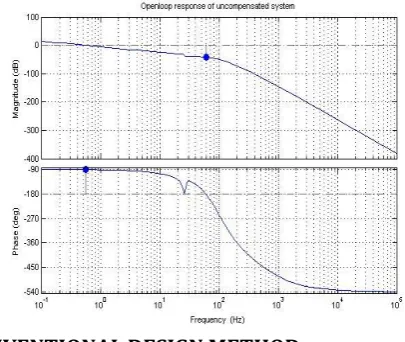
The open loop and closed loop response analysis of actuator is carried out and are shown in Fig-4 and Fig-5.
Fig-4: Open loop response of uncompensated system
`
V1,P1 V2,P2
PR P
[image:3.595.36.255.138.294.2]S PR
Fig 4. Dynamics of actuator chamber and load Kl1
lm Jcs,Bcs
Kl2
Qvs Qvr
Q1
Q2 Q4 Q3
Servo valve spool
Actuator mounting structure
Hinge point
xcs
cs
(11)
(12)
(13)
(15)
(14)
[image:3.595.319.574.303.456.2] [image:3.595.340.543.526.697.2]© 2015, IRJET ISO 9001:2008 Certified Journal Page 540
Fig-5: Closed loop response of uncompensated systemThe step response is shown in Fig-6.
Fig-6: Step response of uncompensated system
From the open loop and closed loop response analysis of the system it is found that even though the system is stable, the system specifications are not met. So in order to meet the specifications of the system a suitable compensation scheme is to be provided. The compensation scheme is developed based on the requirements of the system. The compensation scheme consists of a PI controller, a notch filter and a rate filter. The compensation scheme is shown in Fig-7.
Fig-7Compensation scheme
The PI controller is designed to offer maximum gain and to offer relative stability for systems and is designed using trial and error method. The transfer function for PI controller is,
where and are the proportional and integral gains.
The PI controller is designed as given by,
The notch filter is introduced in the forward path to attenuate the high frequency oscillations in the circuit [8]. The notch filter transfer function is given by,
From the open loop frequency response the resonant peak was obtained at 21.2Hz. A notch filter centered at frequency 21.2Hz is used to attenuate the oscillations. The
notch filter is designed such that the ratio , which is
the depth of the notch is 10 and is designed as,
(16)
(17)
(18)
International Research Journal of Engineering and Technology
(IRJET)
e-ISSN: 2395 -0056Volume: 02 Issue: 05 | Aug-2015 www.irjet.net p-ISSN: 2395-0072
© 2015, IRJET ISO 9001:2008 Certified Journal Page 541
The rate filter is used in the feedback path and the ratefilter transfer function is given by,
where is the rate gain and is the frequency of the rate loop.
The rate filter is designed with 100Hz frequency as,
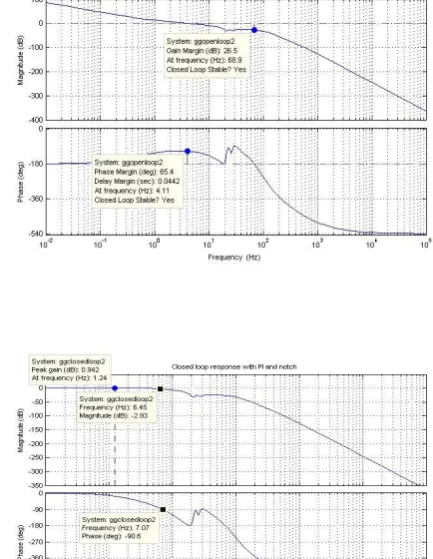
The simulation results with the compensation scheme are shown in below figures. The frequency response plots are shown in Fig-8 and Fig-9.
Fig-8: Open loop response of compensated system
Fig-9: Closed loop response of compensated system
The step response analysis is shown in Fig-10 which shows the tracking performance.
Fig-10: Step response of compensated system
The conventional method will meet the specifications but the trial and error design procedure is time consuming and does not yield optimal results. So in order to get optimum values for the controller, a particle swarm optimization technique is used for designing the PI controller. Initially, a PI controller is designed and the parameters are optimized using PSO technique.
5. PARTCLE SWARM OPTIMIZATION TECHNIQUE
Particle swarm optimization (PSO) is an evolutionary computational technique introduced by Russell Eberhart and James Kennedy. This method is highly robust in solving problems having non linearity and non-differentiability. The basic PSO is developed from the principles of fish schooling and bird flocking. It has got stable convergence characteristics and has high computational efficiency. Every PSO uses a population of particle and each particle flies in the search space with a particular velocity [9], [10]. The PSO algorithm works by simultaneously maintaining several candidate solutions in the work space. During each iteration of the algorithm, each of the candidate solution is being evaluated by the fitness function thus determining the fitness. Each candidate solution is considered as a particle flying through the search space. Initially, PSO chooses the candidate solutions randomly within the search space. The PSO algorithm has got three steps which are repeated until the stopping condition is met [11].
1. Generation of particles and their information. 2. Evaluating the fitness.
3. Updating the particles and forming new vectors.
(20)
© 2015, IRJET ISO 9001:2008 Certified Journal Page 542
The information of the particle refers to the positionand velocity. A set of particles, is first initialized having position and velocity and an evaluation function is formulated based on the system requirements. Then the function is evaluated with each of the particle as the input vectors. The position and the velocity of the particle can be changed at each time step. When a particle discovers that any value obtained is better than the previously obtained value, then it stores that value as , the personal best value [12]. The overall best value among the personal best values is the value represented by . The position and velocities are initialized first. Let and are the upper and lower bound of the position of the particle. The position of the particle can be obtained as,
where refers to a random number between 0 and 1.
Fitness evaluation is conducted by applying the candidate solution to the function formulated. Individual and global best positions are updated by comparing the new fitness value with the previously obtained value.
The velocity of each particle is updated using the formula [12],
where is the number of iterations, is the inertia weight which provides a balance between the personal and the global values. The value of ranges from 0.4 to 0.9 and it is calculated as [12],
where is the maximum number of iterations. The constants and are the acceleration constant terms that makes the solution near to or away from the personal and global best values. The acceleration constants are usually in the range of 1.5 or 2. Once the velocity of each particle is calculated, then the position is updated by applying the new velocity to the particles previous position as [12],
6. IMPLEMENTATION OF PSO-PI CONTROLLER
A PI controller is designed using the PSO technique. The gain values of the PI controller are optimized using this method. The particles are represented by the parameters of the controller. The open loop transfer function of the
system is given by,
The PI controller is designed as follows,
Step 1: The magnitude and phase at , the gain cross over frequency is calculated.
Step 2: The phase margin of the uncompensated system and the angle to be contributed to achieve the desired phase margin is to be determined. Let be the phase margin of the uncompensated system, be the desired phase margin, be the phase angle of the controller at . Then the phase margin of the uncompensated system is given by, and the phase angle is given by
Step 3: The PI controller is designed as,
The values of and obtained are shown in Table.1.
Table 1: Controller parameters
Parameters
Value 8.1173 82.602
These values form the maximum range for the PI parameters. The PI parameters become the number of particles for the PSO algorithm.
(22)
(23)
(24)
(25)
(27)
International Research Journal of Engineering and Technology
(IRJET)
e-ISSN: 2395 -0056Volume: 02 Issue: 05 | Aug-2015 www.irjet.net p-ISSN: 2395-0072
© 2015, IRJET ISO 9001:2008 Certified Journal Page 543
Considering there are individuals in a population. Sincethere are two parameters to control, then the dimension of the population is . The position represents the parameters of the PI controller and the initial values are given by,
A fitness function is to be formulated for the PSO algorithm. The function is designed based on the time domain specifications and it includes rise time , settling time and overshoot . The evaluation function is
formulated as the sum of the ratios of settling time, rise time and the overshoot. The function is given by,
where , and are the settling time, rise time and
overshoot values of the required system with the controller. For each of the iteration process the value is changed and the fitness function is calculated. The searching procedure for the PSO-PI controller is as follows:
Step 1: Specify the lower and upper bounds of the controller parameters and initialize randomly the position, velocities and local best values. Enter the maximum number of iterations which is taken as 50.
Step 2: For each of the individuals, evaluate the fitness function consisting of , and .
Step3: Compare each individual’s new fitness value with the best value initialized . The best value among the
is the value.
Step 4: Modify the velocity of the particle and update the position of the particle using the new velocity.
Step 5: When the number of iteration reaches the maximum, then it is stopped. The latest value is taken as the optimal controller parameters of the PI controller.
[image:7.595.332.549.424.704.2]The simulation parameters are taken as given in Table 2.
Table 2: Parameters of PSO algorithm
Parameter Values
Population size, n 50
Inertia weight wmax, wmin 0.9, 0.4
Acceleration constants c1,c2 2
After optimization the values of the PI controller are obtained are shown in Table 3.
Table.3: Optimal controller parameters
Parameter
Optimized value 7.5469 26.9698
In order to meet the bandwidth requirements and to suppress the unwanted oscillations of the system a notch filter is designed. The filter centered at frequency 21.2 Hz is used toavoid the high frequency oscillations. The notch filter is designed as,
(29)
(30)
© 2015, IRJET ISO 9001:2008 Certified Journal Page 544
7. SIMULATION RESULTS
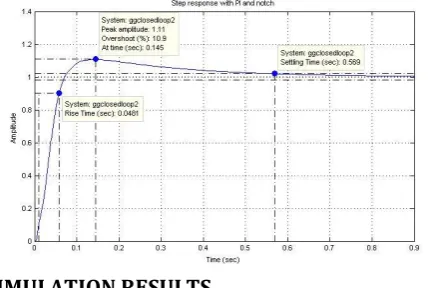
[image:8.595.55.271.111.255.2]The PI controller is designed using particle swarm optimization technique and optimal values of gain are obtained. The frequency response and step response plots are given in Fig-11, Fig-12 and Fig-13 respectively.
Fig-11: Open loop response with PSO-PI controller and notch filter
Fig-12: Closed loop response with PSO-PI controller and notch filter
Fig-13: Step response with PSO-PI controller and notch filter
The performance evaluation is shown in Table.4 and it can be seen that better results are obtained with the PSO-PI controller with a notch filter. By using PSO-PSO-PI controller and a notch filter, all the specifications are met and hence the rate loop is avoided.
Table 4: Performance evaluation with the conventional method and the PSO-PI controller
Specification Requirement Convention al method
PSO-PI, notch
filter
Phase margin
>
Gain margin >6dB 25.7dB 26.5dB
-3dB bandwidth
6 7.84Hz 6.45Hz
-90degree bandwidth
6.9Hz 7.07Hz
Rise time 50 msec 0.0414sec 0.0481secc
Settling time <600 msec 0.349sec 0.569sec
Peak overshoot
<20% 19.4% 10.9%
Maximum peak
<2dB 1.68dB 0.942dB
8. CONCLUSION
The controller design for actuator system for RLV system is considered. The basic criteria in order for optimality are its phase margin, settling time and overshoot and the bandwidth. The conventional trial and error method is time consuming and does not yield optimal results. Thus the PSO technique is implemented for the design of PI controller. From the simulation results, it is shown that the PSO-PI controller with a notch filter showed better results when compared to the conventional method.
REFERENCES
[1] DSP Control of Electro hydraulic servo actuators, Texas Instruments, Jan.2005
[2] K. Ogata, ‘Modern Control Systems.’ University of Minnesota,Prentice Hall, 2002.
[3] A. Visioli, ‘Tuning of PID Controllers with Fuzzy Logic.’ Proceedings IEEE Control Theory and Applications, vol 148, no 1,pp 1-8,Jan 2001.
[4] T.L.Seng, M.B. Khalid and R. Yusuf, ‘Tuning of Neuro-Fuzzy Controller by Genetic algorithm.’ IEEE Transactions On Systems, Man and Cybernatics. B, vol 29,pp 226-326, Apr 1991.
[5] Ayman.A.Aly, ‘PID Parameters Optimization Using Genetic Algorithm Technique for Electro hydraulic Servo Control Systems.’ Journal of Intelligent Control and Automation, no 2, pp 69-76,May 2011.
[6] R.C Eberhart and Y.Shi, ‘Comparison between genetic algorithm and particle swarm optimization.’ Proceedings. IEEE International Conference Evolutionary Computation, pp 611–616,May 1998.
International Research Journal of Engineering and Technology
(IRJET)
e-ISSN: 2395 -0056Volume: 02 Issue: 05 | Aug-2015 www.irjet.net p-ISSN: 2395-0072
© 2015, IRJET ISO 9001:2008 Certified Journal Page 545
Conference on Neural Networks, Perth, Australia, volIV,pp 1942-1948,1995
[8] P. Schmidt and T.Rehm, ‘ Notch Filter Tuning for Resonant Frequency Reduction in Dual Inertia Systems.’Proceedings of IEEE Industry Applications Conference, vol.3, pp 1730-1734, Oct 1999.
[9] Zwe-Lee Gaing, ‘A Particle Swarm optimization Approach for Optimum design of PID Controller in AVR System.’ IEEE Transactions on Energy Conversion, vol 19,no 2, June 2004.
[10] Mahmud Iwan Solihin, Lee Fook Tack and Moey Leap Kean, ‘Tuning of PID Controller Using Particle Swarm Optimization.’ Proceedings of International Conference on Advanced Science, Engineering and
Information Technology, pp 458-461, Jan 2011.
[11] Trias Andromeda, Azli Yahya, Nor Hisham Haji Khamis, Ameruddin Baharom and Muhammad Arifabdul Rahim, ‘PID Controller Tuning by Particle Swarm Optimization on Electrical Discharge Machining Servo Control System.’ International Conference on Intelligent and Advanced Systems, pp 51-55, 2011.