c
2003 Hindawi Publishing Corporation
A Statistical Approach to Automatic Speech
Summarization
Chiori Hori
Department of Computer Science, Tokyo Institute of Technology, 2-12-1 O-okayama, Meguro-ku, Tokyo 152-8552, Japan
Email:[email protected]
Sadaoki Furui
Department of Computer Science, Tokyo Institute of Technology, 2-12-1 O-okayama, Meguro-ku, Tokyo 152-8552, Japan
Email:[email protected]
Rob Malkin
Interactive Systems Labs, Carnegie Mellon University, Pittsburgh, PA 15213, USA Email:[email protected]
Hua Yu
Interactive Systems Labs, Carnegie Mellon University, Pittsburgh, PA 15213, USA Email:[email protected]
Alex Waibel
Interactive Systems Labs, Carnegie Mellon University, Pittsburgh, PA 15213, USA Email:[email protected]
Received 20 March 2002 and in revised form 11 November 2002
This paper proposes a statistical approach to automatic speech summarization. In our method, a set of words maximizing a summarization score indicating the appropriateness of summarization is extracted from automatically transcribed speech and then concatenated to create a summary. The extraction process is performed using a dynamic programming (DP) technique based on a target compression ratio. In this paper, we demonstrate how an English news broadcast transcribed by a speech recognizer is automatically summarized. We adapted our method, which was originally proposed for Japanese, to English by modifying the model for estimating word concatenation probabilities based on a dependency structure in the original speech given by a stochastic dependency context free grammar (SDCFG). We also propose a method of summarizing multiple utterances using a two-level DP technique. The automatically summarized sentences are evaluated by summarization accuracy based on a comparison with a manual summary of speech that has been correctly transcribed by human subjects. Our experimental results indicate that the method we propose can effectively extract relatively important information and remove redundant and irrelevant information from English news broadcasts.
Keywords and phrases:speech summarization, summarization scores, two-level dynamic programming, stochastic dependency context free grammar, summarization accuracy.
1. INTRODUCTION
The revolutionary increases in the computing power and storage capacity have enabled an enormous amount of speech data, or multimedia data that includes speech, to be managed as an information source. The next step is to create a system in which speech data is tagged (annotated) by text allowing information to be retrieved and extracted from such
query matching to indexes based on automatic recognition results which had been synchronized with the speech data [1]. However, users attempting to retrieve information from such a speech database prefer to access abstracts rather than the whole range of data before they decide whether they are going to read or hear the entire body of information or not. The summarization of meetings/conferences will be-come useful if it can be developed to extract relatively impor-tant information scattered throughout the original speech. Techniques to compress and summarize information from meetings and conferences are actively being investigated [2, 3]. Speech summarization is particularly important in the closed captioning of broadcast news (BN) to reduce the number of captioned words representing speech, because the number of words spoken by professional announcers sometimes exceeds the number that people can read or un-derstand when these are presented on a TV screen in real time.
Our goal is to build a system that extracts and presents information from spoken utterances based on the amount of information users want.Figure 1is a flowchart of our pro-posed system. The output of the system can be a summa-rized sentence of an individual utterance or a summarization of a speech that contains multiple utterances. These outputs can be used for indexing and making closed captions and ab-stracts to name a few. The extracted information can be rep-resented by original speech, text, or synthesized speech.
Although state-of-the-art speech recognition technology can obtain high recognition accuracy for speech read from a previously written text or similar types of pre-prepared language, the accuracy is quite poor for freely spoken spon-taneous speech. Sponspon-taneous speech is ill-formed and very different from written text. Even though a speech recog-nition system can accurately transcribe, the transcription usually includes redundant information such as disfluen-cies, filled pauses, repetitions, repairs, and word fragments. Irrelevant information also included in the transcription due to recognition errors is usually inevitable. Transcrip-tions that include such redundant and irrelevant informa-tion cannot be directly used for indexing, or preparing ab-stracts or minutes. A speech summarization technique that includes both information extraction and skimming tech-nology will be required in the near future to construct a system whereby archived multimedia can be freely accessed using large vocabulary continuous recognition (LVCSR) sys-tems.
Speech conveys both linguistic and paralinguistic (prosodic) information. Chen and Withgott [4] reported the usefulness of prosodic information in discourse speech summarization. However, Kobayashi et al. [5] reported that prosodic information was difficult to use in summarizing monologues. Since we are interested in summarizing mono-logues such as those in BN and presentations, this paper focuses on using the linguistic information obtained through automatic speech recognition.
Techniques for automatically summarizing written text have been actively explored throughout the field of natu-ral language processing [6]. One of the main techniques of
summarizing written text is the process of extracting impor-tant sentences. Recently, Knight and Marcu [7] proposed a sentence compression method based on training using a pair of texts and their abstracts. There is a major difference be-tween text summarization and speech summarization due to the fact that transcribed speech is sometimes linguisti-cally incorrect due to the spontaneity of speech and errors in recognition. A new approach to automatically summarizing speech is needed to solve these problems.
We have already proposed an automatic speech summa-rization technique for Japanese speech [8,9,10], which can effectively summarize Japanese news broadcasts and presen-tations. Since our method is based on a statistical approach, it can also be applied to other languages. In this paper, English news broadcasts transcribed by a speech recognizer [11] are automatically summarized and the accuracy of the technique is evaluated.
2. SUMMARY OF EACH UTTERED SENTENCE
The process of summarizing speech involves excluding recog-nition errors and maintaining important information. In addition, the summarized sentence should be meaningful. Therefore, our summarization approach focuses on topic-word extraction, weighting correct-topic-word concatenations lin-guistically and semantically, and reliable parts of speech recognition acoustically as well as linguistically.
Our sentence-by-sentence speech summary method ex-tracts a set of words maximizing a summarization score from an automatically transcribed sentence according to a marization ratio, and it concatenates them to build a sum-mary. The summarization ratio is the number of charac-ters/words in the summarized sentence divided by the num-ber of characters/words in the original sentence. The marization score, indicating the appropriateness of a sum-marized sentence, is defined as the sum of the word signif-icance score I, the confidence score C of each word in the original sentence, the linguistic score L of the word string in the summarized sentence [8,9], and the word concate-nation score T [10]. The word concatenation score given by the SDCFG indicates the word concatenation probabil-ity determined by the dependency structure in the original sentence.
Given a transcription result consisting ofNwords,W =
w1, w2, . . . , wN, the summarization is done by extracting a set ofM(M < N) words,V =v1, v2, . . . , vM, which maximizes the summarization score given by
S(V)=
M
m=1
Ivm
+λLL
vm| · · ·vm−1
+λCC
vm
+λTT
vm−1, vm
,
(1)
Indexing
Figure1: Automatic speech summarization system.
Time
Figure2: Example of word graph.
This method is effective in reducing the number of words by removing redundant and irrelevant information without losing relatively important information. A set of words maxi-mizing the total score is extracted using a dynamic program-ming (DP) technique [8].
2.1. Word significance score
The word significance scoreI indicates the relative signifi-cance of each word in the original sentence [8]. The amount of information based on the frequency of each word given by (2) is used as the word significance score for topic words,
Iwi
=filogFA Fi,
(2)
wherewiis a topic word in the transcribed speech, fiis the number of occurrences of wi in the transcription,Fiis the number of occurrences ofwiin all the training documents, andFAis the summation of allFi in all the training docu-ments (=iFi).
The wi which frequently occurs throughout all docu-ments is deweighted by the measure given by (2). Our pre-liminary experiments revealed that this is more effective than the tf-idf measure in whichwiis deweighted, based on its ho-mogeneous occurrence in documents in the collected data.
In this study, we choose nouns and verbs as topic words for English. We awarded a flat score to words other than topic words. To reduce the repetition of words in the summarized sentence, we also awarded a flat score to each reappearing noun and verb.
2.2. Linguistic score
The linguistic scoreL(vm| · · ·vm−1) indicates the appropri-ateness of the word strings in a summarized sentence and it is measured by the logarithmic value ofn-gram probability P(vm| · · ·vm−1) [8]. In contrast with the word significance score which focuses on topic words, the linguistic score is helpful in extracting other words that are necessary to con-struct a readable sentence.
2.3. Confidence score
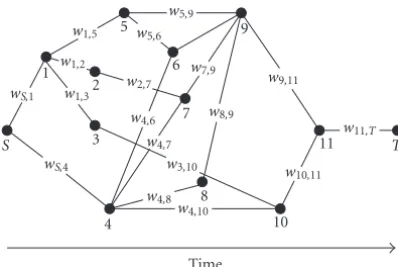
We incorporated the confidence score C(vm) to weight re-liable hypotheses acoustically as well as linguistically [9]. Specifically, the posterior probability of each transcribed word, that is, the ratio of word hypothesis probability to that of all other hypotheses, is calculated using a word graph ob-tained through a decoder and used as a measure of confi-dence [12,13]. A word graph consisting of nodes and links from the beginning nodeSto the end node T is shown in Figure 2.
Nodes represent time boundaries between possible word hypotheses, and the links connecting these nodes represent word hypotheses. Each link is given the acoustic log likeli-hood and the linguistic log likelilikeli-hood of a word hypothe-sis.
The beautiful cherry blossoms bloom in spring Figure3: Example of dependency structure.
wj+1· · ·wL
wk+1· · ·wy· · ·wz· · ·wj
wi· · ·wx· · ·wk
w1· · ·wi−1
β β
α
α
α S
Figure4: Phrase structure tree based on dependency structure.
T,Pac(wk,l) is the acoustic likelihood ofwk,l,Plg(wk,l) is the linguistic likelihood ofwk,l, andᏳis the forward probability from the beginning nodeSto the end nodeT(=αT).
2.4. Word concatenation score
Suppose that “the beautiful cherry blossoms in Japan” is summarized as “the beautiful Japan.” The summary is gram-matically correct but semantically incorrect. Since its linguis-tic score is not powerful enough to alleviate this problem, we incorporated a word concatenation scoreT(vm−1, vm) to penalize the concatenation between words that had no de-pendency in the original sentence. Every language has its own structures for dependency, and basic computation of the word concatenation score independent of the type of lan-guage is described below.
2.4.1 Dependency structure
The arches in Figure 3show the dependency structure rep-resented by a dependency grammar. In a dependency gram-mar, one word is designated as the “head” of the sentence, and all other words are either a “dependent” of that word, or dependent on some other word which is connected to the “head” word through a sequence of dependencies [14]. The word at the tail of the arrow in the arches is the “modifier,” and the word at the point of the arrow is the “head.” For in-stance, the dependency grammar of English consists of both right-headed dependency indicated by the arrows pointing
right and left-headed dependency indicated by the arrows pointing left. These dependencies can be represented by a phrase structure grammar, that is, a dependency context free grammar (DCFG), using the following rewriting rules based on Chomsky’s normal form:
α−→βα(right-headed),
α−→αβ(left-headed), α−→w,
(4)
whereαandβare nonterminal symbols andwis a terminal symbol (word).Figure 4has an example of a phrase structure tree based on a word-based dependency structure for a sen-tence which consists ofLwords,w1, . . . , wL. Thewxmodifies wz when a sentence is derived from the initial symbolSand the following requirements are fulfilled: (1) the ruleα→βα is applied; (2)wi· · ·wkis derived fromβ; (3)wxis derived fromβ; (4)wk+1· · ·wj is derived fromα; and (5)wz is de-rived fromα.
2.4.2 Dependency probability
Since the dependencies between words are usually ambigu-ous, whether or not there are dependencies between words must be estimated by a dependency probability that one word is being modified by the others. In this study, the de-pendency probability is calculated as a posterior probability estimated by the inside-outside probabilities [15] based on the SDCFG. The probability that thewxandwzrelationship has a right-headed dependency structure is calculated as a product of the probabilities of the above steps from (1) to (5). However, left-headed dependency probability is calcu-lated as the product of probabilities when ruleα→αβis ap-plied. Since English has both right and left dependencies, the dependency probability is defined as the sum of the right-headed and left-right-headed dependency probabilities. If a lan-guage has only right-headed dependency, the right-headed dependency probability is used for dependency probability. For simplicity, the dependency probabilities betweenwxand wz are denoted byd(wx, wz, i, k, j), whereiandkare the in-dices of the initial and final words derived fromβ, and jis the index of the final word derived fromα. The dependency probability is calculated as
dwm, wl, i, k, j
=
#
αβ
f(i, j|α)P(α−→βα)hm(i, k|β)hl(k+ 1, j|α)
+
αβ:α=β
f(i, j|α)P(α−→αβ)hm(i, k|α)hl(k+ 1, j|β) $
,
(5)
hn(i, j|α)= where eis the inside probability given by (A.2) in the ap-pendix.
2.4.3 Word concatenation probability
In general, asFigure 4shows, a modifier derived fromβcan be directly connected with a head derived fromαin a sum-marized sentence. In addition, the modifier can also be con-nected with each word which modifies the head. The word concatenation probability betweenwx andwy is defined as the sum of the dependency probabilities betweenwxandwy, and betweenwx and each of thewy+1· · ·wz. Using the de-pendency probabilitiesd(wx, wy, i, k, j), the word concatena-tion score is calculated as the logarithmic value of the word concatenation probability given by
Twx, wy
The SDCFG is constructed using a manually parsed cor-pus. The SDCFG parameters are estimated using the inside-outside algorithm. In our SDCFG based on Ito et al. [16], we only determined the number of nonterminal symbols and considered all possible phrase trees. We applied rules con-sisting of all combinations of nonterminal symbols to each rewriting symbol in a phrase tree. The nonterminal sym-bol in this method is not given a specific function such as that of a noun phrase, and the functions of nonter-minal symbols are automatically learned from data. The probabilities for frequently used rules increase and those for rarely used rules decrease. Since words in the learn-ing data for SDCFG are tagged with POS, the dependency probability of words excluded from the learning data can be calculated based on their POS. Even if the transcrip-tion results obtained by a speech recognizer are ill-formed, the dependency structure can be robustly estimated by the SDCFG.
2.5. DP for automatic summarization
Given a transcription result consisting of N words, W =
w1, w2, . . . , wN, summarization is done by extracting a set of M(M < N) words,V=v1, v2, . . . , vM, which maximizes the summarization score given by (1). The algorithm is as fol-lows.
Algorithm 1. (1)Definition of symbols and variables
sis the beginning symbol of sentence,/sis the ending sym-bol of sentence,P(wn|wkwl)is the linguistic score,I(wn)is the word significance score,C(wn)is the confidence score,T(wl, wn) is the word concatenation score, s(k, l, n)is the summariza-tion score of each words(k, l, n) = I(wn) +λLL(wn|wkwl) +
The summarization score is calculated for each subsentence hy-pothesis consisting of one word. The value of−∞is awarded for each word which is never selected as the first word in the summarized sentence consisting ofMwords,
g(1,0, n)
DP recursion is applied to each pair of the last two words (wl, wn) for each subsentence hypothesis consisting ofmwords,
form=2toM,
(4)Select the optimal path
The best complete hypothesis consisting of M words is deter-mined by selecting the last two words(wˆl, wˆn), summarization result by tracking the back pointers retained in (3),
form=Mto1, vm=wnˆ,
/s
Figure5: Example of DP alignment to summarize an individual utterance.
Figure6: Example of DP process to summarize multiple utterances.
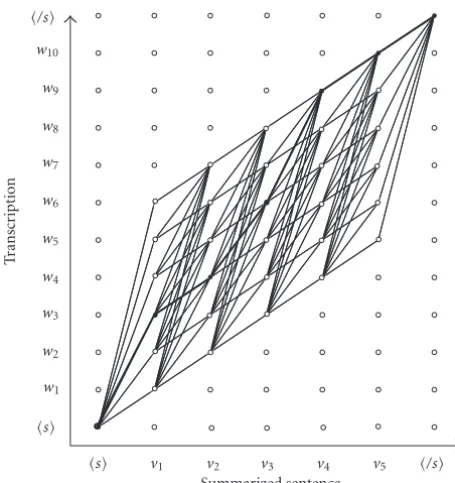
Figure 5 shows the two-dimensional space for the DP process. The vertical axis represents the transcription con-sisting of 10 words (N = 10), and the horizontal axis rep-resents the summarized sentence having 5 words (M =5). All possible sets of 5 words extracted from the 10 words are traced by paths from the bottom-left corner to the top-right corner. The path which maximizes the summarization score is selected.
3. SUMMARIZATION OF MULTIPLE UTTERANCES
3.1. Basic algorithm
Our proposed technique to automatically summarize the speech in individual sentences can be extended to
summa-14
Number of words in summarized multiple utterances S1
Backtrack from best condition within target number of words
Figure7: Example of two-level DP process to summarize multiple utterances.
rizing a set of multiple utterances (sentences) by incorpo-rating a rule which provides restrictions at sentence bound-aries [10,17]. In multiple utterances summarization, original sentences including many informative words are preserved, and sentences including few informative words are deleted or shortened. Given the total summarization ratio for multi-ple utterances, the summarization ratio for each utterance is automatically calculated so that the total score can be maxi-mized. Figure 6illustrates the DP process for summarizing multiple utterances. This technique incorporates the sum-marization method, developed in the field of natural lan-guage processing to extract important sentences, into our sentence-by-sentence summarization method.
3.2. Summarization of multiple utterances using two-level DP
However, the amount of calculation required to select the best combination of all those possible in multiple utter-ances increases as the number of words in the original ut-terances increases. To alleviate this problem, we propose a new method in which each utterance is summarized, based on all possible summarization ratios, and then the best com-bination of summarized sentences for each utterance is deter-mined according to a target compression ratio using a two-level DP technique.Figure 7illustrates the two-level DP tech-nique for summarizing multiple utterances. The algorithm is as follows.
Algorithm 2. (1)Definition of symbols and variables sn(l)is the summarization score for a sentence consisting ofl
s The beautiful cherry blossoms in Japan bloom in spring /s
Automatic summarization of automatic transcription The word string most similar to
the automatic summarization in the network
Summarization accuracy
sChillDELbloom in spring/s sCherry blossoms bloom in spring/s
5−(1 + 0 + 1)/5∗100=60%
Figure8: Example to calculate summarization accuracy using a word network. The underlined word andDELin automatic summarization represent a substitution error and a deletion error. The summarization accuracy is given by (15).
(3)DP process
forn=2toN, M=M+Ln,
form=0toM,
g(n, m)= max m−Ln≤l≤m, l≥0
g(n−1, l) +sn(m−l),
B(n, m)= arg max m−Ln≤l≤m, l≥0
g(n−1, l) +sn(m−l).
(13)
(4)Backtracking
forn=Nto1, ln=M−B(n, M), M=B(n, M),
forn=1toN,
OutputSn
ln
.
(14)
4. EVALUATION
4.1. Word network of manual summarization results used for evaluation
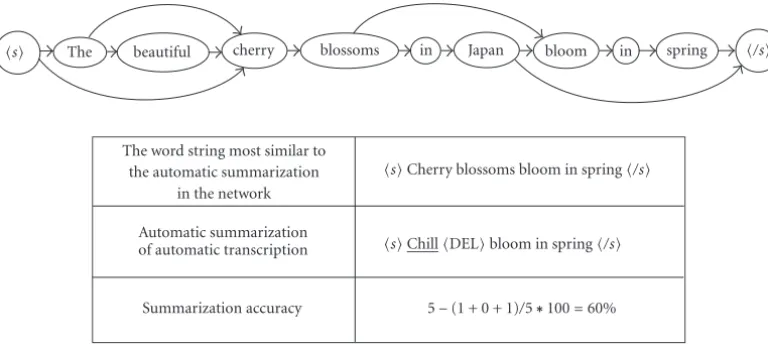
Correctly transcribed speech is manually summarized by hu-man subjects and used as correct targets to automatically evaluate summarized sentences. The manual summarization results are merged into a word network which approximately expresses all possible correct summarizations including sub-jective variations. The summarization accuracy given by (15) is calculated using the word network [10]. The word string that is the most similar to the automatic summarization results extracted from the word network is considered the correct target for automatic summarization. The accuracy,
comparing the summarized sentence with the target word string, is a measure of linguistic correctness and retention of the original meanings of the utterance,
Summarization accuracy
=Len−(Sub + Ins + Del)
Len ×100[%],
(15)
where Sub is the number of substitutions compared with tar-get word string, Ins is the number of insertions compared with target word string, Del is the number of deletions com-pared with target word string, and Len is the number of words in target word string.
Figure 8shows an example of calculating summarization accuracy using a word network. In this example, “cherry” is misrecognized as “chill” by the recognition system and is ex-tracted into a summarized sentence. The summarization ac-curacy is defined by the word acac-curacy based on the word string extracted from the word network that is most similar to the automatic summarization results.
4.2. Evaluation data
Table1: Examples of automatic summarization and the corresponding target extracted from a manual summarization word network. In each summarization ratio, upper sentence represents a set of words extracted from summarization network which is the most similar to automatic summarization, and lower sentence represents automatic summarization of recognition results. The underlined word in the recognition result is a recognition error.INSandDELindicate an insertion error and a deletion error in summarization.
VICE PRESIDENT AL GORE SAYS THE GOVERNMENT HAS A PLAN TO AVOID Recognition result
THE INEVITABLE PROSPECT OF INCREASED AIRPLANE CRASHES AND FATALITY IS VICE PRESIDENT AL GORE SAYS THE GOVERNMENT HAS A PLAN TO AVOID 70% THE INCREASED AIRPLANE CRASHES
summarization VICE PRESIDENT AL GORE SAYS THE GOVERNMENT HAS A PLAN TO AVOID
<DEL>INCREASED AIRPLANE CRASHES
<INS>THE GOVERNMENT HAS A PLAN TO AVOID 40% THE INCREASED AIRPLANE CRASHES
summarization GORE THE GOVERNMENT HAS A PLAN TO AVOID THE INCREASED AIRPLANE CRASHES
extracting words, and they were merged to build word net-works.
4.3. Structure of transcription system
The English news broadcasts were transcribed under the fol-lowing conditions.
4.3.1 Feature extraction
Sounds were digitized at 16-kHz sampling and 16-bit quanti-zation. Feature vectors had 13 elements consisting of MFCC. Vocal Tract Length Normalization (VTLN) and cluster-based cepstral mean normalization were used to compensate for speakers and channels. Linear Discriminant Analysis (LDA) was applied to produce a 42-dimensional vector from a set of features in each segment consisting of 7 frames.
4.3.2 Acoustic model
We used a pentphone model with 6000 distributions sharing 2000 codebooks. There were about 105-k Gaussians in the system. The training data was composed of 66 hours of BN.
4.3.3 Language model
The bigram and trigram were constructed using a BN corpus with a vocabulary of 40 k.
4.3.4 Decoder
A word-graph-based 3-pass decoder was used for transcrip-tion. In the first pass, a frame-synchronous beam search was conducted using a tree-based lexicon, the above-mentioned hidden Markov models (HMMs) and a bigram model to gen-erate a word graph. In the second pass, a frame-synchronous beam search was conducted again using a flat lexicon hy-pothesized in the word graph by the first pass and a trigram model. In the third pass, the word graph was minimized and rescored using the trigram language model.
4.4. Training data for summarization models
A word significance model, a bigram language model, and SDCFG were constructed using approximately 35-M words
(10681 sentences) from the Wall Street Journal corpus and the Brown corpus in the Penn Treebank (http://www.cis. upenn.edu/∼treebank/).
4.5. Evaluation results
We summarized both manual transcription (TRS) and auto-matic transcription (REC).Table 1shows examples of auto-matic summarization and the corresponding target extracted from a manual summarization word network.Figure 9shows summarization accuracies of utterance summarizations at 40% and 70% summarization ratios, and Figure 10shows those for summarizing articles with multiple utterances at 40% and 70% summarization ratios. In these figures, I,L, C, andTindicate, word significance scores, linguistic scores, confidence scores, and word concatenation scores, respec-tively. We compared conditions with and without the word confidence score (I L C T) and (I L T) in the REC sum-marization. To summarize both TRS and REC, we compared conditions with and without the word concatenation score (I L T,I L C T) and (I L,I L C).
The summarization accuracies for manual summariza-tion (SUB) were considered to be the upper limit for auto-matic summarization accuracy. To ensure that our method was sound, we produced randomly generated summarized sentences (RDM) according to the summarization ratio and compared them with those we obtained with our proposed method.
Table2: Number of recognition errors in summarized sentences ((·) is the number of sentences including recognition errors).
Individual utterance Multiple utterances
REC 180(45) 326(94)
Summarization ratio 40% 70% 40% 70% I 42 (27) 111 (40) 99 (56) 199 (71)
Figure 9: Individual utterance summarization at 40% and 70% summarization ratios. REC: summarization of recognition results, TRS: summarization of manual transcriptions, RDM: random word selection, C: confidence score,I: significance score, L: linguistic score,I L: combination of 2 scores,I L C,I L T: combination of 3 scores,I L C T: combination of all scores, and SUB: subjective summarization.
5. CONCLUSIONS
Individual utterances and a whole news article consisting of multiple utterances taken from English news broadcasts were summarized by our automatic speech summarization method based on the following: word significance score, linguistic likelihood, word confidence measure, and word concatenation probability. The experimental results revealed that our method can effectively extract relatively important information and remove redundant and irrelevant informa-tion from English news broadcasts in the same way as it does in Japanese news broadcasts.
In contrast with the confidence score which was incor-porated into the summarization score to exclude word er-rors by the recognizer, the linguistic score effectively re-duces out-of-context word extraction both from recogni-tion errors and human disfluencies. In summarizing the speech of Japanese news broadcasters, the confidence mea-sure improved summarization by excluding in-context word
70%
Figure10: Article summarization at 40% and 70% summarization ratios. REC: summarization of recognition results, TRS: summa-rization of manual transcriptions, RDM: random word selection, C: confidence score,I: significance score,L: linguistic score,I L: combination of 2 scores,I L C,I L T: combination of 3 scores, I L C T: combination of all scores, and SUB: subjective summa-rization.
errors. In the English case, the confidence measure not only excluded word errors, but also helped extract clearly pro-nounced important words. Consequently, the use of the con-fidence measure yielded a larger increase in the summariza-tion accuracy for English than it did for Japanese.
APPENDIX
PARAMETER RE-ESTIMATION IN SDCFG
The parameters of SDCFG for languages with both right and left dependency structures are estimated from a manual-parsed corpus using the inside-outside algorithm. Suppose that a sentence consists ofLwords,
S−→w1· · ·wi· · ·wL, (A.1)
SDCFG
Figure11: Estimation algorithm for SDCFG.
The rewrite probabilities of α → βα and α → w are denoted by P(α → βα) and P(α → w), respectively. The algorithm for estimating the parameters of the SDCFG is de-scribed below.Figure 11lists the estimation steps.
Algorithm A.3. (1)Initialization
P(α → βα)andP(α → αβ)are given a flat probability and
P(α→w)is given random values.
(2)Calculation of the inside probability
The inside probability inFigure 11(a) is calculated as follows:
e(i, j|α)=Pα−→wi· · ·wj
(3)Calculation of the outside probability
The outside probability inFigure 11(b) is calculated as follows:
f(i, j|α)=Pw1· · ·wi−1αwj+1· · ·wL
(4)Estimate of parameters
The parameters are re-estimated, using the probabilities ob-tained through steps (2) to (3),
(5)Iteration
Steps from (2) to (4) are iterated until the parameters are satu-rated.
ACKNOWLEDGMENT
The authors would like to thank Dr. Yoshi Gotoh (Sheffield University) for an arrangement of generating the correct an-swer for automatic summarization.
REFERENCES
[1] R. Valenza, T. Robinson, M. Hickey, and R. Tucker, “Summa-rization of spoken audio through information extraction,” in Proc. ESCA Workshop on Accessing Information in Spoken Au-dio, pp. 111–116, Cambridge, UK, 1999.
[2] Z. Klaus, “Automatic generation of concise summaries of spo-ken dialogues in unrestricted domains,” inProc. 24th ACM SIGIR International Conference on Research and Development in Information Retrieval, New Orleans, La, USA, September 2001.
[3] S. Furui, K. Maekawa, H. Isahara, T. Shinozaki, and T. Ohdaira, “Toward the realization of spontaneous speech recognition-introduction of a Japanese priority program and preliminary results,” inProc. International Conference on Spo-ken Language Processing (ICSLP2000), vol. 3, pp. 518–521, Beijing, China, 2000.
[4] F. R. Chen and M. M. Withgott, “The use of emphasis to automatically summarize a spoken discourse,” inProc. IEEE Int. Conf. Acoustics, Speech, Signal Processing, vol. 1, pp. 229– 232, San Fransisico, Calif, USA, March 1992.
[5] S. Kobayashi, N. Yoshikawa, and S. Nakagawa, “Extracting summarization of lectures based on linguistic surface and prosodic information,” IPSJ Technical Report SIG-SLP-43-7, Toyohashi University of Technology, Japan, 2002.
[6] I. Mani and M. T. Maybury,Advances in Automatic Text Sum-marization, MIT Press, Cambridge, Mass, USA, 1999. [7] K. Knight and D. Marcu, “Statistics-based summarization—
step one: sentence compression,” inProc. 17th National Con-ference on Artificial Intelligence (AAAI-00), Austin, Tex, USA, August 2000.
[8] C. Hori and S. Furui, “Automatic speech summarization based on word significance and linguistic likelihood,” in Proc. IEEE Int. Conf. Acoustics, Speech, Signal Processing, vol. 3, pp. 1579–1582, Istanbul, Turkey, 2000.
[9] C. Hori and S. Furui, “Improvements in automatic speech summarization and evaluation methods,” inProc. 6th Interna-tional Conference on Spoken Language Processing (ICSLP2000), vol. 4, pp. 326–329, Beijing, China, 2000.
[10] C. Hori and S. Furui, “Advances in automatic speech summa-rization,” inProc. 7th European Conference on Speech Commu-nication and Technology (Eurospeech), vol. 3, pp. 1771–1774, Aalborg, Denmark, 2001.
[11] A. Waibel et al., “Advances in meeting recognition,” inProc. 1st International Conference on Human Language Technology Conference (HLT 2001), pp. 11–13, San Diego, Calif, USA, March 2001.
[12] T. Kemp and T. Schaaf, “Estimating confidence using word lattices,” inProc. 5th European Conference on Speech Com-munication and Technology (Eurospeech), vol. 2, pp. 827–830, Rhodes, Greece, September 1997.
[13] V. Valtchev, J. Odell, P. Woodland, and S. Young, “MMIE training of large vocabulary recognition systems,” Speech Communication, vol. 22, no. 4, pp. 303–314, 1997.
[14] C. Manning and H. Schutze, Foundations of Statistical Natu-ral Language Processing, MIT Press, Cambridge, Mass, USA, 1999.
[15] K. Lari and S. J. Young, “The estimation of stochastic context-free grammars using the inside-outside algorithm,”Computer Speech & Language, vol. 4, no. 1, pp. 35–56, 1990.
[16] A. Ito, C. Hori, M. Katoh, and M. Kohda, “Language mod-eling by stochastic dependency grammar for Japanese speech recognition,” inProc. 6th International Conference on Spoken Language Processing (ICSLP2000), vol. 1, pp. 246–249, Beijing, China, 2000.
[17] C. Hori and S. Furui, “A new approach to automatic speech summarization,” to appear in the IEEE Trans. Multimedia.
Chiori Hori received the B.E. and the M.E. degrees in electrical and informa-tion engineering from Yamagata Univer-sity, Yonezawa, Japan in 1994 and 1997, re-spectively. From April 1997 to March 1999, she was a Research Associate in the Fac-ulty of Literature and Social Sciences, Yam-agata University. In April 1999, she started the doctoral course in the Graduate School of Information Science and Engineering at
Tokyo Institute of Technology (TITECH) and received her Ph.D. degree in March 2002. She is currently a Researcher in NTT Com-munication Science Laboratories (CS Labs) at Nippon Telegraph and Telephone Corporation (NTT), Kyoto, Japan in 2002. She is a member of the IEEE, the Acoustical Society of Japan (ASJ), and the Institute of Electronics, Information and Communication En-gineers of Japan (IEICE).
Sadaoki Furuiis currently a Professor at the Department of Computer Science, Tokyo Institute of Technology. He is engaged in a wide range of research on speech analy-sis, speech recognition, speaker recognition, speech synthesis, and multimodal human-computer interaction and has authored and coauthored over 400 published articles. He is a Fellow of the IEEE, the Acoustical So-ciety of America, and the Institute of
Robert Malkin received the B.S. degree in computational linguistics and the Mas-ter of Language Technologies, both from Carnegie Mellon University, in 1996 and 1998, respectively. He is currently a Ph.D. candidate at Carnegie Mellon’s Language Technologies Institute. Mr. Malkin’s re-search interests include computational au-ditory scene analysis, machine perception, and speech recognition.
Hua Yureceived his B.S. and M.S. degrees in computer science, Tsinghua University, China in 1994 and 1996, respectively. He is now a Ph.D. candidate in the School of Computer Science, Carnegie Mellon Uni-versity, working on recognition of conver-sational speech. His research interest in-cludes speech recognition, pattern recogni-tion, and language technologies in general. He is a student member of the IEEE and the ACM.
Alex Waibelis a Professor of computer sci-ence at Carnegie Mellon University, Pitts-burgh and at the University of Karlsruhe (Germany). He directs the Interactive Sys-tems Laboratories (www.is.cs.cmu.edu) at both universities with research emphasis in speech recognition, handwriting recog-nition, language processing, speech trans-lation, machine learning, and multimodal and multimedia interfaces. At Carnegie