R E S E A R C H
Open Access
DSC and universal bit-level combining for HARQ
systems
Tiejun Lv
*, Jinhuan Xia and Feichi Long
Abstract
This paper proposes a Dempster -Shafer theory based combining scheme for single-input single-output (SISO) systems with hybrid automatic retransmission request (HARQ), referred to as DSC, in which two methods for soft information calculations are developed for equiprobable (EP) and non-equiprobable (NEP) sources, respectively. One is based on the distance from the received signal to the decision candidate set consisting of adjacent constellation points when the source bits are equiprobable, and the corresponding DSC is regarded as DSC-D. The other is based on the posterior probability of the transmitted signals when the priori probability for the NEP source bits is available, and the corresponding DSC is regarded as DSC-APP. For the diverse EP and NEP source cases, both DSCD and DSC-APP are superior to maximal ratio combining, the so-called optimal combining scheme for SISO systems. Moreover, the robustness of the proposed DSC is illustrated by the simulations performed in Rayleigh channel and AWGN channel, respectively. The results show that the proposed DSC is insensitive to and especially applicable to the fading channels. In addition, a DS detection-aided bit-level DS combining scheme is proposed for multiple-input multiple-output–HARQ systems. The bit-level DS combining is deduced to be a universal scheme, and the traditional log-likelihood-ratio combining is a special case when the likelihood probability is used as bit-level soft information.
Keywords:Basic probability assignment (BPA), Bit-level combining, Dempster -Shafer (D -S) evidence theory, Hybrid automatic retransmission request (HARQ), Multiple-input multiple-output (MIMO), Maximum-ratio combining (MRC)
I Introduction
A concern in packet data communication systems is how to control the transmission errors caused by the channel noise and interferences so that packets can be transmitted reliably. Automatic retransmission request (ARQ), as a fundamental approach, is intended to ensure an extremely low packet error rate. The effi-ciency of the system can be improved if the ARQ is combined with a forward-error-correcting (FEC) code, referred to as HARQ, which includes Chase combining [1] and incremental redundancy (IR) [2]. There are many HARQ strategies: including separating the HARQ process into HARQ sub-processes that operate over an isolated pairing of a transmitter and receiver antenna [3]; the constellation rearrangement technique [4] and the bit rearrangement scheme [5] that can provide a kind of diversity for performance improvement. In [4,5],
authors developed effective HARQ strategies at the transmitter in order to improve the system reliability. Contrariwise, both [6,7] discussed combining algorithms at the receiver.
Three linear combining schemes [8], selection com-bining (SC), equal-gain comcom-bining (EGC), and maximal ratio combining (MRC), entail various trade-offs between performance and complexity, and compara-tively MRC is deemed to be superior to the others by outputting the maximum signal-to-noise (SNR) ratio in SISO systems. Jang et al. [6] proposed an optimal com-bining scheme for MIMO systems with HARQ, which can be used in both symbol-level and bit-level. However, the complexity imposed in [6] increases exponentially with the number of both bits per symbol and transmit antennas [7] proposed an improved LLR combining scheme, invoking a new LLR calculation method. The traditional combining schemes are developed on the basis of Bayesian theory. This paper concentrates on the DST-based combining scheme [9,10]. DST has attracted
* Correspondence: [email protected]
School of Information and Communication Engineering, Beijing University of Posts and Telecommunications, Beijing, 100876, China
much attention in many fields owing to its counteract-ing uncertainty merit, such as artificial intelligence research [11,12], data fusion [13,14], and has been shown to achieve a satisfactory performance. Xia et al. [9] first proposed a DS detection-aided bit-level DS combining scheme for MIMO -HARQ systems. After-ward, a symbol-level DS combining is proposed in [15]. Xia and Lv [10] aims to analyze the merits of the com-bining based on DST, in which DSC is justified to out-perform the Bayesian theory based MRC for SISO systems.
The distance-based method for soft information calcu-lations in the DSC scheme (termed as DSC-D) is pro-posed for equiprobable source bits [10], which are usually used in realistic applications. In the traditional MRC scheme, decisions-making is based on the maxi-mal-likelihood (ML) rule (termed as MRC-ML) or the maximum-a-posterior-probability (MAP) rule (termed as MRC-MAP), both of which are equivalent for the equi-probable source [10] presents that the proposed DSC-D outperforms the traditional ML as well as MRC-MAP, and the performance gap becomes bigger with increasing SNR. This paper focuses on the performance of the proposed DSC scheme when the source bits are non-equiprobable for research integrity. For non-equi-probable source, this paper presents the system perfor-mance comparison between the DSC-D and MRC-ML as well as MRC-MAP, and shows that the DSC-D is inferior to the MRC-MAP because the distance-based soft information calculations do nothing with the priori probability of the transmitted signal, by which a new method for soft information calculations on the basis of the posterior probability of the transmitted signal (termed as DSC-APP) is inspired. DSC-APP is demon-strated to be superior to the other combining counter-parts performed in Rayleigh fading channel, and both DSC-D and DSC-APP are insensitive to the channel state. However, the performance of MRC in AWGN channel is much degraded if it is employed in Rayleigh channel. Such conclusions validate the robustness of the proposed DSC. In addition, inspired by the DS detec-tion-aided DS combining in [9], a universal bit-level combining scheme is proposed. It is deduced that the traditional LLR combining is a special case of the pro-posed universal bit-level DS combining scheme if the likelihood probability is used as the bit-level soft information.
The rest of this paper is organized as follows: The HARQ system model is introduced in Section II, fol-lowed by the proposed DSC combining scheme in Sec-tion III. The universal bit-level DS combining is proposed in Section IV. Simulations and comparisons are provided in Section V. At the end of this paper, con-clusions are given in Section VI.
Notation: Transpose and Hermitian transpose of a vector or matrix are denoted by (·)T and (·)H, respec-tively. Additionally, vectors and matrices are denoted by the bold lowercase and uppercase letters, respectively.
II System model
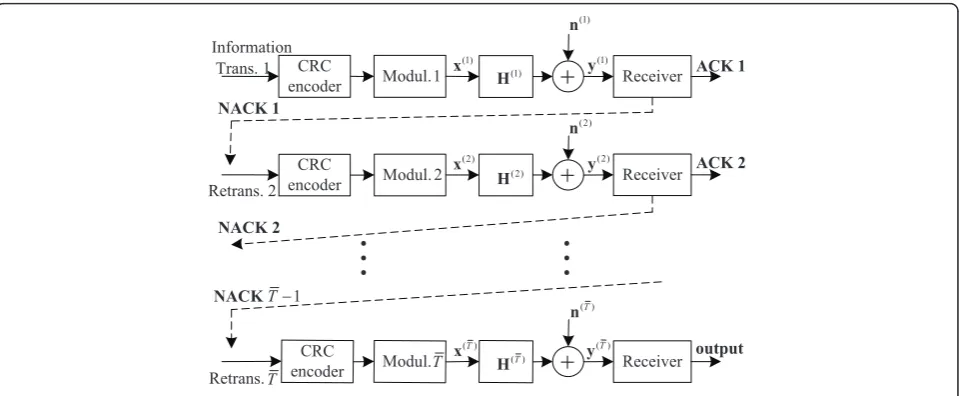
Figure 1 depicts the system model of interest, a packet-oriented ARQ system. This paper focuses on the BER performance after packets combined by diverse combin-ing schemes, and the functional FEC code is therefore omitted from the system model for simplicity. As illu-strated in Figure 1, original information bits are encoded by CRC, then modulated into transmissive signals suita-ble for the noisy and/or fading channel. If the receiver decodes the packet correctly, the recovered bits are out-put and an acknowledgment (ACK) signal is fed back to the transmitter. Otherwise, a negative acknowledgement (NACK) signal is fed back and the receiver simulta-neously requests retransmission of the same packet.
In the tth (re)transmission with t= 1, 2,. . .,T¯, for MIMO systems with Nt transmit antennas and Nr receive antennas, the receiver obtains
y(t)=H(t)x(t)+n(t), t= 1, 2,. . .,T¯, (1)
where H(t)∈CNr×Nt is the channel matrix in the tth (re)transmission with the entryh(ijt)denoting the channel gain between the jth transmit antenna and the ith receive antenna. For additive white Gaussian noise (AWGN) channel, h(ijt)= 1, i = 1,..., Nr; j = 1,..., Nt;
t= 1,. . .,T¯, but for Rayleigh fading channel, each entry ofH(t)is modeled as an independent complex Gaussian random variable with zero mean and unit variance.x(t) denotes anNtlength modulated transmit symbols vector in the tth (re)transmission, whose elements are taken from the complex constellation set U= {s1, s2,..., sM } with cardinality M. The component ofUis obtained by invoking the mapping function sa= map (sa1sa2... sac) (e.g. Gray mapping), wheresak(k= 1, 2,...,c;c= log2M ) represents the binary information bit. Pr (sak= 0) and Pr (sak= 1) denote the priori probability for the binary information bit 0 and 1, respectively, satisfying Pr (sak= 0) + Pr (sak= 1) = 1, with Pr (sak= 0) = Pr (sak= 1) = 0.5 indicating the equiprobable source bits.n(t)∈CNr×1 is an independent and identical distributed (i.i.d.) Gaus-sian stationary noise vector with zero mean and variance matrix s2I, where Iis a (Nr ×Nr)-dimensional identity matrix. For SISO systems with Nt=Nr= 1, (1) is sim-plified as
y(t)=h(t)x(t)+n(t), t= 1, 2,. . .,T¯, (2)
x(t)
, noise vector n(t)and entry of channel matrixH(t)in MIMO systems, respectively.
Although the information packets are identical in bit-level during all the transmissions, symbols x(t) trans-mitted in a specific (re)transmission may be different, because different modulation schemes may be employed in each transmission, as presented in Figure 1.
III DST-based combining scheme and MRC
The traditional combining schemes, MRC as well as SC and EG, are based on Bayesian theory. DST as a gener-alization of the Bayesian theory has unique merits in uncertainty processing, based on which a novel combin-ing scheme called DSC is proposed in [10].
A DSC
DSC refers to the modulation constellation setUas the frame of discernment with mutually exclusive and exhaustive hypotheses. Focal element set (FES)Smis a subset Sm ⊂ U, in which the number of elements is denoted bym, e.g. S1 = {sa} or S2 = {sa, sb} or S3= {sa, sb, sg}..., wherea≠b≠gand a,b,g= 1, 2,...,M. SetSm reflects the uncertainty of decision judgements. For example,S2= {sa,sb} contains more uncertainty thanS1 = {sa}, which implies that the transmitted symbol may be sa or sb, but there is no convincing evidence for deciding which one must be the transmitted symbol. In wireless communication systems, the transmitted signals suffer from multipath fading channels and interferences, and the received signals thus contain much uncertainty. Therefore, it is reasonable to use FESSmto characterize the uncertain decisions. In the proposed DSC scheme [10], the uncertain decision propositionsSmconsist of the adjacent constellation points, since it is usually
difficult to ensure which one is the transmitted symbol between the adjacent constellation points.
Basic probability assignment (BPA) denoted by Mas (Sm) characterizes the confidence reposed in the trans-mitted signal being contained in setSm. Two methods for BPA calculations are proposed for equiprobable and non-equiprobable sources, respectively. One is based on the distance from the received signal to the decision candidate set, i.e. the nearer-distance-more-confidence rule, and the other is based on the posterior probability of the transmitted signals, both of which are introduced in detail as follows:
(1) distance-based BPA calculations: The nearer-dis-tance-more-confidence principle is used for BPA calcula-tions in [10], which is based on the distance between the received signal and the decision candidate set consisting of adjacent constellation points with the assumption that the source bits are equiprobable. The corresponding MasD(Sm|y(t)) function is expressed as where N(Sm) denotes the total number of the set Sm containing madjacent constellation points, P is a key issue concerned with the trade-off between performance and complexity, and
is a normalization coefficient, satisfying
P
From (3) it is obvious that the nearer it is from the received signaly(t)to the decision candidate setSm, the more confidence (larger MasDSm _y(t)) is placed in the set.
(2) a posterior probability-based BPA calculations: When the source bits are non-equiprobable (NEP), of which the priori probability is available to the receiver, ML become suboptimal and MAP is the optimal method. In view of this, BPA calculations can thus be performed based on the posterior probability of the transmitted signals as
wheref y(t)|Smis likelihood function,
fy(t)S
withs2 denoting the AWGN noise power. The nor-malization coefficientR(APPt) is expressed as
R(APPt) =
whereby the summation of 5 is unity as like 4.
If not specially pointed, the Mas (·) function has two expressions MasD (·) and MasAPP (·) as the above mentioned, both of which denote the soft information BPA but obtained by diverse calculation methods. For simplicity, only Mas (·) is used in the following context.
In addition, DST contains two new measure of“belief” or “credibility” that are foreign to Bayesian theory. These are the notions of support and plausibility [16], respectively. The support for the transmitted signal being in the set Sm is defined as the total BPA of all subsets implying theSmset. Thus,
SptSmy(t)
The support is a kind of loose lower limit to the uncertainty. On the other hand, a loose upper limit to the uncertainty is the plausibility. This is defined, for the Sm set, as the total BPA of all subsets that do not contradict theSmset. In other words,
PlsSmy(t)
As a result, it can be inferred that the belief of the transmitted signal contained in setSmlies in the interval
[Spt Sm |y(t), PlsSm|y(t)], which represents the uncer-tain propositions. The smaller the interval is, the clearer the evidence is to support the corresponding proposi-tions. The more detailed explanations about the support and the plausibility functions refer to Shafer’s original work on DST in [17].
As the approach above mentioned, the similar belief interval as [SptSm|y(t)), Pls(Sm|(y(t))] can be achieved for each y(t),t= 1, 2,. . .,T¯. The interval is gradually reduced along with making more use of the received signals as follows
At this time, Spt(Sm) and Pls(Sm) are two measures of the aggregate belief in the transmitted signal being con-tained in set Sm, which are achieved after combining multiple information sources by (9). These two mea-sures of the aggregate belief need to be further merged before decision-making, since it is beneficial to make more reliable decisions by taking full advantage of them. The proposed DSC merges Spt(Sm) and Pls(Sm) in terms of the Dempster’s rule [18], which is a generalization of Bayes’rule and is justified under many situations. The aggregation can be expressed as
Spt Pls(Sm) =
Spt(Sm)Pls(Sm)
1−Spt(Sm)(1−Pls(Sm))
, m= 1, 2,. . .,P, (10)
where Spt_Pls(Sm) is regarded as the reliable belief in the transmitted signal that is included in set Sm and is applied to assist in making decisions. However,Sm is still a set containing m adjacent constellation points withm = 1, 2,..., P. The ultimate goal of the proposed scheme is to correctly judge which point of the constel-lation is the transmitted signal, thus the decision statis-tics are defined as
De(sα) =
sα∈Sm
Spt Pls(Sm)
m ,α= 1, 2,. . .,M, (11)
where the summation is carried out among all the sets (Sm) that contains the constellation sa. Finally, the resulting decision is written asˆs= arg maxs
α∈UDe(sα).
B MRC
˜
n= [n(1)n(2)· · ·n(T¯)]T, y˜= [y(1) y(2)· · ·y(T¯)]T, ˜
n= [n(1)n(2)· · ·n(T¯)]T, respectively.T¯ transmissions for the signalx can thus be written in matrix expression as
˜
y=xH˜ +n˜, to which model the MRC scheme is applied, and the resulting decision statistics can be expressed as
x= H˜
where xˆ is a Gaussian random variable with xmean ands2variance.
If the source bits are equiprobable, the ML rule is equivalent to the minimum distance rule. The decision result of MRC is accordingly written as
ˆ
Otherwise, if the source bits are non-equiprobable and the priori probability of the source signals Pr(sa),a = 1, 2,...,M , is available to the receiver, the decision result according to the maximum posterior probability rule can thus be achieved as
ˆ
IV A universal bit-level combining scheme
The authors previously proposed a novel DS detection-aided bit-level DS combining scheme, called a soft-deci-sion-soft-combining algorithm, for MIMO - HARQ systems in [9]. The scheme includes two important stages: DS detection and DS combining. In the DS detec-tion stage, the symbol-level BPAs are assigned by the probability-density-function (PDF), i.e. the likelihood function (6), which is equivalent to the above-mentioned nearer-distance-more-confidence rule for BPA calcula-tions. Soft information sources (symbol-level BPAs) from all receive antennas are aggregated by the Dempster’s combination rule, and the uncertainty is counteracted during the combination process. In the DS combining stage, the bit-level BPAs are calculated according to the reliable aggregations that are induced from the DS detec-tion stage. After receiving all (re)transmissions of the same packet, bit-level BPAs are combined, during which procedure the uncertainty is further counteracted. Such a soft-decision-soft-combining scheme improves system performance by characterizing and counteracting uncer-tainty, and the performance simulations demonstrate that the proposed DS detection-aided DS combining outper-forms its conventional minimum-mean-square-error (MMSE) detection-aided LLR combining counterpart.
The ultimate aggregate symbol-level BPAs outputted by the DS detection algorithm are transformed to the plausibility values Pls (s1), Pls (s2),..., Pls (sM), wheresa, a = 1, 2,..., M, is a single constellation point, and the detailed algorithm flow refers to [9]. In the DS combin-ing procedure, different from what happens in the DS detection, the frame of discernment Θ= {1, 0} is sup-posed, so there are only two choices for FESS, which is a set containing only one element, i.e.S= {1} orS= {0}. The bit-level BPA Mas(αtk)(S) (k= 1, 2,. . .,c), satisfying
Mas(αtk)(S) >0, represents the soft information for each bit of the transmited signalxj, j= 1, 2,...,Ntthat is cal-culated by virtue of the plausibility values Pls (s1), Pls (s2),..., Pls (sM ) with most credibility obtained from the DS detection stage. Specifically, the bit-level BPA Mas(jkt)(S)for thekth bit ofxjis given by
where the normalization coefficientR(jkt)is represented as
R(jkt)= 1
The receiver obtains the maximumT¯ transmissions of the same information packet and combines all the soft information sources of the packet in bit-level. As for the kth bit of the transmitted signalxj, the aggregation can be expressed as
The combining notion⊕here refers to the Dempster’s combination operator, which is defined as the orthogo-nal sum (commutative and associative) as follows
m=m1⊕m2⊕ · · · ⊕mm,
where the aggregationmis expressed as
m(A)=
most of such independent soft information and counter-act the uncertainty contained in each information source, so that the aggregationMasfjk(S)is more cred-ible. After the DS combining (17), reliability of the soft informationMasfjk(S)for thekth bit ofxjis improved,
then Masfjk(S)is utilized to make decisions, and the decision output is written as
ˆ
xjk=
1, Masfjk(S={1})≥Masfjk(S={0}),
0, Masfjk(S={1}) <Masfjk(S={0}). (18)
Although it is first proposed as a DS detection-aided bit-level DS combining, the proposed DS combining is a universal scheme, in which the soft information sources Mas(jkt)(S)t= 1, 2,. . .,T¯ are achieved by (15), imposing the plausibility values from the DS detection. However, DS detection is not obligatory, and any other MIMO detection scheme is applicable. If only symbol-level BPA could be achieved according to the decision statistics of detection scheme, the DS combining algorithm needs only the symbol-level BPA for bit-level BPA calculations. Actually, the soft informationMas(jkt)(S)for each bit can be calculated by other ways. For example, in the LLR combining scheme [6], log-likelihood-probability-ratio for each bit is used. If the likelihood probability is invoked as a form of bit-level BPA, the conventional LLR combining is demonstrated to be equivalent to the proposed DS combining scheme with details as below.
Without loss of generality, this demonstration focuses on the kth bit of the transmitted signalxjwith k = 1, 2,...,cand j= 1, 2,...,Nt. The LLR of thekth bit of the transmit signal xj in the tth (re)transmission is
LLR(t)= lnp
(t)(x jk=1)
p(t)(xjk=0) After receiving all ofT¯ transmissions
for the same information packet, the receiver computes the final LLRffor each bit by
LLRf =
In the DS combining scheme, if choose
Mas(jkt)(S={1})=p(t)x
jk= 1 and Mas(jkt)(S={0})=p(t)
xjk= 0 as a special case, the receiver combines all of T¯ soft information sources and achieves the final aggregation as
In the decision-making stage, in terms of (19), the decision output in LLR combining scheme can be expressed as
In the DS combining scheme, according to (20) and (21), the decision output can be expressed as (18). Com-paring (18) with (22), it is concluded that the LLR com-bining is equivalent to the DS comcom-bining when the likelihood probability is chosen as a form of bit-level BPA. In other words, the LLR combining is a special case of the proposed bit-level DS combining scheme.
V Simulation and comparison
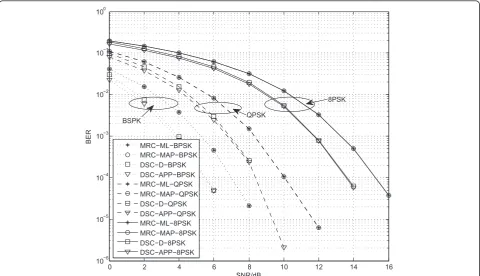
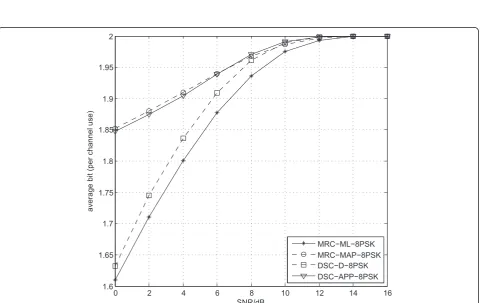
The system performance comparison between the pro-posed DS detection-aided DS combining and the con-ventional MMSE detection-aided LLR combining in MIMO -HARQ systems presented in [9] validates the proposed scheme. In addition, for SISO systems, system performance improvement of the proposed DSC over its MRC counterpart is demonstrated in [10] when the source bits are equiprobable, and the simulation result is shown in Figure 2. As MAP algorithm is equivalent to ML when source bits are equiprobable, thus MRC-MAP is equivalent to MRC-ML, which can be easily seen in Figure 2. The proposed DSC-D and DSC-APP outper-form both MRC-ML and MRC-MAP, while gap between DSC-D and DSC-APP is very small. In the following context, we mainly focus on the situation when the source bits are non-equiprobable.
the receiver, so adaptive coded modulation as a com-mon technique at the transmitter is not invoked in all simulation cases.
For the constellation setU= {s1,s2,...,sM}, the element is achieved by the mapping function sa= map (sa1sa2 ... sac). When the source bits are non-equiprobable, let p and 1 -pdenote the priori probability for bit 1 and 0, respectively, i.e. Pr (sak = 1) =p, Pr (sak = 0) = 1 - p. The corresponding priori probability for the modulated symbols for BPSK, QPSK, and 8PSK can be written as
BPSK : Pr(s1= map(1))=p, Pr(s2= map(0))= 1−p;
QPSK : Pr(s1= map(11))=p2, Pr(s2= map(10))=p1−p ,
Pr(s3= map(01))=p1−p , Pr(s4= map(00))=1−p2;
8PSK : Pr(s1= map(111))=p3, Pr(s2= map(110))=p21−p,
Pr(s3= map(101))=p2
1−p , Pr(s4= map(100))=p
1−p2, Pr(s5= map(011))=p2
1−p , Pr(s6= map(010))=p
1−p2, Pr(s7= map(001))=p1−p2, Pr(s8= map(000))=1−p3;
A Performance comparison between DSC and MRC in Rayleigh channel, when the source bits are NEP and the priori knowledge is unavailable
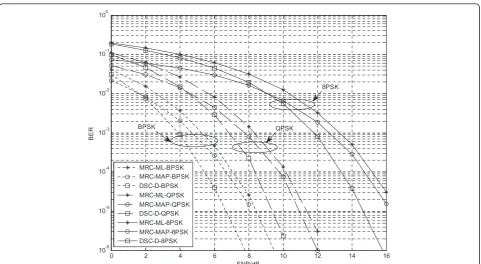
When the source bits are non-equiprobable withp= 0.1, i.e. Pr (sak= 1) = 0.1, Pr (sak= 0) = 0.9, and such priori probability is not available to the receiver, the proposed DSC scheme calculates the BPAs on base of the distance from the received signaly(t)to the decision candidate set Sm, i.e. the nearer-distance-more-confidence rule (3). The
system performance after combining two transmissions of the same packet by means of the proposed DSC scheme is shown in Figure 3, and the corresponding performance of MRC by the ML (13) as well as the MAP rule (14) is also provided in Figure 3 for the sake of comparison. From this figure, it is obvious that the proposed DSC (marked by DSC-D, denoting the distance-based BPA cal-culations for DSC) outperforms the ML-based MRC (marked by MRC-ML), both of which do not know the priori probability for the non-equiprobable source, and the gap for performance gains appears at low SNR region and becomes large as SNR increases. In addition, the cor-responding performance of the MAP-based MRC (marked by MRC-MAP) plotted in Figure 3 is provided for reference. It is found that the significant performance gains of MRC-MAP over MRC-ML appear in low SNR region and the gap becomes small as SNR increases. As a result, the performance lines of DSC-D and MRC-MAP cross, but both outperform the MRC-ML scheme.
B Performance comparison between DSC-D and DSC-APP in Rayleigh channel, when the source bits are NEP and the priori knowledge is available
Following the last subsection, if the priori probability of the non-equiprobable source bits is available to the receiver, the posterior probability of the transmitted sig-nal can be used for BPA calculations in the proposed
í
í
í
í
í
í
615G%
%(5 05&í0/í%36.
05&í0$3í%36. '6&í'í%36. '6&í$33í%36. 05&í0/í436. 05&í0$3í436. '6&í'í436. '6&í$33í436. 05&í0/í36. 05&í0$3í36. '6&í'í36. '6&í$33í36.
%63. 436.
36.
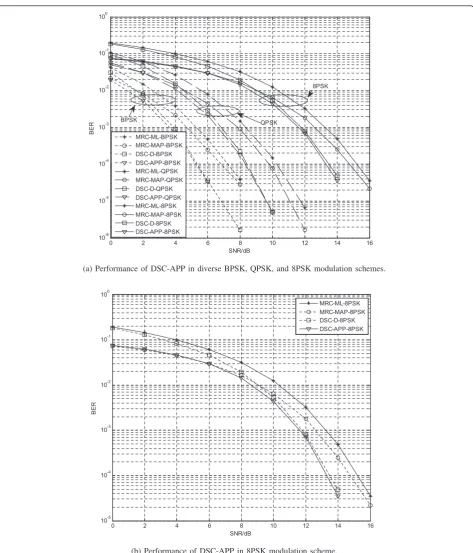
DSC scheme as (5), so as to improve the system perfor-mance compared to the distance-based method for BPA calculations (DSC-D). Assuming the priori probability is Pr (sak = 1) = 0.1, Pr (sak = 0) = 0.9, the DSC scheme makes use of such priori probability for BPA calcula-tions, and the resulting system performance (marked by DSC-APP) in diverse BPSK, QPSK, and 8PSK modula-tion schemes is shown in Figure 4a, where the perfor-mance of DSC-APP in 8PSK is re-portrayed in Figure 4b for legible observation.
From Figure 4, it is concluded that DSC-APP outper-forms DSC-D by making use of the priori probability of the non-equiprobable source, especially in low SNR region. Moreover, the performance of the proposed DSC-APP is almost equivalent to that of MRC-MAP in low SNR region, both of which employed the priori knowledge of the source, whereas when SNR increases, the superior performance of DSC-APP is becoming remarkable and the performance gap of DSC-APP over MRC-MAP is gradually enlarged. However, if the recei-ver cannot obtain the priori knowledge, the proposed DSC-APP degrades to be DSC-D that has been demon-strated to be superior to MRC-ML in previous subsec-tion. In conclusion, whether the source bits are equiprobable or non-equiprobable, the proposed DSC outperforms its MRC counterpart.
C Performance comparison with Turbo codes, when the source bits are NEP and the priori knowledge is available
Since FEC coding schemes are incorporated in main-stream research about bit-level combining of HARQ retransmission mechanisms, we give the simulations with Turbo codes here. The frame size is 1024, code rate is 12, maximum iteration number is 10, and MAP algorithm is adopted when decoding. The simulation result is given in Figure 5, as can be seen, the system performance is greatly improved when turbo code is applied, and the relationship between the proposed algo-rithms remains the same.
D System throughput comparison when the source bits are NEP and the priori knowledge is available
Since throughput is the main term in ARQ systems, we give the throughput comparison in Figure 5 besides the comparison of BER. The system throughput has the units bit/s/Hz and represents the amout of information cor-rectly received at the receiver per channel use. The result is simulated in Rayleigh channel, when the source bits are non-equiprobable with priori probability Pr (sak= 1) = 0.1 in 8PSK modulation scheme, and we only give the result in 8PSK for the relationship among these algo-rithms are more significant in 8PSK modulation. From Figure 6, it can be easily seen that DSC-D outperforms
615G%
%(5
05&0/%36. 05&0$3%36. '6&'%36. 05&0/436. 05&0$3436. '6&'436. 05&0/36. 05&0$336. '6&'36.
36.
436. %36.
615G%
%
(5
05&0/%36. 05&0$3%36. '6&'%36. '6&$33%36. 05&0/436. 05&0$3436. '6&'436. '6&$33436. 05&0/36. 05&0$336. '6&'36. '6&$3336.
436. %36.
36.
(a) Performance of DSC-APP in diverse BPSK, QPSK, and 8PSK modulation schemes.
615G%
%(
5
05&0/36. 05&0$336. '6&'36. '6&$3336.
(b) Performance of DSC-APP in 8PSK modulation scheme.
í
í í í
615G%
%(5
05&í0/í%36. 05&í0$3í%36. '6&í'í%36. '6&í$33í%36. 05&í0/í436. 05&í0$3í436. '6&í'í436. '6&í$33í436. 05&í0/í36. 05&í0$3í36. '6&í'í36. '6&í$33í36.
Figure 5Performance comparison with Turbo codes, when the source bits are non-equiprobable with priori probability Pr (sak= 1) = 0.1.
615G%
DYHUDJHELWSHUFKDQQHOXVH
05&í0/í36. 05&í0$3í36. '6&í'í36. '6&í$33í36.
ML, while DSC-APP slightly outperforms MRC-MAP. One can see that these relationships are largely related to that of BER, which is verified by comparing Figures 4 and 6.
E Performance comparison between DSC and MRC in AWGN channel
This simulations will demonstrate the robustness of the proposed DSC by comparing the performance of system in Rayleigh channel and in AWGN channel. Figure 7 shows the system performance of DSC-D and DSC-APP in QPSK and 8PSK modulation schemes, the corre-sponding performance lines of the ML and MRC-MAP in Rayleigh channel and in AWGN channel are provided for the sake of comparison.
The similar conclusion can be achieved from Figure 7 that the proposed DSC-APP outperforms DSC-D in low SNR region, but both of them as well as MRC-ML con-verges as SNR increases in AWGN channel. In addition, the system performance of MRC-MAP in AWGN chan-nel is superior to all others in both QPSK and 8PSK modulation schemes. It is also observed that the perfor-mances of both MRC-ML and MRC-MAP are much degraded in Rayleigh channel compared to those in AWGN channel, which implies that the MRC scheme is sensitive to the channel state. It is obvious that the sys-tem performances of DSC-D and DSC-APP in Rayleigh channel degrade little compared to those in AWGN
channel, which demonstrates that the proposed DSC scheme is robust to the channel state and is especially applicable to fading channels like the Rayleigh fading channel.
It is necessary to point out that the main term in an ARQ system is throughput, and the relationship between the throughput of the system with different algorithms is mostly related to that between the BER performance.
F Complexity analysis
Finally, to see how much additional computing effort is made by the proposed combining schemes to gain the BER improvement, we discuss the performance gain vs. computing complexity in this subsection. The ML and MAP combining schemes are shown in (13) and (14), respectively, and the complexity of them can be summar-ized asO(M+t2) due to the complexity of ML detector OMNtN
rN2t [19] and the complexity of (12).M is the modulation constellation set cardinality,tis the number of retransmission,NtandNris simplified as 1 according to our simulations. As for the proposed DST-based schemes, the complexity is mainly decided by the com-plexity of BPAs calculations and combinations. In (3), N(S2)= 12M(M−1)and N (S1) = M, the complexity of (3) is thus approximatelyO(M2t), and the complexity of (5) is almost the same with (3) except the computation
615G%
%
(5
$:*105&0/436. $:*105&0$3436. $:*1'6&'436. $:*1'6&$33436. $:*105&0/36. $:*105&0$336. $:*1'6&'36. $:*1'6&$3336. 5D\OHLJK05&0/436. 5D\OHLJK05&0$3436. 5D\OHLJK05&0/36. 5D\OHLJK05&0$336.
$:*1
5D\OHLJK 5D\OHLJK
$:*1
of exponential function. The complexity of (7), (8), and (9) is approximately O12M(M+ 1)t and for (10) and (11) the complexity is approximatelyO12M(M+ 1) and O(3M) respectively. In summary, the total complexity of the proposed two combining schemes is both approxi-mately12O(3M+ 1)Mt+M2+ 7M.
From the above analyses, although the total complex-ity of the proposed combining schemes is larger than ML and MAP, the total complexity is polynomial or non-exponential withM andt. And with this penalty of complexity, the performance of the proposed schemes is improved at a considerable extent, which can be seen in the above subsections.
VI Conclusions
The DS detection and DS combining schemes based on the DST are proposed, which are demonstrated to out-perform the traditional ones. This paper proposes two methods for BPAs calculations of the DSC: distance-based D, and a posterior probability-distance-based DSC-APP. The simulations are performed in BPSK, QPSK, and 8PSK modulation schemes to illustrate the impact of equiprobable or non-equiprobable source bits on the performance of diverse
HARQ systems based on the MRC and the proposed DSC schemes. The results justify the validity of the pro-posed DSC. Moreover, the comparison between the per-formance in Rayleigh channel and that in AWGN channel demonstrates the robustness of the proposed DSC that is insensitive to and especially applicable to the fading channels. In addition, this paper follows the research of the DS detection-aided DS combining scheme proposed previously and deduced that the bit-level DS combining is a universal scheme. If only the likelihood probability is used as the bit-level soft infor-mation, the LLR scheme is deduced to be a special case of the proposed bit-level DS combining. Whereas, the DSC-APP only exists in the case that the priori prob-ability of the non-equiprobable source is available to the BPA calculator. But if the priori probability is only avail-able to the combiner, but not availavail-able to the BPA cal-culator, the combining rule under the instruction of the priori probability is being studied and will be presented in another paper.
Acknowledgements
This work is financially supported by the National Natural Science Foundation of China (NSFC) under Grant no. 60972075. Competing interests
The authors declare that they have no competing interests.
Received: 22 June 2011 Accepted: 18 August 2011 Published: 18 August 2011
References
1. D Chase, I CNR, M Needham, Code combining—a maximum-likelihood decoding approach for combining an arbitrary number of noisy packets. IEEE Trans Commun.33(5), 385–393 (1985). doi:10.1109/TCOM.1985.1096314 2. M Pursley, S Sandberg, Incremental-redundancy transmission for
meteor-burst communications. IEEE Trans Commun.39(5), 689–702 (1991). doi:10.1109/26.87160
3. H Zheng, A Lozano, M Haleem, Multiple ARQ processes for MIMO systems. EURASIP J Appl Signal Process.2004, 772–782 (2004). doi:10.1155/ S1110865704311042
4. C Wengerter, A von Elbwart, E Seidel, G Velev, M Schmitt, inProceedings of IEEE 56th Vehicular Technology Conference VTC’02-Fall. Advanced Hybrid ARQ Technique Employing a Signal Constellation Rearrangement4, 2002–2006 (2002)
5. S Moon, H Park, A Goldsmith, M Oh, inProceedings of IEEE Global Communications Conference GLOBECOM’07. Bit Rearrangement for MIMO Retransmissions, 3509–3513 (2007)
6. E Jang, J Lee, H Lou, J Cioffi, inProceedings of IEEE International Symposium on Information Theory, ISIT’07. Optimal Combining Schemes for MIMO Systems with Hybrid ARQ, 2286–2290 (2007)
7. H Wang, Y Chang, inProceedings of IEEE International Conference on Communications, ICC’08. Novel Hybrid-ARQ Chase Combining Algorithms for ZF-SIC V-BLAST, 5118–5122 (2008)
8. A Goldsmith,Wireless Communications(Cambridge University Press, Cambridge, 2005)
9. J Xia, T Lv, Y Li, J Cioffi, inProceedings of IEEE International Symposium on Information Theory, ISIT’09. A Novel Bit-Level DS Combining Scheme for MIMO Systems with HARQ1, 244–248 (2009)
10. J Xia, T Lv, DST-Based Combining Scheme Outperforms Maximal-Ratio Combining. Electron Lett.46(7), 536–537 (2010). doi:10.1049/el.2010.3518 11. T Denoeux, A Neural Network Classifier Based on Dempster–Shafer Theory.
IEEE Trans Syst Man Cybern A.30(2), 131–150 (2000). doi:10.1109/ 3468.833094
12. H Liangmei, G Jun, W Andong, H Young, inProceedings of IEEE Intelligent Transportation Systems. A Neural Network Shape Recognition System Based on D–S Theory1, 524–528 (2003)
13. H Zhu, O Basir, A scheme for constructing evidence structures in Dempster–Shafer evidence theory for data fusion. IEEE Int Symp Comput Intell Robot Autom.2, 960–965 (2003)
14. L Rujie, Y Baozong, inProceedings of 5th International Conference on Signal Processing, WCCC-ICSP2000. A D–S Based Multi-Channel Information Fusion Method Using Classifier’s Uncertainty Measurement2, 1297–1300 (2000) 15. J Xia, T Lv, inProceedings of IEEE Global Communications Conference,
GLOBECOM’09. Uncertainty Processing Applied to Packet Combining in MIMO-HARQ Systems, 1–5 (2009)
16. S Challa, D Koks, Bayesian and Dempster–Shafer fusion. Sadhana29(2), 145–174 (2004). doi:10.1007/BF02703729
17. G Shafer,A Mathematical Theory of Evidence(Princeton University Press, Princeton, 1976)
18. K Sentz, S Ferson,Combination of Evidence in Dempster–Shafer Theory,835
(2002). Report no. SAND2002
19. E Viterbo, J Boutros, A universal lattice code decoder for fading channels. IEEE Trans Inf Theory45(5), 1639–1642 (1999). doi:10.1109/18.771234
doi:10.1186/1687-1499-2011-66