Article
1
Big data-driven Market-Oriented Information System
2
for the Internationalisation and Strategic and
3
Sustainable Management of SMEs
4
Yoseob Heo 1, 2, Jungjoon Kim 3, 5 and Jongseok Kang 2, 3, *
5
1 Data Analysis Platform Centre, Korea Institute of Science and Technology Information (KISTI), 66,
6
Hoegi-ro, Dongdaemun-gu, Seoul, 02456, Korea
7
2 Department of Science and Technology Management and Policy, Korea University of Science and
8
Technology (UST-Korea), 217 Gajeong-ro, Yuseong-gu, Daejeon 34113, Korea
9
3 Busan-Ulsan-Kyeongnam Branch, Korea Institute of Science and Technology Information (KISTI),
10
Centum Science Park 4F, 79, Centum jungang-ro, Haeundae-gu, Busan, 48058, Korea
11
4 Dept. of Convergence Research Center for Diagnosis, Treatment and care System of Dementia, Korea
12
Institute of Science and Technology (KIST), 5, Hwarangno 14-gil, Seongbuk-gu, Seoul, 02792, Republic of
13
Korea
14
5 Future Technology Analysis Centre, Korea Institute of Science and Technology Information (KISTI), 66,
15
Hoegi-ro, Dongdaemun-gu, Seoul, 02456, Korea
16
* Correspondence: [email protected]; Tel.: +82-51-831-0760
17
18
Abstract: There have been many discussions on the globalisation of SMEs, but it is true that there is
19
not enough academic achievement after such the study of Born global (BG) ventures. The
20
internationalisation of SMEs (Small and Medium Enterprises) is not easy because they lack
21
resources or capabilities compared to multinational corporations. This study investigated the role
22
of government in assisting the internationalisation of SMEs. In particular, SMEs lacked the ability
23
to acquire market-oriented information, so we’ve established the scheme of efficient information
24
support system for the internationalisation of SMEs. In other words, we proposed an information
25
analysis system through the establishment of a relational database constructed for market-oriented
26
information support. KISTI (Korea Institute of Science and Technology Information), which is one
27
of the government-funded research institutes in the Republic of Korea, provided information
28
support to the SMEs dealing with hydrazine related products. This study suggests this case for the
29
market-oriented information support of the government in the internationalisation of SMEs. The
30
research on information support of the government is meaningful in that it suggests a way to
31
support SMEs in practical level.
32
Keywords: Internationalisation of SMEs; Big data; Market-oriented information; Relational
33
database; Supply chain network; Optimized database; Trade condition; Data visualization
34
35
1. Introduction
36
SMEs account for a significant portion of the economy. In the OECD economy, SMEs and
37
microenterprises not only account for more than 95% of enterprises and 60-70% of employment and
38
55% of GDP but creating new jobs as well [1]. Also, European Commissioner Günther Verheugen
39
announced at a press pack from 2006 as following; "SMEs are the backbone of the European economy
40
and the best potential source of jobs and growth," [2]. In Korea, similarly, the number of small and
41
medium-sized enterprises comprised 99.9% of the total industry, and those engaged in SMEs also
42
account for 90.2% by statistics in 2015 [3]. In other words, in every country in the world regardless of
43
the development stage, from this perspective based on the fact that SMEs account for the majority the
44
number of companies and employment, it is said that the main character of the economy is not a large
45
company but an SME. The researches and policies that have been focused on economic growth
46
centred on large corporations can be said to be due to the mistaken or exaggerated interpretation of
47
'modernity.' Instead, it is a problem today that we overlook the fact that economic growth has become
48
more active in regions and clusters where traditional SMEs have developed [1, 4].
49
Meanwhile, it is accepted that the participation of SMEs in the internationalisation of production
50
should be revitalised in the era of globalisation as a consensus of many researchers [5-17]. Researches
51
on the importance of geographical expansion, namely globalisation or internationalisation, to
52
strengthen the growth of SMEs have been actively conducted around the 1990s. Globalisation refers
53
to the operation and management of a company at an international level outside of a specific region
54
and country. As market globalisation accelerates, market conditions, including marketing,
55
distribution, production, and so forth, are changing drastically, companies are faced with a global
56
competition system because of the pressure and hurdles of traditional exports [19-20]. Thus,
57
according to Barringer and Greening [17], such an international (or geographical) expansion is
58
essential to the growth of SMEs, even for the SMEs that focus on local markets and have limited
59
geographic areas of activity.
60
However, studies on the internationalisation of SMEs are still relatively insufficient in the
61
literature [18-21]. Of course, research on the internationalisation of SMEs has also made remarkable
62
achievements on specific topics over the last decades, such as international entrepreneurship [16],
63
born-global ventures [22-23], and newly emerging international venture companies [24].
64
Nevertheless, there are still numerous issues not yet revealed in this field. That is because researches
65
on international management (IM) and international business (IB) have been concentrated on
66
Multinational corporations (MNCs) rather than SMEs [21].
67
Simon [25] argues that the export competitiveness of a particular country is determined by a
68
"hidden champions," which are innovative SMEs relatively unknown to the general public than large
69
corporations, though, dominating the world market in each field. Even, the interests in 'Born-global'
70
start-ups, which have entered into international business (especially exports) from the start with the
71
young and innovative entrepreneurial spirit, have also increased, since their innovative activities can
72
foster the growth of new markets and create a virtuous cycle of recreating the way companies operate
73
in those markets [22-23]. Therefore, it is necessary to study the theoretical basis and method to
74
establish effective globalisation strategies and efficiently execute action plans for contemporary
75
SMEs.
76
The problem is that SMEs are weaker than large corporations or MNEs in international markets.
77
That is because there are weaknesses that are inherent in the characteristics of SMEs, and related
78
researches have been extensively studied [26-27]. For instance, differences in firm size generate
79
strategic advantages in recognising and responding to trade barriers [28-29]. Generally speaking, the
80
many studies indicate that larger firms with more capital and infrastructure can better cope with
81
these trade barriers than SMEs [30-34]. In other words, SMEs are faced with a shortage of business
82
capabilities compared to large enterprises that have achieved elaborate knowledge and resource
83
management over an extended period. While large firms are exporting based on developed systems,
84
SMEs are less likely to overcome difficulties in exporting because of their lack of resources and
85
capabilities in many ways [34]. The unique characteristics of these SMEs and their position in the
86
market competition system are the major factors that make it difficult for SMEs to enter the
87
international market [35-36].
88
Accordingly, SMEs are confronted with more risks than large corporations in the process of
89
internationalisation. That is due not only to the restricted financial resources, but also to the high
90
level of uncertainty, high-cost information, and lack of market experience and knowledge [37-39]. Of
91
course, SMEs may choose maturity by accumulating long-term experience, know-how and
92
knowledge in the domestic market to reduce risk and uncertainty in the international market entry.
93
However, for SMEs competing in the high-tech sector, selecting the above-mentioned method can
94
make it difficult to gain competitive advantage due to the nature of high-tech such as technology
95
discontinuity, dynamic changes of market structure, etc [40]. Spontaneously, one of the most critical
factors affecting the SMEs' performance in the dynamic high-tech marketplace is the rate of
97
internationalisation [41]. In the end, SMEs may experience a lack of time to consolidate prior
98
knowledge and exploit their international strategies before they even implement them [42].
99
Therefore, in order to survive in rapidly changing international market pressures, it is necessary
100
for technology-oriented SMEs to develop a mechanism to respond quickly to market opportunities
101
and promote capability to efficiently allocate resources in a short time frame [43]. This has been
102
steadily studied by various researchers dealing with the internationalisation of SMEs from the
103
perspective of the resource-based view (RBV). The RBV suggests that businesses must create value
104
through unique products or services that can satisfy their target customers in order to achieve
105
superior performance in international markets [44]. To this end, many researches indicate that SMEs
106
should actively utilize the diverse resources available from external environments or inter-firm
107
networks [45-48]. Information is one of the most important resources that new ventures or SMEs need
108
to leverage [49]. It is also important for firms to obtain information acquisition capability, and
109
adaptive capability [39, 50-54]. The former refers to the ability to gain, absorb, and consolidate
110
information to grasp customer needs and market opportunities [44], and the latter means to adjust,
111
recombine, and allocate resources in accordance with market information [55].
112
However, SMEs are vulnerable to collecting and using market-oriented information [56].
113
Previous studies have shown that, unlike large MNCs, where these corporations can simply rent or
114
purchase information resources, SMEs often have difficulty securing the core resources such as
115
international markets and financial capital information that are crucial for them to explore
116
opportunities in overseas markets, because they need to find the resources that external organizations
117
provide [44, 57]. Ultimately, SMEs need to take advantage of institutional resources belonging to
118
government agencies as an option for obtaining quality market information, including taking part in
119
government programs [58-59], or another option is gaining it from partners such as suppliers,
120
customers, and even competitors [16, 60-61].
121
Therefore, we focus on information and information analysis methodologies that can be
122
provided and supported in terms of institutional resources for internationalisation of SMEs. There is
123
little research on what kind of information is necessary for the internationalisation of SMEs in practice
124
and how to analyse such information and provide it at the governmental and/or public level. In this
125
paper, we suggest and discuss the types of information that can be provided for the
126
internationalisation of SMEs, and the results of the information analysis performed by Korea Institute
127
of Science & Technology (KISTI) in the public sector, which provides market-oriented information to
128
SMEs through supply chain network system embodiment system. And this study aims to contribute
129
to the practical policy implication of the government and the public for the internationalisation of
130
SMEs.
131
The rest of this paper is structured as follows. In Section 2, theoretical backgrounds are suggested
132
concerning prior researches related to the internationalisation of SMEs in various perspectives, and
133
market-oriented information provision of public sector for SMEs. And then, the research objectives,
134
data source, the framework of the market-oriented information system are described in Section 3. In
135
Section 4, the specific case of information support of KISTI for SMEs is showed. Finally, in Section 5
136
and 6, the conclusions, implications and limitations are suggested and discussed.
137
2. Theoretical background
138
2.1. Internationalisation of SMEs
139
Up to the 1980s, SMEs had a strong tendency to concentrate mainly on their original countries
140
or regions [62]. That is because, for SMEs with limited resources and market competitiveness, the
141
internationalisation was a somewhat challenging strategy [63]. Rather, region-based SMEs prefer to
142
focus entirely on domestic and regional markets, as they can have a competitive advantage in the
143
domestic market over foreign competitors [57, 64].
144
However, the pressure of globalisation due to liberalisation of the economy caused the reduction
145
of trade barriers due to international trade liberalization, resulting in the integration of the world
146
economy [19, 22, 43, 65]. SMEs could not be free from this huge flow of globalisation, and since the
1990s, 'international new ventures (INVs)' or ‘born globals (BGs)’ have begun to emerge. They gain
148
competitive advantages from inception by rapidly entering the international market and utilising
149
resources and products in diverse countries [13, 23, 66-69].
150
Before the concept of 'born global' emerged, the initial internationalisation model of firms was
151
an incremental stage model represented by ‘the Uppsala model’ [42, 62, 70-71]. This model has its
152
rationale in behaviour theory of the firm [72-73] and Penrose's [74] theory of the growth of the firm.
153
Comparisons of theses traditional internationalisation models of firms and the models emerging
154
afterwards would be discussed in the following sections.
155
2.1.1. Traditional internationalisation model of SMEs
156
Initial researches on firm’s internationalisation have focused primarily on large MNCs, and on
157
that account, the characteristics of SMEs have been pretermitted [16, 75]. In the 1970s, a model for the
158
internationalisation of firms appeared with the Nordic countries as the centre. The model is referred
159
to as the Uppsala model (U-model) [16]. In accordance with this model, SMEs accumulate enough
160
experience in the domestic market first. Based on this, they would gradually expand and intensify
161
their international business capabilities, starting with geographically and/or culturally close foreign
162
countries, and gradually moving into more distant regions. Therefore, the internationalisation of
163
enterprises in this model is a slow, incremental and gradual process of growth of firms [42, 71].
164
To put the practical internationalisation process based on this traditional model specifically, it is
165
as follows. Firms start exporting when their domestic base is strong and exports are ready to be
166
phased in. In the beginning of exporting, to reduce the risk of uncertainty about the overseas market,
167
they started exporting to other countries through an agent, and then we established sales subsidiaries
168
later. The local production in that countries is the final stage of the internationalisation. The factor
169
that plays a role when choosing the region where the export begins is ‘psychic distance’. Psychic
170
distance is closer to a region with similar linguistic and cultural identities. The export of SME usually
171
extends from the area near psychic distance to the area far away [42, 76].
172
173
Figure 1. The structure of internationalisation in the Uppsala model. Source: Johanson and Vahlne
174
(1977:26).
175
The U-model researchers have proposed a dynamic model in which the outcome that one
176
decision influences the next in the process of internationalisation, and analyse its process of SMEs as
177
‘state aspects’ and ‘change aspects’. They assume that the present state of internationalisation is the
178
factor that drives future change. In the state aspects, ‘market commitment’ and ‘market knowledge’
179
in overseas markets are operated as the important continents. And ‘change aspects’ are comprised in
180
‘commitment decisions’ and ‘current business activities’ [42]. The detailed description of each
181
element is given below.
State Aspects
184
185
● Market Commitment: the concept of market commitment consists of two components - the
186
amount of resources put into the market and the degree of commitment. The degree of
187
commitment represents the ease with which resources can be transferred from one market to
188
another [76, 77]. The concept of commitment can be also defined as the outcome of the
189
multiplication of the scale of the investment and the degree of rigidity (inflexibility) [78].
190
● Market Knowledge: it refers to the knowledge and information that the firm retains about its
191
certain markets, competitors, customers, operations and so on [79-81]. Market knowledge is very
192
important in expanding the market globally, and researchers supporting the U-model have
193
found that knowledge of the international market is derived from individual experience.
194
Empirical knowledge is crucial to international activities by providing a framework for
195
recognizing and shaping opportunities and recognizing 'specific' opportunities [76, 77].
196
197
Change Aspects
198
199
● Current business activities: this serves as a major source of experiential knowledge. Supporters
200
of the U-model thought that as the product became more complicated and specified, the total
201
amount of current business activities and the total market commitment would increase. The best
202
way to quickly acquire and utilise the market experience is to hire a representative, or to merge
203
and/or acquire a company or part of it. Sometimes, however, this type of experience is not an
204
object of sale, so the process of internationalisation may be slowed because it can only be
205
acquired through a long learning process in relation to current business activities [76].
206
● Commitment decisions: when entering foreign markets, it means deciding where to allocate
207
resources among various alternatives, depending on which alternative. This decision is made at
208
a particular point in time, taking into account the current situation and opportunity. In general,
209
when market uncertainties are large, commitment decisions begin at a lower level. Uncertainty
210
can be reduced if the firm’s resources are very abundant, the market conditions are stable, or the
211
firm has lots of similar market experiences [76-78].
212
There is criticism of the Uppsala model, as well. In a business environment where many
213
industries have been already highly globalised, it may take a considerable amount of time for firms
214
to pursue internationalisation through these steps of U-model. In addition, some steps may be
215
omitted depending on the situation and strategy of an individual firm, and the time required for each
216
step may be significantly different for each company. In such a case, the explanation ability of the
217
Uppsala model may be lowered. Actually, there are studies that explains firms that make a high level
218
of resource investment from the beginning of internationalisation without the sequential process that
219
the Uppsala model cannot explain. In the case of the firms with high levels of resources or product
220
competitiveness, it is possible to start internationalisation through foreign direct investment or
221
penetrating multiple markets. Even if they partially follow a stepwise internationalisation, there is
222
also a way to establish production facilities directly or promote a global strategy through
223
international division of labour without indirect export stage through agency or sales subsidiaries
224
stage [82-83].
225
2.1.2. The emergence of born globals (BGs)
226
Basically, the U-model is a gradual stage model of the internationalisation process. However,
227
this internationalisation model has revealed limitations in explaining the internationalisation of
228
venture firms that have rapidly become globalised with advanced technologies since the 1990s when
229
they have started to appear. This type of firm is called ‘born global (BG)’1. In addition, the emergence
230
1 In addition to this born global, firms that are making rapid internationalisation are variously referred to as
of a knowledge-intensive BG with an extensive global network from the early stage of establishment
231
has added to the necessity for new theories. Studies of BG’s internationalisation have revealed that
232
characteristics of these firms represent technology, knowledge-intensive and discontinuous
233
globalisation patterns [64, 84].
234
The above model has been treated as an exceptional phenomenon in previous studies (eg. [93]).
235
However, the recent BG model is regarded as one of the important strategies of venture firms, not
236
exceptional, by researchers focusing on studying entrepreneurship. The researchers are emphasising
237
that in the case of BG ventures founded by entrepreneurs with a lot of international experience, they
238
can combine the resources of various countries and respond to the demands of overseas markets
239
through the international experience of them [64, 94].
240
What capability differences exist between BG and non-BG ventures so that BGs do not follow
241
the existing internationalisation process? Various studies have been carried out to get answers. Many
242
studies have shown that the firms that follow the BG model are new technology-based firms (NTBFs)
243
that are included in technology-intensive industries [95-96]. In the new technology-based industry,
244
the market uncertainty and the competitive intensity is high due to the rapid rate of technology
245
change and short product life cycle [64]. Therefore, the market environment that shortens the product
246
life cycle due to the rapid change of technology leads to the globalisation of the market [70]. In
247
addition, if there is a high level of competition in the domestic market, it may become a strategic
248
alternative to advance into the overseas market. Therefore, the firms exposed to above-mentioned
249
environment tend to pursue rapid internationalisation. Ultimately, for high-tech SMEs, securing their
250
competitiveness at the pace of globalisation is directly linked to the creation of the enterprise's
251
performance and profit [41].
252
2.2. Internationalisation of SMEs from Diverse Theoretical Perspectives
253
2.2.1. The drivers of early internationalisation of BGs from resource-based view (RBV)
254
So what are the drivers that BGs have been able to achieve rapid and early internationalisation?
255
Researches on this topic have also been carried out actively. Fundamentally, a considerable number
256
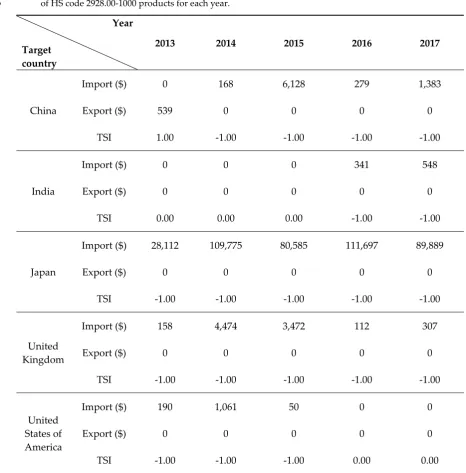
of contributors to this area chose entrepreneurs as the driver of this early internationalisation. In other
257
words, the firm's entry into the overseas market is determined by the function of the firm's internal
258
capabilities [67, 96-97]. The components of this function are knowledge accumulation, financial
259
resources, organizational learning ability, physical equipment, and so on [63]. Especially, the
260
researchers perceiving the internationalisation of firms from the viewpoint of knowledge-base
261
framework and resource-based view (RBV) regard the presence of overseas experience of the firm as
262
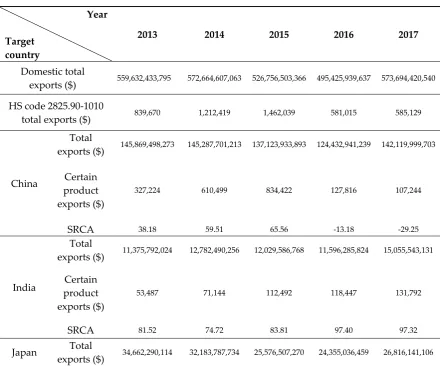
an important variable for determining whether to invest resources in the overseas market or not.
263
Various empirical studies also indicate that firms' overseas experience is an important parameter that
264
accelerates the internationalisation [98-99].
265
However, it is not easy for SMEs to have knowledge of these internal resources, especially
266
technological and market experience. This lack of internal resources can be a significant impediment
267
to the internationalisation of SMEs [86, 100]. Nonetheless, personal experience can complement
268
organisational experience [101]. In particular, in the case of venture firms that rely heavily on the
269
personal capabilities of entrepreneurs, the more entrepreneur's personal oversea experience, the
270
more likely they are to attempt rapid internationalisation. In previous studies, it is explained that
271
entrepreneurs' knowledge and vision are an important factor which encourages venture firms to seek
272
opportunities for internationalisation actively [102-103].
273
From the point of view of venture firms, it is possible to develop skills and technologies as a part
274
of the source of competitive advantage because early attempts at internationalisation can provide
275
them with opportunities to improve learning in aspects of organisation and technology [64, 104].
276
However, venture firm’s undergoing the internationalisation process cannot solely promote the
277
acquisition of new knowledge. It depends on the firm's ability to take advantage of opportunities for
278
the internationalisation. In order to successfully exploit external knowledge or skills, the ability to
279
internalise and absorb them, namely absorptive capacity, should be developed within the firm [105].
280
Therefore, among the venture firms in similar environment, the BG firms have the firm-specific
281
resources such as overseas experience of entrepreneur, the knowledge and information of overseas
282
market, and , in particular, the absorptive capacity.
283
According to Korbin [106], technology-intensive industries tend to be globalised, because the
284
international activities of firms can be an important source of gaining competitive advantage. In order
285
to have high competitiveness in a globalised market, R&D intensity should be high, and firms with
286
high R&D intensity should focus on ‘intelligence gathering’ with international scale. In order to meet
287
the enormous cost and cope with the complexity of R&D, therefore, venture firms need to expand
288
their overseas markets rapidly [106-108].
289
In study of Rialp and Rialp [109], they looked upon the backsight of securing a sustainable
290
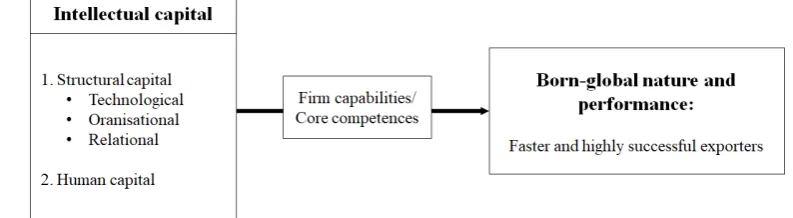
competitive advantage as a sustainable export potential, and based on this premise, developed a
291
model of the BGs’ nature and performance based on RBV as shown in Figure 2. In this model, they
292
emphasise that what the most crucial and highly relevant determinants for characteristics of BGs is
293
the firm's intangible resources and competencies. They also demonstrated that intangible resources
294
partially influence the nature of BG as an export business through empirical studies aimed at Spanish
295
export companies.
296
297
Figure 2. The RBV-based model of the BG nature and performance. Source: Rialp and Rialp (2007: 74)
298
2.2.2. The rapid internationalisation of SMEs from the network approach
299
Venture firms that lack the resources to use imitate competitors' strategies or successful
300
implementations [110]. Strategic capabilities, however, are difficult to imitate completely because
301
they consist of complicated the internal business activities and the unique resources. As a result,
302
venture firms are constantly seeking internal development through their R&D capabilities or
303
pursuing cooperation with competitors in overseas markets. Accordingly, it can be a strategy for
304
venture firms belonging to technology-intensive industries to pursue internationalisation rapidly
305
from the beginning of establishment rather than approaching the incremental internationalisation.
306
Also, this can be a better strategic choice for them to open a ‘window of opportunity’ in the light of
307
the current business environment [111].
308
According to Knight and Cavusgil [112], the main contributors to the rapid internationalisation
309
of BGs are: increased trade liberalisation and economic integration, the development of ICT
310
(Information and Communication Technology), particularly the emergence of the Internet and the
311
World Wide Web (WWW), the globalisation of knowledge and the growth of global networks. In the
312
studies of Coviello and Munro [94, 113], they indicated that it is the network they developed to drive
313
the internationalisation process of SMEs. They also found that how companies enter the overseas
314
market and what market they choose are influenced by their network partners. This supports the
315
view of Johanson and Vahlne [114], who conclude that strategic decision-making and networking
316
capabilities play an essential role in entering international markets.
317
However, there are some limitations in explaining the internationalisation of SMEs by the
318
network approach. According to Young et al. [115], although the network approach provides new
319
insights into the internationalisation of SMEs, it can be seen that the networking is an alternative way
to overcome resource shortage rather than the actual driving force of internationalisation. This is
321
where the ambiguity of the causality and the order of the incidents occurs. Nonetheless, the network
322
approach can explain much of the internationalisation process of SMEs. The followings are the
323
examples of what the network approach can explain; the interactions between network internal
324
resources, activities and actors, their impact on international activities [90, 116], information on
325
international activities, and so on [22, 117-118]. Empirically, in the study of Loane and Bell [119], they
326
conducted in-depth interviews with 57 companies that were able to demonstrate the network
327
characteristics of the SMEs with less than 250 employees in Australia, New Zealand, Canada and
328
Ireland. Through this, they found that SMEs utilise networking as a means to overcome the
329
deficiencies of resources and knowledge within the enterprise, and these results are consistent with
330
previous studies by Young et al. [115] and Kuivalainen [119].
331
2.2.3. The role of market-orientation (MO) in internationalisation of SMEs
332
The market orientation (MO) perspective has been understood in various ways by many
333
researchers. Shapiro [120] saw the MO from decision-making perspective. Kohli and Jaworski [80]
334
introduced a market intelligence perspective on MO as the role to help make strategic decisions at
335
critical stages such as securing market opportunities, making market-penetrating strategies, and
336
developing market.
337
In addition, Narver and Slater [81] emphasised MO as an organisational culture to deliver better
338
value to customers. In a similar but somewhat different direction, Ruekert [121] approached MOs
339
from a strategic perspective for increasing organisational performance. And now, the definition of
340
these two groups of researchers is regarded as the most prominent conceptualisation.
341
MO can also be understood from the RBV. In accordance with RBV, MO is seen as an intangible
342
resource that allows the firms to deploy and exploit market information as a means to create better
343
value [122]. According to Armario et al. [123], they counted the company's global MO as a key
344
capability in supporting the market activities of firms in overseas markets. This is because the global
345
MO provides the ability for firms to quickly learn about overseas markets and to build a promptly
346
response system for overseas markets. Therefore, they pointed out that the MO, represented by the
347
market intelligence generation, is the key to promoting international market commitment.
348
MO as an intangible resource can help to develop an "inside-out" capability that connects
349
internal processes based on firm’s internal capabilities with the external environment, providing a
350
framework for self-awareness of internal capabilities simultaneously [81]. Indeed, Day [79] argues
351
that firms’ building stronger relationships with customers, distributors and suppliers can increase
352
their competitiveness. MO is the basis for explaining the interaction between BG and various foreign
353
markets. In addition, MO plays an important role in elaborating marketing strategies and enhancing
354
corporate performance based on these interactions [124]. In fact, some studies have shown that MO
355
can provide the requisite information to acquire customer knowledge, develop the host market, and
356
establish appropriate product development strategies, so MO was found to be relevant to the process
357
of establishing appropriate marketing strategies in foreign markets and supporting tactical business
358
activities for firms [22, 125].
359
As steadily mentioned above, the internationalisation of SMEs is closely related to the export
360
activity and export potential of enterprises. In this regard, studies on between Export Market
361
Orientation (EMO) and export performance have been carried out in various directions. In the area
362
of studying export performance, MO has been attracting attention as a potential major determinant
363
of export performance [126], and many researches have been conducted concerning the relationships
364
between the extent of use of MO activities and export performance and the extent to which exporters
365
accept MO activities [e.g., 127-132]. Accordingly to Cadogan et al. [133], EMO behaviour can be
366
defined as the export-focused activities generating, disseminating, and responding to export market
367
intelligence as parts of the market-oriented activities that a firms carry out in its export markets.
368
Empirically, Cadogan et al. [134] demonstrated that there is an inverted U-shaped relationship
369
between EMO behaviours and export sales performance in export activities unlike the conventional
370
wisdom that there is a linear relationship between them. Namely, they demonstrate that as the market
dynamics increase, the magnitude of inverted U-shaped relationship is greater, and the optimal value
372
of EMO behaviour decreases with market dynamics increased and increases with the degree of
373
corporate internationalization decreased. Thus, they suggested firms should manage MO behaviours
374
at an optimal level, rather than continually increasing them with the internationalisation process
375
progressed.
376
2.3. Market-oriented Information Provision of Public Sector for the SMEs’ internationalisation
377
SMEs adopt various corporate strategies and governance systems to manage their relationships
378
with external stakeholders, such as customers, suppliers, distributors, and so forth [135-137]. Indeed,
379
companies cannot be competitive in isolation from the diverse entities, including suppliers within
380
their supply chain [138]. This would be the same in the internationalisation process of SMEs.
381
As mentioned above, the internationalisation process of SMEs should utilise various external
382
resources. In particular, in order for the high-tech SMEs to achieve the rapid internationalisation,
383
securing resources on network and market-oriented information is the key resources. According to
384
Yeoh [39], start-ups, however, lack the know-how to commercialise, even though they have excellent
385
development capabilities. Therefore, it is necessary for them to acquire information that can capture
386
overseas market opportunities through various channels. And in the same study, firms that relied on
387
information source from individual and quasi-government tend to have higher performance levels,
388
as well as firms that have made efforts to acquire information.
389
The information, such as overseas market conditions, customer’s demands, and regulations (e.g.
390
tariffs), play an important role in making appropriate strategic decisions at a certain point in the
391
internationalisation of a firm [39, 50]. Dhanaraj and Beamish [60] have shown that the ability of an
392
entrepreneur to quickly collect and process information on foreign markets positively affects firm’s
393
performance in international markets. However, it is not easy for SMEs entrepreneurs, especially
394
entrepreneurs in emerging economies, to obtain high quality information related to foreign markets
395
[50]. International marketing research has therefore indicated that it is important for governments to
396
provide these SMEs with information on foreign market conditions, trade information, and
397
competition in foreign markets, namely market-oriented information [39, 44, 139].
398
3. Research Design
399
3.1. Research Objective
400
The purpose of this study is to explore the information support system that can facilitate the
401
rapid and efficient internationalisation of SMEs. Among the internal resources of SMEs, the resources
402
required for internationalisation would be market-oriented resources. However, as mentioned above,
403
it is not easy for SMEs to acquire overseas market information [50]. In addition, it is time consuming
404
and costly [140], and it is not easy for SMEs to consume these resources.
405
KISTI is a government-funded research institute in Republic of Korea and has been providing
406
information on R&D, technology, and industry for innovation growth of SMEs for a long time.
407
According to Jun et al. [141], as a result of conducting research on SMEs in ICT field, R&D planning
408
and technology information support of KISTI led SMEs to increase their R&D investment. It is also
409
pointed out that this increased investment in technology development has a very significant relation
410
to the technical and economic performance of SMEs, regardless of other variables. This prior study
411
can indirectly reveal that KISTI's information support has a substantial impact on SMEs.
412
This study is an exploratory study to build a system that can provide market-oriented
413
information to SMEs at domestic and overseas in a systematic way. This market-oriented information
414
includes trade information and product supply chain network information. In order to improve the
415
objectivity and reproducibility of the system, the existing data is constructed as a relational database
416
(DB) and the information analysis result is automatically derived through the inter-field network
417
structure in the relational DB.
418
3.2. Structure of Relational Database
The purpose of this study is to explore the information support system that can facilitate the
420
rapid and efficient internationalisation of SMEs. Among the internal resources of SMEs, the resources
421
required for internationalisation would be market-oriented resources. However, as mentioned above,
422
it is not easy for SMEs to acquire overseas market information [50]. In addition, it is time consuming
423
and costly [140], and it is not easy for SMEs to consume these resources.
424
In order to give functions to export market intelligence, the relational DB used in this study
425
consists of multiple DBs in total. It is a relational DB created to systematically provide information
426
on product supply chain network, and trade condition in KISTI, and detailed DB structure is specified
427
in the past researches of the authors [141-142].
428
Briefly, trade and end products information was based on data from Harmonized System (HS)
429
codes and trade indicators by codes. And information on raw materials and intermediates for each
430
product was obtained from the Chemical Abstracts Service Registry Number (CASRN) data and the
431
patent data corresponding to each CASRN.
432
The HS code of the tariff nomenclature is the internationally standardized name and numbering
433
system for classifying the products that have been traded [143]. The HS code is a series of six-digit
434
numbers specifying the general product category in the World Customers Organization (WCO).
435
Countries adopting this system additionally set a four-digit number to supplement the product to a
436
more detailed level [144]. Therefore, each merchandise traded globally is typically assigned 10 digits.
437
The total number of HS codes in the relational database is 33,143. Products that assigned individual
438
HS code have quantitative data concerning trade condition such as total product prices and the
439
import or export prices of each product that are traded in the real world.
440
CASRN is a unique numeric identifier assigned by the Chemical Abstracts Service (CAS) for all
441
chemicals described in the open scientific literature, including organic and inorganic compounds,
442
minerals, isotopes, alloys, and chemicals [145].
443
In general, chemicals are used in raw materials or intermediates in the process of producing
444
some specific end products. We have matched the HS code and product for the same chemical with
445
CASRN in the relational database. If the product in the HS code database matches the product in the
446
CASRN, it can be considered a raw or intermediate product. In the other case, it can be regarded as
447
a finished product and is assigned to the finished product code consisting of the alphabet 'p' and the
448
7-digit HS code. Namely, there are also DBs as joints that connect these two DBs. Therefore, these
449
relational DBs automatically represent the structure in which raw materials, intermediate materials,
450
and finished products are interconnected. The overall relational database scheme is shown Figure 3.
451
452
Figure 3. The database structure of market-oriented information system.
453
3.3. The Framework of Market-Oriented Information System
454
The information to be provided by the market-oriented information system designed in this
455
study can be divided into two categories. The first is trade information. In other words, the system is
456
designed to enable SME to easily obtain information about import and export for its flagship
457
products. Trade information includes trade products, trade volume, trading unit prices, and trade
indices. Second, the system provides product supply chain network information for each product
459
that is generated by linking the HS code with the CAS code. As a result, each company can easily and
460
quickly check various usage information of the certain product. Usage information is based on patent
461
information and is divided into fields such as chemical, mechanical, electrical and electronic,
462
biomedical, and others. The framework of the detailed system is represented in more detail below.
463
3.3.1. Trade information
464
Trade information covers trade data for each item from 2013 to 2017. Trade data includes
465
information on total trade volume, total trade volume, and trade unit price by HS code, year, and
466
destination country.
467
In order to assess the unfavourable trade balance, it is necessary to establish specific criteria. In
468
general, the trade balance, which is unfavourable, is expressed as a trade situation in which exports
469
exceed import volumes and/or costs. Therefore, in this study, UTAB (Unfavourable Trade Amount
470
Balance) is defined as the difference between the amount of imports and the exports as the equation
471
(1). Likewise, UTCB (Unfavourable Trade Cost Balance) can be calculated by subtracting import unit
472
price from export unit price like the equation (2).
473
𝑈𝑇𝐴𝐵 = 𝐴 − 𝐴 (1)
474
𝐴 : 𝐼𝑚𝑝𝑜𝑟𝑡 𝑎𝑚𝑜𝑢𝑛𝑡
475
𝐴 : 𝐸𝑥𝑝𝑜𝑟𝑡 𝑎𝑚𝑜𝑢𝑛𝑡
476
𝑈𝑇𝐶𝐵 = 𝐶 − 𝐶 (2)
477
𝐴 : 𝐼𝑚𝑝𝑜𝑟𝑡 𝑢𝑛𝑖𝑡 𝑝𝑟𝑖𝑐𝑒
478
𝐴 : 𝐸𝑥𝑝𝑜𝑟𝑡 𝑢𝑛𝑖𝑡 𝑝𝑟𝑖𝑐𝑒
479
Depending on the combination of the plus and minus signs of each UTAB and UTCB, four types
480
of unfavourable trade balance conditions can be assumed within the quadrant. Initially, let X and Y
481
be the UTAB and UTCB, respectively. If UTAB represents a positive value, it means that the amount
482
of imports is higher than that of exports. In addition, it can be interpreted that the larger UTAB value,
483
the greater the market share of a particular product. Therefore, UTAB can show market power. If
484
UTCB is positive, the products are imported at a higher price than when exporting certain products.
485
In other words, UTCB means price advantage and competitiveness.
486
In summary, when the X and Y axes are crossed, we can describe each quadrant by UTAB and
487
UTCB as shown in Figure 4.
488
489
Figure 4. Quadrant configuration representing unfavourable trade status in accordance with the
490
combination of UTAB and UTCB +/− signs.
492
● Technology and market dependent area - (+, +) area: the products (groups) which are weak in
493
the domestic market dominance and technology-dependent, and have low price
494
competitiveness
495
● Technology-dependent area - (−, +) area: the products (groups) which have somewhat strong
496
domestic market dominance similar to that of the imported products, but weak price
497
competitiveness
498
● Technology catch-up competition area - (−, −) area: the products (groups) which have somewhat
499
strong domestic market dominance and price competitiveness at the same time
500
● Weak market dominance area - (+, −) area: the products (groups) which have weak dominance
501
in the domestic market, but the price competitiveness similar to that of the imported products
502
Indicators are provided for each item to determine whether they are import-dependent or
503
export-oriented. Dependence on imports by item is confirmed through Trade Specialization Index
504
(TSI). TSI is an indicator developed by Greenaway and Milner [146], which represents the ratio of net
505
exports to total trade. The equation for obtaining TSI is as follows (3).
506
𝑇𝑆𝐼 = 𝑋 − 𝑀
𝑋 + 𝑀 (−1 < 𝑇𝑆𝐼 < 1) (3)
507
𝑋 ∶ 𝐸𝑥𝑝𝑜𝑟𝑡𝑠 𝑡𝑜 𝑡𝑟𝑎𝑑𝑖𝑛𝑔 𝑐𝑜𝑢𝑛𝑡𝑟𝑦 𝑗 𝑓𝑜𝑟 𝑦𝑒𝑎𝑟 𝑖 𝑓𝑜𝑟 𝑐𝑒𝑟𝑡𝑎𝑖𝑛 𝑔𝑜𝑜𝑑𝑠
508
M : 𝐼𝑚𝑝𝑜𝑟𝑡𝑠 𝑡𝑜 𝑡𝑟𝑎𝑑𝑖𝑛𝑔 𝑐𝑜𝑢𝑛𝑡𝑟𝑦 𝑗 𝑓𝑜𝑟 𝑦𝑒𝑎𝑟 𝑖 𝑓𝑜𝑟 𝑐𝑒𝑟𝑡𝑎𝑖𝑛 𝑔𝑜𝑜𝑑𝑠
509
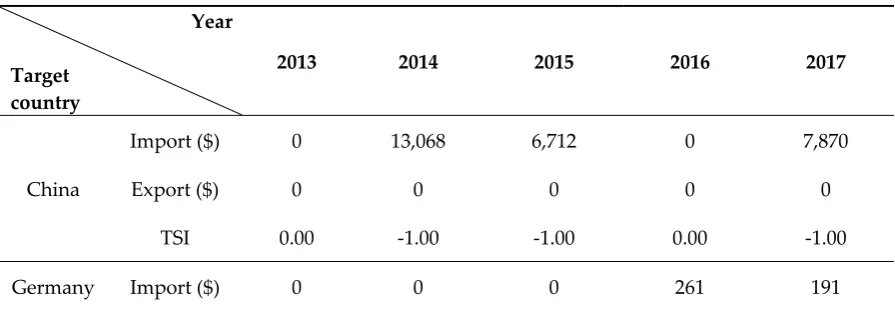
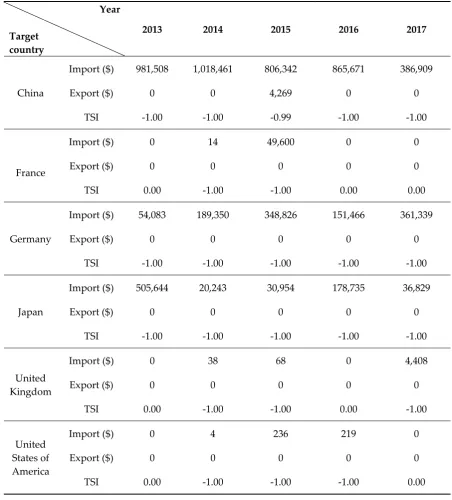
TSI has a value between the maximum value of 1 and the minimum value of -1, and the larger
510
the value, the more competitive it is. The closer to 0 (-0.5<TSI<0.5), the lower the import dependence
511
rate. The closer to -1 (TSI ≤ -0.5), the higher the dependence on imports for a particular country,
512
indicating that import diversification is necessary. Conversely, the closer to 1 (TSI ≥ 0.5), the higher
513
the concentration of exports to a particular country, indicating that export diversification is necessary.
514
RCA (revealed competitive advantage) [147] and SRCA (symmetric revealed competitive
515
advantage) [148] were used as indexes for calculating export intensity. The RCA and SRCA are
516
indices used in the international economy to calculate whether a particular country has a comparative
517
advantage in a particular product or service in trade. The expression of each index is as follows (4)
518
and (5).
519
𝑅𝐶𝐴 = 𝑋 / ∑ 𝑋
∑ 𝑋 / ∑ ∑ 𝑋 (−1 < 𝑇𝑆𝐼 < 1) (4)
520
𝑋 ∶ 𝐸𝑥𝑝𝑜𝑟𝑡𝑠 𝑡𝑜 𝑝𝑟𝑜𝑑𝑢𝑐𝑡 𝑖 𝑓𝑟𝑜𝑚 𝑐𝑜𝑢𝑛𝑡𝑟𝑦 𝑗
521
522
𝑆𝑅𝐶𝐴 = 100tanh (ln 𝑅𝐶𝐴) = 100(𝑅𝐶𝐴 − 1)
(𝑅𝐶𝐴 + 1) (−100 < 𝑆𝑅𝐶𝐴 < 100) (5)
523
If SRCA = 0, then the corresponding trade item is that the export specialisation (concentration)
524
with the target trading partner is the average of all domestic trade items. In addition, the value of
525
SRCA between -100 and 0 means that the export specialisation of the trade item with the target
526
trading partner is relatively low. That is, it is lower than the average of all domestic trade items.
527
Finally, if 0<SRCA<100, the trade item means that its export specialisation with the target trading
528
partner is relatively high. That is, it is higher than the average of all domestic trade items.
529
3.3.2. Product Supply Chain Network Information
530
The product supply chain network is a useful tool for a holistic view of the overall relevance of
531
all business activity networks, from raw materials to finished goods. The mechanism for embodying
532
the product supply chain networks is based on the relational databases in our study. As mentioned
533
earlier, the relational database constructed in this study is designed with a network structure in which
534
the components are connected to each other via the same product or material within the HS code and
535
CASRN. As shown Figure 5, the first band refers to the relationship between the HS code and the
536
product name. In the same way, the second and third bands are connected from the product name to
537
the CASRN, and from the CASRN to various usages, respectively.The usages are linked back to the
538
HS code with the same commodity name again. As these connections occur in a chain, we can finally
539
derive the same network structure as Figure 6.
541
Figure 5. Database-based supply chain network propagation and integration mechanism.
542
Through this product supply chain network, it is possible for a specific company to identify a
543
variety of usage information for its flagship products. As mentioned above, since this usage
544
information is constructed based on patent information, it is possible to establish more objective
545
business model based on data, and it is easy to diversify business and secure market opportunity
546
through systematic approach. In today's age of knowledge economy, securing such market-oriented
547
information is very costly. Therefore, for SMEs lacking resources, it is not easy to access
market-548
oriented information. However, this systematic approach can enable SMEs to obtain market-oriented
549
information through a clearer way and with lower cost.
550
551
Figure 6. The anticipated supply chain network diagram of the supply chain network based on the
552
relational databases.
553
4. The Cases of Information Support of KISTI for SMEs
554
In order to evaluate the feasibility and consistency of the relational database constructed in this
555
study and the analysis results implemented based on this database, some products were actually
556
analysed. We analysed the main products of SMEs, who requested the analysis of their main products
at KISTI and provided the market-oriented information about them through trade and product
558
supply chain network information. For reference, CASRN is mainly a database on chemical
559
substances, and therefore mainly analyses of products of SMEs related to fine chemicals are mainly
560
made. In this study, we present case of analysing hydrazine-related products.
561
4.1. The Overview of the Hydrazine-Related Products
562
Hydrazine is a colourless fumed oily liquid with ammonia odour. It produces toxic nitrogen
563
oxides during combustion and is used in rocket propellants and fuel cells. The HS codes associated
564
with hydrazine are shown in Table 1.
565
The HS codes of products related to hydrazine can be broadly classified into codes starting with
566
2825.10 and codes starting with 2928.00 Products starting with 2825.10 are hydrazine, hydroxylamine,
567
inorganic salts thereof, other inorganic bases, metal oxides, metal hydroxides, metals and oxides. In
568
particular, products beginning with 2825.10 refer to hydrazine, hydroxylamine and inorganic salts
569
thereof. Also, products starting with 2928.00 means organic derivatives of hydrazine hydroxylamine.
570
Table 1. HS codes associated with hydrazine and its derivatives.
571
HS code Product name Sub-product name
2825.10-9010 Hydrazine Hydrazine1
2825.10-9020 Inorganic salt of hydrazine Inorganic salt of hydrazine
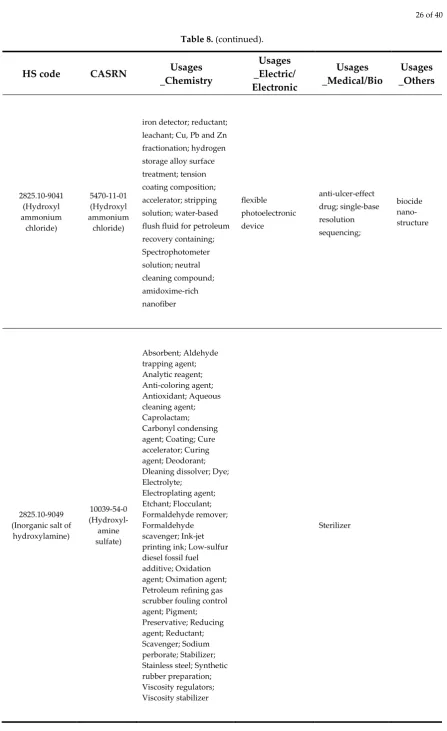
2825.10-9041 Hydroxyl ammonium chloride Hydroxyl ammonium chloride (hydroxylamine hydrochloride)
2825.10-9049 Inorganic salt of hydroxylamine Inorganic salt of hydroxylamine (except 2825.10-9041)
2928.00-1000 Phenylhydrazine Phenylhydrazine
2928.00-9091 Organic derivative of hydrazine
Organic derivative of hydrazine (for agricultural chemical) (except
2928.00-1000; 2928.00-9010; 2928.00-9020)
2928.00-9091 Organic derivative of hydroxylamine
Organic derivative of hydroxylamine (for agricultural chemical) (except
2928.00-1000; 2928.00-9010; 2928.00-9020)
2928.00-9020 Methylethyl ketoxime Methylethyl ketoxime
2928.00-9099
Organic derivative of hydrazine, Organic derivative of
hydroxylamine
Organic derivative of hydrazine (except 2928.00-1000; 2928.00-9010; 2928.00-9020;
2928.00-9091),
Organic derivative of hydroxylamine (except 2928.00-1000; 2928.00-9010;
2928.00-9020; 2928.00-9091)
4.2. The Trade Conditions of the Hydrazine-Related Products
572
In order to examine the trade status of hydrazine-related products, we have derived the
573
aforementioned trade-related indicators. First, the trade volume and trading unit price of hydrazine
574
related products starting with HS code 2825.10 and 2928.00 were investigated, and the UTAB and
575
UTCB values of each product line were derived from these trade information (<Table 2> and <Table
576
3>). The source of all trade data is the information collected from the Korea Customs Service, and the
577
trade volume and trading unit prices are also based on the trade information of the Republic of Korea.
Table 2. Trade condition value of hydrazine-related products starting with HS code 2825.10.
579
Year
Value 2013 2014 2015 2016 2017
Export amount
(A, kg) 7106407.418 7191525.697 6005403.859 19309.78044 7965848.188
Import amount
(B, kg) 1790408.243 2060088.409 2055663.304 1198200.826 3513731.967
UTAB
(B-A, kg) -0.598698034 -0.542935178 -0.465590235 1.792752279 -0.355463396
Export unit
price (C, $/kg) 3.37 3.23 3.11 5.01 2.76
Import unit
price (D, $/kg) 4.61 4.4 6.84 4.84 3.66
UTCB
(D-C, $/kg) 1.24 1.17 3.73 -0.17 0.9
Table 3. Trade condition value of hydrazine-related products starting with HS code 2928.00.
580
Year
Value 2013 2014 2015 2016 2017
Export amount
(A, kg) 916101.0479 956153.0516 683777.284 911448.2813 1406995.435
Import amount
(B, kg) 1344779.701 1958856.272 2171989.223 2259516.871 2044186.401
UTAB
(B-A, kg) 428678.6536 1002703.221 1488211.939 1348068.59 637190.9662
Export unit
price (C, $/kg) 6.68 6.39 8.1 6.4 7.01
Import unit
price (D, $/kg) 6.7 8.37 9.65 9.78 12.06
UTCB
(D-C, $/kg) 0.02 1.98 1.55 3.38 5.05
Based on the trade-related figures shown in Table 2 and Table 3, the trends in annual trade
581
volume and trading unit prices and the changes in the indicators related to the unfavourable
582
condition of trade are shown in Figure 7 and Figure 8, respectively.
584
(a)
585
586
587
(b)
588
Figure 7. Trend in annual trade condition of hydrazine-related products starting with HS code
589
2825.10: (a) Trends in trade volume and UTAB changes, (b) Trends in trade unit price and UTCB
590
changes
591
As shown in Figure 7, in terms of trade volume, the export amounts of hydrazine-related
592
products with HS code 2825.10 is generally larger than imports. Accordingly, except for 2016, the
593
UTAB value remains relatively low. On the other hand, in terms of trading unit prices, the unit price
594
of imports exceeded the export unit price as a whole. As a result, it can be seen that the UTCB value
595
shows a positive value except for 2016. In 2016, unlike other years, the trade volume itself is small, so
596
it does not seem to be similar to other years.In summary, for hydrazine-related products beginning
597
with 2825.10, except for 2016, between 2013 and 2017, most UTABs can be considered negative and
598
UTCBs mostly positive.In summary, in the case of hydrazine-related products starting with HS code
599
2825.10, there is no unfavourable condition of trade volume, but the unfavourable condition of trade
600
unit price is evident.
602
(a)
603
604
605
(b)
606
Figure 8. Trend in annual trade condition of hydrazine-related products starting with HS code
607
2928.00: (a) Trends in trade volume and UTAB changes, (b) Trends in trade unit price and UTCB
608
changes
609
Meanwhile, as shown in Figure 8, the hydrazine-related products starting with HS code 2928.00
610
show a different pattern. That is, it can be seen that the import volume surpasses the export quantity
611
and the import unit price is higher than the export unit price throughout the year. Therefore, UTAB
612
and UTCB are positive values throughout the year. In particular, UTCB has a characteristic that it is
613
shaped like a straight line in the upward direction as a whole. To sum up, while the unfavourable
614
condition of trade volume appears to be easing off in 2017, the unfavourable condition of the trading
615
unit price appears to be intensifying as the year progresses.
616
For more in-depth analysis, the UTAB and UTCB values are shown in Figure 9, with the x and
617
y axes respectively. In the case of the hydrazine-related products starting with HS code 2825.10,
618
except for 2016, the coordinate at which the indicators are located is in the second quadrant. In the
619
second quadrant, UTAB represents a negative value and UTCB represents a positive value. The
620
characteristics of the products in this area are that market dominance in the domestic market is similar
621
to or somewhat stronger than that of imported products, but price competitiveness is weak. In other
622
words, a lot of products are exported, but the export unit price is low. Also, the import amounts are
623
small compared to exports, but the products are imported with high trading unit prices. In 2016, it is
624
located in the fourth quadrant, which has the opposite meaning to the second quadrant. However,
since the amount of trade itself is too small, it can hardly be said to deviate significantly from the
626
trends of the overall indicators.
627
628
(a)
629
630
631
(b)
632
633
Figure 9. Changes in the trade indicators of the unfavourable condition by year. The arrows represent
634
the movement of the indicator along the year: (a) the trade indicators of the unfavourable condition
635
of the hydrazine-related products starting with HS code 2825.10, (b) the trade indicators of the
636
unfavourable condition of the hydrazine-related products starting with HS code 2928.00.
637
In the case of the hydrazine-related products starting with HS code 2928.00, all the indicators are
638
located in the first quadrant. The first quadrant means that market dominance and price dominance
639
are all weak, namely, these products are market and technology dependent. In other words, the
640
products located in this area means that the imports are larger than the exports, and even when
641
importing these products, the trade is done at a high trade price. In terms of the domestic trade
642
situation, it can be said that it means the area to be avoided as much as possible.