Time-Frequency Training OFDM: A Novel
Technique
Poorva Kute1, Dr. Achala Deshmukh2
PG Student [Communication Networks] ,Dept. of ENTC, Sinhgad College Engineering, Vadgaon (bk), Pune, India1,
Associate professor, Dept. of ENTC, Sinhgad College Engineering, Vadgaon (bk), Pune, India2
ABSTRACT: For high spectral efficiency over fast fading channel at the cost of performance loss, the Time Domain Synchronous Orthogonal Frequency Division Multiplexing (TDS-OFDM) is a novel technique. It is the key technology for Chinese National Digital Television Terrestrial Broadcasting (DTTB). With compare to the standard Cyclic-Prefix Orthogonal Frequency Division Multiplexing (CP-OFDM), TDS-OFDM has high spectral efficiency but suffers from severe performance loss due to required iterative interference cancellation algorithm when high speed mobile channel is taken in to consideration. In this paper, a new technique is introduced i.e. Time Frequency Training Orthogonal Frequency Division Multiplexing (TFT-OFDM) in which joint time frequency channel estimation is used to improve performance over fast fading channel without interference cancellation.
KEYWORDS: TDS-OFDM, DTTB, CP-OFDM, TFT-OFDM, joint time frequency channel estimation.
I.INTRODUCTION
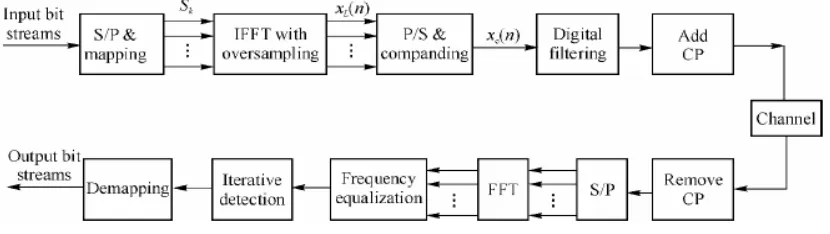
Now a day, Orthogonal Frequency Division Multiplexing attracts more attention over wireless channel. It uses the concept of parallel data transmission scheme. In parallel data transmission scheme, the available frequency band is converted in to number of non overlapping sub-bands. These sub-bands, called as sub-channels, are orthogonal to each other. These sub-channels are frequency multiplexed with each other. The basic Transmitter and Receiver blocks are explained as follows.
Fig 1. Basic OFDM Transmitter and Receiver
OFDM has advantages such as relatively simple one-tap frequency domain equalization, Decoupled the frequency selective fading channel in to parallel set of fast fading channel, Channel capacity maximization. Due to these advantages of OFDM, it is widely uses in different techniques and has applications such as Digital audio broadcast TV (DAB-TV), Digital video broadcast TV (DVB-TV), Wireless local area networks (WLAN) etc. But OFDM has certain disadvantage as Timing Synchronization error results due to IBI, System performance degradation (IBI), High PAPR (Peak-to-Average Power Ratio).
There are different types of OFDM techniques as:
1. Cyclic Prefix Orthogonal Frequency Division Techniques. (CP-OFDM) 2. Zero Padding Orthogonal Frequency Division Techniques. (ZP-OFDM)
4. Time Frequency Training Orthogonal Frequency Division Multiplexing (TFT-OFDM)
II. LITERATURE SURVEY
A. Cyclic Prefix Orthogonal Frequency Division Techniques. (CP-OFDM):
With the help of Inverse Fast Fourier Transfer (IFFT) Cyclic Prefix (CP) are inserted in the OFDM data block at the transmitter and these CP are removed at the receiver.
Fig 2. Block diagram of CP-OFDM
Symbol { ( )} denotes incoming data streams which are converted in to parallel data streams. A N-pt IFFT is taken to get { ( )} after parallel data conversion. a cyclic redundancy of length _ (the number of CP samples) is added as a prefix in such a way that (−i) = xk (N − i) for i = 1, 2, . . . , v.
B. Zero padding Orthogonal Frequency Division Multiplexing (ZP-OFDM):
In ZP-OFDM, non-zero CP are replaced by Zero padding. ZP-OFDM and CP-OFDM has same spectral efficiency if length of zero padding is equal to the CP. Main advantage of ZP-OFDM over CP-OFDM is that it guarantees symbol recovery.
C. Time Domain Synchronous Orthogonal Frequency Division Multiplexing (TDS-OFDM):
TDS-OFDM has high spectral efficiency than that of CP-OFDM. Due to the residual mutual interferences between the pseudorandom noise (PN) guard interval and the OFDM data block, it cannot support the constellation like 254 QAM. It can support up to 64 QAM.
Hence to realize simultaneous multi-channel reconstruction under the framework of structured compressive sensing, we propose the idea of using multiple inter-block-interference (IBI)-free regions of very small size the Sparsity nature of wireless channels as well as the characteristic that path delays vary much slower than path gains are jointly exploited.
Pseudo random sequence is used as a guard interval as well as training sequence in TDS-OFDM for channel estimation and synchronization. Pilots used in CP-OFDM and ZP-OFDM can be saved in the large amount. mutual interferences cause to each other between TS and the OFDM data block. Thus to iteratively achieve reliable time-domain channel estimation and frequency-domain data detection in TDS-OFDM systems, iterative interference cancellation has to be used.
D. Time Frequency Training Orthogonal Frequency Division Multiplexing (TFT-OFDM):
TDS-OFDM is not accurate over fast fading channels. Interference is cause due to TS and OFDM data block. Since the TS length is not large, this IBI can be calculated with relatively low complexity. Since the OFDM block length is usually large such interference, cannot be totally eliminated even when the channel estimation is ideal. The interference caused by the OFDM data block has to be calculated with high complexity. TS-based time-domain channel estimation error in TDS-OFDM would in turn result in the unreliable cancellation of the IBI caused by the TS.
III.SYSTEM MODEL AND ASSUMPTIONS
A. Standard CP OFDM:
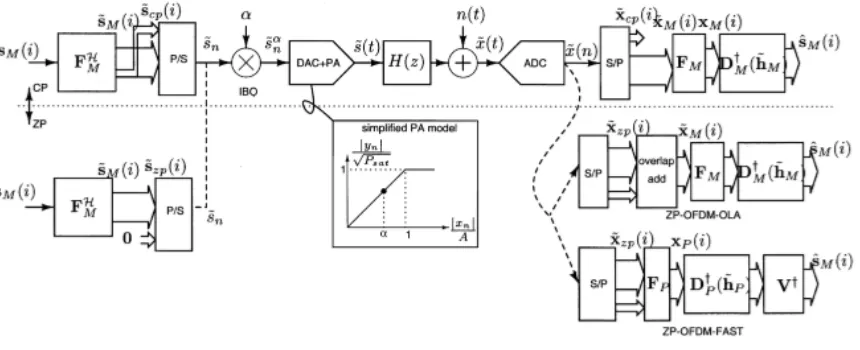
The baseband discrete-time block equivalent model of a standard CP-OFDM system is shown in the upper part of Fig.4.
.
Fig 4. Discrete-time block equivalent models of CP-OFDM and ZP-OFDM.
ith information block is first pre-coded by IFFT matrix. Consider SM(i) is a ith data block of matrix M *1 is pre-coded i.e. F = F to yield so called “time-domain” block vector. The block vector is ̅ ( ) = F ∗S (ı̇) with (m, k)th entry
Fig 5. (a) Concept of CP; (b) OFDM symbol with cyclic extension
The time-domain samples ⃗( ) is cyclically extended by copying the last Ng samples and pasting them to the front, as shown in Fig 5 (a).
= + ...(1) For the ith received symbol block, the expression is given by,
( ) = ( ) + ( −1) + ( ) ...(2)
Where, H is the lower triangular Toeplitz filtering matrix, is the upper triangular Toeplitz filtering matrix and
( ) is AWGN vector. B. ZP-OFDM:
The baseband discrete-time block equivalent model of a ZP-OFDM system is given in the lower part of Fig 4. The main difference between CP-OFDM and ZP-OFDM is that the CP is replaced by D trailing zeros. ( ) is pre-coded block to yield ∗1 transmitted vctor ( ) = ( ), where = [ 0] .
For the ith received symbol block, the expression is given by,
( ) = ( ) + ( −1) + ( ) ...(3) C. TDS-OFDM:
As shown in Fig.3, without CP and frequency-domain pilots in standard CP-OFDM systems, one TDS-OFDM symbol
= [ , , … ] is composed of the known time domain PN sequence c = [ , , … ] of length M and the following OFDM data block of length N.the FFT output of the corresponding time-domain signal x, is, = . In contrast to standard CP-OFDM where plenty of frequency-domain pilots are usually inserted in , TDS-OFDM contains no pilot in the frequency domain.
The discrete-time complex channel impulse response (CIR) h = [ℎ ,ℎ, …ℎ ] comprising S resolvable propagation paths can be modeled as [18], [19].
ℎ =∑ [ − ], 0≤ ≤ −1 ...(4)
Where is the gain, denotes the delay of the lth path normalized to the sampling period at the receiver. The path delay set D is defined as
D={ , , … } ...(5)
where 0 ≤ ≤ ≤ · · · ≤ −1 ≤ L can be assumed without loss of generality. The channel length L is assumed to be not larger than the guard interval length M, i.e., L ≤ M, so that the interference between two adjacent OFDM data
to be used for accurate channel tracking [20]. In contrast to the pilot-based channel estimation, TDS-OFDM without frequency-domain pilot realizes channel estimation based on the time-domain received TS.
D. TFT-OFDM:
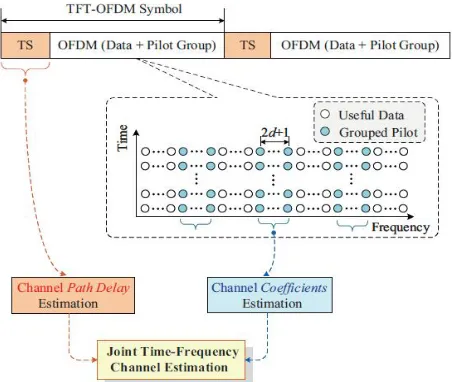
In both time domain and frequency domain, respectively, The signal structure of the TFT-OFDM scheme can be described. The time-domain TS and the frequency-domain grouped pilots scattered over the signal bandwidth are used in TFT-OFDM. Fig 6. shows that TFT-OFDM has training information in both time and frequency domains. The ith
TFT-OFDM symbol = … … … , , , … … . , in time domain is composed of the known time-domain
TS = , … … … . . , and the OFDM data block = , … … … . . , As below
=
∗
= 0
∗ ∗
+ 0 ∗
∗
...(6)
Where P= M + N presents the length of the TFT-OFDM symbol, M is the length of the TS, N is the OFDM data block,
= , … … … . . , denotes the frequency-domain OFDM symbol, and = . Unlike TDS-OFDM,
TFTOFDM has data subcarriers and groups of binary phase-shift keying (BPSK) modulated pilots. These pilots scattered over the signal bandwidth. Each pilot group has 2 + 1 pilots.
Fig 6. Proposed signal structure and the corresponding joint time-frequency Channel estimation of the TFT-OFDM scheme.
There are two assumptions for the estimation:
1. Ideal IBI removal
2. Perfect cyclic prefix reconstruction
Following steps are followed for TFT-OFDM receiver design: I. Joint Time-Frequency Channel Estimation:
II. TS-Based Path Delay Estimation: III. Pilot-Based Channel Estimation: IV. Channel Equalization:
Here, the O(N)-complexity equalizer with the following procedure is adopted [42]:
1. Initial Minimum Mean Square Estimation(MMSE) symbol detection
2. Soft decision based Inter-Channel interference(ICI) cancellation for symbol redetection
3. Iteration termination
=
∝
=∝ ...(7)
2 denotes the constellation points of the modulation Scheme and N/T is the signal bandwidth. Table I
Spectral Efficiency Comparison
TS Length CP-OFDM TDS-OFDM TFT-OFDM
K=N/4 60.00% 80.00% 77.66%
K=N/8 77.78% 88.89% 86.28%
K=N/16 88.23% 94.12% 91.36%
The parameter N = 4096 typically used by digital broadcasting systems is considered.
2. Pilot Power and Corresponding SNR Loss: The equivalent SNR loss at the receiver is given as
= 10 log ( ( ) )...(8) Table II
The SNR Loss Due To Pilots Power Boosting
TS Length CP-OFDM TFT-OFDM
K=N/4 0.77 dB 0.98 dB
K=N/8 0.40 dB 0.98 dB
K=N/16 0.21 dB 0.98 dB
IV. RESULT AND DISCUSSION
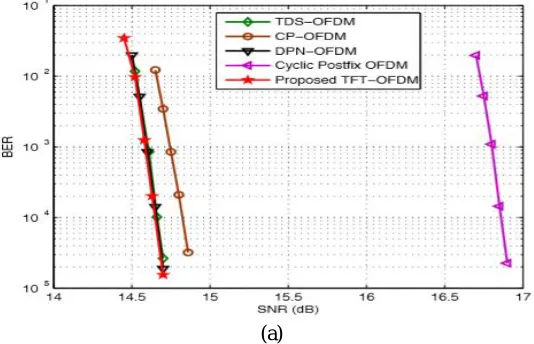
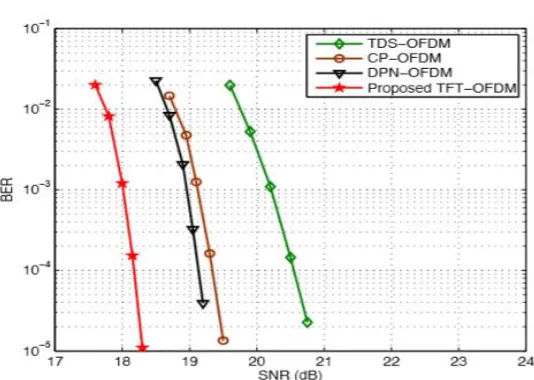
Figure 7(a) shows the comparison of different techniques over AWGN channel. Channel estimation is assumed to be ideal. TFT-OFDM, TDS-OFDM and DPN-OFDM have very close BER performance. Three techniques have the SNR gain of 0.18 dB compared with CP-OFDM.
Fig 7. Comparison between different Techniques over (a) AWGN channel, (b) Vehicular B Channel
Figure 7(b) shows the comparison of different techniques over vehicular B channel. Channel estimation is assumed to be ideal. The BER performance of proposed TFT-OFDM scheme is superior to those three conventional OFDM transmission schemes.
V.CONCLUSION
TFT-OFDM has information in both time and frequency domain i.e. TS in the time domain and a very small amount of grouped pilots in the frequency domain. for TFT-OFDM utilizes the time-domain TS to merely estimate the path delay information of the wireless channel, while the channel path coefficients are acquired by using the frequency-domain grouped pilots. In TDS OFDM, training sequence and data block causes IBI interference. To reduce this interference, a different algorithm is used to remove this IBI. This increases the complexity in system. TFT OFDM has training sequence in both time and frequency domain and channel is done using joint time-frequency channel estimation technique in which training sequence without interference cancellation is used. The simulation results show that TFT OFDM has higher spectral efficiency than other fundamental Types of OFDM. Here conventional iterative interference cancellation algorithm is avoided which introduces the high complexity and poor performance in system.
REFERENCES
[1]F. Adachi and E. Kudoh, “New direction of broadband wireless technology,” Wirel. Commun. Mob. Com., vol. 7, no. 8, pp. 969–983, Oct. 2007. [2] X. Yuan, Q. Guo, X. Wang, and L. Ping, “Evolution analysis of low cost iterative equalization in coded linear systems with cyclic prefixes,” IEEE J. Sel. Areas Commun., vol. 26, no. 2, pp. 301–310, Feb. 2008.
[3]B. Muquet, Z. Wang, G. Giannakis, M. De Courville, and P. Duhamel, “Cyclic prefixing or zero padding for wireless multicarrier transmissions?” IEEE Trans. Commun., vol. 50, no. 12, pp. 2136–2148, Dec. 2002.
[4] C. yen Ong, J. Song, C. Pan, and Y. Li, “Technology and standards of digital television terrestrial multimedia broadcasting,” IEEE Commun. Mag., vol. 48, no. 5, pp. 119–127, May 2010.
[5]X. Wang, P. Ho, and Y. Wu, “Robust channel estimation and ISI cancellation for OFDM systems with suppressed features,” IEEE J. Sel.Areas Commun., vol. 23, no. 5, pp. 963–972, May 2005.
[6] J. Wang, J. Song, and L. Yang, “A novel equalization scheme for ZPOFDM system over deep fading channels,” IEEE Trans. Broadcast., vol. 56, no. 2, pp. 249–252, Jun. 2010.
[7] J. Wang, Z. Yang, C. Pan, and J. Song, “Iterative padding subtraction of the PN sequence for the TDS-OFDM over broadcast channels,” IEEE Trans. Consum. Electron., vol. 51, no. 11, pp. 1148–1152, Nov. 2005.
[8]J. Song, Z. Yang, L. Yang, K. Gong, C. Pan, J. Wang, and Y. Wu, “Technical review on Chinese digital terrestrial television broadcasting standard and measurements on some working modes,” IEEE Trans.Broadcast., vol. 53, no. 1, pp. 1–7, Feb. 2007.
[9] Framing Structure, Channel Coding and Modulation for Digital Television Terrestrial Broadcasting System. Chinese National Standard, GB 20600-2006, Aug. 2006.
[10]S. Zhou and G. Giannakis, “Single-carrier space-time block-coded transmissions over frequency-selective fading channels,” IEEE Trans. Inf. Theory, vol. 49, no. 1, pp. 164–179, Jan. 2003.
[11] S. Tang, K. Peng, K. Gong, J. Song, C. Pan, and Z. Yang, “Novel decision-aided channel estimation for TDS-OFDM systems,” in Proc.IEEE International Conference on Communications (ICC’08), Beijing, China, May 2008, pp. 946–950.
[13]J. Kim, S. Lee, and J. Seo, “Synchronization and channel estimation in cyclic postfix based OFDM system,” in Proc. IEEE 63rd Vehicular Technology Conference (VTC’06-Spring), Melbourne, Vic, May 2006, pp. 2028–2032.
[14]“Synchronization and channel estimation in cyclic postfix based OFDM system,” IEICE Trans. Commun., vol. E90-B, no. 3, pp. 485– 490, Mar. 2007.
[15]S. Tang, K. Peng, K. Gong, and Z. Yang, “Channel estimation for cyclic postfixed OFDM,” in Proc. International Conference on Communications,Circuits and Systems (ICCCAS’08), Fujian, China, May 2008, pp. 246–249.
[16]M. Huemer, C. Hofbauer, and J. Huber, “Unique word prefix in SC/FDE and OFDM: A comparison,” in Proc. IEEE Global Telecommunications Conference (GLOBECOM’10), Miami, USA, Dec. 2010, pp. 1321– 1326.
[17]A. Onic and M. Huemer, “Direct vs. two-step approach for unique word generation in UW-OFDM,” in Proc. the 15th International OFDMWorkshop(InOWo’10), Los Alamitos, CA, Sep. 2010, pp. 145–149.
[18]C. Hofbauer, M. Huemer, and J. Huber, “On the impact of redundant subcarrier energy optimization in UW-OFDM,” in Proc. 4th International Conference on Signal Processing and Communication Systems(ICSPCS’10), Gold Coast, Australian, Dec. 2010, pp. 1–6.
[19]J. Fu, J. Wang, J. Song, C. Pan, and Z. Yang, “A simplified equalization method for dual PN-sequence padding TDS-OFDM systems,” IEEE Trans. Broadcast., vol. 54, no. 4, pp. 825–830, Dec. 2008.
[20] L. Bomer and M. Antweiler, “Perfect N-phase sequences and arrays,” IEEE J. Sel. Areas Commun., vol. 10, no. 4, pp. 782–789, May 1992. [21]A. V. Oppenheim, R. Schafer, and J. Buck, Discrete-Time Signal Processing, 4th ed. NJ, USA: Prentice Hall, 2010.