Volume 8, No. 3, March – April 2017
International Journal of Advanced Research in Computer Science REVIEW ARTICLE
Available Online at www.ijarcs.info
ISSN No. 0976-5697
Study of routing protocol with link estimation time in MANETs
Shweta Singh
M.Tech Scholar, Dept. Computer Sc. & Applications, M.D. University, Rohtak-124001,
Haryana(India)
Gopal Singh
Dept. Computer Sc. & Applications, M.D. University, Rohtak-124001,
Haryana(India)
Abstract: A main constraint in MANETs is the battery power constrained. Thus every effort is to be done towards reducing power consumption at each and every node in network. More specifically, Network node lifetime is one of the key design metric in MANETs. All host in the network performs the operations of a router, if any node goes down early due to lack of power, communication with on networks breaks down. Resulting, disconnection in network will be affected. In this paper, the routing protocols, reactive and proactive, in reference with the link lifetime in any network.Lifetime of a link can be defines as the amount of time the link will beavailable for communication. This study reveals properties, findings showing that lifetimes of the mobile node is of wear-out type property, rather than random failure.
Key words: Link Lifetimes, MANET, Connectivity,Routing Protocol.
I. INTRODUCTION
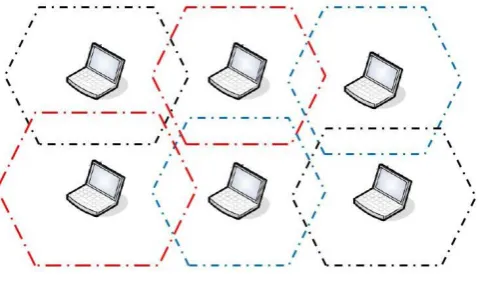
[image:1.595.39.279.436.578.2]In MANET, the mobile nodes communicate with other nodes, wireless network, without any system required. All nodes in network are free to move randomly and organize themselves in any arrangement. Nodes in network communicatewith each other via wireless radios waves that havelimited transmission range and setup. Due to this restriction on transmission, all nodes are not in range. If node communicates by outside the range, it requires the help of other nodes in building a multi-hop route network.
Figure 1: Network Representation
A major challenge in ad-hocis that communication has to be done with random network topology due to node movement.
Ad-hoc network are easy to deploy without a centralized infrastructure. Figure 1 represents the basic architecture of any ad-hoc network.
Random movement in node of the network is because of the
fact the network is self confi gurable and self-organizing
network. Every node in the network can control the network and self-act as routers in nature. Performance of the MANET decreaseswith increase in no of nodes, and network
with large no of nodes quickly becomes difficult to manage.
II. APPLICATIONS OF MANETS
A. Sensor Networks:
Host with smart sensor will add in electronic appliances to allow end user to manage their devices remotely. [1]
B. Home & Enterprise Networking:
Home / office wireless networking: Whiteboard application sharing, use of PDA, wireless printing, Personal area networks [2].
C. Emergency Services:
Early recovery and shifting of patient & data such as record & stats in hospital. System can be replaced. Example of Emergency service:-Search and rescue operation & disaster recover.
D. Radio Services:
Broadcast of weather, news, music, guidance required for accident and vehicles for road. [1][2].
E. Educational Applications:
Setting up virtual classrooms, conferences, meetings & lectures [1].
F. Location Aware Services:
Automating call forwarding, transmission of the workspace information, advertise location specific, services such as server, printer & phone [2].
III. CHARACTERISTICS OF MANETS
A. Low Power And Resource:
B. Dynamic Network Topology:
Every mobile host in the ADHOC network is free to move randomly in any fashion this will make the network topology to change unpredictably and also ADHOC network consists of both unidirectional links & bi-directional links [1].
C. Physical Security:
MANETs are more likely to be suffering from more physical security threats than wired or fixed cable networks because there is the increase in drop-ping, spoofing, and DOS attack that should be carefully monitored in any network [2].
D. Bandwidth Limitation:
Links in MANETs will always have lower bandwidth capacity as compared with fixes wired network links.Throughput of MANET communication in real environments is less than a radio maximum transmission rate. [3]
E. Decentralized Control:
This nature of network control in mobile ADHOC network provides an extra support towards robustness with respect to single points of failure (server).[1].
III. MANET ROUTING PROTOCOLS
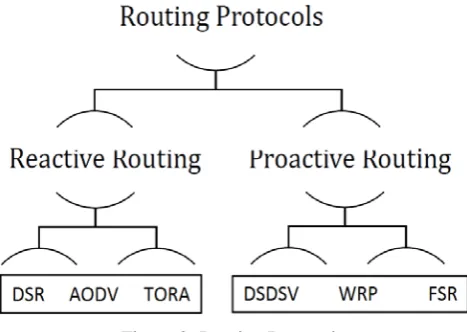
In MANET, for IP network, development of routing supports scaling of active nodes. Proactive and Reactive protocols are specify in group of routing protocol in MANET. Figure 2 represents the categorization in routing protocol. [3,4]
In proactive, node send data to other node, but in case of protocols, the problem occur due to power consumed and signaling traffic. Consumption of local resources also takes place. Each and every node maintain routing table with Update of table to store data or information. Table driven protocols include WRP, DSDV.
Reactive protocols will found a route, whereby, a host is willing to communicate and has information to send. Node has to wait until the routing protocol send packet as they minimized the problem of signaling and congestion traffic.
Mobility decreases the performance in both protocols. In this, routing protocol have to find again and again new route for better packet delivery to the destination, due to mobility, node cannot be found this will arise to the problem of complexity. By this node has to wait until a new route is found to the destination.
IV. PROACTIVE (TABLE-DRIVEN) PROTOCOLS
Proactive routing is where each node has the own routing information. In this, each node has different information. Proactive protocols are defined in [5], [6] and [7].
In this, each node have their own routing table and record each data for the better data transmission.. The routing entry is also maintained. For stability, each node has to modify their packet and broadcast to the destination. Each node contain sequence number while broadcasting message to next destination also how many hops required in delivering of data to the destination, address of the both sender and the receiver and the generating of new sequence number of each node.
[image:2.595.321.555.307.473.2]Many proactive protocols differ from conventional link state routing includes the optimized link state routing protocol. Routes are available on request, it means, each node should have one or more table, updating the table on regular base. To maintain the routing information, topology based data exchanged between the nodes. DSDV is an example of this protocol. (Destination sequenced distance vector).
Figure 2: Routing Protocols
V. REACTIVE (ON-DEMAND) PROTOCOLS
Reactive protocol seeks to set up routes for on demand. This protocol does not use route discovery until it has no route, if no communication occur, the protocol establish the route. [8, 9] DSR, AODV and TORA are examples of reactive routing protocols. Reactive protocol do not maintain route tables, also no updating of table required in case of topology data. In this, on demand technique is used and route discovery too. Route discovery is where the node send the route request packet to other node in the network.[10,11]
VI. COMPARISON OF ROUTING PROTOCOLS
The comparison among routing protocol I have chosen DSDV, DSR, AODV. Details comparison between three selected protocols is listed in table no. 1.
Table 1: Comparison of Routing Protocols
Property DSR DSDV AODV
Table Driven / Source Routing
Source Routing Table Driven Table Driven and
Route Discovery No Yes Yes
Route Mechanism Complete route Cached Route Table with next
hope
Route Table with next hope
Network Overhead Low High Medium
Multiple Routes Yes No No
Unidirectional link Support
Yes No No
Network suitable for Up to 200 nodes Less no. of nodes Highly dynamic
Route maintenance Yes No Yes
Reactive / Proactive Reactive Proactive Reactive
Routing Overhead Low Medium High
VII. DYNAMIC SOURCE ROUTING PROTOCOL
DSR is an accepted reactive routing protocol. In this, node establish a route and issue route request to other nodes. Each node broadcast the packet with the address of the node. When the RREQ is generated, a route reply is send back with the address to the source. This process consume lot of bandwidth and each node send packet with the cache entry, they can also use cache to store the information. DSR is similar to AODV. Updating of route tables with the topology information is not necessary in on demand concept, as this protocol is based on demand technique. As, in this protocol discovery and maintenance technique takes place on the route for transferring packet from source to the destination. If route is not generated, this technique took place to sending the packets firmly. [12][13]
VIII. AD-HOC ON DEMAND DISTANCE VECTOR
AODV is a routing protocol with large number of nodes. In this, route remain in active mode when the data travel from source to destination, when the source stop sending packet or data, the path will timeout and close. To maintain the network, establishment of multi-hop routing takes place. This protocol create route when requested by the source node, it allow the node to enter and leave the network, as it allow flexibility for the network node. It is reactive oppose to DSR, or based upon distance vector technique.[14]
IX. MOTIVATIONS
Mobility plays main aspect in the mobile ad-hoc network. As with high mobility of host in the network, network topology is very dynamic in nature and that will causes the link disconnection between the source and the destination. DSR [5] & AODV [4] are work as standard in MANETs. Both protocol selects the shortest path route. But shortest path of communication will not be the most suited & long life path for communication.
With frequent breakdown of communication link between source and destination decreases the network performance. With the breakdown of any active link between nodes, the routing protocol initiates route discovery which reduce the performance of such a network with utilization of resources. It estimates Link Expiration Time between source and destination [6, 7].
This estimation of link expiration time of link between different hosts in the network will be the source ofmotivation in development of a routing protocol that can solve the problem. In development of routing protocol for
MANET’s power consumption is also one of the most difficult task, because host in network are powered by batteries [10, 11].
X. LINK LIFETIME ESTIMATION
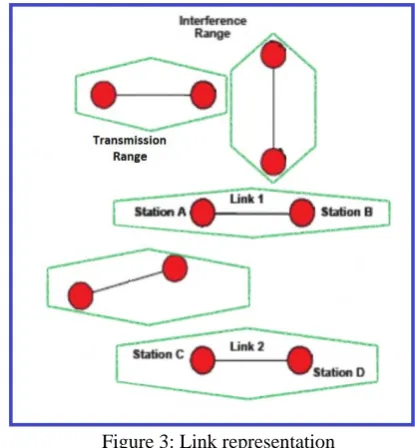
In MANET, some ad hoc allow the discovery and storage of multiple routes to the destination node. In this, the node within the communication range with another node is Link Duration. The data to be send should be in communication range (if it is too long), loss of packet determine with the disconnection. The route availability of period of time is Path Duration, the selection of the path to utilize, is based on the criteria of minimum number of hops. It can also be used to determine the packet length for better communication by minimization of packet loss. In Routing Protocol, performance affects the overhead and throughput of the network. Simulation encloses different mobility and transmission condition. Flooding is the essential mechanism in the route discovery process. It includes probability function and analysis. In a network, Metric is used to determine the best route, with end to end hop count over the network.
[image:3.595.328.536.484.708.2]Figure 3: Link representation
XI. PROPERTIES OF AD-HOC ROUTING PROTOCOLS
Here I discuss some of the important properties of routing protocols and they are listed as follows. [15][16]
A. Distribution Operation:
The protocol should be distributed, it means the control and administration of the network operation are controlled and managed in a distributed type, among the terminal node. It should not be dependent. It should be independent over the network. The node can easily enter or leave the network. Each node act as a relay to implement the operation.Network work due to mobility system.
B. Loop free:
The nodes should be loop free without any error occurs in the network. To have controlled data transmission, The nodes should be carried out the address of own or the next node to have better transmission process without any error. Routing protocol should be loop free to improve the performance, which avoids the system consumption and overall bandwidth.
C. Demand based Operation:
Demand based operation is the wireless ad hoc network is a decentralized. It is self-configuring, in dynamic networks,nodes are free to move. Instead, each node participatesin routing byforwarding data for other node, determination of data forward on the basis of network connectivity. The control should be minimize in the network, as it should not broadcast data periodically being reactive approach.
D. Unidirectional Link Support:
Utilization of these links improves the routing information to the network. The radio environment can cause the formation of unidirectional links.
E. Security:
The radio environment is especially vulnerable to impersonation attacks. Mobile network wireless are more prone to physical security threats than wired counterparts. Security measures should be use, in which encrypting of data and authentication took place and tunneling is used to transfer the data packets.
F. Power Conservation:
In this, routing protocol should support sleep-mode. Nodes have limited battery power, it uses stand-by mode for power saving.
G. Multiple Routes:
If one route has become invalid, it is necessary that another stored route should still be valid. Multiple routes are to be used in case of topological changes.
H. Quality of Service Support:
The primary function is to found the best, shortest path for delivering of packets. Quality of service is important in the routing protocol concept. Protocols are to be extended with more and more functionality concepts.
I. Autonomous Terminal:
In MANET, each mobile node is autonomous and self-configuring. Mobile switches and endpoints are interchangeable and cannot be separated. Mobile node can perform functions and also act as a host of a router.
J. Multi-hop Routing:
Ad hoc routing algorithms can be single or multi hop in nature. In MANET, single hop is simple in term of protocol architecture. Packets are forwarded via one or more intermediate node in multi-hop routing in terms of packet transmission.
K. Dynamic network topology:
As nodes in MANET, the network topology varies with respect to time and space. As a result, the link among the nodes changes with respect to time. The network node accustomed to the traffic and mobility pattern.
L. Light weight terminals:
In MANET, some nodes have their device with less processor constraint like low power backup and memory size. Optimization to such device is important with best mechanism and algorithms technique. This feature of optimize the device vary with best delivery of packet to the destination.
M. Varying link capacity:
High-Bit error rates of wireless connection might be more in a MANET, for this, one path is shared by different direction. The path can traverse multiple link, vary link capacity of the nodes in the network.
XII. CONCLUSION
In this paper I have presented a brief description of routing protocols followed by comparison of routing protocols. Performance of AODV Reactive routing protocol is best, AODV will maintains connection between mobile nodes by exchange of informationwhich is necessary for TCP. AODV & DSR is better than DSDV in respect of large no of nodes. Loop free property is available in all DSDC, DSR, and AODV.AODV& DSR is based on route maintenance and route discovery mechanism.Further link lifetime plays an important role in communication in all of the protocols. With increase in movement of mobile nodes along with increase in no. of mobile node overhead of any network increases drastically. In any protocol capability of handling large no of mobile nodes along with random movement is must.This limitation can be overcome with modification in existing protocol in terms of nodes and network handling.
XIII. REFERENCES
[1] Stephen Mueller, Rose P. Tsang, and DipakGhosal,
“Multipath Routing in Mobile Ad Hoc Networks: Issues and Challenges”, Department of Computer Science, University of California, Davis, CA 95616, Sandia National Laboratories, Livermore, CA 94551.
[2] DongyanChen,SachinGarg, and Kishor S. Trivedi,
“Network Survivability Performance Evaluation: A Quantitative Approach with Applications in Wireless Adhoc Networks”, MSWiM’02, Atlanta, Georgia, USA., Copyright 2002 ACM 158113– 6102/02/0009, (2002) September 28.
[3] K. D. Kaur and M. Bhardwaj, "Literature Survey on
Different Types of Routing Protocols in MANETs," 2015
[4] A. Hinds, M. Ngulube, S. Zhu and H. Al-Aqrabi, "A
[5] C. Perkins and P. Bhagwat. “Highly Dynamic
Destination-Sequenced Distance-Vector Routing
(DSDV) for Mobile Computers”. Proc.Of ACM SIGCOMM, October 1994.
[6] Murthy and J.J. Garcia-Luna-Aceves, "An Efficient
Routing Protocol for Wireless Networks," ACM Mobile Networks and Applications Journal, Special issue on Routing in Mobile Communication Networks, Vol. 1, No. 2, 1996.
[7] Charles E.Perkins, ”Ad hoc Networking”, Addison
Wesley, 2001
[8] D. Dugaev, S. Zinov, E. Siemens and V. Shuvalov, "A survey and performance evaluation of ad-hoc multi-hop routing protocols for static outdoor networks," in Control and Communications (SIBCON), 2015 International Siberian Conference On, 2015, pp. 1-11.
[9] H. Zafar, N. Alhamahmy, D. Harle and I. Andonovic,
"Survey of reactive and hybrid routing protocols for mobile ad hoc networks," International Journal of Communication Networks and Information Security (IJCNIS), vol. 3, 2011.
[10]C. E. Perkins and E. M. Royer, "Ad-hoc on-demand
distance vector routing," in Mobile Computing Systems and Applications, 1999. Proceedings.WMCSA '99. Second IEEE Workshop On, 1999, pp. 90-100
[11]D. B. Johnson and D. A. Maltz, "Dynamic source
routing in ad hoc wireless networks," in Mobile Computing Springer, 1996, pp. 153-181.
[12]Performance Measurement of Various Routing
Protocols in Ad-hoc Network‖, Md. AnisurRahman,
Md. Shohidul Islam, Alex Talevski, Proceedings of the International Multi Conference of Engineers and Computer Scientists 2009, IMECS 2009, March 18 - 20, 2009, Hong Kong.
[13]Performance Evaluation of AODV, DSDV & DSR
Routing Protocol in Grid Environment, by Nor SurayatiMohamadUsop, Azizol Abdullah, IJCSNS International Journal of Computer Science and Network Security, 2009.
[14]Performance Comparison of AODV, DSDV, OLSR and
DSR Routing Protocols in Mobile Ad Hoc Networks by S. A. Ade &P.A.Tijare, International Journal of Information Technology and Knowledge Management,July-December 2010, Volume 2, No. 2, pp. 545-548
[15]Josh Broch, David A. Maltz, David B. Johnson,
Yih-Chun Hu and JorjetaJetCheva,” A Performance Comparison of Multi-hop wireless Ad-Hoc Network Routing protocols”, Mobicom 98, Dallas Texas 25-30 October 1998.
[16]David B. Johnson and David A. Maltz, “Protocols for