Modeling Mobile Intention Recognition Problems with
Spatially Constrained Tree-Adjoining Grammars
Peter Kiefer
Laboratory for Semantic Information Technologies
University of Bamberg
[email protected]
Abstract
The problem of inferring an agent’s in-tentions from her spatio-temporal behav-ior is called mobile intention recognition problem. Using formal grammars we can state these problems as parsing prob-lems. We argue that context-free for-malisms are not sufficient for important use cases. We introduce Spatially Con-strained Tree-Adjoining Grammarswhich enrich TAGs with knowledge about the structure of space, and about how space and intentions are connected.
1
Introduction
The interaction possibilities between a mobile user and her device are often restricted. Mobile usage scenarios, such as navigation (Kr¨uger et al., 2004), location-based gaming (Schlieder et al., 2006), and maintenance work (Kortuem et al., 1999), imply that the user’s haptic and cognitive resources (Baus et al., 2002) are bound by a specific task. In these situations we would desire a system that some-how ‘guesses’ the user’s information needs and presents the information automatically. The sys-tem must have a complex model of the intentions that are possible in a specific use case, and find an intention which consistently explains the user’s behavior (intention recognition problem, IR).
In literature, the IR problem is also known as plan recognition (PR) problem (Carberry, 2001). It can be seen as the problem of revealing the hid-den structural regularities that underlie an agent’s sequence of behaviors. Formal grammars are of-ten used to describe structural regularities, not only in natural language processing (NLP), but also in
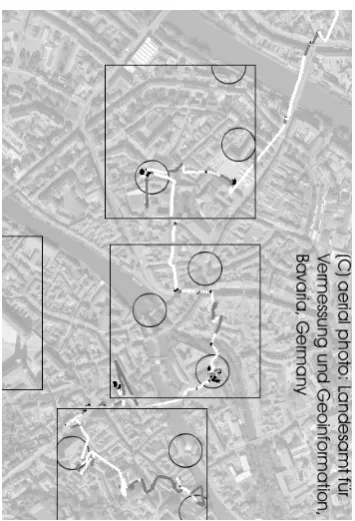
Figure 1: Spatio-temporal behavior in a location-based game: what are the user’s intentions?
areas like computer vision (Chanda and Dellaert, 2004), and action recognition (Bobick and Ivanov, 1998). Consequently, formal grammars were also considered for PR/IR (Pynadath, 1999). Recent work has drawn parallels between NLP and PR/IR and argued that the expressiveness of context-free grammars (CFG) is not sufficient for important use cases (Geib and Steedman, 2007; Kiefer and Schlieder, 2007).
mobile IR problem as parsing problem (section 2). We make the point that this problem class is spe-cial because mobile behavior happens in space and time. Section 3 introduces Spatially Con-strained Tree-Adjoining Grammars(SCTAG), and explains how they can be used to model complex intention-space-relations elegantly. We close with an overview on related work (section 4) and an outlook on our future research (section 5).
2
Mobile intention recognition with
formal grammars
2.1 Bridging the gap
One implication of spatio-temporality is that the gap between sensor input (e.g. position data from a GPS device) and high-level intentions (e.g.‘find a restaurant’) is extremely large. To bridge this gap, we use a multi-level architecture with the level of behaviors as intermediate level between position and intention. We process a stream of (lat/lon)-pairs as follows:
1. Preprocessing The quality of the raw GPS data is improved. This includes removing points with zero satellites, and those with an impossible speed.
2. SegmentationThe motion track is segmented at the border of regions, and when the spatio-temporal properties (e.g. speed, direction) of the last n points have changed significantly (Stein and Schlieder, 2005).
3. Feature Extraction Each segment is ana-lyzed and annotated with certain features, like speed and curvature (Schlieder and Werner, 2003).
4. ClassificationUsing these features, each mo-tion segment is classified to onebehavior. We can use any mapping function from feature vector to behaviors, for instance realized as a decision tree.
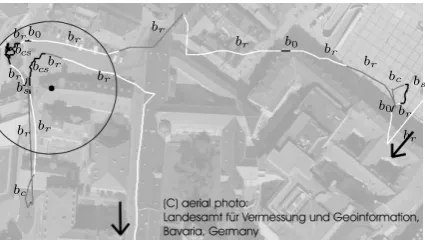
As output we get a stream of behaviors. In the example from Fig. 2 we distinguish the follow-ing spatio-temporal behaviors: ridfollow-ing (br),
stand-ing (b0), sauntering (bs), curving (bc), and
slow-curving (bcs). In other use cases we might as well
have non spatio-temporal behaviors, like manual user input. We call an IR problem amobileone if at least some behaviors are spatio-temporal ones.
br
Figure 2: Spatio-temporal behavior sequence in the first region.
The track from Figures 1 and 2 was recorded in the location-based game CityPoker. In the scope of this paper, we will only roughly introduce the rules of this game whenever needed. For a com-plete description, refer to (Schlieder, 2005). The reason why this game is especially suited as exem-plary use case is that CityPoker is played by bike at high speed.
2.2 Parsing behavior sequences
The stream of behaviors described above serves as input to a parsing algorithm. Using behaviors as terminals and intentions as non-terminals, we can write rules of a formal grammar that describe the intentions of an agent in our domain. Most plan recognition approaches have followed a hier-archical structure of plans/intentions (e.g. (Kautz and Allen, 1986; Geib and Goldman, 2003)). In CityPoker, for instance, a player will certainly have the intention to Play. At the beginning of each game, the members of a team discuss their strategy. Playing in CityPoker means exchang-ing cards in several cache regions, so we model a sequence of intentions as follows: GotoRegion HandleRegion, GotoRegion HandleRegion, and so on. In the cache region players find them-selves a comfortable place to stand, answer a multiple-choice question, and select one out of three caches, depending on their answer. In the cache, they search a playing card which is hidden in the environment (see the behavior sequence in Fig. 2).
A context-free production system for CityPoker is listed in Fig. 31. The choice of the formalism
de-1
Rules with a right-hand side of the form
(symbol1|...|symboln)+ are a simplified notation for
‘an arbitrary sequence ofsymbol1, ..., symboln, but at least
pends on the requirements of the use case. As ar-gued in (Schlieder, 2005), most intention recogni-tion use cases need at least the expressiveness of a CFG. A typical example is leaving the same num-ber of regions as entered before (enternleaven). We can find the currently active intention in the parse tree by choosing the non-terminal which is direct parent of the current behavior.
2.3 Spatially Grounded Intentional Systems
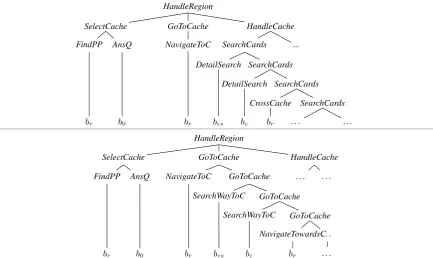
Up to here we have largely ignored the spatial as-pect of mobile intention recognition. We have used space in the preprocessing, but the last subsection was nothing but a simple CFG with intentions and behaviors. Now we will see how space can help us to reduce ambiguity. Consider the two parse trees in Fig. 4: both are possible for the behavior se-quence from Fig. 2. In the upper one the agent has entered the circular cache and is searching for the cards. In the bottom one the agent is in the region and still searching for the cache. Obviously, the upper one can only occur if the behaviors are lo-cated in a cache. This is the basic idea ofSpatially Grounded Intentional Systems (SGIS) (Schlieder, 2005): SGIS are context-free production systems with the extension that each rule is annotated with a number of regions in which it is applicable. We call this the spatial grounding of rules. For in-stance, aHandleCache intention is grounded in all regions of typecache. We modify all rules ac-cordingly. An SGIS rule for the original rule (12) would look like follows:
HandleCache →
SearchCards DiscussStrategy
[grounding:cache1,1, ..., cache5,3]
This reduces the number of possible rules ap-plicable at each position in the behavior se-quence, thus avoiding many ambiguities. For parsing in SGIS we replace the pure behavior stream (beh1, beh2, beh3, ...) by a stream of
be-havior/region pairs: ((beh1, reg1), (beh2, reg2),
(beh3, reg3), ...). Each behavior is annotated with
the region in which it occurs. Also the non-terminals in the parse tree are annotated with a region (Intention, region), with the meaning that all child-intentions or child-behaviors of this in-tention must occur in that region. SGIS are a short form of writing rules of the following form (where
Symbolcan be an intention or a behavior):
(Intention, regx) →
(Symbol1, regx) ... (Symboln, regx)
That means, we cannot write rules for arbitrary combinations of regions. In addition, we require that another rule can only be inserted at an inten-tionSymboliif the region of the other rule is
(tran-sitive) child in the partonomy, i.e. in the above rule we can only insert productions with a region
regy part of regx (which includes the same
re-gion: regy.equals(regx)). SGIS have been
de-signed for partonomially structured space. The nesting of rules follows closely the nesting of re-gions and sub-rere-gions in the spatial model. The CityPoker partonomy is structured as follows: the game area contains five rectangular cache regions, each of which in turn contains three caches (see Fig. 1.
3
A ‘Spatialized’ TAG
3.1 Spatial constraints
SGIS support a partonomial structure between re-gions, i.e. only part of relations exist. In gen-eral, a lot more topological relations are possi-ble, like touches, disjunct, identical, or north-of. Examples can be found in the literature on geo-graphic information science (Egenhofer and Fran-zosa, 1991). This restriction of SGIS hinders us from expressing frequently occurring use cases. Consider the motion track in Fig. 2: the agent enters the cache, shows some searching behavior, and then temporarily leaves the circular cache to the south. Knowing the whole motion track we can decide that this is an AccidentalLeave intention, and not a ChangePlan intention2. It is not nec-essary that the intermediate intention, let us call it
Conf used, is located in the parent cache region of the cache. Finally, entering justanycache is not sufficient for an AccidentalLeave intention, but we require that cache to be the same as left before.
2
Production Rules for CityPoker
Play → DiscussStrategy Continue (1)
DiscussStrategy → b0 (2)
Continue → ε|GotoRegion HandleRegion Continue (3)
GotoRegion → (br|b0|bc)+ (4)
HandleRegion → SelectCache GotoCache HandleCache (5)
SelectCache → FindParkingPos AnswerQuiz (6)
FindParkingPos → (br|bc|bcs)+ (7)
AnswerQuiz → b0 (8)
GotoCache → (SearchWayToC|NavigateTowardsC)+ (9)
SearchWayToC → (b0|bcs|bs)+ (10)
NavigateTowardsC → (br|bc)+ (11)
HandleCache → SearchCards DiscussStrategy (12)
SearchCards → (CrossCache|DetailSearch)+ (13)
CrossCache → (br)+ (14)
DetailSearch → (b0|bcs|bs|bc)+ (15)
Figure 3: Context-free production rules for intention recognition in CityPoker.
HandleRegion
SelectCache
FindPP
br
AnsQ
b0
GoToCache
NavigateToC
br
HandleCache
SearchCards
DetailSearch
bcs
SearchCards
DetailSearch
bc
SearchCards
CrossCache
br
SearchCards
. . . .
...
HandleRegion
SelectCache
FindPP
br
AnsQ
b0
GoToCache
NavigateToC
br
GoToCache
SearchWayToC
bcs
GoToCache
SearchWayToC
bc
GoToCache
NavigateTowardsC
br
. . .
. . . HandleCache
. . . .
AccidentalLeave→SearchCards Confused SearchCards identical
ClothesShopping→ExamineClothes HaveABreak ReturnToShop touches
Figure 5: Two examples for spatial constraints in context-free production rules.
HandleRegion HandleRegion RevisitRegion HandleRegion RevisitRegion
identical identical
Figure 6: Sequence of intentions with crossing spatial constraints.
We would need the following rule
(AccidentalLeave, cache1,1)→
(SearchCards, cache1,1),
(Conf used,[unconstrained]),
(SearchCards, cache1,1)
We cannot formulate this in SGIS, but still it makes no sense to write rules for pairs of (intention, re-gion). What we would need to formalize the ac-cidental leaving pattern elegantly is displayed in Fig. 5, top. We can easily find other examples of the pattern ‘a certain behavior/intention occurs in a region which has a spatial relation r to another region where the agent has done something else before’. For instance, we can find use cases where it makes sense to detect aReturnT oX intention if the agent has forgotten the way back to some place. We could define this as ‘the agent shows a searching behavior in a region whichtouchesa region she has been to before’, see Fig. 5, bottom.
3.2 Cross-dependencies: a parallel to NLP
Two or more ‘return to region’ intentions can eas-ily be crossed, see Fig. 6. In a real CityPoker game this can happen for tactical reasons. Players in CityPoker do not necessarily change a playing card although they have found it. They memorize the types of cards they have found and their exact position, and continue in the game. For a number of reasons it might make sense to change in an-other cache region first. Sometimes they return to that cache region at some time later in the game to change a card (without the effort of answering the quiz, cache search, and so on). What we need for
thiscrossed return to region patternis a possibility to createcross-dependencies.
3.3 Spatially Constrained TAGs
To express the spatial dependencies described above, we take TAGs as defined in (Joshi and Schabes, 1997) with links as described in (Joshi, 1985), and enhance them by spatial knowledge.
Definition: A Spatially Constrained Tree-Adjoining Grammar is defined as SCT AG = (T AG, R, SR, GC, N LC), where
• TAG= (I, B, IT, AT, S), defined over inten-tions I, and behaviors B.
• Ris a set of regions
• SRis a set of spatial relations, where each re-lationr⊆R×R
• GC ⊆(IT ∪AT)×Ris a set of grounding constraints
• NLCis a set of spatial non-local constraints. Each constraint has a type from the spatial re-lationsSRand is defined for two nodes in one tree fromIT∪AT.
As in SGIS, the terminals and non-terminals at the time of writing an SCTAG are not pairs of (symbol, region), but simply behaviors and inten-tions. This supports the intuition of a knowledge engineer who first writes the decomposition of in-tentions to sub-inin-tentions, and in a second step an-notates spatial knowledge.
Figure 7 lists part of a SCTAG that handles the re-visisting of cache regions in CityPoker. Non-local spatial constraints are displayed as dotted lines. A complete grammar for this use case would convert all context-free rules from Fig. 3 to trees and add them to the grammar. This step is trivial. Figure 8 demonstrates how cross-dependencies evolve through two adjoining operations.
3.4 Parsing of SCTAG
For parsing a spatially constrained grammar, we modify Joshi’s existing Early-like parsing algo-rithm (Joshi and Schabes, 1997). Like the original Earley parser for CFG, this parser works on charts in which the elementary constructs of the gram-mar are kept. In Joshi’s parser the ‘Earley dot’ tra-verses trees and not Strings. In our case, we addi-tionally store for each symbol in each chart entry the set of regions in which it may occur, i.e. when inserting a new chart entry we resolve the spatial constraints by a simple look-up in the spatial rela-tion table.
The parser works in four steps: scan, predict, complete, and adjoin. We modify the scan oper-ation. The scan operation reads the next symbol from the input and matches it with the chart en-tries. Although we write our SCTAG rules on in-tentions and behaviors, we get pairs of (symbol, region)during parsing. We first execute scan us-ingsymbol, as in the original parser, and then use theregioninformation to throw away those regions in our chart entries that are not consistent with the region information. As soon as a symbol in a chart entry has an empty set of possible regions we throw away the chart entry.
Although we do not provide a formal descrip-tion of the parser in this paper, it should be clear that adding spatial constraints to such a parser will not make it slower but faster. The reason is that spatial constraints give us more predictive infor-mation. ‘Any algorithm should have enough in-formation to know which tokens are to be ex-pected after a given left context’ (Joshi and
Sch-abes, 1997, p.36). Knowing the spatial context of left-hand terminals we can throw away those hy-potheses that are not consistent with the spatial constraints. A formal description of the parser, as well as an evaluation, will be issue of future publi-cations.
4
Related Work
Approaches for IR differ in the way possible in-tentions are represented. A number of formalisms has been proposed for modeling the mental state of an agent, ranging from finite state machines (Dee and Hogg, 2004) to complex cognitive modeling architectures, like the ACT-R architecture (Ander-son et al., 2004). With formal grammars, which are between these two extremes, we try to keep the balance between expressiveness and computa-tional complexity. Another important line of re-search in IR are approaches based on probabilistic networks, e.g. (Bui, 2003; Liao et al., 2007).
For the classification of segments in Fig. 2 we used a simple decision tree. The set of behavior types we are interested in was chosen manually. An automatic detection of motion patterns is the concern of the spatio-temporal data mining com-munity, see e.g. (Laube et al., 2004).
Spatial constraints are also dealt with in multi-model interfaces supporting sketching, like the nuSketch system (Forbus et al., 2001). Speech recognition provides help ‘for stating what spa-tial relationships are essenspa-tial versus accidental’ (p. 5).
5
Outlook
As a next step we will specify the parsing algo-rithm for SCTAG formally, and implement it for a mobile device. In this paper we treated all spatial relations as arbitrary relations, without using the formal properties of these relations for inference (like transitivity). Adding temporal constraints could also be worthwhile.
References
Anderson, J.R., D. Bothell, M.D. Byrne, S. Douglass, C. Lebiere, and Y. Qin. 2004. An integrated theory
of the mind. Psychological Review, 111(4):1036–
1060, October.
Baus, J., A. Krueger, and W. Wahlster. 2002. A
(α) Play
DiscussStrategy↓ Continue
identical
(β) Continue
GotoRegion↓HandleRegion↓ Continue∗
part of
(γ) Continue
GotoRegion↓ HandleRegion↓ Continue
Continue∗ RevisitR↓
part of
identical
Figure 7: Initial tree (α) and auxiliary trees (βandγ) in a SCTAG for CityPoker.
φ= (γadjα) Play
DiscussStrategy↓ Continue
GotoRegion HandleRegion Continue
Continue
RevisitRegion↓
identical
(γadjφ)
Play
DiscussStrategy↓ Continue
GotoRegion↓HandleRegion↓ Continue
GotoRegion↓HandleRegion↓ Continue
Continue
Continue
RevisitRegion↓
RevisitRegion↓
identical
identical
Proc. 7th International Conference on Intelligent User Interfaces, pages 15–22, San Francisco, USA. ACM Press.
Bobick, A.F. and Y.A. Ivanov. 1998. Action recog-nition using probabilistic parsing. In Proc. of the Conference on Computer Vision and Pattern Recog-nition, pages 196–202.
Bui, Hung H. 2003. A general model for online proba-bilistic plan recognition. InProceedings of the Inter-national Joint Conference on Artificial Intelligence (IJCAI).
Carberry, Sandra. 2001. Techniques for plan recogni-tion. User Modeling and User-Adapted Interaction, 11(1-2):31–48.
Chanda, Gaurav and Frank Dellaert. 2004.
Grammatical methods in computer vision: An
overview. Technical Report GIT-GVU-04-29,
College of Computing, Georgia Institute of
Technology, Atlanta, GA, USA, November.
ftp://ftp.cc.gatech.edu/pub/gvu/tr/2004/04-29.pdf.
Dee, H.M. and D.C. Hogg. 2004. Detecting
inex-plicable behaviour. In Proceedings of the British Machine Vision Conference, pages 477–486. The British Machine Vision Association.
Egenhofer, Max J. and Robert D. Franzosa. 1991.
Point-set topological relations. International Jour-nal of Geographical Information Systems, 5(2):161– 174.
Forbus, Kenneth D., Ronald W. Ferguson, and
Jef-fery M. Usher. 2001. Towards a computational
model of sketching. InProceedings of the 6th in-ternational conference on Intelligent user interfaces, pages 77–83, New York, USA. ACM.
Geib, Christopher W. and Robert P. Goldman. 2003.
Recognizing plan/goal abandonment. In
Proceed-ings of the Eighteenth International Joint Confer-ence on Artificial IntelligConfer-ence (IJCAI), pages 1515– 1517.
Geib, Christopher W. and Mark Steedman. 2007. On natural language processing and plan recognition. In
Proceedings of the 20th International Joint Confer-ence on Artificial IntelligConfer-ence (IJCAI), pages 1612– 1617.
Joshi, Aravind K. and Yves Schabes. 1997.
Tree-adjoining grammars. In Rozenberg, G. and A. Salo-maa, editors,Handbook of Formal Languages, vol-ume 3, pages 69–124. Springer, Berlin, New York.
Joshi, A. K. 1985. Tree adjoining grammars: How much context-sensitivity is required to provide rea-sonable structural descriptions? In Dowty, D. R.,
L. Karttunen, and A. M. Zwicky, editors, Natural
Language Parsing: Psychological, Computational, and Theoretical Perspectives, pages 206–250. Cam-bridge University Press, CamCam-bridge.
Kautz, Henry and James F. Allen. 1986. Generalized plan recognition. In Proc. of the AAAI conference 1986.
Kiefer, Peter and Christoph Schlieder. 2007. Explor-ing context-sensitivity in spatial intention
recogni-tion. InWorkshop on Behavior Monitoring and
In-terpretation, 40th German Conference on Artificial Intelligence (KI-2007), pages 102–116. CEUR Vol-296. ISSN 1613-0073.
Kortuem, G., M. Bauer, and Z. Segall. 1999. Net-man: The design of a collaborative wearable
com-puter system. Mobile Networks and Applications,
4(1):49–58, March.
Kr¨uger, A., A. Butz, C. M¨uller, C. Stahl, R. Wasinger, K.-E. Steinberg, and A. Dirschl. 2004. The con-nected user interface: realizing a personal situated navigation service. InProc. of the 9th international Conference on Intelligent User Interfaces, pages 161–168. ACM Press.
Laube, Patrick, Marc van Krefeld, and Stephan Imfeld. 2004. Finding remo - detecting relative motion pat-terns in geospatial lifelines. InDevelopments in Spa-tial Data Handling, Proceedings of the 11th Interna-tional Symposium on Spatial Data Handling, pages 201–215.
Liao, Lin, Donald J. Patterson, Dieter Fox, and Henry Kautz. 2007. Learning and inferring transportation routines. Artificial Intelligence, 171(5-6):311–331.
Pynadath, David V. 1999. Probabilistic Grammars for
Plan Recognition. Ph.D. thesis, The University of Michigan.
Schlieder, Christoph and Anke Werner. 2003. Interpre-tation of intentional behavior in spatial partonomies. InSpatial Cognition III, Routes and Navigation, Hu-man Memory and Learning, Spatial Representation and Spatial Learning, volume 2685 ofLecture Notes in Computer Science, pages 401–414. Springer.
Schlieder, C., P. Kiefer, and S. Matyas. 2006.
Geogames - designing location-based games from
classic board games. IEEE Intelligent Systems,
21(5):40–46, Sep/Oct.
Schlieder, Christoph. 2005. Representing the mean-ing of spatial behavior by spatially grounded inten-tional systems. InGeoSpatial Semantics, First Inter-national Conference, volume 3799 ofLecture Notes in Computer Science, pages 30–44. Springer.