Analysis of the Leaf Boundary in Different
Medicinal Leaves
Prof.Dr.P.K.Srimani1, K.Nithiyanandhan2
Former Chairman &Director, R&D Division, B.U., DSI, Bangalore, Karnataka, India. 1
Asst. Prof. Department of Master of Computer Applications, Brindavan College, Bangalore, Karnataka, India
and Research Scholar, Rayalaseema University, Kurnool, Andhra Pradesh, India. 2
ABSTRACT:The present study deals with the analysis of medicinal plants specifically Hibiscus leaf by using the techniques of Image Processing, Boundary tracing of a binary digital region is an important first step in the analysis of that region. With an abstract cell complex representation of a digital image the boundary point coordinates may be extracted from that digital image. The results are presented and discussed. Boundary value analysis is a technique for test data selection Boundary values which include maximum, minimum, just inside boundaries, just outside boundaries, typical values, and error values. The expectation is that, if a systems works correctly for these extreme or special values, then it will work correctly for all values in between. An effective way to the test code is to exercise it at its natural boundaries.
KEYWORDS: Image Processing, Hibiscus Leaf, medicinal.
I.INTRODUCTION
Analyzing and manipulating images with a computer. Generally involves three steps: i) Import an image with an optical scanner or directly through digital photography.
ii) Manipulate or analyze the image in some way. This stage can include image enhancement and data compression, or the image may be analyzed to find patterns that aren't visible by the human eye. For example, meteorologists use image processing to analyze satellite photographs.
iii) Output the result. The result might be the image altered in some way or it might be a report based on analysis of the image.
The two aspects of Image Processing are:
Improving the visual appearance of images to a human viewer.
Preparing images for measurement of the features and structures present.
Image Processing is necessary since the digital image is “invisible “it must be prepared for viewing on one or more output device (laser printer, monitor, etc).
The digital image can be optimized for the application by enhancing or altering the appearance of structures within it (based on the body part, diagnostic task, viewing preferences .etc).
The following are the types of Image processing:
Image- to – image transformations Image – to- Information transformations Information- to – image transformations
Image-to- image transformations:
Enhancement ( make image more useful, pleasing) Restoration Egg. deblurring, grid line removal Geometry:
(Scaling, sizing, zooming, morphing one object to another)
Image –to – information transformation: Image statistics ( histogram)
Histogram is the fundamental tool for analysis and image processing
Image compression
Image analysis (Image segmentation, feature extraction, pattern recognition) Computer –aided detection and diagnosis (CAD)
Information – to – image transformations Decompression of compressed image data
Reconstruction of image slices from CT or MRI raw data Computer graphics, animations and virtual reality (synthetic objects).
Image processing basically includes the following three steps.
1 Importing the image with optical scanner or by digital photography.
2 Analyzing and manipulating the image which includes data compression and image enhancement and spotting patterns that are not to human eyes like satellite photographs.
3 Output is the last stage in which result can be altered image or report that is based on image analysis.
Purpose of Image processing
The purpose of image processing is divided into 5 groups. They are: 1. Visualization - Observe the objects that are not visible. 2. Image sharpening and restoration - To create a better image. 3. Image retrieval - Seek for the image of interest.
4. Measurement of pattern – Measures various objects in an image. 5. Image Recognition – Distinguish the objects in an image.
About the Medicinal Plants
Plants are extremely useful for us. On the one hand they provide us with the oxygen we need by means of photo synthesis necessary for us to breathe. But furthermore they contribute with nutrients through food, wood for fire, chemicals for the industries, etc.
The use of the plants as food has been the main aim from time immemorind Throughout history, civilizations have moved around the plants and , living beings have been benefited to a great extent.
Indian Medicinal Plants
15000-20000 plants have good medicinal values). In India the therapeutic use of herbs dates back to the Vedic period. The Rig-Veda has documented about 67 medicinal plants, Yajurveda 81 species and Atharvaveda 290 species.
The ayurvedic classics also described the clinical uses of thousands of medicinal plants. With the increasing esteem of herbal medicine and ayurveda, use of medicinal plants is expected to rise globally. The popularity of herbs have increased because of the side effects of synthetic drugs, development of resistance to many drugs like antibiotics, public awareness, population explosion, insufficient supply of drugs, high cost of synthetic drugs etc.
II.RELATED WORK
In [1] an algorithm for generating the Medial Axis Transform (MAT) of 3D objects with free-form boundaries is discussed. The algorithm proposes the usage of the exact representation of the part and generates an approximate ratio-nal spline description (to within a defined tolerance) of the MAT. The algorithm generates the MAT by a tracing tech-nique that marches along the object boundary. The level of approximation is controlled by the choice of the step size in the tracing procedure. Criteria based on distance and local curvature of boundary entities are used to identify the junction points and the search for these junction points is done in an efficient way. The algorithm works for multiply-connected objects as well. Results of implementation are provided.
In [2] the authors have discussed on Boundary tracing of discrete points is an important step to build up model reconstruction by using LiDAR data. Its result directly effects the location regularization of building corners and the reconstructed building models. At present, the convex hull based boundary tracing algorithm is not suitable for buildings with many concave part and grid index based algorithm is too complicated and not stable enough. This paper proposes a side ratio constraint based boundary tracing algorithm for discrete points. This algorithm can effectively trace the boundary of concave polygons with holes. It doesn’t depend on point densities heavily since it uses side ratio as qualification. This algorithm was finally proved in experiments.
In [3] the authors discuss on the review discussed several techniques to obtain boundary of an object in a digital image. Some of the well known techniques are contour tracing and edge detection techniques. The result of this boundary tracing is used for analyzing an object in the image. This result is critical for certain image analysis. In this study, the techniques are used for obtaining the fish boundary from a digital image. The study will evaluate the suitable approach to get the fish boundary. This study is important for the next study on analyzing the physical characteristic of the fish.
In [4] the authors discuss on the several techniques to obtain boundary of an object in a digital image. Some of the well known techniques are contour tracing and edge detection technique. The study evaluates the suitable approach to get the fish boundary. This study is important for the next study on analyzing the physical characteristic of the fish.
In [5] the authors discuss on the boundary that is necessary for the real estate industry, flood management, and homeland security applications. The extraction of building boundary is also a crucial and difficult step towards generating city models. This study presents an approach to the tracing and regularization of building boundary from raw lidar point clouds. This paper presents the mathematical and algorithmic formulations along with stepwise illustrations. Results from Baltimore city, Toronto city, and Purdue University campus are evaluated.
In [6] a review article on comparison of edge detection methods is presented in leaf shape analysis for plant classification .Leaf is a very significant component of plant species that identify and classify the plants. Plant classification is the task performed by trained botanists and taxonomists. This task includes performing a set of operations. Because of this the task of classification of plants manually is time consuming. There are many biometric features of the leaves of the plants for classification. In this paper, Sobel and Canny edge detection methods are compared for their performance in leaf shape analysis operation for plant classification.
analysis. In this study all models are designed for factor of safety 2.5 and analysis is done using ANSYS software. Deflection and Stresses results were verified for analytical results. Result shows that, the composite spring has stresses much lower than steel leaf spring and weight of composite spring was reduced. By capturing the fundamentals of combining dissimilar materials and thus its equivalent modulus affects the overall stiffness characteristics of multi-leaf design.
In [8] a review article on we used three methods to measure boundary layer conductance to heat transfer (gbH) and water vapor transfer (gbV) in foliated branches of Abies amabilis Dougl. ex J. Forbes, a subalpine forest tree that produces clumped shoot morphology on sun-formed branches. Boundary layer conductances estimated in the field from energy balance measurements increased linearly from approximately 10 mm s1 at low wind speeds (< 0.1 m s1) to over 150 mm s1 at wind speeds of 2.0 m s1. Boundary layer conductances measured on shoot models in a wind tunnel were consistently higher than field measurements. The difference between wind tunnel values and field measurements was attributable to variation in path length between the two experimental environments. Boundary layer conductance estimated by subtracting stomatal resistance (rsV) measured with a porometer from the total branch vapor phase resistance were unusually small. Sensitivity analysis demonstrated that this method is not suitable for coniferous foliage or when stomatal conductance (gsV) is small compared with gbV. Analysis of the relative magnitudes of gsV and gbV revealed that, under most conditions, A. amabilis branches are well coupled (i.e., gsV is the dominant controller of transpiration). The boundary layer conductance to heat transfer is small enough that leaf temperature can become substantially higher than air temperature when radiation is high and wind speed is low. Over a two-month period, the maximum difference between leaf and air temperatures exceeded 6 C. Leaf temperature exceeded air temperature by more than 2 C on 10% of the daylight hours during this period. Consideration of both the photosynthetic temperature response of A. amabilis foliage as well as the summer air temperature conditions in its habitat suggests that these elevated leaf temperatures do not have a significant impact on carbon gain during the growing season.
In [9] a review article on the goal of this study is to present a concept to identify overlapping rubber tree (Hevea brasiliensis-scientific name) leaf boundaries. Basically rubber tree leaves show similarity to each other and they may contain similar information such as color, texture or shape of leaves. In fact rubber tree leaves are naturally in class of palmate leaves, it means that numbers of leaves are joining at their base. So it reflects the information of the position of the leaves whether the leaves are overlapped or separated. Therefore, this unique feature could be used to distinguish particular leaves from others clone to identify the type of trees. This study addresses the problem of identifying the overlapped leaves with complex background. The morphological transformation is often applied in order to obtain the foreground object and the background location as well. However, it does not yield satisfactory results in order to get boundaries information. This study, presents on improved approach to identify boundary of rubber tree leaves based on morphological operation and edge detection methods. The outcome of this fused algorithm exhibits promising results for identifying the leaf boundaries of rubber trees.
In [10] a review article on Leaf springs are special kind of springs used in automobile suspension systems. The advantage of leaf spring over helical spring is that the ends of the spring may be guided along a definite path as it deflects to act as a structural member in addition to energy absorbing device. The main function of leaf spring is not only to support vertical load but also to isolate road induced vibrations. It is subjected to millions of load cycles leading to fatigue failure. Static analysis determines the safe stress and corresponding pay load of the leaf spring and also to study the behavior of structures under practical conditions. The present work attempts to analyze the safe load of the leaf spring, which will indicate the speed at which a comfortable speed and safe drive is possible. A typical leaf spring configuration of TATA-407 light commercial vehicle is chosen for study. Finite element analysis has been carried out to determine the safe stresses and pay loads.
Boundary Tracing is given a “segmented” image (an image with foreground pixels labeled 1 and background pixels
labeled zero), tracing of either boundary of the
foreground.
III. PROBLEM SPECIFICATION
The main objective of the present study is to make a detailed analysis of the structure of veins in Indian Medicinal leaves. One Boundary tracing of a binary digital region which is an important first step in the analysis of that region. With an abstract cell complex representation of a digital image the boundary point coordinates may be extracted from that digital image. Different samples are taken and the experiments are conducted.
IV METHODOLOGY
MAT LAB 7.0 tool is used to make detailed analysis of the boundary detection of different medicinal leaves.
TYPES OF DIGITAL IMAGES
Binary: Each pixel is just black or white. Since there are only two possible values for each pixel (0,1), we only need one bit per pixel.
Grayscale: Each pixel is a shade of gray, normally from 0 (black) to 255 (white). This range means that each pixel can be represented by eight bits, or exactly one byte. Other grayscale ranges are used, but generally they are a power of 2.
True Color or RGB: Each pixel has a particular color; that color is described by the amount of red, green and blue in it. If each of these components has a range 0–255, this gives a total of 2563 different possible colors. Such an image is a “stack” of three matrices; representing the red, green and blue values for each pixel. This means that for every pixel there correspond 3 values
V.EXPERIMENTS AND RESULTS
The experiments are conducted with different images using MAT LAB 7.0 tool.
The results are presented in Table 1 and Figure 1 to Figure 4.
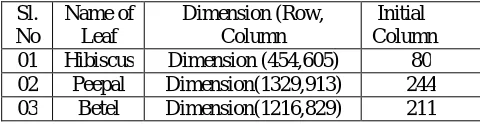
The Table1 shows different medicinal leaves detection of boundaries
Table 1 .
The figure 1 shows Original Image , Filtered image ,Black and white image and display traced boundary. Sl.
No
Name of Leaf
Dimension (Row, Column
Figure 1
The figure 2 display finding of initial point, Inverting, fill inner boundaries where lesion is located
Figure 2
The figure 3 display the Geometrical center with tracing
Figure 3
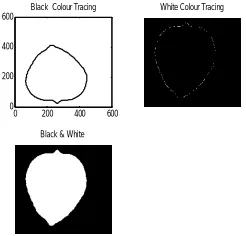
The figure 4 display Original leaf, RGB Components with intensity Original image Filtered Image
Black and White Traced
0 200 400 600
0 200 400 600
Black Colour Tracing White Colour Tracing
Black & White
Figure 4 VI. CONCLUSION
Boundary values include maximum, minimum, just inside boundaries, just outside boundaries, typical values, and error values. The expectation is that, if a System works correctly for these extreme or special values, then it will work correctly for all values in the range. An effective way to test code is to exercise it at its natural boundaries
Boundary Value Analysis (BVA) is a method of testing that complements equivalence partitioning. In this case, data input as well as data output are tested. The rationale behind BVA is that the errors typically occurat the boundaries of the data. The boundaries refer to upper limit and the lower limit of a range of values or more commonly known as the “edges” of the boundary.
ACKNOWLEDGEMENTS
One of the authors Mr. K.Nithiyanandhan acknowledges Brindavan College Department of Master of Computer Applications, Bangalore, Karnataka and Rayalaseema University, Kurnool, India for providing the facilities for carrying out the research work.
REFERENCES
1 . M. Ramanathan and B. Gurumoorthy “ A tracing algorithm for constructing medial axis transform of 3D objects bound by free-form surfaces” ,Int. Con. on Shape Modeling and Applications IEEE 2005.
2.Huang Xianfeng, Cheng Xiaoguang, ZHANG Fan, and Gong Jianya , “Side Ratio Constrain Based Precise Boundary Tracing Algorithm For Discrete Point Clouds”, The International Archives Of The Photogrammetry, Remote Sensing And Spatial Information Sciences. Vol. VII. Beijing 2008.
3. Akmal Rakhmadi , Mohd. Shafry Mohd Rahim and Habibollah Harun ,” Boundary Tracing of Fish Image”.
4.Farsad Zamani Boroujeni, Rahmita Wirza, Norwati Mustapha,Lilly Suriani Affendey,Oteh Maskon and Majid Khalilian ,” A New Tracing Algorithm for Automatic Boundary Extraction from Coronary Cineangiograms”, the International MultiConference of Engineers and Computer Scientists, IMECS 2010, Hong Kong 2010.
5. Aparajithan Sampath and Jie Shan ,” Building Boundary Tracing and Regularization from Airborne Lidar Point Clouds”, Photogrammetric Engineering & Remote Sensing Vol. 73, No. 7, pp. 805-812 2007.
6..Manisha Amlekar , Ashok Gaikwad , Pravin Yannawar , Ramesh Manza “Comparison of Edge Detection Methods in Leaf Shape Analysis For Plant Classification” Gate to Computer Vision and Pattern Recognition ISSN: 2408-0551 vol. 1, no. 1, pp. 19-22, 2015.
7.Ajay B.K. (1), Mandar Gophane(1), P Baskar(2) “Design and Analysis of Leaf Spring with Different Arrangements of Composite Leaves with Steel Leaves” International Journal of Engineering Trends and Technology (IJETT) ISSN: 2231-5381 PP:88-92 Volume 11 Number 2 - May 2014 8.Timothy . Martin, Thomas M. Hinckley, Frederick C. Meinzer and Douglas G. Sprugel “Boundary layer conductance, leaf temperature and transpiration of Abies amabilis branches” Tree Physiology Heron Publishing----Victoria, Canada 19, 435—443 1999.
9. Sule Tekkesinoglu, Mohd Shafry Mohd Rahim, Amjad Rehman, Ismail Mat Amin and Tanzila Saba “ Hevea Leaves Boundary Identification based on Morphological Transformation and Edge Detection Features” Research Journal of Applied Sciences, Engineering and Technology ISSN: 2040-7459; e-ISSN: 2040-74677(12): 2447-2451, 2014 .
10. G Harinath Gowd, E Venugopal Goud “Static Analysis Of Leaf Spring” International Journal of Engineering Science and Technology (IJEST) ISSN : 0975-5462 Vol. 4 No.08 PP: 3794-3803 August 2012.
11. Miyuki Nakata and Kiyotaka Okada “ The Leaf Adaxial-Abaxial Boundary and Lamina Growth” plants ISSN 2223-7747 2,PP: 174-202, 2013 12. Simone Buoncompagni,Vincent Lepetit” Leaf Segmentation under Loosely Controlled Conditions” Buoncompagni Et Al: Leaf Segmentation Under Loosely Controlled Conditions PP:01-12, 2015.
13. Matteson, Ronald G, “Introduction Document Image Processing Techniques”, Artec House 1995 Original Leaf RGB Componets Leaf