University of Windsor University of Windsor
Scholarship at UWindsor
Scholarship at UWindsor
Electronic Theses and Dissertations Theses, Dissertations, and Major Papers
9-4-1962
The influence of situational variables on level of self-acceptance.
The influence of situational variables on level of self-acceptance.
Kenneth S. Solway
University of Windsor
Follow this and additional works at: https://scholar.uwindsor.ca/etd
Recommended Citation Recommended Citation
Solway, Kenneth S., "The influence of situational variables on level of self-acceptance." (1962). Electronic Theses and Dissertations. 6318.
https://scholar.uwindsor.ca/etd/6318
This online database contains the full-text of PhD dissertations and Masters’ theses of University of Windsor students from 1954 forward. These documents are made available for personal study and research purposes only, in accordance with the Canadian Copyright Act and the Creative Commons license—CC BY-NC-ND (Attribution, Non-Commercial, No Derivative Works). Under this license, works must always be attributed to the copyright holder (original author), cannot be used for any commercial purposes, and may not be altered. Any other use would require the permission of the copyright holder. Students may inquire about withdrawing their dissertation and/or thesis from this database. For additional inquiries, please contact the repository administrator via email
TBB INPIBEBOB OP 8IT0ATI0&A& VABIABLBB
OB
IBVBl OP aE&P-AGCBPTABOB
A
Submitted to th* Pmoulty of Grmau&to Studio# through the Dopmrtmoat of Poyohologp la Partial Puifillmoat
of the aoqulromoat# for th# Dogro# of Naotor of Art# at A##u*ptloa
Baivormity of Wiadoor
by
Konaoth 9, Solway
B,A*, AooumptloB ShlYorolty of Viadoor, I960
UMI Number: EC52497
INFORMATION TO USERS
The quality of this reproduction is dependent upon the quality of the copy
submitted. Broken or indistinct print, colored or poor quality illustrations and
photographs, print bleed-through, substandard margins, and improper
alignment can adversely affect reproduction.
In the unlikely event that the author did not send a complete manuscript
and there are missing pages, these will be noted. Also, If unauthorized
copyright material had to be removed, a note will indicate the deletion.
UMI
UMI Microform EC52497Copyright 2008 by ProQuest LLC.
All rights reserved. This microform edition is protected against
unauthorized copying under Title 17, United States Code.
ProQuest LLC
789 E. Eisenhower Parkway PC Box 1346
A 8
5 T
Approved by#
AB6T%A6*
O&rl Reger# (1951) aalatala# th&t th# ##lf~eone#pt
aad *elf-***eptaao# *r* een#i*t#at oempoaaat# within indivi
dual#* Bumerou# attempt# te verify thi# propoaltlea have
heea unable te preduee elear reeult#, The preaent #tudy
ha# examined the iafluenee of experimentally indueed auooee#
and failure on ee&elateney ef #elf-aeo#ptaaee*
Three group# ef 28 aubjeeta, matehed en the baal# of
age, #e%, intelligence and level of aelf-aceeptanoe, were
aeleoted to teat the hypotheaia* One group va# called th#
auooeaa group, a aeoond, the failure group and the third,
the control group# Performance on a fictional perceptual
discrimination taak auppoaedly related to auaceaa or failure
in univeraity graduation vaa employed to provide the experi
mental condition#*
A complex analyaia of variaao# vaa applied to aoorea
on a aelf-aooeptanoe teat before and after the induction of
auooeaa and failure* An P value of .6) not aignifioant at
the 5# level of confidence vaa obtained* A significant
difference vaa obtained, however, at the 1* level of confi
dence within the auooeaa group* Beeulta are tentative in the
abaenoe of teat reliability#
PBBRACB
Bxperlmaatation with the concept# of *#elf* and
*eelf-aeoeptane#' bm# been greatly hampered due to method
ological and theoretical problème. In thi# etudy the
prob-lem otmoemlng ©oasiateney or generality of aelf-aoceptanoe
1# investigated, Blnoe Carl R* Reger* ha# been meet influ
ential in thi# field, Roger*# definition# are employed oper
ationally to define *#elf* and *#elf-aoOeptanoe*, The
specific hypothesis tested was that experimentally induced
success and failure would have no significant effect on the
level of #elf-a#oeptanoe.
The author wishes to express hi# deepest grati
tude to Reverend M, A* Record, M.A,, for his advise
and guidance in the preparation of this study* Similar
gratitude must also be extended to Brother R, Philip, P.8.O.,
Ph#B,, end Dr* Rudolf A# Belling, Ph*D., for their counsel
and insplratlw. The author would also like to thank the
students who took part in the experimentation, finally, this
project might never have been completed without the help of
Reverend R, 0, Pehr, Ph*g,
TABIB 0? OOHTBKTS
AB8TRA0* *
PBBPAOB ,
12 8 * OP TAB&B8
OHAPTm I laraoDuoTioB * * , *
IWw&gpMuad of Related Research * Research Involvlag the Generality
of Oenelsteney of Self # *
Purpose of Present Researoh $
Statement of the Problem , ,
1% MBTBDDOIOGT ABB PROCaDGRE # * 9 10
Experimental Sample * *
Instrument Employed to Measure
* # 10
Self-AoeeptBBo# # 4 # 9 ,
12-Experimental Procedure # m 9 14
III PaaaSRTATIOB ABB AKAIfai* OP RB80%*8 16
Main Analysis * #
Supplementary Analysis
* # 9 16
Part I , * # * 18
Part II . * * 9 * 19
IT DI80G88IO* OP aB89%e8 * # * 22
Main Analysis * . ■» * # 25
Supplementary Analysis ♦ 9 * 26
T 8UMMARI ABD 00B058BI0B8 *, 9. # 51
Shmmway * * *
Ooneluslons * * 4 # * , 52
APPmDIX A
APPmDIl A ( 2 ) « # # ♦ '# # 56
A P P m D H A (5) . . .
APPamix B # » * # # # e 58
APPgRDII 0 ( 1 ) # # * * $ 9 9 41
APPmDI% 0 (2) . . . ,
APPBKDII D * * * * * * 9 45
118* OP &&B&B8
TABIB PAOa
1, Matching of Buooea# (9), Pailnr# (P) aaA
Control (0) Group* f*r I*v#l of
Solf-Accoptaaoo Score, Ago, Intolligeno* (%~20) 11
2^ Matching of Bno##»# (8), Pallnro (P)
and Oontrol (G) Gronpa for 9#% , * # * , , , 11
5* Glgnlfloaao# of Difforenoo# Betwoan th#
Thro# Grcnp# for th# 5 Moot Dooirabl#
Trait# and 5 laaot Boairahl# Trait# , , * * 12
4* Aaalyaic of Variance for Change# in
level of 9elf~Aeceptanoe in Three Groupa (Sneoeea, Pailnre, Control) Before and Afttr the Experiaenthl
Indnction of Bncoeee and Pailare * * + * * 1?
5« Significance of Difference for
Self-Acceptance Score# Within Group# After
the ampertnental Oondition# . * * # * # . # 18
6* Significance of Difference Within Group#
After the Experimental Gendition# for
iOBAMam I
la ##lf"p#yeh#lo*y ha# flouriahad
da-aplt# both theoretical cad methodological problem#
ccaeem-lag the aatare aad ealeteae# of a #elf-comeept# latereat
la thi# field *a# flrat generated by each writer# a# Proem
(19)9) aad BOrmey (1937) eh* olale*d that leva of on### eelf
i#a# a neoeoeary prellmleary for let# of another* Adler (1924)
wrote that a tendency to dlaparage are## oat of a fooling of
inferiority a* .an ov@r-###m#aticm* dallitan (1947) defined
payohlatry a# the etudy of Intorporoeaal relation# and claimed
that an individual manlfe#t# mental health or mental dieorder
within thee# relation#*
Th# greateat Inflnenoe which became the k v to th#
reewrgeneo of Intereot In eelf end ##lf-ln*relatlon#hlp In
peroenallty dynamloa wa# provided by Roger# end hi# aocociate#
at the ixalwerelty of Ohloago# loger»* (If51) hypothoel# that
a person who accept# himeelf thoroughly will neooeearlly
i»-prove hi# rdatlcneblp %flth thooe with whom he ha# perocnal
contact, beeeneo of hi# greater wnderotaadlng and aooeptanoo
of them# led to a eerie# of empirical etadlo# attempting to
m O K G a O m m OP BELAjrED IBgEAROH
Positive relationship# hetwssn aooeptanos of #elf
and good iatsrperaonal relation# were discovered by Rainy
(1946), Sheerer (1949), Stock (1949), Bills, Vanoe and
Meleen (1951), Bndicoff (1952), Mowrer (1955), Butler and
aaigh (1954) aanlen,Boffstaetter and 0*0o«ner (1954),
Kennedy (1958) and Onwake (1959), Meanwhile Meltmer (1955),
Pey (1954), Simmer (1954) end Sudkerman (1956) report nega
tive findings; self-aooeptanee is not related to good inter
personal relations#
Another series of studies dealing with
self-aeeeptanoe and adjustment was also stimulated by Rogers (1951),
He stated.
It would oeour that when all the way# In which the Individual perceives himself — all perceptions of the qualities, abilities, impulses and attitudes of the person and all pereeptlens of himself In relation to other# — are accepted into the organised oonsoious ooneept of the self, then this achievement is aeeompanied by feelings of comfort and freedom fiwa tension whieh are experienced as psyohologioal adjustment.
ampirloal evidenoe in favor of Rogers* formation is
provided by MoQultty (1950), Oowen (1955), Ohaee (1957),
Hapaport (1956), Smith (1958), Turner and Vanderlippe (1958)
and Akeret (1959)* The results of Preedman*# study (1955)
reject a simple relationship between acceptance of self and
adjustment, while Ohodorkoff (1954) and Block and Thcsnas
(1955) argue against a linear relationship and point to a
r 3
&##ea3Mh Invclvlng^^ th* Genwallty or Ocnsistency of Soif
Beeàuoo opnolotonoy or generality of the
self-oonoept and oelf-a#oeptanoe ha# often been aaaweed, relevant
literatnr# i# quite aoenty# Datler and Balgh (1954) report
a riee in the level of eelf-eete#w and adjnmtment ae a
eon-oeqnenoe of elient-oentered therapy, A prodaot-moment cor
relation of ,01 between eelf end ideal aelf-eenoepte wae
found in a group prior to olient-eentered therapy* After
therapy a eorrelation of ,56 ie reported* Per th# control
group this correlation rewtiaed between ,57 and .56,
Thome (1954) found that following indueed failure
on a mirror drawing taak, euhjeote whoee initial level of
eelf-aooeptanoo wa# high tended to lower their aelf-ratinge
in the direction of a more realietic evaluation while origi
nally low accepting eubjeote tended to increaee
eelf-acceptance aeore# and ehowed oonewn over loee of eelf-eeteem,
Theee recuite euggeet that eelf-acceptance i# influenced by
environmental event# and that pereona reapoad self-ref
lexive-ly to perceived cuceeeee# end failure#,
gharmm (1956) found that elgnifioent change# in
#elf-eeteme did occur under oondition# of etreco end oupport, Two
experimmtal group# changed their #elf-e#teem ecore#
aigni-fieantly more than the control group tut the pattern of change
wa# uninterpretable* Purther, those whose self-estem# soores
changed under stre## were found to have exhibited different
personality charactwistic# in the pretest than those who
4
Stotland end gander (1958) on the other hand,
found that performance on a vleual molwir taak (competition
on a puaale) did not produce any coneiatent oonaequenoea on
#elf-evaluation a) in the area of visual actor coordination
ability employed in the tack, or h) in the individual taken
aa a whole, Theee reeulta coincide with an earlier experi
ment performed by Stotland, Thcrley, Thomaa, Oohen and gander
(1957), Their hypotheele that gmeral eelf-eeteem wae too
maduring a oharaoterietio to be effected bf h aingle experi
mental failure on a puaale wae aubatantiated.
In aooordenoe with their hypotheele, Dlggory end
Magaminer (1959) report that aubjeete who failed on a oapaolty
on which they had originally rated thcmaelvea low did not
change aa many aelf-ratinge nor change them mm much aa did
the original hlgh-ratmra, aewever,no aignifioant effeota on
global aelf-evaluation ratings were found for either group,
Wylie (1961) in a survey of literature on
aelf-ccnoept experimentation conolWes that subjects will, under
oertain conditions, change their oharaoterietio level of
aelf-evaluation after experimentally induced suooess end
failure. These changes* however, are more likely to ocour on
the experimental task itself, or on the oharaoterietio which
has been evaluated rather than on the entire self-aooeptanoe
framework# She concludes,
5
*
rmPOSB Of PREaEKT RmSÀROH
Th* problem for thle proposed reseeroh grow# out
of the meed of refihed theoretloal end mothodologloW.
eom-struet# tm *#elf" eyperimemtatlom, heretofore reseeroh Im
this ere# has besm dlfflsult to Interpret#
Theoretloai and Methodologioal Probl### in the Area
There Is no single definition of the self whloh
would be aeeeptable to all. Two meanings out of many pre
dominate first, the self as sabjeot or agent, second, the
self as th# indivldnal who 1# known to himself (English and
English, 1958). The terms "self", and "self-aooeptanoe" and
"self-concept" are commonly used with reference to the latter*
Although the majority of research on self-aceeptance has been
based on Rogers* phsnomemclogical theory, there is a whole
gaant of wpirloal stndies based on other theories whioh
in-oorporate this constraot* (Block and Thomas, 1955, Is Forge
and SnosWc, 1955),
Research ha# been hampered because of the logically
Impossible task of establlahi%% an external criterion with
Which to validate self-aooeptanoe teste. A aurvey of the lit
erature reveals that a new self-acoeptanoe test is devised for
virtually every experiment (Orowne and Stephens, 1961).
Ap-parently, it ie aeeumed, first, that these instruments have
face validity; and second, that they measure similar
oharac-teristios of the self-aooeptanoe construct.
6
the validity of eelf report# — # ebnetruct ef Reger#*
phe-nemenlegy, Wylie (1961) put# forward the view that it would
be naive to I w l y that individual*# eelf report 1# deter
mined solely hr hi# phenm&enal field:
... it i# ebviou# that eueh reepense# may alee (refleet) be influenoed by (a)
#ub-jeet*# intent to eeleet what he wish## to reveal to the E; (b) eubjeet*# intent to
eay that he ha# attitude# or peroeption# whieh he doe# not have* (o) eubjeot*#
re-epwae habit#, partieularly the## involving introepeotien and the use of language# (d) a heat of situational end methodologioal faotor# lAioh may not only indue# vari ation# on (a), (b) and (o) but may exert other more auperfioiml influenoe# on the reepenee# obtained#
Oritiolem extend# alee to the oonetruet validity
of eelf-aooeptanoe inetrumaata* We have already notioed that
the numereu# eelf-aooeptane# teat# have been aeeumed to be
equivalm&t operation# for m#e#uring the oharaoterietio#
In-oorporated in the ooneept# Empirioal evidenoe dee# not support
thi# assumption# Gowon (1956) reports no eorrelation between
two eelf-aooeptanoe measure# dsrived from self# ideal-self
dlsorepanoy soores (Mil*# I n d # of Adjustment and Values
(IA7) (1952) and frewnfain*# (1952) Self-Rating Inventory).
Omwake (1954) report# a eorrelation of .55 between the lAV
"self-aooeptanoe" moor# and the "self" soore on the (1951)
Attitude# Toward Self and Other# Questionnaire of Philips *
end a eorrelation of *49 betwesn the "self-aooeptanoe" soore
on Bill*# lAV and Berger*# (1952) "self-aooeptenee" soale*
Another problem in the oenstruotion of
test lt«w# TheereMeel eomslder#tiens involved in the defi
nition of the eonoept of "self" renders universal seleotion
of "self-evaluative" behaviour isgpossible. As a result, it
is further Impossible to oaleulate a representative sesgple
of self-referent behaviour i t # w and to generalise from one
experimental setting to another*
The instrument used to measure "aelf-aooeptanoe"
may impose external bo^mdaries on the subjeet's freedom of
response. If so, we have prevented true expression of the
subje@t*s oonsoious feelings, denes (1956) reports that in
a free ohoioe Q-sort setting, both normal and abnormal
sub-jests produoed a V-shaped sorting rather than the expeoted
normal distribution.
The influenoe of sooial desirability (Edwards,
1957) on test items of both aooeptanoe" and
"self-report" inventories must also be owsidered, Edwards (1957)
provides evidenoe oonoeming the tendenoy for subjeots to
attribute to themselves personality statements with high
soeially desirable soale values and the tendenoy to
disassoo-iate statements with low soale values, Kenny (1956) gave 25
self-desoriptlve items eegployed by Kimnor (1954) to a group
of judges for sooial desirability sealing* When those items
were given to three Independent groups of subjeots in th#
form of a questionnaire, a self-desariptive rating soale end
a Q-sort, rank order oorrelations with the jSD seals were .82,
.81, and *66 respeotlvely* Oowen and Tongas (1959) report
a produot-moment eorrelation of *91 between sooial desira
8
and a aorralatlon of * 96 batwaan sooial daatrability rating#
and th# "ideal eelf" aeore* Neglecting eentrel of this vari
able on a "eelf-acceptance" Inatrument would rmder impoeelble
a dietineticn of teat recuite ae a) a neaeure of
eelf-aceept-Emce; b) a meaeure of the need for the teetee to oonfcrm to
hie conception of what ie eccially deeirable*
The final problae ie prinarily theoretical; the
generality of the "celf-aaeeptance" concept# While difficulty
in eetabliehing the generality of the "eelf-ccncept" reeult#
fro# the Inadequacy in refinement of "eelf" or "eelf-concept"
definition, there ie alee an enpirleal need of evidence to
prove or dieprove the taeporal etability of eelf-acoeptence;
the coneietency of eelf-acoeptence from one eituaticm to an
other and the etability of aelf-aoceptence in reference to
different aiqpeote of the eelf (e.g* moral "eelf" or intel
lectual "eelf").
The preaent etudy caxmot fully reçoive theee con
flict#, in attempt hae been made to reduce the Influence
of the eocial deeirability variable* The relevant literature
ha# b o w carefully ecreened in the eelectlon of a
eelf-aooept-ance meaeure, Alec, mioh effort hae been ooneumed in reducing
temporal and other influmcee*
s T A T m m r or T m m o s i m
Roger# (1951) euggeet# that#
ic a reeult of the interaction with the environ ment and particularly a# a reeult of evaluational
It 1» also ammmed (Butlar & Balgh, 1954) that aa
ladlvld-%ml will h# able to ordar hla a*lf-P*reaptloaa aloag a
ooa-tlawm of value raaging from "ilke $#" to "unlike me", aad
a ceatiauum of value ranging from "like my Ideal" to "unlike
my Ideal". The dleorepaaoy between plao«ment of the eame
oharaoterietio# on the two eeale# would yield operationally
(a) the manner in which an individual view# himwelf ae poo#
#e##ing a givtm trait; (b) the degree to which he value#
thi# otato* The total di#crepea#y between "#elf " and "ideal"
would yield a meaeure of "celf-acoeptanoe". R%e#e conetruct#
#ugge#t that an individual*# level of "#elf-ac0<qptanee"
should not be sigalfieemtly influenced by sitwtional vari
ables,
Orowne and atephen# (1961) suggest that If
ccn-sietency in self-acoeptance is fouod,
it would be reasonable to construe the self-concept, from whioh the dleeinwKuoy notion of #elf#aeceptence ie derived, a# a meaningful variable on which there are cansl#t#nt differ
ence# between subjects, and it would be highly appropriate to think of individual# in term# of their characteristic levels of eelf-accept ance, To the degree that #elf-aeoeptance is a function of variable# asecciated with specific situatima# or type# of situation#, hcifever, it will be more fruitful to investigate
self-evaluative behaviour ser so and its situational determinants.
This study prepcees to investigate 1) the
gwer-ality or coneietency of self-acceptenoe; 2) the influence of
experimentally induced succès# and failure on the level of
self-acoeptance#
It i# hypothesised that experimentally induced
#ucoes# or failure will have no slgnifioamt effect on levels
OmPTBR II
METHODODOGY AND PROGEDURB
The présent etudy ham for it® primary purpose the
verifloatiom of Carl Reger#* hypotheele (1951) oonoeming the
oo%i#iatemoy of aelf-aooeptamoe. The eeeemtial methodology of
the study consisted in the administration and re-administra
tion of a self-aooeptanoe test to three equated groupe of
suhjeots* Re-administratlon of the self-aooeptanoe test to
two of the groups ooourred immediately after the experimental
ind%&otion of suooess and failure. The third group served a#
a control, hemoe were not exposed to the experimental
eon-ditions, , This ohapter deals first with the experimental
sam-pl# sel«»ted; seoondly# with the Instrument used to meaeure
self-aooeptanoe; and thirdly, with the experimental proce
dure.
Experimental Sample
The total sample oonsisted of 176 Introductory
Peyohology students. Prom these 6G were aeleoted and
div-idod into three equal groups. The eriterlon for seleotion
was that each of the group# contained a normal distribution
of self-aooeptanoe soores. Subjeots were also selected so
that the means of the groups were matehed as closely as
possible for level of self-aooeptanoe, age (to the last
birthday), intelligence (as measured by the College and
11
Sehool Ability Test) and ®#%L Becaua# a prediction of their
enooeae or failure in graduation from univeraity wae later
divulged to 40 of this experimental aaî^le, eubjeet# em
ployed in this study were, with few exceptions in prelim
inary or first year univeraity*
Tables 1 and 2 indicate that there were no significant differ*
enoes between groups of any of theee variables*
Table 1
Matching of Buceess (8), failure (f) and Oontrol (o) Groups for level of 8elf-Aooeptsno# Boore, Age, Intelliganoe ( M O )
Belf-Aooeotance
Mean
M l
&L&*
t . 2*03 for P « *05
t « 2*7% for 2 # .01
8 . t
76*40 71*85 74*55 8f # .80
PO # *45
25*74 17.15 22.92 OS m *55
19*79 19*65 19.55 8P # .40
PC # *85
*61 1*87 1.51 OS .14
308*57 309.90 509*05 8P . .44
PG # *09
6*47 8.15 7*80 08 . .48
Table 2
Matching of Buooess (8), failure (f) and Oontrol (0) Groups for Sex
mÆrniit
■.S..,.. _P., _0
12 12 12
12
Edward# (1957) hae revealad a tendency for
euh-jecte to endorse personality statements with high socially
desirable scale values and tc dlsasscciat# statements with
lew soale values. The 58 personality traits that were
em-ployed to measure self-acceptance in this study were scaled
for their sooial desirability along a seven-point continuum
(Appendix D) by a group of 45 introductory peyohology
stud-ents not used in the original sample. In this manner a
sooial desirability soale value (Appendix B) wae determined
for each of the traits. On the 'Actual Possession of a Trait*
soale the five most socially desirable traits, determined in
the above mentioned manner were measured for each of the
three groups in the main study. No significant difference
on this variable between the groups wae found as may be seen
in Table 5, which gives the t values for the differences
between groups.
TABBg 5
Significance of Differences Between the Three Groups for the 5 Most Desirable Traits and the 5 least Desirable Traits
Success (8) failure (f) Oontrol (C) t 5 Desirable Traits
Mean ' 5.79 5.88 5.78 8P - 0.69
fO . 0.42 08 . 0.04 5 Undesirable Traits
' Kean 1.55 1.48 0.55 8P - 1.92
PC « 1.48 08 - 0.55
t . 2,15 for P .05
12—A
On th# basi# of the ana^al# preewted In Table 5 end the
fact that the groupe weir# hemogeneoua it wae eoneluded that
they were equated on the eoelal deeirability variable. Thua,
the probability of endoreament of eooially favourable or
eoeially unfavourable item# wae the earn# for each of th#
groupe.
finally einoe the experimental ooaditiona involved
pareeptual dieorlmination#, eubjeote who ooiw^lained of poor
eyeeight were eliminated.
Inetrument Employed to Meaeure Belf-Aeoeptanoe
Reger# (1951) maintain# that an individual hae a
"eelf-conoept" prevlouely deeorlbed ae the individual'#
oon-eoioue and ooneietent pattern of peroeption of the "I" and
%e", Roger# alee maintain# that an individual hae an
"ideal-self oonoept" or a oenoept of what he would most like to be.
Bie degree to whioh an individual's "self-oonoept" is con
gruent or discrepant with an individual's "ideal-self
concept* yields an index of self-acceptance,
Since the self is, by nature, not directly acces
sible to study, it can be studied only when it reveals the
conscious verbal self. This is in accordance with Sogers'
(1951) self hypothesis.
In this etudy, subjects were asked to rate 58 self*
referent items (Appendix B) two seven-point rating scales
(Appendix 0), aymonds (1924) suggests that seven is the
optimal number of classes for rating hanman traits,
3.5
school ssnlor end junior girls tp list 16 sdjsctivss (8 they
liksd in others# 8 they did not like) and to give a brief
definition or description of the qualities listed. Riese
subjeots were also asked to categorise these qualities as
sooial# intellectuai# moral or physical# intending to focus
their attention on the several aspects of personality, fre
quency distributions yielded 176 qualities H k e d end dis
liked* In order to get some variance in the sorting of the
adjeetives and at the same time to have important concepts,
adjectives mentiimed more than five end less than eighteen
times were chosen* Eighty adjectives fell within these cut
off points, A group of 50 girls were then asked to make a
self-sort, employing these adjectives. The twenty showing the
least varlsnoe, those <A&osen as being highly characteristio
or very uncharacteristic were eliminated, leaving 60 adjec
tives for the final sorting of items. In the present study,
two adjeotives were omitted since it was felt that they
would be inai^ropriate for the group tested. The use of a
rating scale is based upon an experiment reported by Jones
(1956), already cited*
The initial scale is titled the "Actual Possession
of a Trait" (Appendix 0 (1) ), The latter is entitled the
"Ideal Possession of a Trait" (Appmadix 0 (2) ), The abso
lute sum pf indiyid:^ ^.tem. d$strepsn;ciee, disresfurdlna the
direction ojP discreoancy. will represent the level of
eelf-acceptance^ This procedure has been employed by Bills (1951),
14
EXPvrlmwtal Procedure
Imitlelly, subject# (seen as a group) were given
the eelf-aooeptanoe teat with inetruotions to be ae henest
as poaSlble* They were told that the experimenter only
would eee their résulta and that group results rather than
individual results wsr# being investigated*
As a method for the indwxtion of suooess and fail
ure, each subject w s seen individually* Btudents in Group
8 (Buooess Group) and Group P (failure Group) were informed
that they were taking part in maother reseeroh project, under
taken by the Psychology Department and were requested to take
a peroeptuai diseriminaMon tes^*
An instrument constructed to determine the diff
erential threshold of length eras used to measure peroeptuai
discrimination* Subjeots were required to choose <we peg
differing in length from a g n m p of four* The test was
intro-duoed by the following remaiks#
You are now taking part in a peroeptuai dis-orlsüLnation test* We all know that one sign of wisdom is the ability to be intellectually discriminative, Oollege students have been severely condemned for "parrotting back" the words of their professor, unable aotually to apply what t h ^ have learned to new situations. Thus a graduate college student may still not be able to distinguish a good piece of art from a poor w e (e,g* literature),
15
«mother in th* 8tat#e, A# far a# w# knew, thie is th* flrat time it ha# bean given at a Oana-dlan univeraity*
Each «mbj eat made twenty length dieortminationa*
After each five dieerlmixmtiena, eubjeete in Grenp 8 were
teld they were doing quite well# enbjeota in Group ? were
told they were doing quite poorly, but to oontinue trying
"even harder",
8ubjeota in Group 8 reoeived highly favourable
aeoree# eubjeote In Group p, low eeoree# The auooee# group
were told that four out of every five etudenta who reoeived
the earn* eoore ae they, graduated from university; the fail
ure group were told that only one out of every five reeeivlng
a similar soore graduated from umiversl^* Both groups also
reoeived information that the peroeptuai disorimination test
proved to be an extremely reliable prediotor of suooess
("eighty peroent of the time"), in graduation at the Univer
sity of Niohigan# Ismediately after they had reoeived their
soore, e«mh student was asked to re-t«dce the self-aooeptanoe
test* Group G (Control Group) was also re-administered the
self-«moeptanee test, individually, but they were not given
the peroeptuai disoMminatimi test*
After the seoond test, e#mh student was asked if
he had undergone any experienees diurlng the Interval between
tests whioh might have signifieantly aATeeted his self-esteem*
o m P T m III
PRESmTATION AND ANALYSIS OP mSGDTB
fh# presmat etudy ha# a two-foid purpoea* flrat,
to Inveatlgat# the ewelateney or gwerallty of
aelf-aeeept-anee; aeooad, to inveatlgate the effeota of experimentally
Indueed auooee# and failure on the level of eelf-aoeeptenoe*
To teat thie propoeltion, a oomplex analyele of varlanoe
with a triple olaaelfloatlw (via: guooeae, Pailure,Oontrol)
wae Mployed* Simple t teat# for algnlfleanee dlffermoe#
between mean# were used for a mere oomplete analyele of the
data,
Ohapter III Inapeot# the reeult# of these
oalou-latlons with a view ^ aeoeptauoe or rejeotlon of the null
hypothesis.
Main Analysis
The absolute sum of individual item dlsorepanoies
has been %wed, disregarding the direotion of dlsorepanoy to
represent an individual'# level of self-aooeptanoe.
In order to test the main hypothesis that experi
mentally Induoed suooess or failure would have no effect on
level of self-aooeptanoe a complex analysis of varienoe was
employed. The rwults of this analysis are seen in Table 4,
17
fable 4
Analyele of V&rianoo for Ohangeo in Iiovel of Self-Aooeptanoo in 5 group# (Suoee##, Pallurej, Oontrol) Before and After the
füqperlmental Induotlonl of Buooee# and Pailnre
Source Sum of Square# df
Varlanoe Estimate
Individuals 454,125.88 177 2,452.68
Groups 52.22 2 26.11
feet Soores
Before and After 547.60
1
547.60Group X feet Scores
Interaction 199.55 2 99.78
Remainder 28,056.55 177 158.51
fetal 462,981.60 559
Per Groups ^2,177 " 0.01
Per feet Soore# ^1,177 * 5.45
Per interaction *2,177 * 0.65
It 1# noted In fable 4 that the P value for the
difference bet%feen group# using level of self-aooeptanoe
scores both before and after the ««perlmental conditions was
*01, Wiioh is not slgniflosnt. An P value of 5.45 for the
difference betwew self-acceptance scores before and after
the experimental conditions for the three groups taken to
gether is also noted in fable 4. This value is not
eignif-loent but approaches significance at the 5^ level of confi
16
The final P vain* of $63 wa# obtain** for th#
41ff#r*no# in *#lf*aoo*ptanoe #oor** b#tw**n th* group# a#
*ff#Ot*d by th* expérimental indubtion of euqoeo# and fail""
ur*^ TbdL# ratio %#&# nxMk #i#p&fi(wmt*
Supplementary Analyai#
Part I, The main analyai# of the data refleot# a trend
toward# Inoreaaed #elf*aoeeptanoe, reflected by the lower
ecore# after the experimental induction of auooee# and
fall-ure* fhi# trend warn manifeat when before and after eeore#
of the three group# taken together were compared. Thee#
result© suggested additional analysis of the data In order
to determine to what extent these trend# were operating
Within each group (el## euoce##, failure, control^.
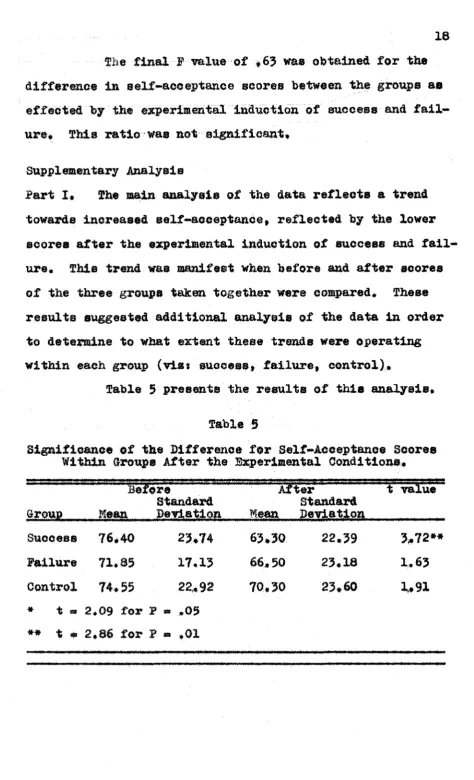
Table 3 present# the result# of this analysis,
Table 9
Significance of the Difference for 8elf*Aoeeptanoe Score# Within Group# After the Experimental Condition#*
Grouo
Èefbre
standard
Mean Deviation
X#ter
Standard
Mean Deviation
t value
Success 76*40 23*74 63,30 22.39 3,72**
Failure 71.85 17*13 66.30 23.18 1.63
Control 74*55 22*92 70,30 23,60 1,91
* t - 2*09 for P * .05
19
Table 5 testifies that a significant increase in the
level of self-acceptance at the 1^ level of confidence has
occurred within the group after the experimental induetion
of success* The change in the control group is significant
at the 10^ level of confidence (Fml.729 for P#.10). In fact
somewhat significant changes are apparent in all three groups.
These findings are in keeping with the results of the analysis
of variance which reflected a trend operating after the experi
mental conditions in the three groups combined.
Part II* The results thus far have been calculated with ref
erence to the absolute sum of individual item discrepancies
for each person within a group. Of the 58 items 28 were desig
nated positive or desirable personality traits# and 30 were
designated negative or undesirable personality traits, A
supplementary analysis was performed to determine whether the
experimental induction of success and failure effected
self-acceptance differently with respect to these positive and
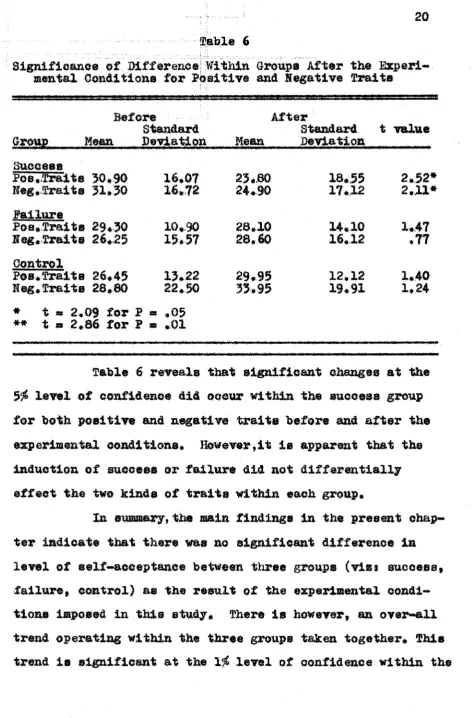
negative traits. Table 6 presents the results of this supple
20
ï&bl® 6
81gnlfloaao# of Difforeaoe Within Group# After the Experl-meat&l Ooaditioa# for Positive and Negative Trait#
Before After
Standard Standard t value
Group Mean Deviation Mean Deviation
Success
Pos*Traits 50,90
BSg+Traits 51,30 1*#0716.72
23*jB0 24*90 18*35 17.12 2.32* 2.11* Failure foe*Traits 29*30 Beg*Traits 2**25 10*90 15*57 28*10 26.60 14*10 16,12 1*47 ,77 Obntrol Pos*Traits 2**45 Heg*Tralts 28,80 13*22 22*50 29.95 33.95 12,12 19*91 1*40 1,24
* t » 2.09 for P « ,05
** t # 2»&6 for P # *01
Table 6 reveal# that oignifioant ehange# at the
level of eonfidenoe did ooeur within the auooee# group
for both positive and negative traits before and after the
experimental oondltions* However,it is apparent that the
induetion of suoeess or failure did mot differentially
offset the two kinds of trait# within eaoh group.
In summary, the main findings in the present
ohap-ter iadioate that there was no signifieant difference in
level of self-aeoeptanoe between three groups (vis# success,
failure, control) as the result of the experimental condi
tions imposed in this study* There is however, an over-all
trend operating within the three groups taken together* This
21
#0 0 6# # * group, F o a ltiv # p e rs o n a lity t r a i t s wore shown n o t
to b * mors s lg n if lo a a t ly e ffe c te d by th e ex p erim en tal condl*
GgAPrm IV
DI80988I0* OF BBBUITS
On t&# bael# of the Bogerisn notion of e#lf and
solf-aoooptano# (1951) it **# hypoth##i##d that #%p#ri~
montally induced euooem# or failure would produce no
eignif-leant difference# in level of eelf-aeeeptmnce. Three matched
group#, each of 20 student#, selected from Introductory Psy
chology classes were used to test this hypothesis* Success
and failure were experimentally induced using false norms
applied to a perceptual discrimination test which supposedly
predicted success or failure in university graduation.
Results presented in the main analysis of the fore
going chapter indicate that the hypothesis may he accepted,
hut only with reservation* This finding corroborate* the
general tendency manifest in previous research in this area*
While the over-all shift between the groups before and after
the experimental conditions lacked significance, a general
trend was revealed* The main analysis also disclose# that
the mean self-acceptance score for each of the three groups
were reduced after the experimental conditions* Thus there
was an increase in level of self-acceptance for eaoh of the
groups*
ainee the main analysis of the data revealed a
trend with regard to change# in level of self-acceptance op
erating in the three groups taken together, a supplementary
25
#naly#l8 of the data wa# performed the##
ahangea a# they existed within eaoh group, aeaults of the
% : ' '
suppleaeatary &nalyeie ladloated a etatietloally significant
increase in level of self-aeoeptanoe within the success
group but not in the other groups, although the changes for
these groups were in the same direction as for the success
group.
Part II of the supplementary analysis reveals
that positive and negative personality traits were net dif
ferentially effected by the experimental conditions*
It is the aim of the present chapter to discuss
the above-mentioned findings in the light of previous
studies in the area of the self concept, and to put forth
some possible reasons far these results. The Issues con
cerning the mein hypothesis will be considered first* This
will be followed by a discussion of the minor findings as
derived from the supplementary analysis of the main hypoth
esis#
M ain A n a ly s is
In the previous chapter it has bean shown that
self-acceptance as defined by Rogers (1931) is not signi
ficantly influenced by success or failure. These results
support those established in previous investigations,
Stotland, Thorley, Thomas, Cohen and Zander (1957) working
with a college sample found that general self-esteem was
24
leaSpiKxciaaiailbiLl jÜ&jLljajr*# *%a * ]pugic]L* Isask:, IKLgBBX»]?" and akifseuBjJCWHr
(1959) jLxi "tliedljp arbowlar iwdLtdb «& jcxToiqi <»jr xmaLli# <;oll4*g4» islhuwliaork#;,
fouEMl no sKljgndLjriiBfua/t adMTeet <KB g;lj»%Hi& sH*].f.»«ry#kl.ia#iti:l(%n dlw#
1k* jrajL]LiLPi# iMi a *a]p*wii1sy tdbdLoti iPWLlbj|#H»1k# inHkiaJUky ]r#ilH*d #ki#
jjawitKruBieniwaJL ik«i igcwaJL jaw&bdiMNKi&enlk. %P* #Klg&l]Plja*inik oJbewoyg#! In
# *lf-# v a ln a tlo n was a la * reported by Barvey, K e lly and
Sbaplre (1957)* In the la t t e r study, fo u r degrees o f un
favourable evaluations o f the s e lf made by o th er persons
served as a method fo r th e induction o f fa ilu re #
While these studies agree in aeoeptanee of the
hypothesis that experimentally induced failure will not
significantly effect level of self-acceptance it must be
remembered that the experimental method for the induction
of failure and hence, the degree of failure induced varies
within each study, Bach study also employs a different
measuring instrument, The synthesis of the results of these
studies as a verification of the hypothesis forwarded in the
present study is therefore risky, since one study is not an
exact replication of the other.
In the present research, it was felt that the ex
perimental conditions may not have been sufficiently stim
ulating to produce significant changes in self-acceptance.
Only two members of the failure group and four members in
the suoeess group stated, when questioned, that their
self-acceptance changed as a result of the simulated test of
success or failure# Thus the experimental task may have
A second reason
2 5
for the failure to obtain
slg-nifleant obaages in level çf self-aooeptanee may be due to
the homogeneity of the grckps# Subjects In all three groups
were matched for age, sex and intelligence# All subjects
were either preliminary or first-year university students.
Since previous research with university students,
cited above, indicates that this population is resistive to
changes in self-evaluation, a more heterogeneous population
may produce more significant results#
nnsuooessfui attempts to produce changes in level
of self-acceptance of university students by the experimental
induction of success and failure may indicate that university
students arc quite self-satisfied. It is reasonable to as
sume that a single experimental success or failure would have
little effect on a group who have already accepted themselves.
Bittes (1959) found impulsivity of closure on three ambiguous
tasks which were administered following the reception of ex
perimental devaluation, only with subjects of characteristi
cally low esteem. The experimental devaluation seemed to
have no effect on the behaviour of subjects who had character
istically high self-esteeç. Since the present study used uni
versity students this factor may also partially explain the
lack of significant results.
While the mean self-acceptance scores for each
group were net significantly different the level of
self-acceptance varied for each individual within eaoh group*
Groups were chosen so that each would equally cover the
26
entire rang# of self-acceptance scores. These hetsrogenecus
distributions within each group say also have accounted for
the failure to obtain significant results. Significant result#
may have appeared if the experimental sample were composed
of three distinct groups each categorised by lew, high or
average self-acoeptcre. Further research concerning consist
ency of self acceptance might find this latter hypothesis
quite valuable.
Interpretation of the findings in this study must
take into account the lack of evidence in support of the va
lidity and reliability of the self-acceptance test used there
in, In this respect, however, the test dees not differ from
other measures of self-acceptsnce; research in the area of
"self* psychology will be hampered until a reliable test of
self-acceptance is constructed.
Supplementary Analysts
The first section of this chapter has discussed
findings which concern the main hypothesis of this study. It
was shewn that results corroborate previous investigations
concerned with the influence of experimentally induced suc
cess and failure on level of self-acceptance* The present
section discusses three minor findings derived from the sup
plementary analysis ef the main hypothesis*
First, the main analysis in Chapter III revealed
an over-all trend in changes of self-acceptance scores before
27
reflected by the dleoovery that the mean eelf-aoeept&nee
BOor# within all the group* wa* reduced. I.e. there warn an
increase in self-aeoeptanoe after the induction of suooees,
after the induction ef failure, and also within the control
group* The nest pertinent question is why the induction of
failure caused an increase in self-acceptance,
Rogers (1951) has stated that an individual re
acts with the purpose of maintaining and enhancing a favour
able self-picture* On the other hand, an individual suppos
edly strives to maintain his basic self-concept, i,e, he will
resist information which is discrepant with his long-standing
views about himself. This may mean that he will reject highly
favourable reports about himself if they are inconsistent
with his self-picture* It is more likely, however, that he
will resist unfavourable information of himself whether it
is congruent or inocngruent with his picture* If a
self-picture is going to be altered it will be altered in the di
rection of enhancement rather than devaluation* Dittos (1959)
has shown that subjects with low self-esteem have a stronger
need to receive a good evaluation from the group than sub
ject# with characteristically high self-esteem*
With this in mind, since the failure group not
only resisted material which devaluated them, but, in fact,
increased in self-acceptance, it might be inferred this be
haviour compensated for their failure or served as a defense
for their failure*
Defensive behaviour manifested in self-evaluative
28
measured s e lf-a e e e p tà a ç # b a th e v e r tly ead c o v e rtly oa a
eevea-p o la t r a tin g eo ale b e fo re aod a f t e r f a ilu r e oa a sim u lated
ia t e lllg e a e e t e s t . A fte r f a ilu r e mo s ig n ifle a m t ehaages ia
e e lf -r a t ia g s eoeurred ea th e o v e rt s e als * Oa th e c o v e rt
so a le a decrease i a s e lf-e s tim a te * s ig n ific a n t a t th e .0 5
Is v e l o f confidence was re v e a le d . B arvey, K e lly and Bhapiro
(1957) report that the more Informed the source* and the more
negative the failure, the greater the amount of tension for
the individual* In the present study the source of failure
was a set of false norm* established through administra
tion of the test to a similar sample of university students.
This procedure may have induced defensiveness.
Another factor which might have produced defensive
behaviour was the method by which the self-acceptance test
was given. Initially subjects were tested a* a group. They
were asked to be as honest as possible and they were told
that group, not individual scores, were being studied, Qnder
these circumstances defence* for the entire group may have
been lowered and a more exact picture of the individual**
subjective feelings of himself obtained. The second testing
session took place immediately after the induction of suc
cess and failure; subjects were seen individually by a grad
uate psychology student, Within these conditions it may well
be that subjects reacted more defensively. BOnce these test
scores would reflect a less true but a higher incidence of
self-acceptance within each group. These circumstances may have
29
stabilized reduction in self-acceptance which should reason
ably have appeared in the failure group. Meanwhile, the
success group was able to use their success as a rationali
zation for their increased level of self-acceptance.
The latter point contributes to a clarification of a
second minor finding; the induction of success caused a
significant change in level of self-acceptance within the
success group. Significant changes within a success group
were also discovered by Biller (1954) on his overt
self-rating scale. Biller explains that when an individual ex
periences success, as opposed to failure, he feels no threat
in maintaining his self-concept; in fact, the success may
enhance it. Self-ratings for Biller*s success group rose on
the covert scale as well but in a less definite way. Mention
was made previously that while Biller’s overt scale reflected
no significant changes for the failure group, there was a
change at the 5# level of confidence towards a decrease in
self-ratings on the covert scale. Biller remarks.
It is possible then that those attitudes which could not be expressed overtly, such as those held by the failure group, were reflected on a covert level, while those attitudes held by the success group could be manifested overtly and, therefore did not need to be expressed as strongly on a covert level.
The final minor finding concerned the evaluation of
desirable and undesirable personality traits within an indi
vidual’s global self-concept# Discrepancies between ideal
50
or positive personality traits and undesirable or negative
personality traits. These disorep&noies or evaluations were
?
not differentially effected by the experimental conditions.
It seems then# that acceptance of desirable and undesirable
charaoteristios within the self-concept are concomitantly
altered with changes in total or global acceptance of self,
*c previous research ha* been discovered to support or con
tradict this finding#
The preceding sections have been concerned with an
interpretation of the analysis of the results presented in
Ohapter III, It is felt that the main explanation of the
finding that the experimental induction of success and fail
ure did not significantly influence level of self-acceptance
was the qualitative inapprepriateness of the experimental
task for university students whs are seemingly quite
self-satisfied* Interpretation of this research must be guarded#
however, since there is no evidence at hand to support the
reliability or validity of the self-acceptance measure* The
result* of the present research are in keeping with previous
investigations# none of which have employed a completely
GBAPTEB V
BOMMAdY ABB OOBGSU8IOB8
The effloaoy of reeearoh ia self psychology ha#
boom limited due to many theoretical and methodological
problem* ia the area. Experimentation hae led to a need for
eetabliehiag evidence confirming the notion of ooneietenoy
of eelf-aeoeptaaoe. In this etudy# the situational varia
ble wa# the experimental induction of success and failure.
The constructs of Roger# (1931) were used operationally to
define self-acceptance. Bence* self-acceptance is a total
discrepancy eoere disregarding the direction of discrepancy
between placement of the same characteristics on two simi
lar scales* One scale was entitled the "Actual Possession
of a Trait", the other the "ideal Possession of a Trait."
Sixty psychology students were placed in three
groups of twenty each* Group# were matched on the basis of
four criteria; 1) age; 2j intelligence on the basis of the
total score on the School and College Ability Teat; 3) sex;
4) level of self-acceptance. One group became the Success
Group, a second, the Failure Group, and the third, the Control
Group*
Prediction of failure or success in university
on the basis of scores received on a fictional perceptual
52
disorimlaation test was used a# a method for the induction
of auooee# and failure, A complex analysis of variance was
employed to determine the effects of the experimental con
ditions on the three groups. The significance of
differ-ences between means within the groups was determined by an
analysis of the trends revealed by the main statistical
procedure.
An F value of ,63, not significant at the 5^ level
of confidence, was found for the interaction of the experi
mental induction of success and failure on the three groups.
However, there wa# a significant change within the success
group at the 1# level of confidence and a significant change
Tfithin the Control Group at the 5# level of confidence. The
latter suggests trends operating within groups.
Bo significant differences were found for the effect
of the experimental conditions on changes within positive or
negative personality traits.
Oonclusions
The main finding of the present research was that
experimentally induced success and failure do not signifi
cantly alter level of self-acceptance. This result confirm#
other similar investigations. It is felt however, that the
relevance of one study to another study in this area of psy
chology is limited,since the degree of inducement and hence
the experimental condition# vary within each of these studies.
33
eoaditloa# ta tkl# particular etudy may not have produced
etgnlfloent change* In eelf-aooeptanoe* Ftret, the method
of Induotlom of euooee# and failure may not have been
euf-fioently stimulating to produce marked changes in
self-acceptance. 8eoond, the experimental task, a simulated
intelligence test,may have been inappropriate for a group
of university students* Third, the group* were homogeneous,
comprised of a group of university students who,in the light
of previous researoh,are shown to be highly resistive to
changes in self-concept and consequently are probably quite
self-satisfied* Pourth, there were heterogeneous distrib
utions of level of self-acceptance scores within each group#
a more homogeneous sample of self-aooeptors may have pro
duced more indicative results# Finally, there is little
evidence to prove or disprove the validity and reliability
of the self-aeceptanee measure employed in this study. In
this respect it is felt that all studies concerning
self-acceptance are similarly open to criticism*
Another finding in this study revealed a trend
operating towards an increase in self-acceptance for all
three groups before and after the experimental conditions*
This trend was statistically significant in the success group
and approaches significance in the failure and control groups.
The explanation given for these changes was that the failure
group compensated for its failure on the experimental task
54
meanwhile utilised the #xperimept*& sueoess as a
ratioaall-matioa to appear more self-aooeptiag. Another explanation
:
forwarded was that defensive behaviour was encouraged in the
second administration of the self-aoeeptanoe test. On this
occasion subjects were observed by a graduate psychology
student*
A final finding of this study was that the accept
ance of desirable and undesirable traits are concurrent with
55
APPBHDII A (1)
Relevant Data Regarding the Membera of the Sample Under Study
Sex Age SCAT 8A^
1 M 21 508 46 42
2 F 19 525 46 55
3 M 21 506 50 66
4 F 19 506 50 71
5 M 21 501 55 51
6 M 20 506 59 51
7 F 21 504 61 45
8 M 20 514 65 59
9 F 19 505 69 55
10 M 18 517 71 70
11 M 20 505 76 56
12 F 18 502 79 62
15 F 19 504 85 62
14 M 20 507 86 65
15 F 19 515 87 69
16 M 22 299 90 78
17 F 18 510 101 55
18 K 22 506 115 110
19 M 19 511 119 86
20 M 19 520 152 122
Self-Aooeptanoe score before experimental conditions
5*
AFPERBIl A (2)
Relevant Bata Regarding the Member# ef the aample Under 8 Fallare Orenn
Sex Age 80AT SA,
^ 1
1 M 19 510 44 44
2 M 20 509 45 44
3 F 19 508 47 29
4 M 21 508 50 55
5 F 19 509 56 64
i M 22 511 54 67
? M 20 509 56 44
8 F 20 508 65 78
9 F 18 525 65 55
10 M 21 281 68 66
11 K 18 516 71 78
12 M 20 508 76 55
15 F 19 516 77 70
14 F 18 506 81 52
15 K 21 510 85 66
16 M 19 515 87 45
17 M 18 515 90 90
18 F 19 509 98 99
19 M 25 5 U 104 114
20 F 19 505 122 117
* 8elf"A*@eptaao* befor# th# experimental ooadltlaaa
57
APPIBDIX À (5)
Relevant Data Regarding the Members of the Sample Under Study
8s% Age 80AI
1 M 20 519 57 25
2 p.. 21 509 48 55
3 M 19 294 49 45
4 M 21 306 50 40
5 M 23 318 54 57
6 P 19 517 55 44
7 M 19 301 65 64
8 P 18 511 58 74
9 F 18 320 68 85
10 M 20 524 70 79
11 F 18 299 77 77
12 F 18 311 77 64
15 M 20 306 87 70
14 M 19 312 89 81
15 M 20 514 94 74
16 M 20 507 72 82
17 M 19 505 90 84
18 F 19 508 102 106
19 M 19 505 115 102
20 F 17 299 128 114
Self—Acceptance score before the experimental ccndj