5HFHQW
KLJKOLJKWV
IURP
WKH
3+(1,;
KHDY\
LRQ
SURJUDP
-&+LOORQEHKDOIRIWKH3+(1,;&ROODERUDWLRQD
1IowaStateUniversity
Abstract. It is accepted that a QGP can be formed in relativistic collisions of heavy nuclei (A+A). Recently long-range correlations have been observed in p+A collisions at the LHC in high multiplicity events. PHENIX has carried out a series of studies of d+Au collisions at 200 GeV to see if such correlations persist at lower energies compared to those at the LHC. Results of a study of long-range correlations and flow are presented for d+Au collisions. Data from Au+Au collisions collected during the beam energy scan (BES) was used to determine both quark and nucleon number scaling. The HBT method was used to determine radii of the fireball at kinetic freezeout. Implications for the nuclear EOS are discussed. Also results of a search for “dark photons” are presented. Recent PHENIX highlights on heavy flavor, electromagnetic probes, spin and plans for PHENIX upgrades were presented in other talks at this conference.
1 Introduction
There are many recent highlights from the PHENIX Heavy Ion Program. In this paper I will discuss recent results from d+Au collision studies, the beam energy scan (BES) and the search for dark photons. In addition at this conference recent PHENIX results on probing the properties of hot dense QCD matter with heavy flavor were discussed by Rachid Nouicer and results from direct photon measurements were discussed by Ilia Ravinovich. A discussion of possible future measurements at PHENIX using the planned upgrade to sPHENIX was given by Eric Mannel. In addition there is a nuclear spin program at PHENIX and recent highlights from that program was discussed by Kiyoshi Tanida.
2 Status of our knowledge of hot and dense QCD matter
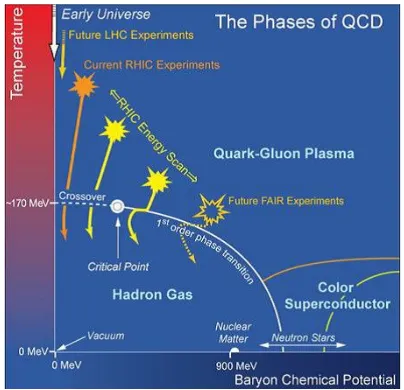
Studies of the matter produced in ultrarelativistic heavy ion collisions provide a method for studying the QCD phase diagram[1]. A typical phase diagram for nuclear matter is shown in figure 1. From studies of the hot and dense QCD matter created in relativistic heavy ion collisions over a period of years a number of conclusions can be reached.
1. A hot dense medium is created in Au+Au collisions. Evidence is observation of nuclear modi-fication factorsRAA<1.0.
ae-mail: [email protected] C
Figure 1.Possible phase diagram for nuclear matter
A critical aspect of the establishment of the nature of the QGP has been the observation that the hot dense matter created in relativistic heavy ion collisions flows. The geometry of flow is illustrated in figure 2.
In studying flow the following points are relevant.
1. The reaction geometry produces an almond shaped interaction region.
2. Compression of mass in the center produces an anisotropicpT distribution.
3. The resultingpT distribution is described in terms of [1+∞n=12v2cos[n(φ−ΨR]]
4. A finitev2is termed elliptic flow.Ψis in the plane of the beam and the impact parameter.
Flow data [2] forv2for 200 GeV/A collisions of Au+Au from both STAR and PHENIX is shown in figure 3. The low values ofv2show that flow is a prominent feature of Au+Au collisions. Relativistic hydrodynamic calculations [3] are a good fit to the data forpT<2.0 Gev/c.
3 Possible long range correlations and flow in small systems
Figure 2.Diagram showing the geometry of flow for collisions of heavy nuclei
Figure 3.Data forv2for 200 GeV/A collisions of Au+Au.
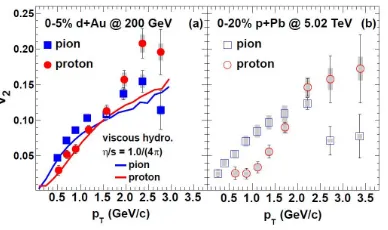
medium because of the small system size. Recently results from ALICE [4] and CMS [5] from 5.02 TeV p+Pb collisions at the LHC indicate the presence of long range correlations. This is shown in figure 4 where both a smallv2and a ridge were observed, both indicating long range correlations and significant flow. One might argue that for the lower beam energies at RHIC such correlations would be absent or much smaller. It is thus of interest to explore whether a smallv2 and a ridge would be observed with d+Au collisions at RHIC at 200 GeV/A.
Figure 5.v2observed for 200 GeV d+Au collisions
It is clear from figure 5 that a non-zerov2and flow are observed for both relativistic d+Au colli-sions at RHIC and p+Pb collisions at the LHC. It is thus of interest to determine if a ridge is observed in d+Au collisions at RHIC. Therefore a correlation functionC(Δφ,pT) is constructed in the following
steps.
1. Correlate one track in the central arm with one in the forward muon piston calorimeter (MPC).
2. Construct a signal distributionS(Δφ,pT) whereφ=φtrack˘φtower.
3. Construct mixed-event distributionM(Δφ,pT) from different events.
4. Construct a normalized correlation functionC(Δφ,pT).
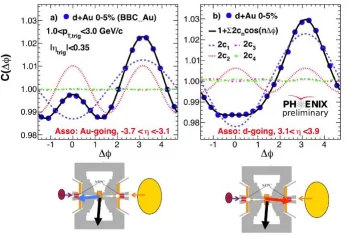
Correlation functions for central d+Au collisions and mid-bias p+p collisions for several pT
ranges [6] are shown in figure 6. Fits from c1 to c4 incos(nΔφ) are shown. The following con-clusions can be drawn.
1. The p+p reactions are dominated by the dipole term (no ridge).
2. The d+Au reactions show a near side peak (ridge) that increases withpT.
Figure 6.Correlation functions for Au+Au and p+p collisions at RHIC
Figure 7.Comparison of correlation functions for the d going and Au going sides of the d+Au collisions
increased. The peripheral collision pattern is similar for the d and Au sides showing essentially no ridge. For the d side no ridge is observed but thec2correlation increases with centrality [8].
During Run-14 in the spring of 2014He3+Aucollision data was takenfor two weeks at RHIC. A data sample of 2.2 B events at mid-bias (MB) was collected. We are eager to see if the odd geometry ofHe3gives us a significantn
3component and more flow.
4 Beam energy scaling results
As can be seen from figure 8 quark scaling works well from 200 to 62 GeV but breaks down at lower energies. A plot can also be made (not shown) [9] where the yield is divided by the number of nucleons rather than the number of quarks. That plot shows that nucleon scaling works well for energies below 40 GeV.
5 Studies of nuclear fireball radii using the HBT method
Figure 9.C2for 39, 62 and 200 GeV Au+Au central reactions
this 2-particle pion correlation functions of the formC2(q) =A(q)/B(q) were constructed using the following steps.
1. A(q) is the measured distribution momentum difference q=p2–p1.
2. B(q) is the pair uncorrelated distribution from different events.
3. C2(q)=N[(λ(1+G(q)))Fc+(λ−l)]
4. G(q)=exp(−R2
sideq2side−R2outq2out−R2longq2long)
In the equations above N=normalization factor,λ=correlation strength,Fc=Coulomb
correc-tion factor and the R’s are the measured Gaussian HBT radii. The parameterizacorrec-tion of Bertsch[12] and Pratt[13] was used for R whereRlong is measured in theqlong =0 frame. The parameterqlongis
along the beam direction,qout is parallel tokT of the pair andqside is perpendicular to the beam and
kT of the pair. The measuredC2(q) can be used to determine R.
Figure 10.Results for HBT radii vs collision energy
TheC2 correlation functions for 39, 62 and 200 GeV collisions of Au+Au [14] are shown in figure 9. From the correlation functionsC2(qout),C2(qside) andC2(qlong) the corresponding HBT pion
radiiRout,RsideandRlongwere calculated [9]. The radii have interesting scaling properties. Results for
nonmonotonic patterns are consistent with the minimum observed as a function of collision energy for the viscous coefficients [17] and could be a further indication of trajectories passing through the softest region in the Equation of State (EOS).
Figure 11.Trends of radii results with energy
6 Dark photons and the muon g-2 standard model discrepancy
Figure 12.Dark photons and the muon g-2 standard model discrepancy
photon U has been introduced [19] to explain the discrepancy. Many experiments have been carried out that limit the U mass range. Even so a muon g-2 explainable band (90% CL) still survives for 30-50 MeV/c2 U mass. A possible decay pattern for the decay of aπ0to a photon and a U particle with the U decaying to a Dalitz pair is shown in figure 12. PHENIX has a large sample ofπ0s and a long history ofe+e−analysis. Theπ0/η > γU > γe+e−reaction was measured using 1.4 million
Dalitz pairs from p+p and d+Au collisions. The resulting 90% CL results are shown in figure 12. In more recent PHENIX measurements the region from 36 to 90 MeV/c2was eliminated [20] but a small region still survives from 30 to 36 MeV/c2as seen from figure 12.
7 Conclusions
1. Evidence for long range correlations and flow was observed for 200 GeV d+Auv2and ridge measurements at RHIC.
2. The RHIC beam energy scan (BES) shows break down in quark scaling below 62 GeV. Nucleon scaling works well below 40 GeV.
3. HBT measurements have determined fireball radii for Au+Au collisions at kinetic freeze out which suggests possible softening of the nuclear matter equation of state in the vicinity of 30 GeV.
4. Dalitz electron pair measurements have limited the range of dark-photon masses as an explana-tion of the muon g-2 anomaly.
References
[1] M. A. Stephanov, K. Rajagopal, and E. V. Shuryak, Phys. Rev. Lett.81, 4816 (1998) [2] J. Adams et al., Phys. Rev. C72, 014904 (2005)
[3] P. Huovinen, private communication to STAR (2004)
[4] B. Abelev et al. (ALICE Collaboration), Phys. Lett.B726, 164 (2013) [5] D. Abbaneo et al. (CMS Collaboration), Phys. Lett.B718, 795 (2013) [6] A. Adare et al. (PHENIX Collaboration), arXiv:1404.7461 (2014) [7] P. Romatschke, private communication (2014)
[8] N.N. Ajitanand for the PHENIX Collaboration, Quark Matter 2014 Proceedings [9] R. Soltz for the PHENIX Collaboration, Quark Matter 2014 Proceedings [10] R. H. Brown and R. Q. Twiss, Nature178, 1046 (1956)
[11] G. Goldhaber, S. Goldhaber, W. Lee, and A. Pais, Phys. Rev.120, 300 (1960) [12] G. Bertsch, Nucl. Phys.A498,173C (1989)
[13] S. Pratt, Phys. Rev. D33, 1314 (1986)
[14] A. Adare et al. (PHENIX Collaboration), arXiv:1410.2559 (2014) [15] L. Adamczyk et al. (STAR Collaboration), arXiv:1403.4972 [16] E. Shuryak and I. Zahed, Phys. Rev. C88, 044915 (2013).
[17] R. A. Lacey, A. Taranenko, J. Jia, D. Reynolds, N. N. Ajitanand, J. M. Alexander, Y. Gu, and A. Mwai, Phys. Rev. Lett.112, 082302 (2014)
[18] J. Beringer et al., Phys. Rev. D86, 010001 (2012)