ISSN:2574 -1241
Determining the Effective Role of Chapattis Prepared
from Composite Flour Against Lipid Profile of
Experimental Subjects
Muhammad Hanif Mughal*
Homeopathic clinic, Islamabad, Pakistan
*Corresponding author: Muhammad Hanif Mughal, Homeopathic clinic, Islamabad, Pakistan
DOI: 10.26717/BJSTR.2019.19.003265
Received: June 21, 2019
Published: June 27, 2019
Citation: Muhammad Hanif Mughal. Determining the Effective Role of Chapattis Prepared from Composite Flour
Against Lipid Profile of Experimental
Subjects. Biomed J Sci & Tech Res 19(2)-2019. BJSTR. MS.ID.003265.
Abbreviations: ANF: Anti-Nutritional Factors; LDL-C: Low-Density Lipoprotein; HDL: High Density Lipoprotein; LPL: Lipoprotein Lipase; LPL: Lipoprotein Lipase
ARTICLE INFO Abstract
The current study was used to examine and assess the role of prepared chapattis against lipid profile of human subjects. Considering lipid profile of subjects, mean values
of low density lipoprotein, high density lipoprotein, triglycerides, and total cholesterol in normal subjects were 105.65±6.55, 38.35±2.31, 116.79±7.66 and 165.75±10.43 mg/dL in comparison with subjects (consumed chapattis) 98.94±8.17, 43.16±2.64, 111.03±10.71 and 146.34±15.1 mg/dL accordingly. Similarly, low density lipoprotein concentrations (normal subjects) were enhanced from 103.21±6.39 (0 days) to
106.53±6.59 (30 days) mg/dL in N0 whereas consumption of selected composite flour chapatti group (N1) significantly lowered the LDL level from 104.33±6.46 to 91.33±5.65
mg/dL in same intervals. Moreover, values for high density lipoprotein levels were recorded as 38.70±2.40, 38.35±2.38, 38.00±2.36 mg/dL on 0, 15 and 30 days intervals respectively in normal subjects of control group whilst consumption of selected
composite flour chapatti group (N1) exhibited significant increment in high density
lipoprotein concentrations from 42.95±2.66 to 43.90±2.72 mg/dL. Conclusively, it was
found that prepared chapattis from composite flour have been found effective against lipid profile of human subjects.
Keywords: Cereals; Composite Flour; Chapatti; Lipid Profile
Introduction
Cereals belong to the family Gramineae and grown for their highly nutritious edible part or grain and frequently referred as grains [1]. Cereals have been consumed directly as staple foods and indirectly as feed for livestock long ago. They are considered as important food sources [2] and foods made of cereals are supposed to be a primary energy source, vitamin B and protein, minerals for the population globally. These crops are grown throughout the temperate and
tropical regions of the world and full fil the approximately fifty
percent food energy requirements of population. Cereals in form
of wheat, rice, maize, barley are significant source of minerals and
bioactive compounds to dire human requirements [3]. Among cereals, wheat (Triticum aestivum) belongs to family gramineae and is considered second only to rice as the main human food crop [4]. In terms of nutrition, there are multiple research data which
as metabolic syndrome, cardiovascular complications, obesity, different types of cancers, and diabetes. Combination of different
nutrients in wheat flour imparts multiple health perspectives. Several studies indicate that consumption of dietary fibers reduced the weight gain and obesity incidence whereas fiber utilization
is also enhanced the satiety and lowered the energy intake [5]. Barley (Hordeum vulgare L.) prevents from cardiovascular disorder via decreasing the cholesterol concentrations and improving the glucose tolerance [6]. The higher level of cholesterol, triglycerides, very low-density lipoprotein, free fatty acids, and decline level of
high-density lipoprotein are linked with hyperlipidemia. Barley β-
glucan has effect on LDL cholesterol, total cholesterol, triglycerides, and high-density lipoprotein (HDL) cholesterol [7]. Mechanistically,
the total body pool of cholesterol [8]. The chickpea (Cicer Arietinum L.) is cultivated in different regions of the world as important grain legume crop.
Moreover, dietary fiber in chickpea significantly lowers the
cholesterol level and also contains a variety of anti-nutritional factors (ANF) including amylase and protease inhibitors. Diabetes is a chronic global disease burden affecting a large segment of population, worldwide. Various mechanisms have been involved in the progression of this human syndrome, such as pancreatic
β-cell dysfunction, higher concentrations of free fatty acids, insulin resistance, leading to overproduction of reactive oxygen species, as well as pancreatic β-cell deficiency and apoptosis. The
diabetes is promoted the cardiovascular disease which is linked with hyperglycemia, obesity, dyslipidemia, glucose intolerance,
and hypertension [9]. Chickpea exhibit hypocholesterolemic effect
through multiple mechanisms such as suppression of cholesterol and fatty acid synthesis, reduction of low-density lipoprotein (LDL-C) levels, triglycerides, enhancement in high density lipoprotein, and inhibition of intestinal absorption of cholesterol [10]. The administration of wheat bran in diabetic volunteers caused momentous reduction in serum glycosylated protein levels, lipoprotein cholesterol, glycosylated albumin levels, and serum lipids levels as well as also decreased the concentrations of blood glucose [11].
Material and Methods
Procurement of Raw Materials
For research purpose, three types of whole grains (Wheat, Barley, Chickpea) were procured from local market, Faisalabad and then were sifted and cleaned to remove dust, dirt, stalks, and any other undesired materials. The cleaned grains were prepared
composite flour to make chapattis (weighed 100±2g). Different types of chapattis were prepared from composite flour by using
the different concentrations of cereal grains. On the basis of overall
acceptability, glycemic index and glycemic load, T3 was used for
further analysis.
Selection Criteria
Normal and hyperglycemic individuals with renal failure and other serious dysfunctions of any major organ were not included in the study.
Bio-Efficacy Studies
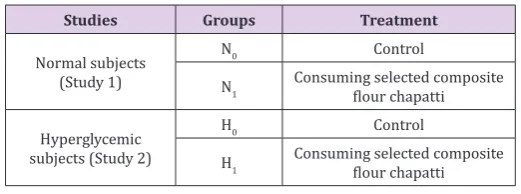
In bio-efficacy trials, two parallel studies i.e. normal (study 1)
and hyperglycemic (study 2) were conducted each comprising of two groups as described in Tables 1 & 3. Each group comprised of
10 subjects. The human efficacy trial continued for thirty days and
blood samples of the participants were collected for biochemical assays at fortnightly basis.
Table 1: Bio-Efficacy Plan.
Studies Groups Treatment
Normal subjects (Study 1)
N0 Control
N1 Consuming selected composite flour chapatti
Hyperglycemic subjects (Study 2)
H0 Control
H1 Consuming selected composite flour chapatti
Biochemical Analysis
Lipid Profiles: For the evaluation of lipid profile, levels of
low-density lipoprotein, high density Lipoprotein, triglyceride and cholesterol were measured.
Low Density Lipoproteins: Low density lipoproteins in human serum samples were determined by adopting the procedure of Kim et al. [12] (Table 2).
High Density Lipoproteins: High density Lipoprotein (HDL) level was measured by Cholesterols Precipitant Methods as described by Alshatwi et al. [13]
Triglyceride: Triglycerides levels were checked by (GPO–PAP) methods [12].
Cholesterol: Cholesterol levels were measured using CHOD– PAP method as mentioned by Kim et al. [12].
Statistical Analysis
All data regarding end parameters were assessed using ANOVA.
To check the level of significance, two factors factorial under
completely randomized design was used. For post hoc comparison,
least significant difference test was performed [14].
Results
(Table 2) represents the treatment effect in both studies. Pooled means for low density lipoproteins, high density lipoproteins, triglycerides and total cholesterol in normal individuals who did
not consumed the composite flour chapatti were 105.65±6.55,
38.35±2.31, 116.79±7.66 and 165.75±10.43 mg/dL respectively.
While the pooled means of all respective parameters for lipid profile
in normal individuals consuming the treatment were observed as 98.94±8.17, 43.16±2.64, 111.03±10.71 and 146.34±15.1 mg/ dL accordingly. In hyperglycemic individuals not consuming the
treatment, the pooled means for respective lipid profile parameters
were observed as 134.51±5.08, 41.27±2.20, 153.47±6.2 and 178.74±10.33 mg/dL respectively and in hyperglycemic individuals consuming the treatment, pooled means were 126.18±8.63, 42.37±1.57, 137.58±8.75 and 175.07±11.47 respectively. Pooled
means for the effect of intervals on lipid profile of both normal
103.77±6.28 which dropped to 98.93±9.83 after 30 days and in study 2, it dropped from 132.77±4.83 to 126.1±11.12 mg/dL after 30 days. High density lipoproteins levels raised in normal subjects from 40.83±3.29 to 40.95±3.91 mg/dL and in hyperglycemic subjects from 40.75±1.90 to 42.95±1.63 mg/dL in 30 days. Levels of triglycerides and total cholesterol in normal study dropped
from 121.55±7.39 to 108.23±8.15 mg/dL and 166.3±10.61 to 148.1±16.67 mg/dL respectively after 30 days. In hyperglycemic individuals the level of triglycerides and total cholesterol also lowered from 147.56±5.83 to 142.35±15.43 and from 188.88±6.94 to 168.85±7.03 mg/dL respectively after 30 days.
Table 2: Pooled means for effect of treatments on lipid profile of normal and hyperglycemic subjects.
Treatments Low Density Lipoproteins (mg/dL) High Density Lipoproteins (mg/dL) Triglycerides (mg/dL) Total Cholesterol (mg/dL)
N0 N1 105.65±6.55a 98.94±8.17b 38.35±2.31b 43.16±2.64a 116.79±7.66a 111.03±10.71b 165.75±10.43a 146.34±15.1b H0 H1 134.51±5.08a 126.18±8.63b 41.27±2.20b 42.37±1.57a 153.47±6.2a 137.58±8.75b 178.74±10.33a 175.07±11.47b Table 3: Pooled Means for Effect of Intervals on Lipid Profile of Normal and Hyperglycemic Subjects.
Studies Intervals Lipoproteins (mg/dL)Low Density Lipoproteins (mg/dL)High Density Triglycerides (mg/dL) Total Cholesterol (mg/dL)
Normal subjects (Study I)
0 103.77±6.28a 40.83±3.29 121.55±7.39a 166.3±10.61a
15 104.17±7.00a 40.49±3.28 111.95±8.38b 153.73±15.44b
30 98.93±9.83b 40.95±3.91 108.23±8.15b 148.1±16.67b
Hyperglycemic subjects (Study II)
0 132.77±4.83a 40.75±1.90c 147.56±5.83a 188.88±6.94a
15 132.16±5.68a 41.75±1.81b 146.66±9.32a 172.97±6.39b
30 126.1±11.12b 42.95±1.63a 142.35±15.43b 168.85±7.03b
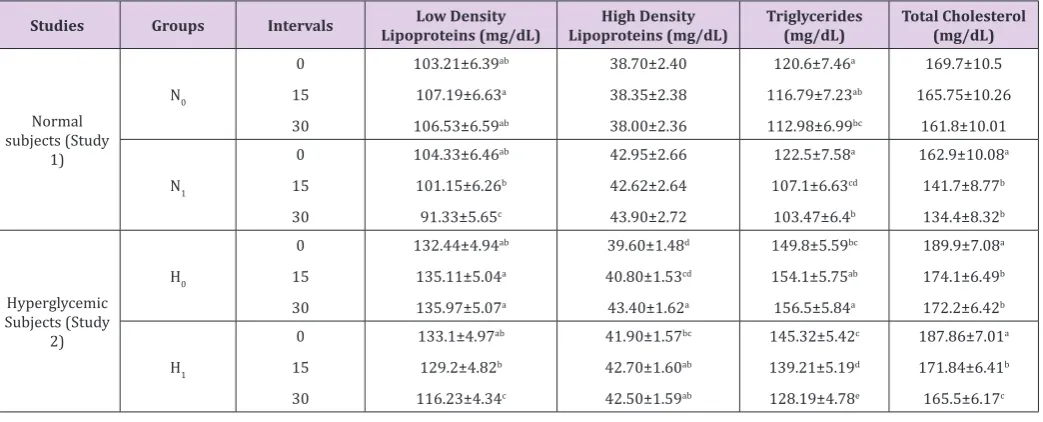
In Table 4, the mean values for low density lipoprotein in study 1 (normal subjects) were enhanced from 103.21±6.39 (0 days) to 106.53±6.59 (30 days) mg/dL in N0 whereas consumption
of selected composite flour chapatti group (N1) significantly
lowered the LDL level from 104.33±6.46 to 91.33±5.65 mg/dL in same intervals. Similarly, values for high density lipoprotein levels were recorded as 38.70±2.40, 38.35±2.38, 38.00±2.36 mg/ dL on 0, 15 and 30 days intervals respectively in normal subjects
of control group whilst consumption of selected composite flour chapatti group (N1) exhibited significant increment in high density
lipoprotein concentrations from 42.95±2.66 to 43.90±2.72 mg/dL. Likewise, momentous enhancement was reported in hyperglycemic subjects of H0 and H1 groups from 39.60±1.48 to 43.40±1.62 mg/ dL and 41.90±1.57 to 42.50±1.59 mg/dL, accordingly. Moreover, mean values for triglycerides concentrations of control group (N0) of normal subjects were recorded as 120.6±7.46, 116.79±7.23, and 112.98±6.99 mg/dL whereas 122.5±7.58, 107.1±6.63 mg/dL and 103.47±6.4 on 0, 15 and 30 days respectively after consuming
selected composite flour chapatti group (N1).
Table 4: Lipid Profile of Normal and Hyperglycemic Individuals Treated with Composite Flour Chapatti.
Studies Groups Intervals Lipoproteins (mg/dL)Low Density Lipoproteins (mg/dL)High Density Triglycerides (mg/dL) Total Cholesterol (mg/dL)
Similarly, significant enhancement was observed in
triglycerides levels in control group (H0) from 149.8±5.59 to 156.5±5.84 mg/dL and momentous reduction was observed after
consuming selected composite flour chapatti group (H1) from
145.32±5.42 to 128.19±4.78 mg/dL. Likewise, mean values of total cholesterol in normal subjects of group (N0) showed 169.7±10.5 mg/dL at day 0 which reduced to161.8±10.01 after 30 days. The subjects consuming treatment showed reduction from 162.9±10.08 to 134.4±8.32 mg/dL after 30 days whereas the hyperglycemic individuals consuming the treatment showed reduction in total cholesterol from 187.86±7.01 to 165.5±6.17 mg/dL within 30 days’ time interval whereas reduction of total cholesterol in the control hyperglycemic group showed reduction from 189.9±7.08 to 172.2±6.42 mg/dL in the same time period (Table 4).
Discussion
The composite flour preparing by lentils, chickpea and guargum exhibited significant hypocholesterolemic effect in male Sprague
Dawley rats for 8 weeks. They observed that consumption of
composite flour enriched with 3g/100 g guar gum showed lowest cholesterol levels (82.46 mg/dl) and caused significant reduction
(17.2%) in comparison with control. Whilst, low density lipoprotein and triglycerides concentrations were recorded as 29.7% and 28.4% in comparison to control, accordingly. They concluded that
presence of dietary fibers mainly lowered the levels of cholesterol,
low density lipoproteins, and triglycerides. Following mechanisms
are involved in hypocholesterolemic potential of composite flour such as suppression of LDL-C oxidation, proliferation of aortic
smooth muscle cells, and maintenance of the physical properties of arterial walls, respectively. They are good source of ferulic, and
p-coumaric acids polyphenols to lower lipid levels in experimental
subjects [15,16]. In another study conducted by Crujeiras and their co-workers [15], they determined that administration of
chickpea-based pulse diet-fed diet significantly lowered the total cholesterol from 215 to 182 mg/dl in experimental subjects [15]. Fiber from chickpea flour exerts hypocholesterolaemic effect via suppressing the synthesis of fatty acids in the liver through fiber fermentation
products such as propionate, butyrate, and acetate.
These short chain fatty acids suppress the cholesterol and fatty acid biosynthesis through suppressing the acetate (provides acetyl-CoA) utilization [17]. Moreover, in another study reported that supplementation of chickpea diet to healthy male ‘Sprague–
Dawley’ rats and showed significant reductions in low density
lipoproteins, triglycerides, and enhancement in high density lipoproteins [18]. Likewise, diets enriched peas (46-62%) and chickpea (49-65·4%) supplemented to Sprague–Dawley’ rats and lowered the levels of plasma cholesterol [19]. The current results are in harmony with the investigations of Rabey et al. [20], they found that supplementation of oat and barley bran are involved to lower the induced hyperlipidemia and hypercholesterolemia in
the experimental subjects (male albino rats). They categorized into different four groups each comprised of five rats such as Control
(G0), G2 (1.0% cholesterol), G2 (10% oat bran, 1% cholesterol), and G3 (10% barley bran, 1% cholesterol), respectively.
Administration of cholesterol to experimental animals caused significant increment in concentrations of total cholesterol, low
density lipoprotein, very low-density lipoprotein, and triglycerides and decreased the levels of high-density lipoproteins. The
supplementation of bran and barley significantly lowered the
concentrations of tri glycerides, cholesterol, very low-density lipoproteins, and increased the levels of high-density lipoproteins. Conclusively, oat bran and barley bran have been found more effectual to prevent from the hypercholesterolemia complications as compared to control [20]. In hypercholesterolemic male Wistar
rats, chickpea flour significantly lowered the total cholesterol,
triglycerides, low density lipoproteins and enhanced high-density lipoproteins in the liver. In another study, the administration of
chickpea and wheat flour chapattis significantly showed reductions
in (serum total cholesterol of 0.25 mmol/L (p 0.01) and low-density lipoprotein-concentrations (0.20 mmol/L). In addition, prepared chapattis also increased the polyunsaturated fatty acids and decreased the monounsaturated fatty acids [21].
Different concentrations of wheat and soy flour (90:10, 80:20,
70:30, and 60:40) supplemented to Wistar rats for 28 days evaluated for biochemical analysis. They found that prepared bread (wheat
flour (90%), soy flour (10%)) lowered the markers (low density
lipoprotein, cholesterol and triacyl glycerol levels) (Table 2) as compared to the control [22]. Similarly, in another study, wheat and
finger millet flour administration to human has been reported to
lower the concentrations of cholesterol, triglycerides, low density lipoproteins, and very low-density lipoproteins as well as also enhanced the levels of high-density lipoproteins, respectively. In
conclusion, flour has been found significant hypoglycemic agent in human and experimental animals [23]. The previous investigations of Yang and their colleagues, they found that chickpea flour has significant effect on visceral adiposity, dyslipidemia and insulin resistance of experimental volunteers. Experimental subjects
were divided into three groups including control group, high fat
supplemented diet group, and high fat plus chickpea flour enriched
group for 8 months.
They investigated that high fat administrated rats (0·032± 0·004 g/g) showed higher epididymal fat pad weight v. total body weight as compared to control fed diet rats (0·015±0·006g/g)
and smaller in high fat plus chickpea flour supplemented rats (0·023±0·007g/g), accordingly. Chickpea flour also showed
reduction in levels of triglycerides, cholesterol, low density lipoproteins, very low-density lipoproteins and enhancement in levels of high-density lipoproteins, respectively. In muscle and liver, rats induced high fat diet have higher concentration of
triacylglycerol (TAG) whereas supplementation of chickpea flour
observed as 23 and 40 % whereas chickpea supplementation to
rats were normalized these levels. In addition, chickpea flour also
showed reduction in leptin and LPL mRNA content in epididymal adipose tissue [24]. In hypercholesterolemic postmenopausal
women, supplementation of soy protein contained 150g isoflavones
for 10 weeks prevented from the cardiovascular disorders through decreasing the concentrations of low-density lipoproteins, triglycerides, cholesterol and showed high density lipoproteins &
paraoxonase activity increment [25].
The earlier findings of Jenkin and their colleagues, they explicated that high based diet from wheat has been found effective
in hyperlipidemic men and women. They found that high protein diet administrated to hyperlipidemic men and women and caused
significant reductions in serum LDL oxidation, triglycerides,
cholesterol and enhancement in high density lipoproteins, respectively. In addition, high consumption of fruits and vegetables
are significant linked with prevention from the cardiovascular risks
[26].
Conclusion
Cereals are promising source of bioactive compounds such
as dietary fibers, ferulic acid, coumaric acid, and phytonutrients.
These compounds have been found as chemo-preventive agent against various human maladies such as cancer insurance, diabetes
complications, cardiovascular disorders, obesity, and oxidative stress. Composite flour is due to the presence of glucan that prevent
from the hypercholesterolemia through lowering the low-density lipoprotein, triglycerides, and enhancing the concentrations of high-density lipoprotein.
Conflict of Interest
There is no conflict of interest among authors.
References
1. Bender DA, Bender AE (2014) Benders’ Dictionary of Nutrition and Food Technology. 12th (Edn). Woodhead Publishing, Abington, USA.
2. (2016) FAO (Food and Agriculture Organization of the United Nations). International Fund for Agriculture Development (IFAD). The State of Food Insecurity in the World: The Multiple Dimension of Food Security. Rome.
3. Oluwakemi OA, Omodele I (2015) The Current Status of Cereal (Maize, Rice and Sorghum) Crops Cultivation in Africa: Need for Integration of Advances in Transgenic for Sustainable Crop Production. International Journal of Agricultural Policy and Research 3(3): 133-145.
4. Bader Ul Ain H Saeed F, Ahmad N, Imran A, Niaz B, Afzaal M et al. (2018) Functional and health-endorsing properties of wheat and barley cell wall’s non-starch polysaccharides. International Journal of Food Properties 21(1): 1463-80.
5. Freeland KR, Anderson GH, Wolever TMS (2009) Acute effects of dietary
fibre and glycaemic carbohydrate on appetite and food intake in healthy
males. Appetite 52(1): 58-64.
6. Behall KM, Scholfield DJ, Hallfrisch J (2004) Lipids significantly reduced
by diets containing barley in moderately hypercholesterolemic men. J Am Coll Nutr 23(1): 55-62.
area in Japanese me a randomized, double- blinded, placebo-controlled trial. Plant Foods Hum Nutr 63(1): 21-25.
8. Malkki Y, Cho SS, Dreher ML (2001) Handbook of Dietary Fiber. Oat fiber:
production, composition, physicochemical properties, physiological effects, safety, and food applications 497-517.
9. Duru KC, Kovaleva EG, Danilova IG, Van der Bijl P, Belousova AV (2018 )
The potential beneficial role of isoflavones in type 2 diabetes mellitus.
Nutr Res 59: 1-15.
10. Yang Y, Zhou L, Gu Y, Zhang Y, Tang J (2007) Dietary chickpeas reverse visceral adiposity, dyslipidemia and insulin resistance in rats induced by a chronic high-fat diet. Br J Nutr 98(4): 720-726.
11. Mani I, Mani (1987) UV: Effect of wheat bran supplementation on blood sugar, glycosylated protein and serum lipids in NIDDM subjects. Plant Foods for Human Nutrition 37:161-168.
12. Kim JI, JK Paik, OY Kim, HW Park, JH Lee, et al. (2011) Effects of lycopene
supplementation on oxidative stress and markers of endothelial function
in healthy men. Atherosclerosis 215(1): 189-195.
13. Alshatwi AA, MA Al Obaaid, SA Al Sedairy, AH Al Assaf, JJ Zhang, KY Lei (2010) Tomato powder is more protective than lycopene supplement
against lipid peroxidation in rats. J Nutr Res 30(1): 66-73.
14. Steel RGD, JH Torrie, D Dickey (1997) Principles and procedures of statistics: a biometrical approach, 3rd (Edn). Mc Graw Hill Book Co, Inc,
New York.
15. Tikkanen MJ, Adlercreutz H (2000) Dietary soy-derived isoflavone
phytoestrogens: could they have a role in coronary heart disease prevention. Biochem Pharmacol 60(1): 1-5.
16. Pan W, Ikeda K, Takebe M (2001) Genistein, daidzein and glycitein inhibit growth and DNA synthesis of aortic smooth muscle cells from stroke-prone spontaneously hypertensive rats. J Nutr 131(4): 1154-1158. 17. Crujeiras AB, Parra D, Abete I (2007) A hypocaloric diet enriched in
legumes specifically mitigates lipid peroxidation in obese subjects. Free
Radic Res 41(4): 498-506.
18. Wright RS, Anderson JW (1990) Propionate inhibits hepatocyte lipid
synthesis. Proc Soc Exp Biol Med 195(1): 26-29.
19. Yang Y, Zhou L, Gu Y (2007) Dietary chickpea reverse visceral adiposity, dyslipidaemia and insulin resistance in rats induced by a chronic high-fat diet. Br J Nutr 98(4): 720-726.
20. El Rabey HA, Al Seeni MN, Amer HM (2013) Efficiency of barley bran and oat bran in ameliorating blood lipid profile and the adverse histological
changes in hypercholesterolemic male rats. Biomed Research International p. 10.
21. Amaral AL Ferreira, ES Neves, VA Demonte A (2014) Legumin from chickpea: hypolipidemic effect in the liver of hypercholesterolemic rats. Nutrition & Food Science 44(5): 378-388.
22. Ebuehi OA, Okafor HK (2015) Defatted Soy Flour Supplementation
of Wheat Bread ameliorates Blood Chemistry and Oxidative Stress in
Wistar rats. Nig Q J Hosp Med 5(3): 156-163.
23. Teradal D, Joshi N, Aladakatti RH (2017) Therapeutic evaluation of grain based functional food formulation in a geriatric animal model. Journal of Food Science and Technology 54(9): 2789-2796.
24. Yang Y, Zhou L, Gu Y, Zhang Y, Tang J et al. (2007) Dietary chickpea reverse visceral adiposity, dyslipidaemia and insulin resistance in rats induced by a chronic high-fat diet. Br J Nutr 98(4): 720-726.
25. Kimiagar M, Mehrabi Y, Esmaillzadeh A, Hu FB, Willett WC et al.
(2007) Dietary soya intake alters plasma antioxidant status and lipid peroxidation in postmenopausal women with the metabolic syndrome.
British Journal of Nutrition 98(4): 807-813.
Submission Link: https://biomedres.us/submit-manuscript.php
Assets of Publishing with us • Global archiving of articles
• Immediate, unrestricted online access • Rigorous Peer Review Process • Authors Retain Copyrights • Unique DOI for all articles
https://biomedres.us/ This work is licensed under Creative
Commons Attribution 4.0 License ISSN: 2574-1241
DOI: 10.26717/BJSTR.2019.19.003265