IJEDR1502207
International Journal of Engineering Development and Research (www.ijedr.org)1263
Response Analysis of Two Parallel Buildings
Coupled by Nonlinear Damper
1
Gulshan Bharti
1M.Tech. Student 1Civil Engineering Department
1M.M. Engineering College Mullana, Ambala, India
________________________________________________________________________________________________________ Abstract – In recent decades, considerable attention has been paid to research and development of structural control with the use of passive structural control devices. Nonlinear viscous dampers are generally well suited to vibration control of civil engineering structures subjected to seismic excitations. The results of several studies on the effects of supplemental viscous damping on the response of structures have showed that they are efficient and very effective in mitigating the seismic responses. This paper presents the response analysis of two parallel buildings coupled by nonlinear viscous damper. The base excitation considered is Imperial Valley, 1940 recorded excitation. The coupled buildings are assumed to be symmetric with their symmetric planes in alignment. The governing equations of motion of the coupled system are derived and are solved by Newmark’s time stepping method for displacement, velocity and acceleration responses of the coupled buildings. MATLAB programs are developed to determine the time history analysis of the dynamic motion of the system. The results of the coupled buildings are compared with that of the single building equipped with nonlinear viscous damper and it is found that the nonlinear viscous damper is very effective in reducing the displacement, velocity and acceleration responses of the parallel coupled buildings.
Index Terms – Structural Control, parallel buildings, nonlinear viscous damper, seismic responses.
________________________________________________________________________________________________________
I.INTRODUCTION
Earthquakes are one of nature’s greatest hazards to life and property on this planet and have destroyed a wide number of cities and villages on virtually every continent. The damage caused by earthquakes is almost entirely associated with the manmade structures. During the major earthquakes, damage of life and property is caused by landslides and by the structure failure but also many earthquakes give very little or no warning before occurring. If the earthquake occurs in a populated area, it may cause many deaths, injuries and extensive property damage. As the time passed on population of cities increased and cities began to grow up horizontally and vertically. Number of buildings in modern cities became higher along the rapidly increasing of human’s needs. Due to increasing buildings and other structures, there are chances of major damages. Mutual pounding can occur between two parallel buildings during the earthquakes. Structural control of structures is necessary to prevent the damage during the earthquakes.
The methods of structural control on the bases of energy consumption are active control system, passive control system, semi-active control system and hybrid system. The passive control system is commonly used, because it does not require an external power source to develop the control forces. This system consists of various damping devices that effectively reduce the vibrations of the structures. Viscous damper, viscoelastic damper, friction damper and metallic damper etc. are the examples of passive control system.
Nonlinear viscous damper
IJEDR1502207
International Journal of Engineering Development and Research (www.ijedr.org)1264
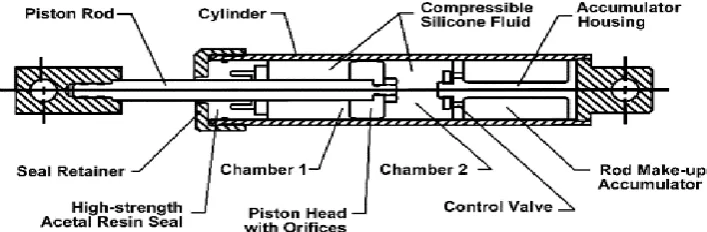
Figure 1 Viscous fluid damper (taylordevices.com)
In the last two decades, the use of viscous fluid damper has become increasingly widespread in the design and retrofit of civil structures excited by wind and earthquake loads, because viscous dampers are having capability of mitigating undesirable aspects of the structural response. Experimental and analytical studies have showed that viscous dampers placed inside the buildings or between adjacent buildings permit to control and significantly mitigate the displacement, motion amplitude and absolute accelerations induced by earthquake forces and also to decrease the dynamic response [5, 7, 14, 19]. Both researchers and earthquake engineers have begun to focus on fluid viscous dampers exhibiting nonlinear force-velocity relationship because of their ability to limit the peak damper force at large structural velocities while still providing sufficient supplemental damping [1, 4, 13, 24]. Experimental investigation on dynamic characteristics and seismic response of adjacent buildings linked by fluid dampers has been carried out and the results showed that the installation of fluid dampers of proper parameters could significantly increase the modal damping ratios and reduce the seismic responses of both buildings while the natural frequencies of both buildings remain almost unchanged [27].
II.MATHEMATICAL FORMULATION
The equation of motion is first formulated for a single-degree-of-freedom (SDOF) building equipped with the nonlinear viscous damper. Later, the equations are formulated for the two SDOF buildings coupled by nonlinear viscous damper.
Assumptions and Limitations
Some assumptions are necessary for highlighting the important features of nonlinear viscous damper connected to parallel buildings. Two buildings are assumed to be symmetric buildings with their symmetric planes in alignment. The symmetric parallel buildings with torsion effects are neglected. Each building is modelled as a linear single-degree-of-freedom system where the mass is concentrated at the floor of building and the stiffness is provided by the columns. The ground acceleration under both the buildings is assumed to be same.
Any effects due to spatial variations of the ground motion or due to soil structure interactions are neglected. The spatial difference of the ground motion can be neglected because the total plan dimensions of the buildings in the excitation direction are not large. The buildings remain elastic and linear under the selected earthquake excitations.
Equation of Motion of a SDOF Building Equipped with Nonlinear Viscous Damper
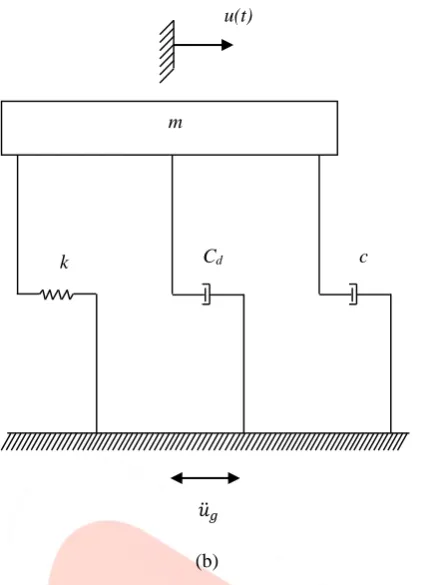
Consider a single-degree-of-freedom building structure which is equipped with a nonlinear viscous damper as shown in Fig. 2. Let m, c and k be the mass, damping coefficient and stiffness of the building, respectively. Let ω = √𝑘 𝑚⁄ be the natural frequency and ξ = 𝑐 2𝑚𝜔⁄ bethe damping ratio of building.
(a) Building
IJEDR1502207
International Journal of Engineering Development and Research (www.ijedr.org)1265
(b)Figure 2 Structural model of a SDOF building equipped with nonlinear viscous damper. (a) A SDOF building equipped with a nonlinear viscous damper. (b) Mathematical model.
The governing equation of motion for SDOF building equipped with a nonlinear viscous damper can be written as 𝑚𝑢̈(𝑡) + 𝑐𝑢̇(𝑡) + 𝑘𝑢(𝑡) + 𝐶𝑑|𝑢̇(𝑡)|𝛼𝑠𝑔𝑛(𝑢̇(𝑡)) = −𝑚𝑢̈𝑔 (1)
where 𝑢(𝑡), 𝑢̇(𝑡) and 𝑢̈(𝑡) are the floor displacement, velocity and acceleration of the building, respectively, 𝑢̈𝑔 is the ground acceleration, 𝐶𝑑 is the damper coefficient, α is theexponent function and sgn is signum function.
Equations of Motion of Two Parallel SDOF Buildings Coupled by Nonlinear Viscous Damper
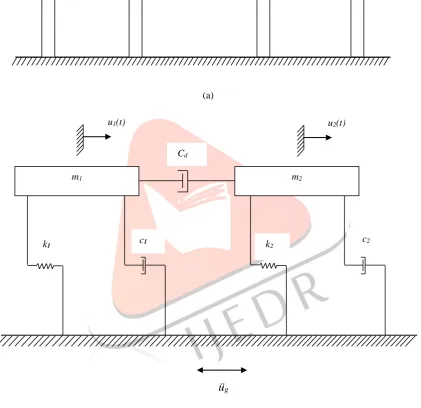
Consider two parallel single-degree-of-freedom (SDOF) building structures connected with a nonlinear viscous damper as shown in Fig. 3. Let m1, c1, k1 and m2, c2, k2be the mass, damping coefficient and stiffness of the buildings 1 and 2, respectively.
Let ω1 = √𝑘1⁄𝑚1 and ω2 = √𝑘2⁄𝑚2 be the natural frequencies of the buildings 1 and 2, respectively. Let ξ1 = 𝑐1⁄2𝑚1𝜔1 and
ξ2 = 𝑐2⁄ 𝑚2 2𝜔2 be the damping ratios of buildings 1 and 2, respectively. The inertia force generated due to ground motion is related with mass of structure and the damper force depends on the relative velocity of the damper ends, which is related with fundamental natural frequency of the connected buildings.
Let ƞ and λ be the mass and frequency ratio of both buildings respectively, expressed as ƞ = 𝑚1
𝑚2 (2)
λ = 𝜔2
𝜔1 (3)
u(t)
𝑢̈𝑔
k c
m
IJEDR1502207
International Journal of Engineering Development and Research (www.ijedr.org)1266
(a)
(b)
Figure 3 Structural model of two parallel SDOF coupled buildings. (a) Two parallel SDOF buildings connected by nonlinear viscous damper. (b) Mathematical model.
Force in Nonlinear viscous Damper
The force in a nonlinear viscous damper can be expressed as [1]
𝐹𝑑 = 𝐶𝑑|𝑢̇𝑟|𝛼sgn(𝑢̇𝑟) (4)
where 𝑢̇𝑟 is the relative velocity of damper ends. The relative velocity of the damper ends 𝑢̇𝑟 is given by
𝑢̇𝑟 = 𝑢̇1− 𝑢̇2 (5)
The exponent α is a representative of the nonlinearity of a viscous damper. For α = 1, Eq. 4 becomes 𝐹𝑑 = 𝐶𝑑𝑢̇𝑟, which represents force in a linear viscous damper. The exponent constant 𝛼 = 0 represents a pure friction damper. For seismic applications the value of α ranges from 0 to 1.
The damping coefficient 𝐶𝑑 is expressed in terms of normalized damping coefficient as Nonlinear
viscous damper
Building 1 Building 2
c1 c2
k1 k2
Cd
ü
gu1(t)
u2(t)
IJEDR1502207
International Journal of Engineering Development and Research (www.ijedr.org)1267
𝜉𝑑 =𝐶𝑑
2𝑚1𝜔1 (6)
where 𝜉𝑑 is the normalized damping coefficient of the damper. The governing equations of motion for the two SDOF building structures connected by nonlinear viscous damper can be written as
𝑚1𝑢̈1(𝑡) + 𝑐1𝑢̇1(𝑡) + 𝑘1𝑢1(𝑡) + 𝐶𝑑|𝑢̇𝑟|𝛼sgn(𝑢̇𝑟) = − 𝑚1𝑢̈𝑔(𝑡) (7)
𝑚2𝑢̈2(𝑡) + 𝑐2𝑢̇2(𝑡) + 𝑘2𝑢2(𝑡) − 𝐶𝑑|𝑢̇𝑟|𝛼sgn(𝑢̇𝑟) = − 𝑚2𝑢̈𝑔(𝑡) (8)
where 𝑢1(𝑡) and 𝑢2(𝑡) are the displacements relative to the ground of buildings 1 and 2 respectively. In matrix form, the governing equations of motion can be written as
[𝑚01 𝑚0 2] {
𝑢̈1 𝑢̈2} + [
𝑐1 0
0 𝑐2] { 𝑢̇1 𝑢̇2} + [
𝑘1 0
0 𝑘2] {
𝑢1 𝑢2} + {
𝐶𝑑|𝑢̇𝑟|𝛼𝑠𝑔𝑛(𝑢̇𝑟) −𝐶𝑑|𝑢̇𝑟|𝛼𝑠𝑔𝑛(𝑢̇𝑟)
} = − [𝑚01 𝑚0 2] {
1
1} 𝑢̈𝑔 (9)
M𝑈̈ + C𝑈̇ + K𝑈 + 𝐹𝑑 = −ME𝑢̈𝑔 (10)
where 𝐹𝑑 = {
𝐶𝑑|𝑢̇𝑟|𝛼𝑠𝑔𝑛(𝑢̇𝑟) −𝐶𝑑|𝑢̇𝑟|𝛼𝑠𝑔𝑛(𝑢̇𝑟)
} and E = {1
1} ; M, C and K are the mass, damping and stiffness matrices, respectively; 𝑈, 𝑈̇ and 𝑈̈ are the floor displacement, velocity and acceleration vectors, respectively.
III.RESULTS AND DISCUSSION
For the present study, a SDOF building equipped with nonlinear viscous damper is considered first and then two parallel SDOF buildings coupled by the nonlinear viscous damper are considered. The floor mass and stiffness are considered to be uniform for both buildings. The damping ratio of 5% is considered for the SDOF building and same for both of the coupled buildings. The frequency ratio λ is considered equal to 2 (i.e. ω1 =π rad/sec and ω2 = 2π rad/sec). The earthquake time history selected to examine
the seismic behavior of the two buildings is Imperial Valley, 1940.
Figure 4 Variation of peak displacement and peak acceleration against normalized damping coefficient (ξd) for a SDOF building equipped with nonlinear viscous damper (ω1 = π rad/sec).
Figure 5 Variation of peak displacement and peak acceleration against normalized damping coefficient (ξd) for a SDOF building equipped with nonlinear viscous damper (ω2 = 2π rad/sec).
Figure 4 and 5, shows the variations of peak displacement and acceleration responses of the SDOF building against the normalized damping coefficient ξd for two different natural frequencies (i.e. ω1 = π rad/sec and ω2 = 2π rad/sec). It is observed that
with the increase in ξd, the peak displacement decreases and the peak acceleration reduces first and attains a minimum value, then it
0 0.05 0.1 0.15
0 0.5 1 1.5 2 2.5
Disp lac em en t (m ) ξd 0 0.5 1 1.5 2 2.5 3 3.5 4
0 0.5 1 1.5 2 2.5
Ac ce lera ti o n (m /se c 2) ξd 0 0.02 0.04 0.06 0.08 0.1 0.12
0 0.5 1 1.5 2 2.5
Disp lac em en t (m ) ξd 0 1 2 3 4 5 6 7 8 9
0 0.5 1 1.5 2 2.5
IJEDR1502207
International Journal of Engineering Development and Research (www.ijedr.org)1268
increases with the increase in ξd. This indicates that there exists an optimum value of the damper damping which provides the minimum responses.ω1 = π rad/sec ω2 = 2π rad/sec
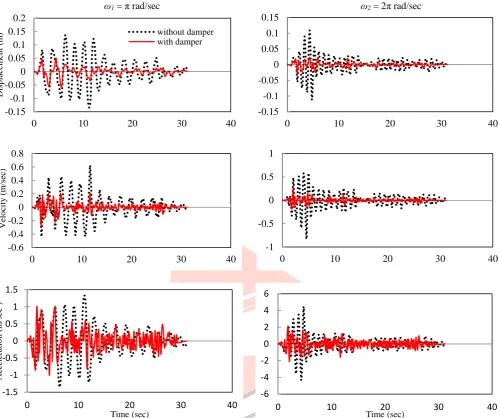
Figure 6 Time histories of displacement, velocity and acceleration of the SDOF building for two different natural frequencies. The time variations of the displacement, velocity and acceleration responses of the SDOF building equipped with nonlinear viscous damper for two different natural frequencies are shown in Fig. 6. These figures clearly indicate the effectiveness of the damper in controlling the earthquake responses of the building.
Table 1 Seismic responses of the SDOF building for Imperial Valley, 1940 earthquake when equipped with nonlinear viscous damper for the natural frequency ω1 = π rad/sec and ξd = 0.281.
Earthquake Displacement (m) Velocity (m/sec) Acceleration (m/sec2)
Unconnected Connected Unconnected Connected Unconnected Connected Imperial
Valley, 1940
0.13658 0.05902
(56.78)#
0.62557 0.29011
(53.62)
1.35581 1.02515
(24.40) # quantity within the parentheses denotes the percentage reduction.
Table 2 Seismic responses of the SDOF building for Imperial Valley, 1940 earthquake when equipped with nonlinear viscous damper for the natural frequency ω2 = 2π rad/sec and ξd = 0.304.
Earthquake Displacement (m) Velocity (m/sec) Acceleration (m/sec2)
Unconnected Connected Unconnected Connected Unconnected Connected Imperial
Valley, 1940
0.11231 0.02736
(75.63)#
0.83039 0.26565
(68.01)
4.47113 2.14896
(51.94) # quantity within the parentheses denotes the percentage reduction.
-0.15 -0.1 -0.05 0 0.05 0.1 0.15 0.2
0 10 20 30 40
Disp lac em en t (m
) without damper
with damper -0.15 -0.1 -0.05 0 0.05 0.1 0.15
0 10 20 30 40
-0.6 -0.4 -0.2 0 0.2 0.4 0.6 0.8
0 10 20 30 40
Ve lo city (m /se c) -1 -0.5 0 0.5 1
0 10 20 30 40
-1.5 -1 -0.5 0 0.5 1 1.5
0 10 20 30 40
Ac ce lera ti o n (m /se c 2) Time (sec) -6 -4 -2 0 2 4 6
0 10 20 30 40
IJEDR1502207
International Journal of Engineering Development and Research (www.ijedr.org)1269
Figure 7 Variation of peak displacement and peak acceleration against normalized damping coefficient (ξd) for the two parallelSDOF buildings coupled by nonlinear viscous damper (ƞ = 1, λ = 2).
Figure 7, shows the variations of peak displacement and acceleration responses of the two coupled buildings against the normalized damping coefficient ξd, considering mass ratio ƞ = 1 and frequency ratio λ = 2 (i.e. ω1 = π rad/sec and ω2 = 2π rad/sec).
It can be observed that the responses of both the buildings are reduced up to a certain value of normalized damping, after which they are again increased. Therefore, there exists an optimum damper damping coefficient which provides the minimum responses. As the optimum damper damping coefficient is not same for both the buildings, the optimum value is taken as the one, which gives the lowest sum of the responses of the two buildings. From the figures, it can be observed that the responses are reduced when the value of damping coefficient is 0.576. For the values higher than this, the performance of the damper is reduced. The time variations of the displacement, velocity and acceleration responses of the two buildings connected by nonlinear viscous damper are shown in Fig. 8. From the figure, it is clear that the nonlinear viscous damper effectively reduces the seismic responses of both the buildings.
Building 1 Building 2
Figure 8 Time histories of displacement, velocity and acceleration of the two connected buildings for Imperial Valley, 1940 earthquake. 0 0.5 1 1.5 2 2.5 3 3.5 4
0 0.5 1 1.5 2 2.5
Disp lac em en t (m ) ξd Building 1 Building 2 0 0.5 1 1.5 2 2.5 3 3.5 4 4.5
0 0.5 1 1.5 2 2.5
Ac ce lera ti o n (m /se c 2) ξd Building 1 Building 2 -0.15 -0.1 -0.05 0 0.05 0.1 0.15 0.2
0 10 20 30 40
Disp lac em en t (m
) without damper
with damper -0.15 -0.1 -0.05 0 0.05 0.1 0.15
0 10 20 30 40
-0.6 -0.4 -0.2 0 0.2 0.4 0.6 0.8
0 10 20 30 40
Ve lo cit y (m /se c) -1 -0.5 0 0.5 1
0 10 20 30 40
-1.5 -1 -0.5 0 0.5 1 1.5
0 10 20 30 40
Ac ce lera ti o n (m /se c 2) Time (sec) -6 -4 -2 0 2 4 6
0 10 20 30 40
IJEDR1502207
International Journal of Engineering Development and Research (www.ijedr.org)1270
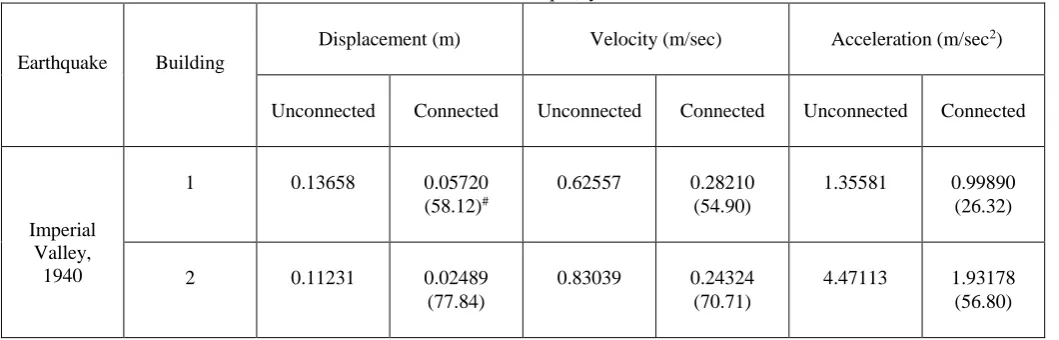
Table 3 Seismic responses of the two parallel SDOF buildings for Imperial Valley, 1940 earthquake when coupled withnonlinear viscous damper, ξd = 0.576.
Earthquake Building
Displacement (m) Velocity (m/sec) Acceleration (m/sec2)
Unconnected Connected Unconnected Connected Unconnected Connected
Imperial Valley,
1940
1 0.13658 0.05720
(58.12)#
0.62557 0.28210 (54.90)
1.35581 0.99890 (26.32)
2 0.11231 0.02489
(77.84)
0.83039 0.24324 (70.71)
4.47113 1.93178 (56.80)
# quantity within the parentheses denotes the percentage reduction.
IV.CONCLUSION
The seismic responses of the SDOF building equipped with nonlinear viscous damper and that of the two parallel SDOF buildings coupled by nonlinear viscous damper are investigated. The nonlinear viscous damper is found to be very effective in reducing the seismic responses of the buildings. The results of the single building equipped with nonlinear viscous damper and that of the two parallel buildings coupled by nonlinear viscous damper are compared. It is found from the numerical results that the displacement, velocity and acceleration responses are reduced more in case of the two coupled buildings.
REFERENCES
[1] C.C. Patel, “Dynamic response of adjacent structures coupled by nonlinear viscous damper”, Advances in Structural Engineering, DOI 10.1007/978-81-322-2193-7_85, 2015.
[2] Luis Perez, Suzana Avila and Graciela Doz, “Coupled structural dynamic response using passive dampers”, International Symposium on Dynamic Problems of Mechanics, 2015.
[3] Anil K. Chopra, “Dynamics of Structures”, Pearson, Prentice Hall, second edition.
[4] Soltani Amir and Wang Xuan, “Vibration control of two adjacent structures using a nonlinear damping system”, International Journal of Civil, Structural, Construction and Architectural Engineering, vol. 8, no. 2, 2014.
[5] E. Tubaldi, M. Barbato and A. Dall’Asta, “Performance-based seismic risk assessment for buildings equipped with linear and nonlinear viscous dampers”, Engineering Structures, 78: 90-99, 2014.
[6] Ahmed Abdelraheem Farghaly, “Optimization of viscous dampers with the influence of soil structure interaction on response of two adjacent 3-D buildings under seismic load”, IOSR Journal of Engineering, vol. 04, issue: 01, pp. 18-27, 2014.
[7] Luca Landi, Simone Lucchi and Pier Paolo Diotallevi, “A procedure for the direct determination of the required supplemental damping for the seismic retrofit with viscous dampers”, Engineering Structures, 71: 137-149, 2014.
[8] George D. Hatzigeorgiou and Nikos G. Pnevmatikos, “Maximum damping forces for structures with viscous dampers under near-source earthquakes”, Engineering Structures, 68: 1-13, 2014.
[9] Carlos A. Martinez, Oscar Curadelli and Maria E. Compagnoni, “Optimal design of passive viscous damping systems for buildings under seismic excitation”, Journal of Construction Steel Research, 90: 253-264, 2013.
[10]A.Gh. Pricopie and D. Cretu, “Rehabilitation of existing structures by optimal placement of viscous dampers”, Life-Cycle and Sustainability of Civil Infrastructure Systems, ISBN 978-0-415-62126-7, 2013.
[11]Ying Zhou, Xilin Lu, Dagen Weng and Ruifu Zhang, “A practical design method for reinforced concrete structures with viscous dampers”, Engineering Structures, 39: 187-198, 2012.
[12]H.P. Zhu, D.D. Ge and X. Huang, “Optimum connecting dampers to reduce the seismic responses of parallel structures”, Journal of Sound and Vibration, 330: 1931-1949, 2011.
[13]Miao Li and Bo Li, “Simplified seismic design and analysis of structures with nonlinear fluid viscous dampers”, National Science Foundation, 978-1-4244-9439 2/11, 2011.
[14]LJ Leu and JT Chang, “Optimal allocation of nonlinear viscous dampers for three dimensional building structures”, Procedia Engineering, 14: 2489-2497, 2011.
[15]F. Hejazi, J. Noorzaei and M.S. Jaafar, “Application of nonlinear damper in reinforced concrete structure control”, Challenges, Opportunities and Solutions in Structural Engineering and Construction, ISBN 978-0-415-56809-8, 2010. [16]Chunxiang Li and Xinhua Gu, “Design of fluid viscous dampers for single-storey asymmetric-plan buildings based on LQR
theory”, International Conference on Computer Modeling and Simulation, DOI 10.1109/ICCMS.2010.70, 2010.
IJEDR1502207
International Journal of Engineering Development and Research (www.ijedr.org)1271
[18]L. Petti and M. De Iuliis, “Torsional seismic response of asymmetric-plan systems by using viscous dampers”, EngineeringStructures, 30: 3377-3388, 2008.
[19]A.V. Bhaskararao and R.S. Jangid, “Optimum viscous damper for connecting adjacent SDOF structures for harmonic and stationary white-noise random excitations”, Earthquake Engineering and Structural Dynamics, 36: 563-571, 2006.
[20]Vasant A. Matsagar and R.S. Jangid, “Base-isolated building connected to adjacent building using viscous dampers”, Bulletin of the New Zealand society for Earthquake Engineering, vol. 39, no. 1, pp. 59-80, 2006.
[21]Jenn-Shin Hwang, Chun-Hsiang Tsai, Shiang-Jung Wang and Yin-Nan Huang, “Experimental study of RC building structures with supplemental viscous dampers and lightly reinforced walls”, Engineering Structures, 28: 1816-1824, 2006. [22]Yuu Azuma, Shunsuke Otani and Koichi Ohami, “Seismic response control by interconnecting adjacent buildings-feasibility
study”, International Conference on Earthquake Engineering, paper No. 188, 2006.
[23]A.V. Bhaskararao and R.S. Jangid, “Seismic response of adjacent buildings connected with dampers”, World Conference on Earthquake Engineering, paper no. 3143, 2004.
[24]Rakesh K. Goel, “Seismic response control of irregular structures using nonlinear dampers”, World Conference on Earthquake Engineering, paper no. 3212, 2004.
[25]Mohsen Kargahi and Chukwuma G. Ekwueme, “Optimization of viscous damper properties for reduction of seismic risk in concrete buildings”, World Conference on Earthquake Engineering, paper No. 1027, 2004.
[26]K. Uetani, M. Tsuji and I. Takewaki, “Application of an optimum design method to practical building frames with viscous dampers and hysteretic dampers”, Engineering Structures, 25: 579-592, 2003.