Intrusion Detection System using Ripple Down
Rule learner and Genetic Algorithm
D.P. Gaikwad
Department of Computer Engineering AISSMS College of Engineering
Pune, India
R.C.Thool
Department of Information Technology SGGSI of Engineering and Technology
Nanded, India
Abstract—Intrusion detection system is used to identify anomalous packets in network. It can also identify unauthorized, malicious activity and malicious code in network. Currently, differnet apporaches of network intrusion detection systems are proposed by researchers. The classification based techniques has some issues such as model overfitting and classification evaluation. The challenging task in intrusion detection is to reduce the false positives and increase classification accuracy. The rule based techniques are simple, advanced and help to reduce the false positives. The rule-based intrusion detection systems and their performances mainly depend on the rule sets. But rules formation becomes a tedious and time consuming task due to the enormous amount of network traffic. In this paper, a novel architecture for intrusion detection system is presented which we call as RDRID. The RDRID is simple and advanved rule based intrusion detection system that reduce false positives and increase classification accuracy. In our implementation, we make use of Ripple Down Rule learner as classifier with Genetic Algorithm based features selection. The Genetic Algorithm is used to select the relevant features from training dataset. The performance of the proposed technique is evaluated in terms of classification accuracy, model building time and False Positive rates. The experimental results show that the proposed approach outperforms existing standard classifier.
Keywords—Ripple Down Rule, Genetic Algorithm, False Positive rate, Accuracy, Classification
I.INTRODUCTION
The Internet is extensively growing in financial organi-zations, Universities, Information Technology industries and Government agencies. The electronic attacks on net-work and information system of the financial organizations, Military and Energy sectors are increasing day by day. Large numbers of computers in network becomes the victim of intruders. Intruders can have many forms such as viruses, spyware, worms, malicious logins and spamware. The secret information of any organizations may be leaked or damaged by intruder or unauthorized users. Intrusion detection sys-tem is used to spot and prevent the entrance of intruder in organization. It is used to identify the malicious use of com-puter and comcom-puter network. It detects access of un-authorized user, illegal users and the violation of security measures. There are two types of intrusion detection tech-niques viz., anomaly and misuse detection. Misuse detection is knowledge or pattern based, whereas anomaly detection is behavior based. Misuse detection is reliable for detecting
known attacks with low false-positive, but it cannot detect the novel attack. Anomaly detection technique can detect novel attack with high false positive rate. The existing ap-proaches of intrusion detection system have high detection rate, whereas they suffer from high false-alarms. The task of reducing warning is extremely necessary for intrusion detec-tion system. The rule based intrusion detecdetec-tion system can help to reduce the false positive rates and increase classifi-cation accuracy. The objective of this research work is to reduce false positives and increase classification accuracy. We are able to achieve good classification accuracy using RDRID.
In this paper, we make two key contributions. Firstly, we have used Genetic Search Algorithm search to select the relevant features from NSL_KDD dataset. Then, we intro-duce a novel approach for anomaly based intrusion detec-tion. The intrusion detection system is based on rule based classification technique that combines a Ripple Down Rule Learner and Genetic algorithm, which we call RDRID. The NSL_KDD dataset is used to generate rules using Ripple Down Rule learner. The proposed RDRID is evaluated by using Cross Validation of 10-fold and supplied test dataset. The performance of RDRID is measured in terms of classi-fication accuracy, model building time and false positives. The experimental results are thoroughly described in this paper. The experimental results show that RDRID offers the best detection rate and classification accuracy. The rest of this paper is organized as follows. Section II provides an overview of related work. Section III describes the experi-ment methodology of the system. Section IV introduces the Ripple Down Rule Learner. Section V describes proposed architecture of intrusion detection system. In Section VI experimental Results are discussed. Finally, Section VII concludes the paper.
II.RELATED WORK
to classify traffic and identify application in network. Au-thors have used a feature selection technique to find out the optimal set of flow attributes. This statistical property of flow is used for classification and identification of packet in network. The influence of different attributes on the learn-ing is also determined. Juvonen and T. Sipola [3] have com-bined unsupervised data analysis with rule extraction algo-rithm to implement online anomaly detection system. Con-junctive rule extraction algorithm is used to create rule sets. These rule sets are used to separate the training dataset into clusters. The same rule sets are used to classify traffic and detect intrusion in real time. Authors have also suggested that the combination of rule extraction algorithm and Ma-chine learning methods is feasible solution to implement real time intrusion detection. Igino Corona, Giorgio Gia-cinto and Fabio Roli [4] have described a general taxonomy of attack tactics against intrusion detection system. The de-tails about measurement, classification and response phases of IDS are given in this paper. The general discussion is found about Probably Approximately Correct algorithm, boosting and framework of robust statistics. The influence of single sample on the built model can be smoothed by using boosting. Authors have suggested that we can substi-tute statistical estimators such as the mean and variance by their robust versions to develop new learning algorithms. Arman Tajbakhsh, Mohammad Rahmati and Abdolreza Mirzaei [5] have used Association Based Classification for designing the intrusion detection system. The speed of Ap-riori algorithm is increased by reducing items involved in rule induction without any information loss. The fuzzy as-sociation rules are used to build descriptive models of dif-ferent classes. The proposed classifier is efficient for classi-fication of large dataset and can handles the symbolic at-tributes. Kamran Shaf and Hussein A. Abbass [6] presented UCSSE framework for real time extraction of maximum general rules using UCS (Supervised Learning Classifier) System supervised classifier. The algorithm used in this frame work automatically identifies and extract signatures for normal and intrusion activities. Muamer N. Moham-mada, Norrozila Sulaimana and Osama Abdulkarim Muhsinb [7] have implemented intrusion detection system using data mining and expert system in WEKA. The per-formance, detection efficiency and false alarm rate are bet-ter than the existing system. Jiankun Hu and Xinghuo Yu [8] have implemented an enhanced incremental HMM sto-chastic process for intrusion detection system. The data pre-processing approach is used to speed up a hidden Markov model. The system is system-call based anomaly intrusion detection system. Mrutyunjaya Pandaa, Ajith Abrahamb and Manas Ranjan Patrac [9] have implemented the hybrid intel-ligent approach for intrusion detection system. The super-vised or un-supersuper-vised classifier is used for data filtering. The output of this classifier is applied to another classifier to classify the training dataset. The system is very intelligent in decision and overall performance is enhanced. Mirco Marchetti, Michele Colajanni and Fabio Manganiello [10] have proposed framework which is based on two unsuper-vised classifier. Self-Organizing maps and
pseudo-Bayesian, probability correlation algorithms are used to identify the multistep attacks. Shrinivasu and P.S.Avadhani [11] have proposed GA-NN based the intrusion detection system. Genetic Algorithm Weight Extraction Algorithm is used to extract and optimize the weights between the neu-rons of ANN to identify the intrusions effectively.
III. METHODOLOGY
The experimental setup is divided into two phases to train and evaluate the performance of proposed method of intrusion detection system. In the first phase, the data pre-processing technique is used to select relevant features. The dataset DARPA 1998, NSL-KDD99 and KDD99 can be used for generating rules for intrusion detection. In this paper, NSL-KDD99 dataset is used to generate rules for normal and abnormal packets in network. The prepro-cessing of dataset is essential to select relevant features is called as feature selection. In feature selection, subsets of relevant features are selected and irrelevant features are eliminated. Feature selection is essential to reduce dimen-sion, boost generalization capability, accelerate learning and enhance model interpretation [15]. More feature selec-tion may produce the problem of lack of generalizaselec-tion, whereas less feature selection causes degradation in level of classification quality. Selection of appropriate features in rules enables the rules to be more general [16][17]. Ge-netic Algorithm is applied on NSL_KDD99 dataset to se-lect relevant features to enable rules more general. The Eighteen features out of Forty One features are selected by Genetic Algorithm.
In the second phase of the experiments, WEKA Data Mining tool was used to evaluate the performance of pro-posed rule based Classifier with other standard classifier. The performance of the proposed rule based classifier is evaluated by using the 10-fold Cross Validation and testing dataset. The performance of the intrusion detection ap-proach is generally depends on the ability of the apap-proach to distinguish normal vs. abnormal, time required for train-ing the model and the time taken durtrain-ing the detection pro-cess. The proposed method is evaluated in term of model building time, False Positive rates and Classification accu-racy. All experiments have performed on Lenovo Laptop with Intel(R) CORE™ i5-3210M CPU @ 2.50GHz, In-stalled 8GB RAM and 32 bit Operating system.
IV. INTRODUCTION TO RIPPLE DOWN RULE
LEARNER
down rule, specifying exceptions. An expert can create a new rule and insert in list, which only have effects in the given context of the parent rule. The ripple down rule technique creates a two-way dependency relation between rules such that rule activation is investigated only in the context of other rule activation. Thus, ripple down rules form a binary decision tree that differs from standard decision trees in which all decisions are made at root nodes [12]. Default rule are generated first and then the exceptions for the default rule with the least error rate. It performs a tree-like expansion of exceptions. A set of rules that predict classes other than the default is called as exception rules. The rules are never modified or deleted but they are locally patched. The approach is based on the combined use of cases to motivate knowledge acquisition and validation. The knowledge is acquired as production rules and structured into decision lists of exceptions. A key feature of RDR, and the reason why maintenance is easily managed, is that rules are never modified or deleted but they are locally patched [13]. That is, new rules are exceptions to previous rules and the new rule is validated in the context of previously seen cases [14]. Rules and their exceptions are ordered, and the first condition that is satisfied fires the corresponding rule.
V.PROPOSED ARCHITECTURE OF INTRUSION
DETECTION SYSTEM
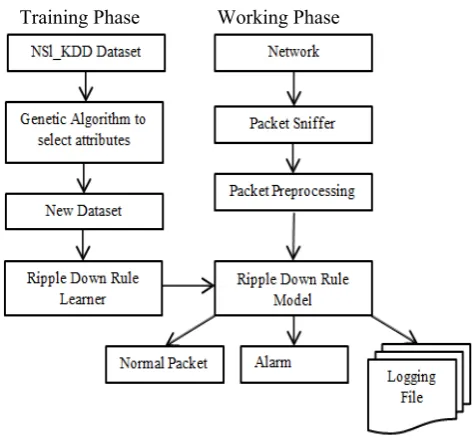
In this section, a novel architecture of RDRID intrusion detection is discussed in detail. The proposed architecture (shown in Fig.1) is composed of two phases: one is train-ing phase and other is detection phase. In first phase, the Genetic Algorithm is applied on NSL_KDD dataset to se-lect relevant features to improve the classification accura-cy. Then, Ripple Down Rule Learner is used to mine the rules for intrusion detection system. The second phase of architecture is used to detect the on line packets. Firstly, the detection phase is used to capture the on line packets over network using packet sniffer and then preprocessed. The preprocessed packets are sent to model for detection. The packets are matched with the rules of model and de-tected as normal, abnormal according to the rule matching. Following 2 subsections describes the working principle of proposed RDRID intrusion detection system in detail.
A. Feature Selection using Genetic Algorithm
The relevant feature selection is a main area of re-search in intrusion detection system. Preprocessing of the dataset can be used to select relevant features and reduce the dimensionality of dataset. The most of the features in-dicated in NSL_KDD99 dataset are not necessary for clas-sification of packets. If more number of features selected then more model building time is required. The relevant feature selection is the most challenging task in intrusion detection system. The rule based classifier is mainly con-cerned with the feature selection problem. It is concon-cerned with identifying the features of the data that experts wish to use in rules. The NSL-KDD99 dataset have suggested
Training Phase Working Phase
Fig 1.Proposed System Architecture
Forty One feature to implement intrusion detection sys-tem. All Forty One features are not essential for packet classification. In this paper, we make use of Genetic Search Algorithm to select relevant feature from NSL_KDD dataset to increase classification accuracy and reduce the model building time. Eighteen features have selected using Genetic Search Algorithm. The relevant features are listed in table 1. The Genetic Search Algorithm is applied with following parameters.
• Population size : 20 • Number of generations : 20 • Probability of crossover : 0.7 • Probability of mutation : 0.033 • Report frequency : 20 • Random number seed : 01
TABLE 1.SELECTED FEATURES BY GENETIC ALGORITHM
Sr.No. Selected Features Using Genetic Algorithm
B. Geneation of Rules using Ripple Down Rule learner
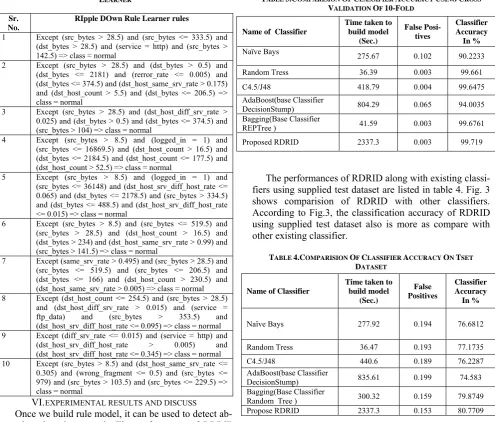
In this paper, we make use of the Ripple Down Rule learner to generate set of rules for normal and abnormal packets. Rule learner generates Forty Seven rules including the default and exception rules. The sample rules generated by Ripple Down Rule learner are listed in table 2. These rules are used to build model for intrusion detection sys-tem.
TABLE 2.SAMPLE RULES GENERATED BY RIPPLE DOWN RULE
LEARNER
Sr. No.
RIpple DOwn Rule Learner rules
1 Except (src_bytes > 28.5) and (src_bytes <= 333.5) and (dst_bytes > 28.5) and (service = http) and (src_bytes > 142.5) => class = normal
2 Except (src_bytes > 28.5) and (dst_bytes > 0.5) and (dst_bytes <= 2181) and (rerror_rate <= 0.005) and (dst_bytes <= 374.5) and (dst_host_same_srv_rate > 0.175) and (dst_host_count > 5.5) and (dst_bytes <= 206.5) => class = normal
3 Except (src_bytes > 28.5) and (dst_host_diff_srv_rate > 0.025) and (dst_bytes > 0.5) and (dst_bytes <= 374.5) and (src_bytes > 104) => class = normal
4 Except (src_bytes > 8.5) and (logged_in = 1) and (src_bytes <= 16869.5) and (dst_host_count > 16.5) and (dst_bytes <= 2184.5) and (dst_host_count <= 177.5) and (dst_host_count > 52.5) => class = normal
5 Except (src_bytes > 8.5) and (logged_in = 1) and (src_bytes <= 36148) and (dst_host_srv_diff_host_rate <= 0.065) and (dst_bytes <= 2178.5) and (src_bytes > 334.5) and (dst_bytes <= 488.5) and (dst_host_srv_diff_host_rate <= 0.015) => class = normal
6 Except (src_bytes > 8.5) and (src_bytes <= 519.5) and (src_bytes > 28.5) and (dst_host_count > 16.5) and (dst_bytes > 234) and (dst_host_same_srv_rate > 0.99) and (src_bytes > 141.5) => class = normal
7 Except (same_srv_rate > 0.495) and (src_bytes > 28.5) and (src_bytes <= 519.5) and (src_bytes <= 206.5) and (dst_bytes <= 166) and (dst_host_count > 230.5) and (dst_host_same_srv_rate > 0.005) => class = normal 8 Except (dst_host_count <= 254.5) and (src_bytes > 28.5)
and (dst_host_diff_srv_rate > 0.015) and (service = ftp_data) and (src_bytes > 353.5) and (dst_host_srv_diff_host_rate <= 0.095) => class = normal 9 Except (diff_srv_rate <= 0.015) and (service = http) and
(dst_host_srv_diff_host_rate > 0.005) and (dst_host_srv_diff_host_rate <= 0.345) => class = normal 10 Except (src_bytes > 8.5) and (dst_host_same_srv_rate <=
0.305) and (wrong_fragment <= 0.5) and (src_bytes <= 979) and (src_bytes > 103.5) and (src_bytes <= 229.5) => class = normal
VI. EXPERIMENTAL RESULTS AND DISCUSS
Once we build rule model, it can be used to detect ab-normal packets in network. The performance of RDRID for intrusion detection system is calculated on the basis of number of rules. The performance is measured according to the classification accuracy, model building time and false positive rate. The classification accuracy is measured using the following expressions.
Accuracy = (TP + TN) (TP + TN + FP + FN)
Where, FN is False Negative, TN is True Negative, TP is True Positive, and FP is False Positive. The false positive rate is the number of normal packets that are misclassified
as attacks divided by the number of normal packets. The RDRID is evaluated in term of classification accuracy, model building time and false positives. The performance of RDRID along with existing classifiers using Cross Vali-dation of 10-fold are listed in table 3. Fig.2 shows comparision of RDRID with other classifier. According to Fig. 2, the classification accuracy of RDRID using Cross Validation of 10-fold is more as compare with other existing classifier.
TABLE 3.COMPARISION OF CLASSIFIER ACCURACY USING CROSS
VALIDATION OF 10-FOLD
The performances of RDRID along with existing classi-fiers using supplied test dataset are listed in table 4. Fig. 3 shows comparision of RDRID with other classifiers. According to Fig.3, the classification accuracy of RDRID using supplied test dataset also is more as compare with other existing classifier.
TABLE 4.COMPARISION OF CLASSIFIER ACCURACY ON TSET
DATASET
The confusion matrix is used a measurement criteria of proposed rule based classifier. The confusion matrix of RDRID on testing data is given in table 5.
TABLE 5.CONFUSION MATRIX OF PROPOSED RULE LEARNER Classified As Normal Anomaly
Normal 67254 89
Abnormal 265 58365
Name of Classifier
Time taken to build model
(Sec.)
False Posi-tives
Classifier Accuracy In %
Naïve Bays 275.67 0.102 90.2233
Random Tress 36.39 0.003 99.661
C4.5/J48 418.79 0.004 99.6475
AdaBoost(base Classifier
DecisionStump) 804.29 0.065 94.0035 Bagging(Base Classifier
REPTree ) 41.59 0.003 99.6761
Proposed RDRID 2337.3 0.003 99.719
Name of Classifier
Time taken to build model
(Sec.)
False Positives
Classifier Accuracy In %
Naïve Bays 277.92 0.194 76.6812
Random Tress 36.47 0.193 77.1735
C4.5/J48 440.6 0.189 76.2287
AdaBoost(base Classifier
DecisionStump) 835.61 0.199 74.583 Bagging(Base Classifier
Fig.2 Classification Accuracy Cross Validation
Fig.3 Classification Accuracy using testing dataset
VII. CONCLUSIONS
In this paper, we present the Ripple Down Rule learner with Genetic Algorithm for intrusion detection system to improve classification accuracy and reduce false positive rate. To increase the rate of accuracy, the Genetic Algo-rithm is used for feature selection. The selected features by Genetic Algorithm are presented in the paper. These fea-tures are used to generate the rule set for anomaly and normal packets in network. Ripple Down Rule learner is used to generate the set of rules. Experiments are per-formed using RDRID learner. All experimental results in this paper are based on our proposed feature selection method using Genetic Algorithm. In addition, we have compared the classification accuracy of RDRID against four exiting approaches. The experimental results show that proposed approach for intrusion detection outperforms them. We have achieved an average classification accuracy of 80.7709 %, and False Positive rate of 0.153 on testing data. Further, Cross Validation evaluation method show that classification accuracy of proposed approach is near 99.719 % and false positive rate of 0.003. This detection rate is possible due to the eighteen data attributes selected by Genetic Algorithm. The proposed classifier exhibits more model building time as compare to existing classifier. In addition, future work is concerned with decreasing the model building time of the proposed system.
REFERENCES
[1] Heba Ezzat Ibrahim, Sherif M. Badr and Mohamed A. Shaheen, “Adaptive Layered Approach using Machine Learning Techniques with Gain Ratio for Intrusion Detection Systems”, in International Journal of Computer Applications Vol. 56, No.7, October 2012. [2] Sebastian Zander, Thuy Nguyen and Grenville Armitage, “Automated
Traffic Classification and Application Identification using Machine Learning”, in Proceedings of the IEEE Conference on Local Com-puter Networks 30th Anniversary (LCN’05) , 2005.
[3] Juvonen and T. Sipola,”Combining conjunctive rule extraction with diffusion maps for network intrusion detection”, in the Eighteenth IEEE Symposium on Computers and Communications (ISCC 2013), IEEE 2013.
[4] Igino Corona, Giorgio Giacinto and Fabio Roli, “Adversarial attacks against intrusion detection systems: Taxonomy, solutions and open issues”, in Inform. Sci. (2013).
[5] Arman Tajbakhsh, Mohammad Rahmati and Abdolreza Mirzaei,” Intrusion detection using fuzzy association rules,” in journal Ap-plied Soft Computing 9 (2009) 462–469, Published by Elsevier. [6] Kamran Shaf and Hussein A.Abbass, “An adaptive genetic-based
signature learning system for intrusion detection,” in Expert Sys-tems with Applications 36, 2009.
[7] Muamer N. Mohammada, Norrozila Sulaimana and Osama Abdulkarim Muhsinb, “A Novel Intrusion Detection System by us-ing Intelligent DataMinus-ing in WEKA Environment:,” in Procedia Computer Science 3 (2011) 1237–1242. 2011.
[8] Jiankun Hu and Xinghuo Yu, “A Simple and Efficient Hidden Markov Model Scheme for Host-Based Anomaly Intrusion Detection”, in IEEE Network January/February 2009.
[9] Mrutyunjaya Pandaa, Ajith Abrahamb and Manas Ranjan Patrac, “A Hybrid Intelligent Approach for Network Intrusion Detection”, in International Conference on Communication Technology and Sys-tem Design 2011.
[10] Mirco Marchetti, Michele Colajanni and Fabio Manganiello,”Framework and Models for Multistep Attack Detec-tion”, in International Journal of Security and Its Applications Vol. 5 No. 4, October, 2011.
[11] P. Shrinivasu and P.S.Avadhani, “Genetic Algorithm based Weight Extraction Algorithm for Artificial Neural Network Classifier in in-trusion Detection”, in Procedia Engineering 38 (2012) 144 – 153, Published by Elsevier Ltd. (2012).
[12] Priyanka Sharma, “Ripple-Down Rules for Knowledge Acquisition in Intelligent System”, (JTES) Delving: Journal of Technology and Engineering Sciences Vol. 1, No. 1 January –June 2009.
[13] Compton, P., Preston, P. and Kang, B., (1994) Local Patching Pro-duces Compact Knowledge Bases A Future in Knowledge Acquisi-tion (eds) L. Steels, G. Schreiber and W. Van de Velde, Berlin, Springer Verlag, 104-117.
[14] Hendra Suryanto, Debbie Richards and Paul Compton, “The Au-tomatic Compression of Multiple Classification Ripple Down Rule”, Macquarie University, Sydney, Australia.
[15] G.Prashanth, Prashanth, P.Jayashree and N.Srinivasan, “Using Ran-dom Forests for Network-based Anomaly detection at Active rout-ers”, IEEE-International Conference on Signal processing, Commu-nications and Networking Madras Institute of Technology, Anna University Chennai India, Jan 4-6, 2008. Pp93-96
[16] P.Compton, G.Edwards, B.Kang, L.Lazarus, R. Malor, T.Menzies, P.Preston. A.Srinivasan and S.Sammut, “Ripple down rules: possi-bilities and limitations”, School of Computer Science and Engineer-ing, University of New South Wales,PO Box 1, Kensington NSW, Australia 2033.
[17] Matjaž Juršič, Igor Mozetič and Nada Lavrač, “Learning Ripple Down Rules for Efficient Lemmatization”, Department of Knowledge Technologies, Jožef Stefan Institute Jamova 39, 1000 Ljubljana, Slovenia.
90.2233
94.0035
99.6475 99.661 99.6761 99.719
Naïve Bays AdaBoost C4.5/J48 Random Tress
Bagging Proposed RDRID Classification Accuracy using Cross Validation of
10-fold
74.583 76.2287
76.6812 77.1735
79.8749 80.7709
AdaBoost C4.5/J48 Native Bays
Random Tress