Automatic Irrigation System Using Wireless Sensor Network
Abstract:
This project probes into the design of the automated irrigation system based on 8051
microcontroller. This Embedded project is to design and develop a low cost feature which is
based on embedded platform for water irrigation system. Optimum use of water is main
objective of this irrigation system to reduce water consumption. This project uses temperature
and soil moisture sensors to detect the water quantity present in agriculture and water level
sensor for detect water level in tank. Aim of this embedded project is to monitor status of the
sensors on remote PC through a web page. Here temperature and soil moisture sensors and water
level can be monitored on web page through micro controller. The web-server is connected to the
internet. By typing the IP-address on the web browser, the owner gets a web page on screen. This
page contains all the information about the status of the sensors and ON/OFF status of the motor.
Keywords: Automation, Internet, Irrigation system, Wireless Sensor Network (WSN).
INTRODUCTION
AGRICULTURE uses 85% of available
freshwater resources worldwide, and this
percentage will continue to be dominant in
water consumption because of population
growth and increased food demand. There is
an urgent need to create strategies based on
science and technology for sustainable use D. Vinodha
M.tech (Embedded system),
Department of Electronics and
communication engineering,
Kasi Reddy Narayanareddy College of
P. Seetha Ramaiah (M.tech)
Assistant Professor
Department of Electronics and
communication engineering,
of water, including technical, agronomic,
managerial, and institutional improvements.
There are many systems to achieve water
savings in various crops, from basic ones to
more technologically advanced ones. For
instance, in one system plant water status
was monitored and irrigation scheduled
based on canopy temperature distribution of
the plant, which was acquired with thermal
imaging. In addition, other systems have
been developed to schedule irrigation of
crops and optimize water use by means of a
crop water stress index (CWSI)
Indian economy is basically depends on
agriculture. Agriculture uses most of
available fresh water resources and this use
of fresh water resources will continue to be
increases Because of population growth and
increased food demand. Increased labour
costs, stricter Environmental regulations and
increased competition for water resources
from urban areas Provide strong motivation
for efficient Irrigation system. The
automated irrigation system is feasible and
cost effective for optimizing water resources
for agricultural production.
Using the automated irrigation system we
can prove that the use of water can be
reduced for different agricultural production.
The irrigation system provide only required
amount of water to crop. This automated
irrigation system allows it to be scaled up
for larger greenhouses or open fields. An
automated irrigation system was developed
to optimize water use for agricultural crops.
The system has a distributed wireless
network of soil moisture and temperature
sensors placed in the root zone of the plants
and water level sensor is placed in tank for
checking the water level in tank. In addition,
a gateway unit handles sensor information,
triggers actuators, and transmits data to a
web application. An algorithm was
developed with threshold values of
that was programmed into a micro-controller
based gateway to control water quantity.
In some of the irrigation system irrigation
scheduling is achieved by monitoring soil,
water status with tension meters under drip
irrigation by the automation controller
system in sandy soil. It is very important for
the farmer to maintain the content in the
field. In this the design of a Micro-controller
based drip irrigation mechanism is proposed,
which is a real time feedback control system
for monitoring and controlling all the
activities of drip irrigation system more
efficiently. Irrigation system controls valves
by using automated controller allows the
farmer to apply the right amount of water at
the right time, regardless of the availability
of the labour to turn valves[1]. Some
irrigation systems are used to implement
efficient irrigation scheme for the field
having different crops. The system can be
further enhanced by using fuzzy logic
controller. The fuzzy logic scheme is used to
increase the accuracy of the measured value
and assists in decision making [2]. The
green house based modern agriculture
industries are the recent requirement in
every part of agriculture in India. In this
technology, the humidity and temperature of
plants are precisely controlled. Due to the
variable atmospheric conditions sometimes
may vary from place to place in large
farmhouse, which makes very difficult to
maintain the uniformity at all the places in
the farmhouse manually. For this GSM is
used to report the detailed about irrigation.
The report from the GSM is send through
the android mobile [3]. The software and
hardware combine together provide a very
advanced control over the currently
implemented manual system. The
implementation involves use of internet for
remote monitoring as well as control of Drip
Irrigation system. This system uses sensors
like humidity, soil moisture. These sensors
Micro-controller sends values to PC using serial
communication. According to real time
sensors values continuous graph is display
on PC and Android Based mobile using
Internet and Android application. Here
threshold value is keep, if sensor values
cross the threshold value then Drip Irrigation
components can be control automatically by
micro-controller. User can also control Drip
Irrigation from anywhere via Android
mobile [4]. In the Micro-controller based
drip irrigation mechanism, this is a real time
feedback control system formonitoring and
controlling all the activities of drip irrigation
system more efficiently. Irrigation system
controls valves by using automated
controller to turn ON OFF. This allows the
farmer to apply the right amount of water at
the right time, regardless of the availability
of the labour to turn valves or motor ON
OFF.
This reduces runoff over watering saturated
soils avoid irrigating at the wrong time of
the day. It improves crop performances and
help in time saving in all the aspects. The
management of this kind of farms requires
data acquisition in each greenhouse and their
transfer to a control unit which is usually
located in a control room, separated from the
production area. At present, the data transfer
between the greenhouses and the control
system is mainly provided by a suitable
wired communication system, such as a field
bus. In such contexts, even though the
replacement of the wired system with a fully
wireless one can appear very attractive, a
fully wireless system can introduce some
disadvantages. A solution based on a hybrid
wired/wireless network, where Controller
Area Network and ZigBee protocols are
used. In particular, in order to integrate at
the Data Link Layer the wireless section
with the wired one, a suitable multi-protocol
bridge has been implemented. Moreover, at
the Application Layer, porting of Smart
called ZSDS, allows one to access the
network resources independently from the
network segment [6]. The some system
highlights the development of temperature
and soil moisture sensor that can be placed
on suitable locations on field for monitoring
of temperature and moisture of soil, the two
parameters to which the crops are
susceptible. The sensing system is based on
a feedback control mechanism with a
centralized control unit which regulates the
flow of water on to the field in the real time
based on the instantaneous temperature and
moisture values [7]. The input parameters
like air temperature, soil moisture, radiations
and humidity are modelled. Then using
appropriate method, ecological conditions,
evapotranspiration and type of crop, the
amount of water needed for irrigation was
estimated and then associated results are
simulated.
WIRELESS SENSOR UNIT
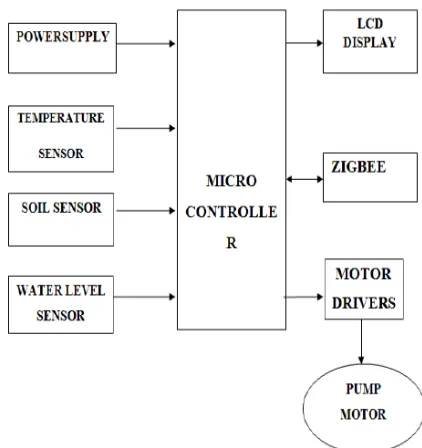
A WSU is comprised of a RF transceiver,
different sensors, a micro-controller, ZigBee
and power sources. Several WSUs can be
deployed in-field to configure a distributed
sensor network for the automated irrigation
system. Each unit is based on the
micro-controller that controls the radio modem
ZigBee and processes information from the
soil-moisture sensor, temperature sensor and
water level sensor.
Figure 1: Wireless Sensor Unit
In this wireless sensor unit or transmission
(Soil moisture, temperature, humidity and
water level) are collected in the main
controller. This data is displayed on
transmission section LCD. Microcontroller
controller is programmed to some threshold
values of temperature and soil moisture.
Sensed values are compared with the
threshold values and according to
comparison automation is takes place.
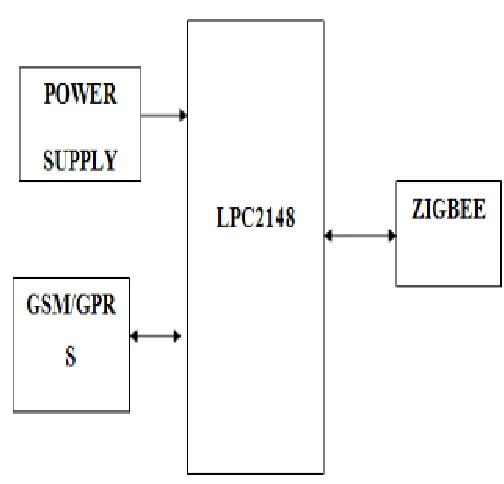
WIRELESS INFORMATION UNIT
The soil moisture, temperature and water
level sensor data from each WSU
arereceived, identified, recorded, and
analysed in the WIU. The WIU consists of a
master microcontroller, an ZigBee radio
modem, a GPRS module This processed
information is send to web page where
status of all these sensors are display
graphically using graphical. user interface
using the GPRS module. The data from the
transmission section is received by ZigBee
communication modem.
Figure 3: Wireless Information Unit
EXPERIMENTATION AND RESULTS
When soil moisture value is less than the
threshold value then the motor is start
automatically but at that time water level is
also checked. As there is no water in tank
then motor remains off. There are different
conditions for the automation of the
irrigation system depends on the sensor
values and these conditions.
Table: 1
Less than Threshold OFF
More than Threshold ON
Table: 2 Different conditions for irrigation
system operation
Condition Soil
Moisture
Water
level
Motor
Status
1. DRY FULL ON
2. WET FULL OFF
3. DRY MEDIUM ON
4. WET MEDIUM OFF
5. DRY LOW ON
6. WET LOW OFF
7. DRY NULL OFF
8. WET NULL OFF
CONCLUSION:
The automated irrigation system
implemented was found to be feasible and
cost effective for optimizing water resources
for agricultural production. This irrigation
system allows cultivation in places with
water scarcity thereby improving
sustainability. The automated irrigation
system developed proves that the use of
water can be diminished for a given amount
of fresh biomass production. The use of
solar power in this irrigation system is
pertinent and significantly important for
organic crops and other agricultural products
that are geographically isolated, where the
investment in electric power supply would
be expensive.
REFERENCE:
1. Soni, G., & Singh, N. Automatic
Irrigation System Using Wireless
Sensor Networks.
2. Kim, Y., Evans, R. G., & Iversen, W.
M. (2008). Remote sensing and
control of an irrigation system using
a distributed wireless sensor
network. IEEE Transactions on
Instrumentation and Measurement,
3. Wang, N., Zhang, N., & Wang, M.
(2006). Wireless sensors in
agriculture and food industry—
Recent development and future
perspective. Computers and
electronics in agriculture, 50(1),
1-14.
4. Gutiérrez, J., Villa-Medina, J. F.,
Nieto-Garibay, A., & Porta-Gándara,
M. Á. (2014). Automated irrigation
system using a wireless sensor
network and GPRS module. IEEE
transactions on instrumentation and
measurement, 63(1), 166-176.
5. Sudha, M. N., Valarmathi, M. L., &
Babu, A. S. (2011). Energy efficient
data transmission in automatic
irrigation system using wireless
sensor networks. Computers and
Electronics in Agriculture, 78(2),
215-221.
6. Pierce, F. J., & Elliott, T. V. (2008).
Regional and on-farm wireless
sensor networks for agricultural
systems in Eastern Washington.
Computers and electronics in
agriculture, 61(1), 32-43.
7. Zhou, Y., Yang, X., Wang, L., &
Ying, Y. (2009, April). A wireless
design of low-cost irrigation system
using ZigBee technology. In
Networks Security, Wireless
Communications and Trusted
Computing, 2009. NSWCTC'09.
International Conference on (Vol. 1,
pp. 572-575). IEEE.
8. Akyildiz, I. F., Su, W.,
Sankarasubramaniam, Y., & Cayirci,
E. (2002). Wireless sensor networks:
a survey. Computer networks, 38(4),
393-422.
9. O’Shaughnessy, S. A., & Evett, S. R.
(2008). Integration of wireless sensor
networks into moving irrigation
systems for automatic irrigation
Rhode Island, June 29–July 2, 2008
(p. 1). American Society of
Agricultural and Biological
Engineers.
10.Kim, Y., Evans, R. G., & Iversen, W.
M. (2009). Evaluation of closed-loop
site-specific irrigation with wireless
sensor network. Journal of Irrigation
and Drainage Engineering, 135(1),