Probing Balitsky-Fadin-Kuraev-Lipatov Dynamics in the Dijet Cross Section
at Large Rapidity Intervals in
p
p
¯
Collisions at
p
p
p
s
5
1800
and 630 GeV
B. Abbott,46 M. Abolins,43V. Abramov,19B. S. Acharya,13D. L. Adams,53M. Adams,30 V. Akimov,17G. A. Alves,2
N. Amos,42E. W. Anderson,35 M. M. Baarmand,48 V. V. Babintsev,19 L. Babukhadia,48 A. Baden,39B. Baldin,29 S. Banerjee,13J. Bantly,52E. Barberis,22P. Baringer,36 J. F. Bartlett,29 U. Bassler,9A. Bean,36 A. Belyaev,18
S. B. Beri,11 G. Bernardi,9I. Bertram,20V. A. Bezzubov,19P. C. Bhat,29 V. Bhatnagar,11 M. Bhattacharjee,48 G. Blazey,31S. Blessing,27 A. Boehnlein,29 N. I. Bojko,19 F. Borcherding,29 A. Brandt,53 R. Breedon,23G. Briskin,52 R. Brock,43G. Brooijmans,29 A. Bross,29 D. Buchholz,32V. Buescher,47V. S. Burtovoi,19 J. M. Butler,40 W. Carvalho,3
D. Casey,43Z. Casilum,48H. Castilla-Valdez,15 D. Chakraborty,48K. M. Chan,47S. V. Chekulaev,19 W. Chen,48 D. K. Cho,47S. Choi,26S. Chopra,27B. C. Choudhary,26J. H. Christenson,29M. Chung,30D. Claes,44A. R. Clark,22
W. G. Cobau,39J. Cochran,26 L. Coney,34B. Connolly,27W. E. Cooper,29D. Coppage,36 D. Cullen-Vidal,52 M. A. C. Cummings,31 D. Cutts,52O. I. Dahl,22 K. Davis,21K. De,53 K. Del Signore,42M. Demarteau,29 D. Denisov,29
S. P. Denisov,19 H. T. Diehl,29 M. Diesburg,29 G. Di Loreto,43 P. Draper,53 Y. Ducros,10L. V. Dudko,18S. R. Dugad,13 A. Dyshkant,19D. Edmunds,43 J. Ellison,26 V. D. Elvira,29R. Engelmann,48S. Eno,39G. Eppley,55 P. Ermolov,18
O. V. Eroshin,19J. Estrada,47 H. Evans,45 V. N. Evdokimov,19T. Fahland,25S. Feher,29 D. Fein,21T. Ferbel,47 H. E. Fisk,29 Y. Fisyak,49 E. Flattum,29 F. Fleuret,22 M. Fortner,31K. C. Frame,43 S. Fuess,29E. Gallas,29 A. N. Galyaev,19 P. Gartung,26V. Gavrilov,17R. J. Genik II,20K. Genser,29 C. E. Gerber,29Y. Gershtein,52B. Gibbard,49
R. Gilmartin,27 G. Ginther,47B. Gobbi,32B. Gómez,5G. Gómez,39P. I. Goncharov,19 J. L. González Solís,15 H. Gordon,49 L. T. Goss,54 K. Gounder,26A. Goussiou,48 N. Graf,49 P. D. Grannis,48J. A. Green,35 H. Greenlee,29
S. Grinstein,1P. Grudberg,22 S. Grünendahl,29 G. Guglielmo,51 A. Gupta,13 S. N. Gurzhiev,19 G. Gutierrez,29 P. Gutierrez,51 N. J. Hadley,39 H. Haggerty,29 S. Hagopian,27V. Hagopian,27 K. S. Hahn,47R. E. Hall,24 P. Hanlet,41
S. Hansen,29 J. M. Hauptman,35 C. Hays,45C. Hebert,36 D. Hedin,31A. P. Heinson,26U. Heintz,40 T. Heuring,27 R. Hirosky,30 J. D. Hobbs,48 B. Hoeneisen,6J. S. Hoftun,52 A. S. Ito,29 S. A. Jerger,43 R. Jesik,33 T. Joffe-Minor,32 K. Johns,21M. Johnson,29 A. Jonckheere,29M. Jones,28H. Jöstlein,29 S. Y. Jun,32 A. Juste,29S. Kahn,49E. Kajfasz,8
D. Karmanov,18 D. Karmgard,34R. Kehoe,34 S. K. Kim,14 B. Klima,29 C. Klopfenstein,23B. Knuteson,22 W. Ko,23 J. M. Kohli,11 A. V. Kostritskiy,19J. Kotcher,49 A. V. Kotwal,45 A. V. Kozelov,19E. A. Kozlovsky,19 J. Krane,35
M. R. Krishnaswamy,13 S. Krzywdzinski,29 M. Kubantsev,37 S. Kuleshov,17Y. Kulik,48S. Kunori,39 G. Landsberg,52 A. Leflat,18 F. Lehner,29 J. Li,53 Q. Z. Li,29J. G. R. Lima,3D. Lincoln,29 S. L. Linn,27J. Linnemann,43 R. Lipton,29
J. G. Lu,4A. Lucotte,48 L. Lueking,29 C. Lundstedt,44 A. K. A. Maciel,31 R. J. Madaras,22 V. Manankov,18 S. Mani,23H. S. Mao,4R. Markeloff,31T. Marshall,33 M. I. Martin,29R. D. Martin,30K. M. Mauritz,35 B. May,32 A. A. Mayorov,33R. McCarthy,48J. McDonald,27 T. McKibben,30T. McMahon,50 H. L. Melanson,29M. Merkin,18
K. W. Merritt,29C. Miao,52 H. Miettinen,55 D. Mihalcea,51A. Mincer,46C. S. Mishra,29 N. Mokhov,29 N. K. Mondal,13 H. E. Montgomery,29 M. Mostafa,1H. da Motta,2E. Nagy,8F. Nang,21M. Narain,40 V. S. Narasimham,13
H. A. Neal,42 J. P. Negret,5S. Negroni,8D. Norman,54L. Oesch,42V. Oguri,3B. Olivier,9N. Oshima,29 P. Padley,55 L. J. Pan,32 A. Para,29 N. Parashar,41R. Partridge,52N. Parua,7M. Paterno,47 A. Patwa,48B. Pawlik,16 J. Perkins,53 M. Peters,28 R. Piegaia,1H. Piekarz,27B. G. Pope,43 E. Popkov,34H. B. Prosper,27 S. Protopopescu,49 J. Qian,42 P. Z. Quintas,29 R. Raja,29 S. Rajagopalan,49N. W. Reay,37S. Reucroft,41 M. Rijssenbeek,48 T. Rockwell,43M. Roco,29
P. Rubinov,32R. Ruchti,34 J. Rutherfoord,21A. Santoro,2L. Sawyer,38 R. D. Schamberger,48H. Schellman,32
A. Schwartzman,1J. Sculli,46 N. Sen,55 E. Shabalina,18H. C. Shankar,13R. K. Shivpuri,12 D. Shpakov,48 M. Shupe,21 R. A. Sidwell,37 H. Singh,26J. B. Singh,11 V. Sirotenko,31P. Slattery,47E. Smith,51R. P. Smith,29 R. Snihur,32
G. R. Snow,44J. Snow,50 S. Snyder,49 J. Solomon,30 X. F. Song,4V. Sorín,1M. Sosebee,53N. Sotnikova,18 M.Souza,2 N. R. Stanton,37 G. Steinbrück,45R. W. Stephens,53M. L. Stevenson,22F. Stichelbaut,49D. Stoker,25 V. Stolin,17
D. A. Stoyanova,19 M. Strauss,51K. Streets,46M. Strovink,22L. Stutte,29 A. Sznajder,3J. Tarazi,25 W. Taylor,48 S. Tentindo-Repond,27T. L. T. Thomas,32J. Thompson,39D. Toback,39T. G. Trippe,22A. S. Turcot,42 P. M. Tuts,45 P. van Gemmeren,29V. Vaniev,19N. Varelas,30A. A. Volkov,19A. P. Vorobiev,19 H. D. Wahl,27H. Wang,32J. Warchol,34
G. Watts,56 M. Wayne,34 H. Weerts,43A. White,53J. T. White,54 D. Whiteson,22J. A. Wightman,35 S. Willis,31 S. J. Wimpenny,26 J. V. D. Wirjawan,54J. Womersley,29D. R. Wood,41 R. Yamada,29 P. Yamin,49 T. Yasuda,29 K. Yip,29
S. Youssef,27 J. Yu,29Z. Yu,32M. Zanabria,5H. Zheng,34 Z. Zhou,35 Z. H. Zhu,47M. Zielinski,47D. Zieminska,33 A. Zieminski,33 V. Zutshi,47 E. G. Zverev,18 and A. Zylberstejn10
(D0 Collaboration)
1Universidad de Buenos Aires, Buenos Aires, Argentina 2LAFEX, Centro Brasileiro de Pesquisas Fisicas, Rio de Janeiro, Brazil
3Universidade do Estado do Rio de Janeiro, Rio de Janeiro, Brazil 4Institute of High Energy Physics, Beijing, People’s Republic of China
5Universidad de los Andes, Bogotá, Colombia 6Universidad San Francisco de Quito, Quito, Ecuador
7Institut des Sciences Nucléaires, IN2P3-CNRS, Universite de Grenoble 1, Grenoble, France 8CPPM, IN2P3-CNRS, Université de la Méditerranée, Marseille, France
9LPNHE, Universités Paris VI and VII, IN2P3-CNRS, Paris, France 10DAPNIA兾Service de Physique des Particules, CEA, Saclay, France
11Panjab University, Chandigarh, India 12Delhi University, Delhi, India
13Tata Institute of Fundamental Research, Mumbai, India 14Seoul National University, Seoul, Korea
15CINVESTAV, Mexico City, Mexico 16Institute of Nuclear Physics, Kraków, Poland
17Institute for Theoretical and Experimental Physics, Moscow, Russia 18Moscow State University, Moscow, Russia
19Institute for High Energy Physics, Protvino, Russia 20Lancaster University, Lancaster, United Kingdom
21University of Arizona, Tucson, Arizona 85721
22Lawrence Berkeley National Laboratory and University of California, Berkeley, California 94720 23University of California, Davis, California 95616
24California State University, Fresno, California 93740 25University of California, Irvine, California 92697 26University of California, Riverside, California 92521 27Florida State University, Tallahassee, Florida 32306
28University of Hawaii, Honolulu, Hawaii 96822 29Fermi National Accelerator Laboratory, Batavia, Illinois 60510
30University of Illinois at Chicago, Chicago, Illinois 60607 31Northern Illinois University, DeKalb, Illinois 60115
32Northwestern University, Evanston, Illinois 60208 33Indiana University, Bloomington, Indiana 47405 34University of Notre Dame, Notre Dame, Indiana 46556
35Iowa State University, Ames, Iowa 50011 36University of Kansas, Lawrence, Kansas 66045 37Kansas State University, Manhattan, Kansas 66506 38Louisiana Tech University, Ruston, Louisiana 71272 39University of Maryland, College Park, Maryland 20742
40Boston University, Boston, Massachusetts 02215 41Northeastern University, Boston, Massachusetts 02115
42University of Michigan, Ann Arbor, Michigan 48109 43Michigan State University, East Lansing, Michigan 48824
44University of Nebraska, Lincoln, Nebraska 68588 45Columbia University, New York, New York 10027 46New York University, New York, New York 10003 47University of Rochester, Rochester, New York 14627 48State University of New York, Stony Brook, New York 11794
49Brookhaven National Laboratory, Upton, New York 11973 50Langston University, Langston, Oklahoma 73050 51University of Oklahoma, Norman, Oklahoma 73019
52Brown University, Providence, Rhode Island 02912 53University of Texas, Arlington, Texas 76019 54Texas A&M University, College Station, Texas 77843
55Rice University, Houston, Texas 77005 56University of Washington, Seattle, Washington 98195
(Received 15 December 1999)
detector. The partonic cross section increases strongly with the size ofDh. The observed growth is even stronger than expected on the basis of BFKL resummation in the leading logarithmic approximation. The growth of the partonic cross section can be accommodated with an effective BFKL intercept of
aBFKL共20GeV兲苷1.6560.07.
PACS numbers: 13.87. – a, 12.38. – t
Jet production in the high-energy limit of quantum chromodynamics (QCD), as defined by center-of-mass (c.m.) energies (ps) much larger than the momentum transfers (Q), presents a very interesting and yet little explored area. In this kinematic region, the significantly different energy scales of the process lead to calculated jet cross sections characterized by the appearance of large logarithms ln共s兾Q2兲, which must be summed to all orders
in as. This summation is accomplished through the
Balitsky-Fadin-Kuraev-Lipatov (BFKL) [1] equation, which involves a spacelike chain of an infinite number of gluon emissions. The gluons have similar transverse momenta, but they are strongly ordered in their pseudora-pidities or, equivalently, in their longitudinal momentum fractions xi. Thus, the BFKL equation effectively
de-scribes the evolution inx (growth with1兾x) of the gluon momentum distribution in the proton.
Attempts to isolate and probe the BFKL evolution in the low-x region inepcollisions at HERA, by measuring the forward jet and particle cross sections [2], have led to ambiguous results. (At HERA, forward denotes the region away from the current jet and towards the proton remnant.) In pp¯ collisions, the azimuthal decorrelation as a function of the pseudorapidity interval, Dh, in dijet systems has been studied [3]. (Here,h 苷2ln关tan共u兾2兲兴, whereu is the polar angle of the jet relative to the proton beam.) It has been argued [4], however, that the azimuthal angle distribution is not an inclusive enough quantity for the cancellation between the real and virtual soft gluons that accompany dijet production; thus, such a distribution cannot be used as a probe of the BFKL equation.
Inclusive dijet production at large pseudorapidity inter-vals in high-energypp¯ collisions, on the other hand, pro-vides an excellent testing ground for BFKL dynamics. We present a measurement of the dijet cross section at large Dh using the D0 detector at the Fermilab Tevatron col-lider. We reconstruct the event kinematics using the most forward /backward jets, and measure the cross section as a function of x1, x2, and Q2. The longitudinal momentum
fractions of the proton and antiproton, x1 and x2, carried
by the two interacting partons are defined as
x1,2 苷
2ET1,2
p
s e
6h¯
cosh共Dh兾2兲, (1) where ET1(ET2) andh1(h2) are the transverse energy and
pseudorapidity of the most forward( backward ) jet,Dh 苷 h1 2 h2$ 0, and h¯ 苷共h1 1 h2兲兾2. The momentum
transfer during the hard scattering is defined as
Q 苷qET1ET2. (2)
The total dijet cross section, s, can be factorized into the partonic cross section, sˆ, and the parton distribution functions (PDF),P共x1,2,Q2兲, in the proton and antiproton: s 苷x1P共x1,Q2兲x2P共x2,Q2兲sˆ. The partonic c.m. energy,
p
ˆ
s, equalspx1x2s. For sufficiently large values ofx1and
x2, any largeasln共s兾Q2兲 terms in s correspond to large
asln共sˆ兾Q2兲, which are of the order ofasDh, and factorize
in sˆ. Using the BFKL prescription to sum the leading logarithmic terms asln共sˆ兾Q2兲to all orders in as, results
in an exponential rise ofsˆ withDh [5]:
ˆ
sBFKL ~
1
Q2 ?
e共aBFKL21兲Dh
p
asDh
, (3)
where aBFKL is the BFKL intercept that governs the
strength of the growth of the gluon distribution at smallx. In the leading logarithmic approximation (LLA),aBFKL
is given by [1]:
aBFKL 21苷
as共Q兲12ln2
p . (4)
The predicted rise of the partonic cross section withDh is difficult to observe experimentally due to the dependence of the total cross section on the PDF. To overcome this dif-ficulty, we measure the cross section at two c.m. energies,
p
sA 苷1800GeV and
p
sB 苷630GeV, and take their
ra-tio for the same values ofx1,x2, andQ2. This eliminates
the dependence on the PDF, and reduces the ratio to that of the partonic cross sections. The latter is purely a function of theDh values:
R ⬅ s共
p
sA兲
s共psB兲 苷 ˆ
s共DhA兲 ˆ
s共DhB兲 苷
e共aBFKL21兲共DhA2DhB兲
p
DhA兾DhB
. (5)
Thus, varyingps, while keeping x1,x2, andQ2 fixed, is
equivalent to varyingDh, which directly probes the BFKL dynamics. In addition, measurement of the ratio leads to cancellation of certain experimental uncertainties, and enables an experimental extraction ofaBFKL.
In the D0 [6] detector, jets are identified using the ura-nium /liquid-argon calorimeters. These cover the range of
jhj#4.1, and are segmented into towers ofDh 3 Df 苷
0.130.1(fis the azimuthal angle).
The data samples for this analysis were collected dur-ing the 1995 – 1996 Tevatron Collider run. Events were selected online by a three-level trigger system culminat-ing in the software trigger requirement of a jet candi-date with ET .12GeV. The trigger was 85% efficient
for jets with ET 苷20GeV, and fully efficient for jets
withET .30GeV. The integrated luminosity of the
trig-ger was 0.7nb21 for the ps苷1800 GeV sample, and
Jets were reconstructed offline using an iterative fixed-cone algorithm with a fixed-cone radius of R苷0.7in 共h,f兲 space [8]. The pseudorapidity of each jet was corrected for small reconstruction and jet algorithm biases. The trans-verse energy of each jet was corrected in three stages: (i) Energy originating from spectator parton interactions, ad-ditional pp¯ interactions, noise from uranium decay, and residual energy from previous pp¯ interactions was sub-tracted on average from the measured jet energy [9]; (ii) The jet energy was corrected for the hadronic response of the calorimeter [9]; (iii) The fraction of the particle en-ergy that showered outside of the jet reconstruction cone was recovered, and the fraction of the energy reconstructed within the cone that did not belong to the original particle was subtracted [10]. The average correction for jets of ET 苷20GeV and jhj苷 2.5is 共22.86 4.8兲% at
p
s 苷
1800 GeV; for jets of the sameETandjhj苷1.2the
cor-rection is共14.5 64.0兲%at 630 GeV.
The event vertex was required to lie within 50 cm of the detector center; 93%(86)% of the events at 1800(630) GeV satisfied this requirement. To remove cosmic ray back-ground, the imbalance in the transverse momentum of the event was required to be less than 70% of the leading jet ET; more than 98% of the events at each c.m. energy
satis-fied this requirement. To ensure good jet reconstruction ef-ficiency and jet energy calibration, jets were selected with ET .20GeV and jhj, 3. Backgrounds from isolated
noisy calorimeter cells, accelerator beam losses, and elec-tromagnetic clusters that mimic jets were eliminated by applying a series of jet quality criteria; 97% of the jets sur-vived this final selection.
The selected jets of each event were ordered in pseudo-rapidity. A minimum pseudorapidity interval ofDh . 2
was required between the most forward and most back-ward jet. In the final samples, the most forback-ward and most backward jets were found to have approximately the same ET. The values of x1, x2, and Q2 were calculated from
Eqs. (1) and (2). Most of the data at ps 苷1800 GeV are within 0.01 ,x1,2 ,0.30, and at 630 GeV, within
0.03 ,x1,2 ,0.60. The region of maximum overlap,
0.06 ,x1,2 ,0.30, was divided into six equal bins ofx1
andx2. Because of limited statistics, only one bin inQ2
was used: 400,Q2 ,1000 GeV2. The dijet cross sec-tion, corrected for trigger, event, and jet selection ineffi-ciencies, was computed in each共x1,x2,Q2兲bin.
The dijet cross section at low 共x1,x2兲 is affected by
the acceptance of theET . 20GeV andDh .2
require-ments. To avoid this bias, we require x1? x2.0.01.
Similarly, the cross section at high 共x1,x2兲 is biased by
the jhj,3requirement, so that we require x1,2 ,0.22.
A total of ten共x1,x2兲bins satisfy both requirements.
Multiple pp¯ interactions during the same beam cross-ing, which, in principle, could distort the topology of the event and bias the cross section, were infrequent for the low instantaneous luminosity [L ,1030共23
1030兲cm22s21 at ps 苷1800共630兲 GeV] data used in this analysis. Nevertheless, any possible luminosity
effects on the dijet cross section were evaluated by measuring the cross section at 630 GeV from lower- and higher-luminosity subsamples. No significant difference was observed between the two measurements.
The dijet cross section is distorted by jet energy resolution. The resolution was measured as a func-tion of jet pseudorapidity and ET, by balancing ET in
events with only two jets back-to-back inf. For jets of ET 苷20GeV, the fractional ET resolution is 27%(14%)
at jhj苷1.2共2.5兲 and ps 苷1800 GeV (measured from the jet data collected during the 1994 – 199592pb21 Teva-tron run). Atps苷630GeV, limited statistics prohibited the measurement of the resolutions in the wholeET and
h spectrum. In the regions where the measurement was possible, the resolutions at 630 GeV were found to be smaller than the resolutions at 1800 GeV by⬃1%.
The distortion of the cross section was corrected using theHERWIG[11] Monte Carlo (MC) event generator, con-voluted with the CTEQ4M [12] PDF. In the MC events, the jet transverse energies were smeared using the resolutions extracted from the 1800 GeV data. The ET .20GeV,
jhj,3, and Dh . 2 requirements were applied sepa-rately to the original fully fragmented (particle-level) jets and to theET-smeared jets. Particle-level and smeared
di-jet cross sections were calculated in the same共x1,x2,Q2兲
bins as in the data. Apart from normalization differences, the smeared HERWIG cross section at both c.m. energies exhibits the same dependence onx1,2 as the data. The
ra-tio of the particle-level to the smeared MC cross secra-tion in each bin was used as an unsmearing factor to correct the data cross section for the jet energy resolution effects. The unsmearing correction for the dijet cross section is typi-cally of the order of 10% at both c.m. energies, whereas the unsmearing correction for the ratio of the cross sections amounts to only 6%. The difference between the measured resolutions at the two c.m. energies was accounted for in the systematic uncertainties. The unsmearing method was verified by using a smeared MC sample generated with ISAJET[13], and comparing theISAJETparticle-level cross section to that obtained using our unsmearing procedure based onHERWIG.
The dijet cross sections forDh . 2atps 苷1800and 630 GeV in the selected共x1,x2兲bins are shown in Table I.
In each bin, the average values ofx1,x2, andQ2are in good
agreement, within the precision of our measurement, be-tween the two c.m. energies. This ensures the cancellation of the PDF in the ratio of the cross sections. Also shown in the Table are the values for the BFKL intercept,aBFKL,
extracted from the cross sections and the average pseudo-rapidity intervals at 1800 and 630 GeV in each共x1,x2兲bin,
using Eq. (5).
The mean value of the ratios of the cross sections in the ten bins is equal to具R典 ⬅ 具s1800兾s630典苷2.86 0.3共stat兲.
The mean value of aBFKL is equal to 1.656 0.05共stat兲.
TABLE I. The dijet cross sections forDh .2atps苷1800
and 630 GeV and the extracted value of the BFKL intercept in each of the ten共x1,x2兲bins. The minimum jetET is 20 GeV. The uncertainties are statistical.
s1800 s630
x1 range x2 range (nb) (nb) aBFKL
0.06 – 0.10 0.18 – 0.22 28.166.9 8.460.9 1.7460.13
0.10 – 0.14 0.14 – 0.18 40.169.5 8.860.9 1.8360.11 · · · 0.18 – 0.22 3.6 12 4.12.3 5.460.6 0.96 12 0.490.28
0.14 – 0.18 0.10 – 0.14 27.967.3 8.460.8 1.7160.13 · · · 0.14 – 0.18 10.4 12 6.15.0 5.060.6 1.50 12 0.290.24
· · · 0.18 – 0.22 5.6 12 4.53.8 2.960.5 1.44 12 0.380.32
0.18 – 0.22 0.06 – 0.10 26.366.6 8.660.9 1.7160.14 · · · 0.10 – 0.14 12.5 12 6.35.4 6.360.7 1.46
1 0.24 2 0.21
· · · 0.14 – 0.18 6.8 12 5.03.2 3.160.4 1.50 12 0.340.23
· · · 0.18 – 0.22 2.4 12 2.81.7 1.760.3 1.28 12 0.600.37
The largest sources of systematic uncertainties on the ra-tio of the cross secra-tions and the BFKL intercept are the jet energy scale (yielding an 8% uncertainty on the ratio and 2% on the intercept) and the jet energy resolutions (7% on the ratio and 2% on the intercept). The individual compo-nents of these were evaluated for correlations between the two data samples. Additional sources of systematic uncer-tainties on the ratio and the intercept include the choice of the input PDF in the Monte Carlo used for unsmearing (1% on the ratio, negligible on the intercept), and the un-certainty in the normalization of the luminosity (2% on the ratio and 1% on the intercept). The total systematic uncer-tainty amounts to 11% on the ratio of the cross sections and 3% on the BFKL intercept, yielding the final results:
具R典苷 2.860.3共stat兲 60.3共syst兲 苷2.860.4 ,
具aBFKL典苷1.65 6 0.05共stat兲6 0.05共syst兲
苷1.65 6 0.07 .
Hence, for the same values of x1, x2, and Q2, the dijet
cross section at large Dh increases by almost a factor of 3 between the two c.m. energies, corresponding to the increase of 具Dh典from 2.4 to 4.6 units.
Several theoretical predictions can be compared to our measurement. Leading order QCD predicts the ratio of the cross sections to fall asymptotically toward unity with increasingDh. For theDhvalues relevant to this analysis, the predicted ratio isRLO 苷1.2[14].
The HERWIGMC provides an alternative prediction. It calculates the exact 2!2 subprocess, including initial and final state radiation and angular ordering of the emitted partons. Using the same 共x1,x2,Q2兲 bins as in the data
yields RHERWIG 苷 1.66 0.1共stat兲.
The LLA BFKL intercept according to Eq. (4) for as共20GeV兲 苷0.17 [14] is aBFKL,LLA苷1.45.
For Dh1800 苷 4.6 and Dh630苷 2.4, Eq. (5) yields
RBFKL,LLA苷1.9. It should be noted, however, that the
leading log approximation may be too simplistic, and
that exact quantitative predictions including the next-to-leading logarithmic [15] corrections to the BFKL kernel are not as yet available.
It is evident that the growth of the dijet cross section with Dh (from具Dh典苷2.4to4.6) is stronger in the data than in the theoretical models we considered. The measured ratio is higher as listed: by 4 standard deviations than the LO prediction, by 3 deviations than theHERWIGprediction, and by 2.3 deviations than the LLA BFKL prediction.
It should be noted that the x1,2 definitions of Eq. (1)
have been kept the same in the data and in the theoretical calculations. Modifying these definitions to account for all jets in the event changes the ratio of the cross sections by less than 10%.
Finally, theDh . 2requirement was changed toDh .
1, and the analysis was repeated. For Dh .1, Eq. (1) yieldsx1? x2 .0.005, which results in a selection of
fif-teen unbiased 共x1,x2兲bins. The mean pseudorapidity
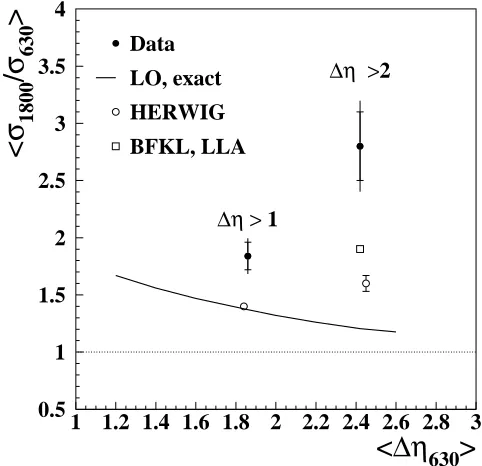
in-terval in the selected bins is equal to 4.2 at 1800 GeV and 1.9 at 630 GeV. The average ratio of the 1800 and 630 GeV cross sections in the selected bins was measured to be1.86 0.1共stat兲 60.1共uncorrelated syst兲. The results are shown in Fig. 1 as a function of the mean pseudorapid-ity interval atps 苷630GeV. In the case of theDh .1
requirement, the observed ratio is once again larger than the exact LO and HERWIG predictions. It is interesting, however, thatHERWIGexhibits the same qualitative behav-ior as the data in that the ratio of cross sections decreases as theDh requirement is relaxed, whereas the exact LO
0.5 1 1.5 2 2.5 3 3.5 4
1 1.2 1.4 1.6 1.8 2 2.2 2.4 2.6 2.8 3
<
∆η
630>
<
σ
1800/
σ
630>
Data
∆η > 1
∆η > 2 LO, exact
HERWIG
BFKL, LLA
FIG. 1. The ratio of the dijet cross sections at ps苷1800
calculation predicts a very different trend. (A BFKL pre-diction is not shown for the case of Dh . 1 since the pseudorapidity interval is not sufficiently large for the for-malism to be meaningful.)
In conclusion, we have measured the dijet cross sec-tion for large pseudorapidity intervals at ps 苷1800 and 630 GeV, and the ratio of the cross sections for the same values ofx1,x2, andQ2at the two energies. The latter
cor-responds to the ratio of the partonic cross sections for dif-ferent values ofDh. The measured partonic cross section increases strongly withDh, more strongly than expected on the basis of any current prediction.
We appreciate the many fruitful discussions with A. Mueller, L. Orr, and J. Stirling. We thank the staffs at Fer-milab and at collaborating institutions for contributions to this work, and acknowledge support from the Department of Energy and National Science Foundation (U.S.A.), Commissariat à L’Energie Atomique and CNRS兾Institut National de Physique Nucléaire et de Physique des Particules (France), Ministry for Science and Technology and Ministry for Atomic Energy (Russia), CAPES and CNPq (Brazil), Departments of Atomic Energy and Science and Education (India), Colciencias (Colombia), CONACyT (Mexico), Ministry of Education and KOSEF (Korea), CONICET and UBACyT (Argentina), A. P. Sloan Foundation, and the Humboldt Foundation.
[1] L. N. Lipatov, Sov. J. Nucl. Phys. 23, 338 (1976); E. A. Kuraev, L. N. Lipatov, and V. S. Fadin, Sov. Phys. JETP 44,
443 (1976); Sov. Phys. JETP 45,199 (1977); Y. Y. Balitsky and L. N. Lipatov, Sov. J. Nucl. Phys. 28,822 (1978). [2] H1 Collaboration, S. Aid et al., Phys. Lett. B 356, 118
(1995); H1 Collaboration, C. Adloff et al., Nucl. Phys.
B538,3 (1999); H1 Collaboration, C. Adloff et al., Phys. Lett. B 462,440 (1999); ZEUS Collaboration, J. Breitweg et al., Eur. Phys. J. C6,239 (1999); ZEUS Collaboration, J. Breitweg et al., Phys. Lett. B 474,223 (2000).
[3] D0 Collaboration, B. Abbott et al., Phys. Rev. Lett. 77,595 (1996).
[4] Y. L. Dokshitzer, in Proceedings of the 1997 Interna-tional Europhysics Conference on High Energy Physics, Jerusalem, Israel, 1997 (Springer, New York, 1999), p. 47. [5] A. H. Mueller and H. Navelet, Nucl. Phys. B282, 727
(1987).
[6] D0 Collaboration, S. Abachi et al., Nucl. Instrum. Methods Phys. Res., Sect. A 338,185 (1994).
[7] J. Bantly et al., Report No. Fermilab-TM-1995, 1997; J. Krane, J. Bantly, and D. Owen, Report No. Fermilab-TM-2000, 1997.
[8] B. Abbott et al., Report No. Fermilab-Pub-97 / 242-E, 1997.
[9] D0 Collaboration, B. Abbott et al., Nucl. Instrum. Methods Phys. Res., Sect. A 424,352 (1999).
[10] A. Goussiou, Report No. Fermilab-Pub-99 / 264-E, 1999. [11] G. Marchesini et al., Comput. Phys. Commun. 67, 465
(1992). We used v5.9.