Kramer CV, Zhang F, Sinclair D, Olliaro PL
This is a reprint of a Cochrane review, prepared and maintained by The Cochrane Collaboration and published inThe Cochrane Library
2014, Issue 8
http://www.thecochranelibrary.com
Drugs for treating urinary schistosomiasis (Review)
1 HEADER . . . .
1
ABSTRACT . . . .
2
PLAIN LANGUAGE SUMMARY . . . .
4
SUMMARY OF FINDINGS FOR THE MAIN COMPARISON . . . .
6
BACKGROUND . . . .
7
OBJECTIVES . . . .
7 METHODS . . . .
9 RESULTS . . . .
Figure 1. . . 10
Figure 2. . . 12
18
ADDITIONAL SUMMARY OF FINDINGS . . . .
29
DISCUSSION . . . .
30
AUTHORS’ CONCLUSIONS . . . .
30
ACKNOWLEDGEMENTS . . . .
31 REFERENCES . . . .
37
CHARACTERISTICS OF STUDIES . . . .
78 DATA AND ANALYSES . . . .
86 ADDITIONAL TABLES . . . .
100 WHAT’S NEW . . . .
100
CONTRIBUTIONS OF AUTHORS . . . .
100 DECLARATIONS OF INTEREST . . . .
100 SOURCES OF SUPPORT . . . .
101
DIFFERENCES BETWEEN PROTOCOL AND REVIEW . . . .
101
INDEX TERMS . . . .
i Drugs for treating urinary schistosomiasis (Review)
Drugs for treating urinary schistosomiasis
Christine V Kramer1, Fan Zhang2, David Sinclair3, Piero L Olliaro4
1Cochrane Infectious Diseases Group, Liverpool School of Tropical Medicine, Liverpool, UK.2School of Public Health and
Manage-ment, Chongqing Medical University, Chongqing, China.3Department of Clinical Sciences, Liverpool School of Tropical Medicine, Liverpool, UK.4UNICEF/UNDP/World Bank/WHO Special Programme for Research and Training in Tropical Diseases (TDR),
World Health Organization, Geneva, Switzerland
Contact address: Christine V Kramer, Cochrane Infectious Diseases Group, Liverpool School of Tropical Medicine, Pembroke Place, Liverpool, L3 5QA, [email protected].
Editorial group:Cochrane Infectious Diseases Group.
Publication status and date:New search for studies and content updated (no change to conclusions), published in Issue 8, 2014.
Review content assessed as up-to-date: 23 May 2014.
Citation: Kramer CV, Zhang F, Sinclair D, Olliaro PL. Drugs for treating urinary schistosomiasis.Cochrane Database of Systematic Reviews2014, Issue 8. Art. No.: CD000053. DOI: 10.1002/14651858.CD000053.pub3.
Copyright © 2014 The Authors. The Cochrane Database of Systematic Reviews published by John Wiley & Sons, Ltd. on behalf of The Cochrane Collaboration. This is an open access article under the terms of theCreative Commons Attribution-Non-Commercial
Licence, which permits use, distribution and reproduction in any medium, provided the original work is properly cited and is not used for commercial purposes.
A B S T R A C T Background
Urinary schistosomiasis is caused by an intravascular infection with parasiticSchistosoma haematobiumworms. The adult worms typically migrate to the venous plexus of the human bladder and excrete eggs which the infected person passes in their urine. Chronic infection can cause substantial morbidity and long-term complications as the eggs become trapped in human tissues causing inflammation and fibrosis. We summarised evidence of drugs active against the infection. This is new edition of a review first published in 1997.
Objectives
To evaluate the efficacy and safety of drugs for treating urinary schistosomiasis.
Search methods
We searched the Cochrane Infectious Diseases Group Specialized Register, MEDLINE, CENTRAL, EMBASE and LILACS and reference lists of articles up to 23 May 2014.
Selection criteria
Randomized controlled trials (RCTs) of antischistosomal drugs and drug combinations compared to placebo, no intervention, or each other.
Data collection and analysis
Two researchers independently screened the records, extracted the data and assessed risk of bias. The primary efficacy outcomes were parasitological failure (defined as the continued presence ofS. haematobiumeggs in the urine at time points greater than one month after treatment), and percent reduction of egg counts from baseline. We presented dichotomous data as risk ratios (RR), and continuous data as mean difference (MD), alongside their 95% confidence intervals (CIs). Where appropriate we combined trials in meta analyses or tables. We assessed the quality of evidence using the GRADE approach.
1 Drugs for treating urinary schistosomiasis (Review)
We included 30 RCTs enrolling 8165 participants in this review. Twenty-four trials were conducted in children in sub-Saharan Africa, and 21 trials were over 20 years old. Many studies were assessed as being at unclear risk of bias due to inadequate descriptions of study methods.
Praziquantel
On average, a single 40 mg/kg dose of praziquantel reduced the proportion of people still excreting eggs in their urine by around 60% compared to placebo at one to two months after treatment (treatment failure: RR 0.42, 95% CI 0.29 to 0.59, 864 participants, seven trials,high quality evidence). The proportion of people cured with praziquantel varied substantially between trials, from 22.5% to 83.3%, but was higher than 60% in five of the seven trials. At one to two months following praziquantel treatment at 40 mg/kg, the mean number of schistosome eggs in the urine was reduced by over 95% in five out of six trials (678 participants, six trials,high quality evidence).
Splitting praziquantel 40 mg/kg into two doses over 12 hours probably has no benefits over a single dose, and in a single trial of 220 participants the split dose caused more vomiting (RR 0.5, 95% CI 0.29 to 0.86) and dizziness (RR 0.39, 95% CI 0.16 to 0.94).
Metrifonate
A single dose of metrifonate 10 mg/kg reduced egg excretion (210 participants, one trial, at eight months), but was only marginally better than placebo at achieving cure at one month (RR 0.83, 95% CI 0.74 to 0.94, 142 participants, one trial). In a single trial comparing one, two and three doses, the absolute number of participants cured improved from 47% after one dose to 81% after three doses (93 participants, one trial,low quality evidence).
Two small trials compared 40 mg/kg single dose praziquantel with two or three doses of 10 mg/kg metrifonate and found no clear evidence of differences in cure (metrifonate 2 x 10 mg/kg at one month: RR 1.03, 95% CI 0.8 to 1.34, 72 participants, one trial; metrifonate 3 x 10 mg/kg at three months: RR 0.33, 95% CI 0.07 to 1.57, 100 participants, one trial. In one trial both drugs performed badly and in one trial both performed well.
Other drugs
Three trials have evaluated the antimalarial artesunate; with inconsistent results. Substantial antischistosomal effects were only seen in one of the three trials, which was at unclear risk of bias due to poor reporting of the trial methods. Similarly, another anti-malarial mefloquine has been evaluated in two small trials with inconsistent effects.
Adverse events were described as mild for all evaluated drugs, but adverse event monitoring and reporting was generally of low quality.
Authors’ conclusions
Praziquantel 40 mg/kg is the most studied drug for treating urinary schistosomiasis, and has the strongest evidence base.
Potential strategies to improve future treatments for schistosomiasis include the combination of praziquantel with metrifonate, or with antimalarial drugs with antischistosomal properties such as artesunate and mefloquine. Evaluation of these combinations requires rigorous, adequately powered trials using standardized outcome measures.
P L A I N L A N G U A G E S U M M A R Y Drugs for treating urinary schistosomiasis
What is urinary schistosomiasis and how is it treated?
Urinary schistosomiasis is a disease caused by infection of people with the parasitic wormSchistosoma haematobium. These worms live in blood vessels around the infected person’s bladder and the worm releases eggs which are released in the person’s urine. If the urine is passed into ponds or lakes, the eggs can hatch and infect people that are washing or swimming there. Infection can cause blood in the urine and if left untreated can eventually lead to anaemia, malnutrition, kidney failure, or bladder cancer. Urinary schistosomiasis is diagnosed by looking for worm eggs in the urine.
The disease occurs mainly in school-aged children and young adults in sub-Saharan Africa. The drug currently recommended for treatment is praziquantel, which can be given as a single dose, but other drugs such as metrifonate, artesunate, and mefloquine have also been evaluated.
2 Drugs for treating urinary schistosomiasis (Review)
What does the research say?
On average, the standard dose of praziquantel cures around 60% of people at one to two months after treatment (high quality evidence), and reduces the number of schistosome eggs in the urine by over 95% (high quality evidence).
Metrifonate, an older drug no longer in use, had little effect when given as a single dose but an improved effect when given as multiple doses two weeks apart. Two trials compared three doses of metrifonate with the single dose of praziquantel and found similar effects.
Two more recent trials evaluated a combination of artesunate and praziquantel compared to praziquantel alone. In one trial artesunate improved cure and in one it made no difference.
Authors conclusions
Future treatments for schistosomiasis could include combining praziquantel with metrifonate, or with artesunate, but these need to be evaluated in high quality trials.
3 Drugs for treating urinary schistosomiasis (Review)
S U M M A R Y O F F I N D I N G S F O R T H E M A I N C O M P A R I S O N [Explanation]
Praziquantel 40 mg/kg versus placebo for treating urinary schistosomiasis Patient or population:People with urinary schistosomiasis
Settings:Endemic areas in sub-Saharan Africa
Intervention:Praziquantel 40 mg/kg (single dose) versus placebo
Outcomes Illustrative comparative risks* (95% CI) Relative effect (95% CI)
No of participants (trials)
Quality of the evidence (GRADE)
Assumed risk Corresponding risk Placebo Praziquantel 40 mg/kg Parasitological failure
At 1 to 2 months
91 per 100 38 per 100
(26 to 54)
RR 0.42
(0.29 to 0.59)
864 (7 trials)
⊕⊕⊕⊕ high1,2,3,4
Percentage egg reduction
At 1 to 2 months
Mean change in egg excretion in the control groups ranged from a53.2% reduction to a
138%increase.
Mean egg excretion in the intervention groups was re-duced by> 98%in all trials
Not pooled 678
(6 trials)
⊕⊕⊕⊕ high1,2,3,5
Microhaematuria
At 8 weeks
53 per 100 28 per 100
(17 to 45)
RR 0.53
(0.33 to 0.84)
119 (1 trial)
⊕⊕ low6,7,8
Haemoglobin
At 6 to 8 months
The mean haemoglobin ranged across control groups from
11.3 to 11.9 G/dL
The mean haemoglobin in the intervention groups was0.08 G/dL lower
(0.24 lower to 0.09 higher)
- 727
(2 trials)
⊕⊕⊕ moderate3,9,1011
Adverse events - - - 1591
(9 trials)
⊕⊕ low12
The basis for theassumed riskis the mean risk in the control groups across trials. Thecorresponding risk(and its 95% CI) is based on the assumed risk in the comparison group and the
relative effectof the intervention (and its 95% CI).
CI:Confidence interval;RR:Risk ratio.
GRADE Working Group grades of evidence
High quality:Further research is very unlikely to change our confidence in the estimate of effect.
Moderate quality:Further research is likely to have an important impact on our confidence in the estimate of effect and may change the estimate.
Low quality:Further research is very likely to have an important impact on our confidence in the estimate of effect and is likely to change the estimate.
Very low quality:We are very uncertain about the estimate.
1No serious risk of bias: Several trials were at unclear or low risk of selection bias. However, a sensitivity analysis excluding these trials
still found a strong effect.
2No serious inconsistency: Six of the seven trials found large consistent effects. The seventh trial found no difference, this may be
explained by the different diagnostic criteria used in this trial.
3No serious indirectness: These seven trials are all conducted in children in endemic areas of sub-Saharan Africa. 4No serious imprecision: The result is statistically significant and the 95% CI is narrow around a clinically important effect.
5No serious imprecision: The trials are small and most did not report tests of statistical significance, however the differences are large. 6No serious risk of bias: This trial was well conducted.
7Downgraded by 1 for serious indirectness: Only a single trial reports this outcome. Further trials from different settings would be needed
to be confident in this effect.
8Downgraded by 1 for serious imprecision: This trial is underpowered.
9Downgraded by 1 for serious risk of bias: both trials had inadequate sequence generation and allocation concealment. 10No serious inconsistency: Low statistical heterogeneity.
11No serious imprecision: only two trials reported this outcome. CIs are narrow. The effect is not statistically significant and does not
appear to be clinically important, when compared to the baseline data.
12Downgraded by 2 for serious risk of bias: Three trials do not comment on adverse events. Six trials made comments that praziquantel was generally well tolerated and no statistically significant differences were noted. However, adverse events were poorly reported in all six trials such that meta-analysis, and assessment of other quality criteria was not possible.
B A C K G R O U N D
Urinary schistosomiasis, also called bilharzia or snail fever, is an in-travascular infection caused by parasiticSchistosoma haematobium
worms. It is endemic in sub-Saharan Africa, the Arabian peninsula and the Middle East. According to the World Health Organiza-tion (WHO), at least 243 million people required treatment for schistosomiasis in 2011 (WHO 2013), and more than 700 million people live in endemic areas (WHO 2014).
The WHO currently recommends regular chemoprophylaxis with praziquantel for populations at risk to prevent the long term con-sequences of infection. These programmes usually target school children (Table 1), but may be extended to the whole community in high risk settings (King 2011).
Description of the condition
Human infection withS. haematobiumis acquired through contact with water bodies containing cercariae, the larval form of the par-asite. The cercariae are able to penetrate human skin and migrate via blood vessels to the liver, where they mature into male and fe-male forms for reproduction. Typically, they then migrate further to the venous plexus of the urinary bladder, and begin to produce eggs which the infected person excretes in their urine (Gryseels 2006). If these eggs reach water, they hatch into miracidia, infect specific freshwater snails which act as intermediate hosts, before emerging as cercariae that can infect humans (Gray 2011;Ross 2002).
Any illness associated with acute infection is typically mild, but chronic schistosomiasis can cause considerable morbidity with chronic pain, anaemia, fatigue, under nutrition and reduced exer-cise tolerance (King 2005). A review of 124 observational studies and 11 randomized controlled trials (RCTs) in 2005 estimated that up to 15% of people infected with any form of schisto-somiasis suffer disabling long-term complications (King 2005). The main pathological process occurs when schistosome eggs be-come trapped in the tissue around the bladder and ureters causing chronic inflammation, which may obstruct the ureters, damage the kidneys, and lead to bladder cancer. Occasionally, eggs can become trapped in other tissues such as the brain and spinal cord (WHO 1985).
Two-thirds of all infected persons are schoolchildren (aged five to 14 years), and the intensity of infection withS. haematobiumis highest in children aged ten to 14 years (WHO 1985).
The standard test for urinary schistosomiasis is urine filtration and microscopic examination of the urine sample (WHO 1991). The urine sample is passed through a filter paper and the eggs retained on the filter are counted either with or without staining. Sedimentation and centrifugation is less commonly used for urine concentration (Cook 2003). High urine egg counts are related to high infection intensity.
in one or more urine samples using standard methods. Besides parasitological cure, researchers also record the relative reduction in egg output after treatment compared to pre-treatment levels. This outcome, expressed as % egg reduction, is an indirect estimate of a reduction of the worm burden (Cook 2003).
Blood and protein excretion in the urine is usually elevated in urinary schistosomiasis and decreases when the infection resolves. The most commonly used test is a dipstick test. Ultrasound can demonstrate organ involvement of the urinary tract as well as its resolution.
Description of the intervention
Praziquantel is the current treatment for urinary schistosomia-sis recommended by the WHO (WHO 2006). Historically, met-rifonate was also used but this fell out of favour due to the need for multiple doses (Feldmeier 1999;WHO 1998). More re-cently, there has been interest in the antischistosomal properties of artemisinin derivates and mefloquine, more commonly used for treating malaria (Utzinger 2004).
Praziquantel is an pyrazinoisoquinoline derivative with activity against adult worms of all schistosome species (S. mansoni,S. in-tercalatumandS. japonicum), but not against maturing worms. Praziquantel has a rapid onset of action. It is well-tolerated, can be given as a single dose (Utzinger 2004) and paediatric formulations are available (Stothard 2013).
Metrifonate, an organophosphorous cholinesterase inhibitor, is active againstS. haematobiumbut not against other schistosome species (Utzinger 2004).
Artemisinin, extensively used as potent antimalarial, has highest activity against immature schistosomes. Artemsinins are safe and well-tolerated (Utzinger 2004).
How the intervention might work
After treatment with praziquantel, the worms appear to die quickly but egg excretion continues for several weeks. There are several possible reasons for this:
• Firstly, some worms might not have been mature at the time of praziquantel treatment and therefore not killed by praziquantel (Cioli 2003). Maturation of the worms after infection takes four to six weeks, and after two months eggs can be detected in the urine.
• Secondly, the patient might have been re-infected (Cioli 2003).
• Thirdly, dead eggs still wander out of the tissue into the urine several weeks after clearing adult worms (Taylor 1988 ZWE). Therefore, a follow-up four to six weeks after treatment is useful (Renganathan 1998). There is also considerable variation in daily urinary egg output (Cook 2003).
6 Drugs for treating urinary schistosomiasis (Review)
relevant evidence for resistance up to now (Doenhoff 2008). In endemic settings, reinfection withS. haematobiumis likely, and cure (often defined as complete cessation of egg excretion) is not a sustainable long term goal. However, reduction of infection in-tensity results in clinical improvement, low morbidity and pre-vention of long term complications. Therefore, WHO promotes morbidity control rather than cure as an objective for schistoso-miasis control programmes (WHO 2002).
Why it is important to do this review
At present, praziquantel as the only drug in use that is exposed to resistance development. It is therefore important to monitor its performance and to assess the effects of other drugs against urinary schistosomiasis.
Dosing regimens for subgroups such as highly infected patient groups, incremental benefits of drug combinations, double dos-ing and optimal interval between doses have to be determined to inform control programmes for urinary schistosomiasis. Paediatric schistosomiasis has gained attention as a public health problem, and evaluation of existing treatment studies is indicated.
O B J E C T I V E S
To evaluate the efficacy and safety of drugs for treating urinary schistosomiasis.
M E T H O D S
Criteria for considering studies for this review
Types of studies
Randomized controlled trials.
Types of participants
Patients diagnosed with urinary schistosomiasis by:
• detection of macro or microhaematuria;
• identification of schistosome eggs by urine microscopy;
• detection of parasite antigens in blood or urine.
Intervention
Drugs used to treat urinary schistosomiasis. Drugs considered as obsolete (such as ambilhar, oltipraz and niridazole) were not included. Metrifonate was included.
Control
Placebo, no intervention, an alternative regimen of the same drug, or an alternative drug used to treat urinary schistosomiasis.
Types of outcome measures
Primary outcomes
• Parasitological failure at one month post-treatment (as defined by the trial authors);
• Percent egg reduction at one month.
Secondary outcomes
• Parasitological failure at time-points > one month;
• Percent egg reduction from baseline at > one month;
• Clinical outcomes: resolutions of signs and symptoms (for example, haematuria and proteinuria);
• Anaemia (decrease of the number of red blood cells or the quantity of haemoglobin in the blood);
• Growth outcomes (gain in body weight, body length).
Adverse events
• Serious adverse events;
• Other adverse events
Search methods for identification of studies
We attempted to identify all relevant trials regardless of language and publication status (published, unpublished, in press, under review and in progress).
Electronic searches
We searched the following databases using the search terms out-lined in Appendix 1: The Cochrane Infectious Diseases Group Specialized Register (23 May 2014); Cochrane Central Register of Controlled Trials (CENTRAL), published inThe Cochrane Library
(2014, Issue 4); MEDLINE (1966 to 23 May 2014); EMBASE (1974 to 23 May 2014); and LILACS (1982 to 23 May 2014). We also searched the metaRegister of Controlled Trials (mRCT) using ’Schistosoma haematobium’ as the search term (23 May 2014).
7 Drugs for treating urinary schistosomiasis (Review)
We checked the reference lists of all studies identified by the above methods for additional studies relevant to this review.
Data collection and analysis
Selection of studies
Vittoria Lutje, the Cochrane Infectious Diseases Group (CIDG) Information Retrieval Specialist, searched the literature and re-trieved trial titles and abstracts.
VK and FZ independently screened the results of the search and retrieved full trial reports of all potentially relevant trials. Then, VK and FZ independently assessed each trial for inclusion using an eligibility form based on the inclusion criteria. We resolved any discrepancies by discussion with PG.
Data extraction and management
VK and FZ independently extracted data using pre-tested stan-dardized forms. We resolved any differences through discussion with PG. For each trial we extracted details of the trial methods, participants, interventions and outcomes.
VK and FZ extracted the number of participants randomized and number of participants followed up in each treatment arm. For dichotomous outcomes, we extracted the number of participants experiencing the event in each group. For continuous outcomes summarized as geometric means, we extracted means and their standard error, if reported. If the data were presented as arithmetic means, we extracted arithmetic means and their standard devia-tions (SD), if reported, for each treatment group. Where contin-uous data were summarized as medians and ranges, these were ex-tracted and entered into tables.
VK and FZ double-entered the data and cross-checked to min-imise errors. VK tried to contact trial authors for clarification or insufficient of missing data when necessary and summarised data reported in multiple publications as one single data set.
Assessment of risk of bias in included studies
VK and FZ independently assessed the risk of bias of each trial using an assessment form based on the Cochrane Collaboration’s ’Risk of bias’ tool (Higgins 2008). DS verified the assessment re-sults.
We assessed the risk of bias for six domains: sequence generation; allocation concealment; blinding (of participants, personnel, and outcome assessors); incomplete outcome data; selective outcome reporting; and other sources of bias. We categorized these judg-ments as low, high or unclear risk of bias.
For sequence generation, allocation concealment and blinding, we quoted the method as described in the trial in theCharacteristics
method and who was blinded separately for different outcomes. For incomplete outcome data, we assigned a judgement for dif-ferent outcomes (for example, loss to follow-up at difdif-ferent time points).
We resolved disagreements by discussion or consultation. Where risk of bias was unclear, we attempted to contact the trial authors for clarification.
Measures of treatment effect
We presented dichotomous outcomes as risk ratios (RR), and con-tinuous outcomes as mean differences or geometric mean ratios. All results are shown with a 95% confidence interval (CI).
Unit of analysis issues
For trials including more than two comparison groups, we split and analysed as individual pair-wise comparisons. When conducting meta-analysis we ensured that participants and cases in the placebo group were not counted more than once, by dividing the placebo cases and participants evenly between the intervention groups.
Dealing with missing data
The primary analysis is a complete case analysis where the number of evaluable participants at each time point is used as the denom-inator.
Assessment of heterogeneity
We assessed heterogeneity by inspecting forest plots for overlap-ping CIs and outlying data. We applied the Chi2test with a P value < 0.10 to indicate statistically significant heterogeneity, and the I
2statistic with a value of greater than 50% to indicate moderate
heterogeneity.
Assessment of reporting biases
We planned to evaluate the possibility of publication bias by con-structing funnel plots, but there were too few trials within each comparison to make this meaningful.
Data synthesis
We analysed the data in pair-wise comparisons using Review Manager (RevMan). We stratified the primary analysis by drug dose and the time point after treatment. Data were combined in meta-analyses using a fixed-effect model. If we detected moderate heterogeneity but still considered combination of the trials to be appropriate we used a random-effects model. We presented data which could not be presented in forest plots in tables (medians, means without measure of variance, ranges).
We assessed quality of evidence using the GRADE approach, and displayed the results in ’Summary of Findings’ tables. The GRADE
8 Drugs for treating urinary schistosomiasis (Review)
low and very low. The evidence from RCTs is rated as ’high quality’ but can be downgraded where there are major concerns about: 1) the risk of bias of the trials; 2) inconsistency between the trial results; 3) a mismatch between the question being asked and the trial setting, population, intervention or control; 4) the trial being underpowered; or 5) evidence of publication bias.
Subgroup analysis and investigation of heterogeneity
We planned to conduct the following subgroup analyses to explore the potential causes of heterogeneity. However, there were too few trials within each comparison to make this meaningful: patient age (children versus adults), intensity of infection, endemicity.
Sensitivity analysis
of missing data.
R E S U L T S
Description of studies
Results of the search
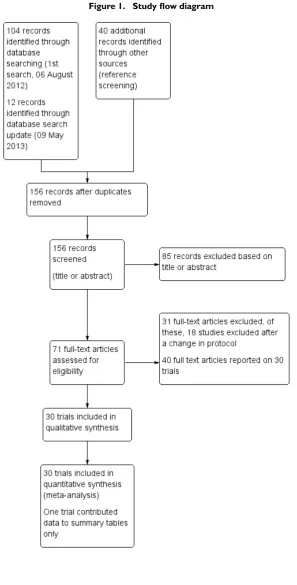
Following database searches, we identified 116 individual cita-tions, and a further 40 potential studies after we checked trial ab-stracts. Following abstract screening, we assessed 71 full text arti-cles for inclusion.Figure 1shows the flow diagram of these trials.
9 Drugs for treating urinary schistosomiasis (Review)
10 Drugs for treating urinary schistosomiasis (Review)
in 39 publications. Twenty trials were over 20 years old, and only eight were published since the year 2000.
Settings
All but one trial were conducted in sub Saharan Africa; 13 trials from East Africa: Somalia (one) Sudan (three), Tanzania (two), Kenya (six), Malawi (one); 13 trials from West Africa: Cameroon (two), Gabon (three), Niger (two), Mali (one), Nigeria (two), Cote d’ Ivoire (one), Ghana (one), Gambia (one); and three trials from southern Africa: Zimbabwe (two), and Zambia (one). Most trials were based in rural settings, but two were conducted in peri-ur-ban or semi-rural settings, three were from urperi-ur-ban settings, and in one trial the setting was not described. The remaining trial was conducted in an urban setting in Saudi Arabia.
Twenty trials were based in schools and one in a college, seven in villages, farms or settlements, one in antenatal clinics and two in referral hospitals.
Participants
Twenty-four trials enrolled school-age children and young adults, although the exact age-range varied; age six to 20 years (16 trials), age five to 18 years (three trials), age two to 23 years (five trials). Two trials enrolled adults only, and four trials didn’t clearly state the age range.
counts as geometric mean egg counts, four trials as arithmetic mean egg counts, three trials reported both. One study reported geometric mean miracidial counts. Six trials used ranges or medi-ans.
Interventions
Eight trials compared praziquantel with placebo, and 14 trials published between 1981 and 2009 compared different doses or regimens of praziquantel.
Five trials compared metrifonate with placebo, and seven trials published between 1983 and 1990 directly compared the efficacy of praziquantel and metrifonate.
More recently, three trials published between 2001 and 2009 eval-uated artesunate as single agent or in combination with praziquan-tel, and two trials published in 2009 and 2011 evaluated meflo-quine.
Excluded studies
We excluded 65 studies for the reasons given in the ’Characteristics of excluded studies’ table.
Risk of bias in included studies
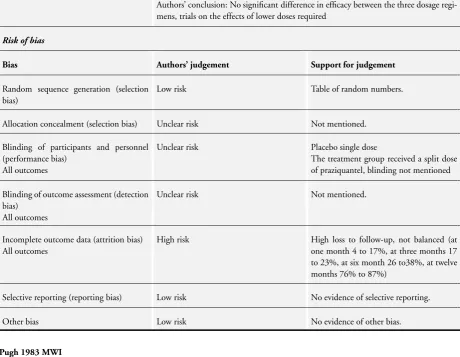
Many trials lacked adequate descriptions of methods to allow judgements on risk of bias, and so have been classified as unclear (seeFigure 2).
11 Drugs for treating urinary schistosomiasis (Review)
trial.
12 Drugs for treating urinary schistosomiasis (Review)
generation, but only six described a method of allocation conceal-ment and could be considered at low risk of selection bias (Abden Abdi 1989 SOM;Basra 2012 GAB;Borrmann 2001 GAB;Olds 1999 KEN;Pugh 1983 MWI;Sacko 2009 MLI).
Blinding
Ten trials reported adequate attempts to blind participants and trial staff to treatment allocation, six trials were unblinded and blinding was unclear in the remaining trials. Seven trials reported adequate blinding of outcome assessors.
Incomplete outcome data
Many trials had high levels of attrition, particularly at later time points. When trials presented cure or failure rates as percentages, we were unable to assess attrition. We considered the risk of attri-tion bias to be unclear in 13 trials and high in nine trials.
Selective reporting
We found evidence of reporting bias in one trial, as trial authors did not present pre-specified outcomes. In three trials, selective reporting was at unclear risk of bias.
Other potential sources of bias
Trial authors reported baseline imbalances in two trials, which we identified as sources of other bias.
The trials were mostly funded by funds, trusts or international agencies (seeCharacteristics of included studiestables). Eight trials did not declare funding, four received drug donations and only two trials declared funding by pharmaceutical companies (both Dafra Pharma).
Effects of interventions
See:Summary of findings for the main comparisonPraziquantel
40 mg/kg versus placebo for treating urinary schistosomiasis;
Summary of findings 2Praziquantel 40 mg/kg single dose versus
30 mg/kg single dose;Summary of findings 3Praziquantel 40 mg/kg multiple doses versus single dose;Summary of findings 4
Metrifonate 3 x 7.5 mg/kg given two weeks apart versus placebo;
Summary of findings 5Artesunate versus placebo;Summary of
findings 6Praziquantel and artesunate versus praziquantel
Praziquantel 40 mg/kg single dose versus placebo (comparison 1)
On average, a single 40 mg/kg dose of praziquantel reduces the propor-tion of people still excreting eggs at one to two months after treatment by around 60% compared to placebo, and reduces the mean number of eggs excreted by over 95%.
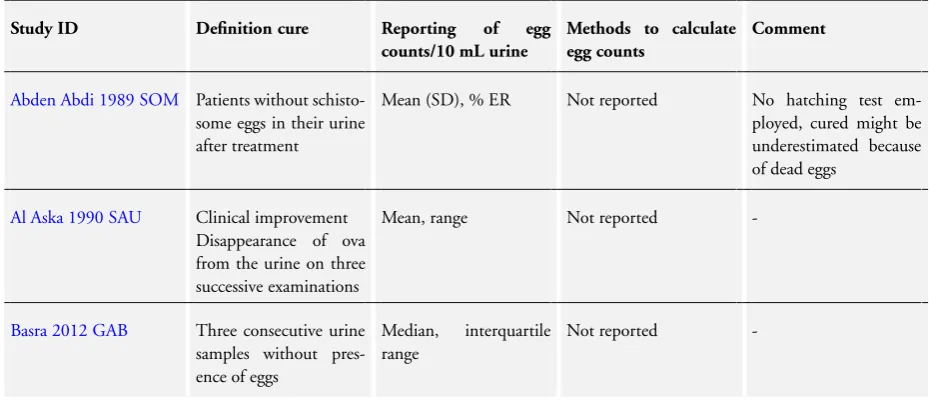
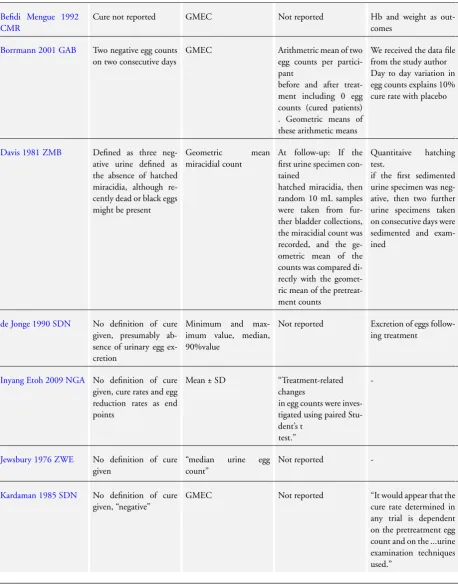
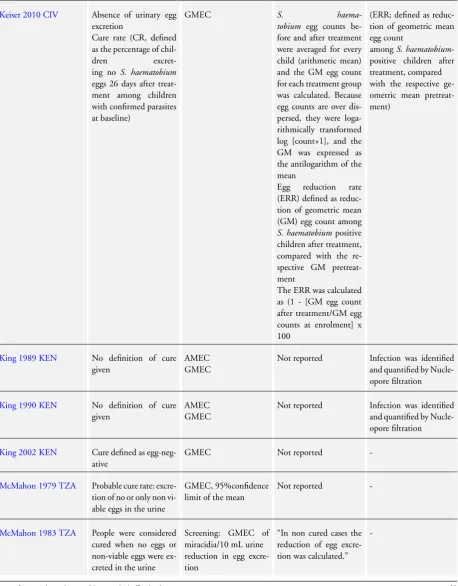
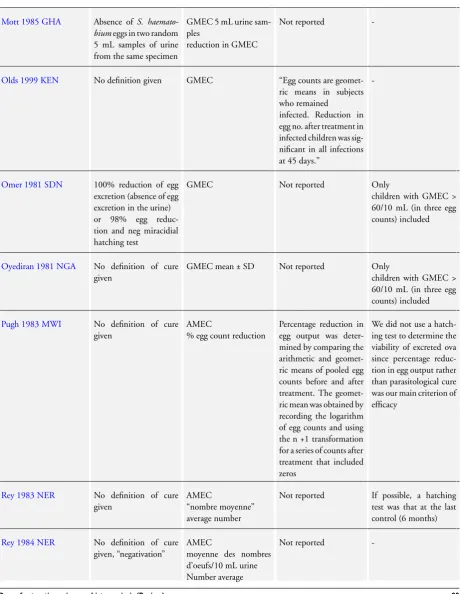
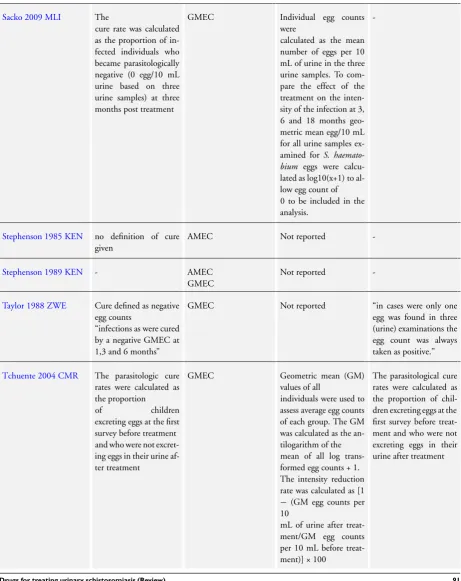
Eight trials compared a single 40 mg/kg dose of praziquantel with placebo or no treatment in schoolchildren in sub-Saharan Africa. We have listed the definitions of parasitological failure inTable 2.
Parasitological failure
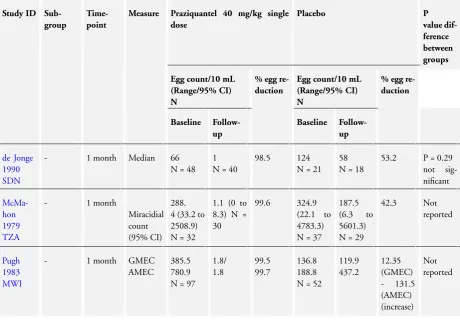
Praziquantel 40 mg/kg as a single dose reduced parasitological treatment failure by around 60% at one to two months compared to placebo (RR 0.42, 95% CI 0.29 to 0.59; 864 participants, seven trials, Analysis 1.1). The absolute level of treatment failure with praziquantel ranged from 16.6% (McMahon 1979 TZA) to 77.5% (de Jonge 1990 SDN). Treatment failure with placebo was greater than 80% in all seven trials and over 90% in four trials. Four trials reported follow-up beyond two months (Analysis 1.1). Failure rate increased over time in two trials, as might be expected in areas of schistosomiasis transmission as people become re-in-fected (McMahon 1979 TZA;Pugh 1983 MWI). However, treat-ment outcomes improved inTaylor 1988 ZWEover time, with moderate reductions in treatment failure at one month and three months and a 70% reduction at six months. The trial authors stated that this improvement might have been due to excretion of remaining eggs from the urinary tract over time.
The fourth trial,de Jonge 1990 SDN, found no difference in treatment failure between praziquantel and placebo at any time point. The trial authors used a more sensitive diagnostic method (three urine samples, filtration of the whole volume up to 350 mL when the 10 mL urine sample contained fewer than 10 eggs) and a strict definition of cure (no excretion of eggs, no viability testing of eggs). This may explain the high failure rates observed despite high percent egg reductions comparable to other trials.
Stephenson 1989 KENreported treatment failure at eight months, its only time point. A single dose of praziquantel reduced treatment failure by 86% compared to placebo (RR 0.14, 95% CI 0.08 to 0.22; 209 participants, one trial, Analysis 1.1).
Six trials reported parasitological failure stratified by intensity of infection; the categorisation of strata varied between trials (642 participants, see Appendix 2). At the first follow-up at four to six weeks, three out of four trials had a tendency to higher failure in participants with higher infection intensity. The pattern attenu-ated at later time points.
13 Drugs for treating urinary schistosomiasis (Review)
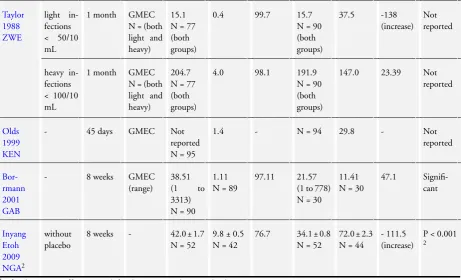
Seven trials reported mean urine egg counts per 10 mL urine at baseline, and at one to two months after a single dose of prazi-quantel 40 mg/kg or placebo (867 participants, seven trials, see
Table 3), although we were only able to reliably interpret this data for six trials (678 participants).
The mean egg count was reduced by more than 95% at one to two months following praziquantel in five trials, and by 75% in one trial. In the placebo groups the change in mean egg count ranged from a 53% decrease to a 115% increase.
Percent egg reduction in the praziquantel group remained high (> 95%) in all three trials reporting at three months, and in all four trials at six months. Percent egg reduction was variable in the placebo group, ranging from 26% increase to 54% reduction at three months and from 5% to 64% reduction at six months (see
Table 4). One additional trial,Stephenson 1989 KEN, reported percent egg reduction at eight months as its only time point (209 participants, seeTable 4). Percent egg reduction after praziquantel was 99% compared to 5% with placebo.
Five trials reported percent egg reduction stratified by intensity of infection (764 participants, Appendix 2). At four to six weeks, all trials reported percent egg reductions over 90% across the strata. Percent egg reduction as a relative measure was at least as high in heavy infections as in mild infections, but post-treatment egg counts as an absolute measure tended to be higher in people with high intensity infections. This pattern persisted at later time points.
Clinical resolution
At eight weeks the proportion of patients with persistent haema-turia (defined as > 5 erythrocytes/mL) was lower in those given praziquantel than placebo in one small trial which reported this (RR 0.53, 95% CI 0.33 to 0.84; 119 participants, one trial, Anal-ysis 1.2). There were substantial reductions in the mean number of erythrocytes in the urine in three trials at one to two months, but we could not combine these data in a meta-analysis (357 par-ticipants, three trials, see Appendix 3).
Proteinuria was reduced by 65% to 84% at one to two months after praziquantel compared to increases in the placebo groups (238 participants, two trials, see Appendix 3).
Two trials reported mean haemoglobin at baseline and at six to eight months after treatment with no difference between groups (mean difference -0.08, 95% CI -0.24 to 0.09; 727 participants, two trials, Analysis 1.3).
Three trials measured a variety of growth parameters (Befidi Mengue 1992 CMR;Olds 1999 KEN;Stephenson 1989 KEN). Two trials reported little or no effect on the outcomes measured (Befidi Mengue 1992 CMR;Olds 1999 KEN). The third trial (Stephenson 1989 KEN) reports 14 measures, some of which are reported as statistically significant, but all appear to be of no or only borderline clinical importance (see Appendix 4). Most
no-measured by the Harvard Step test. The difference in mean im-provement between groups was 6.8% at five weeks (mean end scores 81.2% praziquantel versus 75.5% placebo). Scores between 68% and 82% are considered average. Children that took prazi-quantel also gained 1.2 kg more weight than those in the control group, however baseline differences between groups were of a sim-ilar magnitude to this effect.
Adverse events
Of nine trials, six (with 1286 participants) commented on adverse events. Only four described the methods used for data collection, but rarely reported them in detail (see Appendix 5). Adverse events were usually monitored in the first days after medication. Only two trials actually reported numbers of adverse events, and only abdominal pain was reported by both trials. The absolute num-ber of adverse events was low and none were more common with praziquantel than placebo (see Analysis 1.4). The other trials sum-marized narratively with comments such as “both treatments were well tolerated” (see Appendix 5).
Praziquantel 40 mg/kg versus lower doses (comparison 2)
Praziquantel doses of 20 to 40 mg/kg result in similar reductions in mean egg excretion, but 40 mg/kg is marginally superior at achieving cure.
Ten trials compared praziquantel 40 mg/kg with lower doses: 30 mg/kg (seven trials), 20 mg/kg (three trials), and 10 mg/kg (three trials). All trials were conducted in sub-Saharan Africa in schoolchildren, apart from one trial, which recruited college stu-dents and army recruits.
Treatment with praziquantel 40 mg/kg had fewer treatment fail-ures than lower doses when measured at four to six weeks after treatment (versus 30 mg/kg; RR 0.76, 95% CI 0.59 to 0.99; 401 participants, four trials, Analysis 2.1, versus 20 mg/kg; RR 0.74, 95% CI 0.59 to 0.93; 338 participants, two trials, Analysis 2.1). However, there was no difference between 40 mg/kg and 30 mg/ kg at two to three months (517 participants, five trials, Analysis 2.2), or six months after treatment (699 participants, six trials, Analysis 2.3).
In the five trials comparing praziquantel 40 mg/kg and 30 mg/kg, the mean number of eggs excreted was reduced by greater than 90% with both doses and without significant differences between groups (495 participants, five trials, seeTable 5).
In trials comparing 40 mg/kg and 20 mg/kg, again the mean num-ber of eggs excreted was reduced by more than 95% for both doses and differences in percent egg reduction appeared small (636 par-ticipants, four trials, see Appendix 2). Treatment with praziquan-tel 40 mg/kg appeared to result in greater percent egg reductions than 10 mg/kg (357 participants, three trials, see Appendix 2). One small trial from Kenya (King 1989 KEN) reported similar numbers of participants with persistent haematuria or proteinuria
14 Drugs for treating urinary schistosomiasis (Review)
three months: RR 0.35, 95% CI 0.21 to 0.58, 119 participants, one trial, Analysis 2.4; proteinuria at three months: RR 0.25, 95% CI 0.12 to 0.51; 119 participants, one trial, Analysis 2.5). A larger trial by the same authors comparing 40 mg/kg and 20 mg/kg (King 2002 KEN) detected fewer participants with haematuria at six weeks following praziquantel 40 mg/kg (RR 0.63, 95% CI 0.47 to 0.86; 245 participants, one trial, Analysis 2.6), and fewer participants with proteinuria (RR 0.66, 95% CI 0.46 to 0.96; 245 participants, one trial, Analysis 2.7). These differences were still observed at nine months (haematuria: RR 0.59, 95% CI 0.44 to 0.78; 215 participants, one trial, Analysis 2.8; proteinuria RR 0.67, 95% CI 0.5 to 0.9; 214 participants, one trial, Analysis 2.9).
King 2002 KENalso reported ultrasound findings (bladder thick-ening, bladder irregularity and hydronephrosis) before and after treatment with praziquantel 40 mg/kg and 20 mg/kg respectively, but the results were inconclusive (264 participants, see Appendix 6).
Six of these trials did not comment on adverse events. Four trials described the methods of data collection, but often in insufficient detail; two out of four trials used active, prospective surveillance for adverse events (Appendix 5). Two trials stated for all treatment arms collectively that adverse events after praziquantel treatment were mild and transient. Two trials reported numbers of adverse events with no differences between groups (163 participants, Anal-ysis 3.2).
Praziquantel 40 mg/kg single dose versus split dose (comparison 3)
Splitting the dose of praziquantel 40 mg/kg into two 20 mg/kg doses over 24 hours has not been shown to improve tolerability and may actually cause more vomiting and dizziness.
Three trials compared the single 40 mg/kg dose with a split dose regimen giving two doses of 20 mg/kg over 24 hours. There was no statistically significant difference in treatment failure at one month (RR 0.75, 95% CI 0.51 to 1.11; 374 participants, three trials), three months (RR 0.74, 95% CI 0.45 to 1.2; 361 partici-pants, three trials), or six months (RR 0.83, 95% CI 0.51 to 1.35; 234 participants, three trials, Analysis 3.1). Similarly percent egg reduction was over 90% for both groups (332 participants, three trials, see Appendix 2).
These trials enrolled 191 participants for a single dose of prazi-quantel 40 mg/kg and 195 participants for a split dose of 2 x 20 mg/kg. All trials used active surveillance for adverse events (see Appendix 5). Adverse events were generally reported to be mild and transient. However one trial reports significantly more vom-iting and dizziness with the split dose compared to the single dose (vomiting: RR 0.5, 95% CI 0.29 to 0.86; dizziness: RR 0.39, 95% CI 0.16 to 0.94; 373 participants, three trials, Analysis 3.2).
There are too few trials to determine the optimal frequency and timing of repeated praziquantel dosing.
Two trials compared the standard single dose of praziquantel (40 mg/kg) with two or three doses given at two or three week intervals, and found no statistically significant differences in parasitological failure (Analysis 4.1, Analysis 4.2), percentage egg reduction (Ap-pendix 2), or clinical resolution (Ap(Ap-pendix 3; Analysis 4.3). One additional very small trial from a high transmission setting in Gabon (van den Biggelaar 02 GAB), compared praziquantel 40 mg/kg every three months for two years to a single dose of praziquantel 40 mg/kg given at the beginning of the trial. At two years, patients who received only one dose of praziquantel had almost three times the risk of treatment failure compared to mul-tiple doses (RR 2.71, 95% CI 1.47 to 5.00; 62 participants, one trial, Analysis 5.1). Percent egg reduction was 96% after multiple doses and 80% after a single dose of praziquantel at two years (90 participants, seeTable 6). These effects were no longer apparent one year after the last praziquantel dose.
These trials did not report on adverse events.
Section B: Metrifonate
Metrifonate single dose versus placebo (comparison 6)
A single dose of metrifonate 10 mg/kg probably reduces egg excretion but is only marginally better than placebo at achieving cure.
Two trials compared a single dose of metrifonate to placebo, al-though one trial only reported outcomes at a single time point eight months after treatment (Stephenson 1989 KEN). In the first trial (Pugh 1983 MWI), 80% of those treated with metrifonate continued to excrete eggs one month after treatment which was only marginally better than placebo (RR 0.83, 95% CI 0.74 to 0.94; 142 participants, one trial, Analysis 6.1), and no difference was seen at six months (RR 0.94, 95% CI 0.87 to 1.02; 102 participants, one trial, Analysis 6.1).
In the second trial (Stephenson 1989 KEN), 61% of those treated with metrifonate continued to excrete eggs eight months after treatment compared with almost 100% who received placebo (RR 0.63, 95% CI 0.54 to 0.73, 210 participants, one trial, Analysis 6.1). Egg excretion was also reduced by more than 90% eight months after treatment compared to just 5% with placebo (210 participants, see Appendix 2).
The second trial also reported mean haemoglobin at baseline and eight months (with no difference between groups, Analysis 6.2), and various measures of nutrition and growth (see Appendix 4). However, this trial had three arms and the nutritional measures are reported for the metrifonate and praziquantel groups combined. Consequently, we were unable to evaluate the effect of metrifonate. Trial authors did not report adverse events.
15 Drugs for treating urinary schistosomiasis (Review)
Subsequently trials evaluated multiple doses of metrifonate given two weeks apart, which improved the proportion of patients being cured.
Two trials evaluated three doses of metrifonate 7.5 mg/kg given two weeks apart (Jewsbury 1976 ZWE;Stephenson 1985 KEN), and reported much reduced treatment failures compared to placebo at 11 weeks (RR 0.41, 95% CI 0.30 to 0.56; 93 partic-ipants, one trial, Analysis 7.1) and six months respectively (RR 0.30, 95% CI 0.24 to 0.37; 400 participants, one trial, Analysis 7.1).
A third small trial (de Jonge 1990 SDN) comparing two 10 mg/kg doses given two weeks apart with placebo found very low levels of cure and no difference compared to placebo at one month or five months (51 participants, one trial, Analysis 7.1). However, this is the same trial that found very high levels of treatment failure with praziquantel, which may be a result of the highly sensitive method used for detecting low level egg excretion and the strict definition of cure.
All three trials found substantial reductions in the number of eggs being excreted at their various time points (> 90% reductions in all three trials, seeTable 7).
Stephenson 1985 KENalso reported mean haemoglobin, with slightly higher values at six months after metrifonate compared to placebo (mean difference 0.3 G/dL, 95% CI 0.14 to 0.46; 400 participants, one trial, Analysis 7.2). The authors noted that hookworm endemicity was high, and metrifonate also has an effect on hookworm which could account for this finding.
None of the trials reported on adverse events.
Direct comparisons of different metrifonate regimens (comparisons 8 and 9)
In one trial, multiple doses of 10 mg/kg were superior to a single dose.
One three-arm trial directly compared a single dose of 10 mg/ kg with two or three doses given two weeks apart. Parasitological failure at one month was 53% with a single dose, 40% with two doses, and 19% with three doses. The difference was statistically significant for three doses versus one dose (RR 0.36, 95% CI 0.17 to 0.77; 93 participants, one trial, Analysis 8.1), but not two doses versus one dose (RR 0.75, 95% CI 0.5 to 1.13; 112 participants, one trial, Analysis 8.1). Results were similar at four months (Analysis 8.2).
The percent egg reduction was also improved from 37% after a single dose to 88% after three doses, although this was not main-tained at the four months’ follow-up (see Appendix 2). This trial did not report on adverse events.
One additional trial (Abden Abdi 1989 SOM) compared three doses of 7.5 mg/kg given two weeks apart with three doses of 5 mg/kg given in one day. The trial detected no difference for parasitological failure at one month, three months or six months (201 participants, one trial, Analysis 9.1). Egg reduction at one month was above 90% after both metrifonate doses and was
sus-Appendix 2). This trial recorded adverse events by active surveil-lance (Appendix 5). It did not detect a significant difference for any of the symptoms between treatment groups (201 participants, one trial, Analysis 9.2) The adverse events were mild and tran-sient.Headache and abdominal pain were most common.
Section C: Praziquantel versus metrifonate
Praziquantel 40 mg/kg single dose versus metrifonate 10 mg/kg single dose (comparison 10)
Single dose praziquantel 40 mg/kg was more effective than single dose metrifonate 10 mg/kg in curing patients and reducing egg excretion.
Three trials compared the standard dose of praziquantel 40 mg/kg with a single dose of metrifonate 10 mg/kg, although one trial only reported outcomes at eight months after treatment (Stephenson 1989 KEN).
In the first trial (Pugh 1983 MWI), parasitological failure at one month was halved with praziquantel 40 mg/kg compared to met-rifonate 10 mg/kg (RR 0.46, 95% CI 0.34 to 0.61; 183 partic-ipants, one trial, Analysis 10.1). Treatment failure increased in both groups over the following five months which the authors sus-pect was due to egg excretion by maturing worms, as transmission and re-infection were low in the trial setting (Analysis 10.1). The second trial (Wilkins 1987 GMB), also found praziquantel to be superior to metrifonate at two to three months as its only time point (RR 0.45, 95% CI 0.27 to 0.75; 72 participants, one trial, Analysis 10.1).
The third trial (Stephenson 1989 KEN), found substantial reduc-tions in both treatment failure (RR 0.21, 95% CI 0.13 to 0.36; 208 participants, one trial, Analysis 10.1) and egg excretion (see Appendix 2), with praziquantel compared to metrifonate. Haemo-globin levels measured in this trial were higher in the praziquantel treatment arm both at baseline and at follow-up (208 participants, one trial, Analysis 10.2). The trial did not detect a difference in growth parameters between groups but does not report them sep-arately (see Appendix 4).
None of the trials reported on adverse events.
Praziquantel 40 mg/kg single dose versus multiple doses of metrifonate 10 mg/kg
Two small trials found no difference in parasitological treatment fail-ure or egg excretion between single dose praziquantel 40 mg/kg and two or three doses of metrifonate 10 mg/kg.
Two small trials compared praziquantel 40 mg/kg single dose to two and three doses of metrifonate 10 mg/kg given two weeks apart. The trials detected no difference in parasitological treatment failure at different time points and with different metrifonate reg-imens. However, in one trial both drugs performed poorly (de Jonge 1990 SDN), and in one trial both performed well (Al Aska 16 Drugs for treating urinary schistosomiasis (Review)
and this is likely to be due to the very sensitive method for detect-ing eggs. In this trial, both drugs reduced mean egg excretion by over 98% at one month and five months (see Appendix 2), and a decrease in haematuria by over 90% at one month. Reduction in proteinuria was almost 80% in both groups (see Appendix 3). OnlyAl Aska 1990 SAUreported adverse events; dizziness was more common after praziquantel (RR 2.9, 95% CI 1.59 to 5.3; 100 participants, one trial, Analysis 10.4). Dizziness (20% in the praziquantel group and 10% in the metrifonate group) and ab-dominal pain (12% both in the praziquantel and metrifonate group) were the most common side effects (Appendix 5).
Additional comparisons of praziquantel and metrifonate
One small trial compared a single dose of praziquantel 30 mg/ kg to three doses of metrifonate 10 mg/kg given two weeks apart and found no difference in parasitological failure at two months, but a statistically significant difference in favour of praziquantel at four months (RR 0.24, 95% CI 0.07 to 0.8; 52 participants, one trial, Analysis 10.5). Egg reduction at four months was above 98% in both treatment groups (Appendix 2). In this trial, abdominal pain was more common in the metrifonate group (RR 0.33, 95% CI 0.12 to 0.92; 60 participants, one trial, Analysis 10.6), while no difference was detected for the eight other clinically diagnosed symptoms reported.
One large population-based trial from Kenya compared prazi-quantel 40 mg/kg given once a year to metrifonate 10 mg/kg given three times a year. After one year, this trial detected no difference in treatment failure, haematuria or proteinuria (1400 participants, one trial, Analysis 10.7), but mean egg excretion was reduced by over 80% in both groups at one year (Appendix 2). There con-tinued to be no difference in parasitological failure at two years, but praziquantel was superior in the third year (RR 0.62, 95% CI 0.42 to 0.93; 827 participants one trial, Analysis 10.8). Ultra-sound findings, recorded in a sub-sample of children, were incon-clusive (373 participants, Appendix 6).
One further small trial compared a single dose of praziquantel 40 mg/kg with a combination of praziquantel 10 mg/kg and metri-fonate 10 mg/kg. At two to three months there was no difference in treatment failure (72 participants, one trial, Analysis 10.9). Per-cent egg reduction was 99.4% after praziquantel alone and 92.9% after the combination treatment (see Appendix 2).
Section D: Artesunate
Artesunate versus placebo (comparison 11)
The two placebo controlled trials of artesunate had inconsistent results, and the single trial at low risk of bias found only a modest effect on egg excretion compared to placebo.
logical failure, with one trial finding no difference between arte-sunate and placebo, and one finding lower treatment failures with artesunate at eight weeks (251 participants, two trials, Analysis 11.1). The trial finding an effect was at unclear risk of both selec-tion and detecselec-tion bias due to an inadequate descripselec-tion of trial methods (Inyang Etoh 2009 NGA).
Both trials found that artesunate reduced egg excretion compared to placebo (Table 8), but the percent reduction was low compared to that seen in placebo controlled trials of praziquantel (percent egg reductions of between 52% and 69%).
The trial at unclear risk of bias also reported improved reductions in haematuria and proteinuria compared to placebo, while the trial at low risk of bias (Borrmann 2001 GAB) found no effect on proteinuria (see Appendix 3). No differences in adverse events were reported (see Appendix 5, Analysis 11.3).
Praziquantel versus artesunate (comparison 12)
The results of the three trials are inconsistent, with the single trial at low risk of bias finding only a modest reduction in egg excretion with artesunate.
Three trials (Borrmann 2001 GAB;Inyang Etoh 2009 NGA;
Keiser 2010 CIV) compared artesunate 4 mg/kg/d for three days with praziquantel 40 mg/kg single dose.
The three trials had mixed results. In two trials artesunate per-formed poorly, with parasitological treatment failures of over 70% at one month and two months respectively (Borrmann 2001 GAB;
Keiser 2010 CIV). In these trials praziquantel was clearly superior (Analysis 12.1). In the third trial (Inyang Etoh 2009 NGA), at unclear risk of bias due to inadequate description of trial methods, artesunate performed similarly to praziquantel with 28% treat-ment failures at two months (Analysis 12.1).
The percent egg reduction with artesunate varied across the three trials from 52% to 85% (see Appendix 2). In the single trial where both praziquantel and artesunate performed well at reducing treat-ment failures, both drugs had fairly modest effects on egg excre-tion (Inyang Etoh 2009 NGA).
Only the trial at unclear risk of bias (Inyang Etoh 2009 NGA) reported substantial effects of artesunate on haematuria and pro-teinuria (see Appendix 3). In the trial at low risk of bias (Borrmann 2001 GAB) praziquantel was clearly superior at reducing micro-hematuria (RR 0.43, 95% CI 0.3 to 0.62; 178 participants, one trial, Analysis 12.2).
All trials reported on adverse events with no significant differences noted between groups (see Appendix 5, Analysis 12.3).
Praziquantel versus praziquantel plus artesunate (comparison 13)
The results of the two trials were inconsistent but the trial at low risk of bias found no benefit with adding artesunate to praziquantel.
17 Drugs for treating urinary schistosomiasis (Review)
a treatment arm where patients received both drugs (Borrmann 2001 GAB;Inyang Etoh 2009 NGA). Again, in the trial at low risk of bias (Borrmann 2001 GAB) adding artesunate to praziquantel did not substantially reduce treatment failures or percent egg re-duction at eight weeks compared to praziquantel alone, whereas in the trial at unclear risk of bias (Inyang Etoh 2009 NGA), adding artesunate improved outcomes (Analysis 13.1;Table 9; Appendix 2). No differences in adverse events were reported (see Appendix 5).
Section E: Others
Mefloquine versus sulfadoxine-pyrimethamine (comparison 14)
In a single trial comparing the use of mefloquine and sulfadoxine-pyrimethamine as intermittent preventive treatment for malaria in pregnancy, a re-analysis of the small number of mothers in-fected withS. haematobiumfound more women were cured at one month after mefloquine compared to sulfadoxine-pyrimethamine (RR 0.57, 95% CI 0.4 to 0.83; 44 participants, one trial, Analysis 14.1), and an egg reduction of 80% four weeks after treatment and 98% ten weeks after treatment (see Appendix 2).
Praziquantel versus mefloquine alone or mefloquine in combination with artesunate (comparison 15 and 16)
failures with praziquantel 40 mg/kg alone than with mefloquine 25 mg/kg (RR 0.15, 95% CI 0.05 to 0.43; 45 participants, one trial, Analysis 15.1) or with mefloquine in combination with arte-sunate 4 mg/kg/d for three days (RR 0.23, 95% CI 0.07 to 0.74; 44 participants, one trial, Analysis 16.1). At four weeks, this trial reports a percent egg reduction of 74% at four weeks with meflo-quine alone (19 participants), 96% with meflomeflo-quine and arte-sunate combined, and 97% with praziquantel (Appendix 2).
Keiser 2010 CIVrecorded adverse events by active, prospective surveillance. Adverse events were mild to moderate and common in all groups. There were no statistically significant differences in any individual adverse event (Appendix 5).
Praziquantel versus praziquantel and albendazole (comparison 17)
One trial (Olds 1999 KEN) compared a single dose of praziquantel 40 mg/kg with a combination of single dose praziquantel 40 mg/ kg plus albendazole 400 mg at day 45 (RR 0.9, 95% CI 0.62 to 1.3; 193 participants, one trial, Analysis 17.1). The authors concluded that albendazole does not influence the effect of praziquantel. Adverse events were monitored by active, prospective surveillance and described as mild and transient. Diarrhoea, headache and abdominal pain were observed most frequently, but adverse events were reported for participants treated forS. haematobiumandS. mansonitogether (Appendix 5).
18 Drugs for treating urinary schistosomiasis (Review)
Praziquantel 40 mg/kg compared to praziquantel 30 mg/kg for treating urinary schistosomiasis Patient or population:people with urinary schistosomiasis
Settings:endemic areas in Sub-Saharan Africa
Intervention:praziquantel 40 mg/kg (single dose)
Comparison:praziquantel 30 mg/kg (single dose)
Outcomes Illustrative comparative risks* (95% CI) Relative effect (95% CI)
No of participants (trials)
Quality of the evidence (GRADE)
Assumed risk Corresponding risk Praziquantel 30 mg/kg single
dose
Praziquantel 40 mg/kg single dose
Parasitological failure
At 1 month
32 per 100 24 per 100
(19 to 32)
RR 0.76
(0.59 to 0.99)
401 (4 trials)
⊕⊕ low1,2,3,4
Mean percent egg reduction
At 1 month
The mean reduction in control groups ranged from an85%
reduction to a99%reduction.
The mean reduction in the in-tervention groups was> 95%
in all trials
Not pooled 362
(4 trials)
⊕⊕ low1,3,5,6
Parasitological failure
At 6 months
29 per 100 28 per 100
(22 to 36)
RR 0.97
(0.76 to 1.23)
669 (6 trials)
⊕⊕⊕ moderate 1,3,7,8
Mean percent egg reduction
At 6 months
The mean reduction in control groups ranged from an97%
reduction to a99%reduction.
The mean reduction in the in-tervention groups ranged from a46%reduction15to a99% reduction
Not pooled 362
(4 trials)
⊕⊕ low1,3,9,10
Haematuria 26 per 100 23 per 1000
(12 to 44)
RR 0.89
(0.47 to 1.67)
117 (1 trial)
⊕ very low11,12,13
Proteinuria 15 per 100 13 per 100
(5 to 31)
RR 0.85
(0.34 to 2.12)
117 (1 trial)
⊕ very low11,12,13
Adverse events - - Not estimable 992 (8 trials)
⊕⊕ low14
*The basis for theassumed risk(for example, the median control group risk across studies) is provided in footnotes. Thecorresponding risk(and its 95% CI) is based on the assumed risk in the comparison group and therelative effectof the intervention (and its 95% CI).
CI:Confidence interval;RR:Risk ratio. GRADE Working Group grades of evidence
High quality:Further research is very unlikely to change our confidence in the estimate of effect.
Moderate quality:Further research is likely to have an important impact on our confidence in the estimate of effect and may change the estimate.
Low quality:Further research is very likely to have an important impact on our confidence in the estimate of effect and is likely to change the estimate.
Very low quality:We are very uncertain about the estimate.
1Downgraded by 1 for serious risk of bias: None of the trials described a method of allocations concealment or blinding outcome
assessors.
2No serious inconsistency: No statistical heterogeneity in the relative effect of the two praziquantel doses. However, treatment failure with praziquantel 40 mg/kg ranged from 0% to than more than 50%.
3No serious indirectness: All trials were conducted in sub-Saharan Africa, in patients aged from seven to 20 years.
4Downgraded by 1 for serious imprecision: None of the individual studies found statistical significant differences, and overall, the
meta-analysis remains underpowered to confidently detect an effect.
5No serious inconsistency: Three of the four trials report the difference was not statistically significant. The fourth trial did not report
significance but effects were similar.
6Downgraded by 1 for serious imprecision: We were unable to pool the data, and as such cannot exclude a small difference in effect
between the two doses in a pooled analysis.
7No serious inconsistency. Low statistical heterogeneity.
8No serious imprecision. The effect is of no clinically important difference between the two doses, and the 95% CIs are narrow. 9Downgraded by 1 for serious inconsistency: In one trial praziquantel 40 mg/kg had a very low percent egg reduction of 46%. The
reasons for this are unclear.
10Unable to assess precision as the data were not pooled.
11Downgraded by 1 for serious risk of bias: This trial did not adequately describe allocation concealment. Participants and clinicians
were not blinded.
12Downgraded by 1 for serious indirectness: Only one trial from one setting.
13Downgraded by 1 for serious imprecision. This trial is underpowered to detect an effect. The 95% CI is wide and includes clinically
important benefits and no effect.
14Downgraded by 2 for serious risk of bias. Six out of ten trials comparing praziquantel 40 mg/kg to lower doses did not comment on
adverse events, and of the remaining only two used prospective active surveillance to monitor adverse events. Only two trials out of ten described blinding for clinicians or participants.
Praziquantel 40 mg/kg multiple doses compared to single dose for treating urinary schistosomiasis Patient or population:patients with treating urinary schistosomiasis
Settings:endemic settings
Intervention:Praziquantel 40 mg/kg multiple doses (every three months for two years)
Comparison:Praziquantel 40 mg/kg single dose
Outcomes Illustrative comparative risks* (95% CI) Relative effect (95% CI)
No of participants (trials)
Quality of the evidence (GRADE)
Comments
Assumed risk Corresponding risk Praziquantel 40 mg/kg
single dose
Praziquantel 40 mg/kg multiple doses
Parasitological failure
At 2 years
90 per 100 244 per 100
(132 to 450)
RR 2.71
(1.47 to 5.00)
62 (1 trial)
⊕ very low1,2,3,4
Mean percent egg re-duction
At 2 years
This study reports a81%
reduction after a single dose of praziquantel
This study reports a96%
reduction after multiple doses of praziquantel
- 62
(1 trial)
⊕ very low1,2,3,4
Parasitological failure
At 3 years
63 per 100 56 per 100
(37 to 89)
RR 0.92
(0.59 to 1.42)
43 (1 trial)
⊕ very low1,2,3,4
Haematuria
At 3 years
48 per 100 34 per 100
(20 to 56)
RR 0.7
(0.42 to 1.17)
43 (1 trial)
⊕ very low1,2,3,4
Adverse events - This study reports a96%
reduction after multiple doses of praziquantel
- 43
(1 trial)
⊕ very low5
*The basis for theassumed risk(for example, the median control group risk across studies) is provided in footnotes. Thecorresponding risk(and its 95% CI) is based on the assumed risk in the comparison group and therelative effectof the intervention (and its 95% CI).
CI:Confidence interval;RR:Risk ratio;
GRADE Working Group grades of evidence
High quality:Further research is very unlikely to change our confidence in the estimate of effect.
Moderate quality:Further research is likely to have an important impact on our confidence in the estimate of effect and may change the estimate.
Low quality:Further research is very likely to have an important impact on our confidence in the estimate of effect and is likely to change the estimate.
Very low quality:We are very uncertain about the estimate.
1Downgraded by 2 for serious risk of bias. The one trial reporting the outcome did not report adequately on sequence generation and
blinding. Allocation was not concealed, and loss to follow up was very high. 2No serious inconsistency: only one trial.
3No serious indirectness: only one trial.
4Downgraded by 1 for serious imprecision: This single trial is small and underpowered to reliably detect an effect. 5This trial did not report on adverse events.
Metrifonate compared to placebo for treating urinary schistosomiasis Patient or population:patients with treating urinary schistosomiasis
Settings:endemic settings
Intervention:metrifonate 3 x 7.5 mg/kg given two weeks apart
Comparison:placebo
Outcomes Illustrative comparative risks* (95% CI) Relative effect (95% CI)
No of participants (trials)
Quality of the evidence (GRADE)
Assumed risk Corresponding risk
Placebo Metrifonate 3 x 7.5 mg/kg given two weeks apart Parasitological failure
At 2 to 2.5 months
40 per 100 16 per 100
(12 to 22)
RR 0.41
(0.3 to 0.56)
93 (1 trial)
⊕⊕ low1,2,3,4
Mean percent egg reduction
At 2 to 2.5 months
Egg excretion increased by 131% in the placebo group in this study
Egg excretion was reduced by 100% in this trial
- 93
(1 trial)
⊕⊕ low1,2,3,4
Parasitological failure
At 6 months
96 per 100 29 per 100
(23 to 36)
RR 0.3
(0.24 to 0.37)
400 (1 trial)
⊕⊕⊕ moderate2,3,5,6
Mean percent egg reduction
At 6 months
13%increase 94%reduction - 400
(1 trial)
⊕⊕⊕ moderate2,3,5,7
Adverse events - - - 493
(2 trials)
8
*The basis for theassumed risk(for example, the median control group risk across studies) is provided in footnotes. Thecorresponding risk(and its 95% CI) is based on the assumed risk in the comparison group and therelative effectof the intervention (and its 95% CI).
CI:Confidence interval;RR:Risk ratio.