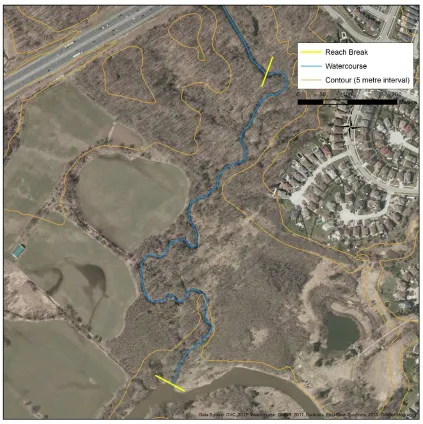
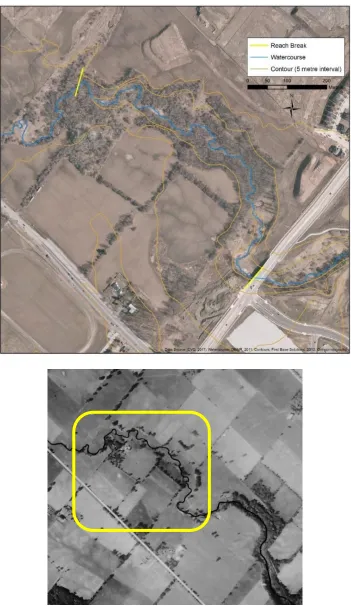
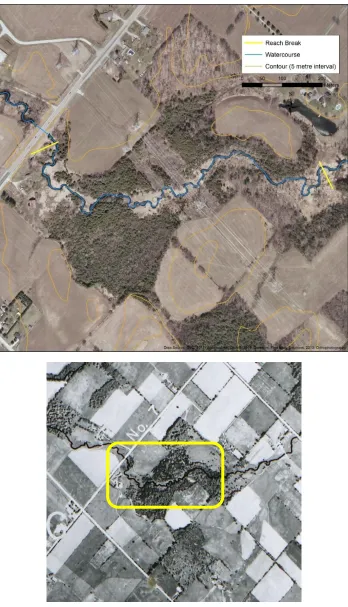
Western University Western University
Scholarship@Western
Scholarship@Western
Electronic Thesis and Dissertation Repository
9-27-2017 1:00 PM
Meander belt delineation: Developing a predictive model for
Meander belt delineation: Developing a predictive model for
meander belt width
meander belt width
Julia Howett
The University of Western Ontario
Supervisor Peter Ashmore
The University of Western Ontario Graduate Program in Geography
A thesis submitted in partial fulfillment of the requirements for the degree in Master of Science © Julia Howett 2017
Follow this and additional works at: https://ir.lib.uwo.ca/etd
Recommended Citation Recommended Citation
Howett, Julia, "Meander belt delineation: Developing a predictive model for meander belt width" (2017). Electronic Thesis and Dissertation Repository. 4915.
https://ir.lib.uwo.ca/etd/4915
This Dissertation/Thesis is brought to you for free and open access by Scholarship@Western. It has been accepted for inclusion in Electronic Thesis and Dissertation Repository by an authorized administrator of
i
Abstract
The delineation of a meander belt has been recognized in Ontario through land use planning
policies as a primary tool for determining the extent a river or stream requires for natural
meandering tendencies; thus, providing input to channel restoration projects, development
constraints or limits, and regulated areas for species-at-risk. Current delineation procedures utilize
site-specific historical migration assessments, or published empirical equations to predict meander
belt width. In the case of altered, low order watercourses in southern Ontario, the meander belt
width dimension is usually assessed by the application of empirical relations, as the available
historic record often lacks the information necessary to conduct meander morphology and
migration assessments. There is limited research concerned with the variables controlling meander
belt development, and on the precision and reliability of the measurement of belt width. Drawing
on a sample population of river reaches in the Credit River watershed, this research project
evaluates the current standards of practice for meander belt delineation in southern Ontario,
focusing on empirical equations to determine whether the width of the meander belt can be reliably
predicted from hydro-geomorphic variables. Results suggest meander belt width is scaled to
drainage area, discharge, and bankfull channel width. These results differ from equations
commonly used in Ontario assessments suggesting further need for model testing and assessment
of the reliability of meander belt width as a planning tool.
Keywords
ii
Acknowledgements
Above all, thank you to my remarkable research advisor, Dr. Peter Ashmore, for making my
Masters experience absolutely incredible, and one which I will always cherish. I am sincerely
grateful for your knowledge and constant support and guidance throughout the past two years.
Thank you to Beacon Environmental Ltd. for financially supporting my research. Moreover, thank
you Imran Khan for not only educating me with your vast amount of knowledge regarding this
research, but also for your friendship and guidance throughout this process.
Thank you to the members of my examination board, Dr. Dan Shrubsole, Dr. Desmond Moser,
and Dr. Imtiaz Shah, for your thoughtful discussion and prompt response.
A wholehearted thank you to Lara Middleton for your love, support, and friendship. I doubt I
would have made it through this journey without you. Thank you to Sarah Peirce for your support
and formatting wizardry. And a big thank you to my other geography mates M. Allen, R. Hilland,
C. Irwin, N. Pearce, T. Wiechers. Our weekly intellectual meetings at the GC were integral to my
thesis and my Masters experience.
A huge thank you to my parents, Nancy and Peter, for sticking with me through the highs and lows
over the last two years, and never turning down the revered opportunity to read through my drafts.
Thank you to all my friends and family for their unconditional love and support. You know who
iii
Table of Contents
Abstract ... i
Keywords ... i
Acknowledgements ... ii
List of Figures ... vi
List of Tables ... viii
Abbreviations ... ix
1 Introduction ... 1
2 Review of River Corridor Management and Meandering Channels ... 3
2.1 General Principles of River Corridor Management ... 3
2.2 Planimetric and Historical Assessment Methods for River Corridor Management ... 4
2.2.1 Channel Migration Zone ... 5
2.2.2 River Corridor (Vermont) ... 6
2.2.3 Freedom Space ... 7
2.3 Limitations of Planimetric and Historical Assessments ... 8
2.3.1 Summary ... 9
2.4 Meander Belt as a Method of River Corridor Management ... 10
2.5 Empirically-Based Models for Corridor Prediction ... 14
2.5.1 Limitations of Empirically-Based Models ... 17
2.5.2 Summary ... 18
2.6 Characterization of Meandering Channels... 19
2.7 Anatomy of Meander Bends ... 23
2.7.1 Sinuosity ... 24
2.7.2 Meander Wavelength ... 25
2.7.3 Meander Amplitude ... 26
2.7.4 Radius of Curvature ... 27
2.7.5 Limitations of Meander Geometry Measurement ... 27
2.8 Study Rationale and the Case of the Credit River ... 29
2.9 Research Objectives ... 29
3 Data Sources and the Credit River Watershed ... 31
3.1 The Credit River Watershed ... 31
iv
3.1.2 Physiography... 33
3.1.3 Hydrology ... 36
3.1.4 Land Use ... 40
3.2 Data Sources for Analysis ... 42
3.2.1 Credit River Watershed Orthophotography ... 43
3.2.2 Credit Valley Conservation Geomorphological Database ... 43
3.2.3 Credit River Watershed Study Conducted by Aquafor Beech Ltd. ... 44
3.2.4 Contours ... 44
3.2.5 Provincial Digital Elevation Model ... 45
3.3 Summary ... 46
4 Site Selection and Measurement of Parameters ... 47
4.1 Site Selection ... 47
4.1.1 Characteristics of Selected Sites ... 49
4.2 Field Investigations ... 59
4.3 Desktop Analysis ... 59
4.3.1 Drainage Area ... 59
4.3.2 Discharge ... 61
4.3.3 Other Hydrogeomorphic Parameters Measured or Calculated ... 61
4.4 Meander Belt Delineation Procedure ... 62
4.4.1 Reach Delineation ... 63
4.4.2 Digitizing Meander Axis... 64
4.4.3 Digitizing Meander Belt ... 66
4.5 Summary ... 67
5 Statistical Analysis of Meander Belt Width and Hydrogeomorphic Parameters ... 69
5.1 Correlations Analysis ... 69
5.1.1 Correlations with Meander Belt Width ... 70
5.1.2 Correlations between Hydrogeomorphic Parameters ... 73
5.2 Regression Analysis Procedures ... 74
5.2.1 Least Squares Regression ... 74
5.2.2 Reduced Major Axis Regression ... 76
5.2.3 Goodness of Fit Statistics... 77
v
5.3.1 Mean bankfull channel width... 78
5.3.2 Discharge ... 80
5.3.3 Drainage Area ... 82
5.3.4 Meander Amplitude ... 84
5.3.5 Discretization of Meander Belt Relations ... 87
5.4 Relations between Hydrogeomorphic Parameters ... 93
5.4.1 Relations between Drainage Area and Discharge ... 93
5.4.2 Relations with Mean Bankfull Channel Width ... 95
5.4.3 Relations with Meander Amplitude ... 98
6 Discussion ... 101
6.1 Characteristics of selected watercourses ... 101
6.2 Definition and Measurement of Meander Belt Width ... 102
6.3 Comparability of Models to Predict Meander Belt Width ... 103
6.3.1 Mean Bankfull Width Relation to Meander Belt Width ... 103
6.3.2 Discharge Relation to Meander Belt Width ... 106
6.3.3 Drainage Area Relation to Meander Belt Width ... 108
6.4 Interpretations ... 110
6.5 Future Research Perspectives ... 111
7 Conclusion ... 113
References ... 115
Appendix A – Site Characteristics ... 120
Appendix B – Descriptive Statistics for Model Development... 122
Appendix C – Field Investigation Form ... 127
Appendix D – Correlation Matrix ... 128
Appendix E – Descriptive Statistics of Regression Analysis ... 129
vi
List of Figures
Figure 2.1 – Channel migration zone delineation, from Rapp & Abbe (2003). ... 6
Figure 2.2 – River corridor delineation, adapted from Kline & Dolan (2008). ... 7
Figure 2.3 – Freedom space delineation, from Biron et al., (2014). ... 8
Figure 2.4 – Erosion hazard allowances by channel confinement, from MNR (2002). ... 12
Figure 2.5 – Common features of river meanders, from Hooke (2013). ... 19
Figure 2.6 – Classification of meander loops, from Brice (1974). ... 21
Figure 2.7 – Meandering channel pattern classification, from Thorne (1997). ... 22
Figure 2.8 – Definition of key meander geometry parameters. ... 24
Figure 2.9 – Configurations for sinuosity index of 1.5, from Hey (1976). ... 25
Figure 3.1 – Credit River Watershed location in southern Ontario, Canada. ... 32
Figure 3.2 – Credit River Watershed elevation. ... 33
Figure 3.3 – Credit River Watershed zones. ... 35
Figure 3.4 – Credit River Watershed physiography. ... 36
Figure 3.5 – Water Survey of Canada gauge station locations. ... 38
Figure 3.6 – Credit River discharge at Orangeville (1967-2015). ... 39
Figure 3.7 – Credit River discharge at Cataract (1915-2015). ... 39
Figure 3.8 – Credit River discharge at Boston Mills (1982-2015). ... 40
Figure 3.9 – Credit River discharge at Norval (1988-2015). ... 40
Figure 3.10 – Mean annual discharge for Credit River at four main-branch gauge stations. ... 40
Figure 3.11 – Credit River Watershed land use. ... 41
Figure 3.12 – Greenbelt boundaries within the Credit River Watershed. ... 42
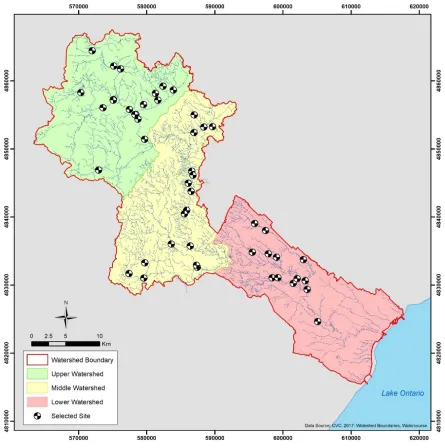
Figure 4.1 – Selected sites within the Credit River watershed. ... 48
Figure 4.2 – Sinuous low-order channel with degree of regular meandering (Reach LC3). ... 50
Figure 4.3 – Irregular meandering apparent in a medium-sized watercourse (Reach FC1). ... 51
Figure 4.4 – Larger fluvial system with regular meandering tendencies (Reach CR11). ... 52
Figure 4.5 – Watercourse which exhibits relative stability from 1954-2013 (Reach HC1). ... 54
Figure 4.6 – Watercourse which exhibits relative stability from 1954-2013 (Reach BC2). ... 55
Figure 4.7 – Watercourse which exhibits relative instability from 1954-2013 (Reach LCR1). ... 57
Figure 4.8 – Watercourse which exhibits relative instability from 1954-2013 (CR9). ... 58
Figure 4.9 – GIS-based drainage area measurement flow chart. ... 60
Figure 4.10 – Reach delineation (Reach BC2). ... 64
Figure 4.11 – Meander axis identification (Reach BC2). ... 65
Figure 4.12 – Meander belt delineation (Reach BC2). ... 67
Figure 5.1 – OLS relation of meander belt width and mean bankfull channel width. ... 79
Figure 5.2 – RMA regression model for meander belt width and mean bankfull channel width. 80 Figure 5.3 – OLS relation of meander belt width and discharge. ... 81
Figure 5.4 – RMA regression model for meander belt width and discharge. ... 82
Figure 5.5 – OLS relation of meander belt width and drainage area. ... 83
Figure 5.6 – RMA regression model for meander belt width and drainage area. ... 84
Figure 5.7 – OLS relation of meander belt width and meander amplitude. ... 85
vii Figure 5.9 – OLS relation of meander belt width and meander amplitude with the addition of
mean bankfull channel width. ... 86
Figure 5.10 – Discretization of the OLS model for meander belt prediction via mean bankfull channel width using the median of bankfull width at 6.10 m. ... 88
Figure 5.11 – Discretization of the OLS model for meander belt prediction via discharge using the median of discharge at 9.23 m3/s. ... 88
Figure 5.12 – Discretization of the OLS model for meander belt prediction using drainage area, with the median of drainage area at 25.3km2. ... 89
Figure 5.13 – Discretization of meander belt width OLS relation to mean bankfull channel width using watershed zones... 90
Figure 5.14 – Discretization of meander belt width OLS relation to discharge using watershed zones. ... 90
Figure 5.15 – Discretization of meander belt width OLS relation to drainage area using watershed zones. ... 91
Figure 5.17 – Organization of meander belt width and discharge by Strahler stream order. ... 92
Figure 5.18 – Organization of meander belt width and drainage areas by Strahler stream order. 93 Figure 5.19 – OLS relation of discharge and drainage area. ... 95
Figure 5.20 – OLS relation of mean bankfull channel width and discharge. ... 97
Figure 5.21 – OLS relation of mean bankfull channel width and drainage area. ... 97
Figure 6.1 – Meander belt width measurement discrepancies. ... 103
Figure 6.2 – Comparison of OLS meander belt width prediction models using bankfull width. 105 Figure 6.3 – Comparison of OLS meander belt width prediction models using discharge. ... 107
Figure 6.4 – Comparison of OLS meander belt width prediction models using discharge and bankfull width. ... 108
viii
List of Tables
Table 2.1 – Concepts of river corridor management. ... 4
Table 2.2 – Planimetric Procedures for Meander Belt Delineation. ... 14
Table 2.3 – Empirical Models for Meander Belt Delineation. ... 16
Table 2.4 – Channel type as defined by sinuosity ratio. Source: Charlton, 2008. ... 24
Table 3.1 – Sources and measurement of data used in statistical analysis. ... 43
Table 5.1 – Meander belt width and hydrogeomorphic parameter correlation coefficients. ... 72
Table 5.2 – Correlation matrix for significantly related hydrogeomorphic variables. ... 74
Table 5.3 – Relations of discharge and drainage area in southern Ontario. ... 94
Table 5.4 – Regional models for bankfull channel width via drainage area... 96
Table 5.5 – Relations of meander amplitude and channel width. ... 99
Table 6.1 – Bankfull width models for meander belt width prediction. ... 105
Table 6.2 – Discharge relations for meander belt width prediction. ... 107
ix
Abbreviations
Abbreviation Property Unit
A Channel cross-sectional area m2
AP Meander amplitude m
D Mean bankfull channel depth m
DA Drainage area km2
MB Meander belt width m
P Sinuosity Ratio
Q2 Discharge m3/s
w Mean bankfull channel width m
S Valley gradient Ratio
ω Total stream power W/m2
1
Chapter 1
1 Introduction
Policies that restrict land uses and protect stream corridors based on meander belt delineation have
been established in many jurisdictions, including Ontario. The concept of river corridor
management was formulated to address issues surrounding erosion hazards and sensitive habitats.
Rather than viewing a river channel as a liability which requires controls, such as bank hardening
and stabilization, watercourses are now viewed as assets which require space for natural processes
to occur (Piegay H. , Darby, Mosselman, & Surian, 2005). Of the various concepts of river corridor
management and delineation methods that now exist, one of the most commonly used is that of
meander belt delineation.
There are varied definitions of a meander belt, some which restrict the definition to a geometrical
parameter, and some which more broadly define it as the space a watercourse occupies within the
floodplain. The delineation of a meander belt has been identified as a tool for designating a corridor
in which meander migration may occur, with the ultimate goal of limiting development
encroachment, minimizing the loss or damage of property, and protecting natural areas or sensitive
habitats along river systems (Parish Geomorphic, 2004; Kline & Dolan, 2008).
In Ontario, for unconfined watercourses, the Ministry of Natural Resources requires a meander
belt allowance for development restrictions and species-at-risk legislation as part of the
Government of Ontario regulation polices (MNR, 2002). Meander belt delineation is commonly
comprised of planimetric and historical assessments of a watercourse which are used to define an
area of natural meander migration and associated erosional processes. The issue of meander belt
delineation is most prominent for watercourses which have been previously altered and no longer
2 meander belt delineation is through the application of empirical models that predict meander belt
width from other watershed or channel characteristics. While research concerned with
understanding the mechanics of meandering rivers exists, there is a paucity of research literature
focussing on the hydrologic and geomorphic controls of meander belts. Additionally, upon the
review of river corridor management techniques and meander belt delineation, it is apparent that
there is a lack of consensus on the methods of meander belt measurement to provide basis for these
predictive equations. The applicability and accuracy of models which are frequently used to predict
meander belt width have not yet been assessed for watercourses in southern Ontario.
The purpose of this research project is to evaluate the current standards of practice for meander
belt delineation in southern Ontario, focusing on empirical equations to determine whether these
models can reliably predict belt width. Drawing on a sample population of river reaches in the
Credit River watershed, this research will add to the database of meander belt literature which is
currently limited for watercourses in southern Ontario.
3
Chapter 2
2 Review of River Corridor Management and Meandering
Channels
2.1 General Principles of River Corridor Management
Perceptions of fluvial governance have shifted in regions of Europe and North America from a
preventative approach (i.e., bank hardening and protection) to a management approach which
focusses on allowing rivers to migrate freely within a delineated space, protecting natural
processes and providing safety for infrastructure; hence, the concept of river corridor management.
The concept of river corridor management has been said to have originated from the increased
awareness of the unsustainable nature and economic cost of engineered bank protections, as well
as the key role of channel dynamics and ecosystem services provided by uninhibited watercourses
(Thorne, Hey, & Newson, 1997; Piegay H. , Darby, Mosselman, & Surian, 2005). Several types
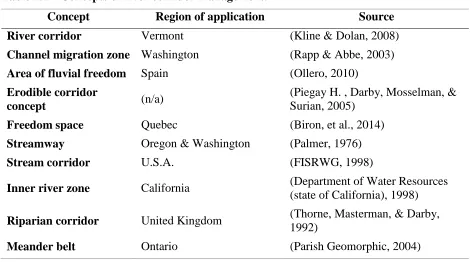
of river corridor management have been developed under a variety of names, as displayed in Table
2.1. The specific definitions and methods of the river corridor concepts vary; however, these
approaches are fundamentally parallel in their purpose of predicting areas at risk of future channel
erosion and associated conservation to help reduce threats to existing infrastructure, human
developments and critical habitats. However, when considering the regions of application for each
of the listed management concepts, it may be inferred that there is a regional association with river
4
Table 2.1 – Concepts of river corridor management.
Concept Region of application Source
River corridor Vermont (Kline & Dolan, 2008)
Channel migration zone Washington (Rapp & Abbe, 2003)
Area of fluvial freedom Spain (Ollero, 2010)
Erodible corridor
concept (n/a)
(Piegay H. , Darby, Mosselman, & Surian, 2005)
Freedom space Quebec (Biron, et al., 2014)
Streamway Oregon & Washington (Palmer, 1976)
Stream corridor U.S.A. (FISRWG, 1998)
Inner river zone California (Department of Water Resources
(state of California), 1998)
Riparian corridor United Kingdom (Thorne, Masterman, & Darby,
1992)
Meander belt Ontario (Parish Geomorphic, 2004)
2.2 Planimetric and Historical Assessment Methods for River
Corridor Management
The most common approach to delineating a river corridor is through planimetric assessments of
a watercourse (Thorne, Hey, & Newson, 1997; Lagasse, Zevenbergen, Spitz, & Thorne, 2004;
Piegay H. , Darby, Mosselman, & Surian, 2005). Historical data, including topographic maps and
aerial imagery, are used to identify channel geometry variables (e.g., channel sinuosity, meander
wavelength, bankfull channel widths), rates of channel mobility (e.g., rates of erosion and
floodplain turnover rates), and structures preventing channel migration (e.g., bank protection and
infrastructure). Field data, including riparian vegetation, bed and bank substrate, channel
dimensions, fluvial features, and mass movements, are used to supplement the remotely-sensed
data collected on a watercourse. With this information, the historical dynamics of a watercourse
can be assessed in order to predict channel behaviour in the future. Generally, channel mobility is
5 configurations of the watercourse. The product of this data is used to determine the extent of a
river corridor. Three examples of river corridor delineation methods, which were selected based
on different detailed approaches to river corridor delineation, are described and compared in the
sections to follow.
2.2.1 Channel Migration Zone
The concept of a channel migration zone is one example of a river corridor which is delineated
using planimetric assessment for channel which are assumed to be actively meandering; thus,
having associated erosion hazards. To delineate a channel migration zone, four distinct areas must
be identified: the hazard migration zone, avulsion hazard zone, erosion hazard area, and the
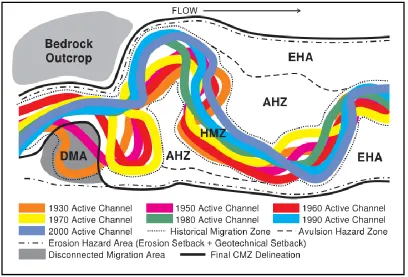
disconnected migration area (Rapp & Abbe, 2003). This method requires overlays of previous
channel configurations (Figure 2.1) to identify rates of erosion and directional movement of
meanders, as well as physical characteristics surrounding the watercourse, such as bed
stratigraphy, riparian vegetation, and structures which prevent channel migration. The restricting
characteristic of this methodology is that the channel must be actively migrating to delineate the
6
Figure 2.1 – Channel migration zone delineation, from Rapp & Abbe (2003).
(HMZ - Historical Migration Zone, AHZ – Avulsion Hazard Zone, EHA – Erosion Hazard Zone, DMA – Disconnected Migration Area)
2.2.2 River Corridor (Vermont)
The process of identifying a river corridor, as described by the Vermont Agency of Natural
Resources (Kline & Dolan, 2008), has been automated using the GIS extension, titled Stream
Geomorphic Assessment Tool (SGAT), which identifies the limits of a river corridor in a four-step
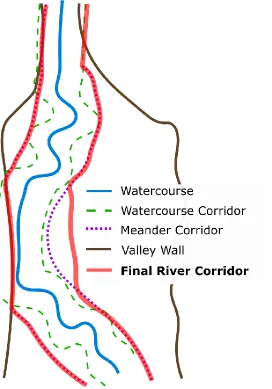
process. The corridor is created using the product of a space delineated parallel to the watercourse
centreline (watercourse corridor), a space parallel to the meander centreline (meander corridor),
and a space parallel to the valley wall (Figure 2.2). The GIS extension uses variables such as
bankfull channel width, valley wall position, sinuosity, and centrelines to delineate a final river
7 approach to delineating a river corridor, however the designated corridor which is output from the
automation tool may be arbitrary and require further analysis for proper corridor delineation.
Figure 2.2 – River corridor delineation, adapted from Kline & Dolan (2008).
2.2.3 Freedom Space
Freedom space is a river corridor concept which integrates flooding as well as the erosion and
migration processes occurring within a fluvial system into the space permitted for natural river
processes to occur (Biron, et al., 2014). The freedom space limits are conceptualized with two
distinct spaces: mobility space and flooding space. To delineate the mobility space, historical rates
8 extension uses transects across multiple years of channel configurations to generate a quantitative
representation of channel migration. The flooding space is determined by identifying distinctive
landforms suggesting flood processes, and relating them to the severity of flooding (low, medium,
high). Together, the mobility space and flood space are used to delineate three types of freedom
space: minimum (Lmin), functional (Lfunc), and rare (Lrare), based on the likelihood of channel
migration and flooding (Figure 2.3). Expert practitioners can then determine which freedom space
is most necessary for a particular watercourse.
Figure 2.3 – Freedom space delineation, from Biron et al., (2014).
2.3 Limitations of Planimetric and Historical Assessments
There are various limitations associated with the planimetric approach of delineating river
9 channel features and delineate river corridors. Planimetric analyses are only appropriate if the
channel is sufficiently large to be identified clearly on maps or images, and if channel movement
can be observed from one survey to another (Piegay H. , Darby, Mosselman, & Surian, 2005; Rapp
& Abbe, 2003). This dependency on map or image quality is also largely influenced by the scale
of the mapping medium. Although high resolution data may be acquired for more recent years,
historical imagery is often subject to lower resolutions, making it difficult to accurately map
watercourses. Additionally, the accuracy of the delineated river corridor is dependent on the time
span covered by the obtained mapping materials, which are commonly independent of the temporal
distribution of flooding and migration activity (Piegay H. , Darby, Mosselman, & Surian, 2005).
For migration analyses, this limitation is magnified as high-resolution historical images may be
required for delineation. It has been recommended that historical and current imagery have a scale
of 1:10,000 or 1:20,000 be used in overlay procedures (Thorne, Hey, & Newson, 1997; Parish
Geomorphic, 2004). In some cases, obtaining imagery for current channel configuration may be
difficult due to stream size, vegetation cover, or remote locations. Acquiring the necessary data
for planimetric assessments can be difficult for many watercourses. Moreover, errors associated
with image registration, georeferencing, and feature measurement can be introduced in planimetric
analyses, which can jeopardize the accuracy of river corridor delineation which are based on
historical migration (Rapp & Abbe, 2003).
2.3.1 Summary
The methods of river corridor management discussed above are a few examples of those
approaches grounded in the use of planimetric analysis of historical data (e.g., topographic maps
and aerial photography) and field data to develop an understanding of the watercourse dynamics.
10 which may be due to the varying locations at which they are applied by prioritizing and
emphasizing certain aspects of river migration, and erosion and flooding hazards. Additionally,
while some of these methods rely on more simplistic map and image overlays to track previous
channel migration, others have adopted more GIS-based or computer-automated programs.
Despite the differences in automated or manual delineation, these methods of river corridor
management have a common goal of outlining the space a watercourse needs for natural river
migration processes to occur, protecting sensitive habitats and mitigating fluvial erosion threats to
infrastructure. Nonetheless, these methods are still confined by limitations: the availability of
historical data, erroneous conclusions introduced by mapping and measurement techniques, the
applicability for altered watercourses, and the repeatability and reliability of the methods when
applied to a specific watercourse.
2.4 Meander Belt as a Method of River Corridor Management
Meander belt is a term which is used to describe the space a meandering watercourse occupies
within the floodplain. The width of a meander belt is of particular interest as it defines the area
that the watercourse occupies or can occupy in the future; thus, providing a quantitative
measurement of a river corridor. Jefferson (1902) first coined the term meander belt as, “the width
of the belt of meanders between lines tangent along the swings of the river.” For many descriptions
of meander belt, this definition is similar. For example, Annable (1996) defines meander belt as
the, “greatest lateral width of the meander pattern within the trend of the valley.” Similarly, Ackers
and Charlton (1970) define meander belt width as the width between parallel lines which contain
the meandering channel. However, there is literature which fails to follow set definition, such as
Carlston (1965), who defines meander belt width as the average width of meanders in a river reach,
11 discrepancies in meander belt definition, the term is commonly used throughout literature which
focusses on meander geometry and planform.
The Ontario Ministry of Natural Resources’ (MNR) Water Resources Section published the
Technical Guide for River and Stream Systems: Erosion Hazard Limits in 2002. The guide was
prepared, “to provide a consistent standardized procedure for the identification and management
of riverine erosion hazards in the Province of Ontario,” in order to assist in the understanding of
regulations in the 1996 Ontario Provincial Policy statement (MNR, 2002). Within the Provincial
Policy statement, the discussion of meander belt delineation requirements is scarce, simply stating
that development shall be generally directed to areas outside of erosion hazards or the “predicted
meander belt of a watercourse,” (Section 3, Policy 3.1.1) (Ontario Ministry of Municipal Affairs,
1996). This is reiterated in the Conservation Authorities Act: Ontario Regulation 97/04 where it is
stated that a regulation shall prohibit development within the “predicted meander belt of a
watercourse” (Government of Ontario, 1990). Meander belt delineation is also discussed in the
Endangered Species Act (2007) in relation to Redside Dace (Clinostomus elongates), indicating
habitat is considered as, “the area encompassing the meander belt width” (Government of Ontario,
2007). Despite the brief discussion of meander belt delineation in Ontario regulatory documents,
there is still ambiguity in regards to the circumstances in which a meander belt delineation is
unequivocally required.
The most detailed discussion of meander belt delineation is within the MNR (2002) technical guide
for erosion hazard limits. The document states three main components of erosion hazards: natural
processes of erosion, flooding, and slope stability (MNR, 2002). Fluvial systems are classified in
the guide as confined or unconfined. Confined systems are defined as, “ones in which the physical
12 from the surrounding landscape,” (MNR, 2002). This definition differs from that of the more
specific and standard geomorphology definition in which confined systems are where, “the channel
is bordered on either side by banks that are higher than the highest flood level, or by valley sides,”
(Ashmore & Church, 2001). Unconfined systems are defined as, “ones in which a river or stream
is present but there is no discernible valley slope that can be detected,” (MNR, 2002). Erosion
hazard allowances are varied based on the type of confinement, as seen in Figure 2.4. For
unconfined systems, the guide states a meander belt allowance is necessary. However, in many
cases meander belts are also delineated by practitioners for confined systems.
Figure 2.4 – Erosion hazard allowances by channel confinement, from MNR (2002).
The document defines a meander belt allowance as the maximum extent that a water channel
migrates (MNR, 2002). It is recommended that the meander belt allowance is calculated by 20
13 protocol is said to be based on available information, yet lacks reference to any supporting data.
The technical guide allows for alternative approaches, in that, “if the proponent determines that
the recommended [procedure] is not appropriate for their location, they must provide […] an
analysis of the meander belt width which can be determined through accepted scientific and
engineering study,” (MNR, 2002). For those locations where other analyses seem required, the
Belt Width Delineation Procedure document, prepared by Parish Geomorphic Ltd. (2004) for the
Toronto and Region Conservation Authority (TRCA), appears to be the preferred alternative.
The TRCA report (Parish Geomorphic, 2004) was created to recommend a protocol for the
delineation of meander belt width for river systems within the TRCA jurisdiction, but is generally
adopted by other Conservation Authorities throughout southern Ontario. The document was
authored by consulting company Parish Geomorphic. The document references an extensive list
of academic literature concerned with meander geometry and morphological assessment.
However, as the report was intended for TRCA use and to provide recommendations within set
jurisdiction, the contents of the document were not subject to a critical or peer-review process.
Nevertheless, the document is used widely across southern Ontario as the primary means of
delineating a meander belt. Here, meander belt is defined as the space a watercourse occupies on
its floodplain in which all natural channel processes occur (Parish Geomorphic, 2004). There are
five core procedures within the report which may be used to delineate a meander belt, of which
four are based on the planimetric assessment of a watercourse (Procedures 1-4). Each of the
procedures follow the same methodology for reach delineation, meander belt axis identification,
and historical analyses (where applicable). The procedures differ based on the current and/or
anticipated state of the watercourse, demonstrated as the scenario in Table 2.1. Procedure 1 was
14 planning-level studies. Procedures 2-4 were designed for an accurate delineation of a meander
belt, which requires more detailed analysis of historical and current channel configurations, and
anticipated hydrologic scenarios for the watercourse.
Table 2.2 – Planimetric Procedures for Meander Belt Delineation.
Source: Parish Geomorphic (2004).
Procedure Scenario Meander Belt Width Calculation
Procedure 1 Preliminary belt width
delineation
Tangential lines are drawn along extreme meander bends to generate a preliminary belt width (B). Corrections are made based on channel confinement and incision.
Procedure 2 Change in the hydrologic
regime isnot anticipated.
If the existing belt width is < 50m:
Final Belt Width = Belt Width + D + E
If the existing belt width is > 50m:
Final Belt Width = Belt Width * 1.10 + E
Procedure 3
Change in the hydrologic regime is anticipated. (Increase in duration of flows and in frequency of occurrence).
If the existing belt width is < 50m:
Final Belt Width = (Belt Width*1.05) + D + E
If the existing belt width is > 50m:
Final Belt Width = Belt Width * 1.20
Procedure 4
Change in the hydrologic regime is anticipated. (Increase in peak flows and frequency of occurrence).
Final Belt Width = (B + C + D) * adjustment ratio
B = Preliminary Belt Width, C = average bankfull width, D = distance migrated in 100 years (estimated with migration rate), E = distance meander axis shifted in 10-years
2.5 Empirically-Based Models for Corridor Prediction
Knowledge of geomorphic and hydrologic variables which relate to a channel’s ability to migrate
within the landscape has permitted the conception of empirical models which predict meander
15 relations have been adapted and applied as a tool of estimating and predicting meander belt width
through the collection of empirical data on watercourses where the related hydrologic and
geomorphic variables have been measurable. The models are used primarily as a method of
assessing smaller or low-order watercourses lacking the necessary historical mapping materials
and watercourses which have been altered and may no longer demonstrate a ‘natural’ configuration
(Parish Geomorphic, 2004), as well as a substitute for time-consuming planimetric analyses. Table
2.3 lists several empirical equations which have been developed to estimate meander belt width
(MB) based on other properties of the river channel and/or watershed.
The most common variables used to predict meander belt width are channel and meander geometry
variables, including meander wavelength, radius of curvature, and bankfull channel measurements.
Hydrologic parameters are also employed, including stream power and discharge. However, a brief
review of the empirical models in Table 2.4 demonstrates large discrepancies among coefficients
in equations which relate the same variable to meander belt width. For example, based on these
relations, meander belt width ranges from 4.3 to17.6 times the bankfull channel width. These
inconsistencies may be, in part, due to the spatial variability of watercourses, resulting in
site-specific empirical equations based on the watercourses from which they were developed. From the
empirical equations in Table 2.3, only the models established by Annable (1996) and Parish
Geomorphic (2004) were developed on watercourses from the region of southern Ontario. Annable
(1996) developed his empirical relations from 47 primarily rural watersheds in southern Ontario.
However, he states that the equations display low levels of reliability, as seen by the goodness of
fit statistics, and should only be applied as “…first-order approximations of gross-scale channel
characteristics related to basin scale studies” (Annable, 1996). Therefore, these relations are not
16
Table 2.3 – Empirical Models for Meander Belt Delineation.
Source Variables Model Reliability Conditions
Ackers &
Charlton (1970) Discharge (Q)
MB = 18.50 Q0.51
MB / w = 2.17 Q0.19
λ / MB = 2.06 Q-0.04
S.E. = 0.21
S.E. = 0.23
S.E. = 0.18
Annable (1996) Bankfull
discharge (Qbf)
MB = 56.95 Qbf0.45
MB = 16.30 Qbf0.88
MB = 131.26 Qbf0.29
S.E. = 0.34
S.E. = 0.29
S.E. = 0.01
Rosgen C – type
Rosgen E – type
Rosgen F – type
Bridge & Mackey (1993)
Hydraulic depth
(DH) MB = 59.90 DH
1.8
Carlston (1965) Mean annual
discharge (Qa) MB = 65.80 Qa
0.47 r2 = 0.96
Collinson (1978) Maximum
depth (Dmax) MB = 65.60 Dmax
1.12
Jefferson (1902) Bankfull width
(w) MB = 17.60 w
Lorenz et al. (1985)
Bankfull width
(w) MB = 7.53 w
1.01 Parish Geomorphic (2004) Total Stream power (ω) Drainage area (DA)
MB = -14.827 +
8.319ln (ω * DA)
r2 = 0.739
S.E. = 8.63
DA < 25 km2
Ward et al. (2002) Bankfull width
(w) – in feet MB = 4.00 w
1.12 Williams (1996) Meander wavelength (λ) Radius of curvature (Rc) Bankfull width (w) Bankfull depth (D)
MB = 0.61 λ
MB = 2.88 Rc
MB = 4.30 w1.12
MB = 148.00 D 1.52
r2 = 0.98
r2= 0.96
r2 = 0.92
r2 = 0.81
8 < λ < 23,200 m
2.6 < Rc < 36,000 m
1.5 < w < 4,000 m
0.03 < d < 18 m
17 For highly modified watercourses, Parish Geomorphic Ltd. derived an empirical equation to
predict expected or potential meander belt width from drainage area and stream power of a
watercourse (Procedure 5). Stream power is a quantitative description of the potential of flowing
water to perform geomorphic work as it moves along an energy gradient (Leopold, Wolman, &
Miller, 1964). Stream power can be defined by the total stream power (ω), the power per unit
length of the channel in watts per square metre, or by specific stream power (Ω), as the power per
unit area of the channel in watts per metre. Stream power has been used as a predictor of channel
dimensions and channel pattern (Magilligan, 1992; Knighton, 1999), and as a predictor of channel
mobility (Bull, 1979; Magilligan, 1992). Therefore, stream power may be a likely control of
meander belt width by controlling migration rates and overall channel dimensions. The TRCA
report (Parish Geomorphic, 2004) does not provide the supporting data (watercourse locations,
river characteristics, statistical methods, etc.) from which the empirical equation was developed.
Additionally, incorporating both stream power and drainage area in the relation appears redundant,
as drainage area is highly correlated with discharge, and therefore, drainage area may be used, “as
a surrogate for discharge in empirical studies of channel morphology” (Knighton, 1999). As stated,
the results from the empirical analysis by Parish Geomorphic (2004) are often compared with other
meander belt width relations, primarily those of Williams (1986). Alternatively, other relations are
employed in lieu of the empirical analysis by Parish Geomorphic, including those of Lorenz et al.
(1985) and Ward (2002).
2.5.1 Limitations of Empirically-Based Models
Empirical equations which relate hydrologic and geomorphic watercourse characteristics offer a
way to estimate and predict meander belt dimensions, reducing the extensive data needs of
18 exhibit the site-specific nature apparent in planimetric assessments. For instance, Williams (1986)
and Ward et al. (2002) both state the application of their respective equations are feasible for
meander belt width quantification, despite the large discrepancies among coefficients which relate
meander belt width to bankfull channel width. It has been indicated that poor correlations among
meander properties is likely due to the strong control of stream bank erodibility and other local
factors which control meander size (Leopold & Wolman, 1960; Shahjahan, 1970). This suggests
that the relationships developed between meander belt width and channel geometry features may
be unique to the specific watercourses for which they were developed, or conversely, do not
include all relevant variables for meander belt delineation. Although the site-specific nature of
these equations has been acknowledged (Piegay H. , Darby, Mosselman, & Surian, 2005;
Shahjahan, 1970), whether it be the type of stream or geomorphic characteristics of the region,
empirical relations continue to be applied on watercourses outside of the range of stream size or
type for which they were developed.
2.5.2 Summary
Empirical relations offer an opportunity to estimate the size of a river corridor, specifically the
width of a meander belt, when planimetric assessments are not feasible. Several empirical
equations for the estimation of meander belt width exist which employ both hydrologic and
geomorphic variables. Furthermore, empirical relations, such as Williams (1986) and Ward et al.
(2002), have been used as part of meander belt width justification, but their validity has not been
tested for data from southern Ontario rivers, and the relation by Parish Geomorphic (2004) based
19
2.6 Characterization of Meandering Channels
Meandering channels may be characterized as single-thread channels with sinuous planform which
is comprised of a series of loops or meander bends (Hooke, 2013). They are differentiated from
braided rivers on the continuum of river patterns based on their more stable single-thread
configuration which commonly exhibit higher sinuosity values (Leopold, Wolman, & Miller,
1964; Lagasse, Spitz, Zevenbergen, & Zachmann, 2004; Hooke, 2013). Meandering channels
commonly exhibit an undulating river bed which alternates between deep and shallow sections,
commonly referred to as pool-riffle formations (Leopold, Wolman, & Miller, 1964). This vertical
spatial variation along the length of a channel also influences the lateral planform of the channel
within meandering systems, as pools are commonly associated with meander bends where erosive
forces are concentrated. Figure 2.5 displays the common features of river meanders in an idealized
symmetrical meander bend.
Figure 2.5 – Common features of river meanders, from Hooke (2013).
Unlike the idealized meander shown in Figure 2.5, most meanders appear to be inherently
20 loops in nature are absolutely identical,” resulting in the inadequacy of the single symmetrical
geometric form to describe all meander loops. Despite this notion and the widespread display of
asymmetrical meandering tendencies, many initial theories of meandering channels assumed
symmetry of meander planform.
Rather than confining the classification of meanders to a simple symmetrical form, a broader range
of more complex meander configurations are now utilized. Brice (1974) suggested meander loops
be assessed as either simple symmetrical loops, simple asymmetrical loops, or compound loops
(Figure 2.6). The evolution of the awareness that meander loops can range in form has also been
applied to meandering patterns at larger scales which incorporate several successive meanders. For
example, compound patterns have also been described as a second meandering tendency
21
Figure 2.6 – Classification of meander loops, from Brice (1974).
In addition to the irregularity and pattern of a channel, meandering watercourses can be classified
and defined by stability: whether they are actively migrating laterally and downstream, or are more
relatively stable. A classification method of assessing channel stability was developed by Brice
(1975) and further modified by Lagasse et al. (2004); it classifies channels by sinuosity and by
variation in channel width (Figure 2.7). Brice (1982) found that channels which do not vary
significantly in channel width are relatively stable, while channels which are wider at the apex of
22 assessing channel stability. Combining the width-variability criterion and sinuosity enabled the
formation of a classification system for meandering channels. Nevertheless, the numerous forms
of meander migration and meander patterns may cause difficulty in placing particular reaches
within such classifications.
Figure 2.7 – Meandering channel pattern classification, from Thorne (1997), modified from
23
2.7 Anatomy of Meander Bends
Meandering channels are often described by their shape, which can be quantitatively measured by
a defined set of geometric parameters. Knowledge of meander geometry allows for the
classification of watercourses, permitting the identification of similarities among meandering
channels and comparisons among states of stability based on meander planform. It has been
suggested that meander geometry of a channel is scaled to that of channel width, dominant
discharge, stream power or drainage area (Thorne, Hey, & Newson, Applied Fluvial
Geomorphology for River Engineering and Management, 1997). This follows similar theories of
hydraulic geometry developed by Leopold and Maddock (1953), where river dimensions are scaled
to discharge or drainage area. This notion offers insight as to which parameters may be most
influential of meandering patterns, and thus, which may be most pertinent in meander belt width
estimation.
Meander geometry has been reduced to a manageable number of parameters. Ferguson (1975)
suggested a three-component pattern continuum framework, in which meandering rivers are
characterized by three planimetric properties: the complexity of meandering, the scale of
meandering, and the degree of irregularity. Parameters that are commonly used to address this
include sinuosity (complexity), meander wavelength (scale), meander amplitude (scale), and
radius of curvature of a bend (scale and irregularity) (Figure 2.8). Details of these parameters are
24
Figure 2.8 – Definition of key meander geometry parameters.
2.7.1 Sinuosity
The sinuosity of a channel has been defined as a measure of the degree of complexity or
curvilinearity displayed within a meandering channel (Andrle, 1996). Sinuosity (P) is commonly
measured as a ratio between the length along a channel (LC) to the length of the valley (LV) within
a given reach (Figure 2.8). Ratios are frequently compared to a sinuosity index (Table 2.4). The
threshold values of the sinuosity index are widely used; however, are arbitrary in nature, as the
values are not based on physical differences related to meandering (Charlton, 2008).
Table 2.4 – Channel type as defined by sinuosity ratio. Source: Charlton, 2008.
Sinuosity Ratio Channel Type
<1.1 Straight
1.1-1.5 Sinuous
>1.5 Meandering
For a given sinuosity value, there are numerous channel configurations which are possible (Figure
25 confirmed by Hooke & Yorke (2010), who found a relatively constant sinuosity value in a
meandering reach despite observing major changes in the shape and length of individual meander
bends. Sinuosity is greatly influenced by the scale at which channel parameters are measured.
Figure 2.9 – Configurations for sinuosity index of 1.5, from Hey (1976).
Mueller (1968) and Ferguson (1975) proposed hydraulic and topographic sinuosity indexes to
account for physical attributes of a watercourse, which incorporates a measurement described as
the “air” distance, or shortest distance from the source to the mouth of a watercourse. Additionally,
a surrogate of sinuosity was developed by Andrle (1996) in a method titled the angle measurement
technique, where a characteristic angle (Ac) defines the maximum degree of complexity. Although
this variable is not synonymous with sinuosity, it provides a measure of the scale of complexity
while eliminating the scale-dependent nature of sinuosity measurements. Nevertheless, the
traditional measurement of sinuosity continues to be employed for the purpose of classifying the
scale of complexity apparent in meandering channels.
2.7.2 Meander Wavelength
Meander wavelength (λ) has been defined as a measure of the scale of meandering within a channel
by quantifying the spacing of successive meander bends (Leopold & Wolman, 1960; Andrle, 1996;
26 of the downstream scale of meandering, rather than a lateral migration measurement. Meander
wavelength is determined by doubling the straight-line distance between two successive points of
inflection (Figure 2.8). However, this measurement is complicated by irregularities in channel
pattern. Ambiguity can be introduced when defining points of inflection, particularly in small
channels or when irregularities are apparent. Another issue apparent with meander wavelength
measurements is the selection of an “average” pair of meanders for assessment which can result in
the misrepresentation of a channel (Ferguson, 1975). A detailed characterization of meander
wavelengths is that of spectral analysis where a dominant wavelength may be identified (Speight,
1965; Chang & Toebes, 1970; Ferguson, 1975).
There is a well-established relationship between meander wavelength and channel width, dating
back to work by Leopold and Wolman (1960), which has allowed for the derivation of empirical
equations to estimate meander wavelength. It can be said that meander wavelength bears a
relatively constant ratio with channel width, ranging from approximately six to twelve times
channel width. Although these equations suggest identifiable underlying tendencies in meander
morphology and channel dimensions, they are only approximations of true relations (Williams,
1986). Therefore, care must be taken in applying and relying on such empirical relations to
quantify the scale of meandering in a channel.
2.7.3 Meander Amplitude
Meander amplitude is a measure of the lateral extent of a meander (Figure 2.8), defined as the
lateral distance between tangential lines drawn to the centre of a channel across two successive
meander bends (Leopold, Wolman, & Miller, 1964). As meander amplitude is measured on a set
of meander bends, in order to describe a channel at a reach scale, a governing meander amplitude
27 meander amplitude measurements; however, it has been shown to poorly correlate with other
meander geometry or channel characteristic variables (Leopold, Wolman, & Miller, 1964;
Williams, 1986). It has been inferred that meander amplitude may be controlled more by local
characteristics of the channel, such as the stability of the banks and erosive forces occurring within
the watercourse, rather than any hydrogeomorphic principles (Leopold, Wolman, & Miller, 1964).
2.7.4 Radius of Curvature
Radius of curvature (Rc) can be determined by fitting a circle to the centre line or outer bank of
the meander bend and measuring the radius of the inscribed circle (Figure 2.8). Similar to meander
amplitude, radius of curvature is a parameter which is not measured at the reach scale, as are
meander wavelength and sinuosity. Brice (1974) inscribed circular arcs on idealized meander loops
to indicate the general geometry and symmetry of meanders which assists in understanding and
classifying meander shape and evolution. This visual assessment of curve fitting has been
enhanced quantitatively by introducing the measurement of radius of curvature of an individual
meander bend. This parameter indicates the tightness of an individual meander, and has been
employed to represent the state of meander regularity and stability (Geist, 2005; Lagasse, Spitz,
Zevenbergen, & Zachmann, 2004). For example, it has been suggested that meanders with larger
radius of curvature measurements display greater stability (Hickin & Nanson, 1984; Geist, 2005).
The process of fitting a single circle to a simple symmetrical or asymmetrical meander bend can
be a relatively straightforward task. However, fitting single circles to complex or compound bends
can be difficult and more subjective.
2.7.5 Limitations of Meander Geometry Measurement
Despite the various benefits, there are significant limitations to measuring meander geometry.
28 maps and aerial photographs as a medium of measurement, as well as the subjectivity of
delineating meander parameters.
Although the introduction of aerial photography has reduced many of the errors associated with
topographic maps, issues concerning distortion and scale remain. The scale at which aerial
photography is taken greatly affects the accuracy of meander geometry quantification, especially
with small watercourses displaying complex and minor meander configurations. Enhancing
photographs, specifically those which are historical, can result in the distortion of a channel. The
accuracy at which meander geometry is delineated is dependent on the scale and quality of the
aerial photographs used; thus, errors will propagate through meander geometry quantification
(Ferguson, 1975).
The measurement of geometric meander variables has been proven to be highly subjective.
Meander sinuosity is largely dependent on the scale of measurement, and the estimation of the
channel and valley lengths can become increasingly difficult with small and complex systems
(Andrle, 1996). The precise measurement of meander wavelength is often difficult and subjective,
due to scaling issues, channel complexity, and the identification of inflection points (Andrle, 1996;
Carlston, 1965; Hooke, 1984). As well as being dependent on the scale of the mapping medium,
radius of curvature measurements are significantly influenced by the method of fitting a circle or
arc to a meander bend (Lagasse, Spitz, Zevenbergen, & Zachmann, 2004).
Finally, the use of meander geometry to predict meander migration is subject to the assumption of
continuity of change (Lawler, 1993). The movement of a meander is assumed to be simple,
continuous, and linearly migrating, which fails to account for the sometimes stochastic and
29
2.8 Study Rationale and the Case of the Credit River
Current land use management policies and procedures require the application of site-specific
planimetric assessments, or empirical equations, to measure or predict river corridor and meander
belt dimensions. In the case of small, low-order, or highly modified watercourses, the measurement
of meander belt width is driven by the application of empirical relations. However, there is limited
documentation regarding the range of meander morphology in the watersheds of southern Ontario,
and the principle parameters that control meander belt width have not yet been systematically
investigated. Upon analysis of river corridor management techniques and meander belt delineation,
it is evident that there is a lack of knowledge and agreement regarding the methods of meander
belt delineation, and the controls of meander belt development. Therefore, based on the
conclusions of this analysis, the present research aims to shed light on the array of meander
morphology within southern Ontario, incorporating empirical data from a selection of
watercourses within the region, and to develop an empirical relation for meander belt width
prediction and quantification that is both developed for and supported by regionally derived data.
2.9 Research Objectives
The fundamental question driving this investigation is:
What geomorphic and hydrologic variables primarily control meander belt width?
It is anticipated that meander belt width will scale to hydrogeomorphic variables in a similar
manner to other meander geometry parameters. In order to assess the presented research question,
the project has three primary objectives:
1. Document meander morphology and meander belt width over a range of channel sizes and
30 2. Correlate interactions between meander belt width and primary independent variables:
stream power, drainage area, discharge, bankfull channel dimensions, and channel
configuration.
3. Compare statistical relations of meander belt width prediction developed using the present
data set with previously established relations that are currently used in practice in southern
31
Chapter 3
3 Data Sources and the Credit River Watershed
3.1 The Credit River Watershed
The Credit River is a tributary to Lake Ontario with a drainage area of approximately 860km2 extending northwest to Orangeville, located on the northern shore of Lake Ontario. The watershed
has a well documented geomorphological database consisting of channel characteristics and
measurements, collected by the Credit Valley Conservation Authority (CVC), which has been
made available for the present research. The availability of data made this research feasible within
the restricted time limits. The watershed displays landscape diversity, covering several distinct
geological settings, many of which are characteristic to southern Ontario. By selecting 46 sites in
a fluvial system that includes representative geomorphic and geological settings and range of river
types and sizes, the study results will be transferrable to similar landscapes in other watersheds in
southern Ontario. The purpose of this chapter is to introduce the Credit River watershed and data
sources used in analysis.
The Credit River was selected for two major reasons:
1. Data availability
2. Landscape diversity
3.1.1 Location
The Credit River is located on the northern shore of Lake Ontario and is part of the Great Lakes
Basin which drains into the St. Lawrence River. The watershed falls under the Credit Valley
Conservation Authority’s (CVC) jurisdiction. The watershed, divided into 23 sub-watersheds,
stretches from its headwaters in Orangeville, Erin and Mono, through nine municipalities,
32 Ontario, the upstream drainage is 860km2 (Kennedy & Wilson, 2009), with minimum and maximum elevations of approximately 70 and 525 metres above sea level, respectively, giving a
total relief of approximately 455 metres (Figure 3.2).
33
Figure 3.2 – Credit River Watershed elevation.
3.1.2 Physiography
The Credit River watershed can be divided into three distinct physiographic regions, termed by
the CVC (2009) as the upper, middle, and lower watershed zones (Figure 3.3). The upper
watershed zone, covering 330km2 of the entire catchment, can be characterized by hilly areas of
till plains, moraines, drumlins, and glacial spillways (Figure 3.4). Tributaries located here are
34 (Kennedy & Wilson, 2009). The river exits the plateau through knickpoints in the Niagara
Escarpment at Cataract and Belfountain, with the main and west branches uniting at the Forks of
the Credit. The middle watershed, approximately 300km2, is comprised of portions of the Niagara
Escarpment, dominated by rock outcrops of dolomitic limestone and shale, and steep terrain. The
Oak Ridges Moraine is a prominent feature in the eastern section of the region. The Credit River
has built a wide alluvial plain on the Lake Ontario plain downstream of the escarpment, the lower
watershed, which is approximately 230km2 of the catchment (Kennedy & Wilson, 2009). This
relatively flat topographical area, where the valley is cut into till and underlying shale, leads a
35
36
Figure 3.4 – Credit River Watershed physiography.
3.1.3 Hydrology
The Water Survey of Canada operates a total of nine stream-gauges within the Credit River
catchment, of which four stream-gauges on the main branch will be addressed in this thesis. From
upstream to downstream, the gauges are: 02HB013, “Credit River near Orangeville”; 02HB001,
“Credit River near Cataract”; 02HB018, “Credit River at Boston Mills”; 02HB025, “Credit River
at Norval” (Figure 3.5). The gauges have been operational since 1967, 1915, 1982 and 1988,
37 hydrographs for each gauged station using the historical datasets obtained from Water Survey
Canada. A compilation of annual hydrographs from each of the gauges (Figure 3.10) demonstrates
very little change in discharge since the time the gauges were installed, with the Norval gauge
showing a slight trend with a very low r2value. The lack of a trend suggests that using a discharge
for a particular time period will not greatly impact the results of model development, for this data
set. The hydrographs appear typical for southern Ontario watercourses, and demonstrate little
38
Figure 3.5 – Water Survey of Canada gauge station locations.
39
Figure 3.6 – Credit River discharge at Orangeville (1967-2015).
Figure 3.7 – Credit River discharge at Cataract (1915-2015).
0 0.5 1 1.5 2 2.5 3
0 50 100 150 200 250 300 350
Me an Da ily Dis ch ar ge (m 3/s )
Time (Day of the year)
Mean Daily Discharge Median Daily Discharge 90th Percentile 10th Percentile
0 2 4 6 8 10 12 14 16
0 50 100 150 200 250 300 350
Me an Da ily Dis ch ar ge (m 3/s )
Time (Day of the year)
40
Figure 3.8 – Credit River discharge at Boston Mills (1982-2015).
Figure 3.9 – Credit River discharge at Norval (1988-2015).
0 5 10 15 20 25 30
0 50 100 150 200 250 300 350
Me an Da ily Dis ch ar ge (m 3/s )
Time (Day of the year)
Mean Daily Discharge Median Daily Discharge 90th Percentile 10th Percentile
0 5 10 15 20 25 30 35 40 45
0 50 100 150 200 250 300 350
Me an Da ily Dis ch ar ge (m 3/s )
Time (Day of the year)
40
Figure 3.10 – Mean annual discharge for Credit River at four main-branch gauge stations.
3.1.4 Land Use
Land use within the Credit River watershed is primarily agricultural and developed land, which
together cover approximately 70% of the basin (CVC, 2009). The lower watershed is heavily
developed, covering the majority of Mississauga and western Brampton (Figure 3.11).
Approximately 80% of the 750,000 living within the Credit River watershed are located within the
lower watershed zone (CVC, 2009). The upper and middle watersheds have remained primarily
agricultural and forested. This is, in part, due to the demand for rural estate properties, with 20%
of agriculture declared as equestrian farms (CVC, 2009), and due to the Greenbelt Legislation
which now protects areas of the Oak Ridges Moraine, Niagara Escarpment, and selected
countryside (Figure 3.12) (Kennedy & Wilson, 2009).
Q = 0.05x - 96.87
r² = 0.06
Q = 0.003x - 0.53
r² = 0.00
Q = 0.001x - 1.81
r² = 0.02
Q = 0.002x - 2.86
r² = 0.03
0 1 2 3 4 5 6 7 8 9 10
1900 1920 1940 1960 1980 2000 2020
41
42
Figure 3.12 - Greenbelt boundaries within the Credit River Watershed.
3.2 Data Sources for Analysis
A large amount of data has been collected within the Credit River watershed by CVC in order to
fulfill the Integrated Watershed Monitoring Program (IWMP), which originated in 1999. These
data are of value with respect to the objectives of this thesis, and can be used to determine, analyze,
and validate the findings of meander belt dimensions for the development of a predictive meander