Scholarship@Western
Scholarship@Western
Electronic Thesis and Dissertation Repository
10-23-2015 12:00 AM
Secrecy Enhancement in Cooperative Relaying Systems
Secrecy Enhancement in Cooperative Relaying Systems
Elham Nosrati
The University of Western Ontario
Supervisor Dr. Xianbin Wang
The University of Western Ontario
Graduate Program in Electrical and Computer Engineering
A thesis submitted in partial fulfillment of the requirements for the degree in Master of Engineering Science
© Elham Nosrati 2015
Follow this and additional works at: https://ir.lib.uwo.ca/etd
Part of the Systems and Communications Commons
Recommended Citation Recommended Citation
Nosrati, Elham, "Secrecy Enhancement in Cooperative Relaying Systems" (2015). Electronic Thesis and Dissertation Repository. 3310.
https://ir.lib.uwo.ca/etd/3310
This Dissertation/Thesis is brought to you for free and open access by Scholarship@Western. It has been accepted for inclusion in Electronic Thesis and Dissertation Repository by an authorized administrator of
SECRECY ENHANCEMENT IN COOPERATIVE RELAYING SYSTEMS
(Thesis format: Monograph)
by
Elham Nosrati
Graduate Program in Electrical and Computer Engineering
A thesis submitted in partial fulfillment
of the requirements for the degree of
Masters of Science in Engineering
The School of Graduate and Postdoctoral Studies
The University of Western Ontario
London, Ontario, Canada
c
Cooperative communications is obviously an evolution in wireless networks due to its no-ticeable advantages such as increasing the coverage as well as combating fading and shadow-ing effects. However, the broadcast characteristic of a wireless medium which is exploited in cooperative communications leads to a variety of security vulnerabilities. As cooperative communication networks are globally expanded, they expose security attacks and threats more than ever. Primarily, researchers have focused on upper layers of network architectures to meet the requirements for secure cooperative transmission while the upper-layer security solutions are incapable of combating a number of security threats, e.g., jamming attacks. To address this issue, physical-layer security has been recommended as a complementary solution in the literature.
In this thesis, physical layer attacks of the cooperative communication systems are stud-ied, and corresponding security techniques including cooperative jamming, beamforming and diversity approaches are investigated. In addition, a novel security solution for a two-hop decode-and-forward relaying system is presented where the transmitters insert a random phase shift to the modulated data of each hop. The random phase shift is created based on a shared secret among communicating entities. Thus, the injected phase shift confuses the eavesdropper and secrecy capacity improves.
Furthermore, a cooperative jamming strategy for multi-hop decode-and-forward relaying systems is presented where multiple non-colluding illegitimate nodes can overhear the com-munication. The jamming signal is created by the transmitter of each hop while being sent with the primary signal. The jamming signal is known at the intended receiver as it is accord-ing to a secret common knowledge between the communicataccord-ing entities. Hence, artificial noise misleads the eavesdroppers, and decreases their signal-to-noise-ratio. As a result, secrecy ca-pacity of the system is improved. Finally, power allocation among cooperative jamming and main signal is proposed to ensure that suggested scheme enhances secrecy.
Keywords: Cooperative communication, physical layer, secrecy
”Do not worry about your di
ffi
culties in mathematics, I can
assure you mine are still greater.”
Albert Einstein
The thesis presented here has been written by Elham Nosrati under supervision of Dr. Xianbin Wang. The material presented in chapter three has been published in the proceedings of international conference of communication 2015 (ICC 2015) as follows.
• Elham Nosrati, Xianbin Wang and Arash Khabbazibasmenj, ”Secrecy Capacity En-hancement in Two-hop DF Relaying Systems in the Presence of Eavesdropper”, Pre-sented at IEEE ICC 2015 Communication and Information Systems Security Symposium (’ICC’15 (11) CISS’), London, UK.
The material presented in chapter four is currently under peer review for publication in IEEE 83rd Vehicular Technology Conference (VTC2016-Spring) as below.
• Elham Nosrati, Xianbin Wang, Arash Khabbazibasmenj and Auon Muhammad Akhtar, ”Secrecy Enhancement via Cooperative Relays in Multi-hop Communication Systems”, Submitted to IEEE 83rd Vehicular Technology Conference (VTC2016-Spring), Nanjing, China.
Acknowledgment
First, I wish to express my sincere appreciation to my supervisor Dr. Xianbin Wang for his guidance, support, valuable advise and encouragement. I would like to thank Dr. Wang for giving me the opportunity to work under his supervision and be a member of his research team. Sincere thanks to the examining committee, Dr. Weiming Shen, Dr. Lyndon Brown and Dr. Girma Bitsuamlak.
Special thanks to Dr. Arash Khabbazibasmenj and Dr. Auon Muhammad Akhtar for their insightful hints and helpful discussions.
I would like to thank my husband, Ali, who is a source of unending support, for his un-derstanding throughout the thesis process. Deep thanks to my brothers for their continuous support. I would like to specially thank Reza and Azar for giving me the home feeling since I came to Canada. Last but by no means least, I owe infinite thanks to my lovely parents. I am truly thankful beyond words to my parents for all love and encourage they gave me.
AF Amplify-and-forward
AWGN Additive white Gaussian noise
BBWC Bidirectional wiretap channel
BCC Broadcast channel with confidential messages
BS Base station
CRN Cognitive radio network
CSI Channel state information
DDoS Distributed denial of service
DF Decode-and-forward
DoS Denial of service
DSSS Direct sequence spread spectrum
ESC Ergodic secrecy capacity
FHP Frequency hopping pattern
FHSS Frequency hopping spread spectrum
LA Learning attack
LTE Long-term evolution
MAC Media access control
MIMO Multiple-input and multiple-output
MITM Man in the middle
MRC Maximum ratio combining
OSI Open systems interconnection
PN Pseudo noise
PUE Primary user emulation
RIP Routing Information Protocol
SS Spread Spectrum
SSL Secure Sockets Layer
SNR Signal-to-noise-ratio
TDD Time Division Duplex
TCP Transmission control protocol
TLS Transport layer security
UDP User datagram protocol
UE User equipment
WPA Wi-Fi protected access
WSN Wireless sensor networks
Nomenclature
E{.} Mathematical expectation
P(.) Cumulative distribution funtion
p(.) Probability density funtion
Pr.(.) Probability [x]+ max{0,x}
Abstract ii
Statement of Co-authorship iv
Acknowledgment v
Abbreviations vi
Nomenclature vii
List of Figures xi
List of Tables xii
1 Introduction to Security of Wireless Communications 1
1.1 Background of Security in Wireless Communications . . . 2
1.1.1 Authentication and Non-reputation . . . 2
1.1.2 Confidentiality and Access-control . . . 2
1.1.3 Data Integrity . . . 2
1.1.4 Availability . . . 3
1.2 Attacks Classification in Wireless communication Systems . . . 3
1.2.1 Passive Attacks . . . 3
Passive Eavesdroppers . . . 3
Traffic Analyzers . . . 4
1.2.2 Active Attacks . . . 4
Denial of Service Attacks . . . 4
Message Modification . . . 4
Masquerade Attacks . . . 5
1.3 Security Threats from OSI Layers Perspective . . . 5
1.4 Overview of Security Improvement: From a Layered Networking Architecture Perspective . . . 6
1.5 Motivation of the Thesis . . . 7
1.6 Research Objectives . . . 8
1.7 Contributions . . . 9
1.8 Thesis Outline . . . 9
2 Physical Layer Security 11
2.1 Secrecy Performance Parameters . . . 11
2.1.1 Secrecy Capacity . . . 11
2.1.2 Probability of Non-zero Secrecy Capacity . . . 12
2.1.3 Probability of Outage in Secrecy Capacity . . . 12
2.1.4 Ergodic Secrecy Capacity . . . 13
2.2 Multiple Eavesdroppers . . . 13
2.2.1 Non-colluding Eavesdroppers . . . 13
2.2.2 Colluding Eavesdroppers . . . 14
2.3 Active and Passive Eavesdropping . . . 14
2.3.1 Passive Attacks in the Physical Layer . . . 14
2.3.2 Active Attacks in the Physical Layer . . . 14
2.4 Physical Layer Security Techniques . . . 15
2.4.1 Information-theoretic Security . . . 15
2.4.2 Secure Communication via Beamforming . . . 17
2.4.3 Artificial Noise . . . 17
Power Allocation Between Main Signal and Friendly Jamming . . . 19
Artificial Noise by Source and Receiver . . . 19
A New Way of Using Artificial Noise . . . 20
2.4.4 Security Enhancement via Diversity Techniques . . . 21
Multi-antenna Diversity . . . 21
Multiuser Diversity . . . 22
Cooperative Diversity . . . 22
Relay Selection for Secure Communications with Artificial Noise . . . 24
2.4.5 Exploiting Channel Characteristics for Secrecy . . . 24
Creating the Secret Key . . . 24
RF Fingerprint . . . 25
2.4.6 Security Enhancement via Exploiting Coding . . . 25
2.5 Securing the Transmission via Untrusted Relays . . . 25
2.5.1 Securing the Transmission via Untrusted Relays Using Coding . . . 25
2.5.2 Securing the Transmission via Untrusted Relays Using Cooperative Jamming . . . 26
2.5.3 Securing Transmission via Untrusted Relays Using Cross-layer Ap-proaches . . . 28
2.5.4 Securing the Transmission via Untrusted Relays Using Beamforming . 29 2.6 Secure Transmission with Buffer-aided Relays . . . 29
2.7 Practical Scenarios of Physical Layer Security . . . 30
2.7.1 Physical Layer Security in Ad-hoc Networks . . . 31
2.7.2 Physical Layer Security in WSNs . . . 31
2.7.3 Physical Layer Security in CRNs . . . 31
2.7.4 Physical Layer Security in Cellular Networks . . . 32
2.8 Summary . . . 32
3 Secrecy Enhancement in Two-hop DF Relaying Systems 34 3.1 Introduction . . . 34
3.2 System Model . . . 36
3.3.2 Probability of Non-zero Secrecy Capacity . . . 38
3.3.3 Probability of Outage in Secrecy Capacity . . . 40
3.3.4 A Case Study: Eavesdropper without joint decoding . . . 41
3.4 Improving the Secrecy by Using the Phase Shift Scheme . . . 41
3.5 Scheme Overview . . . 43
3.6 Simulations and Performance Evaluation . . . 44
3.6.1 General Secrecy Evaluation . . . 44
3.6.2 Evaluation of Proposed Random Phase Shift Scheme . . . 46
3.7 Discussion . . . 48
3.8 Summary . . . 48
4 Improving the Secrecy in Multi-hop DF Relaying Systems 49 4.1 Introduction . . . 49
4.2 System Model . . . 50
4.3 Preliminaries . . . 51
4.4 Transmission in the Presence of Multiple Non-colluding Eavesdroppers . . . . 52
4.4.1 Probability of Non-zero Secrecy Capacity . . . 54
4.4.2 Probability of Outage in Secrecy Capacity . . . 54
4.4.3 Ergodic Secrecy Capacity . . . 55
4.5 A Case Study: Communication in the Presence of Colluding Eavesdroppers. . . 55
4.6 Exploiting Artificial Noise . . . 56
4.7 Proposed Security Enhancement Scheme via Artificial Noise . . . 56
4.8 Power Allocation . . . 58
4.9 Sub-optimal Solution . . . 59
4.10 A Case Study: Transmission in the Presence of an Eavesdropper . . . 60
4.11 A Case Study: Security Enhancement Using Conventional Cooperative Jamming 61 4.12 Numerical Results . . . 63
4.12.1 General Secrecy Performance . . . 63
4.12.2 Evaluation of the Proposed Secrecy Improvement Scheme . . . 64
4.13 Discussion . . . 66
4.14 Summary . . . 68
5 Conclusion and Future Work 69 5.1 Conclusion . . . 69
5.2 Future work . . . 71
Curriculum Vitae 83
List of Figures
1.1 Common wireless communication systems passive and active attacks . . . 3
1.2 Wiretapping attack . . . 4
2.1 Communication in the presence of multiple eavesdroppers. . . 14
2.2 Wire-tap channel. . . 15
2.3 Exploiting side information in BBWC. . . 16
2.4 Conventional artificial noise.. . . 18
2.5 Source and destination with temporary jamming role.. . . 19
2.6 A new way of exploiting artificial noise. . . 21
2.7 Relay selection angwith secrecy constraints. . . 23
2.8 First hop of secure communication with untrusted relay via using cooperative jamming. 26 2.9 Second hop of secure communication with untrusted relay via using cooperative jamming. 26 2.10 Impact of power allocation on ESC. . . 28
2.11 Distributing the data stream between the intermediate untrusted relays. . . 29
2.12 Using buffer-aided relays to improve the secrecy. . . 30
3.1 Two-hop communication system model. . . 36
3.2 Security enhancement via using phase shift scheme. . . 42
3.3 MRC at the eavesdropper. . . 43
3.4 Probability of non-zero secrecy capacity versus global transmit power, with/without joint decoding at eavesdropper. . . 45
3.5 Probability of non-zero secrecy capacity versus global transmit power. . . 45
3.6 Probability of outage in secrecy capacity versus global transmit power,Rs=0.1. . . . 46
3.7 Ergodic secrecy capacity versus global transmit power. . . 47
3.8 Probability of non-zero secrecy capacity versus global transmit power, phase shift scheme. . . 47
4.1 Communication through multiple DF relays in the presence ofM eavesdroppers. 51 4.2 Communication via multiple DF relays in the presence of an eavesdropper. . . . 60
4.3 Security enhancement, using conventional cooperative jamming . . . 62
4.4 Probability of non-zero secrecy capacity versus global transmit power. . . 64
4.5 Probability of outage in secrecy capacity versus global transmit power. . . 64
4.6 Ergodic secrecy capacity versus power allocation factor with and without AN . 65 4.7 Ergodic secrecy capacity as a function ofα,Pt. . . 66
4.8 Ergodic secrecy capacity versus global transmit power with and without AN. . . 67
4.9 Ergodic secrecy capacity versus the location of one of the eavesdroppers. . . 67
1.1 Layered overview of wireless systems attacks . . . 6
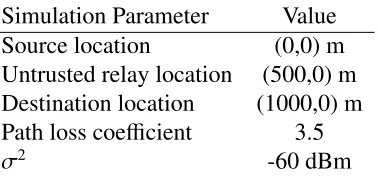
2.1 Simulation set up parameters (untrusted relay) . . . 27
2.2 An overview of physical-layer security techniques . . . 32
3.1 Simulation set up parameters (phase shift scheme) . . . 44
4.1 Simulation set up parameters (new way of using artificial noise) . . . 63
Chapter 1
Introduction to Security of Wireless
Communications
Wireless communication is one of the most important achievements of mankind since it pro-vides transmission of information over faraway nodes without requiring the wires. Long-distance radio transmission was invented by Guglielmo Marconi in 1901 [1]. Since then, many advantages of wireless communications have facilitated humans life. For example, the mobility of wireless communications provides services for the users in almost anywhere and increases the coverage. It can be in a mall, in an airport or in a park. Interestingly, theno-wirednature of wireless communications, makes it very convenient for using, compared to the wired systems in which a cable is always required while the length of the cable could be a major concern. Moreover, the wireless systems are capable of providing service for a large number of users. For example, it is expected that by 2020, and the time that 5G will be deployed, there is a larger number of cellphone subscribers in the world such that each macro-cell must serve up to 1000 subscribers [2]. In addition, wireless communication systems have cheaper installation and maintenance costs compared to the terrestrial communications in which not only all paths must be wired, but also changes in the cabling plan involve additional fees.
On the other hand, the widespread users of wireless communications are now suffering from security issues more than ever. For instance, in early 2015, a cyber security consultant claimed that he was able to control the aircraft engine by connecting to the onboard wifi [3]. Moreover, lack of security in the applications installed on cellphones has been frequently exploited by hackers to track users and access their information. Therefore, it can be said that although the broadcast nature of wireless medium, which reverts back to radio propagation, eases human lives, it intensively introduces many security vulnerabilities and issues. Hereon, it must be pointed out that unfortunately the ever increasing rate of wireless communication deployments and applications on one side, and the rate of corresponding security solutions on the other side, are not matched. Thus, this noticeable gap needs to be addressed. However, the wired systems are not impacted by the security issues as much as the wireless systems because of their closed architecture. In this chapter, due to the importance of security in wireless communication systems, the objective is to study the background and the basis of the security in wireless communication systems.
1.1
Background of Security in Wireless Communications
Availability of wireless medium, which is utilized by wireless communication systems, has led to a variety of security risks and threats. It is vital to enhance the security of wireless communications since it is very easy for eavesdroppers to overhear wireless signals that are transmitted in the air.
The key concepts of wireless communications security is classified into four categories which each attack usually intends to threaten one or more categories. Thus, it is necessary to be aware of associated principals to provide security solutions and protect systems against attacks. Thereby, the principals of the security of wireless communication systems are presented as following.
1.1.1
Authentication and Non-reputation
The goal of authentication process is to confirm the identity of message transmitter. In gen-eral, prior to any data transmission, mutual authentication between communicating parties is required. Authentication via exclusive media access control (MAC) address is maybe the most common technique in today’s networks. However, other layers may also be involved in the authentication. For example, user name and password can be exploited as authentication tools in the application layer [4]. Moreover, non-reputation is used to ensure that neither the source nor the receiver of the message can deny communication occurrence. In this regard, digital signatures are adopted where any node has its exclusive fingerprint which reveals its identity [5].
1.1.2
Confidentiality and Access-control
The confidentiality strategies are set to protect the information from disclosure by illegitimate entities. Primarily, cryptography and encryption techniques have been utilized in upper layers of protocol stack to provide confidentiality. Recently, other methods such as cooperative jam-ming have also been proposed to achieve this goal [4]. It must be pointed out that some attacks aim at analyzing network traffic to obtain certain information, e.g., transmission frequency, or spatial location of the nodes. Thus,access control mechanisms are employed to define a di-verse level of access for different entities. Notably, because of broadcast characteristic of the wireless medium there are many obstacles to provide a comprehensive access-control strategy [5].
1.1.3
Data Integrity
1.2. AttacksClassification inWireless communicationSystems 3
DoS
DoS Message
Modification
Message Modification
Eavesdropping
Eavesdropping
Wireless Communication Systems Attacks
Wireless Communication Systems Attacks
Masquerade Attack
Masquerade Attack
Active Attacks
Active Attacks
Traffic Analyzers
Traffic Analyzers
Passive Attacks
Passive Attacks
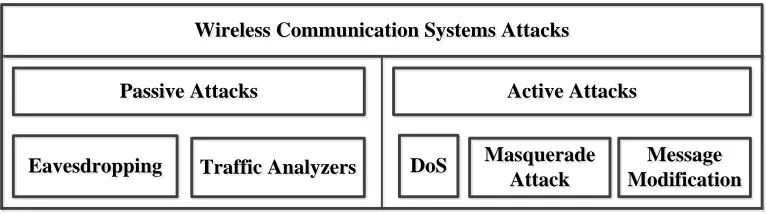
Figure 1.1: Common wireless communication systems passive and active attacks
1.1.4
Availability
Ensuring that legitimate entities can access the network and have a robust communication is termedavailability[5]. For instance, denial of service (DoS) and distributed denial of service (DDoS) attacks (i) may target the availability of a network, (ii) occupy the network resources; and (iii) result in denial of service for authorized nodes.
Notably, the aforementioned security requirements (availability, authentication, non-reputation, data integrity, confidentiality and access control) are complementary to secure wireless com-munications. In other word, they must be provided simultaneously to ensure that the commu-nication is secure.
1.2
Attacks Classification in Wireless communication
Sys-tems
In this section, attacks of wireless communication systems are classified based on their active and passive behaviors, as seen in Fig. 1.1.
1.2.1
Passive Attacks
Passive attacks only monitor and analyze traffic. The main passive attacks are as following.
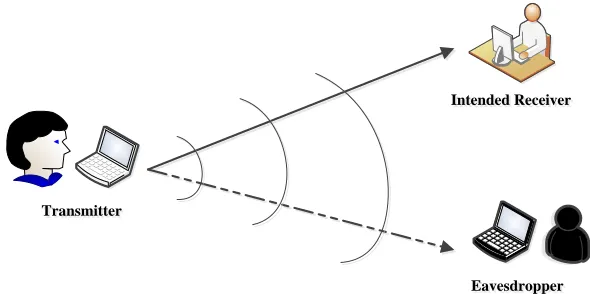
Passive Eavesdroppers
Intended Receiver Intended Receiver
Eavesdropper Eavesdropper Transmitter
Transmitter
Figure 1.2:Wiretapping attack
Traffic Analyzers
Traffic analyzers are another group of passive attacks which do not make any modification in the message, but they are able to reveal sensitive information by analyzing the traffic, e.g., transmission frequency, or spatial location of the communicating parties, or session length and identities of source/receiver [5].
1.2.2
Active Attacks
Active attacks are a category of attacks which are capable of making modifications and changes in messages. For example, they are able to delete a certain message and add to the other. The most common active attacks are as follows.
Denial of Service Attacks
Some attacks try to use network resources so the network can no longer serve the authorized nodes. This type of attacks are called denial of service attacks in the literature and they can take place at different layers of the protocol stack. Distributed denial of service attacks are a more severe type of DoS attacks. In DoS attacks, one device and one connection is exploited by the attack to threat the victim. Whereas, in DDoS attacks, multiple devices, computers and connections are exploited by the attack for threatening the victim node.
Message Modification
1.3. SecurityThreats fromOSI LayersPerspective 5
Masquerade Attacks
There are cases in which illegitimate entity exploits a fake or forged identity so the network considers it as an authorized entity and therefore it can misuse network resources [5]. This type of attack is called masquerade attack in the literature.
1.3
Security Threats from OSI Layers Perspective
Examining current issues in wireless communication systems reveals that different security threats are targeting different layers of communication systems. At this point, major security threats of different layers of the open systems interconnection (OSI) are briefly reviewed.
• Physical layer is vulnerable to security issues due to the accessibility of wireless medium by unauthorized entities. For example, eavesdropping attacks are one of the physical layer attacks. In other cases, active attacks drop down the communication signal by overwhelming the bandwidth via jamming signals. This attack is termed jamming attack [5].
• In the context of the MAC layer attacks, there are attacks such as MAC spoofing and MAC address theft which target the authentication procedure. Denial of service attacks and man in the middle attacks may also target the MAC layer [7], [8]. In particular, MITM attacks may be the active eavesdroppers and send the threat packets via setting up connections to their victims, while the communicating parties are supposed to communi-cate directly. Another group of MAC layer attacks generate numerous number of MAC addresses per minute such that MAC address table of the victim device is overwhelmed [9].
• IP spoofing, routing attack and packet sniffing are targeting the network layer. IP spoof-ing can be via either forgspoof-ing or falsifyspoof-ing the packet’s IP addresses such that the receiver cannot access the true IP address of the packet’s source. Routing attacks damage routing protocol by: (i) eliminating certain routes, (ii) advertising routes to the nodes which does not exist, (iii) updating the routing tables with faulty tables, etc. Moreover, packet sniff -ing is a network layer attack which can access the confidential information via analyz-ing network traffic [10], [11].
resources are consumed by the attack and cannot serve the legitimate nodes. Notably, flooding attacks usually result in denial of service [13], [14].
• Regarding the application layer, viruses, worms and trojan horse are the most well-known attacks. Technically speaking, a virus is attached to a program or a file and travels from one device to the other once the user transfers files or installs programs. Viruses spread the infections and the threats. Similarly, worms also travel from a device to an-other, but the user is not involved. Trojan horse is a malicious software which initially is seen as a helpful and interesting program to convince the user for installation. Blended threats are a combination of viruses, worms and trojan horse attacks that cause severe threats. DDoS are also a common application layer attack [15], [16].
Table 1.1 summarizes the common attacks of different layers of the OSI model.
Table 1.1: Layered overview of wireless systems attacks
OSI Layer Sample Attacks
Physical layer Wiretapping attack, jamming attack
MAC layer MAC address spoofing, identity theft, DoS, MITM, MAC flood Network layer IP spoofing, routing attack, packet sniffing
Transport layer UDP flooding attacks, TCP flooding attacks, DoS Application Layer Viruses, worms, Trojan horse, blended threats, DDoS attacks
1.4
Overview of Security Improvement:
From a Layered Networking Architecture Perspective
In this section, various security enhancement mechanisms from a layered networking architec-ture perspective are reviewed. Herein, physical layer security is confined to a brief introduc-tion whereas detailed technical discussion is referred to chapter 2. It is obvious that different networking layers are threatened by security attacks and in today’s security enhancement ap-proaches, most layers are involved. Such an approach mainly includes the upper layers of the protocol stack, except the physical layer.
Only recently, there has been a growing interest in security enhancement techniques via physical layer [17]. However different methods can be simultaneously used to achieve the most promising results. For example, authentication of users can be realized via exploiting various authentication methods such as MAC address authentication or plain password authentication. On the other hand, a number of security methods have enhanced security through involvement of multiple OSI layers. For instance, a secret key for cryptography purposes can be generated based on the physical characteristics of the communication parties or the medium involved, e.g., the reciprocal channel.
Cryptographytechniques adopt primarily mathematical tools and secret keys to secure the
1.5. Motivation of theThesis 7
which are also, respectively, termed asasymmetric and symmetric keycryptography. In sym-metric key cryptography, similar keys are adopted for encryption and decryption purposes. Whereas, in asymmetric key cryptography, public key is exploited to encrypt a message and the message can only be decrypted by the specific related private key [4]. Using initial upper-layer cryptography techniques, one error in the received plain text results in plenty of errors in the decrypted plain text. Thus, in more recent studies, advance encryption standard (AES) and turbo coding are combined because turbo coding is capable of error correction. Cryptography at physical layer can be through spread spectrum (SS) techniques which are further studied in chapter 2.
The physical layer attack scenarios are mainly based on the existence of the eavesdropper which tries to wiretap the transmission. In order to overcome this issue, friendly jamming, information-theoretic security, beamforming and diversity techniques or combined methods have been proposed in the literature. Jamming attacks are the other types of the threats to the physical layer security and it has been suggested to use spread spectrum techniques to impair them [18], [19]. More recent works have proposed authentication techniques which are based on the physical layer approaches.
In the context of MAC layer and to prevent MAC flooding attack, it is possible to make certain restrictions for each port in the sense of limiting the number of MAC addresses to be received from each port. Another alternative solution is using fixed MAC Addresses although this solution is not applicable in large scale networks [20], [21].
Wi-Fi protected access (WPA) and Wi-Fi protected access 2 (WPA2) are the two exten-sively utilized authentication protocols in the networking layer. Furthermore, the second ver-sion of Routing Information Protocol (RIP-V2) has been presented to prevent the a group of routing attacks. In order to prevent packet sniffing, cryptographs techniques are used [20], [21]. In addition, certain software and hardwares are already in the market as anti-sniffers
(e.g., Kitty-Litter The Anti-Sniffer)[22].
To secure the transport layer, transport layer security (TLS) and secure sockets layer (SSL) have been utilized which in essence are cryptographic protocols to secure the transmission. Username and password can be used in the application layer to enhance the security as it is very common to have different user name and passwords for different applications and sometimes an application requires multiple passwords.
1.5
Motivation of the Thesis
Cooperative communications via relay nodes has been considered as an interesting solution in communication systems where reliable direct transmission between source and intended desti-nation is not possible. The principle of cooperative communication reverts back to [23] where capacity analysis of a two-hop communication system was devised. However, deployment of relays in communication systems has been growing continuously and it has spread to Wimax and cellular communications [24]. To be more precise, the standardizations of 3GPP LTE-Advanced, IEEE 802.16j, and IEEE 802.16m already contain relay-based communications [24].
Relaying communication is specified by cooperation strategies which is termed as
compress-and-forward [24]. Many existing studies have compared the relaying strategies based on reliability performance parameters [25]-[27]. Taking another point of view, some recent works have studied cooperative communications from secrecy perspective [28]-[30]. Accord-ingly, the notion ofcollaborative secrecy was introduced where the relays have the potential to secure the communication. Following this idea, relays have been used as cooperative nodes to improve the secrecy via performing different roles. Towards this goal, upper-layer security techniques have been widely studied in the literature while physical layer techniques are com-plementary schemes to obtain better results. For example, Multiple-input and multiple-output (MIMO) relays are used to reduce the received SNR at the unauthorized entities [28],[31]. Herein, the focus of this thesis is on physical layer cooperative roles of the relays in order to improve the security.
One of the main intuitions behind this work is that many communication entities such as amplify-and-forward relays, repeaters and wireless sensor networks are not capable of han-dling complex security methods due to their hardware limitations. Therefore, physical layer security can be adopted in these systems to secure the communication. Moreover, in some cases communication is only through lower layers of the protocol stack (e.g, communication via repeaters). Thus, physical layer security flourish as a prominent security improvement technique.
In the context of collaborative relaying, cooperative jamming has been widely studied where relays can be utilized as temporary jammers to create intentional noise at the adversary node to enhance security [32]-[34]. However, this technique has a number of disadvantages. First, cooperative jamming strategies require additional node to generate the jamming which is expensive in terms of hardware. Furthermore, conventional cooperative jamming strategies increase the complexity since network overheads increase for the purpose of providing coordi-nation between the helper and the main network. Hence, there is a need to provide alternative solutions which overcome the aforementioned shortcomings.
1.6
Research Objectives
The objectives of the current work are summarized as below.
• The first goal includes the followings: (i) to comprehensively study the physical layer security of cooperative communication systems in terms of security attacks, (ii) to in-vestigate existing security improvement techniques, and (iii) to address advantages or shortcoming of current solutions. This primary goal is a guide to further provide security improvement schemes.
• The second objective is to provide a novel solution for two-hop communication systems which rectifies the shortcomings of conventional cooperative jamming strategies.
1.7. Contributions 9
1.7
Contributions
Major contributions of this thesis, based on the proposed security solutions for cooperative communication systems in chapter 3 and 4, are stated below.
• In chapter 3, a two-hop DF relaying systems is presented where communication takes place in the presence of an external eavesdropper which can intercept the communica-tions of both hops. Considering this system model the following results are obtained: (i) A novel security solution is proposed which exploits the randomness of the channel between the communicating parties and introduces a phase shift to the modulated data such that the adversary node is not aware of it. It is proven that the proposed scheme can increase the secrecy capacity of the system by degrading the received SNR at illegitimate entities. (ii) Secrecy performance analysis of the system model is presented. (iii) It is shown that increasing the transmit power can haveharmful or helpfulimpact on secrecy, depending on where the eavesdropper is located. For instance, it is demonstrated that if the eavesdropper is an adjacent neighbor to the transmitter, raising the transmit power results in more leakage of the signal to the illegitimate entity and therefore secrecy of the system is degraded.
• In chapter 4, a multi-hop DF relaying system is considered where there exist multiple non-colluding eavesdroppers. The contributions related to this system are stated at this point: (i) Inspired by [35], a new way of using cooperative jamming is extended to the aforementioned system to enhance the secrecy. In the proposed strategy, on the contrary with traditional cooperative jamming, extra helper is not needed and the transmitter cre-ates the intentional jamming. (ii) Secrecy performance of the aforementioned system is analyzed. (iii) Power allocation strategies are presented to improve the security by optimally allocating the power to the friendly jamming and the primary signal. It is illus-trated that using the optimal power assignment boosts the ergodic secrecy capacity. (iv) It is shown that diverse parameters impact the optimal power allocation factor among which channel state information (CSI) of the adversary nodes must be noted particularly. (v) Since accessing the CSI of the adversary nodes may not be feasible in many cases, the sub-optimal solution is given which does not require the CSI of the adversary nodes. The sub-optimal solution can be considered as close bound for the optimal solution if the illegitimate entity is close to the transmitter.
1.8
Thesis Outline
This thesis is organized as follows:
networks such as ad-hoc networks, cognitive radio networks, cellular networks, and wireless sensor networks.
In chapter 3, secure communication in a two-hop communication system is investigated where the relay employs decode-and-forward protocol. Analysis of secrecy performance of the system model is presented where closed-form expressions of the probability of outage in secrecy capacity and probability of non-zero secrecy capacity are calculated. Then, a random phase shift scheme is presented which improves the secrecy capacity. Finally, simulation re-sults are given which validate the theoretical contributions.
Chapter 4 is focused on the security of a multi-hop cooperative communication systems where the relays adopt decode-and-forward strategy and there are multiple illegitimate wire-tappers. First, the security analysis of the system model is given. Next, the new artificial noise strategy is presented to degrade the received SNR at the illegitimate nodes, and increase the secrecy. Due to particular importance of power allocation between the friendly noise and the primary signal, power allocation solutions are proposed. Lastly, simulation results are pre-sented to evaluate the capability of the proposed strategy to improve secrecy.
Chapter 2
Physical Layer Security
Using the OSI model as a reference model, security measures to protect the user’s data nor-mally takes place at the upper layers such as presentation layer. These security measures are a family of various encryption techniques including symmetric and asymmetric cryptography. The focus on upper layer security resulted in the abandonment of lower layer, physical layer, security features [35]. However, a specified level of secrecy is needed in physical layer to further utilize upper-layers security schemes [35]. Also, one cannot claim any contradictions between employing the upper-layer and physical-layer security techniques. Therefore, diff er-ent layers security techniques can be adopted concurrer-ently as they are complemer-entary to each other. Accordingly, the combination of different levels security solutions (such as physical layer, network layer and link layer) have been investigated in recent studies [35]. In this regard, the concept ofcross-layer securityhas been used to indicate the aforementioned collaboration of the layers for the purpose of security improvement [35], [36].
Physical layer security was pioneered in [37], [38] and [39]. However, more recently the interest in physical layer security was revived in the 1990s [40]. Physical-layer security schemes may be based on information theoretic techniques ([38], [41]-[42]), cooperative jam-ming ([43]-[45]) or diversity and beamforjam-ming approaches ([46]-[48]). In addition, combining multiple physical-layer security techniques have been used in the literature, e.g., using coop-erative jamming and beamforming jointly to secure the communication [28]. In this chapter, physical-layer secrecy performance criteria are defined. Next, physical layer eavesdropping is examined. Finally, main existing security improvement approaches in physical layer for cooperative relaying systems are investigated.
2.1
Secrecy Performance Parameters
In this section, the parameters of secrecy performance which are examined as the secrecy criteria in the literature are introduced.
2.1.1
Secrecy Capacity
The fundamental metric of secrecy is termedsecrecy capacity which is maximum achievable secrecy rate of the system and reflects maximum transmission rate from source to desired
tination while eavesdropper is not able to access transmitted data and decode it. This definition is formulated as the following [17, p. 62]
Cs =[Cm−Cw]+, (2.1)
whereCmis the capacity of the main link andCw denotes the capacity of the illegitimate link
that are, respectively, defined by
Cm= log2(1+γsd), (2.2)
Cw =log2(1+γse), (2.3)
in whichγsdandγsddenote the instantaneous received SNR at the intended receiver and the
il-legitimate entity, respectively. Therefore, based on equation (2.1), it can be said that increasing the received SNR of the main link or decreasing the received SNR of the illegitimate link both result in improving the secrecy capacity. Accordingly, security of the communication system has been investigated considering instantaneous SNR of the legitimate and illegitimate links to examine under which conditions positive secrecy capacity is achievable [49], [50].
2.1.2
Probability of Non-zero Secrecy Capacity
Probability of existence of a positive secrecy capacity, also termed as probability of non-zero
secrecy capacity, is an alternative secrecy performance parameter for communication over
fad-ing channels which is given by
Pr[Cs >0]= Pr[Cm>Cw]. (2.4)
2.1.3
Probability of Outage in Secrecy Capacity
Probability of outage in secrecy capacity, (also known as secure outage probability, i.e., SOP)
indicates the likelihood of obtaining a target secrecy rate. SOP is one of the common secrecy performance criteria for communication over fading channels when there is an eavesdropper to intercept communication. This secrecy performance parameter is formulated as
Pout(Rt)= Pr[Cs< Rt], (2.5)
whereRtis the desired target secrecy rate. The outage in (2.5) can occur in any of the following
cases:
• Unreliable communication which is the case where the intended receiver cannot decode a message.
• The eavesdropper is able to overhear a portion of the transmitted message.
2.2. MultipleEavesdroppers 13
a shortcoming as the related outage questionably refers to the secrecy, and it may be due to reliability issues. For example, if the channel between the source and the intended destination is very weak, the transmitter is likely to delay the transmission. Considering definition (2.5), this delay will be an outage whereas transmission has not occurred. To rectify this shortcoming, the work presented in [51] has suggested another definition for the probability of outage in secrecy capacity which is formulated as
Pout(Rt)=Pr[Cw> Rb−Rt|MessageT ransmission], (2.6)
whereRbdenotes transmission rate of the codewords. This new definition (2.6) has the
follow-ing advantages:
• It considers design parameters such asRb.
• Unlike equation (2.5), in (2.6) message transmission is an initial condition of the secure outage definition.
It must be pointed out that continuous transmission may happen in the case where the transmitter is not aware of the destination’s channel. Herein, the outage can be formulated as
Pout(Rt)= Pr[Cw >Rb−Rt] [52]. On the other side, if the destination channel is available, the
transmitter is able to have a more proper design and to designate transmission or suspension mode, in addition to choosing the appropriate transmission rate. The aforementioned design can significantly enhance the security by degrading the probability of outage in secrecy ca-pacity. However, SOP has been mentioned as a more worthwhile secrecy criteria compared to secrecy capacity in the literature [53].
2.1.4
Ergodic Secrecy Capacity
Ergodic secrecy capacity(ESC) indicates the average of secrecy capacity and it is formulated
as [52]
Cs =E{Cs}. (2.7)
2.2
Multiple Eavesdroppers
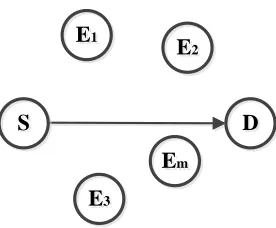
Communication between source and destination can take place in the presence of an eaves-dropper. In a more complicated case, as seen in Fig. 2.1, multiple eavesdroppers can overhear the communication. Multiple eavesdropping can be studied under two categories explained as below.
2.2.1
Non-colluding Eavesdroppers
In the case of non-colluding eavesdropping, there are multiple wiretappers to overhear the communication and received SNR of the illegitimate link is assumed to be the maximum of the received SNR of eavesdroppers. In other words, the illegitimate entities are mutually indepen-dent. Therefore, the received SNR is denoted by [54], [55]
S
S
E1
E1
D
D
Em
Em
E3
E3
E2
E2
Figure 2.1:Communication in the presence of multiple eavesdroppers.
whereγem is the received SNR of themth eavesdropper.
2.2.2
Colluding Eavesdroppers
In the case of colluding eavesdropping, there are multiple eavesdroppers to intercept the com-munication and the received SNR of the illegitimate link is the summation of the received SNR of eavesdroppers. Thus, the above relationship is reformulated as [56], [57]
γe =
XM
m=1γem. (2.9)
2.3
Active and Passive Eavesdropping
Physical layer attacks can be investigated considering the capabilities that are considered for the illegitimate entities. Illegitimate nodes may have several goals. Initially, observing and monitoring communication signal to overhear the main information is one goal pursued by the attacks. From this stage forward, the attacks are categorized based on their active and passive behaviors.
2.3.1
Passive Attacks in the Physical Layer
Passive eavesdroppers (also known as radio eavesdroppers) are capable of monitoring the sig-nals to detect the main transmission, decode and analyze it. Although this group of attacks are able to access the main transmission, they cannot interfere with the channel, and make any changes or modifications. Since passive attacks are silent and they do not make any apparent changes or modification, it is difficult to detect them.
2.3.2
Active Attacks in the Physical Layer
2.4. PhysicalLayerSecurityTechniques 15
Source
Source EncoderEncoder DecoderDecoder
Eavesdropper
Eavesdropper
Figure 2.2:Wire-tap channel.
a cellular network and it could send signaling messages to the base station. Jamming the transmission between the source and the intended receiver via the eavesdropper was studied in [59]. Secure transmission of TDD multicell multi-user massive MIMO systems was examined in [31] where the eavesdroppers were active, and aimed at ruining channel estimation of the legitimate nodes. In addition, DoS attacks can threaten the network though different layers of the protocol stack including physical layer where the radio frequency jamming can jam the main transmission; therefore, the network cannot serve the legitimate users [5].
Note that although active eavesdroppers can significantly reduce the secrecy performance of communication systems but it is mostly easier to detect them, compared to the passive attacks, due to the silent nature of passive attacks.
2.4
Physical Layer Security Techniques
In this section, different physical-layer security techniques and schemes are explained through a classification that includes the following categories: information-theoretic security, beam-forming techniques, artificial noise strategies, diversity approaches, coding techniques and ex-ploiting channel characteristics for secrecy.
2.4.1
Information-theoretic Security
Wyner is a pioneer in the area of information-theoretic security due to his investigation of a channel model in the existence of an eavesdropper. This channel model is also known as a
wiretap channeland is shown in Fig. 2.2 [37].
Wyner considered a discrete memoryless wire-tap channel where the information was trans-mitted from a legitimate node (called Alice) to an intended receiver (called Bob). The commu-nication occurred in the presence of an illegitimate entity (called Eve) which wiretapped the channel between legitimate communication parties. The main goal is to maximize the trans-mission rate from the transmitter to the destination such that leakage of the information to the illegitimate entity is the least. Moreover, Shannon has first introduced the term ofperfect
se-crecyin [38]. The results of these studies were later broadened to a Gaussian wire-tap channel
[39], and the termsecrecy capacitywas introduced.
It must be pointed out that secure communication over fading channels are significantly important as they are helpful to analyze many practical scenarios [17]. To this end,
Encoder
Encoder
Relay
Relay
Receiver A
Receiver A
Channel Channel
ma ma
mb mb
Receiver B
Receiver B
mb mb
ma ma
mb mb
ma ma
Figure 2.3: Exploiting side information in BBWC.
vary over time and it is not always possible to have access to the instantaneous channel state information (e.g., because of limited bandwidth [63]). Time-varying fading may limit the secu-rity of wireless communication systems [60]. Thus, MIMO antennas and diversity techniques were suggested to rectify this issue and enhance the secrecy [61], [62]. Also, the results of se-cure communication over fading channels showed that , unlike communication over Gaussian channels, a non-zero secrecy capacity is achievable even if the average SNR of the legitimate link is less than the average SNR of the illegitimate link. The reason is because fading can be beneficial in terms of secrecy such that instantaneous SNR of the main link is higher than the instantaneous SNR of the illegitimate link [50]. Furthermore, illegitimate entities can be equipped with multiple antennas to combat fading effects [61], [66].
In the year 1978, the authors of [36] have assumed a channel in which there were two receivers indicated by receiver A and receiver B, and two message types as the following.
• Common message:to be received by receiver A and B.
• Confidential message:to be received only by receiver A.
This channel was called thebroadcast channel with confidential messages (BCC), and since then it has been the subject of interest for many researcher. Other works have made some modifications in the aforementioned scenario and changed it to the case where there is one confidential message per receiver [67].
Following this path work, secrecy inbidirectional wiretap channel (BBWC)was introduced by the authors of [68]. This scenario in essence was a two-way communication system via an intermediate DF relay in the presence of an illegitimate entity. In this scenario, Node A intended to send the confidential message ma to the receiver B, and Node B intended to send
the confidential messagemb to the receiver A, where there was an eavesdropper which could
overhear the communication. The intuition behind the presented approach is that each message can be exploited only once as a secret key to decode the other message, as seen in Fig. 2.3.
In particular, the intermediate relay can encode the two messages using the XOR operator; therefore, the coded message is given by [68]
e
2.4. PhysicalLayerSecurityTechniques 17
The coded message me is then sent to both receiver A and receiver B. Next, the receivers apply their original messages, termed side information, to decode the received message. Ac-cordingly, the received message at receiver A is given by
e
m⊗ma = ma⊗mb⊗ma= mb, (2.11)
Similarly at receiver B, the message is as
e
m⊗mb = mb⊗ma⊗mb= ma, (2.12)
Finally, it is concluded that each of the receivers securely attain their corresponding mes-sage.
2.4.2
Secure Communication via Beamforming
Beamforming security approaches are based on a technique in which the main signal is sent in the desired direction such that the destination signal strength is enhanced while the illegitimate entity’s received SNR is minimized. Accordingly, the received SNR of the legitimate entity is increased, but the the received SNR at the adversary node is degraded so the secrecy capacity of the system is improved. The problem of optimal beamforming to maximize the achievable secrecy rate in a dual-hop DF relaying system with the assumption of limited power constraints was studied in [69]. This work has assumed that perfect channel state information is known while this assumption is not applicable in many scenarios. Following this pathwork, the work presented in [70] has devised the beamforming for a MIMO wiretap channel where only the legitimate channels’ CSI is available, but the CSI of the illegitimate node is not known. This work later extended its contributions to the sub-optimal solutions where the perfect CSI of the main link even was not available and channel estimation error was involved.
2.4.3
Artificial Noise
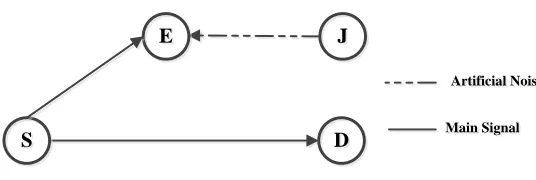
Artificial noise (AN), also known as cooperative jamming (CJ), is based on an intentional jamming signal created by legitimate helpers to confuse the eavesdropper. Consider Fig. 2.4, where the source wants to communicate with the destination in the presence of an eavesdropper. Because of the broadcast characteristic of radio propagation, the eavesdropper can wiretap the main signal so the received SNR at the illegitimate node is given by
γse =
Ps|hse |2
σ2 , (2.13)
in whichPsindicates the transmit power of the source,hseis the channel from the source to the
eavesdropper andσ2 is the noise variance. Next, the controlled interference is created by the
jammer, denoted byJ, to mislead the eavesdropper while the desired receiver is not affected by the artificial noise. Accordingly, the eavesdropper received SNR is degraded as
γse AN = Ps|hse |2 σ2+P
j |hje|2
S
S
E
E
D
D
J
J
Artificial Noise
Artificial Noise
Main Signal
Main Signal
Figure 2.4:Conventional artificial noise.
wherePjdenotes the jamming power andhjseis the channel from the jammer to the
eavesdrop-per. Comparing equations (2.13) and (2.14) shows that received SNR at the illegitimate entity is degraded. Hence, it can be concluded that secrecy capacity of the system is improved.
Artificial noise first was suggested in [71] to improve achievable secrecy of a communi-cation system. This work showed that it is possible to obtain a positive secrecy capacity in a communication system where the illegitimate entity is closer to the transmitter compared to the intended receiver, via employing cooperative jamming. Following this framework, a num-ber of cooperative jamming criteria includingjamming coverageandjamming efficiencywere introduced in [6] , where the parameter∆S OPis defined as
∆S OP= S OPw/oAN
S OPAN
, (2.15)
in which S OPw/oAN andS OPAN, respectively, denote the probability of outage in secrecy
ca-pacity without and with using artificial noise. The intentional interference can be classified into helpful and harmful jamming if ∆S OP ≥ 1.00 and ∆S OP ≤ 1.00, respectively. Us-ing spatial samplUs-ing, jammUs-ing coverage is the total area of the helpful jammUs-ing. If a certain two-dimensional area is denoted by Awhere the eavesdroppers can be located in (xe,ye) ∈ A,
jamming efficiency represents the average of∆S OP(xe,ye). Moreover, jamming strategies for
the cases where the eavesdropper channel state information was or was not available were pre-sented in [6]. The effect of using multiple jammers for the purpose of secrecy enhancement was also investigated, and the results showed that jamming coverage and efficiency could increase via using multiple jammers [6]. The same reference reported that increasing the transmit power can be harmful in terms of secrecy due to the closeness of the adversary nodes to the legitimate nodes. To be more specific, jamming close to the intended receiver needs accurate channel state information which is not necessarily accessible. Although cooperative jamming is known as a physical-layer security enhancement technique, the authors of [34] studied the effects of jam-ming on secrecy from MAC layer prospective. This work introducedsecure throughputnotion and presented jamming strategies where the objective was to enhance the jamming through-put. The results showed that being aware of the location of the jammers are very helpful to devise jamming protocols. As it was mentioned earlier in this chapter, security enhancement schemes may combine two or more physical-layer secrecy improvement techniques. In this regard, beamforming and cooperative jamming can be employed concurrently to improve the security [28], [73], [74].
2.4. PhysicalLayerSecurityTechniques 19
Artificial Noise in 2nd hop
Artificial Noise in 2nd hop
Main Signal in 1st hop
Main Signal in 1st hop
E
E
R
R
S
S DD
Artificial Noise in 1st hop
Artificial Noise in 1st hop
Main Signal in 2nd hop
Main Signal in 2nd hop
Ne
Ne
Ns
Ns NrNr NdNd
Figure 2.5:Source and destination with temporary jamming role.
and (iii) extra network overheads to coordinate between the main network and the jammer. At this point, existing solutions for the aforementioned shortcomings are briefly studied.
Power Allocation Between Main Signal and Friendly Jamming
One of the main challenges toward employing artificial noise techniques is requirement of additional power resources. To compensate this issue, power allocation between friendly jam-ming and main signal has been studied in the literature such that the secrecy criterion (e.g., secrecy capacity) is maximized while power resources are limited [45], [72]. The authors of [48] were the first to assume both the secrecy and the quality of service while using the coop-erative jamming. They proposed a coopcoop-erative jamming scheme which minimized the received signal-to-interference-and-noise (SINR) at the illegitimate entity in addition to ensuring a cer-tain level of SINR at the legitimate receiver.
Artificial Noise by Source and Receiver
Requirement of an extra node as helper to generate the jamming signal is another disadvantage of cooperative jamming strategies. Using the source and the receiver as temporary jammers for creating and sending friendly jamming was proposed in recent studies to rectify this shortcom-ing [73], [75].
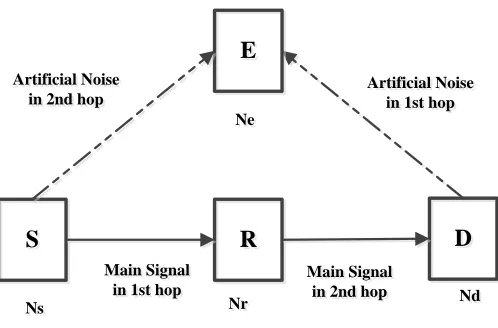
In order to realize this methodology, the system model in Fig. 2.5 is employed where the source, equipped withNsantennas, intends to communicate with the destination, which hasNd
antennas, through a DF relay, with antennas Nr in the presence of an eavesdropper equipped
with Ne antennas. In the first hop of communication, from the source to the intermediate DF
relay, the receiver is used as a helper to generate the friendly interference and send it toward the eavesdropper. Next, in the second hop of transmission, from the relay to the destination, the source performs the jamming role to mislead the eavesdropper.
• Patrial cooperative jamming (PCJ): The transmitter and the destination send artificial noise simultaneously.
• Full cooperative jamming (FCJ): The transmitter and the destination do not send the intentional interference at the same time.
For example, in the fist hop of communication, the received signal at the relay and the illegitimate entity are, respectively, given by
yr =Hsr(Tszs+T´sz´s)+HdrT´dz´d+nr, (2.16)
ye = Hse(Tszs+T´sz´s)+HdeT´dz´d+ne,1, (2.17)
wherezi and ´zi, respectively, stand for the main signal and the artificial noise sent by node i,
wherei∈ {s,d}. Also,Tiand ´Ti, respectively, indicate the beamformers of the main signal and
the artificial noise. Moreover,nr is the noise at the relay, andne,1is noise at the eavesdropper
after the first hop of transmission. If ´zs ,0 and ´zd ,0, it is termed as FCJ; otherwise, PCJ. The
results presented in [28] indicated that for the case in which the channel state information of the eavesdropper was not known, FCJ secrecy performance outperformed the PCJ strategy. The insightful work in [75], proposed a novel cooperative jamming strategy in which the intentional interference was sent from the intended receiver. Remarkably, this strategy did not depend on the channel state information of the receiver at the transmitter side. In addition, the proposed scheme did not rely on the assumption that the number of eavesdropper’s antennas is less than that of the intended receiver.
A New Way of Using Artificial Noise
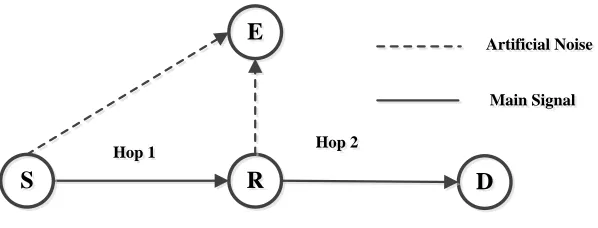
It was mentioned earlier in this chapter that conventional artificial noise strategies have a num-ber of shortcoming as following. First the requirement of the helper is costly in terms of hardware. Second, coordination between the helper and the original network is needed which increases the network overheads significantly. Third, conventional artificial noise strategies are usually limited to few applications. Such disadvantages have attracted researchers’ attention to provide cost-effective and energy-efficient solutions, as the authors of [44] proposed a new way of exploiting friendly jamming which rectifies the aforementioned disadvantages. Herein, a dual-hop DF relaying system is considered in which the source aims to communicate with the destination via a DF relay in the presence of an illegitimate entity, as shown in Fig. 2.6. In this system model, the eavesdropper is able to receive signals from the first and the second hops and employ maximal ratio combining (MRC) technique.
In this scheme, all terminals have single omni-directional antenna. It is assumed that com-munication takes place in two phases only, i.e., direct link between the source and the destina-tion does not exist. The transmitter of the first hop (source) or the second hop (DF relay) are capable of assigning a portion of their power for generating friendly jamming. The intentional noise is created based on a shared secret between communicating parties of the first or the second hops which is not available at eavesdropper side.
2.4. PhysicalLayerSecurityTechniques 21
S
S RR DD
Hop 1
Hop 1
E
E
Hop 2
Hop 2
Artificial Noise
Artificial Noise
Main Signal
Main Signal
Figure 2.6:A new way of exploiting artificial noise.
complexity and network overheads are degraded as coordination between the additional node and the main network is not necessary anymore. Third, conventional artificial noise strategies are only applicable in few certain scenarios whereas the new approach can be utilized in more practical cases. Once the desired receiver of the first hop (relay) or the second hop (destina-tion) receives the signal because they have the knowledge about the intentional noise, artificial jamming can be eliminated. On the contrary, the illegitimate entity does not have access to the the intentional jamming. Accordingly, the intentional noise misleads the eavesdropper and the received SNR of the adversary node is reduced. Based on the definition of secrecy capacity, one approach to increase the maximum achievable secrecy rate is via reduction of the received SNR at the illegitimate terminals. Thus, secrecy capacity of the system is improved.
Notably, proper power allocation in this approach have considerable effect on the perfor-mance of the presented secrecy enhancement scheme. Thus, the authors of [44] have devised an optimal power allocation in which the global channel state information including the CSI of the eavesdroppers was available. It is obvious that in many practical scenarios, the channel state information of the illegitimate nodes, or their statistics, are not accessible. Therefore, sub-optimal solutions were provided in the same reference which did not rely on channel state information of the eavesdropper.
2.4.4
Security Enhancement via Diversity Techniques
Primarily, diversity techniques were introduced to enhance the reliability of communication systems. However, as indicated in [6], improving the received SNR at the intended destination or degrading the received SNR at the adversary nodes, can enhance security. Thus, channel diversity is a helpful technique which can result in secrecy enhancement [46]. Notably, di-versity techniques are more energy-efficient, compared to the cooperative jamming strategies because they do not require extra power resources. The following diversity approaches have been exploited in the literature to improve the security.
Multi-antenna Diversity
desti-nation and minimizing the received SNR at the illegitimate entity. Consider a system model where the source intends to communicate with the receiver via relays over Rayleigh fading channels. The strategy proposed in [46] essentially was based on the definition of secrecy capacity asCs = [Cm−Cw]+, meaning that the capacity of the legitimate channel can be
im-proved by using diversity techniques. Accordingly, ifCris increased, the total secrecy capacity
of the system is improved as well. The same reference recommended using MIMO orVirtual MIMO in order to employ diversity techniques. In the case of virtual MIMO, multiple nodes perform the relaying role such that the received SNR at the illegitimate entity is minimized. To achieve this goal, the access control of the relays must be pre-set. Remarkable results of [46] showed that even under very low SNRs, using diversity techniques can significantly improve the achievable secrecy rate. It must be pointed out that in some practical scenarios, the channel state information of the illegitimate nodes are not known. In the former case, the CSI of the legitimate links are utilized such that the received SNR at the intended receiver is maximized; therefore, secrecy capacity of the system is in turn increased.
Multiuser Diversity
Multiple access techniques (e.g., time devision multiple access, orthogonal frequency division multiple access) are intensively utilized in multiuser communication system to communicate with the end users. If global channel state information is available, the user channel assignment and scheduling can be effectively done such that the capacity of the main channel is maximized while the capacity of the eavesdropper link is minimized. On the other hand, if only the CSI of the main link is available, the scheduling is optimized such that the capacity of the legitimate channel is maximized. However, both of the aforementioned approaches improve the secrecy capacity to a great extent [76].
Cooperative Diversity
Cooperative diversity reverts back to relay selection schemes. In other words, the best relay to perform the relaying role is chosen such that secrecy capacity of the system is maximized. This approach is calledrelay selection with secrecy constraintsin the literature. The aforemen-tioned relay selection strategies are categorized examining that the CSI of the eavesdropper is available or not.
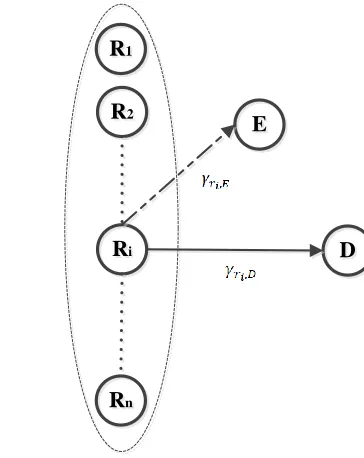
Relay selection schemes have been widely investigated in recent works [77]-[80]. Previ-ous relay selection strategies focus on reliability and performance parameters such as the link strength as the main criterion to select the relay. To describe the relay selection schemes, a two-hop DF relaying system, as seen in Fig. 2.7, is considered in which communication is carried out in the presence of an eavesdropper. In traditional relay selection schemes, the illegitimate link between the transmitters and the eavesdroppers is disregarded; thus, the instantaneous SNR of the intended receiver is employed as a relay selection criterion. Hence, the selected relay is chosen according to
r∗=arg max{γri,D}, (2.18)
wherer∗denotes the selected relay andγri,Dindicates the received SNR of the link between the
2.4. PhysicalLayerSecurityTechniques 23
S
S DD
E
E
R1
R1
R2
R2
Ri
Ri
Rn
Rn
Figure 2.7:Relay selection angwith secrecy constraints.
Recently, an insightful work in [81] opened a new way of relay selection which is based on secrecy constraints. This work took into account the link between the wiretapper and the transmitter so the relay selection scheme with secrecy constraints has been updated as
r∗=arg max{γri,D
γri,E
}, (2.19)
in whichγri,E denotes the received SNR of the link between theith relay and illegitimate entity.
Based on the achievable secrecy rate definition, this strategy aims at maximizing the achievable secrecy rate of the considered system model. Furthermore, since in practice the instantaneous received SNR of the illegitimate link is intractable, a sub-optimal solution was suggested as well [81]. In particular, the sub-optimal solution was based on information about the average channel statistics and it was formulated as
r∗ =arg max{ γri,D
σ2 ri,E
}, (2.20)
whereσ2
ri,E represents an average knowledge about SNR of the link between theith relay and
the illegitimate entity.
Following this framework, relay selection schemes under secrecy constraints have been widely studied in the litrature [43], [81], [82]. An interesting work in [81], investigated a two-hop DF relaying system in which source intended to communicate with the eavesdropper in the presence of multiple non-colluding eavesdroppers. Consequently, the authors of [81] adopted three relay selection strategies as below:
• The second strategy was the conventional scheme where the eavesdropper link was not included in relay selection procedure.
• In the third scheme, the maximum ratio of received SNRs of the main link to the illegit-imate link is incorporated as the selection criteria.
In a more recent work [82], the relay selection was studied in a dual-hop communication system where communications occured in the presence of an eavesdropper while the relays could employ DF and AF protocols.
Relay Selection for Secure Communications with Artificial Noise
As previously mentioned in this chapter, artificial noise and relay selection are two techniques for security enhancement in multi-hop relaying systems. Interestingly, in a recent work [43], cooperative jamming and relay selection under secrecy constraints have been combined. In this research, the authors initially proposed a relay selection strategy for a dual-hop DF relay-ing communication system based on conventional relay selection strategies. Next, a relay was chosen for the purpose of jamming and confusing the wiretappers. Using the proposed relay selection schemes jointly, enhanced the security of the communication system. This work fur-ther devised relay selection strategy for the case where instantaneous channel state information of the illegitimate node was not available.
On the other hand, communication in a wiretap channel in the existence of a helper which can perform either relaying role or jamming role was studied in [83]. This study aimed at answering the question that under different conditions the helper had to perform a relaying or the jamming role in order to improve system secrecy. Therefore, the following two scenarios were investigated over path-loss and fading channels: (i) direct transmission with artificial noise, (ii) dual-hop transmission via relay.
2.4.5
Exploiting Channel Characteristics for Secrecy
Security improvement in physical layer can be achieved via using the channel characteristics. In this regard, different schemes have been proposed including generating the secret key based on the channel between the communicating parties, MIMO diversity and RF finger print. Since MIMO diversity have already been studied in this chapter, hereon other two methods are briefly examined.
Creating the Secret Key