Person Re-Identification
Miss. Kajal Waykole
1, Mrs. Prof. S. S. Vasekar
21
PG Student, 2Assistant Professor
Department of E & TC (VLSI & ES), SKNCOE Vadgaon (BK), Pune, (India)
ABSTRACT
Person identification across non-overlapping camera is personre-identification, and its aim is tomatchpeople at various time and location. Re-identifying people is of extraordinary significance in vital applications, for example, wide-area surveillance and visual tracking. Due to the appearance variations in pose, illumination, and occlusion in different camera views, person re-identification is inherently difficult. This paper addresses the problem of context-aware object search and retrieval in a wide area distributed camera network. With the proliferation of smart cameras in urban networks, it is a challenge to process this big data in an efficient manner. A novel hypergraph based model is proposed to represent relationships, and for search and retrieval tasks. This representation exploits the fact that objects occurring in close spatial-temporal proximity are not completely independent and serve as context for each other. In this project color drift and clothing context-aware person search and re-identification method is utilized for a wide-area camera network with an emphasis on summarization. A hypergraph representation is used to connect related objects for search and re-identification. A diverse hypergraph ranking technique is proposed for person-focused network summarization. Samples of Annotated are used to learn color drift patterns in a non-parametric manner using the random forest distance (RFD) function
Keywords:Camera network, Hypergraph modeling, person re-identification, summarization,
search.
I.INTRODUCTION
In person re-identification and summarization color drift and clothing context-aware is utilized for person search and re-identification method for a wide-area camera network with an accentuation on summarization. A hypergraph representation is utilized to link related objects for search and identification. Tracking and re-identification method in wide-area camera networks is a challenging problem due to non-overlapping visual fields.
In surveillance videos, it is difficult to parse the clothing information for reliably associating a person across multiple camera views due to unknown transformation in color and overall appearance of the person (people occupy few pixels relative to the entire image frame). Also, frequent exchange of raw image data to the central server imposes network bottlenecks and is not scalable for large networks. Existing approaches tackle the problem either with appearance based features alone or in combination with spatial-temporal information. However, appearance based features are insufficient for matching due to viewpoint, pose and lighting changes. Spatial-temporal information helps to an extent, and it requires complete knowledge of the network. Furthermore, existing approaches assume that global trajectories are available and accurate.
II.LITERATURESURVEY
NikiMartinel et al.[2] presented a novel distributed re-identification approach that, for such a reason, endeavors the principles of the distance vector routing algorithm. A C2C cost is proposed to measure the re-identification performance between pairs of cameras. At thatpoint, utilizing the C2C costs as distances between nodes in the distance vector algorithm permits to organize and constrain the arrangement of asked cameras. Comparisons with different baseline and state-of-the-art methods have demonstrated that the proposed approach enhances the first arrangements.. The conducted network performance analysis has demonstrated that utilizing the porposed distributed method the required network bandwidth can be significantly reduced. Such promising performances have been achieved with an unsupervised consensus. This is acquired from difference scores returned byan arrangement of cameras.
Le An et al.[3] proposed the utilization of a reference set for person re-identification. When contrasted with the past strategies in which either invariant features are extracted or a distance metric is explored, here paper a reference set is used to transfer the matching problem from an appearance space to a reference space. The re-identification is accomplished by coordinating the reference descriptors (RDs) produced with the reference set and the matching results are enhanced by a re-ranking step using image saliency information. The trials on various datasets demonstrated that the proposed strategy utilizing RCCA in conjunction with reference set beat 17 current methodologies on the VIPeR dataset and six as of late distributed procedures on the CUHK Campus dataset. The proposed technique stayed away from direct comparison between the gallery and probe using appearance features. Reference based matching with re-ranking significantly improved upon RCCA-based matching as a baseline method (∼35% improvement on the VIPeR Dataset and ∼32% improvement on the CUHK Campus Dataset).
Jorge Garcia et al.[4] depicted a novel unsupervised post-ranking way to deal with enhance the first rank person re-identification performance. In this review concentrate is on the visual ambiguities share between first ranked persons. A discriminant information analysis, based on content and context information, has been proposed to evacuate normal worldwide appearance.. The performance of this method has been compared with state-of-the-art methods using three public benchmark datasets. Results demonstrated that first rank performance moves forward. In particular, previously rank 1 performances have been improved by more than 20% on two datasets. This strongly support the initial ranking includes relevant information that can be used to improve first rank performance.
wide area distributed camera network. With the expansion of smart cameras in urban networks, it is a challenge to process this huge information in an efficient way. A novel graph based model is proposed to represent relationships, and for search and retrieval tasks. This representation exploits the fact that objects occurring in close spatial-temporal proximity are not completely independent and serve as context for each other. Additional information such as appearance and scene context can also be encoded into the graph model to improve the overall accuracy. A manifold ranking strategy is used to order the items based on similarity with an emphasis on diversity. Extensive experimental results on a ten camera network are presented. The proposed methodology is validated with extensive experiments on some real-world large scale camera network dataset. With contextual information, the accuracy of the proposed system is increased by approximately 50% (in terms of F-measure). S. Santhoshkumar et al.[6] exhibited an efficient numerous object tracking by detection algorithm with IMCMC frame work is proposed. For every object, a set of two particle filters i.e.local and global is used. The local particle filter models the local information with respect to the object of interest and does not take multi-object interaction into account. The global particle filter models the interaction with the alternate objects and scene i.e. steady over the scene. Both of these particle filters are incorporated into one utilizing an efficient Interacting Markov Chain Monte Carlo (IMCMC) framework. The proposed algorithm is tested on some datasets and validated with objective results. This algorithm is very fast and could be parallelized completely, it takes approximately 300 milliseconds to track 50 objects per frame on a 2.4 GHz machine.
III.SYSTEMOVERVIEW
The below Fig. shows the block diagram of the proposed system which is further divided into various parts. The block diagram shows the identification of person.
Fig.1. Block diaram of proposed system
The description of block diagram is given below:
3.1 Background Substraction
recognition etc.). Generally an image's regions of interest are objects (humans, cars, text etc.) in its foreground. After the stage of image preprocessing (which may incorporate image de-noising, post processing like morphology etc.) object localization is required which may make utilization of this strategy. Background subtraction is a broadly utilized approach for identifying moving objects in videos from static cameras. The rationale in the approach is that of detecting the moving objects from the difference between the current frame and a reference frame, often called “background image”, or “background model”.
Background subtraction is mostly done if the image in question is a part of a video stream. Background subtraction gives critical signs to various applications in computer vision, for example surveillance tracking or human poses estimation. However, background subtraction is generally based on a static background hypothesis which is often not applicable in real environments. With indoor scenes, reflections or animated images on screens lead to background changes. In a same way, due to wind, rain or illumination changes brought by weather, static backgrounds methods have difficulties with outdoor scenes.
3.2 Morphological Operations
A camera network with distributed and static cameras is considered. It is expected that the whole network is time-synchronized and no calibration information is accessible. At each camera node, a background subtraction based tracker is utilized to segment foreground pixels and automatically detect moving objects (pedestrians and bikers) with the help of connected component analysis. Each camera allocates a unique local ID to every person and sends an abstracted record consisting of: camera ID, timestamp, person’s bounding box on the image plane and the person’s image data to the central server. The central server builds a time-evolving hypergraph with a rotting memory utilizing the observations obtained from remote cameras. An example query would be “Find people wearing red shirt and black shorts in camera 6 between time 10:32am and 10:34am”.
Advantage of Superpixel defined over clothing regions to enhance the robustness of appearance based matching. Most importantly, current methodologies don't unequivocally demonstrate color drift patterns and they are not applicable for multiple views. Unified framework is proposed for coordinating person’s appearance between multiple views by explicitly modelling color drifts in a discriminative manner. Spatial-temporal topology is demonstrated using ground truth associations and build a hypergraph representation for modeling relationships. The problem of person re-identification is tackled as hypergraph ranking. At long last, propose a diverse hypergraph ranking algorithm for summarization.
3.3 Hypergraph
A hypergraph contains a arrangements of vertices characterized as a weighted hyperedge; the magnitude of hyperedge weight denotes the probability of a vertex belonging to the same cluster.Also, in the proposed approach, a pair of relationship is accessible between every two nodes i.e., appearance and spatial-temporal. Traditonally, weights are averaged to form a simple graph or multiple edges are formed between two nodes to create a multi-graph. to such an extent that for every vertex using k-nearest neighbors based on appearance and spatial-temporal weighting matrices and co-occurring people within the same camera view (in our experiments, threshold is set for co-occurring people to 5 seconds) where is the diagonal hyperedge weight matrix. A probabilistic hypergraph is represented utilizing a incidence matrix such that A set of hyperedges are formed with each node as the centroid.
Fig.2. Hypergraph representation of the network.
Hyperedges for the nodes are respectively represented by solid and dashed ellipses. The blue ellipse represents the appearance-based hyperedge and the red ellipse represents the spatial- temporal hyperedge
IV.RESULT
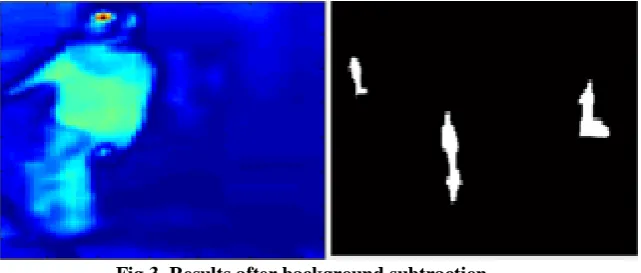
In this section results of this system is given. Following figure, fig.3 shows the results after background subtraction. These results are shown in black and white as well as LAB color space.
Fig.3. Results after background subtraction
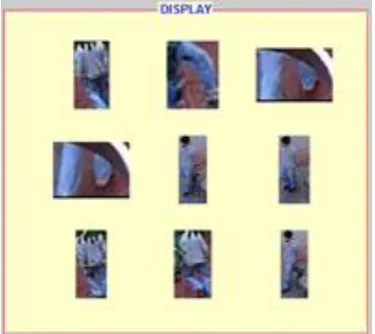
Fig.4. Output of system.
Evaluation of the system is done as follows: Total images :- 500 images
Positive images :- 250 images Negative images :- 250 image
Table 1. Evaluation of the system.
Detected Non detected
Detected 242 8
Non detected 12 238
This methodology is compared with existing methods. Accuracy :- 242+238/500 === 96%
Precision== 242/242+12 == 0.95 % Fall detection :- 8/250 == 0.032
Table 2.Comparison with the existing metods.
Existing
Method
Proposed
Method
Accuracy 88% 96%
Precision 0.79 0.95
Fall
detection
Fig.5. Graphical representation of comparison with existing method
V. CONCLUSION
This system represents new color drift and clothing context-aware person search and re-identification method for a wide-area camera network with an emphasis on summarization. Person re-identification handles pedestrian matching and ranking across non-overlapping camera views. Accuracy of the proposed method is 96%. It has numerous vital applications in video surveillance by saving a lot of human efforts on comprehensivelysearching for a person from large amounts of video sequences. It utilizes hypergraph ranking strategy for summarization.
REFERENCES
[1] Santhoshkumar Sunderrajanand, B. S. Manjunath, “Context-Aware Hypergraph Modeling for Re-identification and Summarization,”IEEE trans. Miltimedia, Vol no.18, Issue 1, Jan. 2016.
[2] Niki Martinel, Gian Luca Foresti, Christian Micheloni, “Person Re-identification in a Distributed Camera Network Framework”, IEEE transactions on cybernetic, pp. 21682267, 2016
[3] Le An, Mehran Kafai, Songfan Yang, Bir Bhanu, “Person Re-Identification with Reference Descriptor”, IEEE transactions on circuits and systems for video technology, 2015.
[4] Jorge Garcia, Niki Martinel, Christian Micheloni, Alfredo Gardel, “Person ReIdentification Ranking Optimisation by Discriminant Context Information Analysis”, IEEE International Conference on Computer Vision, pp. 1550-5499, 2015.
[5] Santhoshkumar Sunderrajan, Jiejun Xu, and B.S. Manjunath, “Context-aware graph modeling for object search and retrieval in a wide area camera network,” in IEEE Int. Conf. Distributed Smart Cameras (ICDSC), pp. 1-7, Oct. 29 2013-Nov. 1, 2013.
[6] S. Santhoshkumar, S. Karthikeyan and B.S. Manjunath, “Robust multiple object tracking by detection with interacting Markov chain Monte Carlo,” in IEEE Int. Conf. Image Processing, pp. 2953 – 2957,15-18 Sept. 2013.