On the Impossibility of Highly-Efficient
Blockcipher-Based Hash Functions
J. Black
∗M. Cochran
∗T. Shrimpton
†An abridged version, reference [1], appears as Advances in Cryptology – Eurocrypt ’05, Lecture Notes in Computer Science, Vol. ????, R. Cramer, ed., Springer-Verlag. This is the full version.
Abstract
Fix a small, non-empty set of blockcipher keysK. We say a blockcipher-based hash function is highly-efficient if it makes exactly one blockcipher call for each message block hashed, and all blockcipher calls use a key fromK. Although a few highly-efficient constructions have been proposed, no one has been able to prove their security. In this paper we prove, in the ideal-cipher model, that it is impossible to construct a highly-efficient iterated blockcipher-based hash function that is provably secure. Our result implies, in particular, that the Tweakable Chain Hash (TCH) construction suggested by Liskov, Rivest, and Wagner [7] is not correct under an instantiation suggested for this construction, nor can TCH be correctly instantiated by any other efficient means.
Keywords: Collision-resistant hash functions, tweakable blockciphers, provable security.
∗ Department of Computer Science, 430 UCB, Boulder, Colorado 80309 USA. E-mail: [email protected],
[email protected] WWW: www.cs.colorado.edu/∼jrblack/, ucsu.colorado.edu/∼cochranm
†Department of Computer Science, Portland State University, Portland, Oregon, 97207, USA. E-mail: [email protected]
Contents
1 Introduction 1
2 Security Definitions 4
3 Hash Function Constructions and Attacks 5
4 The Tweak Chain Hash 10
E n
n
n
mi
hi−1 > f(hi−1, mi)
Figure 1: The Matyas-Meyer-Oseas (MMO) compression function [8]. E: {0,1}n
× {0,1}n
→ {0,1}n
is a block cipher; the hatch mark denotes the location of the key. Iterating this compression function results in a provably-secure hash function [2], however notice that the above compression function will be rekeyed each round.
1
Introduction
Background. Essentially all modern hash functions are built by iterating a compression function according to the Merkle-Damg˚ard paradigm [4, 10]. Moreover, these compression functions are almost always built from a blockcipher. Constructions like the Matyas-Meyer-Oseas (MMO) compression function [8] are explicit about their use of a blockcipher, but even so-called “dedicated” hashing primitives like MD5 and SHA-1 are in fact blockcipher-based. The SHA-1 compression function, for example, uses a 160-bit blockcipher that takes a 512-bit key; this blockcipher has been named SHACAL-1 [6].
This idea of building hash functions from blockciphers goes back more than 25 years. The earliest con-struction by Rabin [12] proposed to hash a message M = m1m2· · ·m` by fixing an initial value h0 and
computingH(M) = DESm`(DESm`−1(· · ·(DESm1(h0)))); effectively, this is a Merkle-Damg˚ard construction
with blockcipher-based compression function f(hi−1, mi) = Emi(hi−1). Other constructions like
Davies-Meyers [9] and MMO followed, but it was Preneel, Govaerts, and Vandewalle [11] who conducted the first systematic study of blockcipher-based hash functions. They considered the security of 64 iterated construc-tions with compression funcconstruc-tions of the formf(hi−1, mi) =Ea(b)⊕cwherea, b, c∈ {hi−1, mi, hi−1⊕mi, v}
for some fixed constantv. The analysis of PGV was attack-based, and schemes not broken by their attacks were deemed secure. Subsequently, Black, Rogaway and Shrimpton [2] considered these same 64 construc-tions using a proof-based approach. They showed that, in the ideal-cipher model, 20 of the 64 schemes are collision-resistant up to the birthday bound; Figure 1 gives one example.
Although provably secure, these 20 schemes could be viewed as inefficient in the following sense: in each, the blockcipher key is changed every round. For all conventional blockciphers, changing the key each round is undesirable since scheduling a new key entails a significant computational cost. It is natural to ask then if it is possible to achieve provable security without incurring this cost, and this question is the focus of our work.
Main Result. Fix a small, non-empty set of blockcipher keys K. We term a blockcipher-based hash function highly-efficient if its compression function uses exactly one call to a blockcipher (ie, it is rate-1), and if the blockcipher uses only keys fromK. Since we can preschedule each key inK, we enjoy a significant performance gain: key scheduling reduces to looking up a precomputed permutation. It is possible that those researchers who have worked on blockcipher-based hash functions over the past 25 years have considered highly-efficient constructions, but found attacks that broke these constructions, or were unable to prove their security. Indeed, the present authors also spent some time trying to find highly-efficient constructions without success. We now explain why.
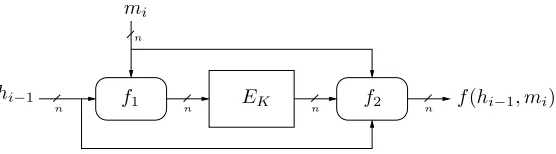
One would like to construct a highly-efficient hash function that is provably collision resistant. If such a construction did exist, its underlying compression function could be constructed as follows (see Figure 2): letf1: {0,1}n× {0,1}n→ {0,1}n andf2: {0,1}n× {0,1}n× {0,1}n → {0,1}n be arbitrary functions. We
definef: {0,1}n× {0,1}n→ {0,1}n as
f(hi−1, mi) =f2(hi−1, mi, EK(f1(hi−1, mi))),
where EK is an n-bit blockcipher with key K ∈ K that is the output of a deterministic key-selection
functiong.
f1
n
hi−1 n n n f(hi−1, mi)
n
mi
f2
EK
Figure 2: The general compression function built from a blockcipher keyed fromK. Functionsf1: {0,1}
n
× {0,1}n
→ {0,1}nandf2: {0,1}
n
× {0,1}n× {0,1}n→ {0,1}nare arbitrary;EKis somen-bit blockcipher with keyK∈ Kselected
by a deterministic key-selection functiong.
tof in any arbitrary way. Notice that it isn’t necessary to feed forward the output off1 tof2, sincef2 can
computef1(hi−1, mi) itself. The key-selection functiongmust be deterministic and well-defined, but beyond
this may depend on other message blocks, chaining values, the round number, or other parameters, provided it always returns a value from K. These notions are made precise in Section 2. (Note that this approach does not captureall blockcipher-based hash functions with a fixed key-set, only those that are iterated via Merkle-Damg˚ard and that use the blockcipher in the forward direction.)
In this paper we prove that any compression function constructed as just described cannot produce a provably collision-resistant hash function when iterated. Specifically, we show—in the ideal-cipher model— that for any functions f1, f2, there exists an information-theoretic adversary that finds a collision in the
iterated function Hf in at most |K|(n+dlg(n)e) blockcipher invocations. In fact, for many natural
func-tionsf1, f2(like XOR) we find collisions in just 2|K|blockcipher invocations. This is in stark contrast to the
Θ(2n/2) expected invocations needed to produce a collision in the 20 rekeying constructions proven secure in [2]. Our impossibility proof uses a greedy algorithm that builds large numbers of messages along with their associated hash outputs. We prove that this algorithm builds a tree with height at most n+dlg(n)e
containing at least 2n(n+dlg(n)e) + 1 hash values, thereby yielding a collision on some level of the tree. We
stress that our results shouldnot be interpreted as giving practical attacks on all highly-efficient hash func-tions: our attacks have exponential running time. Instead we are exhibiting a proof that no highly-efficient iterated blockcipher-based hash functions can exist, in the model we have described.
Security of Tweak Chain Hash. Tweakable blockciphers were introduced by Liskov, Rivest, and Wag-ner [7]. They define a tweakable blockcipher as a map Ee: {0,1}k× {0,1}t× {0,1}n → {0,1}n where the inputs are called thekey, thetweak and themessage. We sometimes writeEeK(T, M) instead ofEe(K, T, M).
For any fixedK∈ {0,1}k andT ∈ {0,1}t, we require thatEe(K, T,·) is a permutation onnbits. The idea is for the tweakable blockcipher to act like a normal blockcipher but with an extra (public) input, the tweak, which adds variability. The key may be expensive to schedule and to change, but changes to the tweak should be inexpensive. Security is defined as indistinguishability of a family of random permutations from
e
EK(·,·) with random keyK, where the adversary controls the tweak and the message. See Section 2 for a
formal definition.
Along with several other constructions, Liskov, Rivest, and Wagner suggest a new iterated hash-function construction built on tweakable blockciphers called the “Tweak Chain Hash” (TCH). This is a straightforward adaptation of the MMO construction into the tweakable setting: let Ee be a tweakable blockcipher with
t=n, and fix a keyK∈ {0,1}k. For anyM ∈({0,1}n)+ writeM =m
1· · ·m` where each|mi|=n, define
TCHEeK
(M) as
functionTCHEeK
(m1· · ·m`)
fori←1 to`dohi←EeK(hi−1, mi)⊕ mi
returnh`
whereh0 is a fixed constant, say 0n. See Figure 3. A main motivation for TCH is efficiency: in each round
m2
TCHEeK
(m1m2)
e
EK EeK
h0
m1
n
n n
Figure 3: Two rounds of the Tweak Chain Hash compression function. EeK is the tweakable blockcipher, K is a fixed
public key; the arc denotes the location of the tweak.
However the security of TCH is left as an open question. In the same paper, the authors propose two ways to create tweakable blockciphers from conventional blockciphers: one construction based on the CBC-MAC and one using universal hash families. So it is natural to wonder whether TCH is secure when built using either of these constructions. But inserting the second construction into TCH yields a fixed-key rate-1 hash function constructed from aconventional blockcipher and given our results above, we would expect that any such construction should be insecure. In fact we show something even stronger.
We demonstrate that using either tweakable-blockcipher construction from Liskov et al., the resulting TCH construction admits a simple attack. These attacks produce an infinite number of same-length colliding message pairs under TCH, regardless of the parameters chosen for the underlying tweakable blockcipher and regardless of the security model. Appealing to our main result, we further show in the ideal-cipher model that
any tweakable blockcipher—built using one call to a conventional blockcipher—will yield an insecure TCH construction. Our result does not, however, rule out TCH being secure when constructed from a tweakable blockcipherprimitive, such as the Hasty Pudding cipher [13]. This is discussed further in Section 4.
Security Model. The standard-model assumption for blockciphers is that they are good pseudo-random permutations (PRPs) [9]. However this assumption is insufficient for proving the security of hash functions based on blockciphers; indeed, Simon has shown [15] that the PRP assumption alone is insufficient for secure blockcipher-based hashing. For this reason, all proofs of security for blockcipher-based hash functions have been done in the ideal-cipher model [2, 9, 10, 15, 16]. This model, which dates back to Shannon [14], treats a blockcipher as a random and independent permutation for each key. Some believe that modeling blockciphers in this way is not realistic: often we find correlations and biases in real blockciphers that one would not expect to see if the object were drawn uniformly from the family of all blockciphers with the same block and key size. Nonetheless, proofs of security in this model do have meaning: security is guaranteed against adversaries that ignore the structure of the underlying blockcipher.
Except for the two simple attacks given for TCH, all attacks in this paper are in the ideal-cipher model. We do not make any probabilistic assumptions nor do we depend on the permutivity of the blockciphers.
The normal measure of security for blockcipher-based hash functions is that they are secure against theoretic adversaries in the ideal-cipher model [2]. Our adversaries are therefore information-theoretic. While this may seem to be giving too much power to an adversary when thinking of real-world attacks, we once again stress that our goal is to demonstrate the nonexistence ofprovably collision-resistant schemes, not to give practically instantiable attacks. Indeed, it is clearly impossible to exhibit a practical attack given the generality of our setting: f1could itself be a collision-resistant hash function and a practical
attack on the resulting hash function would imply a practical attack onf1.
2
Security Definitions
Basic Notions. Letkandnbe positive integers. Ablockcipheris a functionE: {0,1}k×{0,1}n→ {0,1}n
where for each K ∈ {0,1}k we require that EK(·) = E(K,·) is a permutation on {0,1}n. Let Perm(n)
be the set of all permutations on {0,1}n, and let Bloc(k, n) be the set of all blockciphers E: {0,1}k × {0,1}n→ {0,1}n. A functionf: Perm(n)× D → {0,1}c is a (permutation-based)compression function if
D={0,1}a× {0,1}n for somea≥1 wherea+n≥c. If the program for computingf uses a single query
π(x) to computefπ(h, m) =f(π, h, m) thenf israte-1.
For non-empty setsK ⊂ {0,1}kandS ⊆ {0,1}∗, fix a deterministickey-selection functiong: S ×{0,1}n× {0,1}n → S × K. Fix a constant h0 and let σ0=ε. We define a (highly-efficient, blockcipher-based) hash
function by the following program:
functionH[g,K]E(m
1· · ·m`)
fori←1to` do
(σi, K)←g(σi−1, hi−1, mi)
π←EK
hi ←fπ(hi−1, mi)
returnh`
wheref: Perm(n)× {0,1}n× {0,1}n→ {0,1}n is a rate-1 compression function. This program computes a mapH[g,K]E: Bloc(k, n)×({0,1}n
)+ → {0,1}n
, and we say thatH[g,K]Eis rate-1 becausef is. Sometimes
we will callH[g,K]E theiterated hash off, for obvious reasons.
When it is understood from context, we will omit the superscriptπtof, andE toH. We will also often omit explicit reference tog andK, simply writingH forHE[g,K].
We write x←$ S for the experiment of choosing a random element from the finite setS and calling itx. Anadversary is an algorithm with access to one or more oracles, which we write as superscripts.
Collision resistance. To quantify the collision resistance of a highly-efficient, blockcipher-based hash function, we model the blockcipher as a randomly chosen E∈Bloc(k, n). An adversary Ais given oracles forE(·,·) and its inverse E−1(·,·), and wants to find acollision forH—that is,M, M0
∈ DwhereM 6=M0
but H(M) =H(M0
). We look at the number of queries that the adversary makes and compare this with the probability of finding a collision.
Definition 1 [Collision resistance of a hash function] Fix k, n > 0, and let E: {0,1}k× {0,1}n → {0,1}n be a blockcipher. Let K ⊂ {0,1}k and S ⊆ {0,1}∗ be non-empty sets, and let g: S × {0,1}n× {0,1}n → S × K be a key-selection function. Let H[g,K] be a highly-efficient, blockcipher-based hash function,H[g,K] : Bloc(k, n)× D → {0,1}n, and letAbe an adversary. Then the advantage ofAin finding collisions inH is the real number
AdvcollH (A) = Pr
h
E←$ Bloc(k, n); (M, M0
)←$ AE(·,·),E−1(·,·)
: M 6=M0
∧HE(M) =HE(M0
)i
Forq≥1 we writeAdvcollH (q) = maxA{AdvcollH (A)}where the maximum is taken over all adversaries that
ask at mostqoracle queries.
Tweakable Blockciphers. Fixk, t, n >0. Atweakable blockcipher is a functionEe: {0,1}k× {0,1}t× {0,1}n → {0,1}n such that for any K ∈ {0,1}k and anyT ∈ {0,1}t we are guaranteed that Ee(K, T,·) =
e
EK(T,·) is a permutation on {0,1}n. If we writeπe
$
← {0,1}t×Perm(n) we are choosing 2t random
permu-tations on{0,1}n, one for eachT ∈ {0,1}t. The permutation associated toT isπe(T,·).
Definition 2 [Security of Conventional and Tweakable Blockciphers] Let Ee: {0,1}k × {0,1}t× {0,1}n→ {0,1}n be a tweakable blockcipher, and letA be an adversary. Then
AdvprpE (A) = Pr[K← K$ : AEK(·)
= 1]−Pr[π←$ Perm(n) : Aπ(·)= 1]
Advtprpe
E (A) = Pr[K
$
← {0,1}k: AEeK(·,·)
Write AdvprpE (q) = maxA{AdvprpE (A)} and Advtprpe
E (q) = maxA{Adv tprp
e
E (A)} for q ≥ 1 and where the
maxima are taken over all adversaries that ask at mostqoracle queries.
3
Hash Function Constructions and Attacks
We begin this section with a more detailed discussion of the generalized rate-1 blockcipher-based compression function shown in Figure 2, and of certain assumptions we might make in practice (though our later proofs will make no such assumptions). Next we consider attacks on the iterated hash of this compression function. The first attack is particularly efficient (it requires only 2|K| blockcipher invocations) and we argue that it probably applies to many “reasonable” constructions for the compression function. The second is more general: it shows there cannot exist an iterated hash function based on this type of compression function that is provably collision resistant in our model.
Generalized Rate-1 Blockcipher-based Compression Function. We consider any compression functionf that is built in the following way. Letf1: {0,1}n× {0,1}n→ {0,1}n andf2: {0,1}n× {0,1}n× {0,1}n→ {0,1}nbe arbitrary functions. We definef: Perm(n)×({0,1}n×{0,1}n)→ {0,1}nasfπ(h, m) =
f2(h, m, π(f1(h, m))). See Figure 2 withπ=EK. We will not formally argue that this construction covers
all possible 2nto n bit functions that call π at most once; this would take us quite far afield. Instead we give the following informal justification.
The function f takes two n-bit inputs, hand m. We make both of these inputs available to the “pre-processing” function f1 and to the “postprocessing” functionf2. Additionally,f2 has access to the output
ofπ. We do not feed the output off1 tof2sincef2is capable of recomputingf1itself. Similarly, we do not
feed the output off2 back tof1since any computation performed byf2only on inputshandmcould have
been computed byf1; if the output off2 depends also onπthen it cannot be fed back intof1 (and thusπ)
because we are requiringf be rate-1.
Althoughf1andf2are fully arbitrary, we imagine that in practice they will be simple and fast-to-compute
functions. In PGV [11], for example, these functions are never more complex than XOR. It would make little sense to have f1 be, say, SHA-1 since our overall construction is itself aiming to be a cryptographic
hash function. Nonetheless, our results continue to hold even for such far-fetched constructions: since our adversary is information-theoretic, it is able to find all 2n-bit inputs that yield some particularn-bit output forf1 in constant time.
The Two-Fiber Attack. We begin by describing a simple collision-finding attack called the “two-fiber attack” which works on many natural highly-efficient constructions, including all of the fixed-key construc-tions from [11]. In this attack the functionf1 has a certain property, which we call the “two-fiber property.”
We now explain.
Letf1−1(i) represent the set {(h, m) : f1(h, m) =i}. This is commonly called thefiber off1under i, or
thei-fiber. We now define the notion of a well-balanced fiber or function.
Definition 3 [Well-Balanced Fibers] Fix integer n > 0, and let f: {0,1}n× {0,1}n → {0,1}n be a function. Then the fiberf−1(i) iswell-balanced if eachh∈ {0,1}nappears exactly once as a first coordinate of some ordered pair off−1(i). If every fiber of f is well-balanced, then we say thatf is well-balanced.
An example of a well-balanced function isf1(h, m) =h⊕m. In fact, it’s not hard to see that iff1(h,·) is a
permutation on{0,1}n for eachh∈ {0,1}n thenf1 will be well-balanced.
For the purposes of the present attack, we require only that there exist distincti1, i2∈ {0,1}n such that
f1−1(i1) andf1−1(i2) are well-balanced. If f1 has two such fibers, we say thatf1 has thetwo-fiber property
and the resulting attack is called thetwo-fiber attack. Notice that this property can be determined by the adversary without requiring anyE-queries.
The attack is given in the theorem below. The idea behind the attack is that by doing just 2|K|queries toE on pointsi1 andi2, an adversary can produce arbitrarily many same-length messages along with their
hash values.
the compression function f: Perm(n)×({0,1}n × {0,1}n) → {0,1}n be defined as usual by fπ(h, m) =
f2(h, m, π(f1(h, m))), wheref1 has the two-fiber property. Finally, let hash function H[g,K] : Bloc(k, n)× D → {0,1}n be the iterated hash off. ThenAdvcollH (2|K|) = 1.
Proof:Leti1, i2∈ {0,1}n,i16=i2, be chosen such thatf1−1(i1) andf1−1(i2) are well-balanced fibers. We now
defineAE,E−1
, a collision-finding adversary forH. FirstAmakes 2|K|queries to its left oracle at (K, i1) and
(K, i2) for each K∈ K. With the resulting values,Agrows a rooted tree T. TreeT will be annotated with
node-labels and edge-labels; the edge-labels will represent message blocks and the node-labels will contain the intermediate hash values obtained by traversing T from the root to that node. Edges are added by specifying an ordered pair (u, v) of node labels whereu is already inT and v is a new node with labelv. Thus each edge-addition always creates a leaf. Each time we add an edge toT we will also specify the label for that edge.
Let the root ofT be labeledh0. Sinceh0∈ {0,1}n and f1−1(i1) and f1−1(i2) are well-balanced fibers, then
there exist distinct m1, m2 such thati1 =f1(h0, m1) andi2 =f1(h0, m2). Therefore A can now compute
x1 = f(h0, m1) and x2 = f(h0, m2) without any oracle queries since EK(i1) and EK(i2) have been
pre-computed for anyK that was output byg. Ifx1 =x2, thenA halts returning the collsionm1, m2. If not,
A adds an edge (h0, x1) labeled m1 and an edge (h0, x2) labeledm2. ThenA continues at the leaves ofT,
doubling their number using the same technique as above; no additional oracle queries are required. This process is continued byA until a collision occurs. Since there are only 2n possible output values for f and
because the number of leaves doubles at each step, we are guaranteed thatAwill find a collision among the leaves withinn+ 1 iterations of this process.
Note that the proof holds even ifEK is not a permutation; we require only thatEK be a map from nbits
to n bits. Also notice that the colliding messages produced by A are the same length; this means that a length-encoding scheme like MD-strengthening does not help avert the attack.
There are several obvious extensions to the two-fiber attack: for example, had we not insisted that messages be of the same length, a single well-balanced fiber would have sufficed. Also, iff1did not have the
two-fiber property, perhaps it had`fibers in which everyh∈ {0,1}n occurred at least twice among the first coordinates in those` fibers. This would admit an analogous attack using`|K|oracle queries. Rather than pursue these ideas further, we instead proceed to the generalized attack that shows that|K|(n+dlg(n)e)) oracle queries are sufficient to find distinct same-length messages that collide foranygeneralized compression function.
Main Result. The central result of this paper is to show that no rate-1 compression function using blockcipher keys from a small fixed setK can give rise to a provably collision-resistant hash function when iterated. We show this by using at most|K|(n+dlg(n)e) oracle queries to produce an overwhelming number of hash outputs that correspond to distinct messages. More specifically, our attack implements an algorithm to grow a tree of messages where the number of nodes in the tree at least doubles with each level added to it. We then show that the tree will have height at most n+dlg(n)ebut with more than 2n(n+dlg(n)e)
nodes which means there must exist a collision at some level of the tree.
Although the theorems below hold for all n >0, we restrict our statements to n≥8 since small values are of no interest and addressing them would introduce special cases into the proofs.
Theorem 5 [General Attack]Fixk >0,n≥8 and let E: {0,1}k× {0,1}n → {0,1}n be a blockcipher. FixK ⊂ {0,1}k, S ⊆ {0,1}∗, and letg: S × {0,1}n× {0,1}n→ S × Kbe a key-selection function. Define function f: Perm(n)×({0,1}n× {0,1}n)→ {0,1}n as usual by fπ(h, m) =f
2(h, m, π(f1(h, m))), with f1
and f2 arbitrary. LetH[g,K] : Bloc(k, n)× D → {0,1}n be the iterated hash of f. Then AdvcollH (|K|(n+ dlg(n)e)) = 1.
Proof:Like the two-fiber attack above, we will focus our attention onf1. We will conduct the proof initially
for the case |K|= 1, and then generalize at the end. This means we may assume that g is trivial and K
is fixed for all oracle queries. We construct an adversary A with oracles E, E−1. We begin the proof by
introducing an abstraction that will allow us to focus on the most important features of the problem. Let
N = 2n and for all i ∈ [0..N −1] define Ri = {(h, m, f(h, m)) : h, m ∈ {0,1}n
• Over all of the Ri there are exactly N ordered triples of the form (h,·,·) for each h∈ {0,1}n since there are exactlyN possible values form.
• Since f1 is a public function, A can sort each triple (h, m,·) into the appropriate setRi, since
mem-bership depends only onf1(h, m).
• Since evaluating f(h, m) requires an oracle query, A will not initially know the value of the last coordinate of any ordered triple.
In light of the last bullet above, we will think of each triple in eachRias (h, m,?) where “?” is a distinguished symbol indicating we do not yet know the value. Once we haveA perform an oracle query (K, i) for some
i∈[0..N−1], we may fill in the last-coordinates for each triple inRi. Of course we are going to be stingy with our oracle queries, since we can spend at most|K|(n+dlgne) of them. Now Agrows a rooted treeT, the same as we did for the two-fiber attack: tree T will be annotated with node-labels and edge-labels; the edge-labels will represent message blocks and the node-labels will contain the intermediate hash values obtained by traversingT from the root to that node. Edges are added by specifying an ordered pair (u, v) of node labels whereuis already inT andvis a new node with labelv. Thus each edge-addition always creates a leaf. Each time we add an edge toT we will also specify the label for that edge. Edges (h, f(h, m)) added toT will indicate that message blockmgets us from chaining-valuehto chaining-valuef(h, m). Therefore, we would label edge (h, f(h, m)) withm. We start withT having just one node labeledh0. BecauseAhas
not yet queriedE, the tree can be extended no further at this point.
Before doing any E-queries, we make the following three simplifications to the abstraction all of which
remove power from the adversary, and therefore an attack in this simplified setting still yields an attack in the original setting.
Recall that each time A queries E at point (K, i), we may fill in all last-coordinates in set Ri. Our first simplification is to fill in only those triples that are of immediate use. In other words, for each ordered triple (h, m,?) inRi, we replace “?” withf(h, m) only if a node labelledhappears inT. We think of the remaining triples inRi as being distributed arbitrarily among the setsRj wherejhas not yet been queried. This adjustment clearly does not increase the power ofA.
The second simpification is to impose a restriction on T: it may grow at most one level for each queryA
makes. This means that ifA makes a query that adds an edgeetoT that increases its height,Amay not then extendT with a new edge attached to e. This limitation also does not increaseA’s power.
Finally, our third simplification is to notice that two triples (h, m, j) and (h, m0, j) in the ordered triples
contained in the sets of R only helps A. This is because repeating hand j allows an immediate collision at the same level ofT as soon ashappears inT. So we will assume that for every pair of triples (h, m, j) and (h0, m0, j0) in the sets ofR, that h=h0 impliesj 6=j0. Once again, this assumption only makesA’s job
harder.
Before proceeding to the attack, we establish some notation. At any time during the attack, we define t
as the number of nodes in T and we letE be the set of triples used in T thus far. (Note that the number of edges inT may be larger than the number of triples used: if several nodes labeledh appear in T, then triple (h, m, j) may be used to create an edge from each of them.) LetR∗ be all ordered triples inR; that
is R∗ =∪N−1
i=0 Ri. Let E denote the set of ordered triples not in E. That is, E =R
∗− E. The attack now
proceeds as follows: definev: [0..N−1]→Nasv(i) = the number of nodes inT with labeli. NowAscores
each unqueried setRi according to the functions(Ri) =P(h,m,j)∈Riv(h).
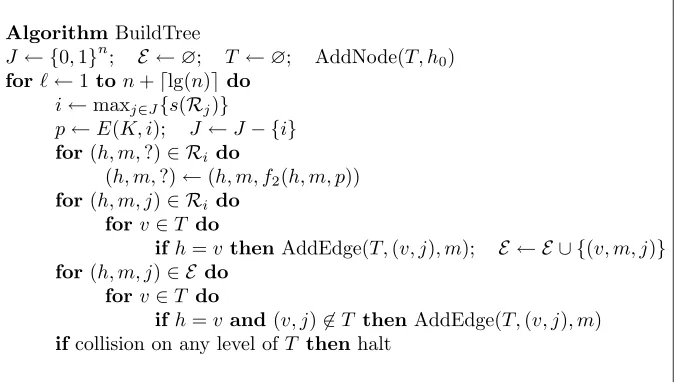
The score ofRi measures the number of nodes we can add toT as a direct result of queryingE(K, i). The tree-building algorithm for A is the natural greedy algorithm: ask the query (K, i) that maximizes s(Ri) where ties are broken arbitrarily. OnceAhas filled in the triples ofRi, it extendsT by each relevant triple available; that is, if (h, m, f(h, m))∈ Riandhis a node inT, add edge (h, f(h, m)) toT with edge-labelm. ButAmay be able to add further edges for already-discovered triples as well. So for each triple (h, m, j) in
AlgorithmBuildTree
J ← {0,1}n; E ←∅; T ←∅; AddNode(T, h0)
for`←1 ton+dlg(n)edo
i←maxj∈J{s(Rj)}
p←E(K, i); J ←J− {i}
for(h, m,?)∈ Ri do
(h, m,?)←(h, m, f2(h, m, p))
for(h, m, j)∈ Ri do forv∈T do
ifh=vthenAddEdge(T,(v, j), m); E ← E ∪ {(v, m, j)}
for(h, m, j)∈ E do forv∈T do
ifh=vand (v, j)6∈T thenAddEdge(T,(v, j), m)
ifcollision on any level of T thenhalt
Figure 4: The tree-building algorithm used by adversaryA. SetJ tracks the unqueried points; set E tracks the triples used in treeT. The algorithm chooses the maximum-scoring setRi that has not been previously queried, and queriesE
at(K, i). It then expands the tree using triples from the newly-discoveredRiand fromE. FunctionAddEdge(T,(u, v), m)
inserts into treeT an edge from the node labeledu to a new leaf labeledv using edge-labelm. With each iteration of the main loop, the height ofT grows by exactly one while the number of nodes inT at least doubles. We stop any time a collision occurs at some level ofT; we omit specifying the data structures forT and how collisions are detected.
Our goal here is to argue thatT increases exponentially in the number of nodes as it increases linearly in height. First, notice that an invariant ofT is thats(E) +s(E) =tN. This is becauses(E) +s(E) =s(E ∪ E) =
s(R∗) =tN. We now state and prove the key lemma.
Lemma 6 [Tree-Doubling Lemma] At any point during the attack, if t > 1 there exists some unqueried valuei∈ {0,1}n such that queryingE(K, i) allows at leastt+ 1 nodes to be added toT. Furthermore, if t= 1 there exists a query that allows at least 1 node to be added toT.
Proof: Fort= 1 no E-queries have been asked. Therefore there must exist some
Ri ∈ R with at least one triple of the form (h0, m,?) for any m∈ {0,1}n, which
means there exists someRi withs(Ri)≥1.
Now assumet >1, which means at least oneE-query has been asked by A. Thus there are at most N −1 unqueried values remaining. We will now bound s(E). Let d be the number of “free extensions” we can make to T by applying triples already in E. Now, notice thats(E) =t−1 +d. This is becauses(E) gets a score oft−1 from each of thet−1 added nodes thus far, but also gets an added score of dfrom thedtriples in E we can add for free. Therefore s(E) =tN −t+ 1−d
and since this score must be distributed among at mostN−1 sets we can use the pigeonhole principle to show that the minimum node-expansion possible when using the maximally-scoring setRi is
tN−t+ 1−d
N−1
+d=
t(N−1)
N−1 −
d−1
N−1
+d=
t−d−1
N−1
+d≥
t−d+1
0
2 0
0
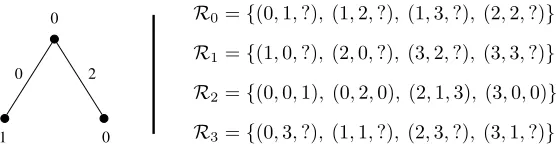
1 R3={(0,3,?), (1,1,?), (2,3,?), (3,1,?)}
R0={(0,1,?), (1,2,?), (1,3,?), (2,2,?)}
R1={(1,0,?), (2,0,?), (3,2,?), (3,3,?)}
R2={(0,0,1), (0,2,0), (2,1,3), (3,0,0)}
Figure 5: An example tree built during the attack forN = 4. We assumeh0= 0
n
and label the root accordingly. Thus farA has queriedE at(K,2), so the last coordinates ofR2 are filled in. Only the first two ordered triples ofR2 were useful, soE={(0,0,1),(0,2,0)}and the edges(0,1)and(0,0)were added toT with edge labels0and2, respectively. Also,t= 3,d= 2, ands(E) = 4, sos(E) = 8.
See Figure 5 for a small example. With this result in hand we can now conclude the proof of the theorem. Sincetincreases by at least 1 from the first query, and by at leastt+ 1 from subsequent queries, we can see by induction that after`queries we will have at least 2`+ 2`−1−1 nodes inT.
Letm=dlg(n)e. Then aftern+mqueries we are guaranteed at leastnN+ 2m−1N−1 nodes inn+m+ 1
levels of T. Ignoring the root node, this is nN + 2m−1N −2 nodes in n+m levels. Since n ≥ 8 then
2m−1≥m+ 1 and
nN+ 2m−1N−2≥(n+m)N+N−2>(n+m)N.
Thus there are more than (n+dlg(n)e)N nodes on n+dlg(n)e levels of T yielding a collision on some level. The same-length messages M and M0
that collide under hash function H are extracted from T by traversing T from the root to each colliding node and reading off the edge labels that form the message blocks ofM andM0.
Finally, we extend this attack to the case where |K| >1. We proceed exactly as above, except that each time that attack calls for a singleE(K, i) query we now ask|K|queries E(K, i), one for eachK∈ K. Since
gat each step will choose oneK∈ Kbased on the path taken in the tree, we are guaranteed to have covered the query and therefore the scoring function will still accurately count the tree expansion that would result from our queries. We therefore will make a total of|K|(n+dlg(n)e) queries to E.
Interpreting the Result. We have used the ideal-cipher model for the blockcipher and endowed the adversary with limitless computational abilities. In this setting we were able to find an attack far more efficient than we can for known-secure constructions like MMO. However, we must realize that this model is not realistic in two ways: (1) When we plug a real blockcipher in for E, say 256-bit Rijndael, and fix a key-selection algorithmg and key-set K, we do not then have a random object. We have a fixed public object that can be attacked via directed cryptanalysis. (2) If we attempt to mount the attacks described here, we will be using real computers with real computational limitations. Building a tree with Ω(2n) nodes
is not feasible for typical values ofn. Of course collisions will appear long before the tree reaches this size, under reasonable probabilistic assumptions, but even a tree containing Ω(2n/2) nodes is impractical to store
whennis (say) 160 or 256.
So one might reasonably ask if the attacks just shown are really of any concern at all. Perhaps we can use 256-bit Rijndael, fix a single key 0256, and find some fast and simple functions f
1 and f2 that do not
TCH-CBCπ(m1m2)
m2
π
π π
π m1
h0
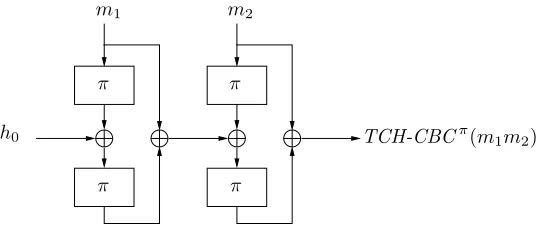
Figure 6: Two rounds of theTCH-CBCπ hash function. Functionπ: {0,1}n
→ {0,1}n
is a fixed permutation. We can easily generate an infinite number of same-length message pairs that collide using this construction.
4
The Tweak Chain Hash
Tweakable blockciphers [7] are a mapEe: {0,1}k× {0,1}t× {0,1}n→ {0,1}nwhere the inputs are called the “key,” the “tweak,” and the “message,” respectively. We sometimes writeEeK(T, M) instead ofEe(K, T, M).
For any fixedK∈ {0,1}k andT ∈ {0,1}t, we require thatEe(K, T,·) is a permutation onnbits. The idea is for the tweakable blockcipher to act like a normal blockcipher but with an extra (public) input, the tweak, which adds variability. The key may be expensive to schedule and to change, but changes to the tweak should be cheap. Security for a tweakable blockcipher was defined in Section 2.
In their paper, Liskov et al. give (among other things) two proposals for constructing tweakable blockci-phers from conventional blockciblockci-phers, along with several other constructions for using tweakable blockciblockci-phers. Their paper suggests a new hash-function construction built on tweakable blockciphers called the “Tweak Chain Hash” (TCH), defined as follows: for anym∈({0,1}n)+ writeM =m
1· · ·m` where each|mi|=n,
defineTCHEeK
(M) as
functionTCHEeK
(m1· · ·m`)
fori←1 to`dohi←EeK(hi−1, mi)⊕ mi
returnh`
where h0 is a fixed constant, say 0n, and Ee is a tweakable blockcipher with n =t and keyK a constant;
see Figure 3. Their is idea is that this construction should be faster than blockcipher-based constructions that rekey: the keyKis fixed and only the tweak and message change for each message block digested. Since changing these two inputs should be cheap (ie, nothing equivalent to rescheduling a key should be required), each round of TCH should be faster than a round of, say, MMO. The authors leave the security of TCH as an open question. This is a question we aim to address in this section.
The First Attack: TCH-CBC.Liskov et al. give two provably-secure constructions of tweakable blockci-phers from conventional blockciblockci-phers. The first construction is the CBC MAC of the two-block messageMkT. In other words, for a given blockcipherE they defineEeK(T, M) =EK(T⊕ EK(M)). They show that this
construction is birthday-close to the underlying blockcipherE. That is,Advtprpe
E (q)<Adv prp
E (q) +q2/2n.
We call this the “CBC construction.”
Taking the CBC construction and inserting it into the TCH construction seems like a natural try at building a collision-resistant hash function from a blockcipher. However, we immediately notice that the resulting TCH-CBC scheme is rate-1/2; that is, two blockcipher calls are required for each message block digested. (This means that our analysis from Section 3 does not apply because the compression function here is not rate-1.) This may in fact be more expensive than a rate-1 scheme that rekeys (like MMO). But TCH-CBC would be an interesting scheme nonetheless because it fixes the blockcipher key; no secure scheme has ever been exhibited that does this.
Unfortunately TCH-CBC is not collision resistant, as we now show. Fix a key K: this induces a fixed permutation that, for notational convenience, we name π = EK. For any M ∈ ({0,1}n)+ write M =
TCH-AXUπ(m1m2)
π π
u m1
h0 u
m2
Figure 7: Two rounds of the TCH-AXUπ
hash function. Functionπ: {0,1}n
→ {0,1}n
is a fixed permutation and u: {0,1}n→ {0,1}nis a fixed arbitrary function. We can easily generate an infinite number of same-length message pairs that collide using this construction.
functionTCH-CBCπ(m1· · ·m`)
fori←1 to`dohi←π(hi−1⊕ π(mi))⊕ mi
returnh`
where as usual,h0 is some fixed constant. See Figure 6. Now for a two-block messageM =m1m2 we have
TCH-CBCπ(M) =π(π(h0⊕ π(m1))⊕ m1⊕ π(m2))⊕ m2.
Let M∗ c = π
−1(c ⊕ h
0)kc and notice that h(Mc∗) = h0 for any c ∈ {0,1}n, yielding a large number of
2-block collisions. This idea can easily be generalized to generate collisions for messages of any even number of blocks>2 as well.
The Second Attack: TCH-AXU. The second tweakable blockcipher construction proposed by Liskov et al. is based on the use of a universal hash family [3]. The flavor they used are known as-AXU2 hash
families. This is the preferred flavor because it leads to an efficient tweakable-blockcipher construction with good security. However, as we will see, plugging their construction into TCH allows a simple attack, and this attack does not depend on the-AXU2 property.
Definition 7 [-AXU2 Hash Families]Fixn >0. We say a set of functionsU ={u: {0,1}n× {0,1}n}
is-AXU2if for all x, y, z∈ {0,1}n withx6=y,
Pr
u∈U[u(x)⊕u(y) =z]≤.
Now let E be a blockcipher, let U be an -AXU2 hash family whose functions map n bits to n bits
and define EeK,u(T, M) =EK(M⊕u(T))⊕u(T) where K ∈ {0,1}k and u∈ U. Liskov et al. show that
Advtprpe
E (q)<Adv prp
E (q) + 3q2. We call this the “AXU construction.”
Let’s try inserting the AXU construction into TCH and see if the resulting TCH-AXU construction is secure. Note that the AXU construction has a longer key since both the key for the underlying blockcipher and the function umust be specified. However, since TCH is a keyless object, we once again must fix both of these keys. Of course, fixingu means selecting some single function from U, and sinceU is an -AXU2
hash family, most of the functions in this set will be “good” in the sense that they will be injective or nearly injective. However, as we will see, the properties of the particular functionuare irrelevant in our attack: it is effective no matter whatn-bit ton-bit function is supplied.
Once we have selected a fixed key K and functionu, we have a rate-1 fixed-key blockcipher-based hash function, and our results from Section 3 immediately tell us the construction is insecure. However, it is even worse than this: there is a very simple attack that yields an infinite number of same-length message pairs that collide, as we now demonstrate.
Fix a keyK and a functionufrom the familyU. For notational convenience we nameπ=EK. For any
M ∈({0,1}n)+ writeM =m
1· · ·m` where each|mi|=n, defineTCH-AXUπ(M) as
functionTCH-AXUπ(m1· · ·m`)
fori←1to `dohi←π(mi⊕ u(hi−1))⊕ mi⊕ u(hi−1)
where as usual,h0 is some fixed constant. See Figure 7. Now for a two-block messageM =m1m2 we have
TCH-AXUπ(M) = π(m2⊕u(π(m1⊕ u(h0))⊕ m1⊕ u(h0)))
⊕ m2⊕u(π(m1⊕ u(h0))⊕ m1⊕ u(h0)).
LetM∗
c =u(h0)⊕cku(π(c) ⊕c) and notice thath(Mc∗) =π(0) for anyc∈ {0,1} n
, yielding a large number of 2-block collisions. This idea can easily be generalized to generate collisions for messages of any even number of blocks>2 as well.
The Security of TCH.The preceding two attacks do not imply that any tweakable blockcipher constructed as a mode on a conventional blockcipher will yield an easily-breakable TCH construction. It just so happened that the two modes given by the authors did fall to simple attacks. However, we can imagine other tweakable-blockcipher constructions where attacks on the resulting TCH are not so obvious. But the results of this paper tell us that if the tweakable blockcipher were constructed from a single call to a conventional blockcipher, the resulting TCH would not have a proof of security and would therefore have to be treated as a primitive.
A New Model. It is natural to ask whether TCH works under any model for tweakable blockciphers. And it’s fairly clear that extending the ideal-cipher model to the tweakable setting does the trick: letk, t, n≥1 be numbers. Define TBloc(k, t, n) be the set of all tweakable blockciphersEe: {0,1}k×{0,1}t×{0,1}n→ {0,1}n. Choosing a random element of TBloc(k, t, n) means that for each (K, T)∈ {0,1}k× {0,1}t one chooses a random permutationEK(T,·).
For TCH, we require t =n and we fix the key K to some constant. But this immediately reduces to MMO in the ideal-cipher model for conventional blockciphers, which was proven secure previously [2]. We have essentially lost the distinction between the key and the tweak since in our new ideal-tweakable-cipher model they are equivalent. The notion that the tweak is public and the key is secret has been lost. The notion that the tweak should be cheap to change while the key is normally expensive to change has similarly been lost.
What does provable security in the ideal-tweakable-cipher model mean? Notice that in each of the above attacks on TCH we exploited details of the construction of the underlying tweakable blockcipher. Had we treated these underlying objects as black boxes, we would have had no effective course of attack; we can therefore conclude that any attack on TCH must exploit the internal features of the tweakable blockcipher upon which it is constructed, meaning that perhaps a a tweakable blockcipherprimitivemight yield a secure TCH. The Hasty Pudding cipher is the only tweakable blockcipher primitive we know of [13]. Whether using Hasty Pudding in TCH yields an efficient collision resistant hash function is left as an open question, but we can be certain that any attacks on TCH-HP would require the cryptanalyst delve into the inner workings of the Hasty Pudding cipher.
5
Conclusion and Open Problems
Our results give strong evidence that we cannot build rate-1 collision-resistant hash functions from a block-cipher that uses only a small set of keys. Does this mean we are forced to accept constructions that change the key arbitrarily with each round if we want provable security? Not necessarily. Our results say nothing about schemes in this framework that rekey, say, every other round. It would be interesting to show sufficient conditions on how often the blockcipher must be rekeyed in order to maintain a good collision resistance bound. Alternatively, perhaps the key can be fixed in a non-Merkle-Damg˚ard construction; the results of Gennaro et al. [5], although for a different security property than we considered here, may provide some insight. Or perhaps there is some relaxation of the model and weakening of the adversary that admit security proofs for highly-efficient blockcipher-based schemes. We leave these as open questions.
Acknowledgements
as well to several Eurocrypt 2005 reviewers for their insightful suggestions. John Black’s work was supported by NSF CAREER-0240000 and a gift from the Boettcher Foundation. Part of this work was conducted while Tom Shrimpton was at UC Davis and was supported by NSF 0208842, NSF 0085961, and a gift from Cisco Systems.
References
[1] Black, J., Cochran, M., and Shrimpton, T. On the impossibility of highly-efficient blockcipher-based hash functions, 2005. To appear inAdvances in Cryptology — Eurocrypt 2005.
[2] Black, J., Rogaway, P., and Shrimpton, T. Black-box analysis of the block-cipher-based hash-function constructions from PGV. In Advances in Cryptology – CRYPTO ’02 (2002), vol. 2442 of
Lecture Notes in Computer Science, Springer-Verlag.
[3] Carter, L., and Wegman, M. Universal hash functions. J. of Computer and System Sciences, 18 (1979), 143–154.
[4] Damg˚ard, I.A design principle for hash functions. InAdvances in Cryptology – CRYPTO ’89 (1990), G. Brassard, Ed., vol. 435 ofLecture Notes in Computer Science, Springer-Verlag.
[5] Gennaro, R., Gertner, Y., Katz, J., and Trevisan, L. Bounds on the efficiency of generic cryptographic constructions, 2005. To appear in theSIAM Journal on Computing.
[6] Handschuh, H., Knudsen, L., and Robshaw, M. Analysis of SHA-1 in encryption mode. In
Advances in Cryptology – CT-RSA ’01 (2001), D. Naccache, Ed., Lecture Notes in Computer Science, Springer-Verlag, pp. 70–83.
[7] Liskov, M., Rivest, R., and Wagner, D. Tweakable block ciphers. In Advances in Cryptology – CRYPTO ’02 (2002), M. Yung, Ed., Lecture Notes in Computer Science, Springer-Verlag, pp. 31–46.
[8] Matyas, S., Meyer, C., and Oseas, J. Generating strong one-way functions with cryptographic algorithms. IBM Technical Disclosure Bulletin 27, 10a (1985), 5658–5659.
[9] Menezes, A., van Oorschot, P., and Vanstone, S. Handbook of Applied Cryptography. CRC Press, 1996.
[10] Merkle, R. One way hash functions and DES. In Advances in Cryptology – CRYPTO ’89 (1990), G. Brassard, Ed., vol. 435 ofLecture Notes in Computer Science, Springer-Verlag.
[11] Preneel, B., Govaerts, R., and Vandewalle, J. Hash functions based on block ciphers: A synthetic approach. In Advances in Cryptology – CRYPTO ’93 (1994), Lecture Notes in Computer Science, Springer-Verlag, pp. 368–378.
[12] Rabin, M. Digitalized signatures. In Foundations of Secure Computation (1978), R. DeMillo, D. Dobkin, A. Jones, and R. Lipton, Eds., Academic Press, pp. 155–168.
[13] Schroeppel, R., and Orman, H. The hasty pudding cipher. AES candidate submitted to NIST, 1998.
[14] Shannon, C. Communication theory of secrecy systems. Bell Systems Technical Journal 28, 4 (1949), 656–715.
[15] Simon, D. Finding collsions on a one-way street: Can secure hash functions be based on general assumptions? In Advances in Cryptology – EUROCRYPT ’98 (1998), Lecture Notes in Computer Science, Springer-Verlag, pp. 334–345.
![Figure 1: The Matyas-Meyer-Oseas (MMO) compression function [8]. E : {0, 1}n × {0, 1}n → {0, 1}n is a block cipher;the hatch mark denotes the location of the key.Iterating this compression function results in a provably-secure hashfunction [2], however notice that the above compression function will be rekeyed each round.](https://thumb-us.123doks.com/thumbv2/123dok_us/1843984.1239094/3.612.239.422.73.141/compression-function-iterating-compression-provably-hashfunction-compression-function.webp)